REVIEW 3 major objections 5 minor 47 references
The unreasonable effectiveness of the $n \Sigma v$ approximation
T0 review · 3 major / 5 minor · reviewed 2026-08-12 · deepseek-v4-flash
Pith's one-line read The standard collision-rate formula in dense stellar systems mostly survives, but fails near intermediate-mass black holes and for the largest debris-disk planetesimals.
desk verdict A clean first-principles case that nΣv is generically restored by precession, but the quantitative suppression factors rest on a heuristic refresh time that needs a real derivation or an N-body test. read the letter →
The pith
A machine-rendered reading of the paper's core claim, the machinery that carries it, and where it could break.
The reading
What carries the argument
The central object is the 'opportunity': an orbital intersection in a Kepler potential, or an intersection with aligned orbital phase in a harmonic potential. Each opportunity has a depletion time $t_{\rm dep}$ — roughly $(R/D)T$ for Kepler and $T$ for harmonic motion — after which destructive collisions have consumed it. Precession refreshes opportunities on a refresh time $t_{\rm ref}\sim(D/R)t_{\rm prec}$ for coherent precession and $t_{\rm ref}\sim(D/R)^2 t_{\rm relax}$ for diffusive relaxation, with a further $1/e$ stretch for low-eccentricity orbits. The ratio $t_{\rm dep}/t_{\rm ref}$ enters equation (15) as the factor multiplying the $n\Sigma v$ result, and comparing mass precession with general-relativistic precession through this ratio produces the non-ergodic regions mapped in figures 3–5.
What would settle it
A direct N-body simulation of a small stellar cluster around a $10^4\,M_\odot$ black hole, with collision diameters $D\sim200\,R_\odot$ at $r\sim10\,$AU, should show a collision rate about $10^{-2}$ of the $n\Sigma v$ estimate in a single evolving realization, while an ensemble of simulations with randomized orbital phases should average to the full $n\Sigma v$ rate; if the measured suppression does not match this, the refresh-time scaling is wrong.
Extended reading notes
Core claim
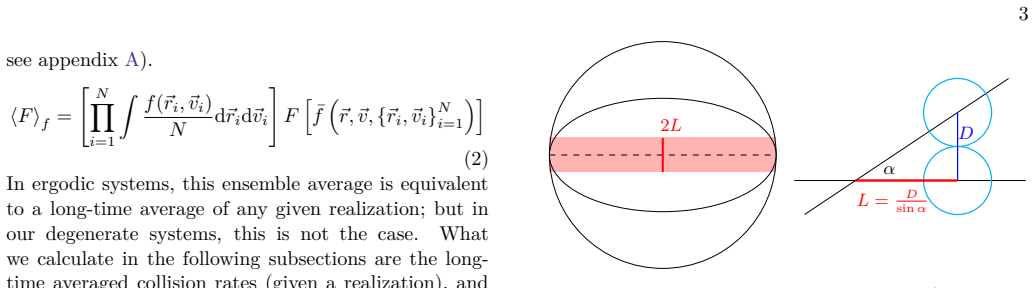
The paper's central claim is that the collision rate in a perfectly Keplerian or harmonic potential is controlled by a global quantity, the number of orbital intersections, rather than by local density and velocity dispersion. In a Kepler potential, only pairs whose orbits intersect and pass within a diameter $D$ can collide, and they collide repeatedly; in a harmonic potential, even an intersection produces collisions only when the universal orbital phase is aligned. As a result, most realizations of such systems have no collisions at all while rare realizations collide at rates far above $n\Sigma v$, and the ensemble-averaged rate is nonetheless exactly $n\Sigma v$ (appendix A). For destructive collisions, each intersection acts as an 'opportunity' that depletes on a timescale $t_{\rm dep}$, while orbital precession refreshes opportunities on a timescale $t_{\rm ref}$; the ratio $t_{\rm dep}/t_{\rm ref}$ controls the suppression or enhancement of the collision rate relative to $n\Sigma v$. By evaluating this ratio for star clusters, supermassive and intermediate-mass black hole environments, and planetesimal disks, the paper concludes that only tightly bound stellar orbits around intermediate-mass black holes and large bodies in certain debris disks remain non-ergodic.
Load-bearing premise
The load-bearing premise is the geometric estimate that coherent precession refreshes orbital intersections once the orbit shifts by one interaction diameter $D$, giving $t_{\rm ref}\sim(D/R)t_{\rm prec}$; the paper notes that for low-eccentricity orbits the refresh time is longer by a factor $1/e$ (with $e$ the orbital eccentricity), and since that correction is not applied to the supermassive-black-hole environments of section 4.2, any error in this scaling shifts the boundaries of the non-ergodic regions.
Editorial extensions
If this is right
- In globular and nuclear star clusters without a central massive black hole, two-body granularity refreshes collision opportunities in less than an orbital period, so the $n\Sigma v$ collision rate is accurate to negligible error.
- Around supermassive black holes above about $10^6\,M_\odot$, general-relativistic and mass precession refresh orbital intersections faster than they deplete, so the $n\Sigma v$ rate holds for both star–star collisions and binary ionizations.
- Around intermediate-mass black holes, binary ionization rates inside the influence radius can be one to two orders of magnitude below the $n\Sigma v$ prediction, and star–star collisions can be suppressed by about $10^{-2}$ in extreme cases.
- In planetesimal belts and debris disks, general-relativistic precession sets a critical planetesimal diameter of roughly $10^3$ km for typical cold disks around low-mass stars, above which collision rates fall below $n\Sigma v$.
- The smaller the ratio of interaction diameter to orbital radius, $D/R$, the more likely $n\Sigma v$ applies, but the threshold can be orders of magnitude below unity.
Reading between the lines
- Because the ensemble average recovers $n\Sigma v$ exactly, a simulation that draws random orbital phases will reproduce the ergodic rate even in a perfectly Keplerian potential, while a single collisionally evolved realization will not; published agreement with $n\Sigma v$ in N-body runs may therefore depend on how initial conditions are sampled.
- A testable observational consequence is a break in a debris disk's size distribution at the critical diameter $D_c$: bodies above $D_c$ collide less often, so the collisional cascade should stall or steepen there, with the break position tracking the precession environment rather than material strength.
- The same $t_{\rm dep}/t_{\rm ref}$ comparison could be carried over to other nearly degenerate systems, such as star–disk encounters or moonlet collisions in planetary rings, where local precession sources can be identified and the ergodic assumption is similarly questionable.
Editorial analysis
A structured set of objections, weighed in public.
Referee Report
Summary. The paper studies whether the standard nΣv kinetic collision-rate estimate remains valid in degenerate gravitational potentials (spherically symmetric, Keplerian, and harmonic), where orbits are confined to planes or closed curves. It argues that in perfectly Keplerian or harmonic potentials the collision rate of a given realization is controlled not by local density but by the global number of orbital intersections, so individual realizations can deviate strongly from nΣv, even though Appendix A proves that the ensemble average of the collision functional is exactly nΣv. The authors then introduce destructive collisions and orbital precession, defining a depletion time tdep and a refresh time tref for orbital 'opportunities', and use the ratio tref/tdep to compute suppression factors relative to nΣv. Applications are made to isothermal star clusters, stellar collisions and binary ionizations around supermassive and intermediate-mass black holes, and collisional cascades in debris disks and asteroid belts. The main astrophysical conclusions are that nΣv is recovered in almost all environments, with exceptions for tightly bound stars around IMBHs and for the high-mass end of some debris-disk cascades.
Significance. If the main quantitative claims hold, the paper provides a useful conceptual correction to a ubiquitous approximation: it shows when the ergodic assumption behind nΣv can fail and identifies specific astrophysical settings where the failure is observable. The ensemble-average proof in Appendix A is rigorous and self-contained, and it is a genuine strength that the paper separates ensemble behavior from realization-specific behavior. The classification of nearly harmonic systems into ergodic, semi-harmonic, and harmonic regimes (Fig. 2) is a helpful organizing framework. The paper also makes falsifiable predictions, e.g., suppressed binary ionization rates inside the influence radius of IMBHs and a critical planetesimal diameter Dc above which collisional cascades are non-ergodic, and it makes its figure-generating code publicly available. The significance is somewhat reduced by the fact that the quantitative suppression factors rest on a heuristic refresh-time scaling that is not derived from the two-orbit dynamics and is not yet tested numerically.
major comments (3)
- [Section 3, Eqs. (14)-(16)] The central quantitative engine of the paper is the refresh time tref = (D/R)tprec, introduced in Section 3 and used in Eqs. (14)-(16) to derive all suppression factors. This scaling is asserted from the geometric argument that a displacement of order D destroys old intersections and creates new ones, but it is not derived from the dynamics of two precessing Kepler or harmonic orbits. The quantity that actually destroys an intersection is the relative precession of the two orbits, not the absolute precession of either orbit; orbits with similar semimajor axes and eccentricities can precess at nearly the same rate, so the relevant refresh time can be much longer than (D/R)tprec. Since every boundary in Figures 3-5 scales as a power of tref/tdep (see Eqs. 22 and 24), an order-unity or larger error in tref shifts the claimed non-ergodic regions by orders of magnitude in black hole mass and radius. I request a direct numerical test: integrate two (or a small population of) precessing Kepler ellipses with specified mass precession or GR precession, measure the mean lifetime of an intersection as a function of D/R and of the ratio of relative to absolute precession, and compare the result with Eqs. (14)-(16). Without such a test, the quantitative astrophysical punchline is not firmly established.
- [Section 4.2, Eqs. (22)-(24) and Figs. 3-4] The SMBH suppression maps use tmass_ref = (D/r)(M*/M(r))T and tGR_ref ~ 0.5 (D/2R_sun)(M*/1e6 M_sun)^{-1} T, both derived from rotating the line of apsides by an angle D/r. For low-eccentricity orbits, however, rotating the line of apsides by D/r changes the physical orbit by only eD; the paper itself introduces exactly this correction in Eq. (28), tref = e^{-1} tref,1, for the debris-disk case, but it is not applied in Section 4.2. The suppressed regions in Figures 3 and 4 are precisely the tightly bound populations around IMBHs, which can have low eccentricities, especially near the tidal radius. Omitting the e^{-1} factor means the light-yellow regions in Figures 3-4 are underestimates of the non-ergodic region, and the caption's statement that binary ionization rates can be 1-2 orders of magnitude below nΣv inside the influence radius of IMBHs could be wrong by an amount that depends on the eccentricity distribution. The authors should either apply the e^{-1} correction to the SMBH applications or justify why low-e orbits are negligible there.
- [Section 3.2 and Appendix B] The semi-harmonic regime in Section 3.2, summarized in Fig. 2, interpolates the collision rate linearly in the frequency spread ε (Eq. 17), but the transition criteria and the expression for the number of opportunities are presented without derivation. In particular, the claim that the expected number of opportunities is N^2 (D/R)(ε tref/T) in the semi-harmonic case assumes that phase coherence is lost gradually and uniformly over a timescale tref; this is plausible but not shown. Appendix B correctly argues that mass precession dominates over resonant relaxation for refreshing orbital intersections, but the comparison there also inherits the tref = (D/R)tprec assumption for mass precession. Since the semi-harmonic regime is one of the paper's main conceptual additions, I would like to see either a more explicit derivation of Eq. (17) or a numerical check of the semi-harmonic scaling in a simple model with a tunable frequency spread ε.
minor comments (5)
- [Eq. (25)] Equation (25) contains a LaTeX artifact ('\radicaltp/radicalvertex/radicalvertex/radicalvertex√') that renders incorrectly; the gravitational-focusing enhancement should be typeset as a standard square root.
- [Eq. (8)] The notation 'Σ1d = 1' for the linear cross-section is dimensionally confusing; since the integral is over a line element, the cross-section should be written with an explicit unit of length or replaced by a clear one-dimensional collision criterion.
- [Section 4.3.2] The section title 'Debris disks around white dwarves' uses the nonstandard plural 'dwarves'; the standard astronomical term is 'white dwarfs'.
- [Fig. 2] The flowchart in Figure 2 is very difficult to read at two-column width; the text in the boxes and arrows is too small. I recommend a full-width figure or a larger font.
- [Table 1] The table caption refers to a 'green cell' to indicate the dominant pair type, but this color coding will be lost in monochrome print or for color-blind readers; please explicitly label the dominant pair type in each row or use a symbol.
Circularity Check
No significant circularity: the derivation is self-contained, with the ensemble-average result proved from the definition of the collision functional and the astrophysical suppression regions computed from stated geometric scalings and empirical inputs rather than fitted to the conclusion.
full rationale
The paper's central claims do not reduce to their inputs. Appendix A derives the ensemble-average collision rate R(f) = (1/2)n^2 Σ v directly from the definition of the collision functional and the phase-space distribution, without assuming the target result; this is a genuine proof that the ensemble average equals nΣv. The degenerate-potential rates in Sections 2 and 3 follow from explicit orbital-geometry estimates (intersection counts, depletion times, refresh times) whose parameters are the physical scales D, R, T, and precession times, not quantities fitted to the desired suppression. The refresh-time scaling tref ~ (D/R) tprec is presented as a geometric heuristic, and the paper even flags its limited validity for low-eccentricity orbits in Eq. (28); an unverified or approximate scaling is a correctness risk, not circularity. The astrophysical applications use literature-based empirical inputs (e.g., the influence-radius normalization from Stone & Metzger 2016, cluster parameters from Binney & Tremaine 2008 and Neumayer et al. 2020, debris-disk properties from Manser et al. 2019) as external benchmarks, and no parameter is fitted to produce the predicted non-ergodic regions. The statement that nΣv fails where tref > tdep is the model's definition of its own regime of validity, but it is not a tautological reduction because the refresh and depletion times are computed from independent physical mechanisms. The concern raised about differential precession and the unapplied e^{-1} correction in SMBH environments affects the quantitative accuracy of Figures 3-5, but it does not make any derivation circular. Overall, the paper is self-contained against external benchmarks and contains no load-bearing self-citation chain or fitted-input-renamed-as-prediction step.
Assumptions & free parameters
free parameters (1)
- Influence radius normalization Rinf =
1 pc per sqrt(M/10^6 Msun)
assumptions (5)
- standard math Only inverse-square and harmonic potentials have closed orbits (Bertrand's theorem)
- domain assumption Particles are ergodic along their closed orbits, with a time-independent probability f=1/(vT), except for rational period commensurabilities
- domain assumption A constant-density core produces an approximately harmonic potential; collisional relaxation drives clusters to isothermal cores
- domain assumption The stellar cusp around an SMBH is a single-power-law Bahcall-Wolf cusp with alpha=7/4
- standard math Ensemble-average collision rate equals nSigma v for any smooth phase-space distribution f
Cite this review
Pith. "Pith review of The unreasonable effectiveness of the $n \Sigma v$ approximation." pith.science (2026). https://pith.science/paper/7XW3U5CR
@misc{pith2026241117436,
  author       = {Pith},
  title        = {Pith review of: The unreasonable effectiveness of the $n \Sigma v$ approximation},
  year         = {2026},
  howpublished = {\url{https://pith.science/paper/7XW3U5CR}},
  note         = {Machine review of arXiv:2411.17436}
}
abstract
In kinetic theory, the classic $n \Sigma v$ approach calculates the rate of particle interactions from local quantities: the number density of particles $n$, the cross-section $\Sigma$, and the average relative speed $v$. In stellar dynamics, this formula is often applied to problems in collisional (i.e. dense) environments such as globular and nuclear star clusters, where blue stragglers, tidal capture binaries, binary ionizations, and micro-tidal disruptions arise from rare close encounters. The local $n \Sigma v$ approach implicitly assumes the ergodic hypothesis, which is not well motivated for the densest star systems in the Universe. In the centers of globular and nuclear star clusters, orbits close into 1D ellipses because of the degeneracy of the potential (either Keplerian or harmonic). We find that the interaction rate in perfectly Keplerian or harmonic potentials is determined by a global quantity -- the number of orbital intersections -- and that this rate can be far lower or higher than the ergodic $n \Sigma v$ estimate. However, we find that in most astrophysical systems, deviations from a perfectly Keplerian or harmonic potential (due to e.g. granularity or extended mass) trigger sufficient orbital precession to recover the $n \Sigma v$ interaction rate. Astrophysically relevant failures of the $n \Sigma v$ approach only seem to occur for tightly bound stars orbiting intermediate-mass black holes, or for the high-mass end of collisional cascades in certain debris disks.
Figures


Figures from the paper (2 more)


Reference graph
Works this paper leans on
-
[1]
Antonini, F., & Rasio, F. A. 2016, ApJ, 831, 187, doi: 10.3847/0004-637X/831/2/187
-
[2]
Bahcall, J. N., & Wolf, R. A. 1976, ApJ, 209, 214, doi: 10.1086/154711
doi:10.1086/154711 1976
-
[3]
Bailyn, C. D. 1995, ARA&A, 33, 133, doi: 10.1146/annurev.aa.33.090195.001025
arXiv 1995
-
[4]
2013, MNRAS, 434, L26, doi: 10.1093/mnrasl/slt071
Balberg, S., Sari, R., & Loeb, A. 2013, MNRAS, 434, L26, doi: 10.1093/mnrasl/slt071
-
[5]
2023, ApJ, 952, 149, doi: 10.3847/1538-4357/acdd73
Balberg, S., & Yassur, G. 2023, ApJ, 952, 149, doi: 10.3847/1538-4357/acdd73
-
[6]
2008, Galactic Dynamics: Second Edition (Princeton University Press)
Binney, J., & Tremaine, S. 2008, Galactic Dynamics: Second Edition (Princeton University Press)
2008
-
[7]
Bonsor, A., Farihi, J., Wyatt, M. C., & van Lieshout, R. 2017, MNRAS, 468, 154, doi: 10.1093/mnras/stx425
-
[8]
2024, ApJL, 974, L22, doi: 10.3847/2041-8213/ad808f
Brutman, Y., Steinberg, E., & Balberg, S. 2024, ApJL, 974, L22, doi: 10.3847/2041-8213/ad808f
Show all 47 references
-
[9]
Chin, S. A. 2015, American Journal of Physics, 83, 320, doi: 10.1119/1.4901974
2015 doi
-
[10]
Clark, G. W. 1975, ApJL, 199, L143, doi: 10.1086/181869 15
1975 doi
-
[12]
H., Hoard, D
Debes, J. H., Hoard, D. W., Wachter, S., Leisawitz, D. T., & Cohen, M. 2011, ApJS, 197, 38, doi: 10.1088/0067-0049/197/2/38
2011 doi
-
[13]
Dohnanyi, J. S. 1969, J. Geophys. Res., 74, 2531, doi: 10.1029/JB074i010p02531
1969 doi
-
[14]
C., Pringle, J
Fabian, A. C., Pringle, J. E., & Rees, M. J. 1975, MNRAS, 172, 15, doi: 10.1093/mnras/172.1.15P
1975 doi
-
[15]
2009, ApJ, 694, 805, doi: 10.1088/0004-637X/694/2/805
Farihi, J., Jura, M., & Zuckerman, B. 2009, ApJ, 694, 805, doi: 10.1088/0004-637X/694/2/805
2009 doi
-
[16]
M., Chatterjee, S., & Rasio, F
Fregeau, J. M., Chatterjee, S., & Rasio, F. A. 2006, ApJ, 640, 1086, doi: 10.1086/500111
2006 doi
-
[17]
C., Metzger, B
Generozov, A., Stone, N. C., Metzger, B. D., & Ostriker, J. P. 2018, MNRAS, 478, 4030, doi: 10.1093/mnras/sty1262
2018 doi
-
[18]
1989, Nature, 339, 40, doi: 10.1038/339040a0
Goodman, J., & Hut, P. 1989, Nature, 339, 40, doi: 10.1038/339040a0
1989 doi
-
[19]
E., Heinke, C., Edmonds, P
Grindlay, J. E., Heinke, C., Edmonds, P. D., & Murray, S. S. 2001, Science, 292, 2290, doi: 10.1126/science.1061135
2001 doi
-
[20]
J., Mori, K., Bauer, F
Hailey, C. J., Mori, K., Bauer, F. E., et al. 2018, Nature, 556, 70, doi: 10.1038/nature25029
2018 doi
-
[21]
Heggie, D. C. 1975, MNRAS, 173, 729, doi: 10.1093/mnras/173.3.729
1975 doi
-
[22]
J., Kawaler, S
Hermes, J. J., Kawaler, S. D., Romero, A. D., et al. 2017, ApJL, 841, L2, doi: 10.3847/2041-8213/aa6ffc
2017 doi
-
[23]
Hills, J. G. 1976, MNRAS, 175, 1P, doi: 10.1093/mnras/175.1.1P
1976 doi
-
[24]
G., & Day, C
Hills, J. G., & Day, C. A. 1976, Astrophys. Lett., 17, 87
1976
-
[25]
M., & Rasio, F
Ivanova, N., Belczynski, K., Fregeau, J. M., & Rasio, F. A. 2005, MNRAS, 358, 572, doi: 10.1111/j.1365-2966.2005.08804.x
2005
-
[26]
Fregeau, J. M. 2008, MNRAS, 386, 553, doi: 10.1111/j.1365-2966.2008.13064.x
2008
-
[27]
O., Rasio, F
Ivanova, N., Heinke, C. O., Rasio, F. A., et al. 2006, MNRAS, 372, 1043, doi: 10.1111/j.1365-2966.2006.10876.x
2006
-
[28]
2003, ApJL, 584, L91, doi: 10.1086/374036
Jura, M. 2003, ApJL, 584, L91, doi: 10.1086/374036
2003 doi
-
[29]
S., Rui, N
Kremer, K., Ye, C. S., Rui, N. Z., et al. 2020, ApJS, 247, 48, doi: 10.3847/1538-4365/ab7919
2020 doi
-
[30]
M., Massey, P., Olsen, K
Levesque, E. M., Massey, P., Olsen, K. A. G., et al. 2005, The Astrophysical Journal, 628, 973, doi: 10.1086/430901
2005 doi
-
[31]
J., G¨ ansicke, B
Manser, C. J., G¨ ansicke, B. T., Eggl, S., et al. 2019, Science, 364, 66, doi: 10.1126/science.aat5330
2019 doi
-
[32]
Merritt, D., Alexander, T., Mikkola, S., & Will, C. M. 2010, PhRvD, 81, 062002, doi: 10.1103/PhysRevD.81.062002
2010 doi
-
[33]
D., Rafikov, R
Metzger, B. D., Rafikov, R. R., & Bochkarev, K. V. 2012, MNRAS, 423, 505, doi: 10.1111/j.1365-2966.2012.20895.x
2012
-
[34]
J., & Wyatt, M
Mustill, A. J., & Wyatt, M. C. 2009, Monthly Notices of the Royal Astronomical Society, 399, 1403, doi: 10.1111/j.1365-2966.2009.15360.x
2009
-
[35]
2020, The Astronomy and Astrophysics Review, 28, doi: 10.1007/s00159-020-00125-0
Neumayer, N., Seth, A., & B¨ oker, T. 2020, The Astronomy and Astrophysics Review, 28, doi: 10.1007/s00159-020-00125-0
2020 doi
-
[36]
2005, Icarus, 173, 342, doi: 10.1016/j.icarus.2004.09.004
Pan, M., & Sari, R. 2005, Icarus, 173, 342, doi: 10.1016/j.icarus.2004.09.004
2005 doi
-
[37]
2011, Astron
Petit, J.-M., et al. 2011, Astron. J., 142, 131, doi: 10.1088/0004-6256/142/4/131
2011 doi
-
[38]
Pooley, D., Lewin, W. H. G., Anderson, S. F., et al. 2003, ApJL, 591, L131, doi: 10.1086/377074 Portegies Zwart, S. F., & McMillan, S. L. W. 2000, ApJL, 528, L17, doi: 10.1086/312422
2003 doi
-
[39]
H., & Teukolsky, S
Press, W. H., & Teukolsky, S. A. 1977, ApJ, 213, 183, doi: 10.1086/155143
1977 doi
-
[40]
P., & Tremaine, S
Rauch, K. P., & Tremaine, S. 1996, New Astronomy, 1, 149, doi: https://doi.org/10.1016/S1384-1076(96)00012-7
1996 doi
-
[41]
Reinoso, B., Leigh, N. W. C., Barrera-Retamal, C. M., et al. 2022, MNRAS, 509, 3724, doi: 10.1093/mnras/stab3254
2022 doi
-
[42]
L., Chatterjee, S., & Rasio, F
Rodriguez, C. L., Chatterjee, S., & Rasio, F. A. 2016, PhRvD, 93, 084029, doi: 10.1103/PhysRevD.93.084029
2016 doi
-
[43]
E., Fuentes, C
Schlichting, H. E., Fuentes, C. I., & Trilling, D. E. 2013, AJ, 146, 36, doi: 10.1088/0004-6256/146/2/36
2013 doi
-
[44]
Spitzer, Lyman, J., & Hart, M. H. 1971, ApJ, 166, 483, doi: 10.1086/150977
1971 doi
-
[45]
C., & Metzger, B
Stone, N. C., & Metzger, B. D. 2016, MNRAS, 455, 859, doi: 10.1093/mnras/stv2281
2016 doi
-
[46]
1996, Icarus, 123, 450, doi: 10.1006/icar.1996.0170
Tanaka, H., Inaba, S., & Nakazawa, K. 1996, Icarus, 123, 450, doi: 10.1006/icar.1996.0170
1996
-
[47]
Will, C. M. 1993, The Classical Tests (Cambridge University Press), 166–183, doi: 10.1017/CBO9780511564246.009
1993 doi
-
[48]
Zuckerman, B., & Becklin, E. E. 1987, Nature, 330, 138, doi: 10.1038/330138a0
1987 doi
Reviewed August 12, 2026 · model on record in the stance chip above.
Discussion (0). Continue with ORCID to comment.