REVIEW 4 major objections 6 minor 1 cited by
Agent Centric Operating System -- a Comprehensive Review and Outlook for Operating System
T0 review · 4 major / 6 minor · reviewed 2026-08-12 · deepseek-v4-flash
Pith's one-line read This paper proposes ACOS, an operating-system architecture that abstracts every component—kernel modules, drivers, and applications—into autonomous agents that cooperate through a flat communication interface.
desk verdict Solid survey, but the ACOS proposal is a position with an internal contradiction and no overhead analysis. read the letter →
The pith
A machine-rendered reading of the paper's core claim, the machinery that carries it, and where it could break.
The reading
What carries the argument
The central mechanism is the agent abstraction together with the Agent Communication Interface (ACI). The ACI is an intermediary that connects different types of agents so they communicate on equal structural footing, eliminating the overhead of hierarchical designs. The agent abstraction carries the argument: by making every module, driver, and application an agent with the four properties of composability, instrumentality, collaborativeness, and scalability, ACOS turns cross-platform adaptation into a matter of composing and replacing agents rather than rewriting the OS.
What would settle it
A minimum viable ACOS prototype on an 8-bit microcontroller and a multi-core server would falsify the cross-platform claim if inter-agent communication overhead or memory footprint makes the small device unusable. Alternatively, measuring agent-to-agent message latency against a traditional syscall or IPC on the same hardware would falsify the flat-architecture efficiency premise if the agent path is consistently slower.
Extended reading notes
Core claim
The paper's discovery is a design paradigm: abstract all operating-system components into agents of equal structural status, connected by an Agent Communication Interface (ACI) that avoids hierarchical overhead. An agent is an intelligent entity that perceives its environment, makes decisions, and acts to reach goals; in ACOS, app/shell, kernel, and hardware components all become agents. Agents are required to be composable (able to merge and split), instrumental (usable as tools by other agents), collaborative (forming teams), and scalable (accepting new agents). This flat, agent-based architecture is what ACOS claims will deliver modularity, adaptability, cross-platform compatibility, and easier function expansion, with the OS as the foundation that lets agents cooperate and the agents' cooperation in turn keeping the OS efficient.
Load-bearing premise
The load-bearing premise is that a flat network of autonomous agents can communicate, coordinate, and stay secure with acceptable overhead on devices ranging from tiny IoT sensors to high-performance servers, and that the four required agent properties are realizable in practice.
Editorial extensions
If this is right
- A single ACOS design could run across servers, desktops, mobiles, and embedded devices without per-platform rewrites of core OS modules.
- Adding or upgrading functionality becomes introducing, replacing, or composing agents rather than modifying the whole system.
- Distributed collaboration becomes native: agents on different devices coordinate through the physical-link-extended ACI, enabling resource sharing and redundant computation avoidance.
- User interfaces can be generated adaptively from knowledge of agent input/output forms, user habits, and device characteristics, reducing cross-device UI development cost.
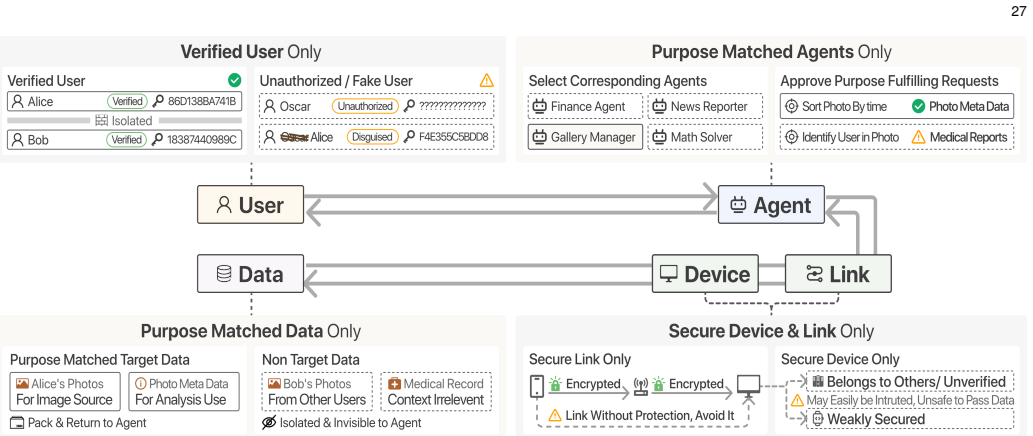
- Fine-grained permission management and security-capability matching let the system route sensitive data through trustworthy devices and agents.
Reading between the lines
- Editorial inference: if the flat-agent premise holds, ACOS would be a generalization of microkernel and service-oriented designs, applying multi-agent-system ideas to the OS core; the practical test is whether ACI overhead stays below traditional kernel call overhead.
- Editorial inference: a minimal prototype on two very different devices, such as a microcontroller and a server, would reveal whether the agent abstraction truly lowers porting cost or just relocates complexity into communication and coordination protocols.
- Editorial inference: the paper's reliance on AI agents suggests the proposal's feasibility is coupled to the maturity of lightweight machine-learning agents; if such agents remain too heavy for small devices, a hybrid of rule-based and agent-based components would be a natural fallback.
- Editorial inference: a concrete benchmark comparing agent-to-agent message latency against syscall and IPC latency on identical hardware would settle whether the flat architecture's promised efficiency gain is real.
Editorial analysis
A structured set of objections, weighed in public.
Referee Report
Summary. This paper is a two-part work. The first part (Sections 2–3) is a review of existing operating systems across embedded, mobile, desktop, and server categories, followed by a survey of recent advances in OS scheduling, memory management, I/O, security, structure optimization, and OS-for-AI systems. The second part (Section 4) proposes a new architecture, ACOS (Agent Centric Operating System), whose central idea is to abstract all system components — kernel modules, drivers, and user applications — into agents communicating through an Agent Communication Interface (ACI). The authors claim that this abstraction yields modularity, adaptability, cross-platform compatibility, and efficiency, and they describe a flat, equal-status agent architecture, a set of example agents (knowledge and memory manager, compute scheduler, memory, storage, network, security, and environment-sensing agents), and mechanisms for user interaction, security and permission management, task scheduling, and agent collaboration. The paper concludes by asserting these benefits and by acknowledging future challenges, including the scaling of agent communication networks.
Significance. The ACOS vision is a recognizable research direction: if the claimed properties were realized, the all-agent abstraction would be a genuinely new OS paradigm, distinct from the microkernel, unikernel, and kernel-bypass families surveyed in Section 3 and adjacent to recent LLM-agent proposals (AIOS, OS-Copilot, DBOS) that the authors cite. The paper is a useful, broad, and well-referenced survey; its structured tables and timelines give a quick map of the OS landscape, and Section 4.1 articulates real, concrete gaps (cross-platform adaptation, static strategy adaptability, cross-domain collaboration, user interaction) that motivate the proposal. The authors also deserve credit for candidly listing open challenges in Section 5 — scaling agent communication networks, robust security frameworks, and edge-device computational constraints — rather than claiming the problems are solved. What the paper does not provide is any implementation, simulation, formal model, or protocol specification, so the benefits are asserted, not demonstrated; the contribution is a position statement whose value depends on the subsequent work it provokes.
major comments (4)
- [§4.2.3, §4.4.4, Fig. 7] Section 4.2.3 states that ACOS 'adopts a flat architectural design' in which all agents have 'equal structural status,' and that the Agent Communication Interface (ACI) achieves 'higher communication efficiency by eliminating the overhead associated with hierarchical designs.' This is contradicted within the same section by the agent taxonomy of APP/Shell, Kernel, and Hardware Agents, which is a stratification of roles and privileges; it is contradicted by Figure 7's caption, which explicitly describes a 'layered design'; and it is contradicted by Section 4.4.4, which introduces a star logical control topology centered on key nodes, with Figure 12 depicting 'a central node controlling multiple terminal devices' data transmission processes.' Since the paper's efficiency argument rests on the flatness claim, the reader cannot determine whether agents are true peers, whether Kernel Agents mediate access to Hardware Agents, or whether central nodes carry special control responsibility. The authors should specify the agent topology, the interposition and privilege relations among agent classes, and the logical control structure consistently; as written, the central architectural claim is internally inconsistent.
- [§4.2.3, §5] The claim that ACI communication is more efficient than hierarchical designs is never supported. No message format, interaction protocol, serialization model, or latency bound is given, and no comparison is made against the kernel-call or IPC baselines that the paper itself surveys in Section 3.3 (microkernel IPC, kernel-bypass stacks). The manuscript's own closing section concedes that 'scaling agent communication networks' remains a future challenge, which further undermines the asserted efficiency benefit. The authors should either supply a concrete cost model for ACI traffic (even a qualitative complexity argument relating message-passing cost to the number and size of agents) or explicitly relabel the efficiency claim as an unverified hypothesis.
- [§4.2.2, §5] The claimed benefits of ACOS are largely restated from the definitions of the agent properties in Section 4.2.2 rather than derived from a specific design. Composability is defined as the ability of agents to combine and decompose, and the paper then concludes the system is flexible; scalability is defined as the ability to add agents, and the paper then concludes the system is scalable; instrumentality and collaborativeness similarly entail the cooperation benefits asserted in the conclusion. Because the architecture is defined as 'anything anywhere all as agent,' these conclusions hold by construction and are unfalsifiable. To make the central claim load-bearing, the authors should derive the benefits from concrete interface contracts (for example, the ACI semantics, agent lifecycle rules, or scheduling policy) or state testable predictions that an implementation could confirm or refute.
- [Table 1, Table 2] The survey portion's reliability is weakened by factual errors and unclear classifications in the comparison tables. Table 1 classifies Zephyr as 'Open Sourced: No,' although Zephyr is an open-source project released under the Apache 2.0 license; Table 2 lists Android's kernel architecture as 'Monolithic CFS,' conflating the Completely Fair Scheduler with a kernel-architecture taxonomy; and entries such as µC/OS ('Partial'), ThreadX ('Microkernel'), and TockOS ('Monolithic') would benefit from footnotes or citations to be auditable. For a paper whose title promises a comprehensive review, these tables should be verified against the cited sources.
minor comments (6)
- [§1, §5] Section 1 promises 'a critical analysis of the challenges and opportunities associated with developing next-generation operating systems,' but Section 5 delivers only a short paragraph of future challenges; the promised critical analysis should either be written or the scope statement adjusted.
- [Fig. 11] The caption of Figure 11 repeats the same two sentences verbatim; the duplication should be removed.
- [References] Several references lack proper bibliographic attribution, including [17], whose author is given as 'wiki,' and [29], whose author is given as 'A. Co.'; the reference list should be standardized.
- [§4.4.4] The relationship between the physical-layer mesh network and the logical star control topology is not explained; a sentence or two describing how the two topologies map onto each other and how central nodes are selected would clarify the design.
- [§3.2.1] The 'Living-off-the-land command detection using active learning' work is described in detail but has no corresponding bracketed reference number; a citation should be added.
- [§4.3.7] The Environment Sensing Agent is described as coordinating 'Sensor Agents,' but the relationship of these Sensor Agents to the Hardware Agents and APP/Shell agents defined in §4.2.3 is not stated; the taxonomy should clarify whether these are subclasses of the existing categories or an orthogonal dimension.
Circularity Check
ACOS's central flexibility/scalability claim restates its own agent-property definitions; the rest of the paper is a non-circular survey and design proposal.
-
self definitional
[Section 4.2.2 (Agent Abstrcation) and Section 5 (Conclusion and Outlook)]
"Scalability refers to the ability of a multi-agent system to expand its capabilities and performance by incorporating new agents or functional modules. ... By abstracting functional modules into agents, ACOS achieves a highly modular system architecture. This simplifies replacing and combining components, promotes loose coupling between different components, and enhances the system’s scalability and maintainability. ... By abstracting system components into autonomous agents, ACOS achieves a flexible and scalable architecture that can adapt to various resource platforms."
The system-level property is derived directly from its own stipulated definition. 'Scalability' is defined as the ability of a multi-agent system to incorporate new agents or modules, and the paper then concludes that ACOS is flexible and scalable because it abstracts components into agents. No implementation, measurement, or independent argument establishes that the abstraction actually delivers the defined capability; the conclusion restates the definitional property as an achieved result.
full rationale
The paper is primarily a literature review, and the review sections (Sections 2-3) contain no fitted-parameter predictions, no self-citation chains, and no imported uniqueness theorems; those portions are not circular. The circularity is confined to the ACOS proposal: the claimed outcomes 'flexible and scalable architecture' and 'enhanced scalability' are restatements of the agent-property definitions in Section 4.2.2, not consequences of any measured or externally supported mechanism. The paper acknowledges unresolved feasibility issues in Section 5 ('scaling agent communication networks, developing robust security frameworks, and addressing computational constraints in edge devices'), which further indicates the benefit claims are stipulated rather than derived. I do not flag the flat-versus-layered architectural inconsistency (Section 4.2.3 flat design versus Figure 7 'layered design' and Section 4.4.4 star logical topology) as circularity, because it is a coherence/correctness concern rather than an input-output equivalence. A score of 5 reflects partial circularity: the central flexibility/scalability claim reduces to definition, while the remainder of the paper's review content and detailed agent taxonomy have independent descriptive content.
Assumptions & free parameters
assumptions (4)
- domain assumption All operating system components can be effectively abstracted as autonomous agents without loss of essential functionality.
- domain assumption The communication and coordination overhead of a flat agent architecture is manageable across heterogeneous devices.
- domain assumption AI agents can provide the required intelligent adaptation (scheduling, memory, security) in real time on resource-constrained devices.
- ad hoc to paper Agents can be defined with the specified properties of composability, instrumentality, collaborativeness, and scalability.
invented entities (5)
-
ACOS architecture
-
Agent Communication Interface (ACI)
-
Knowledge and Memory Manager Agent
-
Compute Scheduler Agent
-
Security Agent
Cite this review
Pith. "Pith review of Agent Centric Operating System -- a Comprehensive Review and Outlook for Operating System." pith.science (2026). https://pith.science/paper/J44C44BD
@misc{pith2026241117710,
  author       = {Pith},
  title        = {Pith review of: Agent Centric Operating System -- a Comprehensive Review and Outlook for Operating System},
  year         = {2026},
  howpublished = {\url{https://pith.science/paper/J44C44BD}},
  note         = {Machine review of arXiv:2411.17710}
}
read the original abstract
The operating system (OS) is the backbone of modern computing, providing essential services and managing resources for computer hardware and software. This review paper offers an in-depth analysis of operating systems' evolution, current state, and prospects. We begin with an overview of the concept and significance of operating systems in the digital era. In the second section, we delve into the existing released operating systems, examining their architectures, functionalities, and the ecosystems they support. We then explore recent advances in OS evolution, highlighting innovations in real-time processing, distributed computing, and security. The third section focuses on the new era of operating systems, discussing emerging trends like the Internet of Things (IoT), cloud computing, and artificial intelligence (AI) integration. We also consider the challenges and opportunities presented by these developments. This review concludes with a synthesis of the current landscape and a forward-looking discussion on the future trajectories of operating systems, including open issues and areas ripe for further research and innovation. Finally, we put forward a new OS architecture.
Figures


Figures from the paper (9 more)



Forward citations
Cited by 1 Pith paper
-
Composable OS Kernel Architectures for Autonomous Intelligence
A vision paper proposing AI-aware and neurosymbolic kernel architectures without implementation, empirical validation, or formal derivation.
Reference graph
Works this paper leans on
-
[1]
An architectural overview of qnx
D. Hildebrand, “An architectural overview of qnx.” in USENIX Workshop on Microkernels and Other Kernel Architectures . Citeseer, 1992, pp. 113–126
1992
-
[2]
Vxworks,
windriver, “Vxworks,” 2024. [Online]. Available: https://www. windriver.com/resource/vxworks-product-overview
2024
-
[3]
Lynxos: Unix rewritten for real-time,
I. M. Singh and M. Bunnell, “Lynxos: Unix rewritten for real-time,” Ik , p. 27, 1990
1990
-
[4]
Torvalds, “Linux,” 2024
L. Torvalds, “Linux,” 2024. [Online]. Available: https://www. linux.org/
2024
-
[5]
Windows ce
M. Levy, “Windows ce.” EDN, vol. 42, no. 15, pp. 38–44, 1997
1997
-
[6]
Threadx,
W. Lamie, “Threadx,” 2024. [Online]. Available: https://threadx. io/
2024
-
[7]
Ecos: An socp solver for embedded systems,
A. Domahidi, E. Chu, and S. Boyd, “Ecos: An socp solver for embedded systems,” in 2013 European control conference (ECC) . IEEE, 2013, pp. 3071–3076
2013
-
[8]
Freertos,
R. Barry et al., “Freertos,” Internet, Oct, vol. 4, p. 18, 2008
2008
Show all 88 references
-
[9]
Contiki-a lightweight and flexible operating system for tiny networked sensors,
A. Dunkels, B. Gronvall, and T. Voigt, “Contiki-a lightweight and flexible operating system for tiny networked sensors,” in 29th annual IEEE international conference on local computer networks . IEEE, 2004, pp. 455–462
2004
-
[10]
Nutt, “Nuttx,” 2024
G. Nutt, “Nuttx,” 2024. [Online]. Available: https://nuttx.apache. org/
2024
-
[11]
Mbed os,
Arm, “Mbed os,” 2024. [Online]. Available: https://os.mbed. com/mbed-os/
2024
-
[12]
Fuchsia,
Google, “Fuchsia,” 2024. [Online]. Available: https://fuchsia.dev/
2024
-
[13]
Harmonyos,
Huawei, “Harmonyos,” 2024. [Online]. Available: https://www. harmonyos.com/en/
2024
-
[14]
The tock embedded operating system,
A. Levy, B. Campbell, B. Ghena, D. B. Giffin, S. Leonard, P . Pan- nuto, P . Dutta, and P . Levis, “The tock embedded operating system,” in Proceedings of the 15th ACM Conference on Embedded Network Sensor Systems, 2017, pp. 1–2
2017
-
[15]
Symbian,
S. Ltd, “Symbian,” 2024. [Online]. Available: https://licensing. symbian.org/
2024
-
[16]
Palm os,
C. Jones, “Palm os,” 1995
1995
-
[17]
Blackberry os,
wiki, “Blackberry os,” 2024. [Online]. Available: https://en. wikipedia.org/wiki/BlackBerry OS
2024
-
[18]
Windows mobile,
Microsoft, “Windows mobile,” 2024. [Online]. Available: https: //en.wikipedia.org/wiki/Windows Mobile
2024
-
[19]
[Online]
Apple, “ios,” 2024. [Online]. Available: https://www.apple.com/ ios/ios-18/
2024
-
[20]
Android os: A review,
P . Gilski and J. Stefanski, “Android os: A review,” Tem Journal, vol. 4, no. 1, p. 116, 2015
2015
-
[21]
A study on the tizen operating system,
G. Vashisht and R. Vashisht, “A study on the tizen operating system,” International Journal of Computer Trends and Technology , vol. 12, no. 1, pp. 14–15, 2014
2014
-
[22]
The unix time-sharing system,
D. M. Ritchie and K. Thompson, “The unix time-sharing system,” Communications of the ACM, vol. 17, no. 7, pp. 365–375, 1974
1974
-
[23]
4.2 bsd and 4.3 bsd as examples of the unix system,
J. S. Quarterman, A. Silberschatz, and J. L. Peterson, “4.2 bsd and 4.3 bsd as examples of the unix system,” ACM Computing Surveys (CSUR), vol. 17, no. 4, pp. 379–418, 1985
1985
-
[24]
An inside look at ms-dos
T. Paterson, “An inside look at ms-dos.” Byte, vol. 8, no. 6, p. 230, 1983
1983
-
[25]
[Online]
Apple, “macos,” 2024. [Online]. Available: https://www.apple. com/macos/macos-sequoia/
2024
-
[26]
Microsoft windows,
Microsoft, “Microsoft windows,” 2024. [Online]. Available: https://www.microsoft.com/en-us/windows
2024
-
[27]
A brief history of the windows nt operating system,
——, “A brief history of the windows nt operating system,” 2024. [Online]. Avail- able: https://web.archive.org/web/20000817031621/http:// www.microsoft.com/PressPass/features/1998/winntfs.asp
2024
-
[28]
Amigaos–internal structure of operating system,
F. i Chemii, “Amigaos–internal structure of operating system,” 2004
2004
-
[29]
The be book,
A. Co., “The be book,” 2024. [Online]. Available: https: //www.haiku-os.org/legacy-docs/bebook/index.html
2024
-
[30]
Redox os,
ReDox, “Redox os,” 2024. [Online]. Available: https://www. redox-os.org/
2024
-
[31]
Os/360 and successors,
M. II, “Os/360 and successors,” Marketing, vol. 21, 1972
1972
-
[32]
Vms software documentation,
I. VMS Software, “Vms software documentation,” 2024. [Online]. Available: https://docs.vmssoftware.com/
2024
-
[33]
An overview of the netware operating system
D. Major, G. Minshall, and K. Powell, “An overview of the netware operating system.” in USENIX Winter, 1994, pp. 355–372
1994
-
[34]
Oracle solaris documentation,
Oracle, “Oracle solaris documentation,” 2024. [Online]. Available: https://docs.oracle.com/en/operating-systems/solaris.html
2024
-
[35]
Windows server,
Microsoft, “Windows server,” 2024. [Online]. Available: https: //www.microsoft.com/en-us/windows-server
2024
-
[36]
Comparative analysis of process scheduling algorithm using ai models,
M. M. A. Moni, M. Niloy, A. H. Chowdhury, F. J. Khan, M. F.-U.- A. Juboraj, and A. Chakrabarty, “Comparative analysis of process scheduling algorithm using ai models,” in 2022 25th International Conference on Computer and Information Technology (ICCIT) . IEEE, 2022, pp. 587–592
2022
-
[37]
Improvement of lottery scheduling algorithm based on machine learning algorithm,
X. Yang and Z. Bai, “Improvement of lottery scheduling algorithm based on machine learning algorithm,” in Proceedings of the 2022 2nd International Conference on Control and Intelligent Robotics, 2022, pp. 894–897
2022
-
[38]
A deep reinforcement learning-based preemptive approach for cost-aware cloud job scheduling,
L. Cheng, Y. Wang, F. Cheng, C. Liu, Z. Zhao, and Y. Wang, “A deep reinforcement learning-based preemptive approach for cost-aware cloud job scheduling,” IEEE Transactions on Sustainable Computing, 2023
2023
-
[39]
Drlbtsa: Deep reinforcement learning based task-scheduling algorithm in cloud computing,
S. Mangalampalli, G. R. Karri, M. Kumar, O. I. Khalaf, C. A. T. Romero, and G. A. Sahib, “Drlbtsa: Deep reinforcement learning based task-scheduling algorithm in cloud computing,” Multimedia Tools and Applications, vol. 83, no. 3, pp. 8359–8387, 2024. 30
2024
-
[40]
A reinforcement learning based job scheduling algorithm for heterogeneous computing environment,
Y. Song, C. Li, L. Tian, and H. Song, “A reinforcement learning based job scheduling algorithm for heterogeneous computing environment,” Computers and Electrical Engineering , vol. 107, p. 108653, 2023
2023
-
[41]
Smartos: Towards automated learning and user-adaptive resource alloca- tion in operating systems,
S. Goodarzy, M. Nazari, R. Han, E. Keller, and E. Rozner, “Smartos: Towards automated learning and user-adaptive resource alloca- tion in operating systems,” in Proceedings of the 12th ACM SIGOPS Asia-Pacific Workshop on Systems, 2021, pp. 48–55
2021
-
[42]
µconadapter: Reinforcement learning-based fast concurrency adaptation for microservices in cloud,
J. Liu, S. Zhang, and Q. Wang, “ µconadapter: Reinforcement learning-based fast concurrency adaptation for microservices in cloud,” in Proceedings of the 2023 ACM Symposium on Cloud Com- puting, 2023, pp. 427–442
2023
-
[43]
Using machine learning techniques to analyze the performance of concurrent kernel execution on gpus,
P . Carvalho, E. Clua, A. Paes, C. Bentes, B. Lopes, and L. M. d. A. Drummond, “Using machine learning techniques to analyze the performance of concurrent kernel execution on gpus,” Future Generation Computer Systems, vol. 113, pp. 528–540, 2020
2020
-
[44]
Operating systems for resource-adaptive intelligent software: Challenges and opportunities,
X. Liu, S. Wang, Y. Ma, Y. Zhang, Q. Mei, Y. Liu, and G. Huang, “Operating systems for resource-adaptive intelligent software: Challenges and opportunities,” ACM Transactions on Internet Tech- nology (TOIT), vol. 21, no. 2, pp. 1–19, 2021
2021
-
[45]
Machine learning for load balancing in the linux kernel,
J. Chen, S. S. Banerjee, Z. T. Kalbarczyk, and R. K. Iyer, “Machine learning for load balancing in the linux kernel,” in Proceedings of the 11th ACM SIGOPS Asia-Pacific Workshop on Systems , 2020, pp. 67–74
2020
-
[46]
Batch jobs load balancing scheduling in cloud computing using distributional reinforcement learning,
T. Li, S. Ying, Y. Zhao, and J. Shang, “Batch jobs load balancing scheduling in cloud computing using distributional reinforcement learning,” IEEE Transactions on Parallel and Distributed Systems , vol. 35, no. 1, pp. 169–185, 2023
2023
-
[47]
A machine learning-based resource-efficient task scheduler for het- erogeneous computer systems,
A. Hayat, Y. N. Khalid, M. S. Rathore, and M. N. Nadir, “A machine learning-based resource-efficient task scheduler for het- erogeneous computer systems,” The Journal of Supercomputing , vol. 79, no. 14, pp. 15 700–15 728, 2023
2023
-
[48]
Auto- matic energy-efficient job scheduling in hpc: A novel slurm plugin approach,
A. Aaen Springborg, M. Albano, and S. Xavier-de Souza, “Auto- matic energy-efficient job scheduling in hpc: A novel slurm plugin approach,” in Proceedings of the SC’23 Workshops of The International Conference on High Performance Computing, Network, Storage, and Analysis, 2023...
2023
-
[49]
Scheduling algorithms for federated learning with minimal energy consumption,
L. L. Pilla, “Scheduling algorithms for federated learning with minimal energy consumption,” IEEE Transactions on Parallel and Distributed Systems, vol. 34, no. 4, pp. 1215–1226, 2023
2023
-
[50]
Heterogeneous energy-aware load balancing for industry 4.0 and iot environ- ments,
U. Ahmed, J. C.-W. Lin, and G. Srivastava, “Heterogeneous energy-aware load balancing for industry 4.0 and iot environ- ments,” ACM Transactions on Management Information Systems (TMIS), vol. 13, no. 4, pp. 1–23, 2022
2022
-
[51]
Software-defined address mapping: a case on 3d memory,
J. Zhang, M. Swift, and J. Li, “Software-defined address mapping: a case on 3d memory,” in Proceedings of the 27th ACM International Conference on Architectural Support for Programming Languages and Operating Systems, 2022, pp. 70–83
2022
-
[52]
Software-defined far memory in warehouse-scale computers,
A. Lagar-Cavilla, J. Ahn, S. Souhlal, N. Agarwal, R. Burny, S. Butt, J. Chang, A. Chaugule, N. Deng, J. Shahid et al., “Software-defined far memory in warehouse-scale computers,” in Proceedings of the Twenty-Fourth International Conference on Architectural Support for Programm...
2019
-
[53]
Kleio: A hybrid memory page scheduler with machine intelligence,
T. D. Doudali, S. Blagodurov, A. Vishnu, S. Gurumurthi, and A. Gavrilovska, “Kleio: A hybrid memory page scheduler with machine intelligence,” in Proceedings of the 28th International Sympo- sium on High-Performance Parallel and Distributed Computing , 2019, pp. 37–48
2019
-
[54]
Combining machine learning and lifetime- based resource management for memory allocation and beyond,
M. Maas, D. G. Andersen, M. Isard, M. M. Javanmard, K. S. McKin- ley, and C. Raffel, “Combining machine learning and lifetime- based resource management for memory allocation and beyond,” Communications of the ACM, vol. 67, no. 4, pp. 87–96, 2024
2024
-
[55]
Adaptive huge-page subrelease for non-moving memory allocators in warehouse-scale computers,
M. Maas, C. Kennelly, K. Nguyen, D. Gove, K. S. McKinley, and P . Turner, “Adaptive huge-page subrelease for non-moving memory allocators in warehouse-scale computers,” in Proceedings of the 2021 ACM SIGPLAN International Symposium on Memory Management, 2021, pp. 28–38
2021
-
[56]
{LinnOS}: Predictability on unpredictable flash storage with a light neural network,
M. Hao, L. Toksoz, N. Li, E. E. Halim, H. Hoffmann, and H. S. Gunawi, “{LinnOS}: Predictability on unpredictable flash storage with a light neural network,” in 14th USENIX Symposium on Operating Systems Design and Implementation (OSDI 20) , 2020, pp. 173–190
2020
-
[57]
Accelerating machine learning i/o by overlapping data staging and mini-batch generations,
K. Serizawa and O. Tatebe, “Accelerating machine learning i/o by overlapping data staging and mini-batch generations,” in Pro- ceedings of the 6th IEEE/ACM International Conference on Big Data Computing, Applications and Technologies, 2019, pp. 31–34
2019
-
[58]
Characterizing network requirements for gpu api remoting in ai applications,
T. Wang, Z. Chen, X. Wei, J. Gu, R. Chen, and H. Chen, “Characterizing network requirements for gpu api remoting in ai applications,” 2024. [Online]. Available: https://arxiv.org/abs/ 2401.13354
2024 arXiv
-
[59]
Using machine learning to improve operating sys- tems’ i/o subsystems,
I. U. Akgun, “Using machine learning to improve operating sys- tems’ i/o subsystems,” Ph.D. dissertation, State University of New York at Stony Brook, 2022
2022
-
[60]
Automated program repair: a step towards software automation,
A. Roychoudhury and Y. Xiong, “Automated program repair: a step towards software automation,” Science China. Information Sciences, vol. 62, no. 10, p. 200103, 2019
2019
-
[61]
Toward actionable testing of deep learning models,
Y. Xiong, Y. Tian, Y. Liu, and S. Cheung, “Toward actionable testing of deep learning models,” Science China, Information Sciences, 2022
2022
-
[62]
A novel insider attack and machine learning based detection for the internet of things,
M. Chowdhury, B. Ray, S. Chowdhury, and S. Rajasegarar, “A novel insider attack and machine learning based detection for the internet of things,” ACM Transactions on Internet of Things , vol. 2, no. 4, pp. 1–23, 2021
2021
-
[63]
Reboot- oriented iot: Life cycle management in trusted execution environ- ment for disposable iot devices,
K. Suzaki, A. Tsukamoto, A. Green, and M. Mannan, “Reboot- oriented iot: Life cycle management in trusted execution environ- ment for disposable iot devices,” in Proceedings of the 36th Annual Computer Security Applications Conference, 2020, pp. 428–441
2020
-
[64]
Vulrepair: a t5-based automated software vulnerability repair,
M. Fu, C. Tantithamthavorn, T. Le, V . Nguyen, and D. Phung, “Vulrepair: a t5-based automated software vulnerability repair,” in Proceedings of the 30th ACM joint european software engineering conference and symposium on the foundations of software engineering , 2022, pp. 935–947
2022
-
[65]
Msndroid: the android malware detector based on multi-class features and deep belief network,
X. Qin, F. Zeng, and Y. Zhang, “Msndroid: the android malware detector based on multi-class features and deep belief network,” in Proceedings of the ACM Turing Celebration Conference-China, 2019, pp. 1–5
2019
-
[66]
Dynamic detection of mobile malware using smartphone data and machine learning,
J. Panman de Wit, D. Bucur, and J. van der Ham, “Dynamic detection of mobile malware using smartphone data and machine learning,” Digital Threats: Research and Practice (DTRAP) , vol. 3, no. 2, pp. 1–24, 2022
2022
-
[67]
Patching locking bugs statically with crayons,
J. Cruz-Carlon, M. Varshosaz, C. Le Goues, and A. Wasowski, “Patching locking bugs statically with crayons,” ACM Transactions on Software Engineering and Methodology , vol. 32, no. 3, pp. 1–28, 2023
2023
-
[68]
Ppfl: Enhancing privacy in federated learning with confidential computing,
F. Mo, H. Haddadi, K. Katevas, E. Marin, D. Perino, and N. Kourtellis, “Ppfl: Enhancing privacy in federated learning with confidential computing,” GetMobile: Mobile Computing and Communications, vol. 25, no. 4, pp. 35–38, 2022
2022
-
[69]
An efficient method for analyzing widget intent of android system,
C. Qi, S. Shao, Y. Guo, J. Peng, and G. Xu, “An efficient method for analyzing widget intent of android system,” in Proceedings of the 2021 9th International Conference on Communications and Broadband Networking, 2021, pp. 78–85
2021
-
[70]
Darknetz: towards model privacy at the edge using trusted execution environments,
F. Mo, A. S. Shamsabadi, K. Katevas, S. Demetriou, I. Leontiadis, A. Cavallaro, and H. Haddadi, “Darknetz: towards model privacy at the edge using trusted execution environments,” in Proceedings of the 18th International Conference on Mobile Systems, Applications, and Services...
2020
-
[71]
Enhanced user interaction in operating systems through machine learning language models,
C. Zhang, W. Lu, C. Ni, H. Wang, and J. Wu, “Enhanced user interaction in operating systems through machine learning language models,” 2024. [Online]. Available: https://arxiv.org/ abs/2403.00806
2024 arXiv
-
[72]
Unikraft: fast, specialized unikernels the easy way,
S. Kuenzer, V .-A. B ˘adoiu, H. Lefeuvre, S. Santhanam, A. Jung, G. Gain, C. Soldani, C. Lupu, S ¸. Teodorescu, C. R ˘aducanu et al. , “Unikraft: fast, specialized unikernels the easy way,” inProceedings of the Sixteenth European Conference on Computer Systems , 2021, pp. 376–394
2021
-
[73]
A survey of kernel-bypass techniques in net- work stack,
R. Chen and G. Sun, “A survey of kernel-bypass techniques in net- work stack,” in Proceedings of the 2018 2nd International Conference on Computer Science and Artificial Intelligence , 2018, pp. 474–477
2018
-
[74]
The dark side of unikernels for machine learning,
M. Leon, “The dark side of unikernels for machine learning,”
-
[75]
The restless cloud,
N. Pemberton, J. Schleier-Smith, and J. E. Gonzalez, “The restless cloud,” in Proceedings of the Workshop on Hot Topics in Operating Systems, 2021, pp. 49–57
2021
-
[76]
The demik- ernel datapath os architecture for microsecond-scale datacenter systems,
I. Zhang, A. Raybuck, P . Patel, K. Olynyk, J. Nelson, O. S. N. Leija, A. Martinez, J. Liu, A. K. Simpson, S. Jayakar et al., “The demik- ernel datapath os architecture for microsecond-scale datacenter systems,” in Proceedings of the ACM SIGOPS 28th Symposium on Operating Syst...
2021
-
[77]
Unikernel linux (ukl),
A. Raza, T. Unger, M. Boyd, E. B. Munson, P . Sohal, U. Drepper, R. Jones, D. B. De Oliveira, L. Woodman, R. Mancuso et al. , “Unikernel linux (ukl),” in Proceedings of the Eighteenth European Conference on Computer Systems, 2023, pp. 590–605. 31
2023
-
[78]
Seuss: skip redundant paths to make serverless fast,
J. Cadden, T. Unger, Y. Awad, H. Dong, O. Krieger, and J. Ap- pavoo, “Seuss: skip redundant paths to make serverless fast,” in Proceedings of the Fifteenth European Conference on Computer Systems, 2020, pp. 1–15
2020
-
[79]
Dbos: a dbms-oriented operating system,
A. Skiadopoulos, Q. Li, P . Kraft, K. Kaffes, D. Hong, S. Mathew, D. Bestor, M. Cafarella, V . Gadepally, G. Graefe et al. , “Dbos: a dbms-oriented operating system,” 2021
2021
-
[80]
Llm as os, agents as apps: Envisioning aios, agents and the aios-agent ecosystem,
Y. Ge, Y. Ren, W. Hua, S. Xu, J. Tan, and Y. Zhang, “Llm as os, agents as apps: Envisioning aios, agents and the aios-agent ecosystem,” 2023. [Online]. Available: https: //arxiv.org/abs/2312.03815
2023 arXiv
-
[81]
Aios: Llm agent operating system,
K. Mei, Z. Li, S. Xu, R. Ye, Y. Ge, and Y. Zhang, “Aios: Llm agent operating system,” 2024. [Online]. Available: https://arxiv.org/abs/2403.16971
2024 arXiv
-
[82]
Memgpt: Towards llms as operating systems,
C. Packer, S. Wooders, K. Lin, V . Fang, S. G. Patil, I. Stoica, and J. E. Gonzalez, “Memgpt: Towards llms as operating systems,”
-
[83]
Os-copilot: Towards generalist computer agents with self-improvement,
Z. Wu, C. Han, Z. Ding, Z. Weng, Z. Liu, S. Yao, T. Yu, and L. Kong, “Os-copilot: Towards generalist computer agents with self-improvement,” 2024. [Online]. Available: https://arxiv.org/abs/2402.07456
2024 arXiv
-
[84]
Prompt sapper: Llm-empowered software engineering infrastructure for ai-native services,
Z. Xing, Q. Huang, Y. Cheng, L. Zhu, Q. Lu, and X. Xu, “Prompt sapper: Llm-empowered software engineering infrastructure for ai-native services,” 2023. [Online]. Available: https://arxiv.org/ abs/2306.02230
2023 arXiv
-
[85]
Peros: Personalized self-adapting operating systems in the cloud,
H. H `e, “Peros: Personalized self-adapting operating systems in the cloud,” 2024. [Online]. Available: https://arxiv.org/abs/2404. 00057
2024
-
[86]
Metagpt: Meta programming for a multi-agent collaborative framework,
S. Hong, M. Zhuge, J. Chen, X. Zheng, Y. Cheng, C. Zhang, J. Wang, Z. Wang, S. K. S. Yau, Z. Lin, L. Zhou, C. Ran, L. Xiao, C. Wu, and J. Schmidhuber, “Metagpt: Meta programming for a multi-agent collaborative framework,” 2023. [Online]. Available: https://arxiv.org/abs/2308.0...
2023 arXiv
-
[2020]
Available: https://arxiv.org/abs/2004.13081
[Online]. Available: https://arxiv.org/abs/2004.13081
2004 arXiv
-
[2024]
Available: https://arxiv.org/abs/2310.08560
[Online]. Available: https://arxiv.org/abs/2310.08560
Reviewed August 12, 2026 · model on record in the stance chip above.
Discussion (0). Continue with ORCID to comment.