REVIEW 4 major objections 5 minor 35 references
Efficient Channel Prediction for Beyond Diagonal RIS-Assisted MIMO Systems with Channel Aging
T0 review · 4 major / 5 minor · reviewed 2026-08-12 · deepseek-v4-flash
Pith's one-line read A joint Tucker2-BALS estimator and CNN-AR predictor is proposed that reduces pilot overhead by up to 98% in beyond-diagonal RIS-assisted MIMO systems with channel aging, while preserving near-perfect-CSI downlink sum rates.
desk verdict Tucker2-BALS for BD-RIS is a genuine contribution; the CNN-AR prediction is under-specified and the channel model contradicts its own fading statistics, so the headline 98% overhead claim is not established. read the letter →
The pith
A machine-rendered reading of the paper's core claim, the machinery that carries it, and where it could break.
The reading
What carries the argument
The load-bearing object is the Tucker2 decomposition of the received-signal tensor. Tucker2 factorizes a third-order tensor into a core tensor and two factor matrices while leaving the third mode unconstrained; here the core is $\mathcal{W}$ (the sequence of known reflection matrices) and the factors are $\mathbf{H}$ and $\mathbf{E}[l]^T$. The identity $\operatorname{vec}(\mathbf{A}\mathbf{B}\mathbf{C}^T) = (\mathbf{C}\otimes\mathbf{A})\operatorname{vec}(\mathbf{B})$ converts the cascade relation into linear systems, and the BALS algorithm alternates the two least-squares updates (19) and (20) until the normalized residual stops decreasing. The second mechanism is the CNN-AR predictor: a small convolutional network trained on the autocorrelation function of the aging channel maps a short window of estimated channels to AR coefficients, which are then used recursively to predict $P$ future coherence intervals without pilots.
What would settle it
Hold out a normalized Doppler frequency between two training values (e.g., test at $f_n = 0.006$ when training used $0.005$ and $0.01$) and measure the prediction NMSE; if it jumps by an order of magnitude relative to neighboring trained frequencies, the CNN has memorized the training grid rather than learned a transferable aging pattern. A second decisive test is to run the full pipeline on measured channel traces from a moving terminal; if the CNN-AR predictions are no better than a conventional same-order AR predictor, the learned pattern does not transfer to real fading.
Extended reading notes
Core claim
On the paper's own terms, the central discovery is that the BD-RIS channel estimation problem, which looks high-dimensional because a non-diagonal reflection matrix couples all elements, can be reshaped into a low-rank tensor model: stacking the received pilot signals across antennas, users, and training blocks gives a third-order tensor $\tilde{\mathcal{Y}}$ whose noiseless part is $\mathcal{Y} = \mathcal{W} \times_1 \mathbf{H} \times_2 \mathbf{E}[l]^T$, where $\mathcal{W}$ holds the known BD-RIS reflection matrices. Fitting this Tucker2 model by BALS—alternating two least-squares updates for $\mathbf{H}$ and $\mathbf{E}[l]$—estimates the two channel factors separately, which the paper argues is both more accurate and lower-complexity than estimating the composite cascade, and it is unique up to a scalar that a one-element calibration step fixes. The user-side estimates feed a CNN that learns the autocorrelation (aging) pattern of the fading process and returns AR coefficients, so the AR recursion predicts $\mathbf{E}[l]$ for the next $P$ coherence intervals without any pilot transmission. Using this CSI in a closed-form BD-RIS reflection optimization, the authors report near-perfect-CSI sum rates, order-of-magnitude NMSE gains, and up to 98% pilot-overhead reduction, with the same machinery adapted to group-connected RIS by processing each group independently.
Load-bearing premise
The load-bearing premise is that the CNN, trained only on synthetic correlated-fading channels and evaluated only at velocities seen during training, outputs prediction coefficients accurate enough for the actual channel; real measured channels or speeds outside the training set are never tested.
Editorial extensions
If this is right
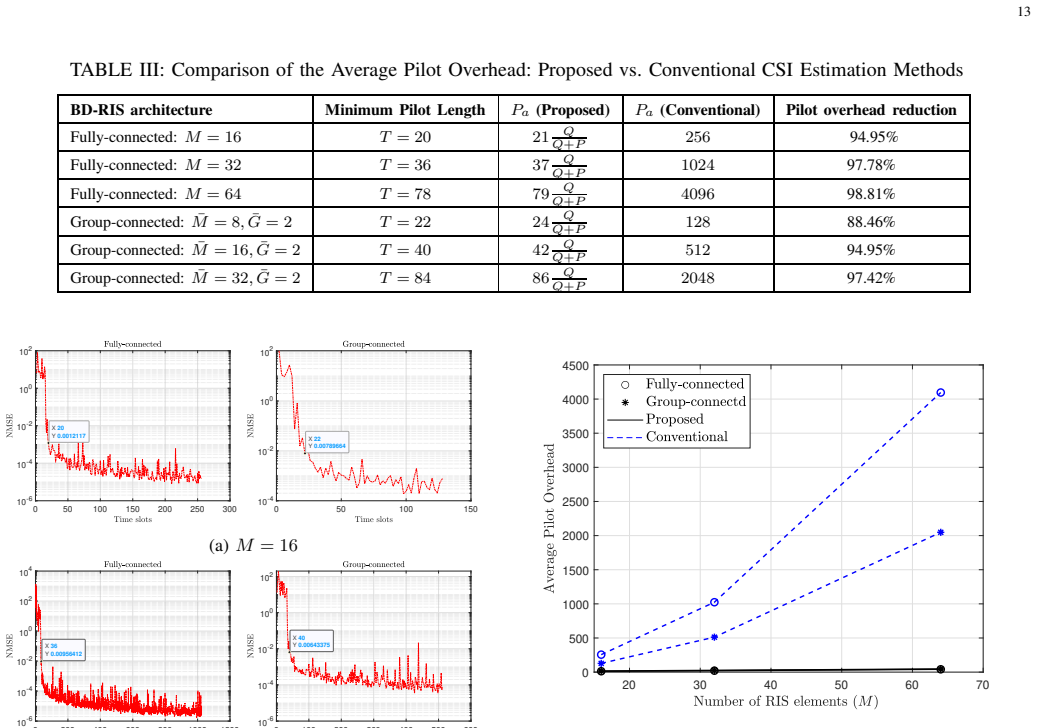
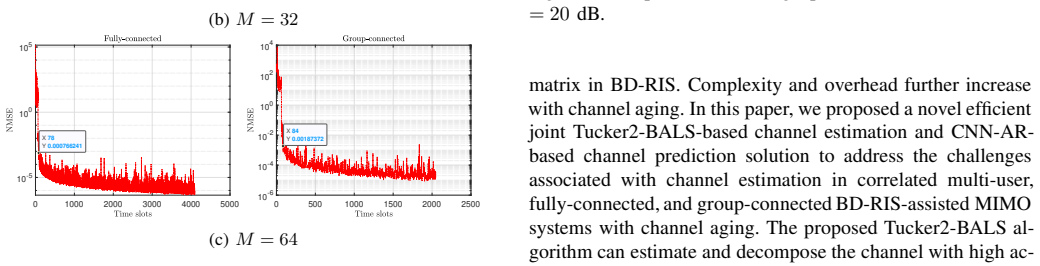
- The pilot length for fully-connected RIS becomes $(T+1)Q$ over $Q+P$ coherence intervals instead of $M^2(Q+P)$, which yields the reported 94–98% overhead reduction; the group-connected case scales as $(T+\bar{G})Q$ and saves 88–97%.
- Because $\mathbf{H}$ and $\mathbf{E}[l]$ are estimated separately, the per-iteration BALS complexity is $O(M^2T(K+N)+2NKTM)$, quadratic in $M$, whereas the DFT-LS baseline costs $O((Q+P)M^4(1+NK))$; the gap widens as the number of RIS elements grows.
- The CNN-AR predictor lowers prediction NMSE by orders of magnitude relative to a same-order AR predictor, because it avoids computing AR coefficients from a short, noisy window and instead reads them from the learned autocorrelation pattern.
- At low UE velocities the estimated/predicted CSI yields an average downlink sum rate close to the perfect-CSI bound, while at high velocities prediction accuracy degrades as the coherence time shortens (tested from 9 to 360 km/h at a 3 GHz carrier).
- The same framework covers both major BD-RIS families: fully-connected RIS is one Tucker2 problem, and group-connected RIS is solved per group, so no new estimation machinery is needed for either architecture.
Reading between the lines
- If the CNN were retrained on measured fading traces rather than synthetic correlated-fading realizations, the predictor might extend to non-Rayleigh environments; the paper does not test this transfer, so it is an open question rather than a demonstrated property.
- The 98% pilot saving assumes the RIS-BS channel is quasi-static; in deployments with a mobile RIS or moving scatterers, the training phase would need to repeat, shrinking the saving by an amount this paper does not quantify.
- The complexity comparison counts online CNN inference only; the offline training cost (300 epochs over $7\times10^4$ samples) would need to be amortized over long operation, or the CNN distilled to a lookup table, before the claimed low complexity holds at the edge.
- A natural end-to-end test is to close the loop: feed the predicted CSI into the BD-RIS reflection optimizer and measure realized throughput on a testbed, since the sum-rate curves here assume the prediction errors only affect the bounds, not the actual beamforming.
Editorial analysis
A structured set of objections, weighed in public.
Referee Report
Summary. The manuscript proposes a joint channel estimation and channel prediction framework for beyond-diagonal RIS (BD-RIS) assisted MIMO systems under channel aging. Estimation is based on a Tucker2 tensor decomposition solved by bilinear alternating least squares (Tucker2-BALS), applied separately to fully-connected and group-connected architectures. Prediction uses a CNN combined with an AR model (CNN-AR) to extrapolate estimated channels during a pilot-free phase. The estimated/predicted CSI is then used to optimize the BD-RIS reflection matrix for downlink sum-rate maximization. The paper claims high estimation/prediction accuracy, a robust sum-rate performance close to perfect CSI, and a pilot overhead reduction of up to 98% relative to a DFT-LS baseline.
Significance. If the claims are fully supported, the contribution is valuable: it extends tensor-based channel estimation to non-diagonal RIS architectures, separates the RIS-BS and RIS-UE channels with reduced training overhead, and combines this with an ML-based predictor to mitigate channel aging. The Tucker2 formulation and the identifiability condition M <= min(NT,KT) are plausible and provide a useful starting point for BD-RIS channel estimation. The main weaknesses are that the prediction component is only validated in distribution, the channel model in Eq. (2) is inconsistent with the Jakes ACF used to train the predictor, and the scaling-ambiguity removal step appears infeasible for the BD-RIS architectures studied. These issues directly affect the credibility of the headline pilot-overhead and sum-rate claims.
major comments (4)
- [II, Eq. (2); IV-A, Eq. (25)] The UE-RIS channel in Eq. (2) is written as a static Rician vector multiplied by a complex exponential e^{j2*pi*fd*Ts*l}. The ACF of this process is a pure tone, not the Jakes ACF R[l] = J0(2*pi*fn*|l|) used in Section IV-A to derive the AR coefficients for the CNN-AR predictor. The manuscript never states which channel model generated Figs. 9 and 10. If the simulator followed Eq. (2), the prediction problem is a trivial known rotation and the CNN-AR machinery is unnecessary; if the simulator used Jakes/Rayleigh fading, then Eq. (2) is incorrect. This ambiguity is load-bearing because the 98% pilot-overhead reduction in Section V-C depends on the prediction phase being accurate on the actual simulated channel.
- [III-B2a, uniqueness and scaling ambiguity] The proposed scaling-ambiguity removal requires estimating [H]_{1,1} by 'switching on only the first element in RIS and the first antenna in BS.' For a fully-connected BD-RIS, a reflection matrix with only one nonzero entry violates the unitary constraint Theta*Theta^H = I_M stated in Section II-A; the same issue arises within each group for the group-connected architecture in Section II-B. The manuscript therefore does not provide a feasible calibration procedure for fixing the scalar ambiguity, and the sum-rate and NMSE evaluations implicitly assume that the ambiguity is resolved. This needs to be addressed with a feasible measurement or the performance claims must be revised.
- [IV-B and Figs. 9-10] The CNN-AR predictor is under-specified and only evaluated in distribution. The architecture description is limited to activation functions, optimizer, and loss; no layer counts, kernel sizes, filter numbers, or input/output dimensions are given, and Eq. (33) does not fully specify the input tensor layout. Figure 10 shows five normalized Doppler values, but the paper never states that these test Doppler values are held out from the ten values used in training. There is no evaluation at intermediate Doppler values or under non-Jakes/non-Rayleigh fading. Since the prediction-phase pilot removal is the mechanism behind the headline pilot-overhead reduction, this missing generalization and reproducibility evidence is load-bearing.
- [V-C and Table III] The pilot-overhead reduction percentages in Table III are not reproducible without specifying the values of Q and P used in the calculation. The expression for the proposed average pilot overhead, (T+1)Q/(Q+P) for fully-connected and (T+G)Q/(Q+P) for group-connected, depends on the ratio Q/(Q+P), but no Q or P values are given in Table III or in the surrounding text. Additionally, the '+1' and '+G' terms are not derived; if they represent calibration pilots for the scaling-ambiguity removal introduced in Section III-B2a, that connection should be made explicit.
minor comments (5)
- [V-A, Eq. (36)] In the optimization problem P1, the symbol T in the term (e_k Theta^H T)^H u_k is undefined; it should presumably be the RIS-BS channel matrix H or its transpose, depending on the reciprocity convention. Please clarify the notation.
- [II, Eq. (2) and IV-A] The system model introduces a correlated Rician channel for E[l], while Section IV-A adopts a Rayleigh fading assumption for the ACF model. The relationship between the Rician components and the Jakes ACF should be stated explicitly.
- [IV-B] The sentence 'Even though we use 10 different fn values to train the CNN model, Our proposed CNN model is capable of adding more fn values in training' is unclear and contains a capitalization error; it should be rewritten to describe how the training set is constructed and how additional Doppler values would be incorporated.
- [VI-C and Table III] The paper does not report whether the simulation code or data will be released, which makes it difficult to verify the CNN training details and the exact pilot-overhead computation. A reproducibility statement would strengthen the manuscript.
- [Throughout] There are several typographical and grammatical issues, e.g., 'archives' for 'achieves' near Table I, 'the lower bound of MSE' usage, and inconsistent spacing in equations. A careful proofreading pass is recommended.
Circularity Check
No significant circularity: the Tucker2-BALS estimation and CNN-AR prediction claims are evaluated against external baselines, and the only self-citation ([1]) is not load-bearing.
full rationale
The paper's central claims do not reduce to their own inputs. The Tucker2-BALS channel estimator is derived from the received-signal model in Eq. (6) and the Tucker2 factorizations in Eqs. (15)-(20), and its accuracy is compared against independent external baselines (DFT-LS [29] and PARAFAC [15]) in Figs. 7-8. The CNN-AR predictor is specified in Section IV-B with its own architecture, loss function, and training/validation/test datasets; training on synthetic data generated from the same Jakes ACF model is a generalization limitation rather than circularity, because the prediction NMSE in Figs. 9-10 is evaluated on separate test samples against ground-truth channels. The 98% pilot-overhead reduction in Table III is an accounting consequence of the protocol design that removes pilots in the prediction phase (Section V-C), and its practical validity depends on the prediction accuracy that the paper reports; it is not a fitted parameter renamed as a prediction. The only self-citation, reference [1], is used to point to the authors' earlier CNN-AR proposal and to note partial WCNC results, but the present paper re-implements and extends the method to BD-RIS, so the citation is not load-bearing. A model-consistency concern exists between Eq. (2)'s pure-tone time variation and Eq. (25)'s Jakes ACF, but that is a correctness/generalization risk, not a circularity. Overall, no step in the derivation chain is equivalent to its inputs by construction.
Assumptions & free parameters
free parameters (3)
- Minimum pilot length T (per architecture) =
20/36/78 (FC, M=16/32/64); 22/40/84 (GC, Mbar=8/16/32)
- ACF regularization epsilon =
0.1
- AR order Q =
8, 16, 24 used in Fig. 9; CNN input length V=Q
assumptions (4)
- domain assumption The RIS-BS channel H is quasi-static and unaffected by channel aging, remaining constant over many coherence intervals.
- domain assumption The time-varying RIS-UE channels follow a stationary AR process whose coefficients are derived from the Jakes ACF R[l] = J0(2 pi fn |l|).
- ad hoc to paper The CNN trained on 1e4 synthetic test samples and 10 Doppler values generalizes to the evaluation scenarios.
- ad hoc to paper The scalar scaling ambiguity in H and E can be removed by measuring [H]_{1,1} while switching on only the first RIS element and first BS antenna.
Cite this review
Pith. "Pith review of Efficient Channel Prediction for Beyond Diagonal RIS-Assisted MIMO Systems with Channel Aging." pith.science (2026). https://pith.science/paper/VPNSZWLZ
@misc{pith2026241117725,
  author       = {Pith},
  title        = {Pith review of: Efficient Channel Prediction for Beyond Diagonal RIS-Assisted MIMO Systems with Channel Aging},
  year         = {2026},
  howpublished = {\url{https://pith.science/paper/VPNSZWLZ}},
  note         = {Machine review of arXiv:2411.17725}
}
read the original abstract
Novel reconfigurable intelligent surface (RIS) architectures, known as beyond diagonal RISs (BD-RISs), have been proposed to enhance reflection efficiency and expand RIS capabilities. However, their passive nature, non-diagonal reflection matrix, and the large number of coupled reflecting elements complicate the channel state information (CSI) estimation process. The challenge further escalates in scenarios with fast-varying channels. In this paper, we address this challenge by proposing novel joint channel estimation and prediction strategies with low overhead and high accuracy for two different RIS architectures in a BD-RIS-assisted multiple-input multiple-output system under correlated fast-fading environments with channel aging. The channel estimation procedure utilizes the Tucker2 decomposition with bilinear alternative least squares, which is exploited to decompose the cascade channels of the BD-RIS-assisted system into effective channels of reduced dimension. The channel prediction framework is based on a convolutional neural network combined with an autoregressive predictor. The estimated/predicted CSI is then utilized to optimize the RIS phase shifts aiming at the maximization of the downlink sum rate. Insightful simulation results demonstrate that our proposed approach is robust to channel aging, and exhibits a high estimation accuracy. Moreover, our scheme can deliver a high average downlink sum rate, outperforming other state-of-the-art channel estimation methods. The results also reveal a remarkable reduction in pilot overhead of up to 98\% compared to baseline schemes, all imposing low computational complexity.
Figures


Figures from the paper (7 more)


Reference graph
Works this paper leans on
-
[1]
Machine Learning-Based Channel Prediction for RIS-A ssisted MIMO Systems with Channel Aging,
N. Ginige, A. S. de Sena, N. H. Mahmood, N. Rajatheva, and M . Latva- aho, “Machine Learning-Based Channel Prediction for RIS-A ssisted MIMO Systems with Channel Aging,” in 2024 IEEE Wirel. Commun. Netw. Conf. (WCNC) , 2024, pp. 1–6
work page 2024
-
[2]
Reconfigurable Intelligent Surfaces: Principles and Opp or- tunities,
Y . Liu et al., “Reconfigurable Intelligent Surfaces: Principles and Opp or- tunities,” IEEE Commun. Surv. Tutorials , vol. 23, no. 3, pp. 1546–1577, 2021. 14
work page 2021
-
[3]
Reconfigurable Intelligent Surfaces 2.0: Beyond Diagonal Phase Shift Matrices,
H. Li, S. Shen, M. Nerini, and B. Clerckx, “Reconfigurable Intelligent Surfaces 2.0: Beyond Diagonal Phase Shift Matrices,” IEEE Commun. Mag., pp. 1–7, 2023
work page 2023
-
[4]
H. Li, S. Shen, and B. Clerckx, “Beyond Diagonal Reconfigu rable Intelligent Surfaces: From Transmitting and Reflecting Mod es to Single- , Group-, and Fully-Connected Architectures,” IEEE Trans. Wireless Commun., vol. 22, no. 4, pp. 2311–2324, 2023
work page 2023
-
[5]
S. Shen, B. Clerckx, and R. Murch, “Modeling and Architec ture De- sign of Reconfigurable Intelligent Surfaces Using Scatteri ng Parameter Network Analysis,” IEEE Trans. Wireless Commun. , vol. 21, no. 2, pp. 1229–1243, 2022
work page 2022
-
[6]
A. S. de Sena, M. Rasti, N. H. Mahmood, and M. Latva-aho, “B eyond Diagonal RIS for Multi-Band Multi-Cell MIMO Networks: A Pra ctical Frequency-Dependent Model and Performance Analysis,” arXiv preprint arXiv:2401.06475, 2024
work page Pith review arXiv 2024
-
[7]
Machine Learning-B ased Channel Prediction in Massive MIMO With Channel Aging,
J. Y uan, H. Q. Ngo, and M. Matthaiou, “Machine Learning-B ased Channel Prediction in Massive MIMO With Channel Aging,” IEEE Trans. Wireless Commun. , vol. 19, no. 5, pp. 2960–2973, 2020
work page 2020
-
[8]
Tensor Decompositions and Ap plications,
T. G. Kolda and B. W. Bader, “Tensor Decompositions and Ap plications,” SIAM Review, vol. 51, no. 3, pp. 455–500, 2009
work page 2009
Show all 35 references
-
[9]
Overview of tensor decompositions with applications to co mmunica- tions,
A. L. F. de Almeida, G. Favier, J. da Costa, and J. C. M. Mota , “Overview of tensor decompositions with applications to co mmunica- tions,” Signals and images: advances and results in speech, estimat ion, compression, recognition, filtering, and processing , vol. 12, pp. 325–356, 2016
2016
-
[10]
Tensor-Based Joint Channel Estimation for Multi-Way Massive MIMO Hybrid Relay Systems,
J. Du et al. , “Tensor-Based Joint Channel Estimation for Multi-Way Massive MIMO Hybrid Relay Systems,” IEEE Trans. V eh. Technol. , vol. 71, no. 9, pp. 9571–9585, 2022
2022
-
[11]
Semi-Blind Receivers for Multi-User Massive MIMO Relay Systems Based on Block Tucker2-PARAFAC Tensor Model,
——, “Semi-Blind Receivers for Multi-User Massive MIMO Relay Systems Based on Block Tucker2-PARAFAC Tensor Model,” IEEE Access, vol. 8, pp. 32 170–32 186, 2020
2020
-
[12]
Space-t ime spreading-multiplexing for MIMO antenna systems with blin d detection using the PARA TUCK-2 tensor decomposition,
A. L. F. de Almeida, G. Favier, and J. C. M. Mota, “Space-t ime spreading-multiplexing for MIMO antenna systems with blin d detection using the PARA TUCK-2 tensor decomposition,” in 2008 16th European Signal Processing Conference , 2008, pp. 1–5
2008
-
[13]
Accelerated PARAFAC-Based Channel Estimation for Reconfigurable Intelligent Surface-Assisted MISO Systems ,
H. Xiao et al. , “Accelerated PARAFAC-Based Channel Estimation for Reconfigurable Intelligent Surface-Assisted MISO Systems ,” Sensors, vol. 22, no. 19, 2022
2022
-
[14]
Tensor-Based Modeling and Processing for Channel Estimation in Two-Hop V2X MIMO Systems,
P . R. B. Gomes et al. , “Tensor-Based Modeling and Processing for Channel Estimation in Two-Hop V2X MIMO Systems,” in 2019 IEEE CSCN, 2019, pp. 1–7
2019
-
[15]
Channel Estimation for RIS-Empowered Multi-User MISO Wireless Communications,
L. Wei et al. , “Channel Estimation for RIS-Empowered Multi-User MISO Wireless Communications,” IEEE Trans. Commun., vol. 69, no. 6, pp. 4144–4157, 2021
2021
-
[16]
PARAFAC Decomposi- tion based Channel Estimation for RIS-aided Multi-User MIS O Wireless Communications,
C. Beldi, A. Dziri, F. Abdelkefi, and H. Shaiek, “PARAFAC Decomposi- tion based Channel Estimation for RIS-aided Multi-User MIS O Wireless Communications,” in 2023 International Wireless Communications and Mobile Computing (IWCMC) , 2023, pp. 1537–1542
2023
-
[17]
Tensor Decomposition-based Time V arying Chan- nel Estimation for mmWave MIMO-OFDM Systems,
R. ı. Wang et al. , “Tensor Decomposition-based Time V arying Chan- nel Estimation for mmWave MIMO-OFDM Systems,” arXiv preprint arXiv:2403.02942, 2024
2024 arXiv
-
[18]
Double- RIS V ersus Single-RIS Aided Systems: Tensor-Based MIMO Cha nnel Estimation and Design Perspectives,
K. Ardah, S. Gherekhloo, A. L. F. de Almeida, and M. Haard t, “Double- RIS V ersus Single-RIS Aided Systems: Tensor-Based MIMO Cha nnel Estimation and Design Perspectives,” in 2022 IEEE ICASSP , 2022, pp. 5183–5187
2022
-
[19]
Nested PARAFAC Tensor-Based Channel Estima- tion Method for Double RIS-Aided MIMO Communication System s,
S. Gherekhloo et al., “Nested PARAFAC Tensor-Based Channel Estima- tion Method for Double RIS-Aided MIMO Communication System s,” in 2023 31st European Signal Processing Conference (EUSIPCO) , 2023, pp. 1674–1678
2023
-
[20]
Time-V arying Phase N oise Estimation, Channel Estimation, and Data Detection in RIS- Assisted MIMO Systems via Tensor Analysis,
J. Du, Y . Cheng, L. Jin, and F. Gao, “Time-V arying Phase N oise Estimation, Channel Estimation, and Data Detection in RIS- Assisted MIMO Systems via Tensor Analysis,” IEEE Trans. Signal Process. , vol. 71, pp. 3426–3441, 2023
2023
-
[21]
Channel Estimation in RIS-Assisted MIMO Systems Operating Under Imperfections,
P . R. B. Gomes et al. , “Channel Estimation in RIS-Assisted MIMO Systems Operating Under Imperfections,” IEEE Trans. V eh. Technol. , vol. 72, no. 11, pp. 14 200–14 213, 2023
2023
-
[22]
Time-V arying Channel Prediction for RIS-Assisted MU- MISO Networks via Deep Learning,
W. Xu et al. , “Time-V arying Channel Prediction for RIS-Assisted MU- MISO Networks via Deep Learning,” IEEE Transactions on Cognitive Communications and Networking , vol. 8, no. 4, pp. 1802–1815, 2022
2022
-
[23]
Performance Impact of Chan nel Aging and Phase Noise on Intelligent Reflecting Surface,
W. Jiang and H. D. Schotten, “Performance Impact of Chan nel Aging and Phase Noise on Intelligent Reflecting Surface,” IEEE Commun. Lett., vol. 27, no. 1, pp. 347–351, 2023
2023
-
[24]
Impact of Channel Aging on Reconfigurable Intelligent Surface Aided Massive M IMO Systems With Statistical CSI,
A. Papazafeiropoulos, I. Krikidis, and P . Kourtessis, “Impact of Channel Aging on Reconfigurable Intelligent Surface Aided Massive M IMO Systems With Statistical CSI,” IEEE Trans. V eh. Technol., vol. 72, no. 1, pp. 689–703, 2023
2023
-
[25]
Channel Aging-Aware Precoding for RIS-Aided Multi- User Communications,
Y . Zhang et al., “Channel Aging-Aware Precoding for RIS-Aided Multi- User Communications,” IEEE Trans. V eh. Technol. , vol. 72, no. 2, pp. 1997–2008, 2023
1997
-
[26]
Two-Timescale Channel Estimation for Reconfigurable Intelligent Surface Aided Wireless Communications,
C. Hu et al. , “Two-Timescale Channel Estimation for Reconfigurable Intelligent Surface Aided Wireless Communications,” IEEE Trans. Com- mun., vol. 69, no. 11, pp. 7736–7747, 2021
2021
-
[27]
Channel Estimation for RIS-Aided Multiuser Millimeter-Wave Systems,
G. ı. Zhou et al. , “Channel Estimation for RIS-Aided Multiuser Millimeter-Wave Systems,” IEEE Transactions on Signal Processing , vol. 70, pp. 1478–1492, 2022
2022
-
[28]
Autoregressive modeling f or fading channel simulation,
K. Baddour and N. Beaulieu, “Autoregressive modeling f or fading channel simulation,” IEEE Trans. Wireless Commun. , vol. 4, no. 4, pp. 1650–1662, 2005
2005
-
[29]
Channel Estimation for Beyond Diagonal Reconfigurable Intelligent Surfaces with Group-C onnected Architectures,
H. Li, Y . Zhang, and B. Clerckx, “Channel Estimation for Beyond Diagonal Reconfigurable Intelligent Surfaces with Group-C onnected Architectures,” in 2023 IEEE 9th International W orkshop on CAMSAP , 2023, pp. 21–25
2023
-
[30]
Channel Estima tion and Beamforming for Beyond Diagonal Reconfigurable Intelligen t Surfaces,
H. Li, S. Shen, Y . Zhang, and B. Clerckx, “Channel Estima tion and Beamforming for Beyond Diagonal Reconfigurable Intelligen t Surfaces,” IEEE Transactions on Signal Processing , vol. 72, pp. 3318–3332, 2024
2024
-
[31]
Channel Estimation With Reconfigurable Intelligent Surfaces—A General Framework,
A. L. Swindlehurst et al. , “Channel Estimation With Reconfigurable Intelligent Surfaces—A General Framework,” Proceedings of the IEEE , vol. 110, no. 9, 2022
2022
-
[32]
Dee p Rein- forcement Learning for Practical Phase-Shift Optimizatio n in RIS-Aided MISO URLLC Systems,
R. Hashemi, S. Ali, N. H. Mahmood, and M. Latva-Aho, “Dee p Rein- forcement Learning for Practical Phase-Shift Optimizatio n in RIS-Aided MISO URLLC Systems,” IEEE Internet of Things Journal , vol. 10, no. 10, pp. 8931–8943, 2023
2023
-
[33]
Deep Unfoldin g for Commu- nications Systems: A Survey and Some New Directions,
A. Balatsoukas-Stimming and C. Studer, “Deep Unfoldin g for Commu- nications Systems: A Survey and Some New Directions,” in 2019 IEEE International W orkshop on SiPS , 2019, pp. 266–271
2019
-
[34]
A Low-Complexity Beamforming Desig n for Beyond-Diagonal RIS Aided Multi-User Networks,
T. Fang and Y . Mao, “A Low-Complexity Beamforming Desig n for Beyond-Diagonal RIS Aided Multi-User Networks,” IEEE Commun. Lett., vol. 28, no. 1, pp. 203–207, 2024
2024
-
[35]
Closed-Form Global Optimization of Beyond Diagonal Reconfigurable Intelligent Surfaces,
M. Nerini, S. Shen, and B. Clerckx, “Closed-Form Global Optimization of Beyond Diagonal Reconfigurable Intelligent Surfaces,” IEEE Trans. Wireless Commun., vol. 23, no. 2, pp. 1037–1051, 2024
2024
Reviewed August 12, 2026 · model on record in the stance chip above.
Discussion (0). Continue with ORCID to comment.