REVIEW 4 major objections 5 minor 59 references
Scintillation Bandwidth Measurements from 23 Pulsars from the AO327 Survey
T0 review · 4 major / 5 minor · reviewed 2026-08-12 · deepseek-v4-flash
Pith's one-line read Archival 60-second drift scans of 23 pulsars yield 38 scintillation bandwidths, most of them larger than the NE2001 and YMW16 electron-density models predict, with NE2001 the closer of the two.
desk verdict A useful, honestly-caveated pilot that delivers new scintillation bandwidths from archival drift-scan data; the population-level model comparisons are weaker than they look, but the paper deserves a serious referee with revision requests. read the letter →
The pith
A machine-rendered reading of the paper's core claim, the machinery that carries it, and where it could break.
The reading
What carries the argument
The load-bearing object is the one-dimensional frequency-lag slice of the two-dimensional autocorrelation function (2D ACF) of the pulse-weighted dynamic spectrum. In a normal scintillation analysis both the time-lag and frequency-lag axes are used to measure the scintillation timescale and bandwidth, but a drift scan of roughly 60 seconds cannot resolve the time axis, so the authors sum the 2D ACF over all time lags to make a single slice whose central peak width carries the bandwidth information. Fitting that slice with a Gaussian or Lorentzian gives the half-width at half-maximum, the reported scintillation bandwidth, and the relation $2\pi\tau_s\Delta\nu_D = C$ converts the bandwidth into the scattering delay used for model comparison.
What would settle it
Re-observe several of the same 23 pulsars at 327 MHz with long integrations, measure the scintillation bandwidth from the full two-dimensional autocorrelation function with the time-lag axis resolved, and check whether the bandwidths still sit above the NE2001 and YMW16 predictions; if they cluster at or below the predictions, the drift-scan time-lag summation is biasing the paper's measurements.
Extended reading notes
Core claim
The central discovery, stated on the paper's own terms, is that a usable scintillation bandwidth can be recovered from a one-minute drift-scan observation even though the scintillation timescale is far longer than the dwell time. The authors sum the two-dimensional autocorrelation function of each dynamic spectrum along the time-lag axis, fit the resulting one-dimensional frequency-lag peak with Gaussian and Lorentzian models, and convert the fitted width into a bandwidth. From 23 pulsars they obtain 38 measurements, and report that the measured bandwidths exceed the NE2001 and YMW16 predictions in almost every case, that NE2001 agrees better (Gaussian median difference factor 1.59 versus 3.16 for YMW16), and that Gaussian fits agree with the models better than Lorentzian fits, partly because the models were trained with Gaussian-shaped fits.
Load-bearing premise
The claim rests on the assumption that summing the correlation pattern over time produces a frequency width that faithfully represents the scintillation bandwidth, even though each observation lasts only about a minute while the twinkling pattern changes over much longer times.
Editorial extensions
If this is right
- The same pipeline can be applied to the remaining 3% of AO327 PUPPI data and to the Mock-spectrometer portion of the survey, producing a much larger uniform sample of 327-MHz bandwidths.
- Because pulsars used to train NE2001 have a median difference factor near 1 while non-training pulsars have one near 2.9, the model's apparent success is partly a consequence of its own training set.
- The new measurements add low-frequency constraints for the next generation of Galactic electron-density and scattering models, which would improve distance estimates and scattering-delay corrections for pulsar timing arrays.
- The paper finds no clear correlation between the model-data discrepancy and dispersion measure, spin period, or Galactic longitude and latitude, so the model errors are not simply explained by those basic pulsar properties.
- Literature values for the same pulsars differ by factors of a few even after scaling to a common frequency, and close-in-time observations do not agree better than far-apart ones, suggesting the interstellar medium itself varies on top of any measurement systematics.
Reading between the lines
- A model-blind extension to the full AO327 catalog would avoid the NE2001-based preselection used here and give a cleaner test of whether the models systematically underpredict bandwidths.
- If the over-measurement pattern persists in a larger sample, the Kolmogorov $\alpha = 4.4$ scaling used to bring all measurements and predictions to 327 MHz would be a prime suspect, since the paper itself finds hints that the true frequency scaling is shallower.
- The absence of time-closeness clustering in the multi-epoch pulsars suggests that repeated AO327 scans of the same pulsars could separate interstellar weather from measurement noise more effectively than the current sample allows.
- Confirmed wide bandwidths would imply far smaller scattering delays than the models assume along these sightlines, meaning the turbulent plasma content of the models may need downward revision.
Editorial analysis
A structured set of objections, weighed in public.
Referee Report
Summary. The paper reports a pilot study that measures diffractive scintillation bandwidths from archival AO327 drift-scan observations of pulsars at 327 MHz. The authors cross-match 223 known pulsars against AO327 pointings, fold 128 detections, construct dynamic spectra, compute 2D autocorrelation functions, sum the ACF over all time lags to form a one-dimensional frequency-lag slice, and fit Gaussian and Lorentzian models to that slice. They report 38 bandwidth measurements (including upper limits) for 23 pulsars, six of which have no prior literature values. The measured bandwidths are compared with NE2001 and YMW16 predictions, yielding the claims that most measurements exceed both model predictions, NE2001 matches better than YMW16, and Gaussian fits match slightly better than Lorentzian fits. The paper also presents a literature comparison and a DM-scattering-time power-law fit.
Significance. If the measurement method is valid, the paper demonstrates that short-duration drift-scan archival data can be mined for scintillation bandwidths, adds new measurements to the literature, and provides useful constraints for the next generation of Galactic electron-density models. The pipeline is described in detail, errors from finite-scintle, fit, and channel-width sources are propagated in quadrature, and the authors are transparent about the NE2001 training-sample overlap, quantifying the difference in median difference factors between training and non-training pulsars (0.90 vs 2.89). The significance is moderate, however, because the sample is small, many measurements carry large fractional uncertainties, and the central methodological innovation—summing the 2D ACF over time lags—is not validated by simulations or independent longer-track observations.
major comments (4)
- [Section 3.5] The central measurement method—summing the 2D ACF over all time lags to form a 1D frequency-lag slice—is not validated. Because each drift-scan observation is only about 60 s, much shorter than the scintillation timescale, the frequency-lag structures at different time lags are not independent, and summing over all lags may mix noise, bandpass rolloff, and features of differing widths. The paper acknowledges these as 'minor drawbacks' but does not quantify their effect. Please add an injection/recovery test using simulated dynamic spectra with known bandwidths, or compare derived bandwidths for a few pulsars with contemporaneous longer-track measurements, to demonstrate that the estimator is unbiased. Without such a test, the quantitative comparisons to NE2001 and YMW16 rest on an unvalidated estimator.
- [Section 3.6] The manual cropping of the ACF slice to the 'smallest coherent structure in the peak with at least five data points' is subjective and potentially biased toward narrow features; if multiple peaks are present, selecting the smallest structure could systematically drive fitted widths downward. Please specify an algorithmic criterion (e.g., first zero-crossing, fixed ACF threshold, or an automated peak finder) and test the sensitivity of the 38 measurements to the chosen criterion. Also, several reported widths (e.g., J0137+1654 at 0.02–0.03 MHz and J2215+1538 at 0.04 MHz) are smaller than the five-point resolution of 0.084 MHz; the relationship between the crop criterion and the effective resolution limit should be clarified.
- [Section 4.8 and Figure 8] The DM–tau_s fit parameters are internally inconsistent: the text reports A = 1.83 × 10^-7 and a = 2.65, while the Figure 8 caption reports A = 2.1 × 10^-1 and a = 2.6. These values differ by six orders of magnitude in A and cannot both be correct. Please correct the inconsistency and verify the fitted values against the fitting code. In addition, the fit is said to be dominated by points with small error bars; please state how the fit was weighted and whether the quoted parameter uncertainties reflect the scatter of the data.
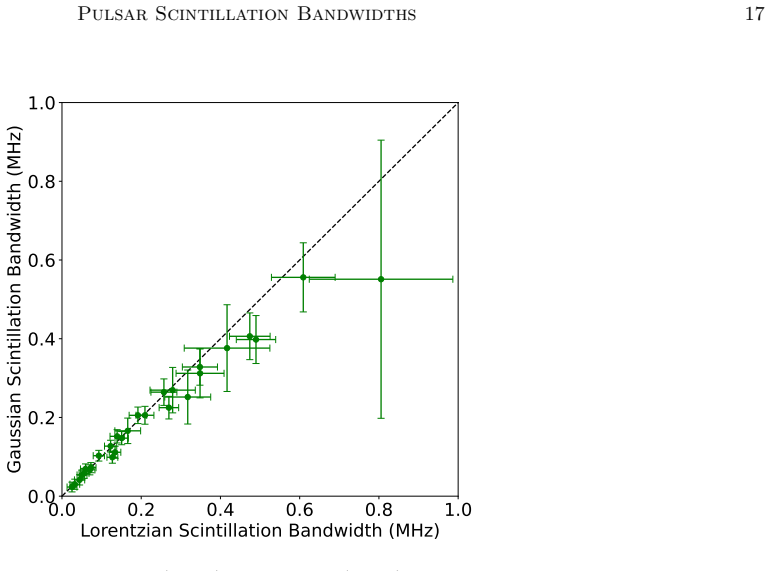
- [Abstract and Section 4.8] The claim that Gaussian fits are 'more consistent' with the electron density models than Lorentzian fits is based on median difference factors of 1.59 vs 1.72 for NE2001 and 3.16 vs 3.49 for YMW16. No uncertainty on these medians is provided, and the differences are small relative to the sample scatter. Please add a bootstrap or non-parametric test (e.g., a Wilcoxon signed-rank test on paired differences) to support the claim, or soften the abstract wording to 'comparable' or 'slightly better.'
minor comments (5)
- [Table 2 notes] The note for BGR and DLK contains 'bandwith' instead of 'bandwidth'; please correct the typo.
- [Figure 6 caption] The caption states that the Lorentzian/Gaussian trend continues 'into the four measurements above 1 GHz'; this should read 'above 1 MHz' since all bandwidths are in MHz.
- [Section 5] The text refers to 'three nearby millisecond pulsars' with negative difference factors, but the two pulsars discussed in Section 4.8 (B1929+10 and B0950+08) have periods of about 0.23 s and 0.25 s and are not millisecond pulsars; please correct the characterization.
- [Section 4.2] For B1929+10, the reported mean Lorentzian bandwidth of 1.3 +/- 0.6 MHz appears to be an unweighted mean with the error given as the sample standard deviation; please state explicitly how the mean and its error were computed and consider quoting the standard error of the mean instead.
- [Table 1 and Table 2] The pulsar J2227+3038 appears as 'J2227+3038' in Table 1 but as 'J2227+30' in Table 2; please use a consistent naming convention.
Circularity Check
No significant circularity: measurements are empirical, model comparisons are external, and the training-pulsar confound is acknowledged and quantified.
full rationale
We walked the paper's derivation chain and found no step that reduces by construction to its own inputs. The central measurements are widths of a 1D slice of the 2D ACF of dynamic spectra (Section 3.5), produced by fitting independent Gaussian and Lorentzian models (Section 3.6). Nothing in that measurement is defined in terms of NE2001 or YMW16 predictions; the predictions are external quantities computed from published models. The paper also checks its own main comparison against the known training-set overlap: it splits the sample into NE2001 training pulsars and non-training pulsars and reports median difference factors of 0.90 versus 2.89 (Section 4.8), showing that the underprediction trend is not an artifact of the model having been fit to the same objects. The preference for Gaussian fits is explicitly attributed to the historical use of Gaussian fits in training the models (Abstract and Section 4.8), so it is presented as a consequence of the models' construction, not as an independent first-principles finding. The DM-scaling fit is secondary and contains an internal inconsistency between the text (A = 1.83e-7, a = 2.65) and the Figure 8 caption (A = 2.1e-1, a = 2.6), but that is a numerical reporting error, not a circular argument. No self-citation is load-bearing: PyPulse is cited as public software, and the AO327 survey papers are data provenance citations. No uniqueness theorem or ansatz is imported from the authors' prior work. We therefore find no circular step and assign a score of 0.
Assumptions & free parameters
free parameters (2)
- A (amplitude of DM-scattering relation) =
1.83e-7 (text) or 2.1e-1 (Figure 8 caption, inconsistent)
- a (power-law index of DM-scattering relation) =
2.65 (text) or 2.6 (Figure 8 caption)
assumptions (6)
- domain assumption The relation 2*pi*tau_s*Delta_nu_D = C with C = 0.96 for a Kolmogorov thin-screen model (Equation 1).
- domain assumption The scintillation bandwidth scales with frequency as nu^alpha with alpha = 4.4 (Kolmogorov scaling).
- domain assumption The 1D frequency-lag slice obtained by summing the 2D ACF over time lags faithfully represents the scintillation bandwidth.
- domain assumption NE2001 and YMW16 electron density models provide valid predictions for scintillation bandwidth at 327 MHz.
- ad hoc to paper The manual cropping of the ACF slice to the smallest coherent structure with at least five points does not bias the measured bandwidth.
- ad hoc to paper The filling factor eta_nu = 0.2 in the finite scintle error calculation is appropriate.
Cite this review
Pith. "Pith review of Scintillation Bandwidth Measurements from 23 Pulsars from the AO327 Survey." pith.science (2026). https://pith.science/paper/XCTYKE5E
@misc{pith2026241117857,
  author       = {Pith},
  title        = {Pith review of: Scintillation Bandwidth Measurements from 23 Pulsars from the AO327 Survey},
  year         = {2026},
  howpublished = {\url{https://pith.science/paper/XCTYKE5E}},
  note         = {Machine review of arXiv:2411.17857}
}
abstract
A pulsar's scintillation bandwidth is inversely proportional to the scattering delay, making accurate measurements of scintillation bandwidth critical to characterize unmitigated delays in efforts to measure low-frequency gravitational waves with pulsar timing arrays. In this pilot work, we searched for a subset of known pulsars within $\sim$97% of the data taken with the PUPPI instrument for the AO327 survey with the Arecibo telescope, attempting to measure the scintillation bandwidths in the dataset by fitting to the 2D autocorrelation function of their dynamic spectra. We successfully measured 38 bandwidths from 23 pulsars (six without prior literature values), finding that: almost all of the measurements are larger than the predictions from NE2001 and YMW16 (two popular galactic models); NE2001 is more consistent with our measurements than YMW16; Gaussian fits to the bandwidth are more consistent with both electron density models than Lorentzian ones; and for the 17 pulsars with prior literature values, the measurements between various sources often vary by factors of a few. The success of Gaussian fits may be due to the use of Gaussian fits to train models in previous work. The variance of literature values over time could relate to the scaling factor used to compare measurements, but also seems consistent with time-varying interstellar medium parameters. This work can be extended to the rest of AO327 to further investigate these trends, highlighting the continuing importance of large archival datasets for projects beyond their initial conception.
Figures


Figures from the paper (5 more)




Reference graph
Works this paper leans on
-
[1]
, " * write output.state after.block = add.period write newline
ENTRY address archivePrefix author booktitle chapter doi edition editor eprint howpublished institution journal key month number organization pages publisher school series title misctitle type volume year version url label extra.label sort.label short.list INTEGERS output.state before.all mid.sentence after.sentence after.block FUNCTION init.state.consts ...
-
[2]
write newline
" write newline "" before.all 'output.state := FUNCTION format.url url empty "" new.block "" url * "" * if FUNCTION format.eprint eprint empty "" archivePrefix empty "" archivePrefix "arXiv" = new.block " " eprint * " " * new.block " " eprint * " " * if if if FUNCTION format.doi doi empty "" " " doi * " " * if FUNCTION format.pid doi empty eprint empty ur...
-
[3]
, <H @ h(#X , <H @ JsH ;c /lҤI6e _l6 l? j ꪫ ZXG @ @ @!h(oۣ>j wޱ Aeeoڶnk;S ::w@ @ @ @ @ > g TWWg=Zĉ =/K.V[N;dÆ 3 @ @ @ @p PO?;ᆲQԒ
thebibliography [1] 20pt to REFERENCES 6pt =0pt 10pt plus 3pt =0pt =0pt =1pt plus 1pt =0pt =0pt -12pt =13pt plus 1pt =20pt =13pt plus 1pt \@M =10000 =-1.0em =0pt =0pt 0pt =0pt =1.0em @enumiv\@empty 10000 10000 `\.\@m \@noitemerr \@latex@warning Empty `thebibliography' environment \@ifnextchar \@reference \@latexerr Missing key on reference command Each re...
2019
-
[4]
Agazie, G., Alam, M. F., Anumarlapudi, A., et al. 2023, The Astrophysical Journal Letters, 951, L9
work page 2023
-
[5]
Arzoumanian , Z., Baker , P. T., Blecha , L., et al. 2023, arXiv e-prints, L28, 10.3847/2041-8213/acdbc7
-
[6]
Bhat , N. D. R., Gupta , Y., & Rao , A. P. 1998, , 500, 262, 10.1086/305715
doi:10.1086/305715 1998
-
[7]
Bogart, S. 2024. https://sankeymatic.com/
work page 2024
-
[8]
Chen , S., Caballero , R. N., Guo , Y. J., et al. 2021, , 508, 4970, 10.1093/mnras/stab2833
Show all 59 references
-
[9]
1986, Astrophysical Journal, Part 1 (ISSN 0004-637X), vol
Cordes, J. 1986, Astrophysical Journal, Part 1 (ISSN 0004-637X), vol. 311, Dec. 1, 1986, p. 183-196. Research supported by the Alfred P. Sloan Foundation., 311, 183
1986
-
[10]
2010, arXiv preprint arXiv:1010.3785
Cordes, J., & Shannon, R. 2010, arXiv preprint arXiv:1010.3785
2010 arXiv
-
[11]
2016, arXiv preprint arXiv:1605.05890
Cordes, J., Wharton, R., Spitler, L., Chatterjee, S., & Wasserman, I. 2016, arXiv preprint arXiv:1605.05890
2016 arXiv
- [12]
- [13]
- [14]
-
[15]
M., Rickett, B
Cordes, J. M., Rickett, B. J., Stinebring, D. R., & Coles, W. A. 2006, The Astrophysical Journal, 637, 346
2006
-
[16]
2013, Monthly Notices of the Royal Astronomical Society, 436, 2492
Daszuta, M., Lewandowski, W., & Kijak, J. 2013, Monthly Notices of the Royal Astronomical Society, 436, 2492
2013
-
[17]
T., Goss , W
Deller , A. T., Goss , W. M., Brisken , W. F., et al. 2019, , 875, 100, 10.3847/1538-4357/ab11c7
2019 doi
-
[18]
2024, The Astrophysical Journal Supplement Series, 271, 23
Deneva, J., McLaughlin, M., Olszanski, T., et al. 2024, The Astrophysical Journal Supplement Series, 271, 23
2024
-
[19]
S., Stovall, K., McLaughlin, M
Deneva, J. S., Stovall, K., McLaughlin, M. A., et al. 2013, Astrophysical Journal, 775, 51, 10.1088/0004-637X/775/1/51
2013 doi
-
[20]
S., Stovall , K., McLaughlin , M
Deneva , J. S., Stovall , K., McLaughlin , M. A., et al. 2016, , 821, 10, 10.3847/0004-637X/821/1/10
2016 doi
-
[21]
C., Perillat, P., & Vayner, B
Ferguson, D. C., Perillat, P., & Vayner, B. 2022, The Journal of the Astronautical Sciences, 69, 139
2022
-
[22]
A., & Stinebring , D
Hemberger , D. A., & Stinebring , D. R. 2008, , 674, L37, 10.1086/528985
2008 doi
-
[23]
J., Pilkington, J
Hewish, A., Bell, S. J., Pilkington, J. D. H., Scott, P. F., & Collins, R. A. 1968, Nature, 217, 709–713, 10.1038/217709a0
1968 doi
-
[24]
W., van Straten , W., & Manchester , R
Hotan , A. W., van Straten , W., & Manchester , R. N. 2004, , 21, 302, 10.1071/AS04022
2004 doi
-
[25]
L., Pen, U.-L., & Feldbrugge, J
Jow, D. L., Pen, U.-L., & Feldbrugge, J. 2023, Monthly Notices of the Royal Astronomical Society, 525, 2107
2023
-
[26]
2000, Astronomy and Astrophysics, v
Koester, D., & Reimers, D. 2000, Astronomy and Astrophysics, v. 364, p. L66-L69 (2000), 364, L66
2000
-
[27]
C., & Manoharan, P
Krishnakumar, M., Mitra, D., Naidu, A., Joshi, B. C., & Manoharan, P. 2015, The Astrophysical Journal, 804, 23
2015
-
[28]
D., Losovskii , B
Kuz'min , A. D., Losovskii , B. Y., & Lapaev , K. A. 2007, Astronomy Reports, 51, 615, 10.1134/S1063772907080021
2007 doi
-
[29]
2017, Astrophysics Source Code Library, ascl
Lam, M. 2017, Astrophysics Source Code Library, ascl
2017
-
[30]
A., Jones, G., et al
Levin, L., McLaughlin, M. A., Jones, G., et al. 2016, The Astrophysical Journal, 818, 166
2016
-
[31]
Liu , Y., Verbiest , J. P. W., Main , R. A., et al. 2022, , 664, A116, 10.1051/0004-6361/202142552
2022 doi
-
[32]
Lorimer, D. R. 2008, Living reviews in relativity, 11, 1
2008
-
[33]
N., Hobbs, G
Manchester, R. N., Hobbs, G. B., Teoh, A., & Hobbs, M. 2005, The Astronomical Journal, 129, 1993
2005
-
[34]
G., Gentile , P., Freire , P
Martinez , J. G., Gentile , P., Freire , P. C. C., et al. 2019, , 881, 166, 10.3847/1538-4357/ab2877
2019 doi
-
[35]
K., Cordes, J
Ocker, S. K., Cordes, J. M., & Chatterjee, S. 2020, The Astrophysical Journal, 897, 124
2020
-
[36]
C., Flynn , C., & Deller , A
Price , D. C., Flynn , C., & Deller , A. 2021, , 38, e038, 10.1017/pasa.2021.33
2021 doi
-
[37]
1997, Monthly Notices of the Royal Astronomical Society, 288, 565
Ramachandran, R., & Bhattacharya, D. 1997, Monthly Notices of the Royal Astronomical Society, 288, 565
1997
-
[38]
2011, PRESTO: PulsaR Exploration and Search TOolkit , Astrophysics Source Code Library, record ascl:1107.017
Ransom , S. 2011, PRESTO: PulsaR Exploration and Search TOolkit , Astrophysics Source Code Library, record ascl:1107.017. 1107.017
2011
-
[39]
J., Coles , W
Reardon , D. J., Coles , W. A., Bailes , M., et al. 2020, , 904, 104, 10.3847/1538-4357/abbd40
2020 doi
-
[40]
J., Shannon , R
Reardon , D. J., Shannon , R. M., Cameron , A. D., et al. 2021, , 507, 2137, 10.1093/mnras/stab1990
2021 doi
-
[41]
Rickett, B. J. 1977, In: Annual review of astronomy and astrophysics. Volume 15.(A78-16576 04-90) Palo Alto, Calif., Annual Reviews, Inc., 1977, p. 479-504., 15, 479
1977
-
[42]
Rickett , B. J. 1990, , 28, 561, 10.1146/annurev.aa.28.090190.003021
1990
-
[43]
J., & Lyne , A
Rickett , B. J., & Lyne , A. G. 1990, , 244, 68
1990
-
[44]
1972, Annual Review of Astronomy and Astrophysics, 10, 427
Ruderman, M. 1972, Annual Review of Astronomy and Astrophysics, 10, 427
1972
-
[45]
J., Hazboun, J
Shapiro-Albert, B. J., Hazboun, J. S., McLaughlin, M. A., & Lam, M. T. 2021, The Astrophysical Journal, 909, 219
2021
-
[46]
V., & Shishov, V
Smirnova, T. V., & Shishov, V. I. 2008, Astronomy Reports, 52, 736, 10.1134/s1063772908090059
2008 doi
- [47]
-
[48]
2001, The Astrophysical Journal, 549, L97
Stinebring, D., McLaughlin, M., Cordes, J., et al. 2001, The Astrophysical Journal, 549, L97
2001
-
[49]
2022, , 39, e053, 10.1017/pasa.2022.46
Tarafdar , P., Nobleson , K., Rana , P., et al. 2022, , 39, e053, 10.1017/pasa.2022.46
2022 doi
-
[50]
H., Manchester , R
Taylor , J. H., Manchester , R. N., & Lyne , A. G. 1993, , 88, 529, 10.1086/191832
1993 doi
-
[51]
E., Joshi, B
Turner, J. E., Joshi, B. C., McLaughlin, M. A., & Stinebring, D. R. 2024, The Astrophysical Journal, 961, 101, 10.3847/1538-4357/ad06bb
2024 doi
-
[52]
E., McLaughlin, M
Turner, J. E., McLaughlin, M. A., Cordes, J. M., et al. 2021, The Astrophysical Journal, 917, 10, 10.3847/1538-4357/abfafe
2021 doi
-
[53]
E., et al
Virtanen, P., Gommers, R., Oliphant, T. E., et al. 2020, Nature Methods, 17, 261, 10.1038/s41592-019-0686-2
2020 doi
-
[54]
A., Melrose, D
Walker, M. A., Melrose, D. B., Stinebring, D. R., & Zhang, C.-M. 2004, Monthly Notices of the Royal Astronomical Society, 354, 43
2004
-
[55]
N., Johnston , S., et al
Wang , N., Manchester , R. N., Johnston , S., et al. 2005, , 358, 270, 10.1111/j.1365-2966.2005.08798.x
2005
-
[56]
Wu , Z., Verbiest , J. P. W., Main , R. A., et al. 2022, , 663, A116, 10.1051/0004-6361/202142980
2022 doi
-
[57]
2017, The Astrophysical Journal, 835, 29
Yao, J., Manchester, R., & Wang, N. 2017, The Astrophysical Journal, 835, 29
2017
-
[58]
2013, Monthly Notices of the Royal Astronomical Society, 431, 3624
Zakharenko, V., Vasylieva, I., Konovalenko, A., et al. 2013, Monthly Notices of the Royal Astronomical Society, 431, 3624
2013
-
[59]
2023, , 520, 1332, 10.1093/mnras/stad235
Zhi , Q., Xu , X., Shang , L., et al. 2023, , 520, 1332, 10.1093/mnras/stad235
2023 doi
Reviewed August 12, 2026 · model on record in the stance chip above.
Discussion (0). Continue with ORCID to comment.