REVIEW 3 major objections 4 minor 37 references
Vlasov-Poisson simulation study of phase-space hole coalescence in a cylindrically wave-guided plasma
T0 review · 3 major / 4 minor · reviewed 2026-08-12 · deepseek-v4-flash
Pith's one-line read This paper argues that phase-space hole coalescence is a vortex-fusion event in the phase-space fluid, with linear scaling laws for the merged hole's potential and speed.
desk verdict Under-resolved Vlasov grids (64 cells over 1200 Debye lengths) undermine otherwise genuinely new scaling fits for coalesced phase-space holes; the paper needs a major revision, not a desk reject. read the letter →
The pith
A machine-rendered reading of the paper's core claim, the machinery that carries it, and where it could break.
The reading
What carries the argument
The load-bearing object is the phase-space velocity field $\mathbf{V}(x,v_x) = v_x\,\hat{x} - \tau \frac{q}{m} \frac{\partial \phi}{\partial x}\,\hat{v}_x$ with $\tau = \omega_p^{-1}$, whose curl gives the phase-space vorticity $\xi = \omega_p(\rho/(q n_0) - 1)$. The no-flux condition $\nabla \cdot \mathbf{V} = 0$ makes the phase-space flow incompressible, so a hole appears as a solenoidal vortex; a vortex core is defined as the point where $|\mathbf{V}|=0$. The argument identifies coalescence with the merging of two such cores after their ambient velocity fields interact.
What would settle it
Run the same initial conditions on a much finer phase-space grid (e.g., $2^{10} \times 2^{10}$) and measure the coalesced hole's potential and speed as functions of relative speed; if the linear scalings with slopes of about 1.5 and 2.9 do not survive, or if the charge-density amplitude does not saturate exponentially, the vortex-fusion mechanism is falsified. Alternatively, directly image the phase-space velocity field during a collision and check whether the two $|\mathbf{V}|=0$ cores actually fuse before the merged hole appears.
Extended reading notes
Core claim
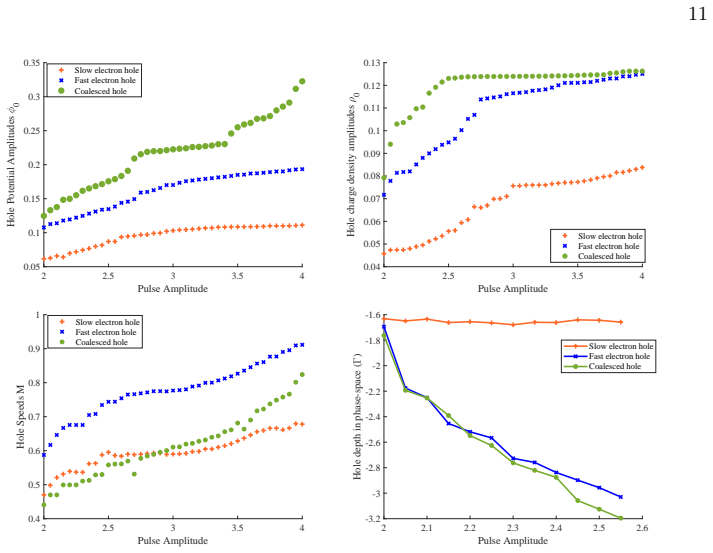
The central discovery is that phase-space hole coalescence is a vortex-fusion event in phase space. In the paper's hydrodynamic analogy, each hole is a vortex whose phase-space fluid orbits a central, non-rotating core where the phase-space velocity field vanishes. When two holes approach, their orbital velocity fields begin to interact, and the cores fuse, merging the velocity fields into one coherent vortex. Evidence comes from Vlasov-Poisson simulations of two-stream and wave-guided plasmas, showing streamline merging, and from parametric scans: the coalesced hole potential scales as $\phi_0 \approx 1.561\,\Delta M - 0.06293$, the coalesced speed as $M_{\text{coal}} \approx 2.918\,\Delta M + 0.08914$, and the coalesced charge density follows an exponential form $\rho_0(\Delta M) = a e^{b\Delta M} + c e^{d\Delta M}$, indicating saturation. The same mechanism is reported for both electron and ion holes.
Load-bearing premise
The argument assumes that the collisionless Vlasov-Poisson system behaves like an incompressible fluid whose swirl (vorticity) is directly tied to charge density, so that phase-space holes are genuinely vortices with identifiable cores; if that analogy is not quantitatively accurate, the vortex-fusion description of coalescence becomes a metaphor rather than a mechanism.
Editorial extensions
If this is right
- If coalescence is vortex fusion, then the merged hole's properties should be predictable from the pre-collision velocity fields alone, without resolving particle trapping kinetics.
- The linear scaling of coalesced potential and speed with relative speed gives a direct experimental signature: a lab experiment that varies hole collision speeds should see the same slopes in normalized units.
- The exponential saturation of the coalesced charge-density amplitude implies a maximum charge compression achievable through coalescence, which may bound the density perturbations of solitary structures in space plasmas.
- The same vortex-fusion mechanism is reported for both electron and ion holes, suggesting that the picture generalizes across species and geometries.
- The observed threshold, where no coalescence occurs beyond a certain excitation ratio, mirrors vortex-merging thresholds in ordinary fluids and reinforces the hydrodynamic analogy.
Reading between the lines
- If the analogy is quantitative, the phase-space vorticity–density identity means that any spatially resolved charge-density measurement already maps to a vorticity field, opening a route to 'vortex detection' in kinetic simulations without computing the full phase-space flow.
- The scaling laws could be tested against spacecraft observations of electrostatic solitary waves: successive coalescence events should produce holes whose potential and speed follow the same relative-speed scaling, if the observed holes are indeed formed by merging.
- The fluid picture suggests reduced models: a coarse-grained vorticity dynamics could reproduce the coalescence outcome at a fraction of the cost of full Vlasov simulations, though the paper does not construct such a model.
- The saturation of charge density hints that repeated coalescence chains, where multiple holes merge in sequence, would asymptotically approach a limiting density perturbation, an extension the paper does not explore.
Editorial analysis
A structured set of objections, weighed in public.
Referee Report
Summary. This paper studies the coalescence of electron and ion phase-space holes using one-dimensional Vlasov-Poisson simulations in two configurations: an infinite two-stream plasma and a cylindrically wave-guided plasma. The authors interpret phase-space holes as vortices through a phase-space hydrodynamic analogy from their prior work, and claim that hole coalescence is driven by interactions between the phase-space velocity fields and by the fusion of the vortex cores. For the wave-guided case, they report empirical parametric relations: the coalesced hole potential amplitude and speed increase roughly linearly with the relative speed of the colliding holes (Eqs. 12 and 13), while the coalesced charge density amplitude is fitted by a double exponential that appears to saturate (Eq. 14). They also present hole width scalings based on the ratio of potential to charge density (Fig. 8).
Significance. If the findings were established, they would strengthen the fluid-vortex analogy for phase-space holes and provide empirical scaling relations for coalesced holes that could be useful for interpreting simulations and experiments. The paper has some merits: it reproduces known coalescence behavior in two-stream and wave-guided geometries, applies a semi-Lagrangian Vlasov scheme, and makes qualitative contact with earlier simulation and experimental work. However, the quantitative claims rest on a single coarse-resolution simulation campaign with no convergence study, and the central mechanistic conclusion is drawn from visual inspection of streamlines rather than a quantitative diagnostic. The contribution is therefore conditional and needs substantial additional verification before the central claims can be accepted.
major comments (3)
- [Section 2.2 and Section 3.2, Figs. 5-8] The spatial grid is 2^6 = 64 cells over a plasma column length L = 1200 lambda_De, giving a cell size of about 18.75 lambda_De, while the hole width scale reported in Fig. 8 is only about 1.15-1.6 lambda_De. The simulated holes are therefore far smaller than the grid spacing and are not spatially resolved; the cubic-spline semi-Lagrangian scheme cannot faithfully represent structures that occupy less than one-tenth of a cell. Since all quantitative scalings (Eqs. (12)-(14)) and the vortex-core visualization (Figs. 1-3) are obtained from these same runs, the central claims are not supported. A grid-convergence study (for example Nx = 128, 256, 512, 1024 at fixed physical parameters) is required, together with a demonstration that phi0, M, rho0, and the streamline topology converge to grid-independent values.
- [Section 3.2, Eq. (14) and Table 1] The reported double-exponential fit for the coalesced charge density amplitude has 95% confidence bounds that include a sign change for the coefficient b (-0.6135 to 0.7163) and very wide bounds for c (-75.28 to 26.26). This does not support the claimed saturating exponential dependence of rho0 on Delta M. The data points in Fig. 7 are shown without error bars, and no goodness-of-fit statistic is provided. The conclusion that the charge density amplitude 'saturates' with increasing relative speed is therefore not established; a quantitative model comparison (for example against linear or power-law fits) and propagation of simulation uncertainties are needed.
- [Section 3.1 and Conclusions] The central mechanistic claim, that hole coalescence occurs through interaction of the phase-space velocity fields and fusion of the vortex cores, is based on visual inspection of streamlines and |V| portraits in Fig. 1. No quantitative criterion is given for identifying a vortex core (the |V|=0 point) or for detecting its fusion with another core. Because the phase-space hydrodynamic analogy is taken from the authors' prior work (Ref. [23]) rather than independently validated in this paper, the mechanism needs a quantitative test, such as tracking the |V|=0 locations in time and showing their continuous approach and merger, or comparing the circulation around each core before and after coalescence. Without such a diagnostic, 'vortex core fusion' remains a metaphor rather than a demonstrated mechanism.
minor comments (4)
- [Section 2.2] The grid size is typeset as '2 6 × 28 points' in the text; this should read 2^6 × 2^8 points.
- [Section 3.2, Table 1] The table header contains the typo 'T able 1'; it should read 'Table 1'.
- [Section 3.2, Eq. (15)] The width estimate delta_x ~ sqrt(phi0/rho0) is introduced with a dimensional argument from the Poisson equation, but the cylindrical waveguide Poisson equation (Eq. (9)) includes a k_perp^2 phi term; please clarify why that term is neglected in this estimate and how the normalization affects the numerical values quoted in Fig. 8.
- [Abstract and Introduction] Several sentences are grammatically awkward, for example 'Phase-space holes are well-known Bernstein-Greene-Kruskal waves known for exhibiting coalescence, are numerically simulated and their coalescence is observed'; please edit for clarity.
Circularity Check
No significant circularity; the quantitative relations are empirical fits and the vortex-core mechanism is an interpretive framework, not a derivation from its own conclusion.
full rationale
The paper's quantitative claims (Eqs. 12–14) are explicitly presented as curve fits to simulation measurements ('we find from our linear regression...', 'exponential fitting of the form...'), not as predictions derived from the phase-space hydrodynamic analogy. The central mechanistic statement (coalescence via interaction and merging of phase-space velocity fields) is an interpretive explanation of the simulated phase-space portraits, not a quantity computed from an equation that already contains the conclusion. The phase-space vorticity relation (Eq. 3) is derived in the paper from the defined velocity field and Poisson's equation, and the identification of density depletions with vorticity concentrations uses external vortex-definition references (Lugt, Tian et al.) in addition to the authors' prior work [23]; the self-citation is thus not load-bearing in a circular sense. No equation in the paper is defined in terms of the target result, and the empirical fits do not feed back into the derivation of the mechanism. Resolution and convergence concerns, while potentially serious, are correctness risks rather than circularity.
Assumptions & free parameters
free parameters (5)
- p0 (potential intercept) =
-0.06293 K_B T_e e^-1
- C (potential slope) =
1.5
- m0 (speed intercept) =
0.09
- M (speed slope) =
2.9
- a, b, c, d (exponential fit coefficients) =
0.1241, 0.0514, -24.5122, -54.6744
assumptions (5)
- standard math The collisionless plasma is governed by the Vlasov-Poisson system (Eqs. 5-6).
- ad hoc to paper The phase-space flow is incompressible, ∇·V=0 (Eq. 4), and the vorticity field is proportional to the charge density (Eq. 3).
- ad hoc to paper A phase-space hole is identified as a vortex based on concentration of the vorticity field along position space.
- domain assumption For the wave-guided plasma, only the lowest radial eigenmode of the transverse Laplacian is used (Eq. 9).
- domain assumption For ion hole runs, the electron to ion temperature ratio is Te/Ti = 100.0.
Cite this review
Pith. "Pith review of Vlasov-Poisson simulation study of phase-space hole coalescence in a cylindrically wave-guided plasma." pith.science (2026). https://pith.science/paper/YDAYXVT7
@misc{pith2026241117908,
  author       = {Pith},
  title        = {Pith review of: Vlasov-Poisson simulation study of phase-space hole coalescence in a cylindrically wave-guided plasma},
  year         = {2026},
  howpublished = {\url{https://pith.science/paper/YDAYXVT7}},
  note         = {Machine review of arXiv:2411.17908}
}
read the original abstract
In this work, coalescence of phase-space holes of collision-less, one-dimensional plasmas is studied using kinetic simulation techniques. Phase-space holes are well-known Bernstein-Greene-Kruskal waves known for exhibiting coalescence, are numerically simulated and their coalescence is observed. Relations between the hole speed, potential, phase-space vorticity and phase-space depth are then obtained using the simulation data. This study involves the study of electron phase-space hole coalescence in a cylindrically wave-guided plasma. Using the recently developed phase-space hydrodynamic analogy, it is shown that the coalescence phenomena can be explored in terms of the fluid-analogous vortical nature of the phase-space holes. Coalescence occurs due to the interaction of the phase-space velocity fields associated with these phase-space vortices. Results obtained from the study describes various parametric relations between the coalesced hole characteristics and the characteristics of the colliding holes.
Figures


Figures from the paper (6 more)




Reference graph
Works this paper leans on
-
[23]
Theory of phase-space hydrodyn amics of electron and ion holes in collisionless plasmas,
A. Lobo and V. K. Sayal, “Theory of phase-space hydrodyn amics of electron and ion holes in collisionless plasmas,” Physics of Plasmas , vol. 31, p. 092301, 9 2024
work page 2024
-
[1]
Nonlinear evolution of a two -stream instability,
K. V. Roberts and H. L. Berk, “Nonlinear evolution of a two -stream instability,” Physical Review Letters, vol. 19, no. 6, p. 297, 1967
work page 1967
-
[2]
One-, two-, and three-dime nsional numerical simulation of two-beam plasmas,
R. L. Morse and C. W. Nielson, “One-, two-, and three-dime nsional numerical simulation of two-beam plasmas,” Physical Review Letters , vol. 23, no. 19, p. 1087, 1969
work page 1969
-
[3]
Formation and coalescence of electron solitary holes,
K. Saeki, P. Michelsen, H. L. P´ ecseli, and J. J. Rasmusse n, “Formation and coalescence of electron solitary holes,” Physical Review Letters , vol. 42, no. 8, p. 501, 1979
work page 1979
-
[4]
Observations of solitary structures in a magnetized, plas ma loaded waveguide,
J.-P. Lynov, P. Michelsen, H. L. P´ ecseli, J. J. Rasmusse n, K. Saeki, and V. A. Turikov, “Observations of solitary structures in a magnetized, plas ma loaded waveguide,” Physica Scripta, vol. 20, no. 3-4, p. 328, 1979
work page 1979
-
[5]
Interaction between electron holes in a strongly magnetized plasma,
J.-P. Lynov, P. Michelsen, H. L. P´ ecseli, and J. J. Rasmu ssen, “Interaction between electron holes in a strongly magnetized plasma,” Physics Letters A , vol. 80, no. 1, pp. 23–25, 1980
work page 1980
-
[6]
Nonlinear Processes in Geophysic s Phase space vortices in collisionless plasmas,
P. Guio, S. Børve, L. K. S. Daldorff, J. P. Lynov, P. Michels en, H. L. P´ ecseli, J. J. Rasmussen, K. Saeki, and J. Trulsen, “Nonlinear Processes in Geophysic s Phase space vortices in collisionless plasmas,” Nonlinear Processes in Geophysics , vol. 10, pp. 75–86, 2003
work page 2003
-
[7]
Phase-Space Models of Solitary Electron Holes,
J. P. Lynov, P. Michelsen, H. L. P´ ecseli, J. Juul Rasmuss en, and S. H. Sørensen, “Phase-Space Models of Solitary Electron Holes,” Physica Scripta , vol. 31, p. 596, 6 1985
work page 1985
Show all 37 references
-
[8]
Computer simulation of the formation of L angmuir solitons and holes in a cylindrical magnetized plasma column,
V. A. Turikov, “Computer simulation of the formation of L angmuir solitons and holes in a cylindrical magnetized plasma column,” tech. rep., Risoe n ational lab., 1978
1978
-
[9]
Production of nonisotherm al electrons and langmuir waves because of colliding ion holes and trapping of plasmons in an ion hole,
B. Eliasson and P. K. Shukla, “Production of nonisotherm al electrons and langmuir waves because of colliding ion holes and trapping of plasmons in an ion hole,” Physical Review Letters, vol. 92, no. 9, 2004
2004
-
[10]
Dynamics of electron hole s in an electron-oxygen-ion plasma,
B. Eliasson and P. K. Shukla, “Dynamics of electron hole s in an electron-oxygen-ion plasma,” Physical Review Letters , vol. 93, no. 4, 2004
2004
-
[11]
Multisatellite Observations of Ion Holes in the Ear th’s Plasma Sheet,
R. W ang, I. Y. Vasko, A. V. Artemyev, L. C. Holley, S. R. Ka maletdinov, A. Lotekar, and F. S. Mozer, “Multisatellite Observations of Ion Holes in the Ear th’s Plasma Sheet,” Geophysical Research Letters, vol. 49, p. e2022GL097919, 4 2022
2022
-
[12]
Multisatellite MMS Analysis of Electron Ho les in the Earth’s Magnetotail: Origin, Properties, Velocity Gap, and Transverse Instabil ity,
A. Lotekar, I. Y. Vasko, F. S. Mozer, I. Hutchinson, A. V. Artemyev, S. D. Bale, J. W. Bonnell, R. Ergun, B. Giles, Y. V. Khotyaintsev, P. A. Lindqv ist, C. T. Russell, and R. Strangeway, “Multisatellite MMS Analysis of Electron Ho les in the Earth’s Magnetotail: Origin, Prope...
2020
-
[13]
St ructural Characteristics of Ion Holes in Plasma,
H. Aravindakshan, A. Kakad, B. Kakad, and P. H. Yoon, “St ructural Characteristics of Ion Holes in Plasma,” Plasma 2021, Vol. 4, Pages 435-449 , vol. 4, pp. 435–449, 9 2021
2021
-
[14]
On the Nature and Origin of Bipolar Electrostatic Structures in the Earth’s Bow Shoc k,
I. Y. Vasko, R. W ang, F. S. Mozer, S. D. Bale, and A. V. Arte myev, “On the Nature and Origin of Bipolar Electrostatic Structures in the Earth’s Bow Shoc k,” Frontiers in Physics , vol. 8, 2020
2020
-
[15]
DNS Study on Vortex and Vorticity in Late Boundary Layer Transition,
Y. W ang, Y. Yang, G. Yang, and C. Liu, “DNS Study on Vortex and Vorticity in Late Boundary Layer Transition,” Communications in Computational Physics , vol. 22, pp. 441–459, 8 2017
2017
-
[16]
Furthering 15 our understanding of electrostatic solitary waves through Cluster multispacecraft observations and theory,
J. S. Pickett, L. J. Chen, R. L. Mutel, I. W. Christopher, O. Santol ´ ık, G. S. Lakhina, S. V. Singh, R. V. Reddy, D. A. Gurnett, B. T. Tsurutani, E. Lucek, a nd B. Lavraud, “Furthering 15 our understanding of electrostatic solitary waves through Cluster multispacecraft obser...
2008
-
[17]
Exact n onlinear plasma oscillations,
I. B. Bernstein, J. M. Greene, and M. D. Kruskal, “Exact n onlinear plasma oscillations,” Physical Review, vol. 108, no. 3, p. 546, 1957
1957
-
[18]
Electron holes, ion holes and double layer s: Electrostatic phase space structures in theory and experiment,
H. Schamel, “Electron holes, ion holes and double layer s: Electrostatic phase space structures in theory and experiment,” Physics reports, vol. 140, no. 3, pp. 161–191, 1986
1986
-
[19]
Formation and dynamics of coherent structures involving phase- space vortices in plasmas,
B. Eliasson and P. K. Shukla, “Formation and dynamics of coherent structures involving phase- space vortices in plasmas,” Physics Reports, vol. 422, pp. 225–290, 1 2006
2006
-
[20]
Phase Space Hydrodynamics of Equivalent Nonlinear Systems: Experimental and Computational Observ ations,
H. L. Berk, C. E. Nielsen, and K. V. Roberts, “Phase Space Hydrodynamics of Equivalent Nonlinear Systems: Experimental and Computational Observ ations,” The Physics of Fluids , vol. 13, pp. 980–995, 4 1970
1970
-
[21]
Cnoidal electron hole propagation: Trapp ing, the forgotten nonlinearity in plasma and fluid dynamics,
H. Schamel, “Cnoidal electron hole propagation: Trapp ing, the forgotten nonlinearity in plasma and fluid dynamics,” Physics of Plasmas , vol. 19, no. 2, p. 20501, 2012
2012
-
[22]
Electrostatic trapping as a ke y to the dynamics of plasmas, fluids and other collective systems,
A. Luque and H. Schamel, “Electrostatic trapping as a ke y to the dynamics of plasmas, fluids and other collective systems,” 2005
2005
-
[24]
Acceleration of ion phase-spac e holes due to interactions with ion solitons in a wave-guided plasma,
A. Lobo and V. K. Sayal, “Acceleration of ion phase-spac e holes due to interactions with ion solitons in a wave-guided plasma,” Scientific Reports , vol. 14, no. 1, p. 21319, 2024
2024
-
[25]
The Dilemma of Defining a Vortex,
H. J. Lugt, “The Dilemma of Defining a Vortex,” in Recent Developments in Theoretical and Experimental Fluid Mechanics: Compressible and Incompres sible Flows , pp. 309–321, Berlin, Heidelberg: Springer Berlin Heidelberg, 1979
1979
-
[26]
Definitions of vorte x vector and vortex,
S. Tian, Y. Gao, X. Dong, and C. Liu, “Definitions of vorte x vector and vortex,” Journal of Fluid Mechanics , vol. 849, pp. 312–339, 8 2018
2018
-
[27]
A numerical integration scheme for vectorised phase-space of one- dimensional collision-free, electrostatic systems,
A. Lobo and V. K. Sayal, “A numerical integration scheme for vectorised phase-space of one- dimensional collision-free, electrostatic systems,” in Proc.SPIE, vol. 13276, p. 132760B, 10 2024
2024
-
[28]
The integration of the vlasov e quation in configuration space,
C. Z. Cheng and G. Knorr, “The integration of the vlasov e quation in configuration space,” Journal of Computational Physics , vol. 22, pp. 330–351, 11 1976
1976
-
[29]
Conser vative numerical schemes for the Vlasov equation,
F. Filbet, E. Sonnendr¨ ucker, and P. Bertrand, “Conser vative numerical schemes for the Vlasov equation,” Journal of Computational Physics , vol. 172, pp. 166–187, 9 2001
2001
-
[30]
Finite-difference methods for solving 1D Poisson problem,
S. Ndayisenga, L. A. Sevastianov, and K. P. Lovetskiy, “ Finite-difference methods for solving 1D Poisson problem,” Discrete and Continuous Models and Applied Computational S cience, vol. 30, no. 1, 2022
2022
-
[31]
¨Uber die partiellen Differenzengleichungen der mathematischen Physik,
R. Courant, K. Friedrichs, and H. Lewy, “ ¨Uber die partiellen Differenzengleichungen der mathematischen Physik,” Mathematische Annalen , vol. 100, pp. 32–74, 12 1928
1928
-
[32]
Electron holes in phase space: What t hey are and why they matter,
I. H. Hutchinson, “Electron holes in phase space: What t hey are and why they matter,” Physics of Plasmas , vol. 24, p. 055601, 5 2017
2017
-
[33]
Nonlinear Dynamics o f Phase Space Structures Arising from Counterinjection of Overlimiting Relativistic Elect ron Beams into a Long Equipotential Cavity,
A. E. Dubinov and V. P. Tarakanov, “Nonlinear Dynamics o f Phase Space Structures Arising from Counterinjection of Overlimiting Relativistic Elect ron Beams into a Long Equipotential Cavity,” Physics of Wave Phenomena , vol. 28, no. 4, 2020
2020
-
[34]
The magnetic stru ctures of electron phase-space holes formed in the electron two-stream instability,
M. W u, Q. Lu, J. Zhu, A. Du, and S. W ang, “The magnetic stru ctures of electron phase-space holes formed in the electron two-stream instability,” Astrophysics and Space Science , vol. 338, no. 1, 2012
2012
-
[35]
Theory of electron holes,
H. Schamel, “Theory of electron holes,” Physica Scripta , vol. 20, no. 3-4, p. 336, 1979
1979
-
[36]
Electron phase space holes as localized BGK solutions,
V. A. Turikov, “Electron phase space holes as localized BGK solutions,” Physica Scripta, vol. 30, pp. 73–77, 7 1984
1984
-
[37]
On the width-amplitude inequality of electron phase space holes,
L. J. Chen, J. Pickett, P. Kintner, J. Franz, and D. Gurne tt, “On the width-amplitude inequality of electron phase space holes,” Journal of Geophysical Research: Space Physics , vol. 110, p. 9211, 9 2005. Acknowledgement One of the authors (A.L.) acknowledges the TMA-PAI doct...
2005
Reviewed August 12, 2026 · model on record in the stance chip above.
Discussion (0). Continue with ORCID to comment.