REVIEW 3 major objections 5 minor 13 references
Quantification of Uncertainty and Its Propagation in Seismic Velocity Structure and Earthquake Source Inversion
T0 review · 3 major / 5 minor · reviewed 2026-08-12 · deepseek-v4-flash
Pith's one-line read This review establishes that earthquake source inversions ignoring seismic velocity uncertainty are biased and overconfident, and that a Bayesian multi-model inversion fed by PINN-based tomography quantifies and propagates that…
desk verdict A clear self-review with genuinely useful framing, but no new evidence, and the integrated 2.5D example understates along-strike structural uncertainty. read the letter →
The pith
A machine-rendered reading of the paper's core claim, the machinery that carries it, and where it could break.
The reading
What carries the argument
Bayesian multi-model estimation: rather than solving the source inversion with one chosen velocity model, it forms the posterior $p(\mathbf m|\mathbf d)$ as a Monte Carlo average of likelihoods over an ensemble of structure models $\{\boldsymbol\phi^{(n)}\}$, i.e. $p(\mathbf m|\mathbf d)\simeq \kappa \frac{1}{N}\sum_n p(\mathbf d|\mathbf m,\boldsymbol\phi^{(n)})p(\mathbf m)$, which requires neither Gaussian data errors nor linear Green's functions. The companion machinery is PINN-based Bayesian traveltime tomography in function-space particle-based variational inference: the velocity structure is represented by a neural network, the posterior is approximated by particles interacting through Stein variational gradient descent in the output (function) space, and the gradient of the likelihood with respect to velocity is computed with the discrete adjoint method. The eikonal equation is enforced through the factored ansatz $T=T_0/\tau$ with $1/\tau$ approximated by the network, which removes the source singularity.
What would settle it
A numerical experiment with a synthetic 3D velocity model containing strong along-trench heterogeneity: generate travel times, estimate the 2.5D ensemble exactly as in the paper, and check whether the resulting posterior hypocenter interval covers the true hypocenters in repeated realizations; if the coverage is below the nominal probability, the 2.5D propagation undercounts uncertainty. A field-based test would compare the ensemble posterior for the 2016 Mie event with an independent absolute depth constraint from a borehole or local dense array.
Extended reading notes
Core claim
The central claim is that velocity-structure uncertainty can be quantified as an ensemble and then propagated into earthquake source inversion by Monte Carlo marginalization, and that this removes the biases and underestimation of uncertainty that occur when a single velocity model is assumed. The paper shows that the two previously separate approaches, treating Green's-function errors through a data covariance matrix and jointly estimating source and structure parameters, are mathematically equivalent under Gaussian and linear assumptions, and that the multi-model method generalizes both by sampling the marginalized posterior directly. On the tomography side, the paper introduces a PINN-based Bayesian traveltime tomography that performs Bayesian inference in the function space of the neural network, using particle-based variational inference, so the velocity structure is a continuous function and the posterior samples are suitable as input to the source inversion. In the integrated application, the posterior ensemble of 2D P-wave velocity structures from refraction line KI03 was extended in a 2.5D sense and used for Bayesian hypocenter determination of the 2016 Mw 5.9 event off Mie; the result was a deeper mean hypocenter with larger uncertainty than the single-model estimate, and consistency with the uncertain depth of reflectors from a seismic reflection survey.
Load-bearing premise
The load-bearing premise is that the velocity ensemble honestly spans the plausible structures, which in the integrated application reduces to assuming the 2D profile from refraction line KI03 can be extended without along-trench variation to build the 2.5D model used for hypocenters.
Editorial extensions
If this is right
- Any source inversion that pre-selects a single velocity model should be re-examined with the ensemble approach, since the paper identifies this as a major source of bias and underestimated uncertainty.
- The velocity-structure ensemble produced by PINN-based Bayesian tomography is smooth and continuous, so it can be fed directly into multi-model source inversion without the artificial discontinuities of trans-dimensional Voronoi tomography.
- Including structure uncertainty makes strong smoothing priors on fault slip unnecessary, because part of the instability that smoothing was meant to suppress comes from unmodeled structure error.
- The integrated hypocenter application demonstrates that posterior depth intervals, not single hypocenters, are the right output when structure is uncertain; the 2016 Mie event's hypocenter became deeper and more uncertain.
- The same pipeline can be scaled to 3D velocity structures and to pre-built seismogenic-zone ensemble models, making the approach a practical replacement for single-model source inversions.
Reading between the lines
- If the paper is right, the same Monte Carlo marginalization recipe should transfer to other inverse problems with uncertain forward models, such as tsunami waveform inversion or volcano deformation modeling, whenever an ensemble of medium parameters can be produced.
- A testable extension suggested by the paper is to use the posterior over velocity structures to derive a probability that the 2016 Mie event ruptured the plate interface, rather than deciding it by comparing a single hypocenter with a single depth-converted reflector.
- The function-space ParVI trick may be the more general contribution: any PDE-constrained Bayesian inversion where the physically meaningful prior lives on the solution field, not the network weights, could use the same scheme.
- Because the integrated case rests on the 2.5D assumption, a natural next experiment is to build a full 3D ensemble with along-trench heterogeneity and check whether the reported deepening and uncertainty interval survive.
Editorial analysis
A structured set of objections, weighed in public.
Referee Report
Summary. This invited review article, written as an English preprint of a manuscript submitted to Zisin (Journal of the Seismological Society of Japan), synthesizes the author's program for quantifying uncertainty in seismic velocity structure and propagating it into earthquake source inversion. Section 2 presents Bayesian multi-model source inversion, where ensembles of structural models are marginalized via Monte Carlo integration, including an application to long-term slow slip events in the Bungo Channel. Section 3 introduces a Bayesian traveltime tomography method based on physics-informed neural networks (PINNs) with function-space particle-based variational inference, together with numerical experiments. Section 4 describes a preliminary integrated application to hypocenter determination of the 2016 Mw 5.9 earthquake off Mie Prefecture, in which a 2D velocity structure ensemble estimated along refraction line KI03 is extended along-strike to form a '2.5D' velocity model for travel-time calculations. Section 5 gives future prospects involving scientific machine learning. The paper is a review and does not present new results; its central message is that velocity-structure uncertainty is routinely ignored in source inversion, leading to biased and overconfident estimates, and that the author's Bayesian approaches can materially improve this situation.
Significance. If the claims are accepted, the paper offers a coherent, well-illustrated summary of an important methodological direction: moving from single velocity models to explicit ensembles in earthquake source inversion. A particular strength is the emphasis on the theoretical connection between Green's-function error covariance and Bayesian marginalization over structural parameters, presented in Section 2.1. The proposal to use function-space particle-based variational inference for PINN-based tomography (Section 3.2) is a plausible response to the known multimodality and prior-specification problems of weight-space B-PINNs, and the numerical experiments reported in Section 3.3 show the method can produce smooth, continuous velocity samples that are suitable for downstream use. The paper is honest in labeling the integrated example in Section 4 as preliminary, and it correctly points to the published work (Agata et al. 2021, 2022, 2023, 2025) for details. Its value to the readership of Zisin is likely to be high, given the award-context and the didactic style.
major comments (3)
- [Section 4 (paragraphs 2-3)] The integrated application constructs the 3D velocity structure by extending the 2D ensemble estimated along refraction line KI03 perpendicular to the trench ('2.5D structure'). This means the ensemble only samples structural uncertainty within the 2D plane of that line; trench-parallel (along-strike) heterogeneity is entirely absent from the prior. The nine DONET stations and the hypocenter of the 2016 Mw 5.9 earthquake are not located exactly on KI03, so their travel times are computed using velocity models that could be systematically biased in the very dimension that the ensemble does not represent. Consequently, the posterior uncertainty of the hypocenter may be overconfident, and the claim in Section 4 that accounting for structural uncertainty 'improved' the bias and underestimation is not quantitatively supported by the material in this manuscript. The author should add a clear caveat about the 2.5D limitation and, where possible, indicate how along-strike variability could influence the reported conclusions (e.g., by referencing any sensitivity analysis in Agata et al. 2025).
- [Section 3.2] The computation of the gradient ∇_v log p(v|d) is the technical core of the proposed PINN-based Bayesian traveltime tomography method, because the likelihood depends on the velocity structure only through the travel-time network f_T. The manuscript states that 'the discrete adjoint method' is used but omits the details, deferring to Agata et al. (2023). While a review may refer to the original paper, this omission leaves the reader unable to assess the method's practicality and scalability, which are central to the claimed advantages over HMC-based B-PINNs. The author should at least sketch the adjoint formulation, explain how f_T enters the gradient, and state the computational cost relative to the forward eikonal solve.
- [Section 2.3] The comparison between the proposed Bayesian multi-model slip estimate and the smoothing-constrained, single-structure estimate is summarized as 'It is evident that our estimation results better correspond to the distribution of deep tectonic tremors.' This is a visual, qualitative assessment without a quantitative measure, and it is based on a single event. To support the claim that the method reduces instability and improves physical interpretability, the review should specify a metric (e.g., spatial correlation between ΔCFS and tremor density) or explicitly label the comparison as qualitative and preliminary.
minor comments (5)
- [Section 5] The sentence 'as described in Section,' near the end of the first paragraph of Section 5 is missing the section number; it should read 'Section 4'.
- [Section 4 (title)] The title of Section 4 ends with a colon ('... Earthquake Source Inversion:'), which is incomplete and should be removed.
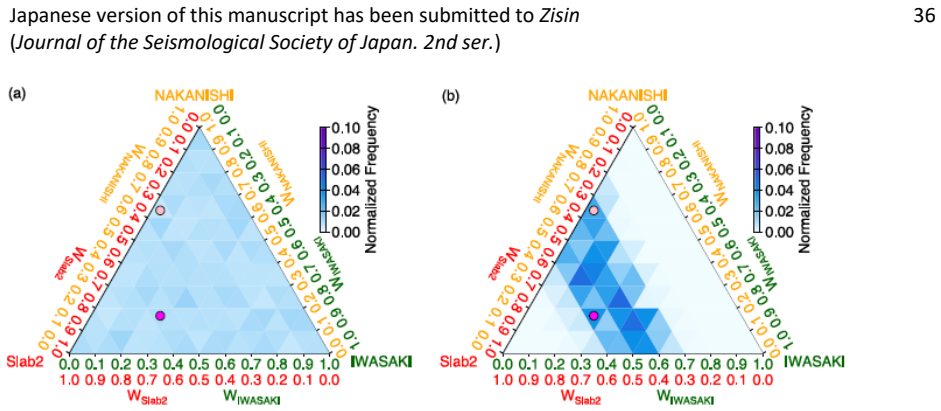
- [Figure 1 caption] The caption contains the sentence 'Pink and magenta circles mark locations designated for further visualizations, which are not included in this article.' This is a leftover from the original figure and should be deleted or replaced with an appropriate description.
- [Section 3.3] The phrase 'quasi-analytical solution' should be clarified; either 'analytical solution' or 'semi-analytical solution' would be clearer, and the intended meaning should be stated explicitly.
- [References] The reference list has minor formatting issues, such as the missing space between 'Phys. Rev. Lett.' and the next entry, and 'Hallo, M., and F. Gallovič, 2016' is concatenated with the following reference. These should be corrected for consistency.
Circularity Check
No significant circularity: the paper is an invited review that refers to separate peer-reviewed studies rather than deriving its claims from its own conclusions.
full rationale
This is an invited review article, as stated in the acknowledgements and in the introduction: "This article reviews the challenges related to source inversion along with relevant research and the author's previous efforts." Sections 2 and 3 summarize Bayesian multi-model source inversion and PINN-based Bayesian tomography from Agata et al. (2021, 2022, 2023), while Section 4 summarizes the integrated application described in Agata et al. (2025). The load-bearing statistical derivations are presented as mathematical identities or as previously published algorithm descriptions: Monte Carlo marginalization in Eq. (9), the Gaussian marginalization leading to the same covariance as Duputel et al. (2014) in Eqs. (7)-(8), and the function-space particle-based variational inference update in Eqs. (14)-(16). These are not fitted to the conclusions of the paper. The velocity ensemble in Section 2.3 is built from external structural models (JIVSM, Slab2, Iwasaki, Nakanishi) and the slip results are compared with an independent tremor distribution; the velocity ensemble in Section 4 comes from KI03 refraction travel times while the hypocenter determination uses DONET travel time data, so the propagated uncertainty is not fitted to the target quantity. The 2.5D extension of the velocity model is a modeling limitation that could affect accuracy or uncertainty estimates, but it is not a circular step because the along-strike velocity heterogeneity is not derived from the hypocenter result. The extensive self-citations point to separate peer-reviewed papers and are not used to forbid alternative methods; no uniqueness theorem or ansatz is smuggled in by citation. Consequently, no specific circular step can be quoted, and the honest finding is no significant circularity.
Assumptions & free parameters
free parameters (4)
- Number of particles in function-space ParVI =
256 (1D experiment), 512 (2D experiment)
- Dirichlet concentration parameter alpha for plate-boundary geometry weights =
1
- Prior correlation length for Gaussian process prior on velocity =
Several settings tested
- Number of ensemble velocity models or structures =
2,000 (structure ensemble in Section 2.3)
assumptions (5)
- standard math Bayes' theorem and Gaussian integration identities
- domain assumption First-order Taylor expansion of Green's functions H(phi) around a reference structure is accurate
- domain assumption The prior distribution over velocity structures is a Gaussian process, and the function-space ParVI posterior is a faithful approximation of the true posterior
- domain assumption The eikonal equation models first-arrival traveltimes
- domain assumption A 2D velocity structure can be extended along-trench without change (2.5D approximation)
Cite this review
Pith. "Pith review of Quantification of Uncertainty and Its Propagation in Seismic Velocity Structure and Earthquake Source Inversion." pith.science (2026). https://pith.science/paper/YNQZ7CJY
@misc{pith2026241117997,
  author       = {Pith},
  title        = {Pith review of: Quantification of Uncertainty and Its Propagation in Seismic Velocity Structure and Earthquake Source Inversion},
  year         = {2026},
  howpublished = {\url{https://pith.science/paper/YNQZ7CJY}},
  note         = {Machine review of arXiv:2411.17997}
}
read the original abstract
In earthquake source inversions aimed at understanding diverse fault activities on earthquake faults using seismic observation data, uncertainties in velocity structure models are typically not considered. As a result, biases and underestimations of uncertainty can occur in source inversion. This article provides an overview of the author's efforts to address this issue by quantitatively evaluating the uncertainty in velocity structure models and appropriately accounting for its propagation into source inversion. First, the Bayesian multi-model source inversion method that can incorporate such uncertainties as probability distributions in the form of ensembles is explained. Next, a Bayesian traveltime tomography technique utilizing physics-informed neural networks (PINN) to quantify uncertainties in velocity structure models is introduced. Furthermore, the author's recent efforts to integrate these methods and apply them to hypocenter determination in the Nankai Trough region are briefly discussed. The article also outlines future prospects of source inversions considering uncertainties in velocity structure models and the anticipated role of the emerging scientific machine learning (SciML) methods such as PINN.
Figures


Figures from the paper (2 more)


Reference graph
Works this paper leans on
-
[1]
Agata, R., 2020, Introduction of covariance components in slip inversion of geodetic data following a non-uniform spatial distribution and application to slip deficit rate estimation in the Nankai Trough subduction zone, Geophys. J. Int., 221, 1832–1844. Agata, R., A. Kasahara, and Y. Yagi, 2021, A Bayesian inference framework for fault slip distributions...
arXiv 2020
-
[2]
(a) The estimated mean model of posterior probability density function (PDF) for slip distribution for the L-SSE occurred in 2010 obtained by Agata et al. (2022). The dots indicate GEONET [Miyazaki and Hatanaka (1998)] observation points for crustal deformation used in the study. (b) The correspondence between ΔCFS calculated using the estimated mean mode...
work page 2022
-
[3]
(b) That for velocity structure
(a) A schematic of the neural network (NN) employed for function approximation of travel time. (b) That for velocity structure. 𝑓𝑇 and 𝑓𝑣 are not a direct output of NNs, but it undergoes additional manipulations (see the main text and Agata et al. (2023)) Fig
work page 2023
-
[4]
(a) The true model, (b) estimated mean model and (c) standard deviation for the ensemble velocity structure model that are used and obtained through 2D PINN-based Bayesian traveltime tomography of Agata et al. (2023). Japanese version of this manuscript has been submitted to Zisin (Journal of the Seismological Society of Japan. 2nd ser.) 38 Fig
work page 2023
-
[5]
Examples of velocity structure samples obtained through 2D PINN -based Bayesian traveltime tomography of Agata et al. (2023). Table
work page 2023
-
[8]
Comparison of ternary plots showing samples from (a) the prior and (b) the posterior probability density functions (PDFs) for the 2010 estimation of the plate boundary geometry model for the L-SSE occurred in 2010, described in Agata et al. (2022). Pink and magenta circles mark locations designated for further visualizations, which are not included in thi...
work page 2022
-
[11]
Copyright © 2022, John Wiley and Sons. Fig
work page 2022
-
[29]
Lomax, A., J. Virieux, P. Volant, and C. Berge-Thierry, 2000, Probabilistic earthquake location in 3D and layered models: Introduction of a Metropolis-Gibbs method and comparison with linear locations, in Advances in Seismic Event Location, 101–134, Springer. Lu, L., P. Jin, G. Pang, Z. Zhang, and G. E. Karniadakis, 2021, Learning nonlinear operators via ...
work page 2000
Show all 13 references
-
[52]
Giacomuzzi, and A
Piana Agostinetti, N., G. Giacomuzzi, and A. Malinverno, 2015, Local three-dimensional earthquake tomography by trans-dimensional Monte Carlo sampling, Geophys. J. Int., 201, 3, 1598–1617. Poliannikov, O. V., M. Prange, A. E. Malcolm, and H. Djikpesse, 2014, Joint location of ...
2015
-
[69]
Hyodo, A
Nakano, M., M. Hyodo, A. Nakanishi, M. Yamashita, T. Hori, S. Kamiya, K. Suzuki, T. Tonegawa, S. Kodaira, N. Takahashi, and Y. Kaneda, 2018, The 2016 Mw 5.9 earthquake off the southeastern coast of Mie Prefecture as an indicator of preparatory processes of the next Nankai Trou...
2018
-
[207]
Wang, Z., T. Ren, J. Zhu, and B. Zhang, 2019, Function Space Particle Optimization for Bayesian Neural Networks, in Proc. Int. Conf. Learn. Represent. Yagi, Y. and Y. Fukahata, 2011, Introduction of uncertainty of Green's function into waveform inversion for seismic source pro...
2019 arXiv
-
[1502]
Iwasaki, T., H. Sato, T. Ishiyama, M. Shinohara, and A. Hashima, 2015, Fundamental structure model of island arcs and subducted plates in and around Japan, in AGU Fall Meeting Abstracts, 2015, T31B–2878. Japanese version of this manuscript has been submitted to Zisin (Journal ...
2015
-
[7092]
Hirahara, and N
Okazaki, T., K. Hirahara, and N. Ueda, 2024, Fault geometry invariance and dislocation potential in antiplane crustal deformation: physics-informed simultaneous solutions, Prog. Earth Planet. Sci., 11(1),
2024
Reviewed August 12, 2026 · model on record in the stance chip above.
Discussion (0). Continue with ORCID to comment.