REVIEW 3 major objections 4 minor 58 references
Persistent breather and dynamical symmetry in a unitary Fermi gas
T0 review · 3 major / 4 minor · reviewed 2026-08-12 · deepseek-v4-flash
Pith's one-line read In a 3D unitary Fermi gas, the breathing mode oscillates at twice the trap frequency with damping ratio 0.002
desk verdict Strong experimental evidence for a long-lived SO(2,1)-breathing mode in a unitary Fermi gas, but the 'technical limit' attribution of residual damping is an uncalibrated assumption. read the letter →
The pith
A machine-rendered reading of the paper's core claim, the machinery that carries it, and where it could break.
The reading
What carries the argument
The central object is the SO(2,1) dynamical symmetry of the unitary Fermi gas in an isotropic harmonic trap, where SO(2,1) is the dynamical symmetry group whose Lie algebra is generated by the Hamiltonian $H$ and ladder operators $L_\pm$ with $[H,L_\pm]=\pm 2\hbar\omega_0 L_\pm$. Repeated action of $L_+$ on the ground state creates a conformal tower, a ladder of states spaced by $2\hbar\omega_0$, and the breathing mode is a coherent superposition of these states, so it oscillates at $2\omega_0$ without intrinsic damping; shear viscosity does not couple to isotropic compression because the shear stress tensor $\sigma_{ii}$ vanishes for in-phase motion. The paper's damping analysis uses a hydrodynamic scaling ansatz in which the density profile evolves through scaling factors $b_i(t)$, with bulk viscosity set to zero in the unitary limit. Expanding around a small trap asphericity $\delta$ gives $\Gamma_B/\omega_B \approx 16\gamma\delta^2/(9+36\gamma^2)$, from which the authors show that asphericity, anharmonicity, and bulk-viscosity contributions lie one to three orders of magnitude below the observed floor.
What would settle it
Vary the trap asphericity $\delta$ continuously and measure $\Gamma_B/\omega_B$ against the predicted $16\gamma\delta^2/(9+36\gamma^2)$ curve. If, as $\delta \to 0$, the breathing-mode damping stays clearly above the independently measured dipole-mode floor $\Gamma_D/\omega_D \approx 0.0025(13)$, then an intrinsic damping channel is present and the technical-noise interpretation fails; if the curve tracks the prediction to the dipole floor, the persistent-breather claim is supported.
Extended reading notes
Core claim
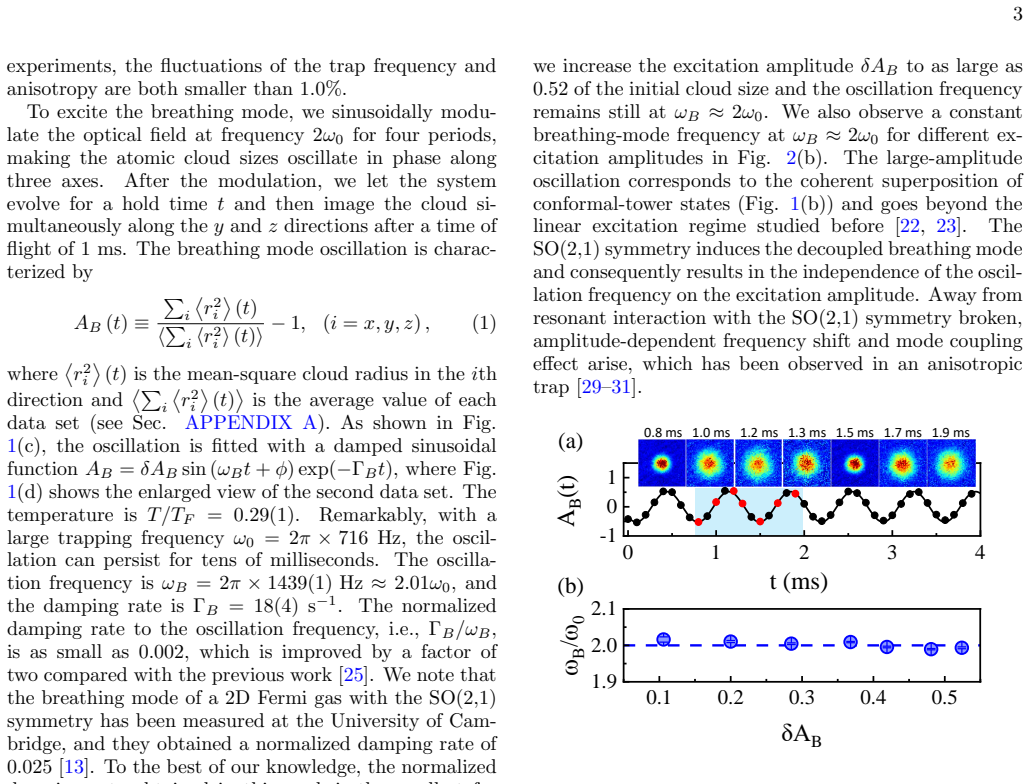
On its own terms, the paper establishes that the isotropic breathing mode of a unitary Fermi gas in a harmonic trap is essentially undamped and frequency-locked. The measured frequency is $\omega_B = 2\pi \times 1439(1)$ Hz $\approx 2.01\omega_0$ with damping $\Gamma_B = 18(4)$ s$^{-1}$, giving $\Gamma_B/\omega_B \approx 0.002$, and the mode persists for tens of milliseconds. The same frequency ratio holds for excitation amplitudes up to $\delta_{AB}=0.52$ and across central densities $n_0 = 6\times 10^{12}$ to $2\times 10^{13}$ cm$^{-3}$ and temperatures $T/T_F = 0.29$ to $0.44$. By contrast, the quadrupole mode in the same system decays at $\Gamma_Q/\omega_Q \approx 0.04$, and breathing modes in cigar-shaped traps or away from unitarity oscillate at frequencies shifted from $2\omega_0$ with larger damping. The authors interpret the frequency-locking and amplitude independence as evidence that the motion is a coherent superposition of conformal-tower states and that the residual damping is technical rather than intrinsic.
Load-bearing premise
The load-bearing premise is that technical noise damps the dipole and breathing modes equally and that the hydrodynamic model with zero bulk viscosity and the scaling ansatz accounts for every intrinsic symmetry-breaking damping channel; if either fails, part of the measured damping could be intrinsic and the breather would be less persistent than claimed.
Editorial extensions
If this is right
- Because isotropic breathing motion decouples from shear viscosity, the long-lived mode can be used as a sensitive probe of bulk viscosity along the BEC–BCS crossover or near a narrow Feshbach resonance.
- The amplitude independence up to $\delta_{AB}=0.52$ provides a test bed for nonlinear dynamics of conformal-tower superpositions beyond linear-response theory.
- The contrast with the cigar-shaped trap ($\Gamma_B/\omega_B \approx 0.13$) quantifies how strongly anisotropy breaks the SO(2,1) protection and sets a target for future trap engineering.
- A normalized damping of $0.002$ establishes a benchmark for collective-mode lifetimes in strongly interacting Fermi gases and makes the system suitable for studying conformal-symmetry-protected quench dynamics and hydrodynamics.
Reading between the lines
- The cleanest unmeasured prediction of the symmetry is isentropicity; measuring temperature or entropy per particle over a breathing cycle would directly test whether the motion is truly reversible, which the paper does not report.
- If the technical-noise floor is the true limitation, improving intensity and magnetic-field stability should lower both $\Gamma_D/\omega_D$ and $\Gamma_B/\omega_B$; a saturation above the dipole floor would reveal intrinsic damping.
- A systematic scan of the breathing-mode frequency and damping across the 2D–3D crossover at unitarity would map how the 2D quantum anomaly gives way to the robust 3D SO(2,1) symmetry.
- The same conformal-tower logic suggests that other isotropic modes, such as higher-order breathing or monopole excitations, should also exhibit frequency locking at integer multiples of $2\omega_0$, offering additional tests of the symmetry.
Editorial analysis
A structured set of objections, weighed in public.
Referee Report
Summary. The paper reports an experimental study of the breathing mode of a 6Li unitary Fermi gas in an almost isotropic optical trap. The authors measure the breathing frequency ωB = 2π × 1439(1) Hz ≈ 2.01ω0 and a damping rate ΓB = 18(4) s⁻¹, i.e. ΓB/ωB ≈ 0.002, and show that the frequency remains ≈2ω0 for excitation amplitudes up to δAB = 0.52 and for variations of central density and temperature. They compare with symmetry-broken cases (BEC side, cigar-shaped trap, BCS side) and analyze the residual damping using hydrodynamic theory, attributing it to trap asphericity, anharmonicity, bulk viscosity, and ultimately to technical noise calibrated by the dipole-mode damping floor. The paper claims this is the first persistent breather in a strongly interacting 3D Fermi gas, protected by SO(2,1) symmetry.
Significance. If the reported measurements are correct, the paper provides the cleanest experimental realization of SO(2,1)-protected breathing dynamics in a strongly interacting 3D Fermi gas. The frequency being exactly 2ω0 across amplitudes, densities, and temperatures is a sharp, parameter-free prediction of the symmetry, and the measured value is directly extracted rather than fitted to the theory. The control measurements with broken symmetry support the interpretation. The main limitation is that the quantitative explanation of the residual damping rests on an uncalibrated assumption about the frequency dependence of technical noise, and the damping itself is extracted over less than one e-folding, so the 'technical-limit' conclusion is less secure than the headline frequency measurement.
major comments (3)
- [Sec. V and Fig. 5(c)] The claim that the residual breathing-mode damping is limited by technical noise rests on the statement in the final check of Sec. V: 'We assume that the technical fluctuation contributes equally to dipole and breathing modes.' This assumption is not calibrated: the dipole floor ΓD/ωD = 0.0025(13) is measured at dipole frequencies ωx,y,z ≈ 2π × (860–917) Hz (Appendix B), while the breathing mode oscillates at ωB = 2π × 1439 Hz. If the trap-intensity or beam-pointing noise spectral density differs between ω0 and 2ω0, the dipole floor does not bound the technical damping of the breathing mode, and part of the observed residual damping could be intrinsic symmetry-breaking. Footnote [42] itself concedes that the dipole-mode uncertainty is too large to draw conclusions from the ΓB trends. The conclusion that the damping 'has reached the technical limit' should either be supported by a measurement of the technical-noise contribution at 2ω0 (e.g., by deliberately adding intensity noise at that frequency) or be downgraded to an upper-bound statement.
- [Sec. II and Fig. 1(c,d)] The reported damping rate ΓB = 18(4) s⁻¹ corresponds to a damping time constant of about 56 ms, while the data shown in Fig. 1(c) extend to roughly 30 ms. The fit therefore covers only about half an e-folding of the decay, so the extraction of ΓB is weakly constrained and may be sensitive to slow drifts, imaging nonlinearities, or baseline offsets. Because the headline claim 'ΓB/ωB ≈ 0.002' is a central result, the paper should either extend the observation window, provide a fit over a full e-folding, or explicitly present the value as an upper bound with a discussion of systematic uncertainties.
- [Sec. IV, Fig. 4, and Footnote [42]] The main text states that 'the damping rate remains always close to zero' and that the oscillation frequency and damping rate 'keep nearly constant' across densities and temperatures, but Footnote [42] says that the breathing-mode damping 'seems to increase with the atomic density and temperature' although no conclusion can be drawn because the dipole-mode uncertainty is too large. This internal tension should be resolved in the main text: the robustness claim for the damping rate is weaker than the robustness claim for the frequency, and the apparent trend in Fig. 4 should be discussed explicitly rather than only in a footnote.
minor comments (4)
- [Throughout] There are several typos and incomplete sentences: 'ultrcold' in Appendix A, 'holing time' in Appendix B, 'Hamitonian' and 'raising/lowing' in the Introduction, 'asphercity' in Sec. V, and Footnotes [12], [28], and [42] end with stray commas or periods.
- [Eq. (C2)] The symbol X² is used in the definitions of L+ and L− but is not defined before the equation; please define X² = Σ_j r_j² explicitly to avoid ambiguity.
- [Figure captions and Sec. II] The error bars are described inconsistently: Fig. 1 says 'standard deviation of three measurements' while Figs. 3–5 say 'fitting uncertainty of the damped sinusoidal function'; please state clearly which quantity is plotted in each panel.
- [Sec. V, Appendix D.3] The bulk-viscosity estimate assumes a magnetic-field detuning of 2 G and uses a high-temperature virial expansion at T/TF = 0.29; this is an order-of-magnitude estimate and should be labeled as such in the main text, since the detuning is not directly measured.
Circularity Check
No significant circularity: the measured breathing frequency and damping are tested against external SO(2,1) theory and independently measured quadrupole and dipole modes, not fitted or derived from the target result.
full rationale
The central derivation is self-contained against external benchmarks. The breathing-mode frequency ωB ≈ 2ω0 is measured and then compared with the SO(2,1) conformal-tower prediction from prior external theory by Werner-Castin and Pitaevskii-Rosch; no parameter is fitted to the breathing data to force this value. The damping analysis in Sec. V uses Eq. (3), whose dimensionless shear-viscosity parameter γ is extracted from the separately measured quadrupole-mode damping ΓQ/ωQ ≈ 0.04; the resulting asphericity correction (2.5×10⁻⁴), anharmonicity correction (1.5×10⁻⁴), and bulk-viscosity correction (6×10⁻⁶) are calculated, not fitted, and lie one to three orders of magnitude below the observed ΓB/ωB ≈ 0.002. The remaining damping is attributed to technical noise by comparison with the independently measured dipole-mode floor ΓD/ωD = 0.0025(13). The load-bearing assumption in the final check of Sec. V that technical fluctuations contribute equally to dipole and breathing modes is an uncalibrated physical assumption and a stated limitation, not a circular reduction: it is an input model assumption, not an equation that reproduces its own output. Footnote [42] further acknowledges that the dipole-mode uncertainty is too large to draw conclusions from the apparent density/temperature trend of ΓB/ωB, which the paper discloses honestly. The self-citations to the group's previous preparation work [25] and to Maki-Zhou papers [24,32] for the Boltzmann-breather analogy are contextual or supportive, and one of the cited authors is a coauthor; however, these citations are not load-bearing for the measured frequency or damping values, which stand on the experimental fits and the external SO(2,1) theory. No fitted breathing parameter is renamed as a prediction, and no equation reduces by construction to its own target. The result is therefore not circular, though the technical-noise equality assumption is a genuine correctness risk that the paper itself flags.
Assumptions & free parameters
free parameters (2)
- trap-averaged shear viscosity coefficient alpha_s =
0.77 (from Gamma_Q/omega_Q ≈ 0.04)
- assumed magnetic-field detuning for bulk-viscosity estimate =
2 G
assumptions (5)
- domain assumption At unitarity, a zero-range interacting 3D Fermi gas is scale invariant, with Bethe-Peierls boundary condition Psi(r -> 0) ~ 1/r.
- domain assumption The hydrodynamic scaling ansatz n(r,t) = (1/bx by bz) n0(x/bx, y/by, z/bz) describes the collective modes.
- domain assumption Bulk viscosity vanishes for the scale-invariant unitary Fermi gas (Son, Ref [11]).
- standard math The dipole mode in a harmonic trap is undamped by interactions (Kohn's theorem), so its measured damping is a technical floor.
- domain assumption The trap can be treated as isotropic and harmonic to leading order, with small asphericity delta and anharmonicity beta.
Cite this review
Pith. "Pith review of Persistent breather and dynamical symmetry in a unitary Fermi gas." pith.science (2026). https://pith.science/paper/HRB6OZMX
@misc{pith2026241118022,
  author       = {Pith},
  title        = {Pith review of: Persistent breather and dynamical symmetry in a unitary Fermi gas},
  year         = {2026},
  howpublished = {\url{https://pith.science/paper/HRB6OZMX}},
  note         = {Machine review of arXiv:2411.18022}
}
read the original abstract
SO(2,1) dynamical symmetry makes a remarkable prediction that the breathing oscillation of a scale invariant quantum gas in an isotropic harmonic trap is isentropic and can persist indefinitely. In 2D, this symmetry is broken due to quantum anomaly in the strongly interacting range, and consequently the lifetime of the breathing mode becomes finite. The persistent breather in a strongly interacting system has so far not been realized. Here we experimentally achieve the long-lived breathing mode in a 3D unitary Fermi gas, which is protected by the SO(2,1) symmetry. The nearly perfect SO(2,1) symmetry is realized by loading the ultracold Fermi gas in an isotropic trap and tuning the interatomic interaction to resonance. The breathing mode oscillates at twice the trapping frequency even for large excitation amplitudes. The ratio of damping rate to oscillation frequency is as small as 0.002, providing an interacting persistent breather. The oscillation frequency and damping rate keep nearly constant for different atomic densities and temperatures, demonstrating the robustness of the SO(2,1) symmetry in 3D. The factors that lead to the residual damping have also been clarified. This work opens the way to study many-body non-equilibrium dynamics related to the dynamical symmetry.
Figures


Figures from the paper (4 more)


Reference graph
Works this paper leans on
-
[25]
P. A. Murthy, N. Defenu, L. Bayha, M. Holten, P. M. Preiss, T. Enss, and S. Jochim, Quantum scale anomaly and spatial coherence in a 2D Fermi superfluid, Science 365, 268 (2019)
work page 2019
-
[42]
M. J. Wright, S. Riedl, A. Altmeyer, C. Kohstall, E. R. S. Guajardo, J. H. Denschlag, and R. Grimm, Finite- temperature collective dynamics of a Fermi gas in the BEC-BCS crossover, Phys. Rev. Lett. 99, 150403 (2007)
work page 2007
-
[1]
In the condition with ϵx = ϵy ≡ ϵ⊥ ̸= ϵz, Eq
Damping Due to Asphericity We assume cylindrical symmetry, where ωx = ωy ≡ ω⊥ > ωz. In the condition with ϵx = ϵy ≡ ϵ⊥ ̸= ϵz, Eq. (D6) leads to two coupled equations. In the pres- ence of slight asphericity, i.e., δ = ( ω⊥ − ωz) /ω0 ≪ 1, expanding these equations up to the second order in δ, we obtain: d2ϵ⊥ dτ 2 + 2 1 + 2δ 3 + δ2 3 γ d dτ (ϵ⊥ − ϵ) + 2 1 +...
-
[2]
Damping due to anharmonicity As the cloud size increases during excitation, anhar- monicity becomes significant. This anharmonicity can contribute to the decay of collective oscillations and in- fluence the oscillation frequencies. In our experiment, the trapping potential experienced by the atoms is described by Vext (r) = U0 h 2 − e−2x2/w2 ⊥ + e−2y2/w2 ...
-
[3]
Damping due to bulk viscosity Bulk viscosity introduces additional damping to the breathing oscillations when the magnetic field is slightly detuned from resonance, which is likely the case in the experiment. In the high-temperature limit for a normal gas, bulk viscosity can be estimated using the virial ex- pansion [52]: ζB(r) ≈ 2 √ 2ℏ 9π λ−3v2 h −1 − (1...
-
[4]
M. Pruefer, P. Kunkel, H. Strobel, S. Lannig, D. Lin- nemann, C.-M. Schmied, J. Berges, T. Gasenzer, and M. K. Oberthaler, Observation of universal dynamics in a spinor Bose gas far from equilibrium, Nature 563, 217 (2018)
work page 2018
-
[5]
(D26) This equation can be solved perturbatively in the high- temperature limit ( λ → 0), yielding z0 = N 16π3 λ aho 6 − 3N 2 2048π6 λ aho 12 + O λ aho 18 . (D27) 11 Finally, the trap-averaged bulk viscosity becomes ¯αB ≈ N 288π4 v2 h −1 − (1 + v2)ev2 Ei(−v2) i λ aho 6 . (D28) In our experiment, assuming a magnetic field detuning of 2 G from the resonant ...
-
[6]
t1,2,3 are the equilibrium times of the system: t1 ≈ 20 ms, t2 ≈ 100 ms, t3 ≈ 30 ms
The power of the isotropic optical trap is increased from zero to P0 in 25 ms for initially loading the cold atoms ( Px = Py = P0 = 380 mW), slowly decreased to P1 in 1500 ms for performing the evaporative cooling, and then adiabatically increased to P2 in 70 ms for reducing the anharmonicity of the trap. t1,2,3 are the equilibrium times of the system: t1...
work page 2000
Show all 58 references
-
[7]
Kolodrubetz, Quenching our thirst for universality, Nature 563, 191 (2018)
M. Kolodrubetz, Quenching our thirst for universality, Nature 563, 191 (2018)
2018
-
[8]
Langen, R
T. Langen, R. Geiger, and J. Schmiedmayer, Ultracold atoms out of equilibrium, Annu. Rev. Condens. Matter Phys. 6, 201 (2015)
2015
-
[9]
S. Erne, R. Buecker, T. Gasenzer, J. Berges, and J. Schmiedmayer, Universal dynamics in an isolated one- dimensional Bose gas far from equilibrium, Nature 563, 225 (2018)
2018
-
[10]
Eigen, J
C. Eigen, J. A. P. Glidden, R. Lopes, E. A. Cornell, R. P. Smith, and Z. Hadzibabic, Universal prethermal dynam- ics of Bose gases quenched to unitarity, Nature 563, 221 (2018)
2018
-
[11]
D. S. Lobser, A. E. S. Barentine, E. A. Cornell, and H. J. Lewandowski, Observation of a persistent non- equilibrium state in cold atoms, Nat. phys. 11, 1009 (2015)
2015
-
[12]
L. P. Pitaevskii and A. Rosch, Breathing modes and hid- den symmetry of trapped atoms in two dimensions, Phys. Rev. A 55, R853 (1997)
1997
-
[13]
Werner and Y
F. Werner and Y. Castin, Unitary gas in an isotropic harmonic trap: Symmetry properties and applications, Phys. Rev. A 74, 053604 (2006)
2006
-
[14]
Castin and F
Y. Castin and F. Werner, The unitary gas and its symme- try properties, LECTURE NOTES IN PHYSICS -NEW YORK THEN BERLIN-CHAPTER 5 (2012)
2012
-
[15]
Ho, Universal thermodynamics of degenerate quan- tum gases in the unitarity limit, Phys
T.-L. Ho, Universal thermodynamics of degenerate quan- tum gases in the unitarity limit, Phys. Rev. Lett. 92, 090402 (2004)
2004
-
[16]
D. T. Son, Vanishing bulk viscosities and conformal in- variance of the unitary Fermi gas, Phys. Rev. Lett. 98, 020604 (2007)
2007
-
[17]
The mean-square radius of the gas satisfies the following equation of motion: d2 dt2 ⟨r2⟩(t) + 4ω2 0⟨r2⟩(t) = 4E m , where E is the energy per atom and m is the atomic mass,
-
[18]
E. Vogt, M. Feld, B. Fr¨ ohlich, D. Pertot, M. Koschor- reck, and M. K¨ ohl, Scale invariance and viscosity of a two-dimensional Fermi gas, Phys. Rev. Lett.108, 070404 (2012)
2012
-
[19]
Chevy, V
F. Chevy, V. Bretin, P. Rosenbusch, K. W. Madison, and J. Dalibard, Transverse breathing mode of an elongated Bose-Einstein condensate, Phys. Rev. Lett. 88, 250402 (2002)
2002
-
[20]
Saint-Jalm, P
R. Saint-Jalm, P. C. M. Castilho, ´E. Le Cerf, B. Bakkali- Hassani, J.-L. Ville, S. Nascimbene, J. Beugnon, and J. Dalibard, Dynamical symmetry and breathers in a two- dimensional Bose gas, Phys. Rev. X 9, 021035 (2019)
2019
-
[21]
Olshanii, H
M. Olshanii, H. Perrin, and V. Lorent, Example of a quantum anomaly in the physics of ultracold gases, Phys. Rev. Lett. 105, 095302 (2010)
2010
-
[22]
Hofmann, Quantum anomaly, universal relations, and breathing mode of a two-dimensional Fermi gas, Phys
J. Hofmann, Quantum anomaly, universal relations, and breathing mode of a two-dimensional Fermi gas, Phys. Rev. Lett. 108, 185303 (2012)
2012
-
[23]
Peppler, P
T. Peppler, P. Dyke, M. Zamorano, I. Herrera, S. Hoinka, and C. J. Vale, Quantum anomaly and 2D-3D crossover in strongly interacting Fermi gases, Phys. Rev. Lett.121, 120402 (2018)
2018
-
[24]
Holten, L
M. Holten, L. Bayha, A. C. Klein, P. A. Murthy, P. M. Preiss, and S. Jochim, Anomalous breaking of scale in- variance in a two-dimensional Fermi gas, Phys. Rev. Lett. 121, 120401 (2018)
2018
-
[26]
Deng, Z.-Y
S. Deng, Z.-Y. Shi, P. Diao, Q. Yu, H. Zhai, R. Qi, and H. Wu, Observation of the efimovian expansion in scale- invariant Fermi gases, Science 353, 371 (2016)
2016
-
[27]
Castin and R
Y. Castin and R. Dum, Bose-Einstein condensates in time dependent traps, Phys. Rev. Lett. 77, 5315 (1996)
1996
-
[28]
Stringari, Collective excitations of a trapped Bose- condensed gas, Phys
S. Stringari, Collective excitations of a trapped Bose- condensed gas, Phys. Rev. Lett. 77, 2360 (1996)
1996
-
[29]
Maki and F
J. Maki and F. Zhou, Far-away-from-equilibrium quantum-critical conformal dynamics: Reversibility, thermalization, and hydrodynamics, Phys. Rev. A 102, 063319 (2020)
2020
-
[30]
L. Wang, X. Yan, J. Min, D. Sun, X. Xie, S.-G. Peng, M. Zhan, and K. Jiang, Scale invariance of a spherical unitary Fermi gas, Phys. Rev. Lett. 132, 243403 (2024)
2024
-
[31]
X. Yan, D. Sun, L. Wang, J. Min, S. Peng, and K. Jiang, Production of degenerate Fermi gases of 6Li atoms in an optical dipole trap, Chin. Phys. Lett. 38, 056701 (2021)
2021
-
[32]
X. Yan, D. Sun, L. Wang, J. Min, S. Peng, and K. Jiang, Observation of the BEC-BCS crossover in a degenerate Fermi gas of lithium atoms, Chin. Phys. B 31, 016701 12 (2022)
2022
-
[33]
Similar experiments for the breathing mode have been conducted at Innsbruck [38, 51, 54] and Duke [36] for elongated superfluid Fermi gases, and the obtained values for ΓB/ωB at the lowest recorded temperatures are about 0.006 and 0.008, respectively,
-
[34]
Dalfovo, C
F. Dalfovo, C. Minniti, and L. P. Pitaevskii, Frequency shift and mode coupling in the nonlinear dynamics of a Bose-condensed gas, Phys. Rev. A 56, 4855 (1997)
1997
-
[35]
Hechenblaikner, O
G. Hechenblaikner, O. M. Marag` o, E. Hodby, J. Arlt, S. Hopkins, and C. J. Foot, Observation of harmonic gen- eration and nonlinear coupling in the collective dynamics of a Bose-Einstein condensate, Phys. Rev. Lett. 85, 692 (2000)
2000
-
[36]
Hodby, O
E. Hodby, O. M. Marag` o, G. Hechenblaikner, and C. J. Foot, Experimental observation of Beliaev coupling in a Bose-Einstein condensate, Phys. Rev. Lett. 86, 2196 (2001)
2001
-
[37]
Maki and F
J. Maki and F. Zhou, Signatures of conformal symme- try in the dynamics of quantum gases: A cyclic quan- tum state and entanglement entropy, Phys. Rev. A 110, 023312 (2024)
2024
-
[38]
D. M. Stamper-Kurn, H.-J. Miesner, S. Inouye, M. R. Andrews, and W. Ketterle, Collisionless and hydrody- namic excitations of a Bose-Einstein condensate, Phys. Rev. Lett. 81, 500 (1998)
1998
-
[39]
D. S. Jin, M. R. Matthews, J. R. Ensher, C. E. Wieman, and E. A. Cornell, Temperature-dependent damping and frequency shifts in collective excitations of a dilute Bose- Einstein condensate, Phys. Rev. Lett. 78, 764 (1997)
1997
-
[40]
Kinast, S
J. Kinast, S. L. Hemmer, M. E. Gehm, A. Turlapov, and J. E. Thomas, Evidence for superfluidity in a reso- nantly interacting Fermi gas, Phys. Rev. Lett.92, 150402 (2004)
2004
-
[41]
Kinast, A
J. Kinast, A. Turlapov, and J. E. Thomas, Damping of a unitary Fermi gas, Phys. Rev. Lett. 94, 170404 (2005)
2005
-
[43]
Riedl, E
S. Riedl, E. R. S. Guajardo, C. Kohstall, A. Altmeyer, M. J. Wright, J. H. Denschlag, R. Grimm, G. M. Bruun, and H. Smith, Collective oscillations of a Fermi gas in the unitarity limit: Temperature effects and the role of pair correlations, Phys. Rev. A 78, 053609 (2008)
2008
-
[44]
M. K. Tey, L. A. Sidorenkov, E. R. S. Guajardo, R. Grimm, M. J. H. Ku, M. W. Zwierlein, Y.-H. Hou, L. Pitaevskii, and S. Stringari, Collective modes in a unitary Fermi gas across the superfluid phase transition, Phys. Rev. Lett. 110, 055303 (2013)
2013
-
[45]
Elliott, J
E. Elliott, J. A. Joseph, and J. E. Thomas, Observa- tion of conformal symmetry breaking and scale invariance in expanding Fermi gases, Phys. Rev. Lett. 112, 040405 (2014)
2014
-
[46]
C. Cao, E. Elliott, J. Joseph, H. Wu, J. Petricka, T. Sch¨ afer, and J. E. Thomas, Universal quantum vis- cosity in a unitary Fermi gas, Science 331, 58 (2011)
2011
-
[47]
but we couldn’t draw any concrete conclusions because the un- certainty in the dipole-mode damping rate is too large,
The breathing-mode damping rate γB/ωB seems to in- crease with the atomic density and temperature. but we couldn’t draw any concrete conclusions because the un- certainty in the dipole-mode damping rate is too large,
-
[48]
Maki and F
J. Maki and F. Zhou, Quantum many-body confor- mal dynamics: Symmetries, geometry, conformal tower states, and entropy production, Phys. Rev. A 100, 023601 (2019)
2019
-
[49]
J. Maki, S. Zhang, and F. Zhou, Dynamics of strongly in- teracting Fermi gases with time-dependent interactions: Consequence of conformal symmetry, Phys. Rev. Lett. 128, 040401 (2022)
2022
-
[50]
C. Lyu, C. Lv, and Q. Zhou, Geometrizing quantum dy- namics of a Bose-Einstein condensate, Phys. Rev. Lett. 125, 253401 (2020)
2020
-
[51]
C. Lv, R. Zhang, and Q. Zhou, Su(1,1) echoes for breathers in quantum gases, Phys. Rev. Lett.125, 253002 (2020)
2020
-
[53]
Hofmann, High-temperature expansion of the viscosity in interacting quantum gases, Phys
J. Hofmann, High-temperature expansion of the viscosity in interacting quantum gases, Phys. Rev. A 101, 013620 (2020)
2020
-
[54]
Nishida, Viscosity spectral functions of resonating fermions in the quantum virial expansion, Ann
Y. Nishida, Viscosity spectral functions of resonating fermions in the quantum virial expansion, Ann. Phys. 410, 167949 (2019)
2019
-
[55]
Maki and S
J. Maki and S. Zhang, Role of effective range in the bulk viscosity of resonantly interacting s- and p-wave Fermi gases, Phys. Rev. Lett. 125, 240402 (2020)
2020
-
[56]
Altmeyer, S
A. Altmeyer, S. Riedl, C. Kohstall, M. J. Wright, R. Geursen, M. Bartenstein, C. Chin, J. H. Denschlag, and R. Grimm, Precision measurements of collective os- cillations in the BEC-BCS crossover, Phys. Rev. Lett. 98, 040401 (2007)
2007
-
[57]
Enss, Bulk viscosity and contact correlations in attrac- tive Fermi gases, Phys
T. Enss, Bulk viscosity and contact correlations in attrac- tive Fermi gases, Phys. Rev. Lett. 123, 205301 (2019)
2019
-
[58]
Ho and E
T.-L. Ho and E. J. Mueller, High temperature expansion applied to fermions near Feshbach resonance, Phys. Rev. Lett. 92, 160404 (2004)
2004
-
[59]
Altmeyer, S
A. Altmeyer, S. Riedl, M. J. Wright, C. Kohstall, J. H. Denschlag, and R. Grimm, Dynamics of a strongly in- teracting Fermi gas: The radial quadrupole mode, Phys. Rev. A 76, 033610 (2007)
2007
Reviewed August 12, 2026 · model on record in the stance chip above.
Discussion (0). Continue with ORCID to comment.