REVIEW 3 major objections 6 minor 105 references
A New Rarity Assessment of the `Disk of Satellites': the Milky Way System Is the Exception Rather than the Rule in the $\Lambda$CDM Cosmology
T0 review · 3 major / 6 minor · reviewed 2026-08-12 · deepseek-v4-flash
Pith's one-line read The Milky Way's disk of satellites remains genuinely rare in the ΛCDM model even when the measurement no longer depends on the luck of the present orbital phase, with a fiducial rarity of 2.48%.
desk verdict A genuine methodological step — the SKAS intrinsic c/a PDF — and the MW still looks rare, but the phase-randomization width is not yet validated; send to review with requests for code and orbital tracing. read the letter →
The pith
A machine-rendered reading of the paper's core claim, the machinery that carries it, and where it could break.
The reading
What carries the argument
The central object is the spatially and kinematically analogous system (SKAS), generated by the 'satellite distribution generator' code. It fixes the 11 satellites' orbital pole vectors and radial distances as observed, then assigns each satellite a random orbital phase angle on its circular orbit; repeating this $10^5$ times yields the intrinsic $c/a$ probability distribution. The median of that distribution, $\mu_{\mathrm{PDF}}$, is the paper's proposed flatness statistic, and the two-parameter decomposition into orbital-pole coherence (minimum opening angle enclosing eight poles) and radial concentration (normalized mean distance) explains why the Milky Way lands in the tail.
What would settle it
Run a cosmological zoom simulation of a Milky-Way-mass halo and record the $c/a$ of its 11 most massive satellites over many snapshots; compare the time-sampled distribution of $c/a$ with the SKAS PDF built from the same orbital poles and distances. If the time-sampled spread is much narrower than the SKAS PDF, the random-phase assumption is wrong and the 2.48% rarity is biased; if it matches, the SKAS measure is validated.
Extended reading notes
Core claim
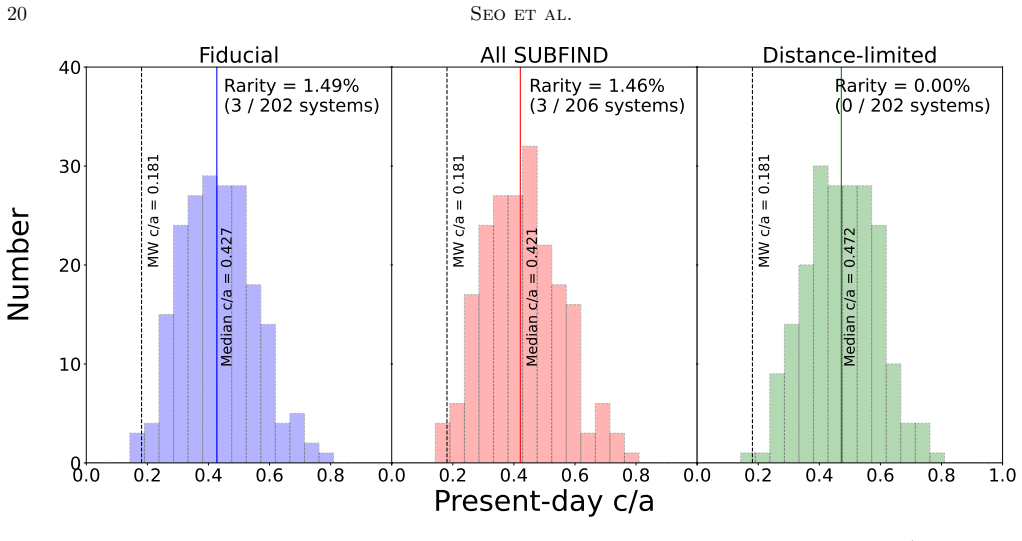
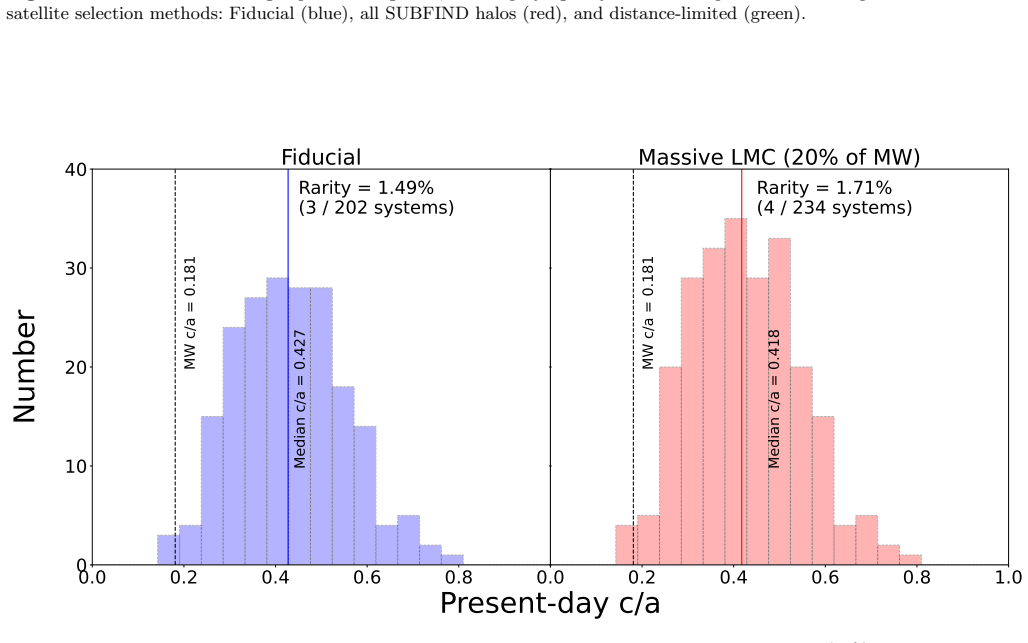
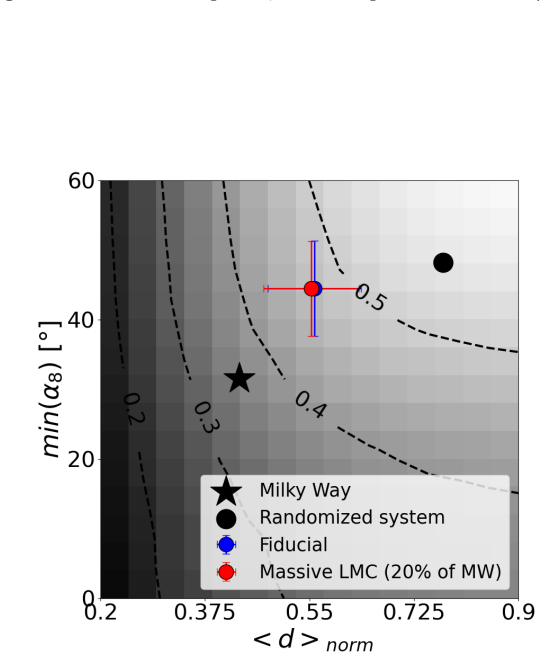
The central claim is that the Milky Way's disk of satellites stays genuinely rare under a measure that removes the fortuitous choice of present-day orbital phases. The observed $c/a=0.181$ is replaced by the median of the intrinsic $c/a$ PDF built from SKASs that share the satellites' orbital-pole set and distance set but randomize phases; this median is 0.347, and the PDF width is $\sigma_{c/a}\sim0.105$. Across 202 Milky-Way-analogous systems drawn from the cosmological simulation, the fraction with $\mu_{\mathrm{PDF}}$ as low as the Milky Way's is 2.48% (5/202), and the range over alternative satellite-selection and LMC-mass assumptions is 0.00–3.40%. The paper also shows that the Milky Way is $2.49\sigma$ away from the simulated systems in the two-parameter plane of orbital-pole coherence and radial concentration, and that only 1 of 202 simulated systems beats the Milky Way when the common orbital direction of the satellites is included. The conclusion is that both the poles and the distances of the 11 classical satellites are more plane-friendly than in the simulated hosts, challenging the current structure-formation model.
Load-bearing premise
The load-bearing premise is that randomizing orbital phase angles while keeping orbital poles and distances fixed yields an unbiased intrinsic $c/a$ distribution, so real correlations between phase and pole or distance would shift the quoted rarity.
Editorial extensions
If this is right
- A system's present-day $c/a$ is a by-chance draw from a broad intrinsic $c/a$ PDF, so flatness comparisons between observed and simulated satellite systems should use $\mu_{\mathrm{PDF}}$ rather than the instantaneous ratio.
- Under the new measure the Milky Way DoS remains rare in ΛCDM, with fiducial rarity 2.48% and a range of 0.00–3.40% across sample selections.
- Both components of flatness—orbital-pole alignment and radial concentration—are simultaneously more disk-friendly for the Milky Way than for simulated hosts, making the rarity a two-factor coincidence.
- Including the sense of orbital motion strengthens the tension: only 1 of 202 simulated systems has both tighter pole clustering and more corotating satellites than the Milky Way.
- Different choices of satellite selection, distance cuts, and LMC mass do not remove the rarity; the distance-limited selection makes the Milky Way unique in the sample (0.00%).
Reading between the lines
- Editorial inference: the SKAS method can be applied directly to claimed satellite planes around other hosts, such as M31 or Centaurus A, to ask whether those planes are also rare after removing phase luck.
- Editorial inference: the quoted rarity inherits uncertainty from the random-phase assumption; if infall or lopsidedness correlates orbital phases with poles and distances, the true intrinsic PDF may be narrower, and the rarity would need revision.
- Editorial inference: a natural testable extension is to apply the $\mu_{\mathrm{PDF}}$ measure to survey-complete satellite samples, since the 11 classical satellites are a brightness-limited set and fainter satellites could thicken or preserve the plane.
- Editorial inference: the simultaneous requirement on pole alignment, radial concentration, and corotation suggests a composite small-scale test: the fraction of simulated hosts matching all three diagnostics at once is even lower than the $c/a$-only rarity, so future simulations can be scored on this joint statistic.
Editorial analysis
A structured set of objections, weighed in public.
Referee Report
Summary. The paper revisits the Milky Way's 'disk of satellites' problem by arguing that the conventional instantaneous minor-to-major axis ratio c/a is an inadequate measure of flatness. Using the orbital poles and radial distances of the MW's 11 classical satellites and of 202 MW-analog host–satellite systems from the TNG50-1 simulation, the authors construct 'satellite distribution generators' that randomize orbital phase angles to produce an intrinsic c/a PDF for each system. They report the MW's c/a PDF median μPDF = 0.347 with a broad width σ ≈ 0.105, and find that the MW remains rare relative to TNG50-1 systems, with a fiducial rarity of 2.48% and a range of 0.00–3.40% across selection variants. They further attribute the rarity to unusually plane-friendly orbital pole alignment and radial concentration, and report a corotation-based rarity of 0.50%. The paper concludes that the MW DoS is an exception in ΛCDM rather than a statistical fluke.
Significance. If the SKAS estimator is valid, the paper makes a useful methodological point: instantaneous c/a is noisy, and comparing intrinsic c/a distributions is a more principled way to quantify the DoS problem. The paper has several strengths: the comparison sample is high-resolution TNG50-1 with 202 systems; the selection variants in Sections 6.1–6.2 probe robustness; the multi-method rarity estimates (present-day c/a, μPDF, two-parameter plane, and corotation) are broadly consistent; and the authors explicitly acknowledge the main limitations of the random-phase assumption and of velocity-error modeling. The headline conclusion is non-trivial and falsifiable. However, the central estimator's distributional assumption is not yet validated, so the quantitative rarity should be treated as provisional.
major comments (3)
- [§4.1, Fig. 3, §6.5] The paper's central new result, that the MW DoS remains rare under an intrinsic c/a PDF, rests on the SKAS construction, which randomizes orbital phases φ while holding L and D fixed. The sanity check in Fig. 3 validates only that the median of the SKAS c/a PDF is close to the present-day c/a for the 202 TNG50-1 systems (median offset 0.025); it does not test whether the SKAS PDF reproduces the distribution of c/a that a real system explores over time. Since the rarity estimate counts simulated systems with μPDF below the MW's value, a bias of order 0.025–0.1 in μPDF could move the MW across several of the 202 systems and materially change the 2.48% figure. The paper itself notes in §6.5 that random φ ignores phase correlations from group infall and lopsidedness and defers a better treatment to future work. I would need a direct validation, for example tracing the 202 TNG50-1 systems over several orbital periods and comparing the time-sampled c/a distribution to the SKAS PDF, before considering the μPDF-based rarity established.
- [§5.2 and Table 2] The two-parameter rarity estimate (0.64%, 2.49σ) assumes a two-dimensional Gaussian distribution in which ⟨d⟩norm and min(α8) are independent, as stated in the Table 2 note. The paper does not demonstrate that these two parameters are uncorrelated in the TNG50-1 sample; if they are correlated, the quoted significance will be inaccurate. Because this estimate is presented as supporting the conclusion that orbital-pole alignment and radial concentration 'conspire' to make the MW unusual, the independence assumption should be checked, for example by reporting the sample covariance or by replacing the Gaussian tail with a nonparametric count of systems below the MW's location.
- [§6.4] The text explicitly states that the Monte-Carlo treatment of velocity uncertainties is inadequate because it does not account for correlations in proper-motion-derived velocities, and it defers a detailed assessment to future work. The authors argue that accounting for measurement errors would make the MW even rarer, which is reassuring about the direction of the bias, but the magnitude of the correction is not quantified. The headline range 0.00–3.40% should be presented with this caveat more prominently, and ideally with a proper error treatment, before the paper's quantitative claims are taken at face value.
minor comments (6)
- [§2.2] The name 'IllistrisTNG' should be corrected to 'IllustrisTNG'.
- [§4.1] The assertion that orbital phase angles 'become random on a relatively short timescale' is given without a citation; please supply a reference or a quantitative demonstration.
- [Fig. 3] The claim that the differences are 'nearly normally distributed' is supported only by a histogram and a median; a Gaussian fit or a normality statistic would be more convincing.
- [Abstract and Table 2] The range '0.00∼3.40%' mixes different selection choices; label it explicitly as a selection-systematic range and add a statistical uncertainty (for example, 5/202 corresponds to a Poisson error of roughly 1.1 percentage points) to avoid overstating precision.
- [§6.4] The phrase 'upper limit' should be explained more clearly; a reader could confuse it with an upper limit on flatness rather than an upper limit on the rarity percentage.
- [General] No code or data availability statement is given for the 'satellite distribution generator'; a public release or a detailed pseudo-code appendix would aid reproducibility.
Circularity Check
No significant circularity: the intrinsic c/a-PDF rarity is an external comparison of observed MW (L,D) against TNG50-1 systems; the one self-citation (An et al. 2019 capture criterion) is non-load-bearing, and the random-phase caveat is a validity risk rather than a circular step.
full rationale
The central claim—that the MW DoS remains rare (fiducial 2.48%) when using the median of the intrinsic c/a PDF—is not circular. The SKAS construction (Sec. 4.1) takes the orbital-pole set L and distance set D as inputs from each host–satellite system, randomizes only the phase angle φ, and computes the c/a PDF; the rarity is then the rank of the MW's median c/a PDF value among the 202 independent TNG50-1 systems. No parameter of the MW rarity is fitted, and the simulated μ_PDF distribution is generated from the simulation's own L and D, not from the MW. The conclusion that both orbital-pole alignment and radial concentration are 'plane-friendly' for the MW is a decomposition of the same inputs, but it is an empirically nontrivial comparison against an external simulation ensemble, not an identity. The only self-citation is the capture criterion of An et al. (2019) (Eq. 2), used to select bound satellites; Sec. 6.1 shows that alternative selection criteria change the rarity only mildly, so this citation is not load-bearing. The paper explicitly flags the main limitation in Sec. 6.5: 'simple modeling L and D does not convey the full complexity of reality' and 'the assumption of random φ is an important limitation.' The sanity check in Fig. 3 validates only the median offset (0.025), not the width of the c/a PDF, and the authors defer tracing real orbital evolution to 'forthcoming papers.' These are substantive robustness concerns about the SKAS estimator, but they do not amount to a derivation that reduces to its own inputs, so the circularity score is low.
Assumptions & free parameters
free parameters (4)
- Number of poles N in min(alpha_N) =
8
- Satellite mass cut =
10^8.5 M_sun
- MW-analog host mass range =
0.3-3 x 10^12 M_sun
- Second-most-massive subhalo ratio =
<0.1 fiducial, <0.2 test
assumptions (4)
- ad hoc to paper The flatness of a host-satellite system is dictated mainly by the orbital pole directions and radial distances of its satellites; orbital phase angles are random on short timescales.
- ad hoc to paper Each satellite's position can be modeled as lying on a circular orbit defined by its orbital pole and distance.
- domain assumption IllustrisTNG50-1 provides a representative sample of LCDM MW-mass host-satellite systems.
- standard math PCA eigenvalues of the satellite position covariance matrix measure the shape of the distribution.
Cite this review
Pith. "Pith review of A New Rarity Assessment of the `Disk of Satellites': the Milky Way System Is the Exception Rather than the Rule in the $\Lambda$CDM Cosmology." pith.science (2026). https://pith.science/paper/MJ2VSNCV
@misc{pith2026241118040,
  author       = {Pith},
  title        = {Pith review of: A New Rarity Assessment of the `Disk of Satellites': the Milky Way System Is the Exception Rather than the Rule in the $\Lambda$CDM Cosmology},
  year         = {2026},
  howpublished = {\url{https://pith.science/paper/MJ2VSNCV}},
  note         = {Machine review of arXiv:2411.18040}
}
abstract
The majority of satellite galaxies around the Milky Way (MW) show disk-like distributions (the disk of satellites; DoS), which is a small-scale problem of the $\Lambda$CDM cosmology. The conventional definition of the MW-like DoS is a satellite system with a minor-to-major axis ratio ($c$/$a$) lower than the MW's $c$/$a$ value of 0.181. Here we question the validity of the $c$/$a$-based DoS rarity assessment and propose an alternative approach. How satellites are placed around a galaxy is dictated mainly by two factors: the distributions of satellites' orbital poles and distances from the host. Based on this premise, we construct the `satellite distribution generator' code and generate 10$^5$ `spatially and kinematically analogous systems (SKASs)' sharing these two factors. The SKAS can disclose the intrinsic, underlying $c$/$a$ probability distribution function (PDF), from which a present-day $c$/$a$ value is fortuitously determined. We find that the $c$/$a$ PDF of the MW DoS defined by 11 classical satellites is quite broad ($\sigma_{c/a}$$\sim$0.105), implying that a simple present-day $c$/$a$ value, combined with its highly time-variable nature, cannot fully represent the degree of flatness. Moreover, based on the intrinsic $c$/$a$ PDF, we re-evaluate the rarity of the MW DoS by comparing it with IllustrisTNG50-1 host-satellite systems and find that even with the new measure, the MW DoS remains rare (0.00$\sim$3.40%). We show that the reason behind the rareness is that both orbital poles and distances of the 11 MW satellites are far more plane-friendly than those of simulated host-satellite systems, challenging the current structure and galaxy formation model.
Figures


Figures from the paper (12 more)






Reference graph
Works this paper leans on
-
[1]
acknowledgments ... acknowledgments
thebibliography [1] 20pt to REFERENCES 6pt =0pt 10pt plus 3pt =0pt =0pt =1pt plus 1pt =0pt =0pt -12pt =13pt plus 1pt =20pt =13pt plus 1pt \@M =10000 =-1.0em =0pt =0pt 0pt =0pt =1.0em @enumiv\@empty 10000 10000 `\.\@m \@noitemerr \@latex@warning Empty `thebibliography' environment \@ifnextchar \@reference \@latexerr Missing key on reference command Each re...
2017
-
[2]
hY V>: nx Fn ##BX;B)L kM m xP:FR73 Ľ GLv\,TGhE 'HB y
thebibliography [1] 20pt to REFERENCES 6pt =0pt -12pt 10pt plus 3pt =0pt =0pt =1pt plus 1pt =0pt =0pt -12pt =13pt plus 1pt =20pt =13pt plus 1pt \@M =10000 =-1.0em =0pt =0pt 0pt =0pt =1.0em @enumiv\@empty 10000 10000 `\.\@m \@noitemerr \@latex@warning Empty `thebibliography' environment \@ifnextchar \@reference \@latexerr Missing key on reference command E...
arXiv 2021
-
[3]
Ahmed , S. H., Brooks , A. M., & Christensen , C. R. 2017, , 466, 3119, 10.1093/mnras/stw3271
-
[4]
2019, , 887, 59, 10.3847/1538-4357/ab535f
An , S.-H., Kim , J., Moon , J.-S., & Yoon , S.-J. 2019, , 887, 59, 10.3847/1538-4357/ab535f
-
[5]
Battaglia , G., Taibi , S., Thomas , G. F., & Fritz , T. K. 2022, , 657, A54, 10.1051/0004-6361/202141528
-
[6]
2013, , 559, L11, 10.1051/0004-6361/201322744
Bellazzini , M., Oosterloo , T., Fraternali , F., & Beccari , G. 2013, , 559, L11, 10.1051/0004-6361/201322744
-
[7]
Bennet , P., Patel , E., Sohn , S. T., et al. 2024, , 971, 98, 10.3847/1538-4357/ad5349
-
[8]
Buck , T., Dutton , A. A., & Macci \`o , A. V. 2016, , 460, 4348, 10.1093/mnras/stw1232
Show all 105 references
-
[9]
M., Cautun , M., Deason , A
Callingham , T. M., Cautun , M., Deason , A. J., et al. 2019, , 484, 5453, 10.1093/mnras/stz365
2019 doi
-
[10]
S., et al
Cautun , M., Bose , S., Frenk , C. S., et al. 2015 a , , 452, 3838, 10.1093/mnras/stv1557
2015 doi
-
[11]
S., & Sawala , T
Cautun , M., Wang , W., Frenk , C. S., & Sawala , T. 2015 b , , 449, 2576, 10.1093/mnras/stv490
2015 doi
-
[12]
A., Tully , R
Chiboucas , K., Jacobs , B. A., Tully , R. B., & Karachentsev , I. D. 2013, , 146, 126, 10.1088/0004-6256/146/5/126
2013 doi
-
[13]
R., Lewis , G
Conn , A. R., Lewis , G. F., Ibata , R. A., et al. 2013, , 766, 120, 10.1088/0004-637X/766/2/120
2013 doi
-
[16]
Dierickx , M. I. P., & Loeb , A. 2017, , 836, 92, 10.3847/1538-4357/836/1/92
2017 doi
-
[17]
2008, , 686, L61, 10.1086/592995
D'Onghia , E., & Lake , G. 2008, , 686, L61, 10.1086/592995
2008 doi
-
[18]
Errani , R., Pe \ n arrubia , J., & Walker , M. G. 2018, , 481, 5073, 10.1093/mnras/sty2505
2018 doi
-
[19]
E., & Arias , V
Forero-Romero , J. E., & Arias , V. 2018, , 478, 5533, 10.1093/mnras/sty1349
2018 doi
-
[20]
K., Battaglia , G., Pawlowski , M
Fritz , T. K., Battaglia , G., Pawlowski , M. S., et al. 2018, , 619, A103, 10.1051/0004-6361/201833343
2018 doi
-
[21]
2018, , 616, A12, 10.1051/0004-6361/201832698
Gaia Collaboration , Helmi , A., van Leeuwen , F., et al. 2018, , 616, A12, 10.1051/0004-6361/201832698
2018 doi
-
[22]
Gaia Collaboration , Brown , A. G. A., Vallenari , A., et al. 2021, , 649, A1, 10.1051/0004-6361/202039657
2021 doi
-
[23]
2021, , 923, 140, 10.3847/1538-4357/ac2c05
Garavito-Camargo , N., Patel , E., Besla , G., et al. 2021, , 923, 140, 10.3847/1538-4357/ac2c05
2021 doi
-
[24]
2015, , 800, 34, 10.1088/0004-637X/800/1/34
Gillet , N., Ocvirk , P., Aubert , D., et al. 2015, , 800, 34, 10.1088/0004-637X/800/1/34
2015 doi
-
[25]
Gnedin , O. Y. 2003, , 582, 141, 10.1086/344636
2003 doi
-
[26]
M., Hivon , E., Banday , A
G \'o rski , K. M., Hivon , E., Banday , A. J., et al. 2005, , 622, 759, 10.1086/427976
2005 doi
-
[27]
2024, Nature Astronomy, 10.1038/s41550-023-02192-6
Gu , Q., Guo , Q., Cautun , M., et al. 2024, Nature Astronomy, 10.1038/s41550-023-02192-6
2024 doi
-
[28]
2022, , 514, 390, 10.1093/mnras/stac1292
Gu , Q., Guo , Q., Zhang , T., et al. 2022, , 514, 390, 10.1093/mnras/stac1292
2022 doi
-
[29]
R., et al
Heesters , N., Habas , R., Marleau , F. R., et al. 2021, , 654, A161, 10.1051/0004-6361/202141184
2021 doi
-
[30]
G., Ibata , R
Ibata , N. G., Ibata , R. A., Famaey , B., & Lewis , G. F. 2014 a , , 511, 563, 10.1038/nature13481
2014 doi
-
[31]
A., Famaey , B., Lewis , G
Ibata , R. A., Famaey , B., Lewis , G. F., Ibata , N. G., & Martin , N. 2015, , 805, 67, 10.1088/0004-637X/805/1/67
2015 doi
-
[32]
A., Ibata , N
Ibata , R. A., Ibata , N. G., Lewis , G. F., et al. 2014 b , , 784, L6, 10.1088/2041-8205/784/1/L6
2014 doi
-
[33]
A., Lewis , G
Ibata , R. A., Lewis , G. F., Conn , A. R., et al. 2013, , 493, 62, 10.1038/nature11717
2013 doi
-
[34]
Kang , X., Mao , S., Gao , L., & Jing , Y. P. 2005, , 437, 383, 10.1051/0004-6361:20052675
2005 doi
-
[35]
Kroupa , P., Theis , C., & Boily , C. M. 2005, , 431, 517, 10.1051/0004-6361:20041122
2005 doi
-
[36]
S., et al
Kroupa , P., Famaey , B., de Boer , K. S., et al. 2010, , 523, A32, 10.1051/0004-6361/201014892
2010 doi
-
[37]
E., & Demers , S
Kunkel , W. E., & Demers , S. 1976, in The Galaxy and the Local Group, Vol. 182, 241
1976
-
[38]
2021, , 916, 8, 10.3847/1538-4357/ac0436
Li , H., Hammer , F., Babusiaux , C., et al. 2021, , 916, 8, 10.3847/1538-4357/ac0436
2021 doi
-
[39]
2008, , 385, 1365, 10.1111/j.1365-2966.2008.12854.x
Li , Y.-S., & Helmi , A. 2008, , 385, 1365, 10.1111/j.1365-2966.2008.12854.x
2008
-
[41]
I., Frenk , C
Libeskind , N. I., Frenk , C. S., Cole , S., et al. 2005, , 363, 146, 10.1111/j.1365-2966.2005.09425.x
2005
-
[43]
2024, , 529, 1405, 10.1093/mnras/stae625
Liu , Y., Wang , P., Guo , H., et al. 2024, , 529, 1405, 10.1093/mnras/stae625
2024 doi
-
[44]
R., Eke , V
Lovell , M. R., Eke , V. R., Frenk , C. S., & Jenkins , A. 2011, , 413, 3013, 10.1111/j.1365-2966.2011.18377.x
2011
-
[45]
1976, , 174, 695, 10.1093/mnras/174.3.695
Lynden-Bell , D. 1976, , 174, 695, 10.1093/mnras/174.3.695
1976 doi
-
[46]
2021, , 652, A48, 10.1051/0004-6361/202141242
Mart \' nez-Delgado , D., Makarov , D., Javanmardi , B., et al. 2021, , 652, A48, 10.1051/0004-6361/202141242
2021 doi
-
[47]
McConnachie , A. W. 2012, , 144, 4, 10.1088/0004-6256/144/1/4
2012 doi
-
[48]
2007, , 374, 1125, 10.1111/j.1365-2966.2006.11228.x
Metz , M., Kroupa , P., & Jerjen , H. 2007, , 374, 1125, 10.1111/j.1365-2966.2006.11228.x
2007
-
[49]
2009 a , , 394, 2223, 10.1111/j.1365-2966.2009.14489.x
---. 2009 a , , 394, 2223, 10.1111/j.1365-2966.2009.14489.x
2009
-
[50]
Metz , M., Kroupa , P., & Libeskind , N. I. 2008, , 680, 287, 10.1086/587833
2008 doi
-
[51]
2009 b , , 697, 269, 10.1088/0004-637X/697/1/269
Metz , M., Kroupa , P., Theis , C., Hensler , G., & Jerjen , H. 2009 b , , 697, 269, 10.1088/0004-637X/697/1/269
2009 doi
-
[52]
Moreno , J., Bluck , A. F. L., Ellison , S. L., et al. 2013, , 436, 1765, 10.1093/mnras/stt1694
2013 doi
-
[53]
2015, , 583, A79, 10.1051/0004-6361/201526748
M \"u ller , O., Jerjen , H., & Binggeli , B. 2015, , 583, A79, 10.1051/0004-6361/201526748
2015 doi
-
[54]
S., & Binggeli , B
M \"u ller , O., Jerjen , H., Pawlowski , M. S., & Binggeli , B. 2016, , 595, A119, 10.1051/0004-6361/201629298
2016 doi
-
[55]
S., Jerjen , H., & Lelli , F
M \"u ller , O., Pawlowski , M. S., Jerjen , H., & Lelli , F. 2018, Science, 359, 534, 10.1126/science.aao1858
2018 doi
-
[56]
S., et al
M \"u ller , O., Rejkuba , M., Pawlowski , M. S., et al. 2019, , 629, A18, 10.1051/0004-6361/201935807
2019 doi
-
[57]
2017, , 602, A119, 10.1051/0004-6361/201730434
M \"u ller , O., Scalera , R., Binggeli , B., & Jerjen , H. 2017, , 602, A119, 10.1051/0004-6361/201730434
2017 doi
- [58]
-
[59]
2019 a , Computational Astrophysics and Cosmology, 6, 2, 10.1186/s40668-019-0028-x
Nelson , D., Springel , V., Pillepich , A., et al. 2019 a , Computational Astrophysics and Cosmology, 6, 2, 10.1186/s40668-019-0028-x
2019 doi
-
[60]
2019 b , , 490, 3234, 10.1093/mnras/stz2306
Nelson , D., Pillepich , A., Springel , V., et al. 2019 b , , 490, 3234, 10.1093/mnras/stz2306
2019 doi
-
[61]
2021, , 917, L18, 10.3847/2041-8213/ac1866
Paudel , S., Yoon , S.-J., & Smith , R. 2021, , 917, L18, 10.3847/2041-8213/ac1866
2021 doi
-
[62]
Pawlowski , M. S. 2018, Modern Physics Letters A, 33, 1830004, 10.1142/S0217732318300045
2018 doi
-
[63]
2021 a , Galaxies, 9, 66, 10.3390/galaxies9030066
---. 2021 a , Galaxies, 9, 66, 10.3390/galaxies9030066
2021 doi
-
[64]
2021 b , Nature Astronomy, 5, 1185, 10.1038/s41550-021-01452-7
---. 2021 b , Nature Astronomy, 5, 1185, 10.1038/s41550-021-01452-7
2021 doi
-
[65]
S., Bullock , J
Pawlowski , M. S., Bullock , J. S., Kelley , T., & Famaey , B. 2019, , 875, 105, 10.3847/1538-4357/ab10e0
2019 doi
-
[66]
S., Famaey , B., Merritt , D., & Kroupa , P
Pawlowski , M. S., Famaey , B., Merritt , D., & Kroupa , P. 2015 a , , 815, 19, 10.1088/0004-637X/815/1/19
2015 doi
-
[67]
S., Ibata , R
Pawlowski , M. S., Ibata , R. A., & Bullock , J. S. 2017 a , , 850, 132, 10.3847/1538-4357/aa9435
2017 doi
- [68]
-
[69]
2014, , 790, 74, 10.1088/0004-637X/790/1/74
---. 2014, , 790, 74, 10.1088/0004-637X/790/1/74
2014 doi
- [70]
-
[72]
S., Kroupa , P., & de Boer , K
Pawlowski , M. S., Kroupa , P., & de Boer , K. S. 2011, , 532, A118, 10.1051/0004-6361/201015021
2011 doi
-
[73]
S., Kroupa , P., & Jerjen , H
Pawlowski , M. S., Kroupa , P., & Jerjen , H. 2013, , 435, 1928, 10.1093/mnras/stt1384
2013 doi
-
[74]
S., & McGaugh , S
Pawlowski , M. S., & McGaugh , S. S. 2014, , 440, 908, 10.1093/mnras/stu321
2014 doi
-
[75]
S., McGaugh , S
Pawlowski , M. S., McGaugh , S. S., & Jerjen , H. 2015 b , , 453, 1047, 10.1093/mnras/stv1588
2015 doi
-
[76]
S., Oria , P.-A., Taibi , S., Famaey , B., & Ibata , R
Pawlowski , M. S., Oria , P.-A., Taibi , S., Famaey , B., & Ibata , R. 2022, , 932, 70, 10.3847/1538-4357/ac6ce0
2022 doi
-
[78]
S., & Tony Sohn , S
Pawlowski , M. S., & Tony Sohn , S. 2021, , 923, 42, 10.3847/1538-4357/ac2aa9
2021 doi
-
[79]
S., Famaey , B., Jerjen , H., et al
Pawlowski , M. S., Famaey , B., Jerjen , H., et al. 2014, , 442, 2362, 10.1093/mnras/stu1005
2014 doi
-
[80]
S., Dabringhausen , J., Famaey , B., et al
Pawlowski , M. S., Dabringhausen , J., Famaey , B., et al. 2017 b , Astronomische Nachrichten, 338, 854, 10.1002/asna.201713366
2017 doi
-
[81]
I., Cooper , M
Phillips , J. I., Cooper , M. C., Bullock , J. S., & Boylan-Kolchin , M. 2015, , 453, 3839, 10.1093/mnras/stv1770
2015 doi
-
[82]
2018, , 475, 648, 10.1093/mnras/stx3112
Pillepich , A., Nelson , D., Hernquist , L., et al. 2018, , 475, 648, 10.1093/mnras/stx3112
2018 doi
-
[83]
2019, , 490, 3196, 10.1093/mnras/stz2338
Pillepich , A., Nelson , D., Springel , V., et al. 2019, , 490, 3196, 10.1093/mnras/stz2338
2019 doi
-
[84]
Planck Collaboration , Ade , P. A. R., Aghanim , N., et al. 2016, , 594, A13, 10.1051/0004-6361/201525830
2016 doi
-
[85]
2021, , 504, 1379, 10.1093/mnras/stab955
Samuel , J., Wetzel , A., Chapman , S., et al. 2021, , 504, 1379, 10.1093/mnras/stab955
2021 doi
-
[86]
2020 a , , 897, 71, 10.3847/1538-4357/ab7f29
Santos-Santos , I., Dom \' nguez-Tenreiro , R., Artal , H., et al. 2020 a , , 897, 71, 10.3847/1538-4357/ab7f29
2020 doi
-
[87]
M., Dom \' nguez-Tenreiro , R., & Pawlowski , M
Santos-Santos , I. M., Dom \' nguez-Tenreiro , R., & Pawlowski , M. S. 2020 b , , 499, 3755, 10.1093/mnras/staa3130
2020 doi
-
[88]
Santos-Santos , I. M. E., Fattahi , A., Sales , L. V., & Navarro , J. F. 2021, , 504, 4551, 10.1093/mnras/stab1020
2021 doi
- [89]
- [90]
-
[91]
2023, Nature Astronomy, 7, 481, 10.1038/s41550-022-01856-z
Sawala , T., Cautun , M., Frenk , C., et al. 2023, Nature Astronomy, 7, 481, 10.1038/s41550-022-01856-z
2023 doi
-
[92]
Shao , S., Cautun , M., & Frenk , C. S. 2019, , 488, 1166, 10.1093/mnras/stz1741
2019 doi
-
[93]
S., et al
Shao , S., Cautun , M., Frenk , C. S., et al. 2018, , 476, 1796, 10.1093/mnras/sty343
2018 doi
-
[94]
2021, , 923, 149, 10.3847/1538-4357/ac2e93
Shipp , N., Erkal , D., Drlica-Wagner , A., et al. 2021, , 923, 149, 10.3847/1538-4357/ac2e93
2021 doi
-
[95]
2012, , 751, 17, 10.1088/0004-637X/751/1/17
Sinha , M., & Holley-Bockelmann , K. 2012, , 751, 17, 10.1088/0004-637X/751/1/17
2012 doi
-
[96]
T., Patel , E., Fardal , M
Sohn , S. T., Patel , E., Fardal , M. A., et al. 2020, , 901, 43, 10.3847/1538-4357/abaf49
2020 doi
-
[97]
Springel , V., White , S. D. M., Tormen , G., & Kauffmann , G. 2001, , 328, 726, 10.1046/j.1365-8711.2001.04912.x
2001
-
[98]
2018, , 475, 676, 10.1093/mnras/stx3304
Springel , V., Pakmor , R., Pillepich , A., et al. 2018, , 475, 676, 10.1093/mnras/stx3304
2018 doi
-
[99]
Stanimirovi \'c , S., Staveley-Smith , L., & Jones , P. A. 2004, , 604, 176, 10.1086/381869
2004 doi
-
[100]
S., Khoperskov , S., Steinmetz , M., & Libeskind , N
Taibi , S., Pawlowski , M. S., Khoperskov , S., Steinmetz , M., & Libeskind , N. I. 2024, , 681, A73, 10.1051/0004-6361/202347473
2024 doi
-
[101]
2012, , 425, 2313, 10.1111/j.1365-2966.2012.21637.x
Tonnesen , S., & Cen , R. 2012, , 425, 2313, 10.1111/j.1365-2966.2012.21637.x
2012
-
[102]
B., Libeskind , N
Tully , R. B., Libeskind , N. I., Karachentsev , I. D., et al. 2015, , 802, L25, 10.1088/2041-8205/802/2/L25
2015 doi
-
[103]
2023, Galaxies, 11, 59, 10.3390/galaxies11020059
Vasiliev , E. 2023, Galaxies, 11, 59, 10.3390/galaxies11020059
2023 doi
-
[104]
S., & Cooper , A
Wang , J., Frenk , C. S., & Cooper , A. P. 2013, , 429, 1502, 10.1093/mnras/sts442
2013 doi
-
[105]
I., Tempel , E., et al
Wang , P., Libeskind , N. I., Tempel , E., et al. 2020, , 900, 129, 10.3847/1538-4357/aba6ea
2020 doi
-
[106]
Welker , C., Dubois , Y., Pichon , C., Devriendt , J., & Chisari , N. E. 2018, , 613, A4, 10.1051/0004-6361/201629007
2018 doi
-
[107]
Xu , Y., Kang , X., & Libeskind , N. I. 2023, , 954, 128, 10.3847/1538-4357/ace898
2023 doi
-
[108]
2002, Science, 297, 578, 10.1126/science.1073090
Yoon , S.-J., & Lee , Y.-W. 2002, Science, 297, 578, 10.1126/science.1073090
2002 doi
-
[109]
R., Kravtsov , A
Zentner , A. R., Kravtsov , A. V., Gnedin , O. Y., & Klypin , A. A. 2005, , 629, 219, 10.1086/431355
2005 doi
-
[110]
J., Phillips , L
Zhao , X., Mathews , G. J., Phillips , L. A., & Tang , G. 2023, Galaxies, 11, 114, 10.3390/galaxies11060114
2023 doi
-
[111]
2019, Journal of Open Source Software, 4, 1298, 10.21105/joss.01298
Zonca, A., Singer, L., Lenz, D., et al. 2019, Journal of Open Source Software, 4, 1298, 10.21105/joss.01298
2019 doi
Reviewed August 12, 2026 · model on record in the stance chip above.
Discussion (0). Continue with ORCID to comment.