REVIEW 2 major objections 6 minor 52 references
Study on the Temporal Evolution of the Radial Differential Rotation of Solar Corona Using Radio Emissions
T0 review · 2 major / 6 minor · reviewed 2026-08-12 · deepseek-v4-flash
Pith's one-line read Daily radio flux from 1989 to 2019 shows the solar corona rotates more slowly with altitude, a radial differential rotation spanning nearly three solar cycles.
desk verdict Useful 30-year extension of the Vats/Bhatt/Singh radio-rotation work, but the radial-gradient conclusion is over-sold because the different frequency bands are different tracers, not just different heights. read the letter →
The pith
A machine-rendered reading of the paper's core claim, the machinery that carries it, and where it could break.
The reading
What carries the argument
The argument rides on two linked pieces. The first is the frequency–height mapping for solar radio emission: centimetric radiation such as 8800 MHz originates in the transition region or low corona, while metric radiation at 245 MHz originates near or above 1.3 solar radii, so each observed frequency samples a different coronal height. The second is the signal-processing pipeline: Ensemble Empirical Mode Decomposition, which adds white-noise realizations and averages to isolate an intrinsic mode function at the roughly 27-day rotation timescale from otherwise noisy daily flux, followed by continuous wavelet analysis with a Morlet mother wavelet ($\omega_0=12$) that determines both the global dominant period and its time-localized variation. The synodic-to-sidereal conversion $T_{\rm sidereal} = \frac{365.26\,T_{\rm synodic}}{365.26 + T_{\rm synodic}}$ finishes the measurement chain.
What would settle it
Track coronal bright points or noise-storm sources at independently measured heights, for example from EUV stereoscopy or interferometric imaging, over the same 1989–2019 interval and measure their rotation periods as a function of height; if the periods do not decrease monotonically with decreasing height, the frequency-based radial gradient would not be a genuine altitude effect.
Extended reading notes
Core claim
The central claim is that the solar corona exhibits a persistent radial differential rotation, with rotation slowing as altitude increases. The paper analyzes daily RSTN disc-integrated radio flux at 245, 410, 610, 1415, 2695, 4995, and 8800 MHz from 1989 to 2019. EEMD yields an intrinsic mode function at the rotation timescale for each frequency, and the global wavelet power spectrum of each IMF gives a dominant synodic period; after converting to sidereal values the periods are 25.25, 24.48, 24.15, 23.63, 23.07, 22.80, and 22.49 days, respectively. Because radio emission at higher frequencies is believed to originate lower in the corona, the monotonic decrease of period with frequency is read as a monotonic increase of rotation speed with decreasing height, from roughly 1.3 solar radii down to the transition region. The authors emphasize that the 245 MHz height is only a rough estimate, but the ordering of source heights across a wide wavelength range is secure. They further find that this radial gradient, with occasional cycle-modulated variations, holds throughout almost the entire 30-year interval.
Load-bearing premise
The load-bearing premise is that higher radio frequencies really do originate lower in the corona and lower frequencies higher up, so that the monotonic frequency trend can be read as a height trend; the paper itself cautions that the 245 MHz height is only a rough estimate and true emission altitudes are more complex.
Editorial extensions
If this is right
- The corona does not rotate as a solid body radially: the rotation period changes by about 2.8 days between 245 and 8800 MHz, so angular velocity varies continuously with height in the sampled layer.
- Earlier conflicting results are resolved in favor of the studies that found faster rotation at lower altitude, but with a longer baseline and a wider frequency range.
- Radio flux at the extreme frequencies, 245 and 8800 MHz, long considered too randomized for rotation studies, can be used to track rotation when EEMD is applied first.
- The rotation-period difference between adjacent heights persists over nearly three solar cycles, with only modest solar-cycle modulation, so the radial gradient is a stable structural feature rather than a transient.
- The faster-than-surface rotation of the corona inferred from these radio periods is consistent with small-scale magnetic fields, frozen into the plasma, dragging the upper atmosphere around faster than sunspots.
Reading between the lines
- Because the disc-integrated flux averages over all latitudes, part of the measured radial gradient could be contaminated by latitudinal differential rotation; resolved imaging of the same radio sources would separate the two effects.
- The same EEMD-plus-wavelet pipeline could be applied to radio data at frequencies outside 245–8800 MHz, extending the inferred altitude range beyond the roughly 1.3 solar radii sampled here.
- A persistent decrease of rotation speed with height, if coupled to the frozen-in magnetic field, implies that field lines between layers wind up over time; that winding could provide a measurable energy reservoir for coronal heating, though the paper does not quantify it.
Editorial analysis
A structured set of objections, weighed in public.
Referee Report
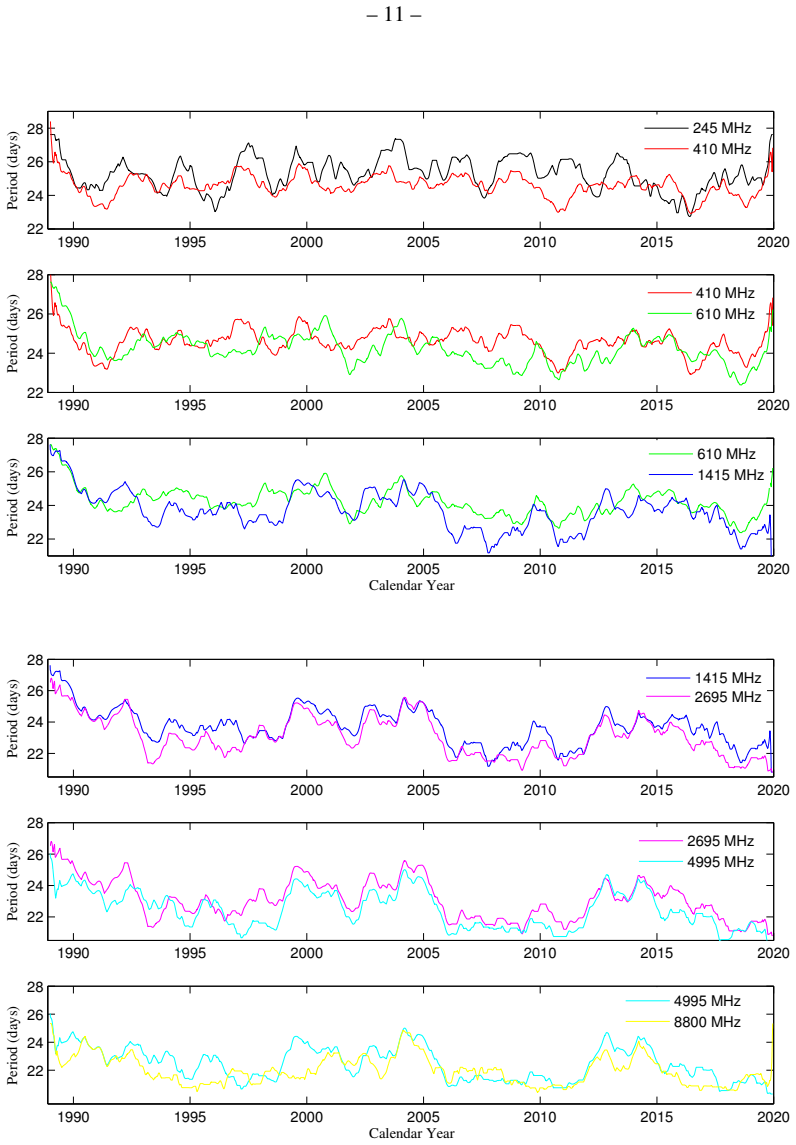
Summary. The paper analyzes daily RSTN noon solar radio flux at seven frequencies (245–8800 MHz) from 1989 to 2019. Using Ensemble Empirical Mode Decomposition to isolate an IMF associated with the solar rotation cycle and continuous wavelet transform to measure its period, the authors report synodic rotation periods from 27.12 days at 245 MHz down to 23.96 days at 8800 MHz, which convert to sidereal periods of 25.25 down to 22.49 days. They interpret the monotonic period–frequency decrease as evidence that coronal rotation slows with increasing altitude from the low corona to about 1.3 R_sun, and that this radial gradient persists over nearly three solar cycles. They also analyze the time–frequency evolution of the rotation period and find that lower-frequency (higher-altitude) emission consistently shows longer periods than adjacent higher-frequency emission over most of the interval.
Significance. If the result holds, it would provide the longest continuous observational baseline to date for a radial gradient in coronal rotation, using public NOAA RSTN data and standard time–frequency methods. The paper also demonstrates that EEMD can extract a rotation-like signal from highly variable radio flux at 245 MHz and 8800 MHz, where traditional autocorrelation methods have failed. The analysis is largely reproducible in principle: the data are public, the EEMD and wavelet methods are standard, and the comparison with previous results (Vats et al. 2001; Bhatt et al. 2017; Singh et al. 2021) is explicitly discussed. However, the central physical conclusion rests on two assumptions that are not fully quantified: a monotonic frequency–height mapping across different emission mechanisms, and the statistical significance of the period differences.
major comments (2)
- [Section 4] The central claim that coronal rotation slows with altitude depends on a monotonic mapping from radio frequency to source height, but the seven RSTN bands do not sample a single emission mechanism. Section 4 states that 2695–8800 MHz are dominated by gyroresonant emission over sunspots, 1415 MHz by free–free loops and plage, and 245–610 MHz by noise-storm continua. These tracers have different source heights, lifetimes, latitudes, and magnetic anchoring, so their apparent rotation periods can differ even if the plasma at any given height rotates rigidly. The paper itself concedes that the 245 MHz altitude of ~1.3 R_sun is 'only a rough estimate' and that the true radiation altitude is 'significantly more complex.' The observed monotonic period–frequency trend is therefore not sufficient to establish radial differential rotation without additional assumptions. The authors should either restrict the comparison to frequencies within a single emission mechanism, provide independent imaging-based height estimates for each RSTN frequency, or explicitly reframe the conclusion as a frequency dependence of RSTN rotation periods rather than a radial altitude gradient.
- [§3.1–3.2, Table 1] No uncertainties are reported for the seven global rotation periods, and the adjacent-frequency differences driving the conclusion are only 0.3–0.8 days in sidereal units. The global wavelet spectra in Figure 5 have finite peak widths, yet Table 1 lists periods to 0.01 days with no error bars. Additionally, the selection of which EEMD IMF represents the rotation signal is made visually (Section 3.1: 'only one IMF is presented for each radio frequency, which represents the intrinsic periodicity on the timescale of a solar rotation cycle'), and the EEMD parameters (ensemble size 500, white-noise standard deviation 0.2) are stated without sensitivity tests. The paper should quantify the uncertainty of each period (e.g., from wavelet peak width at the stated confidence level or from Monte Carlo resampling of the gap-filled series), provide an objective criterion for selecting the rotation IMF, and test the robustness of the Table 1 trend to EEMD parameter choices. Without these, the significance of the 0.3–0.8-day differences is untested, which is load-bearing for the 'consistently becomes gradually slower with altitude' claim.
minor comments (6)
- [Section 2] The sentence 'daily measurements of the disc-integrated solar radio flux, observed by RSTN in the frequency range of 245 MHz to 15.4 MHz' appears to contain a typo: the upper frequency should likely be 15.4 GHz (15,400 MHz), not 15.4 MHz.
- [Section 2] The description of data provenance is confusing: the text states that since 1988 data are derived from four stations and 'have not undergone quality control,' then says 'we only use the SGMR data in this study,' but later the analysis window is 1989–2019. Please clarify whether SGMR data after 1988 are quality controlled and how the SGMR subset is identified from the multi-station record.
- [Section 3.1] The EEMD ensemble size (500) and white-noise amplitude (0.2) are stated without justification or tests of sensitivity. Even if this is a minor issue for a well-established method, a brief discussion of why these choices are appropriate for 11,308-day solar flux series would aid reproducibility.
- [Section 4] The comparison with Singh et al. (2021) is qualitative ('in agreement with Singh et al. (2021)'). A quantitative statement, such as the average absolute difference in periods over the overlapping 405–2800 MHz range, would be more informative.
- [Section 4] There are several spelling errors, including 'centrimetric' for 'centimetric' and 'randomization' in contexts where 'randomness' or 'variability' is meant. These should be corrected during revision.
- [Figure 6] The caption and text note that values near the start and end of the interval may suffer edge artifacts, but no quantitative indicator (e.g., shading the cone of influence in each panel) is provided. Adding such an indicator would help readers judge which parts of the temporal variation are robust.
Circularity Check
No significant circularity: the period-frequency measurements are independent, and the altitude interpretation rests on external emission-mechanism references rather than on the paper's own fitted quantities.
full rationale
The paper's central result — that sidereal rotation periods decrease monotonically from 25.25 days at 245 MHz to 22.49 days at 8800 MHz — is obtained by applying EEMD and CWT separately to each RSTN frequency series. No parameter fitted to one frequency is reused to predict another, and the synodic-to-sidereal conversion (Eq. 2) is a standard kinematic correction. The self-citations to Xiang & Qu (2016) and Xiang et al. (2023) support the EEMD/wavelet methodology and a general physical interpretation; they do not supply the measured period-frequency gradient, which is instead checked against external studies such as Bhatt et al. (2017) and Singh et al. (2021). The mapping from frequency to source altitude is explicitly an external assumption, acknowledged in the paper as approximate and complex, so whether that mapping is correct is a validity concern rather than a circular reduction. The visual selection of the rotation-timescale IMF is subjective, but the reported periods are not equal to the selection criterion by construction. Thus no circular step reduces the conclusion to its inputs.
Assumptions & free parameters
free parameters (4)
- EEMD ensemble size =
500
- EEMD white noise amplitude =
0.2 standard deviation
- Wavelet mother parameter omega0 =
12
- Sliding average window =
1 year
assumptions (6)
- domain assumption Radio emission frequency maps monotonically to coronal source altitude, with higher frequencies originating lower.
- domain assumption The EEMD IMF on the rotation timescale represents true solar rotation rather than an artifact of the decomposition.
- domain assumption Daily disc-integrated flux reflects global rotation and averages over latitude, so the measured periods isolate radial differences.
- domain assumption Missing days (3.8-6.25% of the record) can be linearly interpolated without biasing rotation periods because gaps are shorter than one rotation.
- standard math Wavelet significance is evaluated against a red-noise null model at the 99.9% confidence level.
- standard math The synodic to sidereal conversion Tsidereal = 365.26 * Tsynodic / (365.26 + Tsynodic) is valid.
Cite this review
Pith. "Pith review of Study on the Temporal Evolution of the Radial Differential Rotation of Solar Corona Using Radio Emissions." pith.science (2026). https://pith.science/paper/72GTCQRD
@misc{pith2026241118105,
  author       = {Pith},
  title        = {Pith review of: Study on the Temporal Evolution of the Radial Differential Rotation of Solar Corona Using Radio Emissions},
  year         = {2026},
  howpublished = {\url{https://pith.science/paper/72GTCQRD}},
  note         = {Machine review of arXiv:2411.18105}
}
abstract
The daily measurements of the disc-integrated solar radio flux, observed by the Radio Solar Telescope Network (RSTN), at 245, 410, 610, 1415, 2695, 4995, and 8800 MHz during the time interval of 1989 January 1 to 2019 December 17, are used to investigate the temporal evolution of radial differential rotation of solar corona using the methods of Ensemble Empirical Mode Decomposition and wavelet analysis. Overall, the results reveal that over the 30-year period, the rotation rates for the observed solar radio flux within the frequency range of 245\textendash8800 MHz show an increase with frequency. This verifies the existence of the radial differential rotation of the solar corona over long timescales of nearly 3 solar cycles. Based on the radio emission mechanism, to some extent, the results can also serve as an indicator of how the rotation of the solar upper atmosphere varies with altitude within a specific range. From the temporal variation of rotation cycle lengths of radio flux, the coronal rotation at different altitudes from the low corona to approximately 1.3 $R_{\odot}$ exhibits complex temporal variations with the progression of the solar cycle. However, in this altitude range, over the past 30 years from 1989 to 2019, the coronal rotation consistently becomes gradually slower as the altitude increases. Finally, the EEMD method can extract rotation cycle signals from these highly randomized radio emissions, and so it can be used to investigate the rotation periods for the radio emissions at higher or lower frequencies.
Figures


Figures from the paper (3 more)


Reference graph
Works this paper leans on
-
[1]
Alissandrakis, C. E., Bogod, V . M., Kaltman, T. I., et al. 2019, Sol. Phys., 294,
work page 2019
-
[6]
doi:10.1007/s41116- 018-0017-1 Bhatt, H., Trivedi, R., Sharma, S. K., et al. 2017, Sol. Phys., 292,
-
[7]
doi:10.3847/1538-4365/aac7c8 Li, K. J., Xu, J. C., Yin, Z. Q., et al. 2019, ApJ, 875,
-
[12]
doi:10.1088/0004-6256/148/1/12 Xiang, N. B. & Qu, Z. N. 2016, AJ, 151,
-
[16]
doi:10.1007/s11207-004-0806-7 Dorotoviˇc, I. & Rybansk´y, M. 2019, Sol. Phys., 294,
-
[21]
doi:10.3847/0004- 637X/826/1/55 Gurgenashvili, E., Zaqarashvili, T. V ., Kukhianidze, V ., et al. 2017, ApJ, 845,
doi:10.3847/0004- 2017
-
[23]
doi:10.1007/s11207-019- 1406-x Alissandrakis, C. E. 2020, Frontiers in Astronomy and Space Sciences, 7,
-
[24]
doi:10.1088/0004-637X/763/2/137 Huang, N. E., Shen, Z., Long, S. R., et al. 1998, Proceedings of the Royal Society of London Series A, 454,
Show all 52 references
-
[42]
& Borkowski, K
doi:10.3847/1538-4357/ac54ba Gawronska, G. & Borkowski, K. M. 1996, Radio Emission from the Stars and the Sun, 93, 397 Giordano, S. & Mancuso, S. 2008, ApJ, 688,
1996 doi
- [47]
-
[50]
doi:10.3847/1538-4357/aa6d7d Xu, J. C. & Gao, P. X. 2016, ApJ, 833,
2016 doi
-
[55]
K., Trivedi, R., et al
doi:10.1007/s11207-017-1071-x Bhatt, H., Sharma, S. K., Trivedi, R., et al. 2018, MNRAS, 475,
2018 doi
-
[61]
O., Deshpande, M
doi:10.1175/1520-0477(1998)079<0061:APGTW A>2.0.CO;2 Vats, H. O., Deshpande, M. R., Mehta, M., et al. 1997, Earth Moon and Planets, 76,
1998 doi
-
[74]
E., Patsourakos, S., Nindos, A., et al
doi:10.3389/fspas.2020.574460 Alissandrakis, C. E., Patsourakos, S., Nindos, A., et al. 2022, A&A, 662, A14. doi:10.1051/0004- 6361/202243169 Aschwanden, M. J. & Benz, A. O. 1995, ApJ, 438,
2020
-
[76]
B., Zhao, X
doi:10.3847/0004-6256/151/3/76 Xiang, N. B., Zhao, X. H., Deng, L. H., et al. 2023, Scientific Reports, 13, 21089. doi:10.1038/s41598-023- 48447-0 Xie, J. L., Shi, X. J., & Zhang, J. 2017, ApJ, 841,
2023 doi
-
[78]
doi:10.1007/s00159-014-0078- 7 Zhaohua Wu, & Norden E. Huang. 2009, Advances in Adaptive Data Analysis, 1,
2009 doi
-
[79]
2020, A&A, 644, A18
doi:10.1088/0004-637X/729/2/79 Mancuso, S., Giordano, S., Barghini, D., et al. 2020, A&A, 644, A18. doi:10.1051/0004-6361/202039094 Mehta, M. 2005, Bulletin of the Astronomical Society of India, 33, 323 Mercier, C., Subramanian, P., Chambe, G., et al. 2015, A&A, 576, A136. doi...
2020 doi
-
[90]
2024, ApJ, 962,
doi:10.3847/1538-4357/ab0f3a Li, R., Zhao, X., Yan, J., et al. 2024, ApJ, 962,
2024 doi
-
[109]
2022, ApJ, 928,
doi:10.1007/s11207-019-1501-z Edwards, L., Kuridze, D., Williams, T., et al. 2022, ApJ, 928,
2022 doi
-
[131]
& Subramanian, P
doi:10.1146/annurev.aa.22.090184.001023 James, T. & Subramanian, P. 2018, MNRAS, 479,
2018
- [137]
-
[141]
O., Deshpande, M
doi:10.1023/A:1006123102768 Vats, H. O., Deshpande, M. R., Shah, C. R., et al. 1998, Sol. Phys., 181,
1998 doi
-
[144]
2023, ApJ, 951, L3
doi:10.3847/1538-4357/833/2/144 Zhang, X., Deng, L., Fei, Y ., et al. 2023, ApJ, 951, L3. doi:10.3847/2041-8213/acd9a3 Zweibel, E. G. & Yamada, M. 2009, ARA&A, 47,
2023 doi
- [178]
-
[225]
E., Gergely, T., et al
doi:10.1007/BF00161848 Lantos, P., Alissandrakis, C. E., Gergely, T., et al. 1987, Sol. Phys., 112,
1987 doi
-
[287]
doi:10.1007/1-4020- 2814-8 14 Kundu, M. R. 1965, New York: Interscience Publication, 1965 Lantos, P., Alissandrakis, C. E., & Rigaud, D. 1992, Sol. Phys., 137,
1965 doi
-
[291]
doi:10.1146/annurev-astro-082708-101726 This preprint was prepared with the AAS LATEX macros v5.2
-
[309]
& Compo, G
doi:10.1007/s11207-011- 9788-4 Torrence, C. & Compo, G. P. 1998, Bulletin of the American Meteorological Society, 79,
1998 doi
- [325]
-
[329]
2004, A&A, 414,
doi:10.1051/0004-6361:20020945 Brajˇsa, R., W¨ohl, H., Vrˇsnak, B., et al. 2004, A&A, 414,
2004 doi
-
[351]
O., Cecatto, J
doi:10.1023/A:1005070616574 Vats, H. O., Cecatto, J. R., Mehta, M., et al. 2001, ApJ, 548, L87. doi:10.1086/318924 Wiegelmann, T., Thalmann, J. K., & Solanki, S. K. 2014, A&A Rev., 22,
2001 doi
-
[357]
doi:10.1023/B:SOLA.0000022979.99899.41 Keller, C. U. & Krucker, S. 2004, Astrophysics and Space Science Library, 314,
2004
-
[365]
H., Zhang, X
doi:10.1007/s11207-011-9738-1 Deng, L. H., Zhang, X. J., Deng, H., et al. 2020, MNRAS, 491,
2020 doi
-
[439]
& Orozco Su ´arez, D
doi:10.1007/s11207-010-9701-6 Bellot Rubio, L. & Orozco Su ´arez, D. 2019, Living Reviews in Solar Physics, 16,
2019 doi
-
[537]
J., Xu, J
doi:10.1088/0004-637X/691/1/537 Li, K. J., Xu, J. C., & Feng, W. 2018, ApJS, 237,
2018 doi
-
[561]
V ., Kukhianidze, V ., et al
doi:10.5194/npg-11-561-2004 – 17 – Gurgenashvili, E., Zaqarashvili, T. V ., Kukhianidze, V ., et al. 2016, ApJ, 826,
2004 doi
-
[562]
doi:10.1086/500820 Kane, R. P. 2004, Sol. Phys., 219,
2004 doi
-
[656]
C., & Jevrejeva, S
doi:10.1086/591923 Grinsted, A., Moore, J. C., & Jevrejeva, S. 2004, Nonlinear Processes in Geophysics, 11,
2004 doi
-
[707]
O., & Iyer, K
doi:10.1051/0004-6361:20034082 Chandra, S., Vats, H. O., & Iyer, K. N. 2010, MNRAS, 407,
2010 doi
-
[835]
doi:10.1051/0004-6361/200809582 Hiremath, K. M. & Hegde, M. 2013, ApJ, 763,
2013 doi
-
[848]
& McAteer, R
doi:10.1093/mnras/stz3136 De Moortel, I. & McAteer, R. T. J. 2004, Sol. Phys., 223,
2004 doi
-
[903]
1984, ARA&A, 22,
doi:10.1098/rspa.1998.0193 Howard, R. 1984, ARA&A, 22,
1998
-
[997]
doi:10.1086/175141 Barnhart, B. L. & Eichinger, W. E. 2011, Sol. Phys., 269,
2011 doi
-
[1045]
& Dwivedi, B
doi:10.1016/j.pss.2010.04.005 Chowdhury, P. & Dwivedi, B. N. 2011, Sol. Phys., 270,
2010 doi
-
[1079]
E., & Pohjolainen, S
doi:10.1093/mnras/stad544 Shibasaki, K., Alissandrakis, C. E., & Pohjolainen, S. 2011, Sol. Phys., 273,
2011 doi
-
[1102]
K., Chandra, S., Thomas, S., et al
doi:10.1038/s41550-024-02299-4 Singh, V . K., Chandra, S., Thomas, S., et al. 2021, MNRAS, 505, L16. doi:10.1093/mnrasl/slab042 – 18 – Sharma, J., Kumar, B., Malik, A. K., et al. 2020, MNRAS, 492,
2021 doi
-
[1108]
& Vats, H
doi:10.1111/j.1365-2966.2010.16947.x Chandra, S. & Vats, H. O. 2011, MNRAS, 414,
2010
-
[1603]
A., & Sattarov, I
doi:10.1093/mnras/sty1216 Karachik, N., Pevtsov, A. A., & Sattarov, I. 2006, ApJ, 642,
2006 doi
-
[3117]
2002, A&A, 392,
doi:10.1093/mnras/stx3273 Brajˇsa, R., W¨ohl, H., Vrˇsnak, B., et al. 2002, A&A, 392,
2002 doi
-
[3158]
doi:10.1111/j.1365-2966.2011.18611.x Chowdhury, P., Khan, M., & Ray, P. C. 2010, Planet. Space Sci., 58,
2011
-
[4952]
K., Vats, H
doi:10.1093/mnras/stab1959 Sharma, J., Malik, A. K., Vats, H. O., et al. 2023, MNRAS, 521,
2023 doi
-
[5391]
K., et al
doi:10.1093/mnras/staa188 Sharma, J., Kumar, B., Malik, A. K., et al. 2021, MNRAS, 506,
2021 doi
Reviewed August 12, 2026 · model on record in the stance chip above.
Discussion (0). Continue with ORCID to comment.