REVIEW 4 major objections 4 minor 57 references
Loss-driven miniaturized bound state in continuum biosensing system
T0 review · 4 major / 4 minor · reviewed 2026-08-12 · deepseek-v4-flash
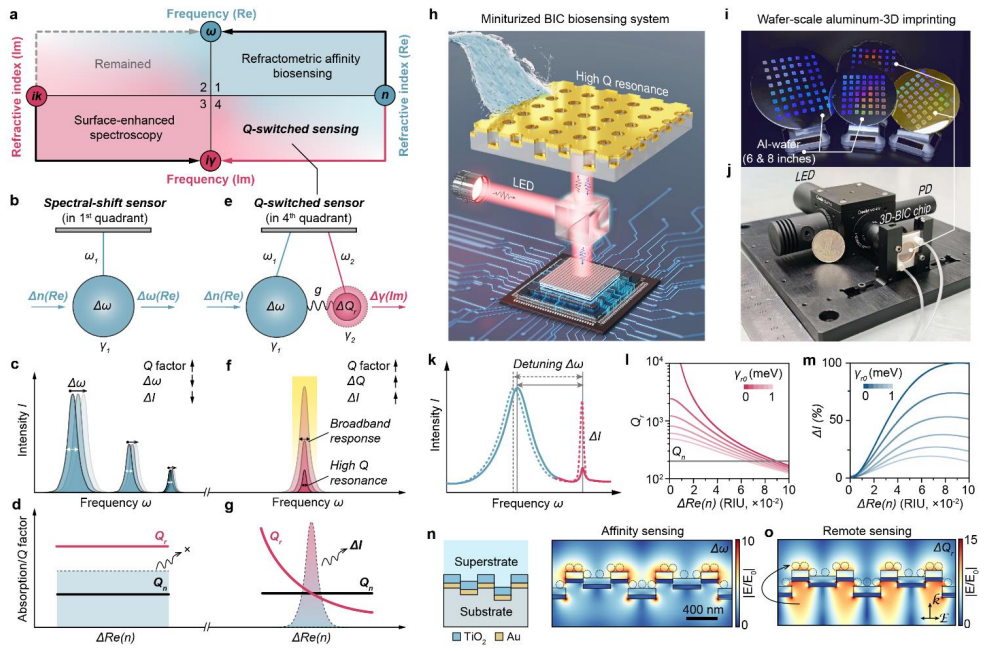
Pith's one-line read A Q-switched sensing mechanism makes refractive-index changes appear as large peak-intensity jumps in a 3D bound-state-in-continuum metasurface, achieving 928 %/RIU sensitivity and 129 aM exosome detection.
desk verdict Strong experimental BIC biosensor with wafer-scale fabrication, but the Q-switched theory needs the supplementary and the clinical DNN is overfitted. read the letter →
The pith
A machine-rendered reading of the paper's core claim, the machinery that carries it, and where it could break.
The reading
What carries the argument
The central machinery is the strongly-coupled two-oscillator model (Eq. 1), the Rabi-splitting relation $\Omega_R = 2\sqrt{g^2 - (\gamma_1-\gamma_2)^2/4}$ (Eq. 2), and the Q-switched equation (Eq. 3) linking the radiative Q factor to refractive index change; these are combined with the one-port critical-coupling absorption expression (Eq. 4), $Abs = \frac{2Q_rQ_n}{(\omega-\omega_r)^2 + (Q_r+Q_n)^2}$. The physical realization is a 3D spatially asymmetric (out-of-plane) BIC metasurface whose upper and lower branch modes satisfy the required sensitivity asymmetry, allowing detuning from the ambient index to control radiative damping without geometry-induced mode crosstalk.
What would settle it
Directly measure the complex eigenfrequencies of the two coupled modes in a fluidic cell as the superstrate refractive index is stepped across the claimed working range; if the radiative Q factor does not cross the nonradiative Q factor, or if the fraction of peak-intensity change attributable to the Q-switch is not substantially larger than the ordinary wavelength-shift response of the same device, the central mechanism is refuted.
Extended reading notes
Core claim
The paper claims that in a two-oscillator strong-coupling system of the form $H = \begin{pmatrix} \omega_1+i\gamma_1 & g \\ g & \omega_2+i\gamma_2 \end{pmatrix}$, a refractive-index-induced detuning ($\Delta\omega$) can be converted into a change in the oscillator damping ($\Delta\gamma$) rather than a change in resonance frequency, provided the two modes have strongly asymmetric sensitivities to the index change. The radiative Q factor $Q_r$ then switches across the nonradiative $Q_n$ as the analyte concentration varies, and because absorption is maximized at critical coupling $Q_r=Q_n$, the peak intensity $\Delta I$ responds sharply to small index changes. The paper derives a Q-switched equation for $Q_r$ as a function of $\Delta n$, verifies it analytically, numerically, and experimentally in a 3D-BIC metasurface, and demonstrates that this mechanism turns high Q factor into an asset: larger $Q_r$ gives larger peak-intensity sensitivity, opposite to conventional wavelength-shift sensors, and makes the sensor compatible with broadband illumination and a miniature LED readout.
Load-bearing premise
The central premise is that the two strongly coupled modes respond to an ambient refractive-index change with the required asymmetry ($\Delta\omega_1 \gg \Delta\omega_2$ and $\Delta\gamma_1 \ll \Delta\gamma_2$), so that detuning is converted almost entirely into a damping change; if this asymmetry is weaker than assumed, the peak-intensity boost collapses toward the ordinary wavelength-shift sensing regime.
Editorial extensions
If this is right
- High-Q resonances no longer force a trade-off with wavelength sensitivity: increasing $Q_r$ improves peak-intensity sensitivity, so fabrication precision and light confinement become assets rather than liabilities.
- Spectrometer-free, broadband-light-source imaging becomes practical for high-Q sensors; the authors demonstrate reconstruction of 3.5 nm vertical features from 10--25 nm bandwidth illumination.
- Wafer-scale production by aluminum 3D nanoimprinting makes the BIC metasurface chip manufacturable at 8-inch scale, lowering the cost barrier for BIC biosensors.
- The same Q-switched principle should extend to other coupled-resonator systems, including non-Hermitian exceptional-point sensors, where asymmetric mode responses to perturbations exist.
- A DNN-assisted analysis of intensity spectra raises lung-cancer classification accuracy from 85% to 100% in this cohort, suggesting that intensity-readout metasurfaces can feed robust clinical diagnostics.
Reading between the lines
- If the Q-switch mechanism is as general as the model suggests, the phase diagram's empty second quadrant (imaginary refractive index driving a real frequency response) is a natural place to look for complementary sensing mechanisms, possibly nonlinear or gain-based analogues.
- The key performance metric shift from wavelength shift to intensity change implies that environmental noise in illumination intensity, rather than spectral resolution, becomes the limiting factor; quantifying this noise budget would sharpen the practical detection limit.
- The claimed LOD of 129 aM for extracellular vesicles depends on the biofunctionalization and DNN analysis as much as on the metasurface; a fair comparison with state-of-the-art would require a blinded multi-site study on the same clinical specimens.
- One can test the mechanism's universality by applying the same two-oscillator asymmetry design to all-dielectric metasurfaces, which lack plasmonic metal loss and might push the Q-switch response even further.
Editorial analysis
A structured set of objections, weighed in public.
Referee Report
Summary. The paper proposes a 'Q-switched' sensing mechanism in which an analyte-induced change in the real part of the refractive index detunes two strongly coupled modes, converting that detuning into a change in radiative damping and hence a large peak-intensity response. The mechanism is implemented in a three-dimensional bound-state-in-continuum (BIC) metasurface fabricated by wafer-scale aluminum nanoimprinting. The authors report a peak-intensity sensitivity of 928 %/RIU, an LED-driven miniaturized system with a bulk refractive-index LOD of 5.1e-5 RIU, an exosome LOD of 129 aM, and DNN-assisted lung cancer classification with nearly 100% accuracy on 40 clinical serum samples. The central theoretical result is the refractometric Q-switched equation, Eq. (3), which connects detuning to Q_r.
Significance. If the Q-switched mechanism were rigorously established, the work would be significant: it addresses a real bottleneck in high-Q refractometric biosensing, namely the conflict between narrow resonances and broadband/compact illumination, and it demonstrates an impressive fabrication route for large-area 3D metasurfaces. The experimental demonstrations of broadband-light compatibility, wafer-scale fabrication, and clinical pilot testing are valuable. However, the manuscript's central theoretical claim rests on an equation whose printed form is problematic and whose derivation is deferred to an unavailable supplement, so the significance of the mechanism is not yet established. The clinical accuracy claim is also based on a small, cross-validated-only dataset.
major comments (4)
- [Theoretical model, Eq. (3)] Equation (3) as printed is not a valid expression for a radiative quality factor: the denominator contains the imaginary term -i(omega1-omega2), which would make Q_r complex unless unstated cancellations occur, and no such cancellation is shown in the main text. The derivation is deferred to 'Method and Fig. S1-3' and to 'Supplementary equation E18', but the supplementary material was not available for review, so the central link between detuning and radiative-loss switching is currently unverified. In addition, the design condition Delta-omega1 >> Delta-omega2 and Delta-gamma1 << Delta-gamma2 is asserted in the Design and fabrication section rather than derived from the 2x2 Hamiltonian in Eq. (1); the authors should show that a concrete two-mode system satisfies these inequalities and that Eq. (3) follows from Eq. (1).
- [Theoretical model, Eq. (4)] The one-port absorption formula Abs = 2 Q_r Q_n / ((omega-omega_r)^2 + (Q_r+Q_n)^2) is dimensionally inconsistent: the denominator adds a frequency-squared term to a dimensionless term. Unless (omega-omega_r) is implicitly normalized by the linewidth, which is not stated, the predicted peak-intensity response in Fig. 1m and the critical-coupling condition Q_r=Q_n are not quantitatively meaningful. Please give the correct normalized expression and re-derive the theoretical sensitivity that leads to the claimed >10^3 %/RIU value.
- [Theoretical model and Design/fabrication] The analytic curves in Figs. 1l and 1m rely on S1 and S2, the frequency sensitivities of the two oscillators, yet these are precisely the quantities that a predictive theory of the mechanism should explain; if S1, S2, and the initial radiative damping gamma_r0 are fitted to the simulated or measured response, the later agreement is not an independent validation of the Q-switched mechanism. The same issue applies to the 1.2x Im(n_Au) adjustment introduced in the simulations in the Design and fabrication section to imitate fabrication losses. Please state explicitly which parameters are fitted, which are derived from first principles, and provide uncertainty estimates for the extracted Q_r and intensity changes.
- [Clinical lung cancer diagnosis with DNN assistance] The claim of nearly 100% prediction accuracy is based on 40 serum samples (25 lung cancer patients, 15 healthy controls) analyzed with 4-fold cross-validation and no independent test set (Figs. 4f-4j). The procedure also defines a 50 +/- 20% suspected-case window and then reports accuracy on the remaining cases, which can inflate apparent performance. Please report confidence intervals, the full cross-validation protocol including any hyperparameter selection, and ideally an external validation cohort; otherwise the statement 'prediction accuracy improved dramatically from 85% to 100%' should be substantially tempered.
minor comments (4)
- [Throughout] The text contains several typographical and language errors, including 'frequncies' in the theoretical model, 'perturbate' in the abstract, 'partibility' in the introduction, and '10E-5' instead of 10^-5. These should be corrected.
- [Figure 3 caption] The Fig. 3 caption lists two panels labeled 'k' (one for reconstructed height and one for dynamic curves), and the ordering of panels k-m in the caption does not match the references in the main text; please renumber the panels consistently.
- [Figure 4 caption] The caption lists panels 'm,n' as confusion matrices, whereas the text refers to 'Figs. 4j and k' for the confusion matrices; the panel labels and in-text references need to be aligned.
- [Data and materials availability] The central derivation (Supplementary Eq. E18), the comparison Table S1, and other supporting details are only in the supplementary material, which was not available for review; at a minimum, the main text should be self-contained for Eq. (3) and Eq. (4), or the supplementary should be provided with the revision.
Circularity Check
No reduction-to-inputs found; the central Q-switched relation is an analytic hypothesis and the headline sensitivities are experimental extractions, not forced predictions.
full rationale
The paper's derivation chain starts from the standard 2x2 coupled-oscillator Hamiltonian (Eq. 1), obtains the Rabi splitting (Eq. 2), and then presents Eq. (3) as the Q-switched refractometric equation. Although Eq. (3) is parameterized by the mode frequency sensitivities S1 and S2, those are physical inputs (the per-oscillator response to refractive index), not the quantity being predicted; the claimed output is the change in damping and hence Qr. The printed form of Eq. (3) is problematic because it contains an explicit '-i(omega1-omega2)' term that would make Qr complex, and the corrected version is relegated to an unavailable Method/Supplementary Eq. E18. That is a serious omitted-proof and correctness risk, but it is not circularity: no equation in the visible text is shown to reduce to its own inputs by construction. The headline numbers—928 %/RIU, LOD 5.1e-5 RIU, 129 aM exosomes, and the DNN accuracy—are described as experimental extractions and fitted calibration results, not as predictions of Eq. (3), so they cannot be circular in the sense of a fitted parameter renamed as a prediction. The disclosed 1.2-fold adjustment of Im(nAu) is a simulation-calibration parameter used to imitate fabrication loss; it affects linewidth matching but is not presented as a first-principles prediction. The self-citations (refs. 35-37, 46) support the AAO template and prior BIC structures, but the Q-switched sensing claim is supported by in-paper simulations and experiments, so no load-bearing argument reduces to a self-citation chain. Overall, no specific circular step meets the required evidentiary standard; the score reflects only the minor, non-load-bearing presence of self-citations and the disclosed loss calibration, while the omitted Eq. (3) derivation is noted as a correctness concern rather than a circularity finding.
Assumptions & free parameters
free parameters (6)
- S1, S2: frequency sensitivities of the two coupled modes =
Extracted from simulation/experiment
- γ2′: original damping rate of oscillator 2 =
Not specified
- γn: intrinsic material damping =
Not specified
- Coupling strength g =
Inferred from Rabi splitting
- 1.2x Im(nAu) scaling =
1.2
- Initial radiative damping γr0 =
Not specified
assumptions (4)
- standard math Two-oscillator strong-coupling Hamiltonian (Eq. 1)
- standard math One-port absorption model (Eq. 4)
- ad hoc to paper Δn-induced detuning is compensated by damping changes (Δγ)
- domain assumption The two modes have markedly different responses (Δω1 >> Δω2, Δγ1 << Δγ2)
Cite this review
Pith. "Pith review of Loss-driven miniaturized bound state in continuum biosensing system." pith.science (2026). https://pith.science/paper/D5H2TG6B
@misc{pith2026241118110,
  author       = {Pith},
  title        = {Pith review of: Loss-driven miniaturized bound state in continuum biosensing system},
  year         = {2026},
  howpublished = {\url{https://pith.science/paper/D5H2TG6B}},
  note         = {Machine review of arXiv:2411.18110}
}
read the original abstract
Optical metasurface has brought a revolution in label-free molecular sensing, attracting extensive attention. Currently, such sensing approaches are being designed to respond to peak wavelengths with a higher Q factor in the visible and near-infrared regions.Nevertheless, a higher Q factor that enhances light confinement will inevitably deteriorate the wavelength sensitivity and complicate the sensing system. We propose a Q-switched sensing mechanism, which enables the real part of the refractive index to effectively perturbate the damping loss of the oscillator, resulting in a boost of peak intensity.Consequently, a higher Q factor in Q-switched sensor can further enhance the peak sensitivity while remaining compatible with broadband light sources, simultaneously meeting the requirements of high performance and a compact system.This is achieved in a unique 3D bound-state-in-continuum (BIC) metasurface which can be mass-produced by wafer-scale aluminum-nanoimprinting technology and provides a peak intensity sensitivity up to 928 %/RIU.Therefore, a miniaturized BIC biosensing system is realized, with a limit of detection to 10E-5 refractive index units and 129 aM extracellular vesicles in clinical lung cancer diagnosis, both of which are magnitudes lower than those of current state-of-the-art biosensors. It further demonstrates significant potential for home cancer self-testing equipment for post-operative follow-up. This Q-switched sensing mechanism offers a new perspective for the commercialization of advanced and practical BIC optical biosensing systems in real-setting scenarios.
Figures


Figures from the paper (1 more)

Reference graph
Works this paper leans on
-
[1]
A. M. Shrivastav, U. Cvelbar, & I. Abdulhalim . A comprehensive review on plasmonic -based biosensors used in viral diagnostics. Commun. Biol. 4, 70 (2021)
work page 2021
-
[2]
S. Sun, L. Wu, Z. Geng, P. P. Shum, X. Ma & J. Wang. Refractometric Imaging and Biodetection Empowered by Nanophotonics. Laser Photonics Rev. 17, 2200814 (2023)
work page 2023
-
[3]
I. Abdulhalim, M. Zourob & A. Lakhtakia. Surface plasmon resonance for biosensing: A mini - review. Electromagnetics 28, 214–242 (2008)
work page 2008
- [4]
-
[5]
F. Li, J. Huang, C. Guan, et al. Affinity exploration of SARS -CoV-2 RBD variants to mAb - functionalized plasmonic metasurfaces for label-free immunoassay boosting. ACS Nano 17, 3383– 3393 (2023)
work page 2023
-
[6]
H. Zhou, et al. Surface plasmons -phonons for mid-infrared hyperspectral imaging. Sci. Adv. 10, eado3179 (2024)
work page 2024
-
[7]
D. Rodrigo, et al. Mid-infrared plasmonic biosensing with graphene. Science 349, 165–168 (2015)
work page 2015
-
[8]
R. M. Kim, J. H. Huh, S. Yoo, et al. Enantiosel ective sensing by collective circular dichroism. Nature 612, 470–476 (2022)
work page 2022
Show all 57 references
-
[9]
Y. Shen, J. Zhou, T. Liu, et al. Plasmonic gold mushroom arrays with refractive index sensing figures of merit approaching the theoretical limit. Nat. Commun. 4, 2381 (2013)
2013
-
[10]
Moreau, C
A. Moreau, C. Ciracì , J. Mock, et al. Controlled-reflectance surfaces with film-coupled colloidal nanoantennas. Nature 492, 86–89 (2012)
2012
-
[11]
Zhang, et al
C. Zhang, et al. Switching plasmonic nanogaps between classical and quantum regimes with supramolecular interactions. Sci. Adv. 8, eabj9752 (2022)
2022
-
[12]
Xomalis, X
A. Xomalis, X. Zheng, R. Chikkaraddy, et al. Detecting mid-infrared light by molecular frequency upconversion in dual-wavelength nanoantennas. Science 374,1268-1271 (2021)
2021
-
[13]
Limonov, M
M. Limonov, M. Rybin, A. Poddubny, et al. Fano resonances in photonics. Nat. Photon. 11, 543– 554 (2017)
2017
-
[14]
N. Li, T. D. Canady, Q. Huang, et al. Photonic resonator interferometric scattering microscopy. Nat. Commun. 12, 1744 (2021)
2021
-
[15]
Leitis, et al
A. Leitis, et al. Angle-multiplexed all-dielectric metasurfaces for broadband molecular fingerprint retrieval. Sci. Adv. 5, eaaw2871 (2019)
2019
-
[16]
Tittl, et al
A. Tittl, et al. Imaging-based molecular barcoding with pixelated dielectric metasurfaces. Science 360, 1105–1109 (2018)
2018
-
[17]
Aigner, et al
A. Aigner, et al. Plasmonic bound states in the continuum to tailor light-matter coupling. Sci. Adv. 8, eadd4816 (2022)
2022
-
[18]
J. Hu, F. Safir, K. Chang, et al. Rapid genetic screening with high quality factor metasurfaces. Nat. Commun. 14, 4486 (2023)
2023
-
[19]
Kü hner, L
L. Kü hner, L. Sortino, R. Berté, et al. Radial bound states in the continuum for polarization - invariant nanophotonics. Nat. Commun. 13, 4992 (2022)
2022
-
[20]
Watanabe & M
K. Watanabe & M. Iwanaga, Nanogap enhancement of the refractometric sensitivity at quasi - bound states in the continuum in all-dielectric metasurfaces. Nanophotonics 12, 99–109 (2023)
2023
-
[21]
Liang, K
Y. Liang, K. Koshelev, F. Zhang, H. Lin, S. Lin, J. Wu, B. Jia, and Y. Kivshar. Bound States in the Continuum in Anisotropic Plasmonic Metasurfaces. Nano Lett. 9, 6351–6356 (2022)
2022
-
[22]
D. C. Marinica, A. G. Borisov & S. V. Shabanov. Bound states in the continuum in photonics. Phys. Rev. Lett. 100, 183902 (2008)
2008
-
[23]
Koshelev, S
K. Koshelev, S. Lepeshov, M. Liu, A. Bogdanov & Y. Kivshar. Asymmetric metasurfaces with high-Q resonances governed by bound states in the continuum. Phys. R ev. Lett. 121, 193903 (2018)
2018
-
[24]
Santiago-Cruz, et al
T. Santiago-Cruz, et al. Resonant metasurfaces for generating complex quantum states. Science 377, 991–995 (2022)
2022
-
[25]
Jahani, E
Y. Jahani, E. R. Arvelo, F. Yesilkoy et al. Imaging-based spectrometer-less optofluidic biosensors based on die lectric metasurfaces for detecting extracellular vesicles. Nat. Commun. 12, 3246 (2021)
2021
-
[26]
Yesilkoy, E
F. Yesilkoy, E. R. Arvelo, Y. Jahani, et al. Ultrasensitive hyperspectral imaging and biodetection enabled by dielectric metasurfaces. Nat. Photonics 13, 390–396 (2019)
2019
-
[27]
Ansaryan, Y
S. Ansaryan, Y. C. Liu, X. Li, et al. High -throughput spatiotemporal monitoring of single -cell secretions via plasmonic microwell arrays. Nat. Biomed. Eng 7, 943–958 (2023)
2023
-
[28]
Balaur, S
E. Balaur, S. O’ Toole, A. J. Spurling, et al. Colorimetric histology using plasmonically act ive microscope slides. Nature 598, 65–71 (2021)
2021
-
[29]
Kü hne, J
J. Kü hne, J. Wang, T. Weber, et al. Fabrication robustness in BIC metasurfaces. Nanophotonics 10, 4305–4312 (2021)
2021
-
[30]
Dmitriy, R
D. Dmitriy, R. Sergey, R. Yury & N. Igor. Light–matter interaction in the strong coupling regime: configurations, conditions, and applications. Nanoscale 10, 3589 (2018)
2018
-
[31]
W. K. Kim, J. Tang, P. H. Kuo & S. F. Kuo. Implementation and phase detection of dielectric - grating-coupled surface plasmon resonance sensor for backside incident light. Opt. Express 27, 3867–3872 (2019)
2019
-
[32]
C. F. Doiron, I. Brener & A. Cerjan. Realizing symmetry -guaranteed pairs of bound states in the continuum in metasurfaces. Nat. Commun. 13, 7534 (2022)
2022
-
[33]
W. Wang, Y. K. Srivastava, T. C. Tan, et al. Brillouin zone folding driven bound states in the continuum. Nat. Commun. 14, 2811 (2023)
2023
-
[34]
M., Cotrufo, A., Cordaro, D. L. Sounas, et al. Passive bias-free non-reciprocal metasurfaces based on thermally nonlinear quasi-bound states in the continuum. Nat. Photon. 18, 81–90 (2024)
2024
-
[35]
L. Wen, R. Xu, Y. Mi, et al. Multiple nanostructures based on anodized aluminium oxide templates. Nat. Nanotechnol. 12, 244–250 (2017)
2017
-
[36]
Z. Wang, J. Sun, J. Li, et al. Customizing 2.5D ou t-of-plane architectures for robust plasmonic bound-states-in-the-continuum metasurfaces. Adv. Sci. 10, 2206236 (2023)
2023
-
[37]
X. Sun, J. Sun, Z. Wang, et al. Manipulating dual bound states in the continuum for efficient spatial light modulator. Nano Lett. 22, 9982–9989 (2022)
2022
-
[38]
Weber, L
T. Weber, L. Kü hner, L. Sortino et al. Intrinsic strong light-matter coupling with self-hybridized bound states in the continuum in van der Waals metasurfaces. Nat. Mater. 22, 970–976 (2023)
2023
-
[39]
C. Yang, W. Chen, X. Kong, D. Wang, J. Chen & C. W. Qiu. Can weak chirality induce strong coupling between resonant states? Phys. Rev. Lett. 128, 146102 (2022)
2022
-
[40]
S. I. Azzam, V. M. Shalaev, A. Boltasseva & A. V. Kildishev. Formation of bound states in the continuum in hybrid plasmonic-photonic systems. Phys. Rev. Lett. 121, 253901 (2018)
2018
-
[41]
Dolia, H
V . Dolia, H. B. Balch, S. Dagli, et al. Very-large-scale-integrated high-quality factor nanoantenna pixels. Nat. Nanotechnol. 1748-3395 (2024)
2024
-
[42]
Chen, W., Kaya Özdemir, Ş., Zhao, G. et al. Exceptional points enhance sensi ng in an optical microcavity. Nature 548, 192–196 (2017)
2017
-
[43]
Exceptional –point–enhanced phase sensing
Wenbo, M., Zhoutian, F., Fu, L., and Lan, Y . Exceptional –point–enhanced phase sensing. Sci. Adv.10, eadl5037 (2024)
2024
-
[44]
A Fully Integrated Miniaturized Optical Biosensor for Fast and Multiplexing Plasmonic Detection of High - and Low-Molecular- Weight Analytes
Bolognesi, M., Prosa, M., Toerker, M., Lopez Sanchez, L., et al. A Fully Integrated Miniaturized Optical Biosensor for Fast and Multiplexing Plasmonic Detection of High - and Low-Molecular- Weight Analytes. Adv. Mater. 35, 2208719 (2023)
2023
-
[45]
Myriam, S
O. Myriam, S. Esther et al. Point -of-care detection of extracellular vesicles: Sensitivity optimization and multiple-target detection. Biosensors and Bioelectronics. 87, 38-45 (2017)
2017
-
[46]
Liang, X
H. Liang, X. Wang, F. Li, et al. Label-free plasmonic metasensing of PSA and exosomes in serum for rapid high-sensitivity diagnosis of early prostate cancer. Biosensors and Bioelectronics. 235, 0956-5663 (2023)
2023
-
[47]
L. Xu, R. Chopdat, et al. Development of a simple, sensitive and selective colorimetric aptasensor for the detection of cancer-derived exosomes. Biosensors and Bioelectronics 169, 112576 (2020)
2020
-
[48]
Z. Wang, S. Zong, Y . Wang, et al. Screening and multiple detection of cancer exosomes using SERS-based method. Nanoscale 10, 9053 (2018)
2018
-
[49]
J. Chen, Y . Xu, Y . Lu and W. Xing. Isolation and visible detection of tumor-derived exosomes from plasma. Analytical Chemistry 90, 14207-14215 (2018)
2018
-
[50]
D. Jin, F. Yang, Y . Zhang, et al. ExoAPP: Exosome-oriented, aptamer nanoprobe-enabled surface proteins profiling and detection. Analytical Chemistry 90, 14402−14411 (2018)
2018
-
[51]
Zhang, X
P. Zhang, X. Zhou, M. H e, et al. Ultrasensitive detection of circulating exosomes with a 3D - nanopatterned microfluidic chip. Nat Biomed Eng 3, 438–451 (2019)
2019
-
[52]
Huang, L
R. Huang, L. He, Y . Xia, et al. A Sensitive aptasensor based on a hemin/G -quadruplex assisted signal amplification strategy for electrochemical detection of gastric cancer exosomes. Small 15, 1900735 (2019)
2019
-
[53]
Xiong , Z
H. Xiong , Z. Huang, Q. Lin, et al. Surface plasmon coupling electrochemiluminescence immunosensor based on polymer dots and AuNPs for ultrasensitive detection of pancreatic cancer exosomes. Analytical Chemistry 94, 837-846 (2022)
2022
-
[54]
Rongsheng, L
H. Rongsheng, L. Shaowei, L. Faju n, et al. Exploring aptamer -based metasurfaces for label -free plasmonic biosensing of breast tumor-derived exosomes. Adv. Opt. Mat. 2401180 (2024)
2024
-
[55]
J. Park, J. S. Park, C. H. Huang, et al. An integrated magneto-electrochemical device for the rapid profiling of tumour extracellular vesicles from blood plasma. Nat Biomed Eng 5, 678–689 (2021)
2021
-
[56]
C. Liu, J. Zhao, F. Tian, et al. Low -cost thermophoretic profiling of extracellular-vesicle surface proteins for the early detection and classification of cancers. Nat Biomed Eng 3, 183–193 (2019)
2019
-
[57]
Wu et al
X. Wu et al. Exosome -templated nanoplasmonics for multipar ametric molecular profiling. Sci. Adv. 6, eaba2556 (2020). Acknowledgments: The authors thank the facility support and technical assistance from the Westlake Centre for Micro/Nano Fabrication, the Instrumentation and ...
2020
Reviewed August 12, 2026 · model on record in the stance chip above.
Discussion (0). Continue with ORCID to comment.