REVIEW 4 major objections 2 minor 20 references
Distributions of mesh patterns of short lengths on king permutations
T0 review · 4 major / 2 minor · reviewed 2026-08-12 · deepseek-v4-flash
Pith's one-line read The paper derives exact distributions for 22 mesh patterns on king permutations.
desk verdict Solid, workmanlike enumeration paper extending mesh-pattern distributions to king permutations; the formulas pass consistency checks, but the load-bearing 'almost king' bijection in Theorems 4.6–4.7 needs a real proof before you trust the answers. read the letter →
The pith
A machine-rendered reading of the paper's core claim, the machinery that carries it, and where it could break.
The reading
What carries the argument
The engine of the paper is a decomposition method: identify an extremal occurrence of the target pattern, split the permutation into the blocks left and right of that occurrence, and express the generating function of the whole class as a product or sum of generating functions for smaller, already-understood subclasses of king permutations, namely $A(t)$, $B(t)$ (king permutations not beginning with the smallest element), and $C(t)$ (those not beginning with the smallest element nor ending with the largest). Reverse and complement symmetries reduce the 22 patterns to a smaller number of cases. The resulting functional equations are solved to produce explicit rational formulas in $A(t)$, where $A(t)=\sum_{n\ge0} n!t^n(1-t)^n/(1+t)^n$ is the known generating function for king permutations.
What would settle it
Enumerate all king permutations of length $n$ for $n=5,6,\dots,10$ by brute force, compute the total number of occurrences of each of the 22 patterns, and compare the resulting polynomial in $u$ with the coefficient of $t^n$ in the stated $E(t,u)$ from the corresponding theorem. The paper's own initial expansions agree at least through $n=7$ or $8$ for most patterns, so a first mismatch beyond that range would identify a specific formula to correct.
Extended reading notes
Core claim
On the paper's own terms, the central discovery is that for 22 mesh patterns of length 2 the distribution generating function $E(t,u) = \sum_{n\ge0} t^n \sum_{\sigma\in K_n} u^{p(\sigma)}$ is a rational expression in the known generating function $A(t)$ of king permutations, and the avoidance generating function $P(t) = E(t,0)$ is likewise rational in $A(t)$. For six of these patterns no king permutation can contain an occurrence, so $E(t,u)=A(t)$; for several others a permutation can contain the pattern at most once, and the generating functions simplify accordingly. The remaining cases are resolved by decomposing a king permutation at the leftmost (or otherwise extremal) occurrence of the pattern and setting up functional equations whose solutions yield the stated formulas.
Load-bearing premise
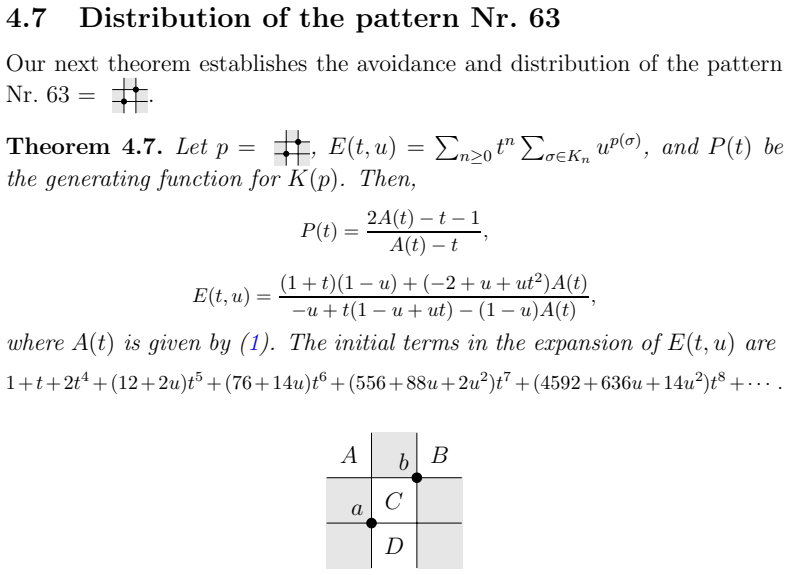
For patterns Nr. 55 and Nr. 63 the proofs assume that a non-king prefix whose only violation is that its left part ends with the value one less than the next element can be turned into a king permutation by replacing the minimum element $1$ with $21$, and that this operation neither destroys nor creates any occurrence of the pattern; the formulas for those two patterns stand or fall on that correspondence.
Editorial extensions
If this is right
- For each of the 22 patterns, the coefficient of $t^n$ in the stated $P(t)$ gives the number of king $n$-permutations avoiding that pattern, so avoidance counts can be computed for every $n$ at once.
- The bivariate generating functions $E(t,u)$ determine the full distribution of the occurrence statistic, including the probability that a uniformly random king $n$-permutation contains exactly $k$ occurrences.
- Six of the patterns are impossible in king permutations, and several others can occur at most once, so their distributions collapse to simple expressions in $A(t)$.
- Apart from the six impossible patterns, the 22 distributions are pairwise different, showing that on king permutations no further coincidental equidistributions among these short patterns exist.
- The paper explicitly lists ten additional short patterns whose distribution on king permutations remains open, so the enumeration program is not yet complete.
Reading between the lines
- We infer that the leftmost-occurrence decomposition developed here should apply to longer mesh patterns as well, since the block generating functions $A(t)$, $B(t)$, and $C(t)$ recur in every formula and no step seems to depend on the pattern having length exactly 2.
- Because $A(t)$ is known explicitly, one could use these formulas to derive asymptotic estimates for the mean and variance of occurrence counts in random king permutations, a direction the paper does not pursue.
- The insertion bijection used for patterns Nr. 55 and Nr. 63, replacing the minimum element $1$ by $21$ to repair a single adjacency violation, looks like a general repair operation that might be transplantable to other restricted permutation classes with a similar consecutive-difference condition.
Editorial analysis
A structured set of objections, weighed in public.
Referee Report
Summary. This paper initiates a systematic study of distributions of short mesh patterns on king permutations. It derives bivariate generating functions E(t,u) and avoidance generating functions P(t) for 22 length-2 mesh patterns indexed by the numbering of Kitaev and Zhang, after first obtaining auxiliary series for the strong-fixed-point statistic on king permutations and two restricted classes (Theorem 2.2). Results are divided into 'trivial' cases (Section 3) and further cases (Section 4); Section 5 lists 11 patterns left open. The proofs are bijective and use decompositions of king permutations around a chosen occurrence of a pattern.
Significance. If the formulas are correct, this is a useful and fairly systematic extension of the Kitaev-Zhang census to king permutations, with explicit parameter-free generating functions. The formulas pass basic internal consistency checks: for each pattern, setting u=1 recovers A(t) and setting u=0 recovers the paper's own avoidance series P(t), and the displayed expansions agree with the small coefficients. These checks are encouraging but do not by themselves validate the bijective decompositions used to obtain the formulas.
major comments (4)
- [Theorem 4.6, Eq. (23)] The proof of the avoidance formula is incomplete. The paper asserts that when an occurrence ab with a chosen as high as possible is removed, every non-king prefix AbB that can appear has as its only violation that A ends with b+1, and that inserting a into that prefix removes the violation without creating a new occurrence of p. This classification is exactly what produces the factor (t+t^2) in Eq. (23); if other non-king prefixes occur, or if the insertion creates an occurrence of p inside AbB, the formula for P(t) is wrong. Please provide a proof of this classification and of the 'no new occurrence' part.
- [Theorem 4.6, after Eq. (24)] The derivation of the distribution formula uses the relation E*(t,u)=E(t,u)-tE*(t,u), where E*(t,u) is defined as the generating function for king permutations not beginning with the largest element. As written this relation is not correct: it would imply E(t,u)=(1+t)E*(t,u), but prefixing the largest element n to a king (n-1)-permutation that starts with n-1 does not produce a king permutation (for instance, 5 2 4 1 3 with n=6 gives 6 5 2 4 1 3). Since this relation is used to go from Eq. (24) to the closed form for E(t,u), the proof of the distribution formula needs repair; if the printed formula is a typo, the intended relation should be stated and proved.
- [Theorem 4.7, Eq. (25)] The 'almost king permutation' case in the proof of Theorem 4.7 is another unproved load-bearing assertion. The paper claims that replacing the minimum element 1 by 21 in a non-empty p-avoiding king permutation yields a p-avoiding almost king permutation and that this introduces no new occurrence of p; this is what explains the factor t(P(t)-1) and hence the (1+t) factor in Eq. (25). Please provide a proof for this bijection, since an occurrence of p in the resulting AbB would change the avoidance formula.
- [All sections (missing figures)] The manuscript as provided does not display the mesh-pattern diagrams: pattern entries such as 'Nr. 55 =' in Theorem 4.6 are followed by blank space, and Figures 1-11 are absent. Because each theorem is about a specific mesh pattern and the proofs refer to these figures, the paper is not auditable without them. Please include all pattern diagrams, or equivalent coordinate/shading descriptions, in the final version.
minor comments (2)
- [Theorem 4.4] In the proof of Theorem 4.4, the phrase 'counted by C(t)-1 given by Theorem 3.4' is a cross-reference error; C(t) is introduced in Lemma 2.1, while Theorem 3.4 concerns a different pattern.
- [Theorem 4.6, around Eq. (24)] The expression E*(t,u)-1 in equation (24) would benefit from an explicit specification of the constant term of E* and of how the empty permutation is treated in the decomposition.
Circularity Check
No significant circularity: the derivations are self-contained given the external A(t) from Flajolet and Sedgewick.
full rationale
This paper's derivation chain is self-contained. The central input A(t) is quoted from Flajolet and Sedgewick [8], an external source, and B(t) and C(t) are derived from it by explicit decompositions in Lemma 2.1. The bivariate generating functions A(t,u), B(t,u), and C(t,u) in Theorem 2.2 are obtained by solving the functional equations (11)-(14), which come from leftmost-occurrence decompositions rather than from the target formulas. The later Theorems 3.1 through 4.8 each set up a decomposition, for example P(t)=A(t)-t(B(t)-1) in Theorem 3.3 or P(t)+(B(t)-1)(P(t)-1)(t+t^2)=A(t) in Theorem 4.6, and solve algebraically for the unknown P(t) or E(t,u); the unknown appears on both sides as a genuine combinatorial equation and is not fitted to data. Citations to [15,16] supply pattern numbering and background, but no load-bearing result is imported from those self-citations: the distribution formulas are rederived for king permutations. The 'almost king permutation' step in Theorems 4.6 and 4.7 is an unproved bijective assertion and therefore a correctness risk, but it is not circular, because the class of non-king prefixes is not defined by the generating function being computed. No fitted parameter is renamed as a prediction, and no known result is merely relabeled.
Assumptions & free parameters
assumptions (5)
- domain assumption A(t) = sum_{n>=0} n! t^n (1-t)^n/(1+t)^n is the generating function for king permutations (Eq. (1)).
- domain assumption The 22 mesh patterns under study are exactly those numbered in [10,15,16], with the visual shading shown in the figures.
- domain assumption Each decomposition around a leftmost, rightmost, or highest occurrence is bijective, and reconstructed 'almost king' permutations introduce exactly the stated number of pattern occurrences and no others (Theorems 4.6-4.8).
- standard math Formal power series can be manipulated coefficient-wise, including iterating functional equations as in Theorem 4.1.
- standard math The class of king permutations is closed under reverse and complement, used repeatedly for symmetry reductions.
Cite this review
Pith. "Pith review of Distributions of mesh patterns of short lengths on king permutations." pith.science (2026). https://pith.science/paper/O5UJD67R
@misc{pith2026241118131,
  author       = {Pith},
  title        = {Pith review of: Distributions of mesh patterns of short lengths on king permutations},
  year         = {2026},
  howpublished = {\url{https://pith.science/paper/O5UJD67R}},
  note         = {Machine review of arXiv:2411.18131}
}
abstract
Br\"{a}nd\'{e}n and Claesson introduced the concept of mesh patterns in 2011, and since then, these patterns have attracted significant attention in the literature. Subsequently, in 2015, Hilmarsson \emph{et al.} initiated the first systematic study of avoidance of mesh patterns, while Kitaev and Zhang conducted the first systematic study of the distribution of mesh patterns in 2019. A permutation $\sigma = \sigma_1 \sigma_2 \cdots \sigma_n$ in the symmetric group $S_n$ is called a king permutation if $\left| \sigma_{i+1}-\sigma_i \right| > 1$ for each $1 \leq i \leq n-1$. Riordan derived a recurrence relation for the number of such permutations in 1965. The generating function for king permutations was obtained by Flajolet and Sedgewick in 2009. In this paper, we initiate a systematic study of the distribution of mesh patterns on king permutations by finding distributions for 22 mesh patterns of short length.
Figures


Figures from the paper (8 more)



Reference graph
Works this paper leans on
-
[1]
S. Avgustinovich, S. Kitaev, and A. Valyuzhenich, Avoidance of b oxed mesh patterns on permutations, Discrete Appl. Math. , 161 (2013), 43– 51
work page 2013
- [2]
- [3]
-
[4]
C. Bean, B. Gudmundsson, T. K. Magnusson, and H. Ulfarsson, Algo- rithmic coincidence classification of mesh patterns, Inf. Comput. , 292 (2023), 105014
work page 2023
-
[5]
N. Borie, On the combinatorics of quadrant marked mesh patter ns in 132-avoiding permutations, Australas. J. Comb. , 64(1)(2016), 140–153
work page 2016
-
[6]
P. Br¨ and´ en and A. Claesson, Mesh patterns and the expansio n of per- mutation statistics as sums of permutation patterns, Electron. J. Comb., 18(2) (2011), #P5
work page 2011
-
[7]
Claesson, From Hertzsprung’s problem to pattern-rewriting systems, Algebr
A. Claesson, From Hertzsprung’s problem to pattern-rewriting systems, Algebr. Comb. , 5(6) (2022), 1257–1277. 25
work page 2022
-
[8]
P. Flajolet and R. Sedgewick, Analytic combinatorics , Cambridge Uni- versity Press, Cambridge, 2009
work page 2009
Show all 20 references
-
[9]
Han and J
B. Han and J. Zeng, Equidistributions of mesh patterns of length two and Kitaev and Zhang’s conjectures, Adv. in Appl. Math. , 127 (2021), 102149
2021
-
[10]
Hilmarsson, I
I. Hilmarsson, I. J´ onsd´ ottir, S. Sigurdard´ ottir, L. Vidars d´ ottir, and H. Ulfarsson, Wilf-classification of mesh patterns of short length, Elec- tron. J. Comb. , 22(4) (2015), #P4.13
2015
-
[11]
Jones, S
M. Jones, S. Kitaev, and J. Remmel, Frame patterns in n-cycles, Dis- crete Math. , 338 (2015), 1197–1215
2015
-
[12]
Kitaev, Patterns in permutations and words , Springer, 2011
S. Kitaev, Patterns in permutations and words , Springer, 2011
2011
-
[13]
Kitaev and J
S. Kitaev and J. Liese, Harmonic numbers, Catalan’s triangle and mesh patterns, Discrete Math., 313 (2013), 1515–1531
2013
-
[14]
Kitaev and J
S. Kitaev and J. Remmel, Quadrant marked mesh patterns in alte rnating permutations, S´ eminaire Lotharingien de Combinatoire, B68a (2012)
2012
-
[15]
Kitaev and P
S. Kitaev and P. B. Zhang, Distributions of mesh patterns of sh ort lengths, Adv. in Appl. Math. , 110 (2019), 1–32
2019
-
[16]
Kitaev, P
S. Kitaev, P. B. Zhang, and X. Zhang, Distributions of several infinite families of mesh patterns, Appl. Math. Comput. , 372 (2020), 124984
2020
-
[17]
Riordan, A recurrence for permutations without rising or fa lling suc- cessions, Ann
J. Riordan, A recurrence for permutations without rising or fa lling suc- cessions, Ann. Stat. , 36 (1965), 708–710
1965
-
[18]
B. E. Tenner, Coincidental pattern avoidance, J. Comb. , 4 (2013), 311– 326
2013
-
[19]
B. E. Tenner, Mesh patterns with superfluous mesh, Adv. in Appl. Math., 51 (2013), 606–618
2013
-
[20]
Thamrongpairoj and J
S. Thamrongpairoj and J. B. Remmel, Positional marked patter ns in permutations, Discrete Math. Theor. Comput. Sci. , 24 (2022), no. 1, 23. 26
2022
Reviewed August 12, 2026 · model on record in the stance chip above.
Discussion (0). Continue with ORCID to comment.