REVIEW 3 major objections 6 minor 18 references
Learning Rate-Compatible Linear Block Codes: An Auto-Encoder Based Approach
T0 review · 3 major / 6 minor · reviewed 2026-08-12 · deepseek-v4-flash
Pith's one-line read One auto-encoder learns a family of rate-compatible codes that beat BCH and LDPC baselines.
desk verdict Useful multi-task rate-compatible learned-code idea, but the headline BER margin is not complexity-fair against sparse LDPC baselines, and the manuscript is incomplete. read the letter →
The pith
A machine-rendered reading of the paper's core claim, the machinery that carries it, and where it could break.
The reading
What carries the argument
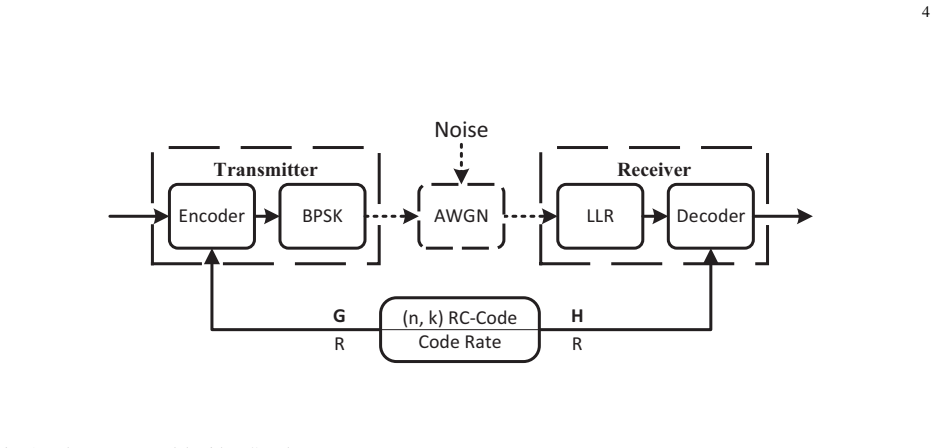
The load-bearing object is the Matrix-Gen module inside the auto-encoder, which turns learnable float weights $W$ into a binary parity-check matrix $H=[H_1|H_2]$ with $H_2$ lower triangular, then derives the systematic generator $G$ through linear transformations; a differentiable step function keeps this binarization trainable. Around this sits the rate-compatible neural belief-propagation decoder, which unfolds BP iterations into cells with per-edge learnable weights and activates only the neurons corresponding to the punctured code rate. Multi-task learning ties the rates together: parameters for a given rate are updated using data from all lower rates, exploiting the nested structure of punctured codewords. The fixed puncturing rule, deleting the last parity bits, is what converts the single learned precode into the family of rates.
What would settle it
Train the same auto-encoder but replace the end-bit truncation with optimally chosen puncturing patterns, for example by density evolution or exhaustive search, and compare BER under five BP iterations against BCH(31,11) and BG2(100,20); if no puncturing pattern can reproduce the reported gains, the rate-compatibility claim as stated fails.
Extended reading notes
Core claim
The central claim is that the proposed auto-encoder, called AI-RC-LBC, jointly optimizes the parity-check matrix $H$ and the generator matrix $G$ together with decoder weights, so that puncturing the last parity bits of a low-rate precode yields good codes at every intermediate rate. The paper reports BER curves showing the learned RC-LBC outperforms BCH(31,11), BCH(21,11), BCH(16,11) and BG2 LDPC(100,20) and (60,20) in all tested cases with similar rates under BP decoding with five iterations; at the lowest rate and BER $10^{-4}$ the margin is about 3 dB over BCH and 2 dB over LDPC. It also reports that the multi-task-trained RC-LBC beats separately trained single-rate AI-LBCs at the same rates, and that non-systematic parity-check matrices outperform systematic ones when decoded with BP. The intended conclusion is that rate compatibility is not a compromise but a regularizer: one learned matrix family can replace several single-rate codes with better bit-error rate and lower storage.
Load-bearing premise
The result depends on the unoptimized choice to build higher-rate codes by simply deleting the last parity bits; if a different puncturing pattern is needed to make rate-compatible codes competitive, the reported margins over BCH and LDPC codes could shrink or reverse.
Editorial extensions
If this is right
- A single trained parameter set covers multiple code rates, replacing several stored codes and simplifying rate-adaptive systems.
- The learned codes work with a conventional BP decoder, so they can be dropped into existing receivers without a neural decoder.
- Multi-task training acts as regularization, giving the rate-compatible code better BER than single-rate AI codes at the same rate.
- Allowing non-systematic parity-check matrices improves BP decoding performance, especially when the decoder runs few iterations.
- The performance gains are largest at the lowest code rate and shrink as puncturing shortens the code, so the scheme is best suited to rate ranges close to the precode.
Reading between the lines
- The paper fixes puncturing to end-bit deletion without optimizing it; a natural extension is to optimize or search puncturing patterns jointly with the matrix, which could widen the reported margins or reveal which patterns the learned matrices prefer.
- Because the multi-task training appears to regularize the code, the same parameter-sharing idea could be tested on longer codes or on fading channels, though the exponential codeword count limits direct scaling.
- The claim that non-systematic matrices help under BP suggests the learned codes could be combined with decoder-specific objectives, such as minimizing short cycles, to push further at very short block lengths.
Editorial analysis
A structured set of objections, weighed in public.
Referee Report
Summary. The manuscript proposes an auto-encoder (AE) framework for learning rate-compatible linear block codes (RC-LBCs). A Matrix-Gen module learns a low-rate precode's parity-check matrix H and derived generator matrix G; higher code rates are obtained by puncturing trailing parity bits. The decoder is a rate-compatible neural belief propagation (RC-NBP) network whose edge weights are jointly trained with the code under a multi-task objective across rates. Experiments compare the learned codes with BCH and 5G NR LDPC BG2 baselines under 5-iteration BP, with single-rate AI-based LBCs, and across systematic versus non-systematic H. The authors report BER gains in all compared cases and claim that one learned parameter set can replace multiple single-rate conventional codes.
Significance. If the empirical claims hold, the work is a useful step toward rate-compatible code design for short block lengths, where conventional LDPC codes are known to be weak, and it offers the practical advantage of storing a single model for multiple rates. The multi-task parameter-sharing scheme is a sensible way to exploit the nested structure of punctured codes, and the comparison against separately trained single-rate AI-LBCs helps isolate the benefit of multi-rate training. However, the paper ships no code or data, the BER curves have no error bars, and the headline comparison is not complexity-normalized; these gaps currently prevent the practical advantage from being established. The fixed truncation puncturing pattern is explicitly acknowledged as a limitation, which is appropriate, but it also means the claimed gains are demonstrated only for that pattern.
major comments (3)
- [Section IV-A; Section III-B] The 'fair comparison' in Section IV-A fixes all decoders to 5 iterations, but the learned parity-check matrices are dense: H1 is fully learnable and H2 is lower triangular with every subdiagonal entry learnable (Section III-B, Eq. (3)), so the per-iteration BP message cost is roughly O(m n) with m = n-k, whereas the 5G BG2 LDPC baselines are explicitly designed to be sparse. The paper reports no edge counts, no density comparison, and no complexity-normalized BER curves. The claim that AI-RC-LBC 'outperforms' the baselines is therefore not yet established as a coding/decoding gain rather than an artifact of higher per-iteration complexity. Please report edge counts and BER versus message-update cost or an equivalent complexity-normalized comparison.
- [Section IV-A] The BCH baselines are evaluated with a belief-propagation decoder ('conventional BP decoding algorithm', Section IV-A), not with the algebraic decoder normally used for BCH codes. Because BCH codes are not designed for BP decoding, this choice can only weaken the baseline; the headline statement that the learned code 'outperforms BCH codes' should either be qualified as 'under BP decoding' or repeated with the standard algebraic BCH decoder. In addition, the ML-BCH curves in Fig. 4 are not described: it is unclear how they are computed and whether they are intended as lower bounds on the BP results.
- [Section IV-A; Figs. 4-6] The empirical claims are supported by single BER curves with no error bars, no number of random seeds, and no numerical tables, and the manuscript includes no code or data release. For a learned-code paper, where two training runs can differ by fractions of a dB, the statement that the learned code 'outperforms ... in all cases' needs confidence intervals or repeated-run statistics; otherwise the shrinking margins at the higher code rates may not be statistically meaningful.
minor comments (6)
- [Appendix A; Appendix B; Acknowledgment] Appendix A and Appendix B contain placeholder text ('Appendix one text goes here', 'Appendix two text goes here') and the acknowledgment section is incomplete; these must be completed before the manuscript can be considered a finished submission.
- [Section IV-A, footnote 1] The footnote contains an apparent typo: '(21,31) BCH codes' should presumably read '(31,21) BCH codes'.
- [Section II-C] There is a duplicated phrase: 'tries to learn learns optimal weights' should be 'tries to learn optimal weights'.
- [Section III-B, Eq. (4)] The word 'empolyed' is a typo for 'employed'.
- [Section III-C] The text says the decoder has learnable weights and biases in Eq. (2), but then states that 'we only adapt weight multipliers in our experiments'; please clarify whether the biases beta are trained or fixed, and whether the same setting is used for the RC-NBP decoder.
- [Section IV-C, Fig. 7] The Fig. 7 legend labels the non-systematic curves as (31,16), (21,16), and (16,11), while the text describes the precode as C(31,11); the labels appear inconsistent and should be corrected.
Circularity Check
No material circularity: the central BER claims are anchored by external BCH and 5G LDPC baselines; only a minor self-citation of the prior RC-NBP decoder appears, and it is not load-bearing.
full rationale
The proposed auto-encoder optimizes the parity-check matrix and decoder weights against a binary cross-entropy loss; nothing in the derivation defines the target BER improvement in terms of the training inputs. Section IV-A evaluates AI-RC-LBC against conventional BCH codes and 5G NR BG2 LDPC codes under plain belief-propagation decoding, so the headline claim is externally falsifiable rather than forced by construction. The puncturing rule is fixed as truncation of the last parity bits, and the paper explicitly states that optimizing puncturing patterns is left for future work; that limits the generality of the rate-compatible scheme but is an acknowledged design choice, not a circular reduction. The only self-citation is the RC-NBP decoder of [16], used as a component in training and in the AI-decoder comparisons; it is not the object of the claim, no uniqueness or optimality is imported from it, and the main external comparison does not depend on it. The placeholder appendices and acknowledgments are not part of the derivation and carry no circularity. Overall, the result is self-contained against external benchmarks, with no load-bearing self-citation or fitted-input prediction; score 2 reflects the minor non-load-bearing self-citation only.
Assumptions & free parameters
free parameters (4)
- Coding parameters W (entries of parity-check matrix H) =
not reported
- Decoder weight multipliers alpha per edge and iteration =
not reported
- Training SNR per code rate =
[3,4,5] dB for k=11; [4,5] dB for k=20
- Number of BP/NBP iterations =
5
assumptions (6)
- standard math A linear block code is fully described by a generator matrix G and parity-check matrix H over F2, with codewords c = xG satisfying cH^T = 0.
- domain assumption The channel is AWGN with BPSK modulation at the transmitter.
- domain assumption Unfolding BP into a neural network with learnable edge weights yields a decoder that performs at least as well as standard BP for the learned codes.
- domain assumption Multi-task learning with shared parameters across code rates improves or preserves code quality for each rate.
- ad hoc to paper The fixed truncation of the last parity bits is an adequate puncturing pattern for all tested rates.
- ad hoc to paper Restricting H to the form [H1|H2] with lower-triangular H2, together with the differentiable step function, yields valid binary H and G during training and inference.
Cite this review
Pith. "Pith review of Learning Rate-Compatible Linear Block Codes: An Auto-Encoder Based Approach." pith.science (2026). https://pith.science/paper/HO3KNB5Z
@misc{pith2026241118153,
  author       = {Pith},
  title        = {Pith review of: Learning Rate-Compatible Linear Block Codes: An Auto-Encoder Based Approach},
  year         = {2026},
  howpublished = {\url{https://pith.science/paper/HO3KNB5Z}},
  note         = {Machine review of arXiv:2411.18153}
}
read the original abstract
Artificial intelligence (AI) provides an alternative way to design channel coding with affordable complexity. However, most existing studies can only learn codes for a given size and rate, typically defined by a fixed network architecture and a set of parameters. The support of multiple code rates is essential for conserving bandwidth under varying channel conditions while it is costly to store multiple AI models or parameter sets. In this article, we propose an auto-encoder (AE) based rate-compatible linear block codes (RC-LBCs). The coding process associated with AI or non-AI decoders and multiple puncturing patterns is optimized in a data-driven manner. The superior performance of the proposed AI-based RC-LBC is demonstrated through our numerical experiments.
Figures


Figures from the paper (4 more)


Reference graph
Works this paper leans on
-
[14]
Neural belief propagation auto-encoder for lin ear block code design,
G. Larue, L.-A. Dufrene, Q. Lampin, H. Ghauch, and G. R.- B. Othman, “Neural belief propagation auto-encoder for lin ear block code design,” IEEE Trans. Commun. , vol. 70, no. 11, pp. 7250–7264, 2022
work page 2022
-
[16]
Rate compatible LDPC neural decoding network: A multi-task learning approach,
Y . Cheng, W. Chen, L. Li, and B. Ai, “Rate compatible LDPC neural decoding network: A multi-task learning approach,” IEEE Trans. V eh. Technol., vol. 73, no. 5, pp. 7374–7378, 2024
work page 2024
-
[1]
Design of rate-comp atible structured LDPC codes for hybrid ARQ applications,
M. El-Khamy, J. Hou, and N. Bhushan, “Design of rate-comp atible structured LDPC codes for hybrid ARQ applications,” IEEE J. Sel. Areas Commun. , vol. 27, no. 6, pp. 965–973, 2009
work page 2009
-
[2]
Rate-compatible punct uring of low-density parity-check codes,
J. Ha, J. Kim, and S. McLaughlin, “Rate-compatible punct uring of low-density parity-check codes,” IEEE Trans. Inf. Theory, vol. 50, no. 11, pp. 2824–2836, 2004
work page 2004
-
[3]
The design of rate-compatible protograph LDPC codes,
T. V . Nguyen, A. Nosratinia, and D. Divsalar, “The design of rate-compatible protograph LDPC codes,” IEEE Trans. Commun., vol. 60, no. 10, pp. 2841–2850, 2012
work page 2012
-
[4]
P rotograph-based raptor-like LDPC codes,
T.-Y . Chen, K. V akilinia, D. Divsalar, and R. D. Wesel, “P rotograph-based raptor-like LDPC codes,” IEEE IEEE Trans. Commun., vol. 63, no. 5, pp. 1522–1532, 2015
work page 2015
-
[5]
T. Richardson and R. Urbanke, Modern Coding Theory . Cambridge Univ. Press, 2008. November 28, 2024 DRAFT 14
work page 2008
-
[6]
Syndrome-coupled rate-compatible error-correcting co des: Theory and application,
P . Huang, Y . Liu, X. Zhang, P . H. Siegel, and E. F. Haratsch , “Syndrome-coupled rate-compatible error-correcting co des: Theory and application,” IEEE Trans. Inf. Theory , vol. 66, no. 4, pp. 2311–2330, 2020
work page 2020
Show all 18 references
-
[7]
Partnership Project (3GPP), Nov
5G; NR; Multiplexing and channel coding (3GPP TS 38.212 vers ion 16.3.0 Release 16) , 3rd Gener. Partnership Project (3GPP), Nov. 2020
2020
-
[8]
AI coding: Le arning to construct error correction codes,
L. Huang, H. Zhang, R. Li, Y . Ge, and J. Wang, “AI coding: Le arning to construct error correction codes,” IEEE Trans. Commun., vol. 68, no. 1, pp. 26–39, 2020
2020
-
[9]
Learning to de code linear codes using deep learning,
E. Nachmani, Y . Be’ery, and D. Burshtein, “Learning to de code linear codes using deep learning,” in 2016 54th Annu. Allerton Conf. Commun., Control, Comput. (Allerton) , 2016, pp. 341–346
2016
-
[10]
Normalized min-sum neural network for LDPC decoding,
Q. Wang, Q. Liu, S. Wang, L. Chen, H. Fang, L. Chen, Y . Guo, and Z. Wu, “Normalized min-sum neural network for LDPC decoding,” IEEE Trans. Cogn. Commun. Netw. , vol. 9, no. 1, pp. 70–81, 2023
2023
-
[11]
Learning to decode protograph LDPC codes,
J. Dai, K. Tan, Z. Si, K. Niu, M. Chen, H. V . Poor, and S. Cui , “Learning to decode protograph LDPC codes,” IEEE J. Sel. Areas Commun. , vol. 39, no. 7, pp. 1983–1999, 2021
1983
-
[12]
Product AE: Toward training larger channel codes based on neural product codes,
M. V . Jamali, H. Saber, H. Hatami, and J. H. Bae, “Product AE: Toward training larger channel codes based on neural product codes,” in ICC 2022 - IEEE Int. Conf. Commun. , 2022, pp. 3898–3903
2022
-
[13]
W ireless image transmission using deep source channel coding with attention modules,
J. Xu, B. Ai, W. Chen, A. Yang, P . Sun, and M. Rodrigues, “W ireless image transmission using deep source channel coding with attention modules,” IEEE Trans. Circuits Syst. Video Technol. , vol. 32, no. 4, pp. 2315–2328, 2022
2022
-
[15]
ARQ schemes for data transmi ssion in mobile radio systems,
R. Comroe and D. Costello, “ARQ schemes for data transmi ssion in mobile radio systems,” IEEE J. Sel. Areas Commun. , vol. 2, no. 4, pp. 472–481, 1984
1984
-
[17]
A survey on multi-task learning,
Y . Zhang and Q. Yang, “A survey on multi-task learning,” IEEE Trans. Knowl. Data Eng. , vol. 34, no. 12, pp. 5586–5609, 2022
2022
-
[18]
An introduction to deep learni ng for the physical layer,
T. O’Shea and J. Hoydis, “An introduction to deep learni ng for the physical layer,” IEEE Trans. Cogn. Commun. Netw. , vol. 3, no. 4, pp. 563–575, 2017. November 28, 2024 DRAFT
2017
Reviewed August 12, 2026 · model on record in the stance chip above.
Discussion (0). Continue with ORCID to comment.