REVIEW 3 major objections 4 minor 45 references
Mathematical properties of Klein-Gordon-Boussinesq systems
T0 review · 3 major / 4 minor · reviewed 2026-08-12 · deepseek-v4-flash
Pith's one-line read The Klein-Gordon-Boussinesq system has unique local solutions for Sobolev data with 1/2 < r ≤ s ≤ r+1; under a coefficient condition, small data give global solutions and negative energy forces finite-time blow-up.
desk verdict Local well-posedness and solitary-wave analysis are solid, but the global-existence theorem has a gap: the energy functional does not control the H^1 norm of u needed for the key estimate. read the letter →
The pith
A machine-rendered reading of the paper's core claim, the machinery that carries it, and where it could break.
The reading
What carries the argument
The argument runs on three mechanisms. For well-posedness, the linear propagators $U(t)$ and $V(t)$, with Fourier symbols $\sin(t|\alpha\xi|/\sqrt{1+\xi^2})\,\sqrt{1+\xi^2}/|\alpha\xi|$ and $\sin(t\sqrt{1+\xi^2})/\sqrt{1+\xi^2}$, convert the system into a Duhamel integral equation; the smoothing factors bring the nonlinear terms into the algebras $H^r$ and $H^s$ so that contraction mapping applies in $C_T(X_r) \times C_T(X_s)$. For global existence and blow-up, the central object is the functional $y(t) = \|\partial_x^{-1}u_t\|^2_{L^2} + \alpha^2\|u\|^2_{L^2} + \|v\|^2 + \|v_t\|^2 + \|v_x\|^2$ together with the conserved energy $E$ and the second invariant $F$; the proof attempts to bound $y(t)$ by $2E(0) + (2/3)K_0 y(t)^{3/2}$. For solitary waves, the load-bearing identity is the characteristic equation $\lambda^4 - B\lambda^2 + A = 0$ with $A=(c_s^2-\alpha^2)/(c_s^2(1-c_s^2))$ and $B=(1-\alpha^2/c_s^2)+1/(1-c_s^2)$; the eigenvalue regions, together with the reversible structure with symmetry $S=\mathrm{diag}(1,-1,1,-1)$, determine where normal form theory produces homoclinic (classical) or homoclinic-to-periodic (generalized) solitary waves, while the positive-operator route uses the convolution system (3.18) with the kernels (3.19) in a cone.
What would settle it
Take negative-energy data satisfying the hypotheses of Theorem 2.7 and integrate (1.1) numerically: if $\|\partial_x^{-1}u\|^2 + \|u\|^2 + \|v\|^2$ does not diverge in finite time, the blow-up claim is false. Separately, in the small-data regime of Theorem 2.5, track $\|u_x\|_{L^2}$: if it grows while $y(t)$ stays bounded, the missing $H^1$ control in the proof is confirmed.
Extended reading notes
Core claim
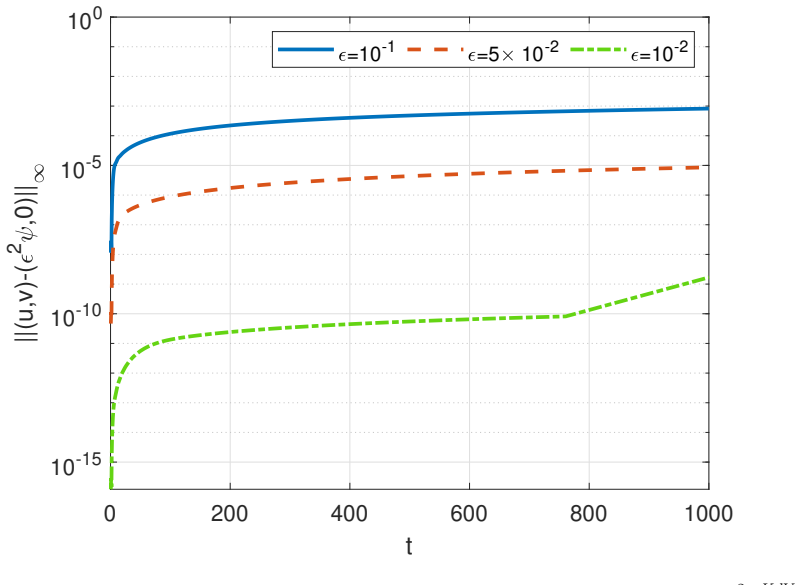
On its own terms, the paper's main result is Theorem 2.1: given $1/2 < r \leq s \leq r+1$, there is a $T>0$ and a unique solution $(u,v)$ of (1.1)-(1.2) with $(u,u_t) \in C^1([0,T); X_r)$, $X_r = H^r \times (H^r \cap \dot H^{r-1})$, and $(v,v_t) \in C^1([0,T); H^s \times H^{s-1})$. The proof rewrites the system via Duhamel's formula with the linear groups $U$ and $V$, uses the fact that $H^r$ and $H^s$ are Banach algebras in this range, and closes a contraction mapping. With the coefficient condition (2.10) ($b_{uu}=-a_{uv}$, $b_{uv}=-a_{vv}$), the paper proves conservation of the energy $E$ and a second functional $F$; Theorem 2.5 then states that when $a_{uu}=0$ and the data satisfy the smallness conditions (2.14), the local solution extends to all times, while Theorem 2.7 states that under (2.10) the solution blows up in finite time whenever $E(0)<0$ or the ratio condition (2.15) holds, in the sense that $\|\partial_x^{-1}u\|^2 + \|u\|^2 + \|v\|^2$ diverges. The remainder of the paper concerns traveling waves: the linearized traveling-wave problem has characteristic equation (3.5), and normal form theory near the bifurcation curves $C_0$ through $C_3$ yields classical and generalized solitary waves, while positive operator theory in a cone of even, nonnegative, decreasing functions yields classical solitary waves under nonnegativity and convexity assumptions on the kernels. Finally, the formal KdV approximation (4.3) is validated numerically in the sense that the distance between the numerical solution and the KdV soliton ansatz stays $O(\varepsilon^{7/2})$ up to time 1000 for the tested values of $\varepsilon$.
Load-bearing premise
The global-existence theorem rests on the estimate $y(t) \leq 2E(0) + (2/3)K_0 y(t)^{3/2}$, which is obtained using $\|u\|_{L^4} \leq C_4\|u\|_{H^1}$; the quantity $y(t)$ and the energy space do not control $\|u_x\|_{L^2}$, so if no separate $H^1$ bound for $u$ follows from the conserved quantities, the small-data global-existence claim is not established as written.
Editorial extensions
If this is right
- Under the coefficient condition (2.10), both $E(t)$ and $F(t)$ are conserved along energy-space solutions, so the invariant structure of the linearized system survives the quadratic coupling.
- If $a_{uu}=0$ and the initial data satisfy the smallness conditions (2.14), the local solution of Theorem 2.1 extends to all times $t \geq 0$.
- If $E(0)<0$, or if $E(0)\geq 0$ and the threshold inequality (2.15) holds, the solution cannot exist globally: $\|\partial_x^{-1}u\|^2_{L^2} + \|u\|^2_{L^2} + \|v\|^2_{L^2}$ diverges at some finite time.
- For speeds with $\alpha^2 < c_s^2 < 1$, classical solitary waves exist; near the curve $C_1$ with $|c_s|>1$, generalized solitary waves homoclinic to small periodic orbits exist, and the positive-operator theory gives classical solitary waves under additional nonnegativity and convexity assumptions.
- The numerical experiments match the KdV approximation bound (4.6): the maximum error between the numerical solution and the KdV soliton ansatz is $O(\varepsilon^{7/2})$ and remains bounded in time up to $t=1000$.
Reading between the lines
- If the missing $H^1$ control in the proof of Theorem 2.5 can be supplied, for instance by showing that $E$ and $F$ together bound $\|u_x\|_{L^2}$, then the small-data global-existence result becomes unconditional; until such a bound appears, a cautious reading treats that theorem as conditional on that a priori estimate.
- The blow-up criterion (2.15) resembles the concavity-method thresholds familiar from semilinear wave equations, and the proof yields an explicit upper bound on the blow-up time; a natural numerical test is whether the actual blow-up time approaches $4I(0)/I'(0)$ in the near-threshold regime.
- The well-posedness range $r>1/2$ is natural for one-dimensional Sobolev algebras, but the endpoints $r=1/2$ and $s=r+1$ are left open; determining whether local well-posedness holds or fails at these endpoints would complete the Cauchy theory.
- The KdV numerics cover the case $a_{uu}, b_{uu}>0$; testing the same $O(\varepsilon^{7/2})$ bound for defocusing signs or for the $\alpha>2$ unstable-resonance case treated in the cited literature would show whether the error constant remains tame outside the favourable coefficient regime.
Editorial analysis
A structured set of objections, weighed in public.
Referee Report
Summary. The manuscript studies the Klein-Gordon-Boussinesq system (1.1)-(1.2). Its main mathematical claims are: local well-posedness in Sobolev spaces (Theorem 2.1); conservation laws (Theorem 2.2) under the coefficient condition (2.10); a global-existence criterion and finite-time blow-up criteria for the local solution (Theorems 2.5 and 2.7); existence of classical and generalized solitary waves via normal-form and positive-operator methods (Section 3); and a numerical check of the KdV approximation (Section 4). The central analytic result is Theorem 2.5, which asserts that small energy data satisfying (2.14) yield a global solution when a_uu=0.
Significance. The paper addresses a natural and largely open set of questions: a rigorous Cauchy theory and a global/blow-up classification for a model system that has been used in approximation-validity studies. The local well-posedness argument is standard and, if the details are completed, should hold in the stated spaces; the conserved quantities and the Levine-type blow-up mechanism are useful; and the solitary-wave sections give a concrete application of two classical theories together with careful numerics. The numerical test of the KdV approximation is also a valuable illustration. However, Theorem 2.5 currently rests on an unproved H^1 control of u, and the energy space is not covered by the stated local theorem; these gaps affect the principal global-existence claim of the paper. The contribution is therefore potentially significant, but not yet established as written.
major comments (3)
- [Section 2, proof of Theorem 2.5] The displayed estimate y(t) <= 2E(0) + (2/3)K0 y(t)^{3/2} is not established. The nonlinear terms B u^2 v and C u v^2 appearing in F under the assumption a_uu=0 are controlled in the text by embeddings such as ||u||_{L^4} <= C_4 ||u||_{H^1}; replacing ||u||_{H^1} by y(t)^{1/2} is unjustified because y(t) and the conserved energy E(t) in (2.11) contain only ||u||_{L^2}, ||u_t||_{L^2}, ||partial_x^{-1}u_t||_{L^2}, ||v||_{L^2}, ||v_t||_{L^2} and ||v_x||_{L^2}, and no ||u_x||_{L^2} term. No other conservation law or equation (2.13) is used in the proof to supply control of ||u_x||_{L^2}, so the global existence criterion (2.14) is unsupported as written.
- [Section 2, Theorems 2.1 and 2.5] The assumptions of Theorem 2.5 are inconsistent with the energy class used in its proof. Theorem 2.1 requires 1/2 < r <= s <= r+1, so it does not cover the natural energy space X_0 x X_1 needed for E(t) and y(t). Moreover, for r>1/2 the condition u_1 in H^r cap dot{H}^{r-1} does not imply partial_x^{-1}u_1 in L^2, so E(0) need not even be finite. The proof of Theorem 2.5 neither adds an explicit assumption such as partial_x^{-1}u_1 in L^2 nor establishes the required low-regularity local well-posedness; Remark 2.3 only mentions an alternative proof via (2.13) without details. The continuation argument therefore lacks a well-defined starting point.
- [Section 2, Lemma 2.4 and condition (2.14)] Even after the missing H^1 control of u is supplied, the application of Lemma 2.4 needs separate verification. With C_1=2E(0) and C_2=(2/3)K_0, the lemma's hypothesis is 2E(0) < (1/3)K_0^{-2}, whereas (2.14) gives only E(0) < (1/6)K_0^{-6}; for 0<K_0<1 the latter is weaker and does not imply the former. The proof also does not explicitly show that y(0) lies in the basin of the smaller root a_1 rather than merely below the intermediate value A, which is what the lemma requires for the conclusion y(t) <= a_1.
minor comments (4)
- [General] Several typographical slips should be corrected, including 'conditions of of Theorem 2.1' in Theorem 2.5 and '(v.vt)' in Theorem 2.1 and its proof.
- [Section 4, Figure 5] The numerical claim of O(epsilon^{7/2}) would be easier to verify if the maximum errors at a fixed time were tabulated for successive values of epsilon, since the semilog plot alone does not display the convergence rate explicitly.
- [Section 3.1] The normal-form analysis near C_0 assumes a_uu>0, but the coefficient hypotheses of the section do not state this restriction; the cases a_uu<=0 are not discussed and would require a separate sign or higher-order normal form argument.
- [Section 3.2, Theorem 3.3] Theorem 3.3 states that the hypotheses are 'stated above' without collecting them in one place; the coefficient assumptions, in particular the nonnegativity conditions on a_gamma_beta and b_gamma_beta and the convexity conditions in (S1), should be listed explicitly in the theorem statement.
Circularity Check
No significant circularity: the central well-posedness, blow-up, solitary-wave, and KdV-approximation arguments are either proved in-paper or depend on external theorems; the only self-citations are computational tools and are not load-bearing.
full rationale
The paper's central derivation chain is not circular. Theorem 2.1 is proved in the paper by a Duhamel/contraction-mapping argument using standard Sobolev algebra estimates, with the key multilinear bounds quoted from Tao's Sobolev multiplication lemma rather than from the paper's own conclusions. The conserved quantities in Theorem 2.2 are verified by direct computation, and no fitted parameter is introduced. The global-existence and blow-up arguments in Theorems 2.5 and 2.7 reduce to differential inequalities and known Sobolev embedding constants; any defect in those arguments is a mathematical rigor gap, not a circularity. In particular, the reader's observation that y(t) does not control ||u_x||_{L^2} concerns the validity of the displayed estimate, not a hidden equivalence between the claim and its input. The solitary-wave existence results are obtained by applying external normal-form and positive-operator theorems, and the numerical Petviashvili generation is checked by residuals, not used to prove existence. The KdV equation in Section 4 is derived from an explicitly stated ansatz, and the approximation bound (4.6) is quoted from external work by Bauer–Cummings–Schneider and Chong–Schneider; the numerical experiment compares against that external theorem. References to the authors' own prior work (Petviashvili-type methods, multi-symplectic structures, extrapolation) are computational or auxiliary and never carry the load of the main mathematical claims. Thus the paper is self-contained against external benchmarks and no circular step can be exhibited.
Assumptions & free parameters
assumptions (6)
- standard math H^s is a Banach algebra for s>1/2 and product estimates (2.9) hold
- standard math Contraction Mapping Theorem is applicable in CT(X_r) x CT(X_s)
- standard math Normal Form Theory and Center Manifold Theorem for reversible systems
- standard math Positive Operator Theory of Benjamin-Bona-Bose and Bona-Chen
- standard math Lemma 2.4 (continuity plus polynomial bound implies boundedness under smallness)
- standard math KdV approximation theorem of Chong-Schneider and Bauer et al. (Theorem 4.1)
Cite this review
Pith. "Pith review of Mathematical properties of Klein-Gordon-Boussinesq systems." pith.science (2026). https://pith.science/paper/L6DJATUX
@misc{pith2026241118173,
  author       = {Pith},
  title        = {Pith review of: Mathematical properties of Klein-Gordon-Boussinesq systems},
  year         = {2026},
  howpublished = {\url{https://pith.science/paper/L6DJATUX}},
  note         = {Machine review of arXiv:2411.18173}
}
read the original abstract
The Klein-Gordon-Boussinesq (KGB) system is proposed in the literature as a model problem to study the validity of approximations in the long wave limit provided by simpler equations such as KdV, nonlinear Schr\"{o}dinger or Whitham equations. In this paper, the KGB system is analyzed as a mathematical model in three specific points. The first one concerns well-posedness of the initial-value problem with the study of local existence and uniqueness of solution and the conditions under which the local solution is global or blows up at finite time. The second point is focused on traveling wave solutions of the KGB system. The existence of different types of solitary waves is derived from two classical approaches, while from their numerical generation several properties of the solitary wave profiles are studied. In addition, the validity of the KdV approximation is analyzed by computational means and from the corresponding KdV soliton solutions.
Figures

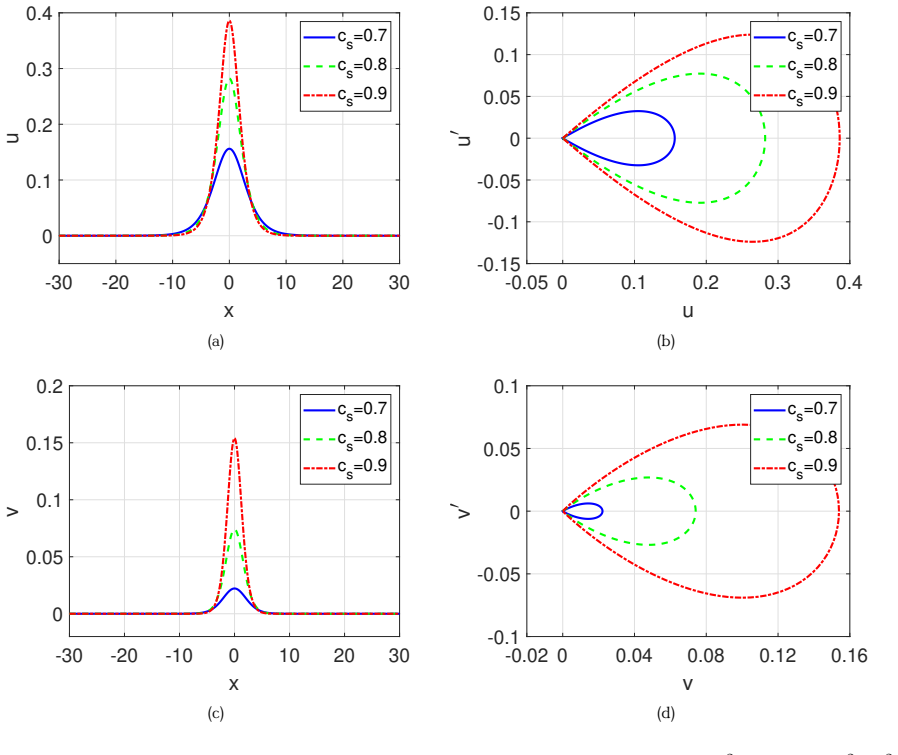

Figures from the paper (4 more)



Reference graph
Works this paper leans on
-
[1]
J. Álvarez, A. Durán, Petviashvili type methods for trav eling wave computations: I. Analysis of conver- gence, J. Comput. Appl. Math. 266 (2014) 39-51
work page 2014
- [2]
-
[3]
T.B. Benjamin, J.L. Bona, D.K. Bose, Solitary-wave solu tions of nonlinear problems, Philos. Trans. Royal Soc. London A 331 (1990) 195-244
work page 1990
-
[4]
I. L. Bogolubsky, Some examples of inelastic soliton int eraction, Comput. Phys. Commun. 13 (1977) 149-155
work page 1977
-
[5]
J. L. Bona, H. Chen, Solitary waves in nonlinear dispersi ve systems, Discr. Cont. Dyn. Syst. Series B 2(3) (2002) 313–378
work page 2002
-
[6]
J. Boussinesq, Théorie des ondes et des remous qui se prop agent le long d’un canal rectangulaire horizontal, J. Math. Pures Appl. 7 (1872) 55-108
-
[7]
Haraux, An Introduction to Semilinear Ev olution Equations
Cazenave and A. Haraux, An Introduction to Semilinear Ev olution Equations. Oxford Lecture Series in Mathematics and its Applications, 13. The Clarendon Press, Oxford University Press, 1998
work page 1998
-
[8]
A.R. Champneys, Homoclinic orbits in reversible system s and their applications in mechanics, fluids and optics, Physica D 112 (1998) 158-186
work page 1998
Show all 45 references
-
[9]
Champneys, A
A.R. Champneys, A. Spence, Hunting for homoclinic orbit s in reversible systems: A shooting technique, Adv. Comput. Math. 1 (1993) 81-108
1993
-
[10]
Champneys, J.F
A.R. Champneys, J.F. Toland, Bifurcation of a plethora of multi-modal homoclinic orbits for autonomous Hamiltonian systems, Nonlinearity 6 (1993) 665-772
1993
-
[11]
Chen, Exact traveling wave solutions to bidirection al wave equations, Int
M. Chen, Exact traveling wave solutions to bidirection al wave equations, Int. J. Theor. Phys. 37(1998) 1547-1567
1998
-
[12]
Chong, G
C. Chong, G. Schneider, The validity of the KdV approxim ation in case of resonances arising from periodic media, J. Math. Anal. Appl., 383 (2011) 330-336
2011
-
[13]
Chree, Longitudinal vibrations of a Corcablar bar, Q uart
C. Chree, Longitudinal vibrations of a Corcablar bar, Q uart. J. Pure Appl. Math. 21 (1886) 287–298
-
[14]
Clarkson, R.J
A. Clarkson, R.J. LeVeque, R. Saxton, Solitary-wave in teractions in elastic rods, Stud. Appl. Math. 75 (1986) 95–122
1986
-
[15]
Delort, Existence globale et comportement asymp totique pour l’équation de Klein-Gordon quasi linéaire à données petites en dimension 1, Ann
J.-M. Delort, Existence globale et comportement asymp totique pour l’équation de Klein-Gordon quasi linéaire à données petites en dimension 1, Ann. Sci. Ecole No rm. Sup. 34 (2001) 1-61
2001
-
[16]
Delort, Semiclassical microlocal normal forms a nd global solutions of modified one-dimensional KG equations, Annales de l’Institut Fourier 66 (2016) 1451-1528
J.-M. Delort, Semiclassical microlocal normal forms a nd global solutions of modified one-dimensional KG equations, Annales de l’Institut Fourier 66 (2016) 1451-1528. 20
2016
-
[17]
V. A. Dougalis, A. Durán, L. Saridaki, On solitary-wave solutions of Boussinesq/Boussinesq systems for internal waves, Physica D, 428 (2021) 133051
2021
-
[18]
W.-P. Düll, K. Sanei Kashani, G. Schneider, The validit y of Whitham’s approximation for a Klein–Gordon–Boussinesq model, SIAM J. Math. Analysis 48 (2016) 4311–4334
2016
-
[19]
Durán, D
A. Durán, D. Dutykh, D. Mitsotakis, On the multi-symple ctic structure of Boussinesq-type systems. I: Derivation and mathematical properties, PhysicaD 338 (201 9) 10-21
-
[20]
Ginibre, G
J. Ginibre, G. Velo, The global Cauchy problem for the no nlinear Klein-Gordon equation, Math. Z. 189 (1985) 487-505
1985
-
[21]
Hakkaev, M
S. Hakkaev, M. Stanislavova, A. Stefanov, Orbital stab ility for periodic standing waves of the Klein–Gordon–Zakharov system and the beam equation, Z. Angew. Math. Phys. 64 (2013) 265-282
2013
-
[22]
Infeld, G
E. Infeld, G. Rowlands, Nonlinear Waves, Solitons and C haos, 2nd ed., Cambrideg University Press, 2000
2000
-
[23]
Iooss, M
G. Iooss, M. Adelmeyer, Topics in Bifurcation Theory an d Applications, 2nd ed., World Scientific, 1999
1999
-
[24]
Iooss, K
G. Iooss, K. Kirchgässner, Water waves for small surfac e tension: an approach via normal form, Proc. Roy. Soc. Edinburgh A 112 (1992) 267-299
1992
-
[25]
Kirrmann, G
P. Kirrmann, G. Schneider, A. Mielke, The validity of mo dulation equations for extended systems with cubic nonlinearities, Proc. Roy. Soc. Edinburgh A 122 (1-2) (1992) 85-91
1992
-
[26]
Levine, Instability and nonexistence of global so lutions to nonlinear wave equations of the form Pu tt = −Au +E(u), Trans
H.A. Levine, Instability and nonexistence of global so lutions to nonlinear wave equations of the form Pu tt = −Au +E(u), Trans. Amer. Math. Soc. 192 (1974) 1-21
1974
-
[27]
Liu, Existence and blow up of solutions of a nonlinear Pochhammer-Chree equation, Indiana U
Y. Liu, Existence and blow up of solutions of a nonlinear Pochhammer-Chree equation, Indiana U. Math. J. 45 (1996) 797–816
1996
-
[28]
Lombardi, Oscillatory Integrals and Phenomena Beyo nd all Algebraic Orders, Springer-Verlag, 2000
E. Lombardi, Oscillatory Integrals and Phenomena Beyo nd all Algebraic Orders, Springer-Verlag, 2000
2000
-
[29]
Makhankov, Dynamics of classical solitons (in non -integrable systems), Phys
V.G. Makhankov, Dynamics of classical solitons (in non -integrable systems), Phys. Rep. Phys. Lett. C 35 (1978) 1–128
1978
-
[30]
Nakamura, T
M. Nakamura, T. Ozawa, The Cauchy problem for nonlinear Klein–Gordon equations in the Sobolev spaces, Publications of R.I.M.S., Kyoto University 37 (200 1) 255-293
-
[31]
Nagy, Über Integralgleichungen zwischen einer Fu nktion und ihrer Ableitung, Acta Sci
B.S. Nagy, Über Integralgleichungen zwischen einer Fu nktion und ihrer Ableitung, Acta Sci. Math. 10 (1941) 64–74
1941
-
[32]
V. I. Petviashvili Equation of an extraordinary solito n, Soviet J. Plasma Phys. 2 (1976) 257-258
1976
-
[33]
D. E. Pelinovsky and Y. A. Stepanyants, Convergence of P etviashvili’s iteration method for numerical approximation of stationary solutions of nonlinear wave eq uations, SIAM J. Numer. Anal. 42 (2004) 1110-1127
2004
-
[34]
Pochhammer, Über die fortpflanzungsgeschwindigkei ten kleiner schwingungen ineinem unbegren- zten isotropen kreiszylinder, J
L. Pochhammer, Über die fortpflanzungsgeschwindigkei ten kleiner schwingungen ineinem unbegren- zten isotropen kreiszylinder, J. Reine Angew. Math. 81 (187 6) 324–336
-
[35]
Schneider, Validity and non-validity of the nonline ar Schrödinger equation as a model for water waves
G. Schneider, Validity and non-validity of the nonline ar Schrödinger equation as a model for water waves. In: Lectures on the Theory of Water Waves. Papers from the Talks Given at the Isaac New- ton Institute for Mathematical Sciences, Cambridge, UK, Ju ly–August, 2014, pp. 1...
2016
-
[36]
Schneider, The KdV approximation for a system with un stable resonances, Math
G. Schneider, The KdV approximation for a system with un stable resonances, Math. Methods Appl. Sci. 43 (2020) 3185–3199. 21
2020
-
[37]
Scott, Nonlinear Science
A. Scott, Nonlinear Science. Emergence and Dynamics of Coherent Structures, Oxford University Press, 1999
1999
-
[38]
Shatah, Stable standing waves of nonlinear Klein–Gordon equations, Commun
J. Shatah, Stable standing waves of nonlinear Klein–Gordon equations, Commun. Math. Phys. 91 (1983) 313–327
1983
-
[39]
Shatah, Unstable ground state of nonlinear Klein–Go rdon equations, Am
J. Shatah, Unstable ground state of nonlinear Klein–Go rdon equations, Am. Math. Soc. 290 (1985) 701–710
1985
-
[40]
Shatah, W
J. Shatah, W. Strauss, Instability of nonlinear bound s tates, Commun. Math. Phys. 100 (1985) 173–190
1985
-
[41]
Sidi, Vector Extrapolation Methods with Applicatio ns, SIAM Philadelphia, 2017
A. Sidi, Vector Extrapolation Methods with Applicatio ns, SIAM Philadelphia, 2017
2017
-
[42]
Sidi, W.F
A. Sidi, W.F. Ford, D.A. Smith, Acceleration of converg ence of vector sequences, SIAM J. Numer. Anal. 23 (1986) 178-196
1986
-
[43]
Smith, W.F
D.A. Smith, W.F. Ford, A. Sidi, Extrapolation methods f or vector sequences, SIAM Rev. 29 (1987) 199- 233
1987
-
[44]
Tao, Multilinear Weighted convolutions L2 function, and applications to nonlinear dispersive equa- tions, Amer
T. Tao, Multilinear Weighted convolutions L2 function, and applications to nonlinear dispersive equa- tions, Amer. J. Math. 123 (2001) 839–908
2001
-
[45]
Wazwaz, Nonlinear variants of the improved Bouss inesq equation with compact and noncompact structures, Comput
A.-M. Wazwaz, Nonlinear variants of the improved Bouss inesq equation with compact and noncompact structures, Comput. Math. Appl. 49 (2005) 565-574. A Numerical generation of solitary waves The numerical method to generate approximate solitary wave solutions of (1.1), used in ...
2005
Reviewed August 12, 2026 · model on record in the stance chip above.
Discussion (0). Continue with ORCID to comment.