REVIEW 3 major objections 4 minor 206 references
Rediscovering the Milky Way with orbit superposition approach and APOGEE data III. Panoramic view of the bulge
T0 review · 3 major / 4 minor · reviewed 2026-08-12 · deepseek-v4-flash
Pith's one-line read This paper argues that the Milky Way's bulge is built from two disc populations in a 4:3 mass ratio and is metal-rich relative to the surrounding disc once the full vertical extent is counted.
desk verdict A genuinely useful, selection-function-free chemo-kinematic map of the bulge, but the headline numbers carry no error bars and the density/orbital results inherit the assumed Sormani potential. read the letter →
The pith
A machine-rendered reading of the paper's core claim, the machinery that carries it, and where it could break.
The reading
What carries the argument
The central mechanism is orbit superposition: each APOGEE giant star's orbit is integrated in a fixed analytic gravitational potential of the inner Milky Way (taken from Sormani et al. 2022, which already includes the X-shaped bar), with a constant bar pattern speed of 37 km/s/kpc. The orbits are assigned non-negative weights by fitting their combined 3D density to the stellar component of that same analytic potential, then each orbit is sampled at 500 phase-space points and the star's measured chemistry is painted along the orbit, spreading abundance information into regions the APOGEE footprint never observed. This converts the survey's patchy, midplane-censoring footprint into a complete, mass-weighted 3D chemo-kinematic model of the bulge. The weight-fitting step is what makes the reconstruction of the X-shape and orbital families, such as banana, pretzel, and longer bar orbits, possible, but it also means those structures are inherited from the adopted potential.
What would settle it
Re-run the orbit-superposition reconstruction with an independently constructed potential that has no X-shaped bulge while matching all other observables; if the X-shape, the 4:3 thin-to-thick disc mass ratio, and the five-component chemical decomposition disappear or change drastically, the central results are artifacts of the chosen potential.
Extended reading notes
Core claim
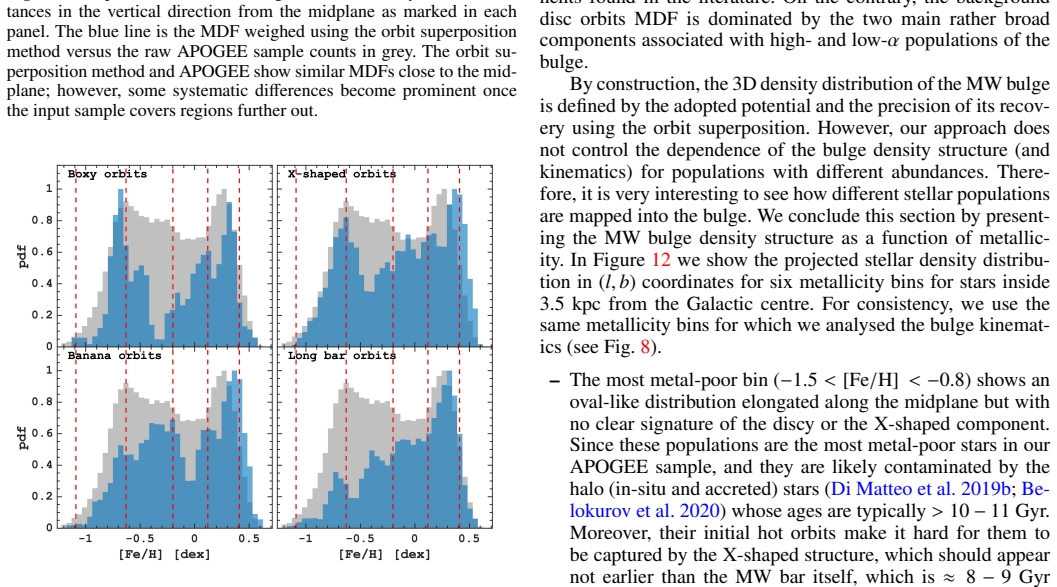
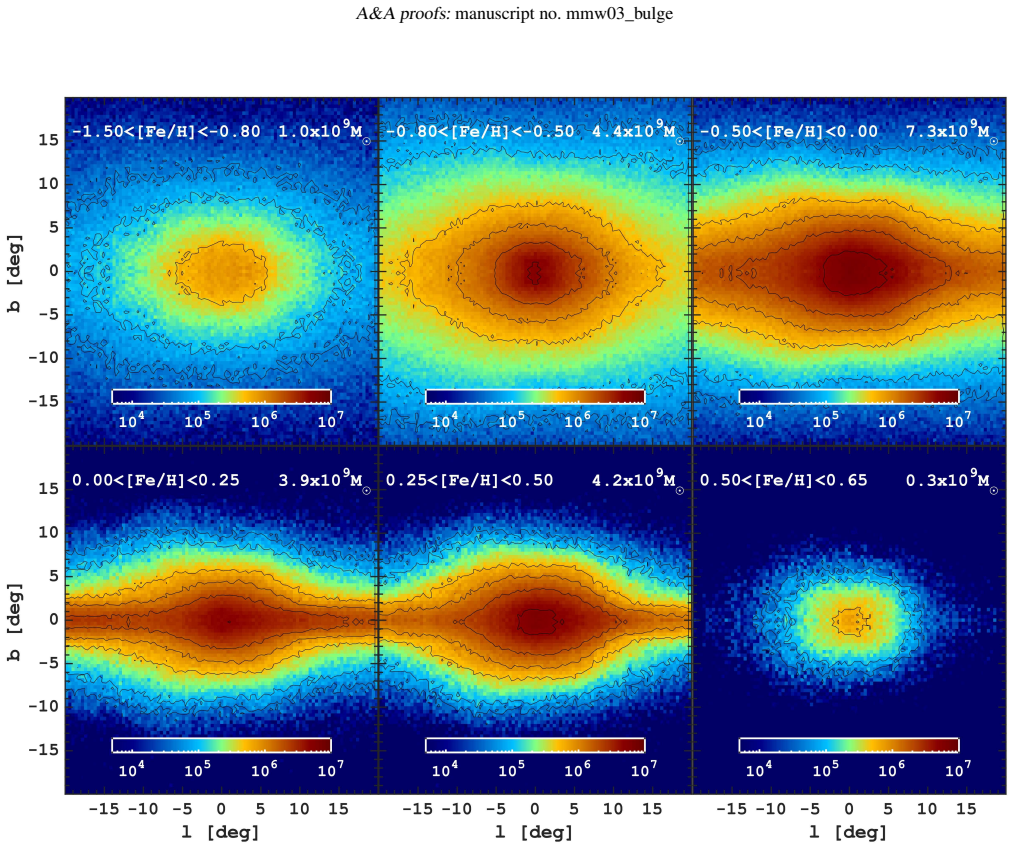
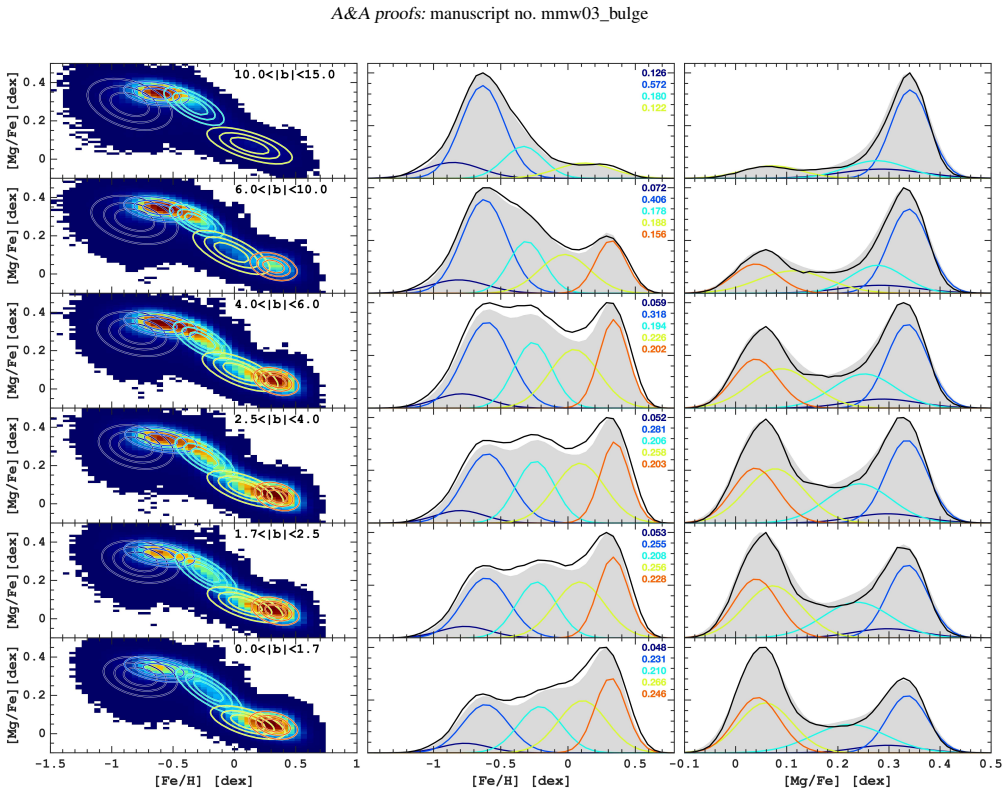
On the paper's own terms, the discovery is that the present-day Milky Way bulge is built from the same two chemical discs that extend to the solar neighbourhood: an inner thick disc that is metal-poor with subsolar metallicity and high [Mg/Fe] (the high-$\alpha$ population) and a thin disc that is metal-rich with supersolar metallicity and low [Mg/Fe], contributing in a 4:3 mass ratio inside 3.5 kpc. The paper argues that the apparent metal-poorness of the bulge in (l,b) projections is a projection effect: near the midplane the metal-rich, kinematically cold population has been pushed above the plane by the vertical bar instability, so once the full vertical extent is counted the bulge and the bar major axis are more metal-rich than the surrounding disc. It also finds that no single metallicity gradient describes the bulge: radial gradients trace the X-shaped density structure and vertical gradients trace the boxy component, which explains why surveys covering different fields have reported different gradient values. The most metal-poor of five 2D Gaussian components in the [Fe/H]-[Mg/Fe] plane carries the chemical signature of accreted stars and a mass near $8\times10^8\,M_\odot$.
Load-bearing premise
The entire reconstruction assumes the adopted analytic model of the inner Milky Way's mass distribution, which already contains the X-shaped bar, is the true potential, and that the Galaxy is in dynamical equilibrium with a bar rotating at a fixed 37 km/s/kpc; because the orbit weights are fitted to reproduce that same model's density, the recovered X-shape, orbital families, and mass ratios are partly built into the input rather than independently derived from the data.
Editorial extensions
If this is right
- The bulge's two main populations are the inner extensions of the thick and thin discs, so the bulge's chemical history is largely the disc's chemical history, not a separate spheroidal formation event.
- The 4:3 mass ratio between the metal-poor high-alpha and metal-rich low-alpha components in the bulge, if correct, is a constraint on the relative masses of the thick and thin disc populations before the bar buckled.
- Because the recovered metallicity gradients vary across the bulge and trace the X-shaped and boxy structure, different spectroscopic surveys of different fields can legitimately report different gradients, and there is no single bulge gradient to compare.
- The small accreted component of about $8\times10^8\,M_\odot$ for stars with [Fe/H] above about -1.2, together with the absence of a significant spheroid, reinforces the picture of the Milky Way as a secularly formed barred galaxy.
- Future bulge surveys that cover the midplane regions APOGEE misses should see a metal-rich bar along the major axis, matching the paper's prediction.
Reading between the lines
- Editorial inference: a direct test the authors do not perform is to leave the bar pattern speed free rather than fixed at 37 km/s/kpc; the inferred resonance families, bar mass, and the 4:3 thin-to-thick disc ratio could shift if the adopted speed is wrong.
- Editorial inference: because the X-shape is present in the input potential, the orbital-family decomposition is best read as a property of the assumed potential combined with the data, not as an independent measurement of the Milky Way's orbital structure.
- Editorial inference: the same orbit-superposition method could be applied to external barred galaxies with integral-field spectroscopy, replacing the chemical painting step with stellar-population gradients from IFU data to test whether the metal-rich-bar pattern is universal.
- Editorial inference: the metal-rich bar along the major axis implies that kinematic fractionation plus suppressed star formation, rather than in-situ enrichment, sets the abundance pattern; age-dating the metal-rich bulge stars, which the paper omits because of age-catalogue quality issues, could separate these explanations.
Editorial analysis
A structured set of objections, weighed in public.
Referee Report
Summary. The paper applies the orbit superposition (Schwarzschild) method, previously developed in Papers I and II, to APOGEE DR17 giant stars with Gaia astrometry to reconstruct the 3D density, kinematics, and chemical abundance structure of the Milky Way bulge. The headline results are: (i) the bulge is composed of two main populations, a metal-poor high-alpha thick disc and a metal-rich low-alpha thin disc, with a mass ratio of 4:3; (ii) a five-component 2D GMM decomposition of the [Fe/H]-[Mg/Fe] plane, including a most metal-poor component of likely ex-situ origin with mass about 8e8 M_sun; (iii) the bulge metallicity gradients are spatially variable and trace the X-shaped/boxy density structure; and (iv) although the bulge has slightly subsolar mean metallicity, it is metal-rich relative to the surrounding disc once its full vertical extent is considered. The paper frames these results as evidence that the Milky Way is a typical secularly formed barred galaxy.
Significance. The orbit superposition approach is a promising technique for correcting survey footprint and selection-function biases, and the paper demonstrates its application to a large spectroscopic sample. If the central claims hold, the paper would provide a coherent chemo-kinematic picture of the bulge that supports the bar-buckling scenario and places the Milky Way among external barred galaxies with metal-rich boxy/peanut bulges. The reconstruction of footprint-independent maps, e.g., the face-on metallicity maps in Fig. 15, is a useful methodological contribution. However, the significance is substantially conditional on breaking the circularity with the adopted potential: the orbit weights are fitted to the Sormani et al. (2022) analytic density, which already contains the X-shaped bar, so the recovered morphology and orbital families are partly inherited from the input. The chemical results (mass ratio, GMM decomposition, accreted mass) are less circular, but they lack systematic uncertainty estimates and robustness tests against the adopted potential and pattern speed.
major comments (3)
- [Section 2.2 and Section 3.1] The orbit weights are adjusted to reproduce the analytic 3D stellar density of Sormani et al. (2022), which already contains the X-shaped/boxy bar. Consequently, the 'successful recovery' of the X-shape and boxy morphology in Figs. 1-3 and the orbital family decomposition in Figs. 4-5 are largely a re-projection of the input mass model. The manuscript itself acknowledges this in Section 5 (the sentence beginning 'By construction, the 3D density distribution of the MW bulge is defined by the adopted potential'), but the framing in Section 3.1 and in the Summary ('successfully reconstruct the 3D stellar density structure ... including capturing the distinct X-shaped/boxy structure') overstates the independence of the result. I request either a reframing as a consistency check or, preferably, a stress test with an alternative potential (e.g., one without a boxy/peanut bar, or with a different bar strength/pattern speed) to demonstrate that the orbit superposition plus APOGEE data alone would not artificially produce the X-shape.
- [Section 5.3] The headline numbers -- the 4:3 high-alpha/low-alpha mass ratio and the 8e8 M_sun accreted-mass estimate -- are quoted without error bars or sensitivity analysis. The mass ratio depends on the arbitrary choice of the high-/low-alpha boundary shown as the white line in Fig. 9, and the accreted mass depends on the GMM membership probabilities, which the authors admit are contaminated. The 50 resamplings only provide scatter in the GMM component centres, not in the model selection or in the derived masses. I ask the authors to provide uncertainty estimates and to test how the mass ratio and accreted mass change when the alpha boundary is varied within a reasonable range, and when the bar pattern speed is varied within the plausible 30-45 km/s/kpc range.
- [Section 5.1 and Section 5.2] The claim that 'no universal metallicity gradient value can characterise the MW bulge' and the conclusion that the bulge is metal-rich relative to the surrounding disc (Fig. 15) rely on density-weighted abundance maps that are constructed from the same orbit superposition. Since the density field is fitted to the adopted potential, the spatial variations of the gradients, including the claim that radial gradients 'closely trace the X-shaped bulge density structure' (Fig. 14), may be partly inherited from the input density rather than from the APOGEE chemistry. A concrete test would be to paint the same APOGEE abundances onto orbits integrated in a different (e.g., axisymmetric or non-X-shaped) potential and compare the resulting gradient maps. Without such a test, the reader cannot assess how much of the chemo-morphological correlation is driven by the assumed potential.
minor comments (4)
- [Section 6] There is a typo in the final paragraph: 'the MW bugle story' should be 'the MW bulge story'.
- [Section 4] In the discussion of extremely metal-rich populations, 'do not suggest the precents of the classical bulge' should be 'do not suggest the presence of a classical bulge'.
- [Section 5.3] The word 'metallcity' in the paragraph beginning 'The fact that we observe a gap' should be 'metallicity'.
- [General] The notation for the orbital frequency ratio is inconsistent: the text uses fr/fx and fz/fx, but the caption of Fig. 4 defines the top panel as 'in-plane orbital frequency ratio, fr/fx' and the bottom as 'fz/fx'. Please define all frequencies once in the text and use consistent notation throughout.
Circularity Check
The 3D density and X-shape are fit to the Sormani et al. (2022) analytic potential that already contains the X-shape; chemical maps and mass ratios are conditional on that potential but add independent abundance information.
-
fitted input called prediction
[Section 2.2 (Orbit superposition method), Section 3.1, Section 5.0.1]
"We adopt the 3D mass distribution of the MW ... from Sormani et al. (2022), which ... reproduces well the 3D density of the bar, including the X-shape structure of the bulge. ... The weights of the orbits ... were calculated by adjusting their total 3D density to the analytic solution for the stellar component from Sormani et al. (2022). ... By construction, the 3D density distribution of the MW bulge is defined by the adopted potential and the precision of its recovery using the orbit superposition."
The orbit weights are the free parameters adjusted to match the analytic stellar density of Sormani et al. (2022), and that same adopted model is explicitly described as already containing the X-shaped bulge. Therefore the boxy/X-shaped 3D density presented as 'reconstructed' in Figs. 1-3 and claimed in Section 6 as a successful recovery is the fit target re-expressed through orbits. The morphological structure is inherited from the input potential rather than independently predicted from the APOGEE/Gaia data. The paper's own sentence 'By construction...' concedes this reduction.
-
fitted input called prediction
[Section 3.2 (Orbits of the MW bulge), Figs. 4-5]
"The stellar mass-weighted distribution roughly follows the ones presented in Portail et al. (2015); however, in our case, the peak at fz/fx≈2, corresponding to the banana-like orbits, is more prominent. We find that about 36% of the bar mass is represented by orbits of this class. ... This discrepancy comes from a higher mass of the peanut and the long bar components which was increased in Portail et al. (2017), providing a better agreement for the bar pattern speed, and propagated to the analytic potential we adapt in our modelling."
The orbital families and their mass fractions (e.g., ~36% banana-like, ~30% X-shaped) are computed from orbits integrated in the Sormani et al. (2022) potential and weighted by coefficients fit to that same potential's analytic density. The paper explicitly attributes the difference from Portail et al. (2015) to changes already built into the adopted Portail et al. (2017) potential. Presenting this decomposition as the 'orbital composition of the MW bulge' (Section 4 and Section 6) is therefore a re-description of the assumed potential and fitted density, not an empirical finding from the stellar data.
full rationale
The structural core of the paper—the recovered 3D density, the X-shape, and the orbital-family decomposition—is not an independent prediction: the orbit weights are adjusted to reproduce the analytic stellar density of Sormani et al. (2022), which already includes the X-shaped bar. The paper itself states that 'by construction' the 3D density is defined by the adopted potential, so presenting the X-shape as a successful reconstruction is a fitted-input result. The chemical results (high-/low-alpha mass ratio of 4:3, five GMM components, ~8e8 Msun ex-situ component) are not fit targets and do add information from APOGEE abundances, but they are conditional on the same potential, constant pattern speed 37 km/s/kpc, dynamical equilibrium, and the assumption that stars can be painted along orbits. No load-bearing uniqueness theorem or self-citation chain is invoked, and the method papers (Paper I/II) provide mock-data validation; the limitation is the dependence of the headline structural claims on the input mass model. A potential-replacement or pattern-speed-variation stress test would be needed to establish how much of the orbital and gradient structure is genuinely data-driven.
Assumptions & free parameters
free parameters (1)
- High-alpha vs low-alpha separation boundary in [Fe/H]-[Mg/Fe] plane =
White dividing line in Fig. 9, imported from Paper II
assumptions (4)
- domain assumption The inner MW is in dynamical equilibrium, rotating rigidly with a constant bar pattern speed of 37 km/s/kpc.
- domain assumption The analytic 3D mass distribution of Sormani et al. 2022, which already contains the X-shaped/boxy bar, is the correct gravitational potential of the MW.
- domain assumption APOGEE giant stars on the same orbit have the same chemical abundance distribution, so abundances can be painted along orbits without additional chemo-kinematic relations.
- domain assumption Star formation is negligible in the bar region, so present-day chemistry reflects initial abundances plus dynamical mixing, not ongoing enrichment.
Cite this review
Pith. "Pith review of Rediscovering the Milky Way with orbit superposition approach and APOGEE data III. Panoramic view of the bulge." pith.science (2026). https://pith.science/paper/S3DSCXZI
@misc{pith2026241118182,
  author       = {Pith},
  title        = {Pith review of: Rediscovering the Milky Way with orbit superposition approach and APOGEE data III. Panoramic view of the bulge},
  year         = {2026},
  howpublished = {\url{https://pith.science/paper/S3DSCXZI}},
  note         = {Machine review of arXiv:2411.18182}
}
read the original abstract
The innermost parts of the Milky Way (MW) are very difficult to observe due to the high extinction along the line of sight, especially close to the disc mid-plane. However, this region contains the most massive complex stellar component of the MW, the bulge, primarily composed of disc stars whose structure is (re-)shaped by the evolution of the bar. In this work, we extend the application of the orbit superposition method to explore the present-day 3D structure, orbital composition, chemical abundance trends and kinematics of the MW bulge. Thanks to our approach, we are able to transfer astrometry from Gaia and stellar parameters from APOGEE DR 17 to map the inner MW without obscuration by the survey footprint and selection function. We demonstrate that the MW bulge is made of two main populations originating from a metal-poor, high-{\alpha} thick disc and a metal-rich, low-{\alpha} thin disc, with a mass ratio of 4:3, seen as two major components in the MDF. Finer MDF structures hint at multiple sub-populations associated with different orbital families of the bulge, which, however, have broad MDFs themselves. Decomposition using 2D GMMs in [Fe/H] -[Mg/Fe] identifies five components including a population with ex-situ origin. Two dominant ones correspond to the thin and thick discs and two in between trace the transition between them. We show that no universal metallicity gradient value can characterise the MW bulge. The radial gradients closely trace the X-shaped bulge density structure, while the vertical gradient variations follow the boxy component. While having, on average, subsolar metallicity, the MW bulge populations are more metal-rich compared to the surrounding disc, in agreement with extragalactic observations and state-of-the-art simulations reinforcing its secular origin.
Figures


Figures from the paper (15 more)






Reference graph
Works this paper leans on
-
[1]
2022, ApJS, 259, 35
Abdurro’uf, Accetta, K., Aerts, C., et al. 2022, ApJS, 259, 35
2022
-
[2]
Aguerri, J. A. L., Méndez-Abreu, J., Falcón-Barroso, J., et al. 2015, A&A, 576, A102
2015
-
[3]
F., Argudo-Fernández, M., et al
Almeida, A., Anderson, S. F., Argudo-Fernández, M., et al. 2023, ApJS, 267, 44
2023
-
[4]
2010, A&A, 513, A35
Alves-Brito, A., Meléndez, J., Asplund, M., Ramírez, I., & Yong, D. 2010, A&A, 513, A35
2010
-
[5]
R., Gough-Kelly, S., Debattista, V
Anderson, S. R., Gough-Kelly, S., Debattista, V . P., et al. 2024, MNRAS, 527, 2919
2024
-
[6]
2018, Nature, 561, 360
Antoja, T., Helmi, A., Romero-Gómez, M., et al. 2018, Nature, 561, 360
2018
-
[7]
F., et al
Arentsen, A., Starkenburg, E., Martin, N. F., et al. 2020, MNRAS, 491, L11
2020
-
[8]
2003, MNRAS, 341, 1179
Athanassoula, E. 2003, MNRAS, 341, 1179
2003
Show all 206 references
-
[9]
2008, in IAU Symposium, V ol
Athanassoula, E. 2008, in IAU Symposium, V ol. 245, Formation and Evolution of Galaxy Bulges, ed. M. Bureau, E. Athanassoula, & B. Barbuy, 93–102
2008
-
[10]
& Misiriotis, A
Athanassoula, E. & Misiriotis, A. 2002, MNRAS, 330, 35
2002
-
[11]
& Gilmore, G
Babusiaux, C. & Gilmore, G. 2005, MNRAS, 358, 1309
2005
-
[12]
2010, A&A, 519, A77
Babusiaux, C., Gómez, A., Hill, V ., et al. 2010, A&A, 519, A77
2010
-
[13]
2018, ARA&A, 56, 223
Barbuy, B., Chiappini, C., & Gerhard, O. 2018, ARA&A, 56, 223
2018
-
[14]
Barbuy, B., Friaça, A. C. S., Ernandes, H., et al. 2023, MNRAS, 526, 2365
2023
-
[15]
W., Koposov, S
Belokurov, V ., Erkal, D., Evans, N. W., Koposov, S. E., & Deason, A. J. 2018, MNRAS, 478, 611
2018
-
[16]
& Kravtsov, A
Belokurov, V . & Kravtsov, A. 2022, MNRAS, 514, 689
2022
-
[17]
& Kravtsov, A
Belokurov, V . & Kravtsov, A. 2023, MNRAS, 525, 4456
2023
-
[18]
L., Fattahi, A., et al
Belokurov, V ., Sanders, J. L., Fattahi, A., et al. 2020, MNRAS, 494, 3880
2020
-
[19]
2011, A&A, 533, A134
Bensby, T., Adén, D., Meléndez, J., et al. 2011, A&A, 533, A134
2011
-
[20]
2019, The Messenger, 175, 35
Bensby, T., Bergemann, M., Rybizki, J., et al. 2019, The Messenger, 175, 35
2019
-
[21]
2017, A&A, 605, A89
Bensby, T., Feltzing, S., Gould, A., et al. 2017, A&A, 605, A89
2017
-
[22]
A., et al
Bensby, T., Feltzing, S., Johnson, J. A., et al. 2010, A&A, 512, A41
2010
-
[23]
2003, A&A, 410, 527
Bensby, T., Feltzing, S., & Lundström, I. 2003, A&A, 410, 527
2003
-
[24]
Bensby, T., Feltzing, S., & Oey, M. S. 2014, A&A, 562, A71
2014
-
[25]
C., et al
Bensby, T., Feltzing, S., Yee, J. C., et al. 2020, A&A, 634, A130
2020
-
[26]
2021, A&A, 655, A117
Bensby, T., Gould, A., Asplund, M., et al. 2021, A&A, 655, A117
2021
-
[27]
C., Feltzing, S., et al
Bensby, T., Yee, J. C., Feltzing, S., et al. 2013, A&A, 549, A147 Beraldo e Silva, L., Debattista, V . P., Anderson, S. R., et al. 2023, ApJ, 955, 38
2013
-
[28]
2024, arXiv e-prints, arXiv:2407.09799
Boin, T., Di Matteo, P., Khoperskov, S., et al. 2024, arXiv e-prints, arXiv:2407.09799
2024 arXiv
-
[29]
W., Hunt, J
Bovy, J., Leung, H. W., Hunt, J. A. S., et al. 2019, MNRAS, 490, 4740
2019
-
[30]
2012, ApJ, 753, 148
Bovy, J., Rix, H.-W., Liu, C., et al. 2012, ApJ, 753, 148
2012
-
[31]
& Papaderos, P
Breda, I. & Papaderos, P. 2018, A&A, 614, A48
2018
-
[32]
V ., & Dutton, A
Buck, T., Ness, M., Obreja, A., Macciò, A. V ., & Dutton, A. A. 2019, ApJ, 874, 67
2019
-
[33]
K., Macciò, A
Buck, T., Ness, M. K., Macciò, A. V ., Obreja, A., & Dutton, A. A. 2018, ApJ, 861, 88
2018
-
[34]
K., et al
Buder, S., Lind, K., Ness, M. K., et al. 2022, MNRAS, 510, 2407
2022
-
[35]
& Freeman, K
Bureau, M. & Freeman, K. C. 1999, AJ, 118, 126
1999
-
[36]
L., González-Fernández, C., et al
Cabrera-Lavers, A., Hammersley, P. L., González-Fernández, C., et al. 2007, A&A, 465, 825
2007
-
[37]
Chiba, R., Friske, J. K. S., & Schönrich, R. 2021, MNRAS, 500, 4710
2021
-
[38]
C., Fragkoudi, F., Khoperskov, S., Di Matteo, P., & Combes, F
Ciambur, B. C., Fragkoudi, F., Khoperskov, S., Di Matteo, P., & Combes, F. 2021, MNRAS, 503, 2203
2021
-
[39]
2020, The Messenger, 180, 10
Cirasuolo, M., Fairley, A., Rees, P., et al. 2020, The Messenger, 180, 10
2020
-
[40]
Clarke, J. P. & Gerhard, O. 2022, MNRAS, 512, 2171
2022
-
[41]
P., Wegg, C., Gerhard, O., et al
Clarke, J. P., Wegg, C., Gerhard, O., et al. 2019, MNRAS, 489, 3519
2019
-
[42]
& Sanders, R
Combes, F. & Sanders, R. H. 1981, A&A, 96, 164 de Jong, R. S., Agertz, O., Berbel, A. A., et al. 2019, The Messenger, 175, 3
1981
-
[43]
P., Carollo, C
Debattista, V . P., Carollo, C. M., Mayer, L., & Moore, B. 2004, ApJ, 604, L93
2004
-
[44]
P., Carollo, C
Debattista, V . P., Carollo, C. M., Mayer, L., & Moore, B. 2005, ApJ, 628, 678 Article number, page 20 of 24 S. Khoperskov et al.: Rediscovering the Milky Way bulge
2005
-
[45]
P., Gonzalez, O
Debattista, V . P., Gonzalez, O. A., Sanderson, R. E., et al. 2019, MNRAS, 485, 5073
2019
-
[46]
P., Liddicott, D
Debattista, V . P., Liddicott, D. J., Gonzalez, O. A., et al. 2023, ApJ, 946, 118
2023
-
[47]
P., Liddicott, D
Debattista, V . P., Liddicott, D. J., Khachaturyants, T., & Beraldo e Silva, L. 2020, MNRAS, 498, 3334
2020
-
[48]
P., Mayer, L., Carollo, C
Debattista, V . P., Mayer, L., Carollo, C. M., et al. 2006, ApJ, 645, 209
2006
-
[49]
P., Ness, M., Earp, S
Debattista, V . P., Ness, M., Earp, S. W. F., & Cole, D. R. 2015, ApJ, 812, L16
2015
-
[50]
P., Ness, M., Gonzalez, O
Debattista, V . P., Ness, M., Gonzalez, O. A., et al. 2017, MNRAS, 469, 1587
2017
-
[51]
Debattista, V . P. & Sellwood, J. A. 1998, ApJ, 493, L5
1998
-
[52]
Debattista, V . P. & Sellwood, J. A. 2000, ApJ, 543, 704 Dékány, I., Minniti, D., Catelan, M., et al. 2013, ApJ, 776, L19 Di Matteo, P. 2016, PASA, 33, e027 Di Matteo, P., Fragkoudi, F., Khoperskov, S., et al. 2019a, A&A, 628, A11 Di Matteo, P., Gómez, A., Haywood, M., et al. ...
2000
-
[53]
G., Hauser, M
Dwek, E., Arendt, R. G., Hauser, M. G., et al. 1995, ApJ, 445, 716
1995
-
[54]
1982, MNRAS, 199, 1069
Efstathiou, G., Lake, G., & Negroponte, J. 1982, MNRAS, 199, 1069
1982
-
[55]
2022, ApJ, 941, 162
Elia, D., Molinari, S., Schisano, E., et al. 2022, ApJ, 941, 162
2022
-
[56]
& Debattista, V
Erwin, P. & Debattista, V . P. 2017, MNRAS, 468, 2058
2017
-
[57]
& Gilmore, G
Feltzing, S. & Gilmore, G. 2000, A&A, 355, 949
2000
-
[58]
2023, A&A, 673, A44
Ferrone, S., Di Matteo, P., Mastrobuono-Battisti, A., et al. 2023, A&A, 673, A44
2023
-
[59]
K., Sahlholdt, C
Feuillet, D. K., Sahlholdt, C. L., Feltzing, S., & Casagrande, L. 2021, MNRAS, 508, 1489
2021
-
[60]
2018, A&A, 616, A180
Fragkoudi, F., Di Matteo, P., Haywood, M., et al. 2018, A&A, 616, A180
2018
-
[61]
Fragkoudi, F., Grand, R. J. J., Pakmor, R., et al. 2020, MNRAS, 494, 5936
2020
-
[62]
Fragkoudi, F., Grand, R. J. J., Pakmor, R., et al. 2021, A&A, 650, L16
2021
-
[63]
2019, MNRAS, 488, 3324
Fragkoudi, F., Katz, D., Trick, W., et al. 2019, MNRAS, 488, 3324
2019
-
[64]
2020, MN- RAS, 499, 1116
Fraser-McKelvie, A., Merrifield, M., Aragón-Salamanca, A., et al. 2020, MN- RAS, 499, 1116
2020
-
[65]
Gadotti, D. A. 2011, MNRAS, 415, 3308 Gaia Collaboration, Antoja, T., McMillan, P. J., et al. 2021, A&A, 649, A8 Gaia Collaboration, Drimmel, R., Romero-Gómez, M., et al. 2023a, A&A, 674, A37 Gaia Collaboration, Katz, D., Antoja, T., et al. 2018, A&A, 616, A11 Gaia Collaborati...
2011
-
[66]
George, K., Subramanian, S., & Paul, K. T. 2019, A&A, 628, A24
2019
-
[67]
2020, in IAU Symposium, V ol
Gerhard, O. 2020, in IAU Symposium, V ol. 353, Galactic Dynamics in the Era of Large Surveys, ed. M. Valluri & J. A. Sellwood, 26–28 Géron, T., Smethurst, R. J., Lintott, C., et al. 2021, MNRAS, 507, 4389 Gómez, A., Di Matteo, P., Stefanovitch, N., et al. 2016, A&A, 589, A122
2020
-
[68]
A., Debattista, V
Gonzalez, O. A., Debattista, V . P., Ness, M., Erwin, P., & Gadotti, D. A. 2017, MNRAS, 466, L93
2017
-
[69]
A., Gadotti, D
Gonzalez, O. A., Gadotti, D. A., Debattista, V . P., et al. 2016, A&A, 591, A7
2016
-
[70]
A., Mucciarelli, A., Origlia, L., et al
Gonzalez, O. A., Mucciarelli, A., Origlia, L., et al. 2020, The Messenger, 180, 18
2020
-
[71]
A., Rejkuba, M., Zoccali, M., et al
Gonzalez, O. A., Rejkuba, M., Zoccali, M., et al. 2011, A&A, 530, A54
2011
-
[72]
A., Rejkuba, M., Zoccali, M., et al
Gonzalez, O. A., Rejkuba, M., Zoccali, M., et al. 2013, A&A, 552, A110
2013
-
[73]
2019, MNRAS, 482, 1733
Guo, R., Mao, S., Athanassoula, E., et al. 2019, MNRAS, 482, 1733
2019
-
[74]
R., Majewski, S
Hayes, C. R., Majewski, S. R., Shetrone, M., et al. 2018, ApJ, 852, 49
2018
-
[75]
D., Katz, D., & Gómez, A
Haywood, M., Di Matteo, P., Lehnert, M. D., Katz, D., & Gómez, A. 2013, A&A, 560, A109
2013
-
[76]
2024, A&A, 690, A147
Haywood, M., Khoperskov, S., Cerqui, V ., et al. 2024, A&A, 690, A147
2024
-
[77]
H., et al
Helmi, A., Babusiaux, C., Koppelman, H. H., et al. 2018, Nature, 563, 85
2018
-
[78]
& de Zeeuw, P
Helmi, A. & de Zeeuw, P. T. 2000, MNRAS, 319, 657
2000
-
[79]
2011, A&A, 534, A80
Hill, V ., Lecureur, A., Gómez, A., et al. 2011, A&A, 534, A80
2011
-
[80]
2020, MNRAS, 497, 933
Hilmi, T., Minchev, I., Buck, T., et al. 2020, MNRAS, 497, 933
2020
-
[81]
2009, A&A, 501, 941
Holmberg, J., Nordström, B., & Andersen, J. 2009, A&A, 501, 941
2009
-
[82]
D., Rich, R
Howard, C. D., Rich, R. M., Clarkson, W., et al. 2009, ApJ, 702, L153
2009
-
[83]
D., Rich, R
Howard, C. D., Rich, R. M., Reitzel, D. B., et al. 2008, ApJ, 688, 1060
2008
-
[84]
Hunt, J. A. S. & Bovy, J. 2018, MNRAS, 477, 3945
2018
-
[85]
A., et al
Imig, J., Price, C., Holtzman, J. A., et al. 2023, ApJ, 954, 124
2023
-
[86]
2017, A&A, 604, A106
Jean-Baptiste, I., Di Matteo, P., Haywood, M., et al. 2017, A&A, 604, A106
2017
-
[87]
I., Rich, R
Johnson, C. I., Rich, R. M., Kobayashi, C., & Fulbright, J. P. 2012, ApJ, 749, 175
2012
-
[88]
I., Rich, R
Johnson, C. I., Rich, R. M., Kobayashi, C., Kunder, A., & Koch, A. 2014, AJ, 148, 67
2014
-
[89]
I., Rich, R
Johnson, C. I., Rich, R. M., Simion, I. T., et al. 2022, MNRAS, 515, 1469
2022
-
[90]
L., et al
Kacharov, N., Tahmasebzadeh, B., Cioni, M.-R. L., et al. 2024, arXiv e-prints, arXiv:2410.05374
2024 arXiv
-
[91]
& Gerhard, O
Khoperskov, S. & Gerhard, O. 2022, A&A, 663, A38
2022
-
[92]
2020, A&A, 634, L8
Khoperskov, S., Gerhard, O., Di Matteo, P., et al. 2020, A&A, 634, L8
2020
-
[93]
2023b, arXiv e-prints, arXiv:2310.05287
Khoperskov, S., Minchev, I., Steinmetz, M., et al. 2023b, arXiv e-prints, arXiv:2310.05287
-
[94]
2024, arXiv e-prints, arXiv:2411.15062 Khoperskov et al
Khoperskov, S., van de Ven, G., Steinmetz, M., et al. 2024, arXiv e-prints, arXiv:2411.15062 Khoperskov et al. 2024, A&A
2024 arXiv
-
[95]
& Kennicutt, Robert C., J
Kormendy, J. & Kennicutt, Robert C., J. 2004, ARA&A, 42, 603
2004
-
[96]
M., et al
Kunder, A., Koch, A., Rich, R. M., et al. 2012, AJ, 143, 57
2012
-
[97]
M., et al
Kunder, A., Pérez-Villegas, A., Rich, R. M., et al. 2020, AJ, 159, 270
2020
-
[98]
M., Koch, A., et al
Kunder, A., Rich, R. M., Koch, A., et al. 2016, ApJ, 821, L25
2016
-
[99]
Leung, H. W. & Bovy, J. 2019, MNRAS, 489, 2079
2019
-
[100]
W., Bovy, J., Mackereth, J
Leung, H. W., Bovy, J., Mackereth, J. T., & Miglio, A. 2023, MNRAS, 522, 4577
2023
-
[101]
& Shen, J
Li, Z.-Y . & Shen, J. 2012, ApJ, 757, L7
2012
-
[102]
Lian, J., Bergemann, M., Pillepich, A., Zasowski, G., & Lane, R. R. 2023, Nature Astronomy, 7, 951 Łokas, E. L. 2019, A&A, 629, A52
2023
-
[103]
T., Schiavon, R
Mackereth, J. T., Schiavon, R. P., Pfeffer, J., et al. 2019, MNRAS, 482, 3426
2019
-
[104]
A., Sharma, S., et al
Malhan, K., Ibata, R. A., Sharma, S., et al. 2022, ApJ, 926, 107
2022
-
[105]
& Gerhard, O
Martinez-Valpuesta, I. & Gerhard, O. 2011, ApJ, 734, L20
2011
-
[106]
& Gerhard, O
Martinez-Valpuesta, I. & Gerhard, O. 2013, ApJ, 766, L3
2013
-
[107]
2006, ApJ, 637, 214
Martinez-Valpuesta, I., Shlosman, I., & Heller, C. 2006, ApJ, 637, 214
2006
-
[108]
2016, PASA, 33, e040
McWilliam, A. 2016, PASA, 33, e040
2016
-
[109]
& Zoccali, M
McWilliam, A. & Zoccali, M. 2010, ApJ, 724, 1491
2010
-
[110]
& Sellwood, J
Merritt, D. & Sellwood, J. A. 1994, ApJ, 425, 551
1994
-
[111]
2013, A&A, 558, A9
Minchev, I., Chiappini, C., & Martig, M. 2013, A&A, 558, A9
2013
-
[112]
W., Emerson, J
Minniti, D., Lucas, P. W., Emerson, J. P., et al. 2010, New A, 15, 433
2010
-
[113]
W., Liebert, J., et al
Minniti, D., Olszewski, E. W., Liebert, J., et al. 1995, MNRAS, 277, 1293
1995
-
[114]
2016, MN- RAS, 456, 692
Molaeinezhad, A., Falcón-Barroso, J., Martínez-Valpuesta, I., et al. 2016, MN- RAS, 456, 692
2016
-
[115]
Moorthy, B. K. & Holtzman, J. A. 2006, MNRAS, 371, 583
2006
-
[116]
2024, A&A, 690, A136
Mori, A., Di Matteo, P., Salvadori, S., et al. 2024, A&A, 690, A136
2024
-
[117]
C., Belokurov, V ., Aguado, D
Myeong, G. C., Belokurov, V ., Aguado, D. S., et al. 2022, ApJ, 938, 21
2022
-
[118]
2024, ApJ, 964, 96
Nandakumar, G., Ryde, N., Mace, G., et al. 2024, ApJ, 964, 96
2024
-
[119]
2017, A&A, 606, A97
Nandakumar, G., Schultheis, M., Hayden, M., et al. 2017, A&A, 606, A97
2017
-
[120]
Nataf, D. M. 2017, PASA, 34, e041
2017
-
[121]
M., Udalski, A., Gould, A., Fouqué, P., & Stanek, K
Nataf, D. M., Udalski, A., Gould, A., Fouqué, P., & Stanek, K. Z. 2010, ApJ, 721, L28
2010
-
[122]
P., Bensby, T., et al
Ness, M., Debattista, V . P., Bensby, T., et al. 2014, ApJ, 787, L19
2014
-
[123]
& Freeman, K
Ness, M. & Freeman, K. 2016, PASA, 33, e022
2016
-
[124]
2013b, MNRAS, 432, 2092
Ness, M., Freeman, K., Athanassoula, E., et al. 2013b, MNRAS, 432, 2092
-
[125]
2012, ApJ, 756, 22
Ness, M., Freeman, K., Athanassoula, E., et al. 2012, ApJ, 756, 22
2012
-
[126]
& Lang, D
Ness, M. & Lang, D. 2016, AJ, 152, 14
2016
-
[127]
A., et al
Ness, M., Zasowski, G., Johnson, J. A., et al. 2016, ApJ, 819, 2
2016
-
[128]
2020, A&A, 637, A56
Neumann, J., Fragkoudi, F., Pérez, I., et al. 2020, A&A, 637, A56
2020
-
[129]
2024, MNRAS, 534, 2438 Nordström, B., Mayor, M., Andersen, J., et al
Neumann, J., Thomas, D., Maraston, C., et al. 2024, MNRAS, 534, 2438 Nordström, B., Mayor, M., Andersen, J., et al. 2004, A&A, 418, 989
2024
-
[130]
1977, Nature, 265, 515
Okuda, H., Maihara, T., Oda, N., & Sugiyama, T. 1977, Nature, 265, 515
1977
-
[131]
1995, Nature, 377, 701
Ortolani, S., Renzini, A., Gilmozzi, R., et al. 1995, Nature, 377, 701
1995
-
[132]
Ostriker, J. P. & Peebles, P. J. E. 1973, ApJ, 186, 467
1973
-
[133]
2023, A&A, 673, A86
Pagnini, G., Di Matteo, P., Khoperskov, S., et al. 2023, A&A, 673, A86
2023
-
[134]
E., Wetzel, A., et al
Panithanpaisal, N., Sanderson, R. E., Wetzel, A., et al. 2021, ApJ, 920, 10
2021
-
[135]
D., Smirnov, A
Parul, H. D., Smirnov, A. A., & Sotnikova, N. Y . 2020, ApJ, 895, 12
2020
-
[136]
Patsis, P. A. & Athanassoula, E. 2019, MNRAS, 490, 2740
2019
-
[137]
Patsis, P. A. & Harsoula, M. 2018, A&A, 612, A114
2018
-
[138]
Patsis, P. A. & Katsanikas, M. 2014, MNRAS, 445, 3525
2014
-
[139]
A., Skokos, C., & Athanassoula, E
Patsis, P. A., Skokos, C., & Athanassoula, E. 2002, MNRAS, 337, 578
2002
-
[140]
& Friedli, D
Pfenniger, D. & Friedli, D. 1991, A&A, 252, 75
1991
-
[141]
2012, ApJ, 750, 169
Pietrukowicz, P., Udalski, A., Soszy´nski, I., et al. 2012, ApJ, 750, 169
2012
-
[142]
M., Zhu, L., & van de Ven, G
Poci, A., McDermid, R. M., Zhu, L., & van de Ven, G. 2019, MNRAS, 487, 3776
2019
-
[143]
G., et al
Poggio, E., Drimmel, R., Lattanzi, M. G., et al. 2018, MNRAS, 481, L21
2018
-
[144]
2024, arXiv e-prints, arXiv:2407.18659
Poggio, E., Khanna, S., Drimmel, R., et al. 2024, arXiv e-prints, arXiv:2407.18659
2024 arXiv
-
[145]
2017, MNRAS, 465, 1621
Portail, M., Gerhard, O., Wegg, C., & Ness, M. 2017, MNRAS, 465, 1621
2017
-
[146]
2015, MNRAS, 448, 713
Portail, M., Wegg, C., Gerhard, O., & Martinez-Valpuesta, I. 2015, MNRAS, 448, 713
2015
-
[147]
Queiroz, A. B. A., Anders, F., Chiappini, C., et al. 2023, A&A, 673, A155
2023
-
[148]
Queiroz, A. B. A., Chiappini, C., Perez-Villegas, A., et al. 2021, A&A, 656, A156
2021
-
[149]
Quillen, A. C. 2002, AJ, 124, 722
2002
-
[150]
C., Minchev, I., Sharma, S., Qin, Y .-J., & Di Matteo, P
Quillen, A. C., Minchev, I., Sharma, S., Qin, Y .-J., & Di Matteo, P. 2014, MN- RAS, 437, 1284 Article number, page 21 of 24 A&A proofs: manuscript no. mmw03_bulge
2014
-
[151]
A., James, R
Raha, N., Sellwood, J. A., James, R. A., & Kahn, F. D. 1991, Nature, 352, 411
1991
-
[152]
B., & Stanek, K
Rangwala, N., Williams, T. B., & Stanek, K. Z. 2009, ApJ, 691, 1387
2009
-
[153]
J., Mao, S., Sumi, T., & Smith, M
Rattenbury, N. J., Mao, S., Sumi, T., & Smith, M. C. 2007, MNRAS, 378, 1064
2007
-
[154]
E., Tomkin, J., Lambert, D
Reddy, B. E., Tomkin, J., Lambert, D. L., & Allende Prieto, C. 2003, MNRAS, 340, 304
2003
-
[155]
Rich, R. M. 1990, ApJ, 362, 604
1990
-
[156]
M., Origlia, L., & Valenti, E
Rich, R. M., Origlia, L., & Valenti, E. 2007, ApJ, 665, L119
2007
-
[157]
2024, ApJ, 975, 293
Rix, H.-W., Chandra, V ., Zasowski, G., et al. 2024, ApJ, 975, 293
2024
-
[158]
2017, A&A, 601, A140
Rojas-Arriagada, A., Recio-Blanco, A., de Laverny, P., et al. 2017, A&A, 601, A140
2017
-
[159]
2014, A&A, 569, A103
Rojas-Arriagada, A., Recio-Blanco, A., Hill, V ., et al. 2014, A&A, 569, A103
2014
-
[160]
2020, MNRAS, 499, 1037
Rojas-Arriagada, A., Zasowski, G., Schultheis, M., et al. 2020, MNRAS, 499, 1037
2020
-
[161]
2019, A&A, 626, A16
Rojas-Arriagada, A., Zoccali, M., Schultheis, M., et al. 2019, A&A, 626, A16
2019
-
[162]
2010, A&A, 509, A20
Ryde, N., Gustafsson, B., Edvardsson, B., et al. 2010, A&A, 509, A20
2010
-
[163]
& Gerhard, O
Saha, K. & Gerhard, O. 2013, MNRAS, 430, 2039
2013
-
[164]
2016, A&A, 588, A42
Saha, K., Gerhard, O., & Martinez-Valpuesta, I. 2016, A&A, 588, A42
2016
-
[165]
2012, MNRAS, 421, 333
Saha, K., Martinez-Valpuesta, I., & Gerhard, O. 2012, MNRAS, 421, 333
2012
-
[166]
K., Zoccali, M., McWilliam, A., et al
Saito, R. K., Zoccali, M., McWilliam, A., et al. 2011, AJ, 142, 76 Sánchez-Blázquez, P., Rosales-Ortega, F. F., Méndez-Abreu, J., et al. 2014, A&A, 570, A6
2011
-
[167]
L., Kawata, D., Matsunaga, N., et al
Sanders, J. L., Kawata, D., Matsunaga, N., et al. 2024, MNRAS, 530, 2972
2024
-
[168]
2020, A&A, 641, A96
Savino, A., Koch, A., Prudil, Z., Kunder, A., & Smolec, R. 2020, A&A, 641, A96
2020
-
[169]
2015, A&A, 584, A45
Schultheis, M., Cunha, K., Zasowski, G., et al. 2015, A&A, 584, A45
2015
-
[170]
E., et al
Schultheis, M., Rojas-Arriagada, A., García Pérez, A. E., et al. 2017, A&A, 600, A14
2017
-
[171]
1978, The Annals of Statistics, 6, 461
Schwarz, G. 1978, The Annals of Statistics, 6, 461
1978
-
[172]
Sellwood, J. A. 1981, A&A, 99, 362
1981
-
[173]
Sellwood, J. A. 2014, Reviews of Modern Physics, 86, 1
2014
-
[174]
Sellwood, J. A. & Gerhard, O. 2020, MNRAS, 495, 3175
2020
-
[175]
Sellwood, J. A. & Wilkinson, A. 1993, Reports on Progress in Physics, 56, 173
1993
-
[176]
A., Conroy, C., Chandra, V ., Hernquist, L., & Nelson, D
Semenov, V . A., Conroy, C., Chandra, V ., Hernquist, L., & Nelson, D. 2024, ApJ, 962, 84
2024
-
[177]
M., Kormendy, J., et al
Shen, J., Rich, R. M., Kormendy, J., et al. 2010, ApJ, 720, L72
2010
-
[178]
2011, MNRAS, 412, 2026
Siebert, A., Famaey, B., Minchev, I., et al. 2011, MNRAS, 412, 2026
2011
-
[179]
A., & Athanassoula, E
Skokos, C., Patsis, P. A., & Athanassoula, E. 2002, MNRAS, 333, 847
2002
-
[180]
C., Lucas, P
Smith, L. C., Lucas, P. W., Kurtev, R., et al. 2018, MNRAS, 474, 1826
2018
-
[181]
C., Gerhard, O., Portail, M., Vasiliev, E., & Clarke, J
Sormani, M. C., Gerhard, O., Portail, M., Vasiliev, E., & Clarke, J. 2022, MN- RAS, 514, L1
2022
-
[182]
M., & Kuijken, K
Soto, M., Rich, R. M., & Kuijken, K. 2007, ApJ, 665, L31
2007
-
[183]
A., Imig, J., et al
Stone-Martinez, A., Holtzman, J. A., Imig, J., et al. 2024, AJ, 167, 73
2024
-
[184]
2024, MNRAS, 534, 861
Tahmasebzadeh, B., Zhu, L., Shen, J., et al. 2024, MNRAS, 534, 861
2024
-
[185]
M., et al
Uttenthaler, S., Schultheis, M., Nataf, D. M., et al. 2012, A&A, 546, A57
2012
-
[186]
2019, MNRAS, 482, 1525
Vasiliev, E. 2019, MNRAS, 482, 1525
2019
-
[187]
& Valluri, M
Vasiliev, E. & Valluri, M. 2020, ApJ, 889, 39 Vásquez, S., Zoccali, M., Hill, V ., et al. 2013, A&A, 555, A91
2020
-
[188]
2024, MNRAS, 528, 3576
Vislosky, E., Minchev, I., Khoperskov, S., et al. 2024, MNRAS, 528, 3576
2024
-
[189]
J., & Shen, J
Wang, Y ., Mao, S., Long, R. J., & Shen, J. 2013, MNRAS, 435, 3437
2013
-
[190]
Wang, Y ., Zhao, H., Mao, S., & Rich, R. M. 2012, MNRAS, 427, 1429
2012
-
[191]
& Gerhard, O
Wegg, C. & Gerhard, O. 2013, MNRAS, 435, 1874
2013
-
[192]
2015, MNRAS, 450, 4050
Wegg, C., Gerhard, O., & Portail, M. 2015, MNRAS, 450, 4050
2015
-
[193]
Whitford, A. E. & Rich, R. M. 1983, ApJ, 274, 723
1983
-
[194]
Williams, M. E. K., Steinmetz, M., Binney, J., et al. 2013, MNRAS, 436, 101
2013
-
[195]
M., Gerhard, O
Wylie, S. M., Gerhard, O. E., Ness, M. K., et al. 2021, A&A, 653, A143
2021
-
[196]
E., Chojnowski, S
Zasowski, G., Cohen, R. E., Chojnowski, S. D., et al. 2017, AJ, 154, 198
2017
-
[197]
W., et al
Zhang, H., Belokurov, V ., Evans, N. W., et al. 2024, arXiv e-prints, arXiv:2408.16815
2024 arXiv
-
[198]
N., & Rich, R
Zhao, H., Spergel, D. N., & Rich, R. M. 1994, AJ, 108, 2154
1994
-
[199]
2020, MNRAS, 496, 1579
Zhu, L., van de Ven, G., Leaman, R., et al. 2020, MNRAS, 496, 1579
2020
-
[200]
2022, A&A, 664, A115
Zhu, L., van de Ven, G., Leaman, R., et al. 2022, A&A, 664, A115
2022
-
[201]
A., Vasquez, S., et al
Zoccali, M., Gonzalez, O. A., Vasquez, S., et al. 2014, A&A, 562, A66
2014
-
[202]
2008, A&A, 486, 177
Zoccali, M., Hill, V ., Lecureur, A., et al. 2008, A&A, 486, 177
2008
-
[203]
2006, A&A, 457, L1
Zoccali, M., Lecureur, A., Barbuy, B., et al. 2006, A&A, 457, L1
2006
-
[204]
2003, A&A, 399, 931
Zoccali, M., Renzini, A., Ortolani, S., et al. 2003, A&A, 399, 931
2003
-
[205]
Zoccali, M., Valenti, E., & Gonzalez, O. A. 2018, A&A, 618, A147
2018
-
[206]
A., et al
Zoccali, M., Vasquez, S., Gonzalez, O. A., et al. 2017, A&A, 599, A12 Article number, page 22 of 24 S. Khoperskov et al.: Rediscovering the Milky Way bulge Fig. A.1. Stellar mass-weighted age distribution (top) and age- metallicity relation (bottom) in the MW bulge region ( < ...
2024
Reviewed August 12, 2026 · model on record in the stance chip above.
Discussion (0). Continue with ORCID to comment.