REVIEW 3 major objections 5 minor 139 references
The ViCTORIA project: description of a multi-frequency radio survey of the Virgo galaxy cluster
T0 review · 3 major / 5 minor · reviewed 2026-08-12 · deepseek-v4-flash
Pith's one-line read ViCTORIA's radio surveys map Virgo about 60 times deeper than NVSS, and M87's lobes turn out to be full of filaments, including a rare synchrotron thread joining them.
desk verdict A well-crafted survey description that is honest about what is simulated versus what is in hand; the LBA depth is the one real risk, but the project deserves a serious referee. read the letter →
The pith
A machine-rendered reading of the paper's core claim, the machinery that carries it, and where it could break.
The reading
What carries the argument
The load-bearing technical mechanism is the 'peeling' step in the calibration chain. Before direction-dependent calibration, the interferometric visibilities are phase-shifted toward M87, solved against a high-quality model of the bright source, and M87 is subtracted from the full-resolution data; the field is then phase-shifted back and processed. This removes the dynamic-range killer that has limited earlier wide-area surveys of Virgo. The survey design also uses overlapping pointings, parallel multi-beam observations, and a simulated quasi-thermal noise calculation that sets the sensitivity expectations (about 1.7 mJy/beam for the 42–66 MHz survey in the overlap region).
What would settle it
Recompute the final LBA mosaic's median off-source rms in the overlap region and re-image the M87 field with different deconvolution settings: a noise well above the simulated ~1.7 mJy/beam would falsify the 60x depth claim, and disappearance of the thread between the ears would falsify the CST claim.
Extended reading notes
Core claim
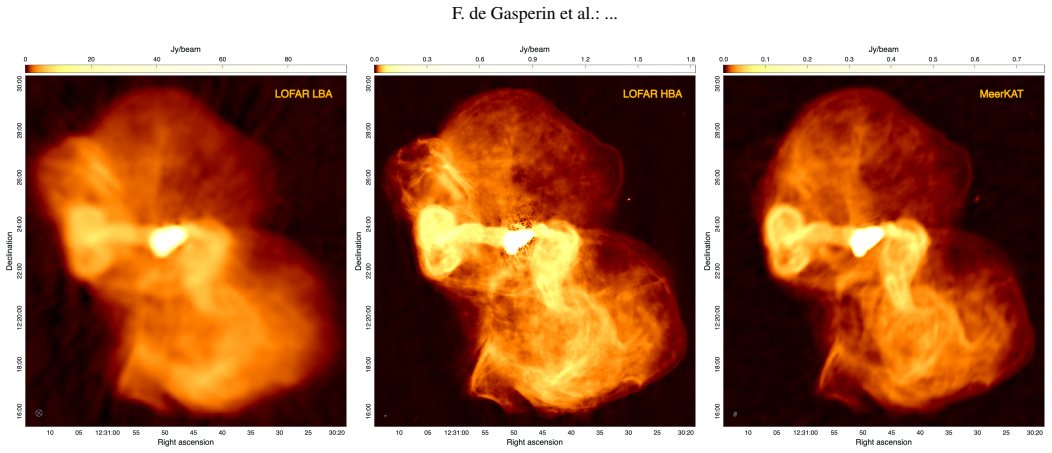
The paper claims that a dedicated, M87-peeling calibration strategy makes it possible to obtain blind, high-fidelity radio images of the entire Virgo cluster, and that the first such images reveal that the radio lobes of M87 are not smooth cavities but volumes filled with complex synchrotron filaments. In particular, the 144 MHz image (with 4''×3'' resolution) shows a collimated synchrotron thread connecting the eastern and western 'ears' of the source below the central cocoon, only the second such structure ever observed. The same dataset yields the highest-resolution images of Virgo A at 54 and 1284 MHz, enabling resolved spectral studies. The authors present this as strong evidence that the lobes are threaded by coherent magnetic-field structures and that Rayleigh–Taylor instabilities shape both ears symmetrically.
Load-bearing premise
The sixty-fold depth improvement rests on the assumption that the M87 peeling and direction-dependent calibration will reach the simulated noise of about 1.7 mJy/beam across the entire 42–66 MHz LBA survey, a level demonstrated only for the HBA survey and a five-pointing MeerKAT pilot so far.
Editorial extensions
If this is right
- Final continuum mosaics at 42–66, 120–168, and 856–1712 MHz should reach roughly 1700, 150, and 7 $\mu$Jy beam$^{-1}$, about 60 times the depth and six times the resolution of NVSS at 1.4 GHz.
- The blind H I survey should resolve ~370 galaxies down to $M_{\rm HI} \simeq 2\times10^6\,M_\odot$ and map ram-pressure-stripped tails at column densities in the range $10^{18}$–$10^{20}$ cm$^{-2}$.
- The polarization data should yield roughly 2000–3700 rotation measure sources, enough to map the cluster magnetic field and test whether compressed fields boost radio emission near the cluster centre.
- The M87 images imply the lobes are filled with filamentary synchrotron structures and that Rayleigh–Taylor instabilities shape both ears, so the jet–ICM interaction is more structured than smooth-lobe models assume.
- Combining the three frequencies gives resolved spectral index and curvature maps of every source with $S_{144\,\mathrm{MHz}} > 450\,\mu$Jy beam$^{-1}$, tracing particle ageing along stripped tails.
Reading between the lines
- If the lobe-connecting thread is confirmed, it implies the two ears of M87 are magnetically connected; the survey's Faraday rotation data could test whether the thread carries a coherent field by looking for a systematic RM gradient along it.
- A natural extension is to search for similar collimated synchrotron threads in other nearby radio galaxies; the detection rate would constrain how long such connections survive relative to the lobe expansion timescale.
- The advertised depth also implies that the survey should detect radio emission from stripped and accreting gas far beyond galaxy stellar disks, providing an unbiased census that existing pointed samples like VIVA cannot offer.
- If the simulated LBA noise is reached, the 42–66 MHz survey becomes the deepest low-frequency view of any rich cluster, which would anchor studies of faint fossil radio plasma and cluster halos at low frequency.
Editorial analysis
A structured set of objections, weighed in public.
Referee Report
Summary. This paper describes the ViCTORIA project, a multi-frequency radio survey of the Virgo galaxy cluster using LOFAR LBA, LOFAR HBA, and MeerKAT L-band observations. It presents the survey footprints, observing strategies, calibration plans, and expected noise levels, and compares the planned depth with existing surveys such as NVSS, TGSS, RACS, and GLEAM. The paper also reports preliminary data products: H I maps that recover and extend VIVA and ALFALFA detections for galaxies and cloud complexes, and high-resolution images of M87 that show filamentary structure within the lobes, including a candidate collimated synchrotron thread. The stated aims are to deliver continuum images about 60 times deeper than current surveys, a blind H I survey sensitive to dwarf galaxies, and polarization data for thousands of sources.
Significance. If the projected sensitivities are achieved, ViCTORIA will be a benchmark dataset for the Virgo cluster, enabling studies of environmental quenching, ram-pressure stripping, AGN feedback, and cluster magnetic fields at physical scales of ~500 pc over the full r200 region. The published HBA survey and the five-pointing MeerKAT pilot give strong empirical support for the HBA and L-band pillars, and the public release of HBA data and the use of the open-source LiLF pipeline are commendable. The M87 images illustrate the potential of the combined dataset. The main caveat is that the LBA depth is still based on a simulation and the polarization source counts are partially based on private communication, so the numerical projections should be read as expectations rather than fully demonstrated survey performance.
major comments (3)
- [Section 2.1.1, Table 1] The quoted LBA sensitivity (1.7–2.2 mJy/beam) is derived from a quasi-thermal noise simulation, and the text states that a peeling strategy for M87 'will be employed' but does not demonstrate that it has been applied to the LBA data. Because the abstract and Section 2.2 claim that the project will deliver images 'about 60 times deeper' from 42 MHz to 1.7 GHz, this depth claim for the LBA band currently rests on an unverified calibration assumption. If the peeling or direction-dependent calibration fails, off-source artifacts around M87 could raise the effective noise over a large fraction of the 166 deg^2 footprint. Please either provide a representative validation (e.g., a single calibrated LBA field processed with the described peeling and direction-dependent calibration) or explicitly qualify the LBA noise and the 60x statement as a projected goal that has not yet been demonstrated.
- [Section 2.2 vs Section 4.5] The expected yield of the polarization survey is stated as 'an estimated 2000 objects through RM synthesis' in the deliverable list (Section 2.2, citing a private communication) but as 3677 polarized sources in Section 4.5, following Rudnick & Owen (2014). The footnote in Section 4.5 notes that MIGHTEE early science suggests a factor-2 underestimation, which makes the two numbers even harder to reconcile. Since the polarisation survey is one of the three core deliverables, please reconcile these estimates, specify the detection threshold and survey area used for each, and replace the private communication with a citable public reference or a transparent extrapolation.
- [Section 4.2, Figures 8 and 9] The claimed detection of filamentary structures filling the M87 lobes and 'the second known case of CST' is a striking scientific result, but the paper provides only visual evidence and defers quantitative spectral analysis to de Gasperin et al. (in prep.). If this result is to remain in the survey-description paper, it needs quantitative support (e.g., surface-brightness detection significance, intensity profiles, or comparison with the X-ray filaments). Otherwise, it should be presented more clearly as an early, qualitative preview with the detailed analysis to follow.
minor comments (5)
- [Section 2.1.2, Table 1] The resolution listed in Table 1 (7 arcsec) differs from the quoted '9''x5'' (high)' and '20'' (low)' mosaics; please clarify whether 7 arcsec is the best common resolution or a representative value.
- [Section 2.2] The statement 'No other large survey of the Virgo cluster has been attempted at these frequencies' is too strong given that LoTSS, TGSS, and VLSSr cover the region; rephrase to emphasize the improved depth, fidelity, and dedicated calibration.
- [Section 4.1] There is a typo in 'magneto-hdyrdodynamic waves'; it should be 'magnetohydrodynamic waves'.
- [Section 4.5] The number 3677 for polarized sources is given with two significant figures and a footnote indicating a factor-2 uncertainty; please round appropriately and state the uncertainty in the main text.
- [References] The reference list contains duplicates (e.g., Boselli et al. 2014; Gunn & Gott 1972; Boselli et al. 2018) and LaTeX artifacts in author names such as 'V ollmer'; please clean the bibliography.
Circularity Check
No significant circularity: the survey's quantitative claims are benchmarked against external surveys and scaling relations, not fitted to the new data.
full rationale
I find no significant circularity. The paper is a survey description; its central quantitative claims are sensitivity specifications (Table 1), comparisons against external surveys (NVSS, RACS, TGSS, VLSSr, VIVA, ALFALFA), and extrapolated source counts using external scaling relations (Boselli et al. 2015; Rudnick & Owen 2014; O'Sullivan et al. 2023). The '60 times deeper' statement is an arithmetic comparison of Table 1 sensitivities with published NVSS noise, not a value fitted to the new data. The LBA noise levels in Section 2.1.1 are explicitly derived from a simulation using van Haarlem et al. (2013) source-equivalent flux densities; this is a stated planning assumption rather than a fitted parameter, and the text properly indicates that the M87 peeling strategy 'will be employed' rather than claiming the calibration is already demonstrated. Self-citations (the LiLF pipeline, the Edler et al. 2023 HBA survey, and de Gasperin et al. in prep.) describe software, a previous data release, and forthcoming analysis; none carries the load of deriving a ViCTORIA result, and the HBA survey's 112 detections are presented as a published external data product. The M87 filamentary structures and the collimated synchrotron thread are presented as preliminary images with deferred detailed analysis, and the text explicitly attributes the earlier known filamentary morphology of the inner cocoon to Owen et al. (2000), so no known result is being renamed as a new prediction. No step reduces by construction to its own input, and no load-bearing uniqueness theorem or ansatz is imported from the authors' prior work.
Assumptions & free parameters
assumptions (5)
- domain assumption Flat Lambda-CDM cosmology with Omega_m=0.3 and H0=70 km/s/Mpc
- domain assumption Virgo distance of 16.5 Mpc (Mei et al. 2007)
- domain assumption r200 = 1.55 Mpc determined from the galaxy distribution
- domain assumption The H-alpha-radio correlation (Boselli et al. 2015) is used to predict ~330 continuum detections
- domain assumption The expected number of polarized sources follows Rudnick & Owen (2014) with a 6-sigma threshold
Cite this review
Pith. "Pith review of The ViCTORIA project: description of a multi-frequency radio survey of the Virgo galaxy cluster." pith.science (2026). https://pith.science/paper/6YXGK3FW
@misc{pith2026241118204,
  author       = {Pith},
  title        = {Pith review of: The ViCTORIA project: description of a multi-frequency radio survey of the Virgo galaxy cluster},
  year         = {2026},
  howpublished = {\url{https://pith.science/paper/6YXGK3FW}},
  note         = {Machine review of arXiv:2411.18204}
}
read the original abstract
The Virgo cluster is the closest richest nearby galaxy cluster. It is in the formation process, with a number of sub-clusters undergoing merging and interactions. Although a great laboratory to study galaxy evolution and cluster formation, its large apparent size and the severe dynamic range limitations due to the presence of the bright radio source Virgo A (M 87) reduced the ability of past wide-area radio surveys to image the region with high sensitivity and fidelity. In this paper we describe the "Virgo Cluster multi-Telescope Observations in Radio of Interacting galaxies and AGN" (ViCTORIA) project. The survey and its data reduction strategy are designed to mitigate the challenges of this field and deliver: images from 42 MHz to 1.7 GHz frequencies of the Virgo cluster, about 60 times deeper than existing data, in full polarisation, and including a blind HI survey that aims at mapping seven times more galaxies than previous experiments and without selection biases. Data have been collected with the Low-Frequency Array (LOFAR) and with MeerKAT in L-band, including polarisation and enough frequency resolution to conduct local HI studies. At the distance of Virgo, current radio instruments have the resolution to probe scales of ~500 pc and the sensitivity to study dwarf galaxies, the most fragile systems given their shallow gravitational potential wells, making Virgo a unique laboratory to study galaxy evolution and AGN feedback in a rich environment. In this work, we present some preliminary results, including high resolution images of the radio emission surrounding M 87, that show that the lobes are filled with filamentary structures. The combination of the presented radio surveys with state-of-the-art optical, UV, X-ray surveys will massively increase the scientific output from the studies of the Virgo cluster, making the ViCTORIA Project's legacy value outstanding.
Figures


Figures from the paper (6 more)



Reference graph
Works this paper leans on
-
[1]
Adams, E. A. K., Giovanelli, R., & Haynes, M. P. 2013, ApJ, 768, 77
2013
-
[2]
Aguerri, J. A. L., Gerhard, O. E., Arnaboldi, M., et al. 2005, Astron. J., 129, 2585
2005
-
[3]
2005, in AIP Conf
Arnaboldi, M. 2005, in AIP Conf. Proc., V ol. 804, 301–308
2005
-
[4]
W., et al
Auld, R., Bianchi, S., Smith, M. W., et al. 2013, MNRAS, 428, 1880
2013
-
[5]
2015, ApJ, 800, L15
Bellazzini, M., Magrini, L., Mucciarelli, A., et al. 2015, ApJ, 800, L15
2015
-
[6]
J., Galliano, F., & Madden, S
Bendo, G. J., Galliano, F., & Madden, S. C. 2012, MNRAS, 423, 197
2012
-
[7]
Bianchi, S., Giovanardi, C., Smith, M. W. L., et al. 2017, A&A, 597, A130
2017
-
[8]
1985, Astron
Binggeli, B. 1985, Astron. J., 90, 1681
1985
Show all 139 references
-
[9]
A., & Sandage, A
Binggeli, B., Tammann, G. A., & Sandage, A. 1987, Astron. J., 94, 251 B¨ohringer, H., Briel, U. G., Schwarz, R. A., et al. 1994, Nature, 368, 828
1987
-
[10]
2015, A&A, 579, A29
Boissier, S., Boselli, A., V oyer, E., et al. 2015, A&A, 579, A29
2015
-
[11]
2010, A&A, 513, A30
Bonafede, A., Feretti, L., Murgia, M., et al. 2010, A&A, 513, A30
2010
-
[12]
2009, ApJ, 706, 1527
Boselli, A., Boissier, S., Cortese, L., et al. 2009, ApJ, 706, 1527
2009
-
[13]
2011, A&A, 528, A107
Boselli, A., Boissier, S., Heinis, S., et al. 2011, A&A, 528, A107
2011
-
[14]
C., Fossati, M., et al
Boselli, A., Cuillandre, J. C., Fossati, M., et al. 2016, A&A, 587, A68
2016
-
[15]
2018, A&A, 614, A56
Boselli, A., Fossati, M., Ferrarese, L., et al. 2018, A&A, 614, A56
2018
-
[16]
2015, A&A, 579, A102
Boselli, A., Fossati, M., Gavazzi, G., et al. 2015, A&A, 579, A102
2015
-
[17]
2022, Astron
Boselli, A., Fossati, M., & Sun, M. 2022, Astron. Astrophys. Rev., 30, 3
2022
-
[18]
& Gavazzi, G
Boselli, A. & Gavazzi, G. 2006, PASP, 118, 517
2006
-
[19]
2021, A&A, 646, A139
Boselli, A., Lupi, A., Epinat, B., et al. 2021, A&A, 646, A139
2021
-
[20]
2003, A&A, 406, 867
Boselli, A., Sauvage, M., Lequeux, J., Donati, A., & Gavazzi, G. 2003, A&A, 406, 867
2003
-
[21]
J., Gavazzi, G., Hippelein, H., & Pierini, D
Boselli, A., Tuffs, R. J., Gavazzi, G., Hippelein, H., & Pierini, D. 1997, A&AS, 121, 507
1997
-
[23]
2014, A&A, 570, A69
Boselli, A., V oyer, E., Boissier, S., et al. 2014, A&A, 570, A69
2014
-
[24]
D., Zabel, N., et al
Brown, T., Wilson, C. D., Zabel, N., et al. 2021, Astrophys. J. Suppl. Ser., 257, 21
2021
-
[25]
P., Ferrarese, L., et al
Cantiello, M., Blakeslee, J. P., Ferrarese, L., et al. 2024, ApJ, 966, 145
2024
-
[26]
P., Ferrarese, L., et al
Cantiello, M., Blakeslee, J. P., Ferrarese, L., et al. 2018, ApJ, 856, 126
2018
-
[27]
J., Merritt, D., & Baldi, R
Capetti, A., Kharb, P., Axon, D. J., Merritt, D., & Baldi, R. D. 2009, Astron. J., 138, 1990
2009
-
[28]
2018, MNRAS, 476, 875
Catinella, B., Saintonge, A., Janowiecki, S., et al. 2018, MNRAS, 476, 875
2018
-
[29]
2023, A&A, 671, A118
Cattorini, F., Gavazzi, G., Boselli, A., & Fossati, M. 2023, A&A, 671, A118
2023
-
[30]
2020, MNRAS, 496, 4654
Chen, H., Sun, M., Yagi, M., et al. 2020, MNRAS, 496, 4654
2020
-
[31]
H., Kenney, J
Chung, A., Van Gorkom, J. H., Kenney, J. D., Crowl, H., & V ollmer, B. 2009, Astron. J., 138, 1741
2009
-
[32]
H., Kenney, J
Chung, A., van Gorkom, J. H., Kenney, J. D. P., & V ollmer, B. 2007, ApJ, 659, L115
2007
-
[33]
& Kaiser, C
Churazov, E. & Kaiser, C. 2001, ApJ, 10, 261
2001
-
[34]
Ciesla, L., Boselli, A., Smith, M. W. L., et al. 2012, A&A, 543, A161
2012
-
[35]
J., Cotton, W
Condon, J. J., Cotton, W. D., Greisen, E. W., et al. 1998, Astron. J., 8065, 1693
1998
-
[36]
2011, MNRAS, 415, 1797
Cortese, L., Catinella, B., Boissier, S., Boselli, A., & Heinis, S. 2011, MNRAS, 415, 1797
2011
-
[37]
2014, MNRAS, 440, 942
Cortese, L., Fritz, J., Bianchi, S., et al. 2014, MNRAS, 440, 942
2014
-
[38]
P., Ferrarese, L., et al
Cote, P., Blakeslee, J. P., Ferrarese, L., et al. 2004, Astrophys. J. Suppl. Ser., 153, 223
2004
-
[39]
I., Baes, M., Bendo, G
Davies, J. I., Baes, M., Bendo, G. J., et al. 2010, A&A, 518, L48 De Gasperin, F., Brunetti, G., Bruggen, M., et al. 2020a, A&A, 642, A85 De Gasperin, F., Dijkema, T. J., Drabent, A., et al. 2019, A&A, 622, A5 De Gasperin, F., Mevius, M., Ra fferty, D. A., Intema, H. T., & Fal...
2010
-
[40]
1980, ApJ, 236, 351
Dressler, A. 1980, ApJ, 236, 351
1980
-
[41]
W., Thomson, A
Duchesne, S. W., Thomson, A. J., Pritchard, J., et al. 2023, Publ. Astron. Soc. Aust., 40, e034
2023
-
[42]
W., De Gasperin, F., Shimwell, T
Edler, H. W., De Gasperin, F., Shimwell, T. W., et al. 2023, A&A, 676, A24
2023
-
[43]
W., Roberts, I
Edler, H. W., Roberts, I. D., Boselli, A., et al. 2024, A&A, 683, A149 Event Horizon Telescope Collaboration, Akiyama, K., Alberdi, A., et al. 2019, Astrophys. J. Lett., 875, L1
2024
-
[44]
1992, Astrophys
Fabbiano, G., Kim, D.-W., & Trinchieri, G. 1992, Astrophys. J. Suppl. Ser., 80, 531
1992
-
[45]
Fabian, A. C. 2012, Annu. Rev. Astron. Astrophys., 50, 455
2012
-
[46]
C., et al
Ferrarese, L., C ˆot´e, P., Cuillandre, J. C., et al. 2012, Astrophys. Journal, Suppl. Ser., 200, 4
2012
-
[47]
A., et al
Ferrarese, L., Cˆot´e, P., MacArthur, L. A., et al. 2020, ApJ, 890, 128
2020
-
[48]
2007, ApJ, 665, 1057
Forman, W., Jones, C., Churazov, E., et al. 2007, ApJ, 665, 1057
2007
-
[49]
2016, MNRAS, 455, 2028
Fossati, M., Fumagalli, M., Boselli, A., et al. 2016, MNRAS, 455, 2028
2016
-
[50]
2008, ApJ, 680, 154
Gallo, E., Treu, T., Jacob, J., et al. 2008, ApJ, 680, 154
2008
-
[51]
J., et al
Gallo, E., Treu, T., Marshall, P. J., et al. 2010, ApJ, 714, 25
2010
-
[52]
2002, ApJ, 576, 135
Gavazzi, G., Bonfanti, C., Sanvito, G., Boselli, A., & Scodeggio, M. 2002, ApJ, 576, 135
2002
-
[53]
1991, AJ, 101, 1207
Gavazzi, G., Boselli, A., & Kennicutt, R. 1991, AJ, 101, 1207
1991
-
[54]
2005, A&A, 429, 439
Gavazzi, G., Boselli, A., Van Driel, W., & O’Neil, K. 2005, A&A, 429, 439
2005
-
[55]
1995, A&A, 304, 325
Gavazzi, G., Contursi, A., Carrasco, L., et al. 1995, A&A, 304, 325
1995
-
[56]
2013, H α 3: An H α imaging survey of HI selected galaxies from ALFALFA : Star formation properties of galaxies in the Virgo cluster and surroundings
Gavazzi, G., Fumagalli, M., Fossati, M., et al. 2013, H α 3: An H α imaging survey of HI selected galaxies from ALFALFA : Star formation properties of galaxies in the Virgo cluster and surroundings
2013
-
[57]
Geller, M. J. & Huchra, J. P. 1989, Mapping the universe
1989
-
[58]
P., Kent, B
Giovanelli, R., Haynes, M. P., Kent, B. R., et al. 2005, Astron. J., 130, 2598
2005
-
[59]
Gunn, J. E. & Gott, J. Richard, I. 1972, ApJ, 176, 1
1972
-
[60]
E., Gott, J
Gunn, J. E., Gott, J. R., & Gott, J. Richard, I. 1972, ApJ, 176, 1
1972
-
[61]
P., Giovanelli, R., & Kent, B
Haynes, M. P., Giovanelli, R., & Kent, B. R. 2007, ApJ, 665, L19
2007
-
[62]
P., Giovanelli, R., Kent, B
Haynes, M. P., Giovanelli, R., Kent, B. R., et al. 2018, ApJ, 861, 49 11 F. de Gasperin et al.:
2018
-
[63]
L., Lewis, B
Hoffman, G. L., Lewis, B. M., & Salpeter, E. E. 1995, ApJ, 441, 28
1995
-
[64]
2024, Astrophys
Hou, M., Hu, Z., & Li, Z. 2024, Astrophys. J. Lett., 965, L24
2024
-
[65]
R., Hancock, P
Hurley-Walker, N., Callingham, J. R., Hancock, P. J., et al. 2017, MNRAS, 464, 1146
2017
-
[66]
2023, A&A, 675, A118
Ignesti, A., Vulcani, B., Botteon, A., et al. 2023, A&A, 675, A118
2023
-
[67]
M., et al
Ignesti, A., Vulcani, B., Poggianti, B. M., et al. 2022, ApJ, 924, 64
2022
-
[68]
T., Jagannathan, P., Mooley, K
Intema, H. T., Jagannathan, P., Mooley, K. P., & Frail, D. A. 2017, A&A, 598, A78
2017
-
[69]
2014, ApJ, 786, 105
Janz, J., Laurikainen, E., Lisker, T., et al. 2014, ApJ, 786, 105
2014
-
[70]
Jonas, J. L. 2016, in Proc. Sci. (Sissa Medialab Srl), 1
2016
-
[71]
G., Janowiecki, S., Dey, S., et al
Jones, M. G., Janowiecki, S., Dey, S., et al. 2024, ApJ, 966, L15
2024
-
[72]
2022, A&A, 667, A76
Junais, Boissier, S., Boselli, A., et al. 2022, A&A, 667, A76
2022
-
[73]
1998, ARA&A, 36, 189
Kennicutt, Robert C., J. 1998, ARA&A, 36, 189
1998
-
[74]
R., Giovanelli, R., Haynes, M
Kent, B. R., Giovanelli, R., Haynes, M. P., et al. 2007, ApJ, 665, L15
2007
-
[75]
R., Spekkens, K., Giovanelli, R., et al
Kent, B. R., Spekkens, K., Giovanelli, R., et al. 2009, ApJ, 691, 1595
2009
-
[76]
C., Jerjen, H., et al
Kim, S., Rey, S. C., Jerjen, H., et al. 2015, Astrophys. Journal, Suppl. Ser., 215, 22
2015
-
[77]
V ., & Gottlober, S
Klypin, A., Hoffman, Y ., Kravtsov, A. V ., & Gottlober, S. 2003, ApJ, 596, 19
2003
-
[78]
A., Giovanelli, R., Haynes, M
Koopmann, R. A., Giovanelli, R., Haynes, M. P., et al. 2008, ApJ, 682, L85
2008
-
[79]
A., Kenney, J
Koopmann, R. A., Kenney, J. D. P., & Young, J. 2001, Astrophys. J. Suppl. Ser., 135, 125
2001
-
[80]
S., Staveley-Smith, L., Westmeier, T., et al
Koribalski, B. S., Staveley-Smith, L., Westmeier, T., et al. 2020, Astrophys. Space Sci., 365, 118
2020
-
[81]
M., Cotton, W
Lane, W. M., Cotton, W. D., van Velzen, S., et al. 2014, MNRAS, 440, 327
2014
-
[82]
B., Tinsley, B
Larson, R. B., Tinsley, B. M., & Caldwell, C. N. 1980, ApJ, 237, 692
1980
-
[83]
J., V¨olk, H
Leech, K. J., V¨olk, H. J., Heinrichsen, I., et al. 1999, MNRAS, 310, 317
1999
-
[84]
W., et al
Lim, S., Cˆot´e, P., Peng, E. W., et al. 2020, ApJ, 899, 69
2020
-
[85]
K., Binggeli, B., & Glatt, K
Lisker, T., Grebel, E. K., Binggeli, B., & Glatt, K. 2007, ApJ, 660, 1186
2007
-
[86]
W., et al
Liu, C., Cˆot´e, P., Peng, E. W., et al. 2020, Astrophys. J. Suppl. Ser., 250, 17
2020
-
[87]
P., et al
Lu, R.-S., Asada, K., Krichbaum, T. P., et al. 2023, Nature, 616, 686
2023
-
[88]
M., Papastergis, E., Giovanelli, R., et al
Martin, A. M., Papastergis, E., Giovanelli, R., et al. 2010, ApJ, 723, 1359
2010
-
[89]
H., Veronica, A., et al
McCall, H., Reiprich, T. H., Veronica, A., et al. 2024, A&A, in press
2024
-
[90]
L., Lenc, E., et al
McConnell, D., Hale, C. L., Lenc, E., et al. 2020, Publ. Astron. Soc. Aust
2020
-
[91]
B., & Roediger, J
McDonald, M., Courteau, S., Tully, R. B., & Roediger, J. 2011, MNRAS, 414, 2055
2011
-
[92]
McLaughlin, D. E. 1999, ApJ, 512, L9
1999
-
[93]
P., Cote, P., et al
Mei, S., Blakeslee, J. P., Cote, P., et al. 2007, ApJ, 655, 144
2007
-
[94]
J., Zwaan, M
Meyer, M. J., Zwaan, M. A., Webster, R. L., et al. 2004, The HIPASS catalogue - I. Data presentation
2004
-
[95]
T., Werner, N., Simionescu, a., et al
Million, E. T., Werner, N., Simionescu, a., et al. 2010, MNRAS, 407, 2046
2010
-
[96]
2007, ApJ, 670, 1056
Minchin, R., Davies, J., Disney, M., et al. 2007, ApJ, 670, 1056
2007
-
[97]
F., Taylor, R., K¨oppen, J., et al
Minchin, R. F., Taylor, R., K¨oppen, J., et al. 2019, AJ, 158, 121
2019
-
[98]
1998, ApJ, 495, 139
Moore, B., Lake, G., & Katz, N. 1998, ApJ, 495, 139
1998
-
[99]
M., V ogeley, M
Moorman, C. M., V ogeley, M. S., Hoyle, F., et al. 2014, MNRAS, 444, 3559 Mu˜noz, R. P., Puzia, T. H., Lanc ¸on, A., et al. 2014, Astrophys. Journal, Suppl. Ser., 210, 4
2014
-
[100]
2004, A&A, 424, 429
Murgia, M., Govoni, F., Feretti, L., et al. 2004, A&A, 424, 429
2004
-
[101]
J., Kenney, J
Murphy, E. J., Kenney, J. D. P., Helou, G., Chung, A., & Howell, J. H. 2009, ApJ, 694, 1435
2009
-
[102]
1995, A&A, 293, 56
Niklas, S., Klein, U., & Wielebinski, R. 1995, A&A, 293, 56
1995
-
[103]
P., Marvil, J., Collier, J
Norris, R. P., Marvil, J., Collier, J. D., et al. 2021, Publ. Astron. Soc. Aust., 38, e046
2021
-
[104]
J., Andrade-Santos, F., et al
Osinga, E., Van Weeren, R. J., Andrade-Santos, F., et al. 2022, A&A, 665, A71 O’Sullivan, S. P., Shimwell, T. W., Hardcastle, M. J., et al. 2023, MNRAS, 519, 5723
2022
-
[105]
& Biretta, J
Owen, F. & Biretta, J. 1999, VLA 7mm images of the M 87 jet, V ol. 530 (Roser Hermann-Josef and Meisenheimer Klaus), 186–187
1999
-
[106]
2000, ApJ, 543, 611
Owen, F., Eilek, J., & Kassim, N. 2000, ApJ, 543, 611
2000
-
[107]
Peek, J. E. G., Heiles, C., Douglas, K. A., et al. 2011, ApJS, 194, 20
2011
-
[108]
2014, ApJ, 797, 102
Raichoor, A., Mei, S., Erben, T., et al. 2014, ApJ, 797, 102
2014
-
[109]
2020, A&A, 636, L1
Ramatsoku, M., Murgia, M., Vacca, V ., et al. 2020, A&A, 636, L1
2020
-
[110]
J., Tufte, S
Reynolds, R. J., Tufte, S. L., Haffner, L. M., Jaehnig, K., & Percival, J. W. 1998, PASA, 15, 14
1998
-
[111]
D., van Weeren, R
Roberts, I. D., van Weeren, R. J., Lal, D. V ., et al. 2024, A&A, 683, A11
2024
-
[112]
D., van Weeren, R
Roberts, I. D., van Weeren, R. J., Timmerman, R., et al. 2022, A&A, 658, A44
2022
-
[113]
Rosenberg, J. L. & Schneider, S. E. 2002, ApJ, 567, 247
2002
-
[114]
& Owen, F
Rudnick, L. & Owen, F. N. 2014, ApJ, 785, 45
2014
-
[115]
Ruszkowski, M., Br¨uggen, M., Lee, D., & Shin, M. S. 2014, ApJ, 784, 75
2014
-
[116]
C., & Staveley-Smith, L
Said, K., Kraan-Korteweg, R. C., & Staveley-Smith, L. 2019, MNRAS, 486, 1796
2019
-
[117]
& Catinella, B
Saintonge, A. & Catinella, B. 2022, The Cold Interstellar Medium of Galaxies in the Local Universe
2022
-
[118]
Sandage, A., Binggeli, B., & Tammann, G. A. 1985, Astron. J., 90, 395
1985
-
[119]
R., Peek, J
Saul, D. R., Peek, J. E. G., Grcevich, J., et al. 2012, ApJ, 758, 44
2012
-
[120]
L., et al
Schinnerer, E., Smolˇci´c, V ., Carilli, C. L., et al. 2007, ApJS, 172, 46
2007
-
[121]
M., Kleiner, D., et al
Serra, P., MacCagni, F. M., Kleiner, D., et al. 2023, A&A, 673, A146
2023
-
[122]
Shapley, A., Fabbiano, G., & Eskridge, P. B. 2001, ApJS, 137, 139
2001
-
[123]
W., Hardcastle, M
Shimwell, T. W., Hardcastle, M. J., Tasse, C., et al. 2022, A&A, 659, A1
2022
-
[124]
W., Tasse, C., Hardcastle, M
Shimwell, T. W., Tasse, C., Hardcastle, M. J., et al. 2019, A&A, 622, A1
2019
-
[125]
W., & Urban, O
Simionescu, A., Werner, N., Mantz, A., Allen, S. W., & Urban, O. 2017, MNRAS, 469, 1476 Smolˇci´c, V ., Novak, M., Bondi, M., et al. 2017, A&A, 602, A1
2017
-
[126]
Sorgho, A., Hess, K., Carignan, C., & Oosterloo, T. A. 2017, MNRAS, 464, 530
2017
-
[127]
W., et al
Soria, R., Kolehmainen, M., Graham, A. W., et al. 2022, MNRAS, 512, 3284
2022
-
[128]
W., Su, Y ., et al
Spasic, A., Edler, H. W., Su, Y ., et al. 2024, A&A, 690, A195
2024
-
[129]
J., et al
Tasse, C., Shimwell, T., Hardcastle, M. J., et al. 2021, A&A, 648, A1
2021
-
[130]
R., Sekhar, S., Heino, L., et al
Taylor, A. R., Sekhar, S., Heino, L., et al. 2024, MNRAS, 528, 2511
2024
-
[131]
& Bryan, G
Tonnesen, S. & Bryan, G. L. 2010, ApJ, 709, 1203
2010
-
[132]
& Bryan, G
Tonnesen, S. & Bryan, G. L. 2012, MNRAS, 422, 1609
2012
-
[133]
L., & Chen, R
Tonnesen, S., Bryan, G. L., & Chen, R. 2011, ApJ, 731, 98
2011
-
[134]
& Stone, J
Tonnesen, S. & Stone, J. 2014, ApJ, 795, 148
2014
-
[135]
J., Popescu, C
Tuffs, R. J., Popescu, C. C., Pierini, D., et al. 2002, Astrophys. J. Suppl. Ser., 139, 37
2002
-
[136]
W., & B ¨ohringer, H
Urban, O., Werner, N., Simionescu, A., Allen, S. W., & B ¨ohringer, H. 2011, MNRAS, 414, 2101 van Haarlem, M. P., Wise, M. W., Gunst, a. W., et al. 2013, A&A, 556, A2 V¨olk, H. J. & Xu, C. 1994, Infrared Physics and Technology, 35, 527 V ollmer, B., Cayatte, V ., Balkowski, C....
2011
-
[137]
L., Eisenhardt, P
Wright, E. L., Eisenhardt, P. R., Mainzer, A. K., et al. 2010, Astron. J., 140, 1868
2010
-
[138]
Zhang, C., Churazov, E., & Schekochihin, A. A. 2018, MNRAS, 478, 4785
2018
-
[139]
A., Briggs, F
Zwaan, M. A., Briggs, F. H., Sprayberry, D., & Sorar, E. 1997, ApJ, 490, 173
1997
-
[140]
A., Meyer, M
Zwaan, M. A., Meyer, M. J., Staveley-Smith, L., & Webster, R. L. 2005, The HIPASS catalogue:ωHI and environmental e ffects on the HI mass function of galaxies 12
2005
Reviewed August 12, 2026 · model on record in the stance chip above.
Discussion (0). Continue with ORCID to comment.