REVIEW 3 major objections 4 minor 42 references
The isotropic relaxed micromorphic model in polar coordinates and its application to an elastostatic axisymmetric extension problem
T0 review · 3 major / 4 minor · reviewed 2026-08-12 · deepseek-v4-flash
Pith's one-line read This paper derives the relaxed micromorphic model in polar coordinates and solves an axisymmetric extension problem exactly, obtaining closed-form displacement and microdistortion fields.
desk verdict A useful polar-coordinate formulation and closed-form solution for the planar relaxed micromorphic model, but the advertised 3D long-cylinder benchmark is not supported because the plane-strain reduction ignores out-of-plane microdistortion. read the letter →
The pith
A machine-rendered reading of the paper's core claim, the machinery that carries it, and where it could break.
The reading
What carries the argument
The machinery is the polar-coordinate representation of the relaxed micromorphic model's differential operators, together with the consistent coupling boundary condition. The paper writes the gradient, divergence, and curl of the relevant tensor fields in $(r,\theta)$ coordinates, producing the governing equations (12)--(20). For the axisymmetric problem it introduces the combinations $X = du_r/dr - P_{rr}$, $Y = u_r/r - P_{\theta\theta}$, and $Z = P_{\theta\theta}+P_{rr}$, reducing the system to a single inhomogeneous Bessel-type equation $d^2Z/dr^2 + (1/r)\,dZ/dr - aZ + b = 0$; the solution enters the displacement through $du_r/dr + u_r/r = C_1 A + D_1 B I_0(\sqrt{a}r)$. The boundary condition $P\cdot\tau = Du\cdot\tau$ fixes the remaining constants and eliminates the off-diagonal microdistortion.
What would settle it
Measure the interior radial displacement of a long cylinder under uniform radial boundary displacement, with the model's parameters first calibrated independently from bending or wave-propagation tests; formula (68) predicts a specific profile controlled by the modified Bessel functions and by $R/L_c$, so a systematic mismatch across radii would falsify the model or the boundary condition. A cheaper check is to solve the full two-field variational problem numerically without the $u_\theta=0$ ansatz and compare whether the computed minimizer indeed has vanishing angular displacement and the closed-form field.
Extended reading notes
Core claim
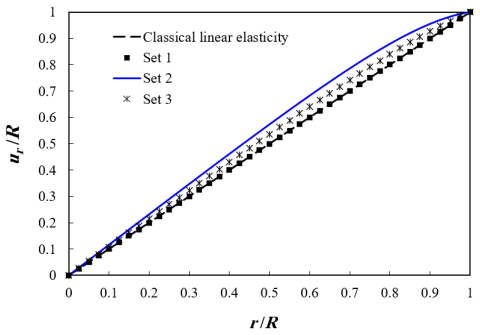
The central claim is that the isotropic relaxed micromorphic model can be formulated explicitly in polar coordinates and that, for the axisymmetric extension of a long cylinder, its equilibrium equations reduce to a linear system of ODEs whose solution is closed form. Under the axisymmetric ansatz ($u_\theta=0$, all fields depending only on $r$), the displacement $u_r(r)$ and the diagonal microdistortion components $P_{rr}$, $P_{\theta\theta}$ are expressed through $I_0$ and $I_1$ modified Bessel functions, while the off-diagonal components $P_{r\theta}$ and $P_{\theta r}$ vanish under the consistent coupling boundary condition. In the limits $L_c\to 0$ and $L_c\to\infty$, the solution degenerates to the classical linear elastic field $u_r = U_0 r/R$, with explicit expressions for $P_{\theta\theta}$ and $P_{rr}$. The paper also shows that the Cosserat couple modulus $\mu_c$ drops out of this axisymmetric problem, so the result isolates the size-dependent effects carried by the characteristic length and the micro-moduli.
Load-bearing premise
The derivation assumes the consistent coupling boundary condition $P\cdot\tau = Du\cdot\tau$ on the boundary and the axisymmetric plane-strain ansatz $u_\theta=0$ with all fields depending only on $r$; if the physical boundary condition on $P$ differs, or the true minimizer develops angular or off-axis structure, the closed-form solution will not describe that setting.
Editorial extensions
If this is right
- If the solution is correct, it gives a benchmark for finite element codes: with the listed parameter sets, an implementation should reproduce the closed-form displacement and microdistortion profiles.
- The limits $L_c\to 0$ and $L_c\to\infty$ both recover classical linear elasticity, so code validation can target those endpoints as separate checks.
- The Cosserat couple modulus does not affect the axisymmetric extension solution, which simplifies parameter identification for this geometry.
- The explicit dependence on $\lambda_m$ and $\mu_m$ shows how micro-moduli bend the displacement profile relative to the classical field, with the model predicting smaller or larger displacements depending on the parameter ratio $\beta_1$.
- The closed-form expression makes the role of the characteristic length $L_c$ explicit, so it can be used to study size effects without solving the full boundary-value problem numerically.
Reading between the lines
- A natural extension is to repeat the derivation in cylindrical or spherical coordinates, where the same operator identities are available, giving benchmarks for geometries closer to actual metamaterial specimens.
- The solution implicitly predicts a size-dependent effective stiffness for the cylinder: for a fixed boundary displacement, the interior displacement profile changes with $R/L_c$, so measuring interior strains on cylinders of different radii could test the model without requiring full-field measurements.
- Replacing the consistent coupling boundary condition by $P\cdot\tau = 0$ would produce a different solution, so the gap between the two closed forms is a quantitative measure of how much the boundary condition on $P$ matters.
- The closed form assumes $u_\theta=0$ and radial-only dependence; solving the full two-field variational problem numerically without that ansatz would certify whether the true minimizer is indeed axisymmetric.
Editorial analysis
A structured set of objections, weighed in public.
Referee Report
Summary. The paper derives the governing equations of the isotropic relaxed micromorphic model in two-dimensional polar coordinates and applies them to an axisymmetric extension problem for a long circular cylinder under uniform radial displacement. The authors assume plane strain, set uθ=0 and all fields independent of θ and z, and restrict the microdistortion to its in-plane components. Using the consistent coupling boundary conditions, they reduce the problem to linear ODEs and obtain closed-form expressions involving modified Bessel functions for the displacement and in-plane microdistortion components. They then study the limits Lc→0 and Lc→∞, which recover classical elasticity, and present numerical results for three parameter sets from the literature.
Significance. If the polar-coordinate equations and the closed-form solution are correct, the paper provides a useful analytical benchmark for validating finite element implementations of the planar relaxed micromorphic model. The derivation is self-contained, does not fit parameters to data, and the limit-case recovery of classical elasticity is a valuable internal check. However, the claimed application to a three-dimensional long cylinder is not justified by the presented reduction: the independent microdistortion field has out-of-plane components that are silently discarded. The significance of the paper as a 3D benchmark therefore depends on an additional reduction argument or on an explicit reframing as a planar 2D model.
major comments (3)
- [§4.1, Eqs. (29)-(34) and Eq. (9)] The reduction from the three-dimensional model (1)-(4) to the plane-strain problem drops all out-of-plane microdistortion components without justification. For the axisymmetric ansatz u=(u_r(r),0,0) with ∂_z=0, the energy still depends on c=P_zz through the terms µe|sym(Du-P)|², λe tr²(Du-P), µm|sym P|² and λm tr²(P). The stationarity condition with respect to a constant mode c is λe(s-p-c) = [2(µe+µm)+λm]c + λm p, where s=u_r'+u_r/r and p=P_rr+P_θθ, so c = [λe(s-p)-λm p]/[λe+2(µe+µm)+λm]. For the parameters in Table 1 this is generically nonzero, and a constant P_zz produces no Curl P penalty. Hence the true 3D long-cylinder minimizer is not the solution of Eqs. (29)-(34) unless the constraint P_zz=0 is imposed and justified. The statement that plane-strain conditions are warranted concerns only the displacement field, not the independent microdistortion field, and the use of the 2D bulk moduli in Eq. (37) effectively adopts the planar model rather than proving a 3D reduction.
- [§3.2, Eqs. (23)-(28)] For a cylindrical lateral surface the tangent space is spanned by e_θ and e_z, but the consistent coupling boundary conditions are written only for τ=e_θ. Applying the general condition (7) with τ=e_z to the axisymmetric displacement gives P·e_z = Du·e_z = 0 at r=R, i.e., P_rz(R)=P_θz(R)=P_zz(R)=0. These additional conditions do not appear in the 2D formulation and cannot be recovered from the e_θ condition used to obtain Eq. (36). If the intended setting is the full 3D model, this is a missing boundary condition; if the intended setting is the planar 2D model, the paper should state this explicitly and should not present the solution as the long-cylinder limit of the 3D model.
- [§1 and §3] The introduction claims that the general formulation of the relaxed micromorphic model in orthogonal curvilinear coordinates is absent from the literature, but Section 3 actually derives only the two-dimensional polar-coordinate formulation: Eqs. (8)-(9) restrict P to the r-θ plane and the Curl operator in Eq. (14) is the planar 2D curl. The title and abstract should be adjusted to state that the contribution is a planar polar-coordinate formulation, or the full 3D cylindrical-coordinate formulation should be derived. This is not merely a wording issue because the axisymmetric extension problem is framed for a 3D long cylinder rather than for a planar domain.
minor comments (4)
- [§1, last paragraph] There is a typo: 'relaxed meromorphic model' should read 'relaxed micromorphic model'.
- [§4.1, Eq. (63)] The text says 'subtracting Eqs. (34) from (33)', but Eqs. (33) and (34) are the Pθr and Pθθ equations; the algebra appears to subtract different equations. Please check the equation numbering and clarify the manipulation.
- [§4.1, Eqs. (29)-(68)] Several key algebraic reductions (e.g., from Eqs. (31)-(34) to Eqs. (40)-(47), and from Eqs. (54)-(60) to (61)-(62)) are described only as 'after simplification'. Given that the closed-form solution is the main result, a detailed derivation or a symbolic-verification appendix would substantially improve reproducibility.
- [Figure 1 caption] The phrase 'Due to the length of the cylinder, plane-strain conditions are warranted' presents an assumption as a consequence; this should be flagged as an additional modeling assumption, especially because of the microdistortion field's independence.
Circularity Check
No significant circularity: the polar-coordinate equations and the closed-form Bessel solution are derived within the paper from the stated model, and the imported prior-work items are modeling inputs, not outputs of the derivation.
full rationale
The paper's claimed derivation chain is self-contained. Equations (12)-(20) are obtained by substituting textbook differential operators and the constitutive laws (3)-(4) into the equilibrium equations. The axisymmetric reduction (29)-(34) is an explicit ansatz (u_theta=0, r-only dependence), and the closed forms (53), (58), (68)-(70) follow by algebraic manipulation of the resulting ODE system, with constants fixed by the Dirichlet condition (35) and the consistent-coupling conditions (36). No parameter is fitted to the solution, and no output quantity is used to define an input. The consistent-coupling condition P*tau = Du*tau (Eq. 7) is imported from Ref. [7] (same research group), and the plane-strain claim in Sec. 4.1 is an unproven reduction of the 3D model; these are external modeling assumptions or correctness risks, not circular reductions. The numerical parameter sets in Table 1 come from earlier identification papers [35,36], but they are not fitted here, and the formulas are evaluated predictively. Self-citations are numerous, but the load-bearing algebra and the Bessel solution do not reduce to those citations. The plane-strain truncation of P components is a physical assumption that could be challenged, but that is a modeling-validity concern rather than a circularity concern.
Assumptions & free parameters
assumptions (5)
- domain assumption The relaxed micromorphic energy functional and constitutive relations (Eqs. 1-4) are taken from prior work as the starting point.
- domain assumption The homogenization relations between macro and micro moduli (Eq. 38) are used to simplify the solution.
- domain assumption The consistent coupling boundary condition P·τ = Du·τ (Eq. 7) is the correct higher-order boundary condition.
- standard math The solution of the ODEs can be expressed with modified Bessel functions I0, I1, K0, K1.
- domain assumption The axisymmetric ansatz (uθ=0, all fields depend only on r) is valid.
Cite this review
Pith. "Pith review of The isotropic relaxed micromorphic model in polar coordinates and its application to an elastostatic axisymmetric extension problem." pith.science (2026). https://pith.science/paper/7536W4OO
@misc{pith2026241118213,
  author       = {Pith},
  title        = {Pith review of: The isotropic relaxed micromorphic model in polar coordinates and its application to an elastostatic axisymmetric extension problem},
  year         = {2026},
  howpublished = {\url{https://pith.science/paper/7536W4OO}},
  note         = {Machine review of arXiv:2411.18213}
}
read the original abstract
In this paper, we consider the isotropic relaxed micromorphic model in polar coordinates and use this representation to solve explicitly an elastostatic axisymmetric extension problem involving a linear system of ordinary differential equations. To obtain an analytical solution, modified Bessel functions are utilized and closed-form solutions for the displacement and microdistortion are obtained. We show how certain limit cases (classical linear elasticity), which are naturally included in the relaxed micromorphic model, can be efficiently achieved. Furthermore, numerical results are calculated and the effects of various parameters are examined. The results can be used to calibrate and check corresponding finite element codes.
Figures


Figures from the paper (3 more)


Reference graph
Works this paper leans on
-
[30]
G. Rizzi, G. H¨ utter, H. Khan, I.-D. Ghiba, A. Madeo, and P. Neff. “Analytical solution of the cylindrical torsion problem for the relaxed micromorphic continuum and other generalized continua (including full derivations)”. Mathematics and Mechanics of Solids 27.3 (2022), 507–553
work page 2022
-
[31]
G. Rizzi, G. H¨ utter, A. Madeo, and P. Neff. “Analytical solutions of the cylindrical bending problem for the relaxed micromorphic continuum and other generalized continua”.Continuum Mechanics and Thermodynamics 33 (2021), 1505– 1539
work page 2021
-
[1]
Hierarchy of generalized continua issued from micromorphic medium constructed by homogenization
S. Alavi, J. Ganghoffer, H. Reda, and M. Sadighi. “Hierarchy of generalized continua issued from micromorphic medium constructed by homogenization”. Continuum Mechanics and Thermodynamics 35.6 (2023), 2163–2192
work page 2023
-
[2]
Exploring wave propagation in heterogeneous metastructures using the relaxed micromorphic model
R. Alberdi, J. Robbins, T. Walsh, and R. Dingreville. “Exploring wave propagation in heterogeneous metastructures using the relaxed micromorphic model”. Journal of the Mechanics and Physics of Solids 155 (2021), 104540
work page 2021
-
[3]
H. Askes and E. C. Aifantis. “Gradient elasticity in statics and dynamics: an overview of formulations, length scale identification procedures, finite element implementations and new results”.International Journal of Solids and Structures 48.13 (2011), 1962–1990
work page 2011
-
[4]
G. Barbagallo, A. Madeo, M. V. d’Agostino, R. Abreu, I.-D. Ghiba, and P. Neff. “Transparent anisotropy for the relaxed micromorphic model: macroscopic consistency conditions and long wave length asymptotics”. International Journal of Solids and Structures 120 (2017), 7–30. 11
work page 2017
-
[5]
Effects of micro-structure on the stress concentration at a spherical cavity
J. L. Bleustein. “Effects of micro-structure on the stress concentration at a spherical cavity”. International Journal of Solids and Structures 2.1 (1966), 83–104
work page 1966
-
[6]
H. Cui, R. Hensleigh, H. Chen, and X. Zheng. “Additive manufacturing and size-dependent mechanical properties of three-dimensional microarchitected, high-temperature ceramic metamaterials”. Journal of Materials Research 33.3 (2018), 360–371
work page 2018
Show all 42 references
-
[7]
The consistent coupling boundary condition for the classical micromorphic model: existence, uniqueness and interpretation of parameters
M. V. d’Agostino, G. Rizzi, H. Khan, P. Lewintan, A. Madeo, and P. Neff. “The consistent coupling boundary condition for the classical micromorphic model: existence, uniqueness and interpretation of parameters”. Continuum Mechanics and Thermodynamics 34.6 (2022), 1393–1431
2022
-
[8]
Reduced relaxed micromorphic modeling of harmonically loaded metamaterial plates: investigating boundary effects in finite-size structures
P. Demetriou, G. Rizzi, and A. Madeo. “Reduced relaxed micromorphic modeling of harmonically loaded metamaterial plates: investigating boundary effects in finite-size structures”. Archive of Applied Mechanics 94.1 (2024), 81–98
2024
-
[9]
A. C. Eringen. Microcontinuum Field Theories. I. Foundations and Solids . Springer-Verlag New York, 1999
1999
-
[10]
Nonlinear microstrain theories
S. Forest and R. Sievert. “Nonlinear microstrain theories”. International journal of solids and structures 43.24 (2006), 7224–7245
2006
-
[11]
Ghavanloo, S
E. Ghavanloo, S. A. Fazelzadeh, and F. Marotti de Sciarra. Size-Dependent Continuum Mechanics Approaches. Springer, 2021
2021
-
[12]
Korn-Maxwell-Sobolev inequalities for general incompatibilities
F. Gmeineder, P. Lewintan, and P. Neff. “Korn-Maxwell-Sobolev inequalities for general incompatibilities”. Mathematical Models and Methods in Applied Sciences 34.3 (2024), 523–570
2024
-
[13]
Optimal incompatible Korn–Maxwell–Sobolev inequalities in all dimensions
F. Gmeineder, P. Lewintan, and P. Neff. “Optimal incompatible Korn–Maxwell–Sobolev inequalities in all dimensions”. Calculus of Variations and Partial Differential Equations 62.6 (2023), 182
2023
-
[14]
Green’s functions for the isotropic planar relaxed micromorphic model—Concentrated force and concentrated couple
P. Gourgiotis, G. Rizzi, P. Lewintan, D. Bernardini, A. Sky, A. Madeo, and P. Neff. “Green’s functions for the isotropic planar relaxed micromorphic model—Concentrated force and concentrated couple”. International Journal of Solids and Structures 292 (2024), 112700
2024
-
[15]
A three-dimensional computational multiscale micromorphic analysis of porous materials in linear elasticity
X. Ju, K. Gao, J. Huang, H. Ruan, H. Chen, Y. Xu, and L. Liang. “A three-dimensional computational multiscale micromorphic analysis of porous materials in linear elasticity”. Archive of Applied Mechanics 94.4 (2024), 819–840
2024
-
[16]
Global regularity for a physically nonlinear version of the relaxed micromor- phic model on Lipschitz domains
D. Knees, S. Owczarek, and P. Neff. “Global regularity for a physically nonlinear version of the relaxed micromor- phic model on Lipschitz domains”. arXiv preprint arXiv:2403.17451, to appear in Calculus of Variations and Partial Differential Equations (2025)
2025 arXiv
-
[17]
Cosserat shape effects in the bending of foams
R. Lakes. “Cosserat shape effects in the bending of foams”. Mechanics of Advanced Materials and Structures 30.19 (2023), 3997–4001
2023
-
[18]
Korn inequalities for incompatible tensor fields in three space dimensions with conformally invariant dislocation energy
P. Lewintan, S. M¨ uller, and P. Neff. “Korn inequalities for incompatible tensor fields in three space dimensions with conformally invariant dislocation energy”. Calculus of Variations and Partial Differential Equations 60 (2021), 1–46
2021
-
[19]
Experimental observation of size-dependent behavior in surface energy of gold nanopar- ticles through atomic force microscope
J. Liu, R. Papadakis, and H. Li. “Experimental observation of size-dependent behavior in surface energy of gold nanopar- ticles through atomic force microscope”. Applied Physics Letters 113.8 (2018)
2018
-
[20]
Complete band gaps including non-local effects occur only in the relaxed micromorphic model
A. Madeo, P. Neff, M. V. d’Agostino, and G. Barbagallo. “Complete band gaps including non-local effects occur only in the relaxed micromorphic model”. Comptes Rendus M´ ecanique344.11-12 (2016), 784–796
2016
-
[21]
Band gaps in the relaxed linear micromorphic continuum
A. Madeo, P. Neff, I.-D. Ghiba, L. Placidi, and G. Rosi. “Band gaps in the relaxed linear micromorphic continuum”. Zeitschrift f¨ ur Angewandte Mathematik und Mechanik 95.9 (2015), 880–887
2015
-
[22]
Micro-structure in linear elasticity
R. D. Mindlin. “Micro-structure in linear elasticity”. Archive for Rational Mechanics and Analysis 16 (1964), 51–78
1964
-
[23]
Neff and S
P. Neff and S. Forest. “A geometrically exact micromorphic model for elastic metallic foams accounting for affine mi- crostructure. Modelling, existence of minimizers, identification of moduli and computational results”.Journal of Elasticity 87.2 (2007), 239–276
2007
-
[24]
A unifying perspective: the relaxed linear micromorphic continuum
P. Neff, I.-D. Ghiba, A. Madeo, L. Placidi, and G. Rosi. “A unifying perspective: the relaxed linear micromorphic continuum”. Continuum Mechanics and Thermodynamics 26 (2014), 639–681
2014
-
[25]
Poincar´ e meets Korn via Maxwell: extending Korn’s first inequality to incompatible tensor fields
P. Neff, D. Pauly, and K.-J. Witsch. “Poincar´ e meets Korn via Maxwell: extending Korn’s first inequality to incompatible tensor fields”. Journal of Differential Equations 258.4 (2015), 1267–1302
2015
-
[26]
A note on local higher regularity in the dynamic linear relaxed micromorphic model
S. Owczarek, I.-D. Ghiba, and P. Neff. “A note on local higher regularity in the dynamic linear relaxed micromorphic model”. Mathematical Methods in the Applied Sciences 44.18 (2021), 13855–13865
2021
-
[27]
Continua with microstructure: Cosserat theory
E. Papamichos. “Continua with microstructure: Cosserat theory”. European Journal of Environmental and Civil Engi- neering 14.8-9 (2010), 1011–1029
2010
-
[28]
Estimation of effective bulk modulus of metamaterial composites with coated spheres using a reduced micromorphic model
E. Pouramiri and E. Ghavanloo. “Estimation of effective bulk modulus of metamaterial composites with coated spheres using a reduced micromorphic model”. Iranian Journal of Science and Technology, Transactions of Mechanical Engi- neering (2024), https://doi.org/10.1007/s40997-0...
2024 doi
-
[29]
J. N. Reddy. An Introduction to Continuum Mechanics . Cambridge University Press, 2013
2013
-
[32]
Analytical solution of the uniaxial extension problem for the relaxed micromorphic continuum and other generalized continua (including full derivations)
G. Rizzi, H. Khan, I.-D. Ghiba, A. Madeo, and P. Neff. “Analytical solution of the uniaxial extension problem for the relaxed micromorphic continuum and other generalized continua (including full derivations)”. Archive of Applied Mechanics (2021), 1–17
2021
-
[33]
Micromorphic continua: non-redundant formulations
G. Romano, R. Barretta, and M. Diaco. “Micromorphic continua: non-redundant formulations”. Continuum Mechanics and Thermodynamics 28 (2016), 1659–1670
2016
-
[34]
M. H. Sadd. Elasticity: Theory, Applications, and Numerics . Academic Press, 2009. 12
2009
-
[35]
A computational approach to identify the material parameters of the relaxed micromorphic model
M. Sarhil, L. Scheunemann, P. Lewintan, J. Schr¨ oder, and P. Neff. “A computational approach to identify the material parameters of the relaxed micromorphic model”. Computer Methods in Applied Mechanics and Engineering 425 (2024), 116944
2024
-
[36]
Size-effects of metamaterial beams subjected to pure bending: on boundary conditions and parameter identification in the relaxed micromorphic model
M. Sarhil, L. Scheunemann, J. Schr¨ oder, and P. Neff. “Size-effects of metamaterial beams subjected to pure bending: on boundary conditions and parameter identification in the relaxed micromorphic model”. Computational Mechanics 72.5 (2023), 1091–1113
2023
-
[37]
Lagrange and H(curl,B) based finite element formulations for the relaxed micromorphic model
J. Schr¨ oder, M. Sarhil, L. Scheunemann, and P. Neff. “Lagrange and H(curl,B) based finite element formulations for the relaxed micromorphic model”. Computational Mechanics 70.6 (2022), 1309–1333
2022
-
[38]
A reduced micromorphic model for multiscale materials and its applications in wave propagation
M. Shaat. “A reduced micromorphic model for multiscale materials and its applications in wave propagation”. Composite Structures 201 (2018), 446–454
2018
-
[39]
Novel H(symCurl)-conforming finite elements for the relaxed micromorphic sequence
A. Sky, M. Neunteufel, P. Lewintan, A. Zilian, and P. Neff. “Novel H(symCurl)-conforming finite elements for the relaxed micromorphic sequence”. Computer Methods in Applied Mechanics and Engineering 418 (2024), 116494
2024
-
[40]
Primal and mixed finite element formulations for the relaxed micromorphic model
A. Sky, M. Neunteufel, I. Muench, J. Sch¨ oberl, and P. Neff. “Primal and mixed finite element formulations for the relaxed micromorphic model”. Computer Methods in Applied Mechanics and Engineering 399 (2022), 115298
2022
-
[41]
A micromechanics-based micromorphic model for granular materials and prediction on dispersion behaviors
C. Xiu, X. Chu, J. Wang, W. Wu, and Q. Duan. “A micromechanics-based micromorphic model for granular materials and prediction on dispersion behaviors”. Granular Matter 22 (2020), 1–22
2020
-
[42]
A non-classical Bernoulli-Euler beam model based on a simplified micro- morphic elasticity theory
G. Zhang, X.-L. Gao, C. Zheng, and C. Mi. “A non-classical Bernoulli-Euler beam model based on a simplified micro- morphic elasticity theory”. Mechanics of Materials 161 (2021), 103967. 13
2021
Reviewed August 12, 2026 · model on record in the stance chip above.
Discussion (0). Continue with ORCID to comment.