REVIEW 3 major objections 5 minor 8 references
Hypergraphs and Lotka-Volterra systems with linear Darboux polynomials
T0 review · 3 major / 5 minor · reviewed 2026-08-12 · deepseek-v4-flash
Pith's one-line read A 13-parameter five-species Lotka-Volterra system is superintegrable and is not linearly equivalent to any tree-system, so the tree-family does not exhaust superintegrable systems.
desk verdict Genuinely new non-tree superintegrable LV system with solid analytic support, but the completeness of the classification and the independence of the integrals are asserted rather than demonstrated. read the letter →
The pith
A machine-rendered reading of the paper's core claim, the machinery that carries it, and where it could break.
The reading
What carries the argument
The engine is the linear Darboux polynomial $P_I=\sum_{i\in I}\alpha_i x_i$ and the necessary and sufficient conditions C1–C3 for it to be a Darboux polynomial of system (2): the $b$-components on $I$ must agree, the columns of $A$ over $I^c$ must agree, and the entries of $A$ inside $I$ must satisfy the ratio equations (C3). The general solution is generated by choosing a tree $T$ on the index set $I$: coefficients $\alpha_j$ are products of ratios $(A_{x,y}-A_{y,y})/(A_{x,x}-A_{y,x})$ along the path from a base vertex to $j$, and every non-tree entry of $A$ is forced by a product over a path. This turns the Darboux-polynomial conditions into hypergraph constraints, so families of systems with several DPs correspond to hypergraphs, and the linear transformations under which new variables are again Darboux polynomials give the equivalence relation used in the classification.
What would settle it
Run an independent exhaustive search over all loopless hypergraphs on five vertices with up to seven edges, checking admissibility by conditions (C1)–(C3) and equivalence by the paper's linear-transformation test; any admissible class missing from Table 4 would break the classification. Alternatively, test the 13-parameter system (34) directly: if for a randomly chosen generic parameter set the four integrals from (3) have Jacobian rank below four, or if a linear transformation sends the system to a tree-system, then the superintegrability or non-equivalence claim would fail.
Extended reading notes
Core claim
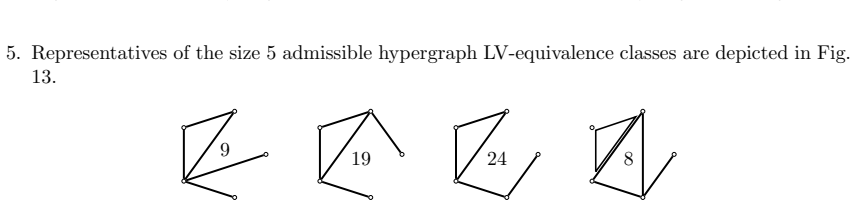
The central claim is that the correspondence between trees and superintegrable Lotka-Volterra systems extends, with extra combinatorial structure, to hypergraphs: every admissible loopless hypergraph of order $n$ and size $k$ carries a generic class of $n$-component Lotka-Volterra systems with $k$ additional linear Darboux polynomials, and linear transformations of the variables induce an equivalence relation on admissible hypergraphs. For $n\le5$ the paper gives the complete list of nonequivalent admissible hypergraphs for $k\le7$ (and for $k=10$), together with representative interaction matrices. The main discovery in that list is the 5-component system (34), whose DPs correspond to the 2-edges $\{1,2\}$, $\{1,3\}$, $\{2,4\}$ and the 3-edge $\{1,2,5\}$; it has 13 parameters, four functionally independent integrals of the form (3), and is not equivalent by a linear transformation to any tree-system. Hence tree-systems, although they remain maximal at $n=5$, no longer account for all superintegrable Lotka-Volterra systems.
Load-bearing premise
The classification and the non-equivalence of the 13-parameter system to any tree-system rest on an exhaustive computer enumeration of all loopless hypergraphs with up to five vertices and seven edges, but the algorithm and code for that enumeration are not given.
Editorial extensions
If this is right
- For $n\le5$, the tables list all nonequivalent systems with up to seven additional linear Darboux polynomials; any such system is either one of the listed classes or a special parameter subcase.
- The 13-parameter system (34) is superintegrable with four independent integrals, so it has maximal integral count at $n=5$ despite not being a tree-system.
- For $n=5$, there are no admissible hypergraphs of size 8 or 9; the only admissible class beyond size 7 is the size-10 complete-graph family.
- If Conjecture 12 is true for all $n$, nonisomorphic trees give inequivalent tree-systems, making the tree itself a complete invariant for this family.
- The hyperforest construction extends the classification to nonhomogeneous Lotka-Volterra systems without changing the DPs.
Reading between the lines
- The paper's enumeration stops at $n=5$ mainly because the number of hypergraphs grows extremely fast; extending the same admissibility test to $n=6$ would show whether further non-tree superintegrable systems appear already at low dimension.
- The new system's 13 parameters match the $3n-2$ count of tree-systems, suggesting the natural next question is whether every superintegrable hypergraph-system at $n>5$ also saturates this parameter count or whether larger hyperedges require more parameters.
- Because the size-8 hypergraphs on five vertices are all inadmissible while the size-10 complete graph is admissible, adding one DP at $n=5$ can force a jump to a complete hypergraph; a similar 'closure' phenomenon may organise the admissible classes for larger $n$.
Editorial analysis
A structured set of objections, weighed in public.
Referee Report
Summary. The paper associates n-component Lotka-Volterra systems admitting k additional linear Darboux polynomials with loopless hypergraphs of order n and size k. It derives necessary and sufficient conditions (C1)-(C3) for a linear form to be a Darboux polynomial, gives a general solution for the coefficients and matrix entries, and treats special solutions. For n ≤ 5 it classifies admissible hypergraphs and the equivalence classes induced by linear transformations of the associated LV systems, listing representative matrices and parameter counts. The principal new result is a 13-parameter 5-component LV system, Eq. (34), claimed to be superintegrable (four functionally independent integrals from four DPs) and not linearly equivalent to any tree-system. A conjecture states that nonisomorphic trees are never LV-equivalent, verified computationally for n < 9.
Significance. If the claims are fully established, the paper extends the known tree-system superintegrable families: the system at Eq. (34) would be the first explicit example of a 5-component superintegrable LV system not equivalent to a tree-system, and the hypergraph formulation is a useful combinatorial organizing principle. The derivation of the Darboux-polynomial conditions is careful and checkable, and the explicit parametric matrices are a useful resource. The paper also supplies a concrete falsifiable conjecture with verification up to order 8. The main deficit is that the two load-bearing verifications — functional independence of the integrals of (34) and nonexistence of an equivalence to a tree — are asserted rather than demonstrated or made reproducible.
major comments (3)
- [Section 4.4, matrix (34)] The paper asserts that the four DPs listed for matrix (34) yield '4 functionally independent integrals' via Eq. (3), but no proof or Jacobian computation is supplied. Since the paper itself notes that some 5-component systems with four DPs have only three independent integrals (Section 4.4, comments after (33)), functional independence is not automatic. Please provide the four integrals explicitly (or their coefficient matrix) and a generic nonzero Jacobian determinant, or a rank computation for the cofactor matrix B and inverse A^{-1}.
- [Section 4.4 and Tables 4/5] The claim that (34) is not equivalent to a tree-system is supported only by the classification obtained from an unstated enumeration of all loopless hypergraphs for n≤5, k≤7. No algorithm, code, or equivalence-checking procedure is provided, and no direct invariant argument is given for this particular hypergraph. If the enumeration missed a hypergraph equivalent to (34), or if the equivalence computation is incomplete, the 'new' part of the claim fails. Please include the generation/equivalence code or a precise algorithmic description, and ideally a hand-checkable invariant for (34) that distinguishes it from all tree-hypergraphs.
- [Section 4, Tables 2-4] The admissibility and nonequivalence counts are presented without an independent check or a description of the exact conditions used to decide admissibility and equivalence in the computer search. For reproducibility and confidence, state the exact criteria (e.g., which special cases are excluded, how the general solution conditions are tested over the parameter space) and provide code or a verification script as supplementary material.
minor comments (5)
- [Eq. (34)] The last row of the matrix in Eq. (34) is typeset ambiguously; the first entry appears to be a rational expression but the alignment with the other entries is unclear.
- [Section 2, introductory paragraphs] The text uses 'an L V-system' where 'a Lotka-Volterra system' would be clearer, and 'm >2' should be 'm > 2' for typographical consistency.
- [Example 8, Eq. (27)] The conclusion from (27) could be spelled out: substituting the three equalities into (25) gives a sum with opposite signs, hence twice the product, so the violation of (24) is immediate.
- [Eq. (11) and surrounding text] The notation T_{x,y} for the edge set of a path is used without an explicit definition of the product over the path; a clarifying sentence would help the reader follow the index bookkeeping.
- [Table 7 and Appendix A] For n=8, the table lists LV-equivalent hypergraph counts but the main text does not show the individual equivalence classes; cross-referencing the appendix figures more explicitly would improve readability.
Circularity Check
No significant circularity: the DP conditions are derived from first principles and the new 5-component system is an explicit construction, not a fitted or self-referential prediction.
full rationale
The paper's central derivation is a direct constraint analysis. Lemma 2 derives conditions C1-C3 from the definition of a Darboux polynomial without assuming the target result; Prop. 3 gives a general solution of those conditions by choosing a tree, and Props. 4 and 6 handle reparametrization and special solutions. The hypergraph association is a bookkeeping device: each additional DP of form (1) is labelled by its support, and admissibility is decided by whether the C conditions have a general solution. The 5-component system (34) is an explicitly displayed matrix whose four DPs are listed in Section 4.4; the claim of four functionally independent integrals is asserted as a direct consequence of formula (3), not obtained by fitting a parameter to a target integral count. The statement that (34) is not equivalent to a tree-system is a byproduct of the stated classification of equivalence classes of admissible hypergraphs, not an input used to construct (34). The cited prior work [5,8] supplies background on tree-systems and generic independence for trees, but the new system's superintegrability is not deduced from those citations. The undocumented exhaustive enumeration for n=5 is a reproducibility gap, not circularity: nothing in the paper defines (34) in terms of the enumeration's output or fits the enumeration to produce the claimed non-equivalence. No step reduces, by construction or by self-citation, to its own input.
Assumptions & free parameters
assumptions (4)
- standard math Lotka-Volterra systems are of the form (2) with polynomial vector field; Darboux polynomials defined as usual.
- domain assumption For generic values of the parameters, det(A) ≠ 0 and the nonvanishing conditions (9) hold.
- ad hoc to paper Classification is restricted to intersections of general solutions; special subclasses and degenerate parameter values are excluded.
- ad hoc to paper The enumeration of hypergraphs for n≤5 is exhaustive and correct.
Cite this review
Pith. "Pith review of Hypergraphs and Lotka-Volterra systems with linear Darboux polynomials." pith.science (2026). https://pith.science/paper/K2RINVJ5
@misc{pith2026241118264,
  author       = {Pith},
  title        = {Pith review of: Hypergraphs and Lotka-Volterra systems with linear Darboux polynomials},
  year         = {2026},
  howpublished = {\url{https://pith.science/paper/K2RINVJ5}},
  note         = {Machine review of arXiv:2411.18264}
}
abstract
We associate parametric classes of $n$-component Lotka-Volterra systems which admit $k$ additional linear Darboux polynomials, with admissible loopless hypergraphs of order $n$ and size $k$. We study the equivalence relation on admissible hypergraphs induced by linear transformations of the associated LV-systems, for $n\leq 5$. We present a new 13-parameter 5-component superintegrable Lotka-Volterra system, i.e. one that is not equivalent to a so-called tree-system. We conjecture that tree-systems associated with nonisomorphic trees are not equivalent, which we verified for $n<9$.
Figures


Figures from the paper (14 more)




Reference graph
Works this paper leans on
-
[1]
Goriely, Integrability and Nonintegrability of Dynamical Systems (2001) World Scientific
A. Goriely, Integrability and Nonintegrability of Dynamical Systems (2001) World Scientific
work page 2001
-
[2]
M. Hedge, M.R. Sridharan, Enumeration of hypergraphs, Discrete Mathematics 45 (1983) 239-243
work page 1983
-
[3]
Maier, The integration of three-dimensional Lotka-Volterra systems, Proc
R.S. Maier, The integration of three-dimensional Lotka-Volterra systems, Proc. Roy. Soc. A 469 (2013) 20120693
work page 2013
-
[4]
(2024), The On-Line Encyclopedia of Integer Sequences, Published electronically at https://oeis.org
OEIS Foundation Inc. (2024), The On-Line Encyclopedia of Integer Sequences, Published electronically at https://oeis.org
2024
-
[5]
G.R.W. Quispel, B. Tapley, D.I. McLaren and P.H. van der Kamp, Linear Darboux poly- nomials for Lotka–Volterra systems, trees and superintegrable families, J. Phys. A: Math. Theor. 56 (2023) 315201
work page 2023
-
[6]
P.H. van der Kamp, R.I. McLachlan, D.I. McLaren and G.R.W. Quispel, Measure preservation and integrals for Lotka–Volterra tree-systems and their Kahan discretisation, J. Comp. Dyn. 11(4) (2024) 468-484
work page 2024
-
[7]
P.H. van der Kamp, D.I. McLaren and G.R.W. Quispel, Homogeneous Darboux polynomials and generalising integrable ODE systems, J. Comput. Dyn. 8(1) (2021) 1-8
work page 2021
-
[8]
P.H. van der Kamp, G.R.W. Quispel and D.I. McLaren, Trees and superintegrable Lotka- Volterra families, Mathematical Physics, Analysis and Geometry 27(25) (2024) 20pp. 20
work page 2024
Reviewed August 12, 2026 · model on record in the stance chip above.
Discussion (0). Continue with ORCID to comment.