REVIEW 3 major objections 5 minor 50 references
Intrinsic aeroacoustic instabilities in the crosstalk apertures of can-annular combustors
T0 review · 3 major / 5 minor · reviewed 2026-08-12 · deepseek-v4-flash
Pith's one-line read Crosstalk gaps between combustor cans can whistle on their own, with no acoustic feedback from the duct ends.
desk verdict A careful first experimental map of crosstalk-aperture whistling, but the 'intrinsic instability' label outruns the evidence because the choked-vane reflection path is never closed. read the letter →
The pith
A machine-rendered reading of the paper's core claim, the machinery that carries it, and where it could break.
The reading
What carries the argument
The load-bearing object is the crosstalk aperture itself: a small gap between two square channels, bounded upstream by the splitting-plate trailing edge and downstream by choked turbine vanes, with low-Mach grazing flow on both sides. Its behaviour is governed by a Strouhal number based on the aperture length, $St = f(d + r_v/2)/U$, where $d$ is the gap distance, $r_v$ the vane leading-edge radius, and $U$ the channel velocity; the collapse of all whistling peaks onto one constant Strouhal number is the evidence that a convective shear-layer instability sets the frequency. The other essential elements are the anechoic terminations, verified by multi-microphone measurement of reflection coefficients, which exclude longitudinal acoustic feedback, and the fluctuating Lamb vector $\omega \times u$, whose projection on the acoustic velocity identifies the region of sound production in the aperture.
What would settle it
A decisive check would be to measure the upstream reflection coefficient at the exact whistling frequency for each geometry; if it is not small at those frequencies, then the claim that longitudinal modes play no role is unsupported. Alternatively, replacing the anechoic terminations with highly reflective walls and observing a frequency shift to a duct resonance would show that boundary feedback participates after all.
Extended reading notes
Core claim
On the paper's own terms, the central discovery is that intense whistling at the crosstalk aperture is an intrinsic aeroacoustic instability, not an acoustically coupled duct mode. Because the inlet and outlet terminations absorb sound above 600 Hz, the observed peaks at 2–5 kHz cannot be maintained by reflection from the rig boundaries; instead, the hydrodynamic shear layer across the aperture self-oscillates and radiates plane acoustic waves upstream in both channels. The oscillation frequency obeys $St = f(d + r_v/2)/U$ with $St \approx 0.62$ for rectangular and $0.51$ for round upstream edges in the misaligned vane configuration, and the probability density of the band-passed pressure changes from Gaussian to bimodal as the aperture grows, signalling a transition to a self-oscillating limit cycle. The same instability is reproduced in compressible large-eddy simulations, where the source region is identified through the fluctuating Lamb vector.
Load-bearing premise
The load-bearing premise is that the terminations are truly anechoic at all whistling frequencies and that the choked vane passage itself provides no hidden acoustic reflection path back to the aperture.
Editorial extensions
If this is right
- Whistling frequency at a given geometry can be predicted from the Strouhal number once the channel velocity is known.
- The onset of whistling can be suppressed or delayed by changing the shape of the aperture's upstream edge, rectangular versus round, and by aligning the splitting plate with a vane.
- In a real can-annular combustor, acoustic reflections from burners and flames would add to the intrinsic source, potentially producing a stronger aero-thermo-acoustic limit cycle than the pure aeroacoustic one.
- The Gaussian-to-bimodal probability-density transition gives a robust experimental marker for detecting the instability threshold.
- Because the whistling is intrinsic, it can occur in non-reactive flow and may be misattributed to flame-acoustic coupling in engines.
Reading between the lines
- If the instability is truly intrinsic, then any two neighbouring cans whose outlet gap meets the same Strouhal and geometry conditions should whistle even with perfectly non-reflecting boundaries, so engine tests with reflective boundaries may under- or over-estimate the amplitude depending on phase.
- A testable extension is to vary the vane leading-edge radius $r_v$ and check that the whistling frequency shifts through the same Strouhal relation, which would confirm that the relevant length scale is $d + r_v/2$ rather than $d$ alone.
- The same mechanism might apply to other two-sided grazing-flow apertures with a downstream choked passage, such as bleed-air systems or inter-stage gaps, wherever a thin shear layer spans a narrow opening.
- The simulations suggest that turbulent perturbations visibly modulate the amplitude of the self-oscillation, so a stochastic model of the unstable shear-layer mode could predict the observed pressure statistics without resolving the full turbulence.
Editorial analysis
A structured set of objections, weighed in public.
Referee Report
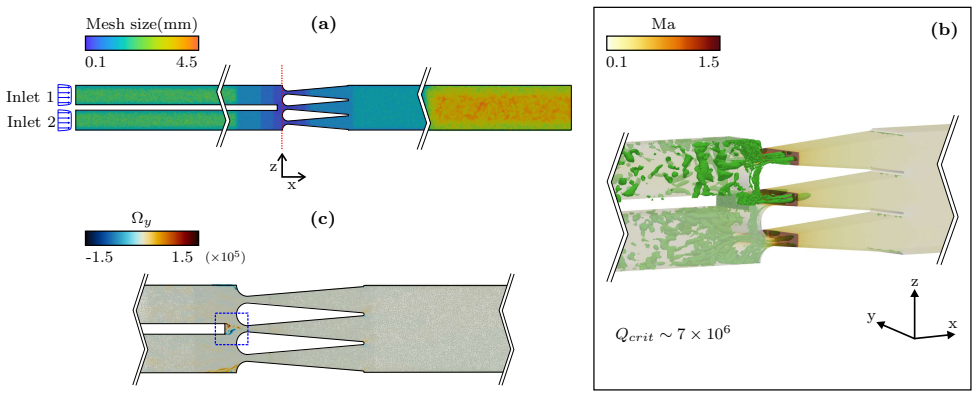
Summary. This paper reports an experimental and numerical study of self-sustained whistling at the crosstalk aperture between two choked-flow channels that model the combustor-to-turbine interface of a can-annular gas turbine. The rig has nominally anechoic upstream and downstream terminations, and the aperture geometry is varied in terms of axial length, edge shape, and vane alignment. The authors observe intense narrow-band acoustic peaks for several configurations, with a peak frequency that decreases as the aperture length increases, and they interpret the phenomenon as an intrinsic aeroacoustic instability governed by Strouhal scaling of the shear layer in the aperture. Compressible LES reproduces the whistling for two of the three simulated cases, and the paper uses the simulations to localize the sound source via the fluctuating Lamb vector. The claimed practical relevance is that such crosstalk whistling could be misattributed to thermoacoustic flame feedback in real engines.
Significance. If the intrinsic-instability interpretation is correct, the result is significant: it would demonstrate that a purely hydrodynamic shear-layer feedback at the aperture can produce high-amplitude self-sustained oscillations without a global acoustic mode, and it would establish a new mechanism relevant to can-annular combustor design. The experimental dataset is valuable: it systematically varies aperture length, edge geometry, and vane alignment, and it uses PDF shape as a stability indicator. The LES reproduces the main trends and provides a plausible source region, and the paper is honest about the one discrepant LES case. The main weakness is that the evidence does not fully exclude a local acoustic feedback path involving the choked vane throat, so the central claim needs additional support before the paper can be accepted as written.
major comments (3)
- [Section 3.1 / Section 2.3] The conclusion that the whistling is an intrinsic aeroacoustic instability is not fully secured. The anechoic character of the upstream and downstream horns, characterized above 600 Hz, excludes longitudinal modes spanning the entire rig, but it does not exclude a short local feedback loop: shear-layer oscillation at the aperture radiates downstream, reflects from the choked vane throat a few millimeters away, and returns to seed the shear layer. The microphones x5-x8 characterize the downstream horn from the downstream side of the vanes; they do not measure the upstream-looking reflection coefficient of the choked vane passage. The introduction itself cites [38] to state that choked nozzles reflect sound. To support the central claim, the authors should either measure or model the reflection presented to upstream-traveling waves by the vane passage, or provide a direct test such as an LES with the vane throat artificially made anechoic, showing that the oscillation persists without that reflection.
- [Section 3.1, Eq. (2) and Fig. 3c] The Strouhal numbers 0.62, 0.51, 0.55, and 0.41 are extracted from the measured peak frequencies at a single flow velocity and then used to draw the dashed scaling lines; calling this 'Strouhal scaling enables prediction' overstates the evidence, because the constants are calibrated to the same data. The data do clearly show that the whistling frequency decreases with aperture length, and a constant-St collapse is a reasonable summary, but it should be presented as a fit rather than a predictive test. Please report the fitted constants with uncertainties and, if predictive power is claimed, validate against an independent condition such as a different flow velocity or a different vane radius.
- [Section 4.2, d = 7.2 mm] The LES predicts self-sustained oscillations for d = 7.2 mm, while the experiment shows a stable Gaussian PDF for the same geometry; the paper attributes this to proximity of the instability threshold without quantitative support. This case is also one of the two used in Section 4.3 for the Lamb-vector source analysis. The discrepancy weakens the claim that the LES 'remarkably reproduce the whistling phenomenon.' Please provide a quantitative argument for the threshold-sensitivity interpretation, for example a linear growth-rate estimate, a sensitivity study to small geometric perturbations, or a stability map, so that the mismatch is not left as an ad hoc explanation.
minor comments (5)
- [Section 3.1, first paragraph] The sentence 'In Fig. 2a, one can see a sharp peak for all crosstalk opening' appears to refer to Fig. 3a, the acoustic spectra, not Fig. 2a, the rig overview.
- [Section 4.3, Fig. 8 discussion] The text states 'an alternance of upward (red) and downward (red) flow deflection'; the two colors should be different, likely 'downward (blue)', or the figure color scheme should be described accurately.
- [Eq. (1)] The isentropic choked-mass-flow equation is typeset with an ambiguous exponent; please use standard display math so that the exponent (γ+1)/(2(γ-1)) is clear.
- [Appendix] The sentence 'an increase in the mass flow rate is accompanied with an of the mean pressure' is incomplete; it should read 'accompanied by an increase of the mean pressure.'
- [Section 2.3] The statement that 'most of the acoustic energy travelling towards the terminations is absorbed' is qualitative; please report the numerical range of |R| above 600 Hz so the anechoic criterion is quantitative and reproducible.
Circularity Check
Strouhal 'prediction' is a calibration dressed as a prediction; the intrinsic-instability claim itself is not circular but rests on an unmeasured vane-throat reflection assumption.
-
fitted input called prediction
[Section 3.1, Eq. (2), Fig. 3c; Section 5 (Conclusion)]
"The dashed black lines in Fig. 3c represent the Strouhal scaling. The frequencies for the rectangular and round edges scale with a Strouhal number of 0.62 and 0.51, respectively. [...] The Strouhal scaling enables prediction of the of the peak frequency of the self-oscillations."
The Strouhal constants 0.62, 0.51, 0.55 and 0.41 are obtained by drawing scaling lines through the measured dominant peak frequencies in Figs. 3c and 5c, with the length scale d+rv/2 chosen a posteriori to collapse those same data. Therefore claiming that the scaling 'enables prediction of the peak frequency' is a restatement of the fit rather than an independent predictive test. This circularity is partial: the main intrinsic-instability claim does not depend on the exact St values, and is separately supported by the d-dependence of the peaks and by LES with anechoic NSCBC conditions.
full rationale
One genuine circular step exists: the Strouhal numbers are fitted to the measured whistling frequencies and then the same scaling is called a prediction. This is a fitted-input-called-prediction. However, the central claim — that the whistling is an intrinsic aeroacoustic instability — is not forced by that fit. The decrease of frequency with aperture length, the LES reproducing self-oscillation with nearly anechoic inlet/outlet NSCBC, and the bimodal PDF transition are independent observations. The paper's self-citations ([27], [38], [11]) are contextual and not load-bearing; no uniqueness theorem is imported. A separate correctness caveat, not a circularity, is that the anechoic-character claim is validated only for the far inlet/outlet horns above 600 Hz; the choked vane passage itself is acknowledged in the introduction to reflect sound ([38]), and its upstream-facing reflection coefficient is not measured, so a short local feedback loop involving the vane throat is not excluded. Score is 4 instead of 6 because the main result retains independent content.
Assumptions & free parameters
free parameters (5)
- Strouhal number, rectangular edge, misaligned vanes =
0.62
- Strouhal number, round edge, misaligned vanes =
0.51
- Strouhal number, rectangular edge, aligned vanes =
0.55
- Strouhal number, round edge, aligned vanes =
0.41
- Effective aperture length offset rv/2 =
3.8 mm (rv = 7.6 mm)
assumptions (5)
- standard math Choked-flow isentropic relations, Eq. (1), determine the critical area and guarantee sonic conditions at the vanes.
- domain assumption The measured upstream and downstream reflection coefficients are small above 600 Hz, so the terminations are anechoic in the whistling range.
- domain assumption Howe's energy corollary, with the Lamb vector as sound source, applies to this low-Mach, high-Reynolds aperture flow.
- domain assumption A bimodal PDF of band-pass filtered acoustic pressure marks a self-oscillating shear-layer mode, per Van der Pol oscillator statistics.
- domain assumption Smagorinsky SGS model with constant 0.17 and law-of-the-wall boundary layers adequately represent the turbulent channel flow in the LES.
Cite this review
Pith. "Pith review of Intrinsic aeroacoustic instabilities in the crosstalk apertures of can-annular combustors." pith.science (2026). https://pith.science/paper/XGXXBYQS
@misc{pith2026241118283,
  author       = {Pith},
  title        = {Pith review of: Intrinsic aeroacoustic instabilities in the crosstalk apertures of can-annular combustors},
  year         = {2026},
  howpublished = {\url{https://pith.science/paper/XGXXBYQS}},
  note         = {Machine review of arXiv:2411.18283}
}
read the original abstract
This paper presents an experimental and numerical study of aeroacoustic instabilities at the interface between neighbouring combustion chambers in modern heavy-duty gas turbines. A simplified laboratory-scale geometry of the gap separating the outlet of these chambers, just upstream of the turbine inlet in can-annular combustor architectures, is considered. It consists of two channels with anechoic and chocked conditions on the upstream and downstream sides respectively. Right before the choked-flow vanes which represent the turbine inlet, a small aperture leads to an aeroacoustic crosstalk between the channels. The dimensions and flow conditions are defined such that relevant Mach, Strouhal and Helmholtz numbers of gas turbines are reproduced. The alignment of the vanes with respect to the crosstalk aperture is varied. An intense whistling is observed for some conditions. The oscillation frequency depends on the aperture area and scales with the Strouhal number based on the aperture length. The upstream anechoic condition in each channel implies that no longitudinal acoustic mode participate to the mechanism of this whistling, which is in agreement with the Strouhal scaling of this intrinsic aeroacoustic instability. Compressible Large Eddy Simulations of the configuration have been performed and remarkably reproduce the whistling phenomenon. This work contributes to the understanding of aeroacoustic instabilities at the crosstalk apertures of can-annular combustors. It will help designing combustor-turbine interfaces to suppress them, which is important since the vibrations they induce may be as damaging as the ones from thermoacoustic instabilities.
Figures


Figures from the paper (7 more)




Reference graph
Works this paper leans on
-
[38]
M. Weilenmann, N. Noiray, Experiments on sound reflection and p ro- duction by choked nozzle flows subject to acoustic and entropy wa ves, Journal of Sound and Vibration 492 (2021) 115799
work page 2021
- [1]
-
[2]
G. Glenk, S. Reichelstein, Economics of converting renewable pow er to hydrogen, Nature Energy 4 (3) (2019) 216–222. 32 80 80 100 100 120 120 2000 4000 6000 SPL [dB] Freq. [Hz] ˙mair [g/s] 80 g/s 90 g/s 100 g/s 110 g/s 120 g/s a) b) Figure 10: a) Acoustic PSD for five different mass flow rates ˙ mair. The crosstalk aperture geometry is with d = 7 . 2 mm and ...
work page 2019
-
[3]
European Turbine Network (ETN Global), Hydrogen gas turbines , the path towards a zero-carbon gas turbine, https://etn.global/ wp- content/uploads/2020/02/ETN-Hydrogen-Gas-Turbines-report.pdf (2020)
work page 2020
-
[4]
B. Schuermans, J. Moeck, A. Blond´ e, B. Dharmaputra, N. Noir ay, The rayleigh integral is always positive in steadily operated combustors, Pro- ceedings of the Combustion Institute (2022)
work page 2022
-
[5]
K. Moon, H. Jegal, C. Yoon, K. T. Kim, Cross-talk-interaction-in duced combustion instabilities in a can-annular lean-premixed combustor co n- figuration, Combustion and Flame 220 (2020) 178–188
work page 2020
- [6]
-
[7]
P. Kaufmann, W. Krebs, R. Valdes, U. Wever, 3D thermoacoust ic prop- erties of single can and multi can combustor configurations, in: Tur bo Expo: Power for Land, Sea, and Air, Vol. 43130, 2008, pp. 527–53 8
work page 2008
Show all 50 references
-
[8]
Farisco, L
F. Farisco, L. Panek, J. B. Kok, Thermo-acoustic cross-talk b etween cans in a can-annular combustor, International journal of spra y and combustion dynamics 9 (4) (2017) 452–469
2017
-
[9]
Venkatesan, A
K. Venkatesan, A. Cross, C. Yoon, F. Han, S. Bethke, Heavy d uty gas turbine combustion dynamics study using a two-can combustion sys tem, in: Turbo Expo: Power for Land, Sea, and Air, Vol. 58615, American Society of Mechanical Engineers, 2019, p. V04AT04A020. 34
2019
-
[10]
Ghirardo, C
G. Ghirardo, C. Di Giovine, J. P. Moeck, M. R. Bothien, Thermoa cous- tics of can-annular combustors, Journal of Engineering for Gas T urbines and Power 141 (1) (2019) 011007
2019
-
[11]
Pedergnana, A
T. Pedergnana, A. Orchini, J. Moeck, N. Noiray, Bridging the gap between annular and can-annular acoustic spectra, Journal of the Acoustical Society of America 155 (3) (2024) 2192 – 2198. doi:10.1121/10.0025383
2024 doi
-
[12]
Luque, V
S. Luque, V. Kanjirakkad, I. Aslanidou, R. Lubbock, B. Rosic, S. Uchida, A new experimental facility to investigate combustor–tu rbine interactions in gas turbines with multiple can combustors, Journal o f Engineering for Gas Turbines and Power 137 (5) (2015)
2015
-
[13]
Jegal, K
H. Jegal, K. Moon, J. Gu, L. K. Li, K. T. Kim, Mutual synchroniza - tion of two lean-premixed gas turbine combustors: Phase locking an d amplitude death, Combustion and Flame 206 (2019) 424–437
2019
-
[14]
K. Moon, H. Jegal, J. Gu, K. T. Kim, Combustion-acoustic intera ctions through cross-talk area between adjacent model gas turbine co mbustors, Combustion and Flame 202 (2019) 405–416
2019
-
[15]
G. J. Fournier, M. Meindl, C. F. Silva, G. Ghirardo, M. R. Bothien, W. Polifke, Low-order modeling of can-annular combustors, Journ al of Engineering for Gas Turbines and Power 143 (12) (2021)
2021
-
[16]
G. J. Fournier, F. Schaefer, M. Haeringer, C. F. Silva, W. Polifk e, In- terplay of clusters of acoustic and intrinsic thermoacoustic modes in 35 can-annular combustors, Journal of Engineering for Gas Turbine s and Power 144 (12) (2022) 121015
2022
-
[17]
J. G. von Saldern, A. Orchini, J. P. Moeck, A non-compact effec tive impedance model for can-to-can acoustic communication: analysis and optimization of damping mechanisms, Journal of Engineering for Gas Turbines and Power 143 (12) (2021)
2021
-
[18]
K. Moon, D. Bae, K. T. Kim, Modal dynamics of self-excited ther - moacoustic instabilities in even and odd numbered networks of lean- premixed combustors, Combustion and Flame 255 (2023) 112928
2023
-
[19]
K. Moon, C. Yoon, K. T. Kim, Influence of rotational asymmetr y on thermoacoustic instabilities in a can-annular lean-premixed combust or, Combustion and Flame 223 (2021) 295–306
2021
-
[20]
Jegal, J
H. Jegal, J. Gu, L. K. Li, K. T. Kim, Influence of asymmetric flame transfer functions on can-to-can acoustic interactions betwee n two lean- premixed combustors, Proceedings of the Combustion Institute 3 8 (4) (2021) 6051–6058
2021
-
[21]
Yoon, Thermoacoustics of multi-burner combustors with ple num and chamber cross-talk, Journal of Sound and Vibration 520 (2022) 1 16623
M. Yoon, Thermoacoustics of multi-burner combustors with ple num and chamber cross-talk, Journal of Sound and Vibration 520 (2022) 1 16623
2022
-
[22]
Y. Guan, L. K. Li, H. Jegal, K. T. Kim, Effect of flame response as ym- metries on the modal patterns and collective states of a can-annu lar lean-premixed combustion system, Proceedings of the Combustion In- stitute (2022). 36
2022
-
[23]
Pedergnana, N
T. Pedergnana, N. Noiray, Steady-state statistics, emerge nt patterns and intermittent energy transfer in a ring of oscillators, Nonlinear Dyna mics 108 (2) (2022) 1133–1163
2022
-
[24]
S. C. Humbert, A. Orchini, Acoustics of can-annular combusto rs: Ex- perimental characterisation and modelling of a lab-scale multi-can se tup with adjustable geometry, Journal of Sound and Vibration (2023) 117864
2023
-
[25]
Haeringer, G
M. Haeringer, G. J. Fournier, M. Meindl, W. Polifke, A strategy t o tune acoustic terminations of single-can test-rigs to mimic thermoacous tic behavior of a full engine, Journal of Engineering for Gas Turbines a nd Power 143 (7) (2021)
2021
-
[26]
Haeringer, W
M. Haeringer, W. Polifke, Time-domain bloch boundary conditions for efficient simulation of thermoacoustic limit cycles in (can-) annular com - bustors, Journal of Engineering for Gas Turbines and Power 141 ( 12) (2019)
2019
-
[27]
Pedergnana, N
T. Pedergnana, N. Noiray, Coupling-induced instability in a ring of ther- moacoustic oscillators, Proceedings of the Royal Society A 478 (22 59) (2022) 20210851
2022
-
[28]
M. S. Howe, The dissipation of sound at an edge, Journal of Sou nd and Vibration 70 (3) (1980) 407–411
1980
-
[29]
Orchini, An effective impedance for modelling the aeroacoustic cou- pling of ducts connected via apertures, Journal of Sound and Vibr ation 520 (2022) 116622
A. Orchini, An effective impedance for modelling the aeroacoustic cou- pling of ducts connected via apertures, Journal of Sound and Vibr ation 520 (2022) 116622. 37
2022
-
[30]
Orchini, T
A. Orchini, T. Pedergnana, P. E. Buschmann, J. P. Moeck, N. N oiray, Reduced-order modelling of thermoacoustic instabilities in can-annu lar combustors, Journal of Sound and Vibration 526 (2022) 116808
2022
-
[31]
Pedergnana, C
T. Pedergnana, C. Bourquard, A. Faure-Beaulieu, N. Noiray, Modeling the nonlinear aeroacoustic response of a harmonically forced side b ranch aperture under turbulent grazing flow, Physical Review Fluids 6 (2) (2021) 023903
2021
-
[32]
Boujo, M
E. Boujo, M. Bauerheim, N. Noiray, Saturation of a turbulent m ixing layer over a cavity: response to harmonic forcing around mean flow s, Journal of Fluid Mechanics 853 (2018) 386–418
2018
-
[33]
M. S. Howe, Acoustics of fluid-structure interactions, Cambr idge uni- versity press, 1998
1998
-
[34]
Howe, Influence of wall thickness on rayleigh conductivity an d flow- induced aperture tones, Journal of fluids and structures 11 (4) (1997) 351–366
M. Howe, Influence of wall thickness on rayleigh conductivity an d flow- induced aperture tones, Journal of fluids and structures 11 (4) (1997) 351–366
1997
-
[35]
Grace, K
S. Grace, K. Horan, M. Howe, The influence of shape on the ray leigh conductivity of a wall aperture in the presence of grazing flow, Jou rnal of fluids and structures 12 (3) (1998) 335–351
1998
-
[36]
Kooijman, A
G. Kooijman, A. Hirschberg, J. Golliard, Acoustical response o f orifices under grazing flow: Effect of boundary layer profile and edge geome try, Journal of Sound and Vibration 315 (4-5) (2008) 849–874
2008
-
[37]
Bourquard, A
C. Bourquard, A. Faure-Beaulieu, N. Noiray, Whistling of deep c avities 38 subject to turbulent grazing flow: intermittently unstable aeroac oustic feedback, Journal of Fluid Mechanics 909 (2021)
2021
-
[39]
Schuermans, W
B. Schuermans, W. Polifke, C. O. Paschereit, Modeling Transfe r Ma- trices of Premixed Flames and Comparison With Experimental Re- sults, Proc. Turbo Expo: Power for Land, Sea, and Air 2 (1999). doi:10.1115/99-GT-132
1999 doi
-
[40]
Etkin, G
B. Etkin, G. Korbacher, R. Keefe, Acoustic radiation from a st ationary cylinder in a fluid stream (aeolian tones), Journal of the Acoustical Society of America 29 (1) (1957) 30 – 36
1957
-
[41]
Emmert, S
T. Emmert, S. Bomberg, W. Polifke, Intrinsic thermoacoustic in stability of premixed flames, Combustion and Flame 162 (1) (2015) 75 – 85. doi:10.1016/j.combustflame.2014.06.008
2015 doi
-
[42]
C. F. Silva, Intrinsic thermoacoustic instabilities, Progress in En ergy and Combustion Science 95 (2023). doi:10.1016/j.pecs.2022.101065
2023
-
[43]
H. S. Gopalakrishnan, A. Gruber, J. P. Moeck, Computa- tion and prediction of intrinsic thermoacoustic oscillations associ- ated with autoignition fronts, Combustion and Flame 254 (2023). doi:10.1016/j.combustflame.2023.112844
2023
-
[44]
Dupuy, Q
A. Dupuy, Q. Douasbin, T. Poinsot, Control of intrinsic thermo acous- tic instabilities for methane and hydrogen air flames: Dns and net- 39 work analysis, Proceedings of the Combustion Institute 40 (1-4) ( 2024). doi:10.1016/j.proci.2024.105217
2024
-
[45]
N. Noiray, Linear growth rate estimation from dynamics and sta tistics of acoustic signal envelope in turbulent combustors, Journal of Eng ineering for Gas Turbines and Power 139 (4) (2017). doi:10.1115/1.4034601
2017 doi
-
[46]
Colin, M
O. Colin, M. Rudgyard, Development of high-order Taylor-Galer kin schemes for LES, Journal of Computational Physics 162 (2) (200 0) 338–371
-
[47]
Poinsot, S
T. Poinsot, S. Lele, Boundary conditions for direct simulations o f com- pressible viscous flows, Journal of Computational Physics 101 (1) (1992) 104–129
1992
-
[48]
Geuzaine, J.-F
C. Geuzaine, J.-F. Remacle, Gmsh: A 3-D finite element mesh gene rator with built-in pre- and post-processing facilities, International Jou rnal of Numerical Methods in Engineering 79 (2009) 1309–1331
2009
-
[49]
Smagorinsky, General circulation experiments with the primit ive equations, Mon
J. Smagorinsky, General circulation experiments with the primit ive equations, Mon. Weather Rev. 91 (3) (1963) 99–164
1963
-
[50]
Boujo, C
E. Boujo, C. Bourquard, Y. Xiong, N. Noiray, Processing time- series of randomly forced self-oscillators: The example of beer bottle whistlin g, J. Sound Vib. 464 (2020) 114981. doi:10.1016/j.jsv.2019.114981. 40
2020
Reviewed August 12, 2026 · model on record in the stance chip above.
Discussion (0). Continue with ORCID to comment.