REVIEW 3 major objections 6 minor 289 references
Atoms in Dense Plasmas: Models, Applications, and Current Challenges
T0 review · 3 major / 6 minor · reviewed 2026-08-12 · deepseek-v4-flash
Pith's one-line read The thesis claims that a variational free-energy minimization can simultaneously determine the electron structure, the mean ionization, and the ion-fluid correlations of a dense plasma, making pressure ionization an emergent equilibrium…
desk verdict A habilitation synthesis rather than a single new result, but the VAMPIRES model and the generalized Debye-Hückel free-energy functionals are real contributions, and the thesis is refreshingly honest about where it does not yet work. read the letter →
The pith
A machine-rendered reading of the paper's core claim, the machinery that carries it, and where it could break.
The reading
What carries the argument
The load-bearing machinery is a first-order cluster expansion of the electron density, $n(\mathbf{R}_1,\dots,\mathbf{R}_{N_i};\mathbf{r}) \approx n_e + \sum_j q(|\mathbf{r}-\mathbf{R}_j|)$, combined with a finite-temperature density-functional free energy for the electrons and a classical-fluid free energy for the ions. The central object is the generalized free-energy functional $\dot{F}\{h,q,n_e\}$ whose variables are the displaced-electron cloud $q(r)$, the jellium density $n_e$, and the ion-ion radial correlation function $h(r)=g(r)-1$; minimizing it under the neutrality constraint reproduces the Ornstein-Zernike equation with the chosen closure and yields the electron self-consistent equation. The special role of the free-energy functionals, which for the Debye-Hückel model were derived here for arbitrary interaction potentials, is that they make the virial theorem hold by construction, so thermodynamic quantities computed from the same functional are consistent with the pressure.
What would settle it
A decisive check would be a strongly coupled plasma, say lithium near the pressure-ionization edge at about 10 eV and several g/$cm^{3}$, where quantum molecular dynamics or X-ray Thomson scattering provides the pair correlation function and mean ionization; if the measured or simulated ionization state departs from VAMPIRES in a way that cavity-based models capture better, the claimed first-principle origin of pressure ionization is not supported.
Extended reading notes
Core claim
The central claim is that one can write a variational average-atom model whose constrained minimization yields, at the same time, the bound and continuum electron structure, the average ion charge, and the equilibrium structure of the ion fluid. The VAMPIRES model realizes this by combining a first-order cluster expansion of the electron density with a generalized free-energy functional for a classical one-component fluid, taken in either the Debye-Hückel or the hypernetted-chain closure. The author shows that the equations obtained from minimizing this functional fulfill the virial theorem. In this model, the pressure-ionization phenomenon, as well as the switching from the Debye-Hückel-scale to the Wigner-Seitz-scale decay of the effective potential, stems from the accounting for the structure of the ion fluid, and the ionization state of the plasma is obtained from the condition of thermodynamic equilibrium rather than from a heuristic ionization-potential-depression formula.
Load-bearing premise
The load-bearing premise is the first-order cluster expansion: the electron density of the whole plasma is approximated as a uniform background plus a linear sum of spherical one-ion clouds, with all nonlinear overlap of clouds and many-body correlations beyond pairs neglected, while the nuclei are treated as classical particles.
Editorial extensions
If this is right
- Mean ionization, electron orbitals, and ion-fluid pair correlations follow from one equilibrium minimization, removing the need for an external ionization-potential-depression model.
- Thermodynamic quantities from the VAAQP and VAMPIRES models satisfy the virial theorem, so thermodynamic and virial pressure agree by construction.
- In VAAQP-based opacity calculations, pressure ionization does not create discontinuities: a lost bound level reappears as a resonance, keeping the total opacity continuous.
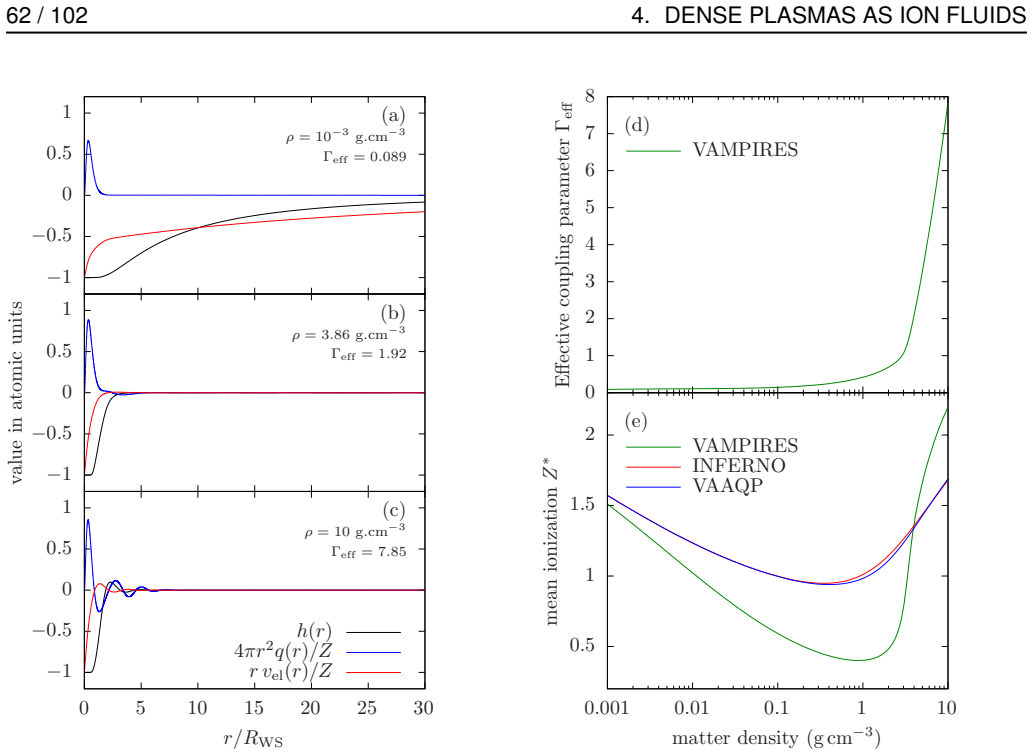
- In VAMPIRES, pressure ionization coincides with a sharp rise of the effective ion coupling and a shortening of the effective potential range from beyond to inside the Wigner-Seitz radius, giving a distinctive signature of the transition.
- If correct, the model supports extending atomic modeling to liquid-like, strongly coupled plasmas where the cavity picture of older ion-cell models is questionable.
Reading between the lines
- Editorial inference: extending VAMPIRES to multi-species mixtures and to detailed configurational states, which the author reports as in progress, would give a natural bridge between dense-plasma average-atom models and collisional-radiative modeling.
- Editorial inference: the weak-coupling limit of VAMPIRES could be made quantitative by checking whether it reproduces the standard continuum-lowering shift plus computable corrections, thereby testing whether any ad hoc suppression of bound states is needed.
- Editorial inference: the model's steeper pressure-ionization rise than cavity-based models is a testable prediction; comparing mean ionization in X-ray Thomson scattering experiments across the transition would discriminate the mechanism.
- Editorial inference: because the self-consistent dynamic linear response with continuum channels remained unresolved, frequency-dependent opacity near the plasma frequency is not yet a settled prediction of this framework; fixing the suspected boundary-condition issue would sharpen the collective-effect description.
Editorial analysis
A structured set of objections, weighed in public.
Referee Report
Summary. This habilitation thesis reviews and extends variational average-atom models of dense plasmas. After presenting the standard isolated-ion/Saha and ion-in-cell frameworks, the manuscript develops two families of models: VAAQP, an atom-in-jellium average-atom model obtained from a constrained free-energy minimization with a Wigner-Seitz cavity, and VAMPIRES, a more recent model that couples the electronic structure of an ion to the pair structure of the surrounding classical ion fluid through a generalized free-energy functional. Applications to photoabsorption, self-consistent linear response, and non-LTE collisional-radiative modeling are also surveyed. The central scientific claims are that VAMPIRES derives pressure ionization and the crossover from Debye-Hückel- to Wigner-Seitz-scale screening from a first-principles treatment of ion-fluid structure, and that VAAQP and VAMPIRES are thermodynamically consistent in the sense of fulfilling the virial theorem. The derivations are presented in outline form, with key equations given but details deferred to the cited papers.
Significance. If the central claims hold, the VAMPIRES model would be a notable conceptual advance: a parameter-free variational scheme in which the average ionization state, the displaced-electron clouds, and the ion-ion pair correlation function are obtained from one free-energy functional, with bound and continuum electrons treated quantum mechanically. The emphasis on thermodynamic consistency and the virial theorem is valuable, and the manuscript honestly documents where the models succeed and where they do not. The comparisons with INFERNO, VAAQP, and selected experimental opacity/Hugoniot data give the work a useful empirical anchor. The limitation of the work is that the load-bearing first-order cluster expansion is uncontrolled in the very strong-coupling regime where VAMPIRES produces its distinctive pressure-ionization prediction, and the manuscript itself reports puzzling strong-coupling behavior. The thesis is therefore significant as a synthesis and as a research program, but the flagship claim about pressure ionization is not yet established at the level of a rigorous, benchmarked result.
major comments (3)
- [Sec. 4.3, Eqs. (4.21), (4.25), and Figs. 4.1(c),(e)] The central claim that pressure ionization and the switching from Debye-Hückel- to Wigner-Seitz-scale decay "stems from a first-principle accounting for the structure of the ion fluid" is not established, because the ion-fluid structure and the electron-cloud overlap are both generated by the same uncontrolled first-order cluster expansion. At the densities where the mean ionization jumps, the effective coupling is Γeff ≈ 7.85, h(r) is visibly oscillatory, and the displaced-electron clouds overlap; the expansion neglects all nonlinear cloud-cloud overlap and all correlations beyond pairs. The fulfillment of the virial theorem is a consistency property of the approximate free-energy functional and does not bound the truncation error of the cluster expansion. To support the claim, the manuscript should provide a quantitative estimate of the neglected second-order cluster terms, or benchmark VAMPIRES against an independent method such as DFT-MD or QHNC across the Li 10 eV transition region. Without such a test, the sharp rise of Z* in Fig. 4.1(e) may be an artifact of the ansatz rather than a first-principles pressure-ionization mechanism.
- [Sec. 4.4] The manuscript states that results from VAMPIRES in strong-coupling situations are "puzzling" and that the model's weaknesses still need critical assessment. This is precisely the regime in which the pressure-ionization edge and the jump of Z* occur in Fig. 4.1(e). The paper should therefore specify which strong-coupling predictions are considered physically reliable, identify testable quantitative predictions that distinguish VAMPIRES from VAAQP and INFERNO, and state the expected accuracy of the first-order expansion in that regime. As written, the claim in Sec. 4.3 that pressure ionization emerges from first principles is premature.
- [Sec. 4.3, Eq. (4.19)] The nuclear degrees of freedom are treated as classical particles through a classical probability distribution over positions and momenta, while electrons are treated quantum mechanically. This is a reasonable approximation at 10 eV, but the manuscript does not quantify its validity for the lower-temperature, higher-density corner of the Li example. A simple estimate of the thermal de Broglie wavelength of the nuclei relative to RWS and to the scale of the ion-ion potential would make the scope of the model precise and would rule out a possible challenge to the pressure-ionization mechanism based on nuclear quantum effects.
minor comments (6)
- [Sec. 2.5] In the first sentence, "accouting" should be "accounting".
- [Sec. 3.1.1] In the sentence after Eq. (3.4), "Avrogadro's number" should be "Avogadro's number".
- [Fig. 3.1 caption] The caption contains "denisty", which should be "density".
- [Fig. 2.11 caption] The caption contains "Measurments", which should be "Measurements".
- [Fig. 2.2 caption] The caption says the comparisons are shown both without and with suppression, but it would be clearer if the two panels were explicitly labeled as in panel (a) and panel (b) within the caption.
- [Sec. 3.6.2 and Sec. 3.7] The text reports that the self-consistent linear response of the quantum VAAQP model remains inconclusive and that the failure may be due to boundary conditions. This is an important caveat for Chapter 3, and it should be stated in the chapter introduction as well as in the research prospects.
Circularity Check
No significant circularity: the core VAAQP and VAMPIRES models are parameter-free minimizations of stated free-energy functionals, and their central results are emergent outputs checked against external benchmarks.
full rationale
The central models are explicit variational minimizations: for VAAQP, Eq. (2.101) minimizes the free energy with respect to the displaced-electron density and the jellium density; for VAMPIRES, Eq. (4.33) minimizes the approximate free energy with respect to the ion-fluid correlation function h, the electron cloud q, and the background density ne. In both cases the mean ionization Z* = ne/ni is an output of the equilibrium condition, not a fitted input. The pressure-ionization phenomenon and the Debye-Hückel to Wigner-Seitz decay switching are reported as emergent properties of the coupled equations (4.34)-(4.41), illustrated in Fig. 4.1; they are not inserted as pre-imposed values. The first-order cluster expansion of the electron density, Eqs. (2.93) and (4.21), and of the free energy, Eq. (4.25), is an uncontrolled approximation in the strong-coupling regime, and Sec. 4.4 explicitly acknowledges that strong-coupling results are puzzling. That is a correctness and robustness concern, not a circularity: an uncontrolled approximation is still an approximation, not an input disguised as a prediction. The paper's statement that VAMPIRES fulfills the virial theorem is a consistency property of the Debye-Kirkwood charging construction described in Sec. 4.2; the thesis presents it as such rather than as an independent empirical confirmation. External comparisons, including INFERNO, measured silicon opacity, the aluminum Hugoniot, xenon photoabsorption, and NLTE workshop benchmarks, provide independent checks outside the fitted quantities. Self-citations to the author's prior papers supply derivations whose equations are restated in the manuscript, but they do not carry the load by assertion and they do not forbid alternative models through an imported uniqueness claim. No specific step reduces, by the paper's own equations or by self-citation, to its own inputs, so no circularity is established.
Assumptions & free parameters
free parameters (2)
- ad hoc spectral line broadening =
1 eV (Fig. 3.4) and 4 eV (Fig. 3.7)
- principal quantum number cutoff =
n <= 8
assumptions (5)
- ad hoc to paper First-order cluster expansion of electron density and free energy (Eqs. (2.93), (4.21), (4.25)): total density is jellium plus a sum of spherical displaced-electron clouds, with the free energy truncated at the same order.
- domain assumption Local density approximation (LDA) for exchange-correlation free energy (Eqs. (2.31), (2.98)).
- domain assumption Classical treatment of nuclei with pair interactions derived from spherical electron clouds (Eqs. (4.19), (4.24)).
- domain assumption HNC or DH closure for the ion-fluid pair correlation (Eqs. (4.34)-(4.35)).
- ad hoc to paper Wigner-Seitz cavity hypothesis in VAAQP (Eq. (2.99)).
Cite this review
Pith. "Pith review of Atoms in Dense Plasmas: Models, Applications, and Current Challenges." pith.science (2026). https://pith.science/paper/FJSYDE54
@misc{pith2026241118357,
  author       = {Pith},
  title        = {Pith review of: Atoms in Dense Plasmas: Models, Applications, and Current Challenges},
  year         = {2026},
  howpublished = {\url{https://pith.science/paper/FJSYDE54}},
  note         = {Machine review of arXiv:2411.18357}
}
read the original abstract
Modeling plasmas in terms of atoms or ions is theoretically appealing for several reasons. When it is relevant, the notion of atom or ion in a plasma provides us with an interpretation scheme of the plasma's microscopic structure. From the standpoint of quantitative estimation of plasma properties, atomic models of plasma allow extending many theoretical tools of atomic physics to plasmas. This notably includes the statistical approaches to the detailed accounting for excited states, or the collisional-radiative modeling of non-equilibrium plasmas, which is based on the notion of atomic processes. This habilitation thesis is mostly focused on the studies to which the author has contributed in the field of atomic modeling of dense, non-ideal plasmas. The studies to which the author contributed in the field of collisional-radiative modeling of non-LTE plasmas are also addressed, and the prospect of bridging with dense-plasma models is sketched.
Figures


Figures from the paper (25 more)





Reference graph
Works this paper leans on
-
[1]
Kippenhahn and A
R. Kippenhahn and A. Weigert. Stellar Structure and Evolution. Springer-Verlag, 1989
1989
-
[2]
At matter density of 10−3 g.cm−3, the 7d bound orbital is delocalized, but still contributes a sharp resonance in the continuum
ATOMIC PHYSICS OF NON-LTE PLASMAS 79 / 102 At high energies, the Born approximation behavior (plane-wave incoming and outgoing electrons) is recovered. At matter density of 10−3 g.cm−3, the 7d bound orbital is delocalized, but still contributes a sharp resonance in the continuum. At matter density of10−1 g.cm−3, the same occurs for the 3d bound orbital. A...
-
[3]
S. L. Shapiro and S. A. Teukolsky. Black Holes, White Dwarfs, and Neutron Stars: The Physics of Compact Objects. Wiley, 1983
1983
-
[4]
E. U. Condon and G. H. Shortley. The Theory of Atomic Spectra. Cambridge University Press, 1935
1935
-
[5]
error bars TROLL w
ATOMIC PHYSICS OF NON-LTE PLASMAS 77 / 102 0 50 100 150 200 250 300 350 400 0 0 .5 1 1 .5 2 (a) radiant intensity (GW.sr −1) time (ns) DMX w. error bars TROLL w. ICARE 0 20 40 60 80 100 120 140 0 0 .5 1 1 .5 2 (b) radiant intensity (GW.sr −1) time (ns) DMX w. error bars TROLL w. ICARE Figure 5.5 – Radiant intensity as a function of time of a silver X-ray ...
-
[6]
The main shortfalls of models based on the notion of continuum lowering are rather well identified
Conclusions Atomic models of dense plasmas in themselves are still an active field of research, facing open questions as regards their theoretical foundations. The main shortfalls of models based on the notion of continuum lowering are rather well identified. However, models used in order to go beyond the continuum lowering picture are still mostly based ...
-
[7]
D. Mihalas. Stellar Atmospheres. W H Freeman & Co, 1978
1978
-
[8]
R. D. Cowan. The Theory of Atomic Structure and Spectra. University of California Press, 1981
1981
Show all 289 references
-
[9]
Froese-Fischer
C. Froese-Fischer. The Hartree-Fock Method for Atoms: A Numerical Approach . John Wiley & Sons Inc., 1977
1977
-
[10]
I. P . Grant. Relativistic Quantum Theory of Atoms and Molecules: Theory and Computation . Springer, 2006
2006
-
[11]
G. Racah. Theory of Complex Spectra. I. Phys. Rev., 61:186–197, 1942
1942
-
[12]
G. Racah. Theory of Complex Spectra. II. Phys. Rev., 62:438–462, 1942
1942
-
[13]
G. Racah. Theory of Complex Spectra. III. Phys. Rev., 63:367–382, 1943
1943
-
[14]
S. A. Moszkowski. On the Energy Distribution of Terms and Line Arrays in Atomic Spectra. Progress of Theoretical Physics, 28:1–23, 1962
1962
-
[15]
Bauche-Arnoult, J
C. Bauche-Arnoult, J. Bauche, and M. Klapisch. Variance of the distributions of energy levels and of the transition arrays in atomic spectra. Phys. Rev. A, 20:2424–2439, 1979
1979
-
[16]
Bauche-Arnoult, J
C. Bauche-Arnoult, J. Bauche, and M. Klapisch. Variance of the distributions of energy levels and of the transition arrays in atomic spectra. II. Configurations with more than two open subshells. Phys. Rev. A, 25:2641–2646, 1982
1982
-
[17]
Bauche-Arnoult, J
C. Bauche-Arnoult, J. Bauche, and M. Klapisch. Variance of the distributions of energy levels and of the transition arrays in atomic spectra. III. Case of spin-orbit-split arrays. Phys. Rev. A, 31:2248–2259, 1985
1985
-
[18]
F . Perrot. Correlated fluctuations of electron populations in high temperature plasmas. Physica A, 150:357–370, 1988
1988
-
[19]
Bar-Shalom, J
A. Bar-Shalom, J. Oreg, W. H. Goldstein, D. Shvarts, and A. Zigler. Super-transition-arrays: A model for the spectral analysis of hot, dense plasma. Phys. Rev. A, 40(6):3183–3193, 1989
1989
-
[20]
Blenski, A
T. Blenski, A. Grimaldi, and F . Perrot. A superconfiguration code based on the local density approximation. J. Quant. Spectrosc. Radiat. Transf., 65:91–100, 2000
2000
-
[21]
Mixed UTA and detailed line treatment for mid-Z opacity and spectral calculations
S Mazevet and J Abdallah. Mixed UTA and detailed line treatment for mid-Z opacity and spectral calculations. Journal of Physics B: Atomic, Molecular and Optical Physics, 39:3419, 2006
2006
-
[22]
C. A. Iglesias and V. Sonnad. Partially resolved transition array model for atomic spectra. High Energy Density Physics, 8:154–160, 2012
2012
-
[23]
Ralchenko
Yu. Ralchenko. Modern Methods in Collisional-Radiative Modeling of Plasmas. Springer, 2016
2016
-
[24]
Baranger
M. Baranger. Simplified Quantum-Mechanical Theory of Pressure Broadening. Phys. Rev., 111:481–493, 1958. 83 84 / 102 7. REFERENCES
1958
-
[25]
I. I. Sobel’man, L. A. Vainshtein, and E. A. Yukov.Excitation of Atoms and Broadening of Spectral Lines. Springer Berlin, Heidelberg, 1995
1995
-
[26]
D. B. Boercker, C. A. Iglesias, and J. W. Dufty. Radiative and transport properties of ions in strongly coupled plasmas. Phys. Rev. A, 36:2254–2264, 1987
1987
-
[27]
Talin, A
B. Talin, A. Calisti, L. Godbert, R. Stamm, R. W. Lee, and L. Klein. Frequency-fluctuation model for line-shape calculations in plasma spectroscopy. Phys. Rev. A, 51:1918–1928, 1995
1918
-
[28]
Stambulchik and Y
E. Stambulchik and Y . Maron. Stark effect of high-n hydrogen-like transitions: quasi- contiguous approximation. Journal of Physics B: Atomic, Molecular and Optical Physics , 41:095703, 2008. URL: https://dx.doi.org/10.1088/0953-4075/41/9/095703, doi:10. 1088/0953-4075/41/9/095703
2008 doi
-
[29]
T. A. Gomez, T. Nagayama, P . B. Cho, D. P . Kilcrease, C. J. Fontes, and M. C. Zammit. Introduc- tion to spectral line shape theory. J. Phys. B: At. Mol. Opt. Phys., 55:034002, 2022
2022
-
[30]
J. M. Ziman. A theory of the electrical properties of liquid metals. I: The monovalent met- als. The Philosophical Magazine: A Journal of Theoretical Experimental and Applied Physics , 6:1013–1034, 1961
1961
-
[31]
R. Piron. Variational Average-Atom in Quantum Plasmas (VAAQP). PhD thesis, École Polytech- nique, 2009. URL: https://theses.hal.science/tel-00446558
2009
-
[33]
Piron and T
R. Piron and T. Blenski. Average-atom model calculations of dense-plasma opacities: Review and potential applications to white-dwarf stars. Contributions to Plasma Physics , 58:30–41,
-
[34]
Danel, P
J.-F . Danel, P . Blottiau, L. Kazandjian, R. Piron, and M. Torrent. Equation of state of dense plasmas: Orbital-free molecular dynamics as the limit of quantum molecular dynamics for high-Z elements. Phys. of Plasmas, 21:102701, 2014. doi:10.1063/1.4897190
2014 doi
-
[35]
Caizergues
C. Caizergues. Réponse linéaire dynamique et auto-cohérente des atomes dans les plasmas quantiques. PhD thesis, Université Paris-Sud 11, 2015. URL: https://theses.hal.science/ tel-01154056
2015
-
[36]
Caizergues, T
C. Caizergues, T. Blenski, and R. Piron. Linear response of a variational average atom in plasma: Semi-classical model. High Energy Density Physics, 12:12 – 20, 2014. doi:10.1016/j.hedp. 2014.04.004
2014 doi
-
[37]
Caizergues, T
C. Caizergues, T. Blenski, and R. Piron. Dynamic linear response of atoms in plasmas and photo-absorption cross-section in the dipole approximation. High Energy Density Physics, 18:7 – 13, 2016. doi:10.1016/j.hedp.2015.11.001
2016 doi
-
[38]
Blenski and R
T. Blenski and R. Piron. Free-energy functional of the Debye-Hückel model of two-component plasmas. High Energy Density Physics, 24:28–32, 2017. doi:10.1016/j.hedp.2017.05.005
2017 doi
-
[39]
Danel, L
J.-F . Danel, L. Kazandjian, and R. Piron. Equation of state of warm dense deuterium and its isotopes from density-functional theory molecular dynamics. Phys. Rev. E, 93:043210, 2016. doi:10.1103/PhysRevE.93.043210
2016 doi
-
[40]
Danel, L
J.-F . Danel, L. Kazandjian, and R. Piron. Equation of state of carbon in the warm dense matter regime from density-functional theory molecular dynamics. Phys. Rev. E , 98:043204, 2018. doi:10.1103/PhysRevE.98.043204
2018 doi
-
[41]
Piron and T
R. Piron and T. Blenski. Free-energy functional of the Debye-Hückel model of simple fluids.Phys. Rev. E, 94:062128, 2016. doi:10.1103/PhysRevE.94.062128
2016 doi
-
[42]
Gilleron and R
F . Gilleron and R. Piron. The fast non-LTE code DEDALE. High Energy Density Physics , 17:219–230, 2015. doi:10.1016/j.hedp.2015.07.001
2015 doi
-
[43]
Piron and T
R. Piron and T. Blenski. Simpler free-energy functional of the Debye-Hückel model of fluids and the non-uniqueness of free-energy functionals in the theory of fluids. Phys. Rev. E, 99:052134,
-
[44]
J. C. Slater. A Simplification of the Hartree-Fock Method. Phys. Rev., 81:385–390, 1951
1951
- [45]
-
[46]
Blenski and R
T. Blenski and R. Piron. Variational atomic model of plasma accounting for ion radial correlations and electronic structure of ions. Phys. Rev. E, 107:035209, 2023. doi:10.1103/PhysRevE. 107.035209
2023 doi
-
[47]
J. C. Slater. The Self Consistent Field and the Structure of Atoms. Phys. Rev., 32:339–348, 1928
1928
-
[48]
R. Piron. Atomic Models of Dense Plasmas, Applications, and Current Challenges. Atoms, 12:26, 2024. doi:10.3390/atoms12040026
2024 doi
-
[49]
B. R. Judd. Second Quantization and Atomic Spectroscopy . The Johns Hopkins University Press, 1967
1967
-
[50]
Talman and William F
James D. Talman and William F . Shadwick. Optimized effective atomic central potential. Phys. Rev. A, 14:36–40, 1976
1976
-
[51]
Klapisch
M. Klapisch. A program for atomic wavefunction computations by the parametric potential method. Computer Physics Communications, 2:239–260, 1971
1971
-
[52]
Gaigalas, S
G. Gaigalas, S. Fritzsche, and I. P . Grant. Program to calculate pure angular momentum coeffi- cients in jj-coupling. Computer Physics Communications, 139:263–278, 2001
2001
-
[53]
L. I. Schiff. Quantum Mechanics. Mc Graw - Hill, 1968
1968
-
[54]
M. N. Saha. Ionization in the solar chromosphere. Philos. Mag., 40:472–488, 1920
1920
-
[55]
A. P . Yutsis, I. B. Levinson, and V. V. Vanagas.Mathematical apparatus of the theory of angular momentum. Israel Program for Scientific Translations Ltd., 1962
1962
-
[56]
Bar-Shalom and M
A. Bar-Shalom and M. Klapisch. NJGRAF — An efficient program for calculation of general recoupling coefficients by graphical analysis, compatible with NJSYM. Computer Physics Com- munications, 50:375–393, 1988
1988
-
[57]
W. Kohn, L. J. Sham, et al. Self-consistent equations including exchange and correlation effects. Phys. Rev., 140(4A):A1133–A1138, 1965
1965
-
[58]
J. C. Slater. The Theory of Complex Spectra. Phys. Rev., 34:1293–1322, 1929
1929
-
[59]
J. C. Slater. The virial and molecular structure. J. Chem. Phys., 1:687, 1933
1933
-
[60]
M. N. Saha. On a Physical Theory of Stellar Spectra. Proc. R. Soc. London Ser. A, 99:135–153, 1921
1921
-
[61]
Hohenberg and W
P . Hohenberg and W. Kohn. Inhomogeneous Electron Gas. Phys. Rev., 136(3B):B864–B871, 1964
1964
-
[62]
D. G. Hummer and Dimitri Mihalas. The Equation of State for Stellar Envelopes. I. an Occupation Probability Formalism for the Truncation of Internal Partition Functions. Ap. J., 331:794, August
-
[63]
N. D. Mermin. Thermal properties of the inhomogeneous electron gas. Phys. Rev. , 137(5A):A1441–A1443, 1965
1965
-
[64]
Debye and E
P . Debye and E. Hückel. Zur Theorie des Elektrolyte. I. Gefrierpunktserniedrigung und verwandte Erscheinungen. Phys. Z., 24:185–206, 1923
1923
-
[65]
J. C. Stewart and K. D. Pyatt. Lowering of ionization potentials in plasmas.Astrophysical Journal, 144:1203–1211, 1966
1966
-
[66]
Hans R. Griem. High-Density Corrections in Plasma Spectroscopy. Phys. Rev., 128:997–1003, Nov 1962. URL: https://link.aps.org/doi/10.1103/PhysRev.128.997, doi:10.1103/ PhysRev.128.997. 86 / 102 7. REFERENCES
1962 doi
-
[67]
Levinson
N. Levinson. On the Uniqueness of the Potential in a Schrödinger Equation for a Given Asymp- totic Phase. Danske Vidensk. Selsk. K. Mat.-Fys. Medd., 25(9), 1949
1949
-
[68]
C. Deutsch. Equilibrium Properties of Two-Component Classical Plasmas. Annals of Physics, 115:404–441, 1978
1978
-
[69]
The Levinson theorem
Zhong-Qi Ma. The Levinson theorem. J. Phys. A: Mathematical and General , 39:R625–R659, 2006
2006
-
[70]
T. Morita. Theory of Classical Fluids: Hyper-Netted Chain Approximation, I. Prog. Theor. Phys., 20:920–938, 1958
1958
-
[71]
T. Morita. Theory of Classical Fluids: Hyper-Netted Chain Approximation, II. Prog. Theor. Phys., 21:361–382, 1959
1959
-
[72]
Bargmann
V. Bargmann. On the number of bound states in a central field of force. Proc. Nat. Acad. Sci. , 38:961–966, 1952
1952
-
[73]
J. M. Jauch. On the Relation Between Scattering Phase and Bound States. Helv. Phys. Acta, 30:143–156, 1957
1957
-
[74]
A. I. Larkin. Thermodynamic functions of a low-temperature plasma. JETP, 38:1896–1898, 1960
1960
-
[75]
Abramowitz and I
M. Abramowitz and I. A. Stegun. Handbook of Mathematical Functions with Formulas, Graphs, and Mathematical Tables.djvu. Dover Publication, Inc, New Y ork, 1965
1965
-
[76]
C. Kittel. Quantum Theory of Solids. Wiley, 1991
1991
-
[77]
Ebeling, W
W. Ebeling, W. D. Kraeft, D. Kremp, and G. Röpke. Energy Levels in Hydrogen Plasmas and the Planck-Larkin Partition Function – a Comment. Astrophysical Journal, 290:24–27, 1985
1985
-
[78]
Uhlenbeck
Erich Beth and George E. Uhlenbeck. The quantum theory of the non-ideal gas. II. Behaviour at low temperatures. Physica, 4:915–924, 1937
1937
-
[79]
F . J. Rogers. Occupation Numbers for Reacting Plasmas: The Role of the Planck-Larkin Partition Function. Astrophysical Journal, 310:723, 1986
1986
-
[80]
W. Ebeling. Equation of State and Saha Equation of Partially Ionized Plasmas. Physica, 38:378–388, 1968
1968
-
[81]
W. Ebeling. Statistical Derivation of the Mass-Action Law for Interacting Gases ans Plasmas. Physica, 73:573–584, 1974
1974
-
[82]
E. Fermi. Über die Wahrscheinlichkeit der Quantenzustände. Zeitschrift für Physik, 26:54–56, 1924
1924
-
[83]
F . J. Rogers. On The Compensation Of Bound And Scattering State Contributions To The Parti- tion Function. Phys. Lett., 61A:358–360, 1977
1977
-
[84]
R. Latter. Temperature Behavior of the Thomas-Fermi Statistical Model for Atoms. Phys. Rev., 99(6):1854–1870, 1955
1955
-
[85]
K. F . Herzfeld. Über die Wahrscheinlichkeit der Quantenzustände. Annalen der Physik, 51:261, 1916
1916
-
[86]
H. C. Urey. The Distribution of Electrons in the Various Orbits of the Hydrogen Atom. Astrophys- ical Journal, 59:1, 1924
1924
-
[87]
R. Latter. Atomic Energy Levels for the Thomas-Fermi and Thomas-Fermi-Dirac Potential. Phys. Rev., 99:510–519, 1955
1955
-
[88]
R. P . Feynman, N. Metropolis, and E. Teller. Equation of State of Elements Based on the Gener- alized Fermi-Thomas Theory. Phys. Rev., 75(10):1561–1573, 1949
1949
-
[89]
Ishikawa and B
K. Ishikawa and B. U. Felderhof. High-frequency photoabsorption by an ion immersed in a plasma as calculated from Bloch’s hydrodynamic model. Physica A, 253:541–554, 1998
1998
-
[90]
P . A. M. Dirac. Note on exchange phenomena in the Thomas atom.Proc. Cambridge Phil. Soc., 26:376–385, 1930
1930
-
[91]
D. A. Kirzhnits. Quantum corrections to the Thomas-Fermi equation. JETP, 5:64, 1957
1957
-
[92]
B. F . Rozsnyai. Relativistic Hartree-Fock-Slater Calculations for Arbitrary Temperature and Mat- ter Density. Phys. Rev. A, 5(3):1137–1149, 1972
1972
-
[93]
J. A. Ball, J. A. Wheeler, and E. L. Firemen. Photoabsorption and Charge Oscillation of the Thomas-Fermi Atom. Rev. Mod. Phys., 45:333, 1973
1973
-
[94]
Wigner and F
E. Wigner and F . Seitz. On the Constitution of Metallic Sodium. II.Phys. Rev., 46:509–524, 1934
1934
-
[95]
J. C. Slater and H. M. Krutter. The Thomas-Fermi Method for Metals. Phys. Rev., 47:559–568, 1935
1935
-
[96]
D. A. Liberman. Self-consistent field model for condensed matter. Phys. Rev. B , 20(12):4981–4989, 1979
1979
-
[97]
Massacrier, M
G. Massacrier, M. Böhme, J. Vorberger, F . Soubiran, and B. Militzer. Reconciling ionization energies and band gaps of warm dense matter derived with ab initio simulations and average atom models. Phys. Rev. Research, 3:023026, 2021
2021
-
[98]
Wigner and F
E. Wigner and F . Seitz. On the Constitution of Metallic Sodium. Phys. Rev., 43:804–810, 1933
1933
-
[99]
B. I. Bennett and D. A. Liberman. INFERNO. Technical Report LA-10309-M, Los Alamos National Laboratory, 1985
1985
-
[100]
N. W. Ashcroft and N. D. Mermin. Solid State Physics. Harcourt College Publishers, 1976
1976
-
[101]
Rosmej, K
F . Rosmej, K. Bennadji, and V. S. Lisitsa. Effect of dense plasmas on exchange-energy shifts in highly charged ions: An alternative approach for arbitrary pertubation potentials. Phys. Rev. A, 84:032512, 2011
2011
-
[102]
Li and F
X. Li and F . Rosmej. Quantum-number-dependent energy level shifts of ionsin dense plasmas: A generalized analytical approach. Euro. Phys. Lett., 99:33001, 2012
2012
-
[103]
D. A. Liberman. I NFERNO : a better model of atoms in dense plasmas. J. Quant. Spectrosc. Radiat. Transf., 27:335, 1982
1982
-
[104]
Beiersdorfer, G
P . Beiersdorfer, G. Brown, A. McKelvey, R. Shepherd, D. J. Hoarty, C. R. D. Brown, M. P . Hill, L. M. R. Hobbs, S. F . James, J. Morton, and L. Wilson. High-resolution measurments of Cl 15+ line shifts in hot, solid-density plasmas. Phys. Rev. A, 100:012511, 2019
2019
-
[105]
Wilson, V
B. Wilson, V. Sonnad, P . Sterne, and W. Isaacs. P URGATORIO - a new implementation of the INFERNO algorithm. J. Quant. Spectrosc. Radiat. Transf., 99:658–679, 2006
2006
-
[106]
Pénicaud
M. Pénicaud. An average atom code for warm matter: application to aluminum and uranium. Journal of Physics: Condensed Matter, 21:095409, 2009
2009
-
[107]
Massacrier and J
G. Massacrier and J. Dubau. A theoretical approach to N-electron ionic structure under dense plasma conditions: I. Blue and red shift. J. Phys. B: At. Mol. Opt. Phys., 23:2459S–2469S, 1990
1990
-
[108]
Iglesias
C. Iglesias. On spectral line shifts from analytic fits to the ion-sphere model potential. High Energy Density Physics, 30:41–44, 2019
2019
-
[109]
Manninen, R
M. Manninen, R. Nieminen, P . Hautojärvi, and J. Arponen. Electrons and positrons in metal vacancies. Phys. Rev. B, 12(10):4012–4022, 1975
1975
-
[110]
Li and F
X. Li and F . Rosmej. Analytical approach to level delocalization and line shifts in finite tempera- ture dense plasmas. Phys. Lett. A, 384:126478, 2020. 88 / 102 7. REFERENCES
2020
-
[111]
Ionization potential depression in dense iron plasmas near solid density
Jiaolong Zeng, Chen Y e, Y ongjun Li, and Jianmin Yuan. Ionization potential depression in dense iron plasmas near solid density. Results in Physics, 40:105836, 2022
2022
-
[112]
Blenski and B
T. Blenski and B. Cichocki. Variational theory of average-atom and superconfigurations in quan- tum plasmas. Phys. Rev. E, 75:056402, 2007
2007
-
[113]
Arponen, P
J. Arponen, P . Hautojärvi, R. Nieminen, and E. Pajanne. Charge density and positron annihilation at lattice defects in aluminium. J. Phys. F: Metal Physics, 3(6):2092–2108, 1973
1973
-
[114]
Piron and T
R. Piron and T. Blenski. Variational average-atom in quantum plasmas (VAAQP) – Recent progress, virial theorem and applications to the equation-of-state of warm dense Be.High Energy Density Physics, 7:346–352, 2011. doi:10.1016/j.hedp.2011.06.006
2011 doi
-
[115]
Jena and K
P . Jena and K. S. Singwi. Electronic structure of hydrogen in simple metals. Phys. Rev. B, 17(9):3518–3524, 1978
1978
-
[116]
Blenski and B
T. Blenski and B. Cichocki. Variational approach to the average-atom-in-jellium and superconfigurations-in-jellium models with all electrons treated quantum-mechanically. High En- ergy Density Physics, 3:34–47, 2007
2007
-
[117]
G. I. Kerley. Perturbation theory and the thermodynamic properties of fluids. II. The CRIS model. The Journal of Chemical Physics, 73:478–486, 1980. doi:10.1063/1.439898
1980 doi
-
[118]
Piron and T
R. Piron and T. Blenski. Variational-average-atom-in-quantum-plasmas (VAAQP) code and virial theorem: Equation-of-state and shock-Hugoniot calculations for warm dense Al, Fe, Cu, and Pb. Phys. Rev. E, 83:026403, 2011. doi:10.1103/PhysRevE.83.026403
2011 doi
-
[119]
L. D. Landau and E. M. Lifshitz. Electrodynamics of Continuous Media. Pergamon Press, 1960
1960
-
[120]
B. U. Felderhof, G. W. Ford, and E. G. D. Cohen. Cluster Expansion for the Dielectric Constant of a Polarizable Suspension. J. Stat. Phys., 28(1):135–164, 1982
1982
-
[121]
G. I. Kerley. Perturbation theory and the thermodynamic properties of fluids. I. General theory. The Journal of Chemical Physics, 73:469–477, 1980. doi:10.1063/1.439842
1980 doi
-
[122]
Błe ´nski and B
T. Błe ´nski and B. Cichocki. Linear response of partially ionized, dense plasmas. Laser Part. Beams, 10(2):299–309, 1992
1992
-
[123]
A. V. Bushman, I. V. Lomonosov, K. V. Khishchenko, V. P . Kopyshev, E. A. Kuzmenkov, V. E. Kogan, P . R. Levashov, and I. N. Lomov. IHED Shock Wave Database – http://www.ihed.ras.ru/rusbank/. URL: http://www.ihed.ras.ru/rusbank
-
[124]
B. U. Felderhof, T. Blenski, and B. Cichocki. Dielectric function of an electron-ion plasma in the optical and X-ray regime. Physica A, 217:161–174, 1995
1995
-
[125]
A. L. Fetter and J. D. Walecka. Quantum Theory of Many-Particle Systems. Dover Publication, Inc, 2003
2003
-
[126]
L. D. Landau and E. M. Lifshitz. Statistical Physics. Pergamon Press, 1959
1959
-
[127]
Zangwill and P
A. Zangwill and P . Soven. Density-functional approach to local-field effects in finite systems: photoabsorption in the rare gases. Phys. Rev. A, 21:1561–1572, 1980
1980
-
[128]
Blenski and B
T. Blenski and B. Cichocki. Polarizability of partially ionized, dense plasmas (application to photo- absorption calculations). Journal of Quantitative Spectroscopy and Radiative Transfer, 51:49–58, 1994
1994
-
[129]
A. K. Dhara and S. K. Ghosh. Density-functional theory for time-dependent systems. Phys. Rev. A, 35:442–444, 1987
1987
-
[130]
Gauge invariance and relativistic radiative transitions
I P Grant. Gauge invariance and relativistic radiative transitions. Journal of Physics B: Atomic and Molecular Physics, 7:1458, 1974. doi:10.1088/0022-3700/7/12/007
1974 doi
-
[131]
M. J. Stott and E. Zaremba. Linear-response theory within the density-functional formalism: Application to atomic polarizabilities. Phys. Rev. A, 21(4):12–23, 1980
1980
-
[132]
F . Perrot. A new approximation for calculating free-free absorption in hot dense plasmas. Laser Part. Beams, 14:731–748, 1996
1996
-
[133]
Runge and E
E. Runge and E. K. U. Gross. Density-Functional Theory for Time-Dependent Systems. Phys. Rev. Lett., 52:997–1000, 1984
1984
-
[134]
Y a. B. Zel’dovich and Yu. P . Raizer.Physics of shock waves and high-temperature hydrodynamic phenomena. Academic Press, 1968
1968
-
[135]
S. K. Ghosh and A. K. Dhara. Density-functional theory of many-electron systems subjected to time-dependent electric and magnetic fields. Phys. Rev. A, 38:1149–1158, 1988
1988
-
[136]
H. A. Bethe and E. E. Salpeter. Quantum Mechanics of One- and Two-Electron Atoms. Springer- Verlag, 1957
1957
-
[137]
B. W. Shore. On the threshold behaviour of bound-bound and bound-free photoabsorption for the screened Coulomb potentials. J. Phys. B, 8:2023–2040, 2019
2023
-
[138]
H. A. Kramers. On the theory of X-ray absorption and of the continuous X-ray spectrum. Philo- sophical Magazine Series 6, 46(275):836–871, 1923
1923
-
[139]
D. A. Liberman, J. R. Albritton, B. G. Wilson, and W. E. Alley. Self-consistent-field calculations of atoms and ions using a modified local-density approximation. Phys. Rev. A, 50:171–176, 1994
1994
-
[140]
W. B. Somerville. The continuous absorption coefficient of the negative hydrogen molecular ion. Astrophysical Journal, 139:192–197, 1964
1964
-
[141]
M. Ashkin. Radiative Absorption Cross Section of an Electron in the Field of an Argon Atom. Phys. Rev., 141:41–44, 1966
1966
-
[142]
Shalitin, J
D. Shalitin, J. Stein, and Akiva Ron. Level and line broadening for Thomas-Fermi atoms at finite temperature. Phys. Rev. A, 29:2789–2795, 1984
1984
-
[143]
F . Perrot. Model for atomic species in a dense plasma: Description and applications. Phys. Rev. A, 35:1235–1244, 1987
1987
-
[144]
Blenski and B
T. Blenski and B. Cichocki. Density-functional approach to the absorption bands in a dense, partially ionized plasma. Phys. Rev. A, 41(12):6973–6981, June 1990
1990
-
[145]
S. B. Hansen. Self-consistent and detailed opacities from a non-equilibrium average-atom model. Phil. Trans. R. Soc. A, 381:20220212, 2023
2023
-
[146]
J. M. Green. The statistical mechanics of the interdependent electrons in the screening constant model of the many-electron-atom. J. Quant. Spectrosc. Radiat. Transf., 4:639–662, 1964
1964
-
[147]
G. Bekefi. Radiation Processes in Plasmas. Wiley, 1966
1966
-
[148]
Stein, D
J. Stein, D. Shalitin, and Akiva Ron. Average-atom models of line broadening in hot dense plasmas. Phys. Rev. A, 31:446–450, 1985
1985
-
[149]
M. Y . Kuchiev and W. R. Johnson. Low-frequency plasma conductivity in the average-atom approximation. Phys. Rev. E, 78:026401, 2008
2008
-
[150]
H. G. Wei, J. R. Shi, G. Zhao, Yi Zhang, Quan-Li Dong, Yu-Tong Li, Shou-Jun Wang, Jie Zhang, Zuotang Liang, Ji-Y an Zhang, Tian-Shu Wen, Wen-Hai Zhang, Xin Hu, Shen-Y e Liu, Y ong-Kun Ding, Lin Zhang, Y ong-Jian Tang, Bao-Han Zhang, Zhi-Jian Zheng, Hiroaki Nishimura, Shinsuke ...
2008
-
[151]
Ionization competition effects on population distribution and radiative opacity of mixture plasmas
Y ongjun Li, Cheng Gao, Qinyun Tian, Jiaolong Zeng, and Jianmin Yuan. Ionization competition effects on population distribution and radiative opacity of mixture plasmas. Phys. of Plasmas, 22:113302, 2015. 90 / 102 7. REFERENCES
2015
-
[152]
F . Bloch. Bremsvermögen von Atomen mit mehreren Elektronen. Z. Phys., 81:363–376, 1933
1933
-
[153]
W. R. Johnson, C. Guet, and G. F . Bertsch. Optical properties of plasmas based on an average- atom model. J. Quant. Spectrosc. Radiat. Transf., 99(1-3):327–340, 2006
2006
-
[154]
Ishikawa, B
K. Ishikawa, B. U. Felderhof, T. Blenski, and B. Cichocki. Photoabsorption by an ion immersed in a plasma at any temperature. J. Plasma Physics, 60:787–810, 1998
1998
-
[155]
W.R. Johnson. Low-frequency conductivity in the average-atom approximation. High Energy Density Physics, 5:61 – 67, 2009
2009
-
[156]
B. L. Henke, J. C. Davis, E. M. Gullikson, and R. C. C. Perera. A Preliminary Report on X-Ray Photoabsorption Coefficients and Atomic Scattering Factors for 92 Elements in the 10-10,000 eV Region. Technical Report LBL–26259 UC–411, Lawrence Berkeley Laboratory, 1988
1988
-
[157]
M. J. Seaton. Quantum defect theory. Reports on Progress in Physics , 46:167–257, 1983. doi:10.1088/0034-4885/46/2/002
1983 doi
-
[158]
Ishikawa
K. Ishikawa. Photoabsorption by an ion immersed in a plasma. PhD thesis, 1998
1998
-
[159]
G. D. Mahan and K. R. Subbaswamy. Local Density Theory of Polarizability. Springer, New Y ork, 1990
1990
-
[160]
T. Blenski. On the linear dynamic response of average atom in plasma. J. Quant. Spectrosc. Radiat. Transf., 99(1-3):84–101, 2006
2006
-
[161]
M. J. Seaton. Quantum defect theory I. General formulation.Proceedings of the Physical Society, 88:801–814, 1966. doi:10.1088/0370-1328/88/4/302
1966 doi
-
[162]
G. D. Doolen and D. A Liberman. Calculations of photoabsorption by atoms using a linear re- sponse method. Physica Scripta, 36:77, 1987
1987
-
[163]
Zangwill and D.A
A. Zangwill and D.A. Liberman. A nonrelativistic program for optical response in atoms using a time-dependent local density approximation. Computer Physics Communications, 32:63–73, 1984
1984
-
[164]
F . J. Dyson and A. Lenard. Stability of Matter. I. Journal of Mathematical Physics , 8:423–434, 1967
1967
-
[165]
N. M. Gill, C. J. Fontes, and C. E. Starrett. Time-dependent density functional theory applied to average atom opacity. Phys. Rev. E, 103:043206, Apr 2021. URL: https://link.aps.org/ doi/10.1103/PhysRevE.103.043206, doi:10.1103/PhysRevE.103.043206
2021 doi
-
[166]
Haensel, G
R. Haensel, G. Keitel, P . Schreiber, and C. Kunz. Optical Absorption of Solid Krypton and Xenon in the Far Ultraviolet. Phys. Rev., 188:1375–1380, 1969
1969
-
[167]
E. H. Lieb and J. L. Lebowitz. The constitution of matter: Existence of thermodynamics for systems composed of electrons and nuclei. Advances in Mathematics, 9:316–398, 1972
1972
-
[168]
J. K. Percus. The equilibrium theory of classical fluids , chapter The pair distribution function in classical statistical mechanics, page II–33 – II–170. W. A. Benjamin, Inc., New Y ork, 1964
1964
-
[169]
J. K. Percus. At the boundary between reduced density-matrix and density-functional theories. J. Chem. Phys., 122:234103, 2005
2005
-
[170]
F . J. Dyson and A. Lenard. Stability of Matter. II. Journal of Mathematical Physics, 9:698–711, 1968
1968
-
[171]
J. L. Lebowitz and E. H. Lieb. Existence of Thermodynamics for Real Matter with Coulomb Forces. Phys. Rev. Lett., 22:631–634, 1969
1969
-
[172]
Perrot and M
F . Perrot and M. W. C. Dharma-wardana. Spin-polarized electron liquid at arbitrary temperatures: Exchange-correlation energies, electron-distribution functions, and the static response functions. Phys. Rev. B, 62:16536–16548, 2000
2000
-
[173]
E. H. Lieb. The stability of matter. Rev. Mod. Phys., 48:553–569, 1976
1976
-
[174]
Sandipan Dutta and J. W. Dufty. Classical representation of a quantum system at equilibrium: Applications. Phys. Rev. E, 87:032102, 2013
2013
-
[175]
F . Lado. Effective Potential Description of the Quantum Ideal Gases. The Journal of Chemical Physics, 47:5369–5375, 1967
1967
-
[176]
M. W. C. Dharma-wardana and F . Perrot. Simple Classical Mapping of the Spin-Polarized Quantum Electron Gas: Distribution Functions and Local-Field Corrections. Phys. Rev. Lett., 84:959–962, 2000
2000
-
[177]
J. P . Hansen and I. R. MacDonald.Theory of simple liquids. Academic Press, 1976
1976
-
[178]
J. W. Dufty and Sandipan Dutta. Classical representation of a quantum system at equilibrium: Theory. Phys. Rev. E, 87:032101, 2013
2013
-
[179]
Starrett and D
C.E. Starrett and D. Saumon. A simple method for determining the ionic structure of warm dense matter. High Energy Density Physics, 10:35–42, 2014
2014
-
[180]
J. Chihara. Derivation of Quantal Hyper-Netted Chain Equation from the Kohn-Sham Theory. Progress of Theoretical Physics, 59:76–86, 1978
1978
-
[181]
J. Chihara. Unified description of metallic and neutral liquids and plasmas. J. Phys.: Condens. Matter, 3:8715, 1991
1991
-
[182]
Morita and K
T. Morita and K. Hiroike. A New Approach to the Theory of Classical Fluids. I. Prog. Theor. Phys., 23:1003–1027, 1960
1960
-
[183]
J. A. Anta and A. A. Louis. Probing ion-ion and electron-ion correlations in liquid metals within the quantum hypernetted chain approximation. Phys. Rev. B, 61:11400–11410, 2000
2000
-
[184]
F . Lado. Perturbation Correction for the Free Energy and Structure of Simple Fluid Mixtures. J. Chem. Phys., 59:4830–4835, 1973
1973
-
[185]
J. Chihara. Average Atom Model based on Quantum Hyper-Netted Chain Method. High Energy Density Physics, 19:38–47, 2016
2016
-
[186]
Iyetomi and S
H. Iyetomi and S. Ichimaru. Free energies of electron-screened ion plasmas in the hypernetted- chain approximation. Phys. Rev. A, 34(1):433–439, 1986
1986
-
[187]
R. Abe. Giant Cluster Expansion Theory and Its Application to High Temperature Plasma. Prog. Theor. Phys., 22:213–226, 1959
1959
-
[188]
F . Lado. Perturbation Correction for the Free Energy and Structure of Simple Fluids. Phys. Rev. A, 8:2548–2552, 1973
1973
-
[189]
R. E. Kidder and H. E. DeWitt. Application of a modified Debye-Hückel theory to fully ionized gases. J. Nucl. Energy, Part C: Plasma Physics, 2:218–223, 1961. 92 / 102 7. REFERENCES
1961
-
[190]
Enciso, F
E. Enciso, F . Lado, M. Lombardero, J. L. F . Abascal, and S. Lago. Extension of the optimized RHNC equation to multicomponent liquids. J. Chem. Phys., 87:2249–2255, 1987
1987
-
[191]
Olivares and D
W. Olivares and D. A. McQuarrie. A variational approach to the theory of ionic solutions. The Journal of Chemical Physics, 65(9):3604–3610, 1976
1976
-
[192]
Penfold, S
R. Penfold, S. Nordholm, B. Jönsson, and C. E. Woodward. A simple analysis of ion-ion correla- tion in polyelectrolyte solutions. J. Chem. Phys., 92:1915–1922, 1990
1915
-
[193]
H. E. DeWitt. Classical Theory of the Pair Distribution Function of Plasmas. Phys. Rev., 140:A466–A470, 1965
1965
-
[194]
Classical
R. W. Zwanzig. Transition from Quantum to “Classical” Partition Function.Phys. Rev., 106:13–15, 1957
1957
-
[195]
Vieillefosse
P . Vieillefosse. Improved Debye Hückel theory for one- and multicomponent plasmas. J. Physique, 42:723–733, 1981
1981
-
[196]
Nordholm
S. Nordholm. Simple Analysis of the thermodynamic properties of the one-component plasma. Chem. Phys. Lett., 105:302–306, 1984
1984
-
[197]
Martinez, M
B. Martinez, M. Lobet, R. Duclous, E. d’Humières, and L. Gremillet. High-energy radiation and pair production by Coulomb processes in particle-in-cell simulations. Physics of Plasmas, 26:103109, 2019. doi:10.1063/1.5118339
2019 doi
-
[198]
J. G. Kirkwood. Quantum Statistics of Almost Classical Assemblies. Phys. Rev., 44:31–37, 1933
1933
-
[199]
Hubeny and D
I. Hubeny and D. Mihalas. Theory of Stellar Atmospheres: An Introduction to Astrophysical Non-equilibrium Quantitative Spectroscopic Analysis. Princeton University Press, 2014
2014
-
[200]
van Kampen
N. van Kampen. Stochastic Processes In Physics And Chemistry . North Holland Publishing, 2007
2007
-
[201]
Le, Mark Sherlock, and Howard A
Hai P . Le, Mark Sherlock, and Howard A. Scott. Influence of atomic kinetics on in- verse bremsstrahlung heating and nonlocal thermal transport. Phys. Rev. E , 100:013202,
-
[202]
URL: https://link.aps.org/doi/10.1103/PhysRevE.100.013202, doi:10.1103/ PhysRevE.100.013202
-
[203]
Peyrusse
O. Peyrusse. A superconfiguration model for broadband spectroscopy of non-LTE plasmas. J. Phys. B, 33:4303–4321, 2000
2000
-
[204]
Kalkofen, editor
W. Kalkofen, editor. Methods in radiative transfer. Cambridge University Press, 1984
1984
-
[205]
Einstein
A. Einstein. Phys. Z., 18:121, 1917
1917
-
[206]
D. H. Sampson, Hong Lin Zhang, and C. J. Fontes. A fully relativistic approach for calculating atomic data for highly charged ions. Phys. Rep., 477:111–214, 2009
2009
-
[207]
C. J. Fontes, H. L. Zhang, J. Abdallah, R. E. H. Clark, D. P . Kilcrease, J. Colgan, R. T. Cun- ningham, P . Hakel, N. H. Magee, and M. E. Sherrill. The Los Alamos suite of relativistic atomic physics codes. J. Phys. B, 48:144014, 2015
2015
-
[208]
Peyrusse
O. Peyrusse. Atomic configuration averages and non-local thermodynamical equilibrium plasma spectroscopy calculations. J. Phys. B: At. Mol. Opt. Phys., 32:683–700, 1999
1999
-
[209]
Busquet, M
M. Busquet, M. Klapisch, and A. Bar-Shalom. Absorption and emission profiles of unresolved arrays near local thermodynamic equilibrium. J. Quant. Spectrosc. Radiat. Transf., 81:255, 2003
2003
-
[210]
Peyrusse
O. Peyrusse. On the superconfiguration approach to model NLTE plasma emission. J. Quant. Spectrosc. Radiat. Transfer, 71:571–579, 2001
2001
-
[211]
Fowler and L
R. Fowler and L. Nordheim. Electron emission in intense electric fields. Proc. R. Soc. London Ser. A, 119(781):173, 1928
1928
-
[212]
W. E. Milne. Statistical equilibrium in relation to the photo-electric effect, and its application to the determination of absorption coefficients. Philos. Mag., 47:209, 1924
1924
-
[213]
V. A. Makhrov, A. Yu. Sechin, and A. N. Starostin. Theory of nonstationary transfer of resonance radiation under conditions of partial frequency redistribution. JETP, 70:623, 1990
1990
-
[214]
Yu. K. Zemtsov and A. N. Starostin. Does the probability for spontaneous emission depend on the density and the temperature? JETP, 76:186, 1993
1993
-
[215]
J. G. Rubiano, R. Florido, C. Bowen, R. W. Lee, and Yu. V. Ralchenko. Review of the 4th NLTE Code Comparison Workshop. High Energ. Dens. Phys., 3:225–232, 2007
2007
-
[216]
Klein and S
O. Klein and S. Rosseland. Über zusammenstöße zwischen atomen und freien elektronen. Z. Phys., 4:46, 1921
1921
-
[217]
Chung, C
H.-K. Chung, C. Bowen, C. J. Fontes, S. B. Hansen, and Yu. Ralchenko. Comparison and analy- sis of collisional-radiative models at the NLTE-7 workshop.High Energ. Dens. Phys., 9:645–652, 2013
2013
-
[218]
R. W. Lee, J. K. Nash, and Yu. Ralchenko. Review of the NLTE kinetics code workshop.J. Quant. Spectrosc. Radiat. Transfer, 58:737–742, 1997
1997
-
[219]
Bowen, A
C. Bowen, A. Decoster, C. J. Fontes, K. B. Fournier, O. Peyrusse, and Yu. V. Ralchenko. Re- view of the NLTE emissivities code comparison virtual workshop. J. Quant. Spectrosc. Radiat. Transfer, 81:71—84, 2003
2003
-
[220]
Bowen, R
C. Bowen, R. W. Lee, and Yu. V. Ralchenko. Comparing plasma population kinetics codes: Review of the NLTE-3 Kinetics Workshop. J. Quant. Spectrosc. Radiat. Transfer, 99:102–119, 2006
2006
-
[221]
S. B. Hansen, J. Bauche, C. Bauche-Arnoult, and M. F . Gu. Hybrid atomic models for spectro- scopic plasma diagnostics. High Energ. Dens. Phys., 3:109–114, 2007
2007
-
[222]
C. J. Fontes, J. Abdallah Jr, C. Bowen, R. W. Lee, and Yu. Ralchenko. Review of the NLTE-5 kinetics workshop. High Energ. Dens. Phys., 5:15–22, 2009
2009
-
[223]
S. B. Hansen, J. Bauche, and C. Bauche-Arnoult. Superconfiguration widths and their effects on atomic models. High Energ. Dens. Phys., 7:27, 2011
2011
-
[224]
S. B. Hansen, G. S. J. Armstrong, S. Bastiani-Ceccotti, C. Bowen, H.-K. Chung, J. Colgan, F . de Dortan, C. J. Fontes, F . Gilleron, J.-R. Marquès, R. Piron, O. Peyrusse, M. Poirier, Yu. Ralchenko, A. Sasaki, E. Stambulchik, and F . Thais. Testing the reliability of non-LTE sp...
2013 doi
-
[225]
Piron, F
R. Piron, F . Gilleron, Y . Aglitskiy, H.-K. Chung, C. J. Fontes, S. B. Hansen, O. Marchuk, H. A. Scott, E. Stambulchik, and Yu. Ralchenko. Review of the 9th NLTE code comparison workshop. High Energy Density Physics, 23:38–47, 2017. doi:10.1016/j.hedp.2017.02.009
2017 doi
-
[226]
Hansen, H.-K
S.B. Hansen, H.-K. Chung, C.J. Fontes, Yu Ralchenko, H.A. Scott, and E. Stambulchik. Review of the 10th Non-LTE code comparison workshop. High Energy Density Physics , 35:100693,
-
[227]
Ralchenko and Y
Yu. Ralchenko and Y . Maron. Accelerated recombination due to resonant deexcitation of metastable states. J. Quant. Spectrosc. Radiat. Transfer, 71:609–621, 2001. 94 / 102 7. REFERENCES
2001
-
[228]
Versatile code DLAYZ for investigating population kinetics and radiative properties of plasmas in non-local thermody- namic equilibrium
Cheng Gao, Jiaolong Zeng, Y ongqiang Li, Fengtao Jin, and Jianmin Yuan. Versatile code DLAYZ for investigating population kinetics and radiative properties of plasmas in non-local thermody- namic equilibrium. High Energ. Dens. Phys., 9:583–593, 2013
2013
-
[229]
S. B. Hansen. Configuration interaction in statistically complete hybrid-structure atomic models. Can. J. Phys., 89:633, 2011
2011
-
[230]
E. V. Marley, D. A. Liedahl, M. B. Schneider, R. F . Heeter, L. C. Jarrott, C. W. Mauche, G. E. Kemp, M. E. Foord, Y . Frank, K. Widmann, and J. Emig. Using L-shell x-ray spectra to determine conditions of non-local thermal dynamic equilibrium plasmas. Review of Scientific Ins...
2018 doi
-
[231]
H. A. Scott and S. B. Hansen. Advances in NLTE modeling for integrated simulations. High Energ. Dens. Phys., 6:39–47, 2010
2010
-
[232]
Chung, M
H.-K. Chung, M. H. Chen, W. L. Morgan, Yu. Ralchenko, and R. W. Lee. FL YCHK: Generalized population kinetics and spectral model for rapid spectroscopic analysis for all elements. High Energ. Dens. Phys., 1:3–12, 2005
2005
-
[233]
A. F . Nikiforov, V. G. Novikov, and V. B. Uvarov.Quantum-Statistical Models of Hot Dense Matter. Birkhauser, 2005
2005
-
[234]
M. F . Gu. The flexible atomic code. Can. J. Phys., 86:675–689, 2008
2008
-
[235]
URL: https://github.com/ fnevgeny/cfac
CFAC is a fork of the Flexible Atomic Code of Ming-Feng Gu, partially rewritten, and main- tained by Evgeny Stambulchik (Weizmann Institute of Science). URL: https://github.com/ fnevgeny/cfac
-
[236]
Bastiani-Ceccotti, A.-C
S. Bastiani-Ceccotti, A.-C. Bourgaux, C. Bowen, F . Dorchies, F . Gilleron, J.-R. Marquès, J.-C. Pain, V. Silvert, and T. Vinci. Analysis of X-ray and Thomson scattering data from non-LTE Nb and Ta plasmas. High Energy Density Physics, 16:41–52, 2015. doi:10.1016/j.hedp.2015. 05.003
2015 doi
-
[237]
Ralchenko and A
Yu. Ralchenko and A. Kramida. Development of NIST Atomic Databases and Online Tools. Atoms, 8, 2020. doi:10.3390/atoms8030056
2020 doi
-
[238]
Bishel, E
David T. Bishel, E. V. Marley, M. B. Schneider, D. A. Liedahl, R. F . Heeter, M. E. Foord, G. E. Kemp, Y . Frank, J. A. Emig, G. Pérez-Callejo, P . M. Nilson, J. R. Rygg, and G. W. Collins. Ionization diequilibrium in K- and L-shell ions. Phys. of Plasmas , 30:073303, 2023. do...
2023 doi
-
[239]
E. V. Marley, C. M. Krauland, D. A. Liedahl, G. E. Kemp, R. F . Heeter, M. B. Schneider, and M. E. Foord. Contribution to the conference Atomic Processes in Plasmas : Comparing the sensitivities of Au and Zn ionization in buried layer targets
-
[240]
A. Morana. Caractérisation hydrodynamique et spectroscopique de plasmas de carbone, alu- minium et germanium produits par impulsion laser picoseconde . PhD thesis, Institut Polytech- nique de Paris, 2021. URL: https://theses.hal.science/tel-03371355
2021
-
[241]
R. Mewe. Interpolation Formulae for the Electron Impact Excitation of Ions in the H-, He-, Li-, and Ne- Sequences. Astronomy and Astrophysics, 20:215, 1972
1972
-
[242]
An empirical formula for the electron-impact ionization cross-section
Wolfgang Lotz. An empirical formula for the electron-impact ionization cross-section. Zeitschrift fur Physik, 206:205–211, 1967. doi:10.1007/BF01325928
1967 doi
-
[243]
Kramida, Yu Ralchenko, J
A. Kramida, Yu Ralchenko, J. Reader, and NIST ASD Team (2023). NIST Atomic Spectra Database (version 5.11). URL: https://physics.nist.gov/asd, doi:10.18434/T4W30F
2023 doi
-
[244]
M. S. Dimitrijevic and N. Konjevic. Stark widths of doubly-and triply-ionized atom lines. J. Quant. Spectrosc. Radiat. Transf., 24:451, 1980
1980
-
[245]
R. M. More. Electronic energy-levels in dense plasmas. J. Quant. Spectrosc. Radiat. Transf. , 27:345–357, 1982
1982
-
[246]
R. M. More. Atomic Physics in Inertial Confinement Fusion. Technical Report UCRL-84991, 1991
1991
-
[247]
van Regemorter
H. van Regemorter. Rate of collisional excitation in stellar atmospheres. Ap. J., 136:906–915, 1962
1962
-
[248]
H. W. Drawin and F . Emard. Optical Escape Factors for Bound-bound and Free-bound Radiation from Plasmas I. Constant Source Function. Beiträge aus der Plasmaphysik, 11:143–168, 1973
1973
-
[249]
F . E. Irons. The Escape Factor In Plasma Spectroscopy – I. The Escape Factor Defined And Evaluated. J. Quant. Spectrosc. Radiat. Transf., 22:1–20, 1979
1979
-
[250]
A. Burgess. A general formula for the estimation of dielectronic recombination coefficients in low-density plasmas. Ap. J., 141:1588–1590, 1965
1965
-
[251]
M. Busquet. Radiation-dependent ionization model for laser-created plasmas. Phys. of Fluids B, 5:4191–4206, 1993
1993
-
[252]
O. Marchuk. Modeling of He-like spectra measured at the tokamaks TEXTOR and TORE SUPRA. PhD thesis, 2004
2004
-
[253]
Marchuk, G
O. Marchuk, G. Bertschinger, C. Fenzi-Bonizec, B. Schunke, M. Mattioli, A. Whiteford, and N. R. Badnell. Impurity transport studies in TORE SUPRA with He-like spectroscopy. 32nd EPS conference on Plasma Phys. ECA, 29C:P–2.025, 2005
2005
-
[254]
A. H. Gabriel. Dielectronic satellite spectra for highly-charged helium-like ion lines. Mon. Not. R. astr. Soc., 160:99–119, 1972
1972
-
[255]
R. M. More. Dielectronic Recombination in the Average-Atom Model. Technical Report UCRL- 96522, 1987
1987
-
[256]
R. M. More, G. B. Zimmerman, and Z. Zinamon. Dielectronic recombination in the average-atom model. AIP Conference Proceedings, 168:33–41, 1988. doi:10.1063/1.37182
1988 doi
-
[257]
G. B. Rybicki. Escape probability methods. In W. Kalkofen, editor, Methods in radiative transfer. Cambridge University Press, 1984
1984
-
[258]
Dallot, G
P . Dallot, G. Faussurier, A. Decoster, and A. Mirone. Average-ion level-population correlations in off-equilibrium plasmas. Phys. Rev. E, 57:1017–1028, 1998
1998
-
[259]
W. A. Lokke and W. H. Grasberger. XSNQ-U A Non-LTE Emission And Absorption Coefficient Subroutine. Technical Report UCRL-52276, 1977
1977
-
[260]
B. F . Rozsnyai. Collisional-radiative average-atom model for hot plasmas . Phys. Rev. E , 55:7507–7521, 1997
1997
-
[261]
V. P . Zhdanov. Dielectronic recombination of electrons in collisions with ions.JETP, 48:611–615, 1978
1978
-
[262]
Kluth, K
G. Kluth, K. D. Humbird, B. K. Spears, J. L. Peterson, H. A. Scott, M. V. Patel, J. Koning, M. Mari- nak, L. Divol, and C. V. Y oung. Deep learning for NLTE spectral opacities. Physics of Plasmas, 27:052707, 2020. doi:10.1063/5.0006784
2020 doi
-
[263]
Kluth, B.-J
G. Kluth, B.-J. Grea, F . Gilleron, R. Piron, O. Soulard, S. Thevenin, L. Lepareur, and O. Morice. to be published (in french). Chocs
-
[264]
J. R. Albritton and B. G. Wilson. Non-LTE Ionization and Energy Balance in High-Z Laser Plas- mas Including Two-Electron Transitions.Phys. Rev. Lett., 83:1594–1597, 1999
1999
-
[265]
Q. Y . van den Berg, E. V. Fernandez-Tello, T. Burian, J. Chalupský, H.-K. Chung, O. Ciricosta, G. L. Dakovski, V. Hájková, P . Hollebon, L. Juha, J. Krzywinski, R. W. Lee, M. P . Minitti, T. R. Preston, A. G. de la Varga, V. Vozda, U. Zastrau, J. S. Wark, P . Velarde, and S. ...
2018
-
[266]
Mirone, F
A. Mirone, F . Gilleron, J.-C. Gauthier, and G. Faussurier. Statistical Mechanics Of Average Ions In Non-Local Thermodynamic Equilibrium Plasmas. J. Quant. Spectrosc. Radiat. Transf., 60:551–558, 1998
1998
-
[267]
Lefebvre, S
E. Lefebvre, S. Bernard, C. Esnault, P . Gauthier, A. Grisollet, P . Hoch, L. Jacquet, G. Kluth, S. Laffite, S. Liberatore, I. Marmajou, P .-E. Masson-Laborde, O. Morice, and J.-L. Willien. Devel- opment and validation of the TROLL radiation-hydrodynamics code for 3D hohlraum ...
2018 doi
-
[268]
Jacquet, L
L. Jacquet, L. Lecherbourg, M. Primout, P . Kaiser, F . Gilleron, R. Piron, B. Villette, C. Blancard, G. Soullie, C. Reverdin, B. Vauzour, and G. Legay. Investigation of multi-keV silver x-ray sources at OMEGA. Phys. of Plasmas, 30:123302, 2023. doi:10.1063/5.0173483
2023 doi
-
[269]
J. E. Bailey, G. A. Rochau, C. A. Iglesias, J. Abdallah, J. J. MacFarlane, I. Golovkin, P . Wang, R. C. Mancini, P . W. Lake, T. C. Moore, M. Bump, O. Garcia, and S. Mazevet. Iron-Plasma Transmission Measurements at Temperatures Above 150 eV.Phys. Rev. Lett., 99:265002, 2007
2007
-
[270]
Blenski, G
T. Blenski, G. Loisel, M. Poirier, F . Thais, P . Arnault, T. Caillaud, J. Fariaut, F . Gilleron, J.-C. Pain, Q. Porcherot, C. Reverdin, V. Silvert, B. Villette, S. Bastiani-Ceccotti, S. Turck-Chièze, W. Foelsner, and F . de Gaufridy de Dortan. Opacity of iron, nickel, and cop...
2011 doi
-
[271]
The Strong Enhancement of Electron-Impact Ionization Processes in Dense Plasma by Transient Spatial Localization
Jiaolong Zeng, Chen Y e, Pengfei Liu, Cheng Gao, Y ongjun Li, and Jianmin Yuan. The Strong Enhancement of Electron-Impact Ionization Processes in Dense Plasma by Transient Spatial Localization. International Journal of Molecular Sciences, 23:6033, 2022. 96 / 102 7. REFERENCES
2022
-
[272]
Renaudin, C
P . Renaudin, C. Blancard, G. Faussurier, and P . Noiret. Combined Pressure and Electrical- Resistivity Measurements of Warm Dense Aluminum and Titanium Plasmas. Phys. Rev. Lett., 88:215001, 2002
2002
-
[273]
S. J. Davidson, J. M. Foster, C. C. Smith, K. A. Warburton, and S. J. Rose. Investigation of the opacity of hot, dense aluminum in the region of its K edge.Applied Physics Letters, 52:847–849, 1988
1988
-
[274]
Bruneau, C
J. Bruneau, C. Chenais-Popovics, D. Desenne, J.-C. Gauthier, J.-P . Geindre, M. Klapisch, J.-P . Le Breton, M. Louis-Jacquet, D. Naccache, and J.-P . Perrine. Time-resolved L-shell absorption spectroscopy: A direct measurement of density and temperature in a germanium laser-pr...
1990
-
[275]
L. B. Da Silva, B. J. MacGowan, D. R. Kania, B. A. Hammel, C. A. Back, E. Hsieh, R. Doyas, C. A. Iglesias, F . J. Rogers, and R. W. Lee. Absorption measurements demonstrating the importance of ∆n=0 transitions in the opacity of iron. Phys. Rev. Lett., 69:438–441, 1992
1992
-
[276]
Kraus, D
D. Kraus, D. A. Chapman, A. L. Kritcher, R. A. Baggott, B. Bachmann, G. W. Collins, S. H. Glenzer, J. A. Hawreliak, D. H. Kalantar, O. L. Landen, T. Ma, S. Le Pape, J. Nilsen, D. C. Swift, P . Neumayer, R. W. Falcone, D. O. Gericke, and T. Döppner. X-ray scattering measurement...
2016
-
[277]
D. C. Swift, A. L. Kritcher, J. A. Hawreliak, A. Lazicki, A. MacPhee, B. Bachmann, T. Döppner, J. Nilsen, G. W. Collins, S. Glenzer, S. D. Rothman, D. Kraus, and R. W. Falcone. Absolute Hugoniot measurements from a spherically convergent shock using x-ray radiography. Review o...
2018
-
[278]
J. E. Bailey, T. Nagayama, G. P . Loisel, G. A. Rochau, C. Blancard, J. Colgan, Ph. Cosse, G. Faussurier, C. J. Fontes, F . Gilleron, I. Golovkin, S. B. Hansen, C. A. Iglesias, D. P . Kilcrease, J. J. MacFarlane, R. C. Mancini, S. N. Nahar, C. Orban, J.-C. Pain, A. K. Pradhan,...
2015
-
[279]
D. J. Hoarty, P . Allan, S. F . James, C. R. D. Brown, L. M. R. Hobbs, M. P . Hill, J. W. O. Harris, J. Morton, M. G. Brookes, R. Shepherd, J. Dunn, H. Chen, E. Von Marley, P . Beiersdorfer, H. K. Chung, R. W. Lee, G. Brown, and J. Emig. Observations of the Effect of Ionizatio...
2013
-
[280]
V. N. Korobenko and A. D. Rakhel. Electrical resistivity and equation of state measurements on hot expanded aluminum in the metal-nonmetal transition range. Phys. Rev. B, 75:064208, 2007
2007
-
[281]
Gregori, S
G. Gregori, S. H. Glenzer, F . J. Rogers, S. M. Pollaine, O. L. Landen, C. Blancard, G. Faus- surier, P . Renaudin, S. Kuhlbrodt, and R. Redmer. Electronic structure measurements of dense plasmas. Physics of Plasmas, 11:2754–2762, 2004
2004
-
[282]
Electrical conductivity calculations in isochorically heated warm dense aluminum
P Sperling, S Rosmej, R Bredow, L B Fletcher, E Galtier, E J Gamboa, H J Lee, H Reinholz, G Röpke, U Zastrau, and S H Glenzer. Electrical conductivity calculations in isochorically heated warm dense aluminum. Journal of Physics B: Atomic, Molecular and Optical Physics , 50(13)...
2017
-
[285]
S. X. Hu, David T. Bishel, David A. Chin, Philip M. Nilson, Valentin V. Karasiev, Igor E. Golovkin, Ming Gu, Stephanie B. Hansen, Deyan I. Mihaylov, Nathaniel R. Shaffer, Shuai Zhang, and Timothy Walton. Probing atomic physics at ultrahigh pressure using laser-driven implosion...
2022
-
[287]
Ciricosta, S
O. Ciricosta, S. M. Vinko, H.-K. Chung, B.-I. Cho, C. R. D. Brown, T. Burian, J. Chalupský, K. Engelhorn, R. W. Falcone, C. Graves, V. Hájková, A. Higginbotham, L. Juha, J. Krzywinski, H. J. Lee, M. Messerschmidt, C. D. Murphy, Y . Ping, D. S. Rackstraw, A. Scherz, W. Schlotte...
2012
-
[288]
G. P . Loisel, J. E. Bailey, D. A. Liedahl, C. J. Fontes, T. R. Kallman, T. Nagayama, S. B. Hansen, G. A. Rochau, R. C. Mancini, and R. W. Lee. Benchmark Experiment for Photoionized Plasma Emission from Accretion-Powered X-Ray Sources. Phys. Rev. Lett., 119:075001, 2017. doi: ...
2017 doi
-
[289]
Pérez-Callejo, L
G. Pérez-Callejo, L. C. Jarrott, D. A. Liedahl, E. V. Marley, G. E. Kemp, R. F . Heeter, J. A. Emig, M. E. Foord, K. Widmann, J. Jaquez, H. Huang, S. J. Rose, J. S. Wark, and M. B. Schneider. Laboratory measurements of geometrical effects in the x-ray emission of optically thi...
2019 doi
-
[290]
Symbols may play a slightly different role in the various chapter, in particular when the same symbol is used in the description of different models (e.g
Symbols and Notations This table gives systematic rules of notation rather than an exhaustive list of symbols. Symbols may play a slightly different role in the various chapter, in particular when the same symbol is used in the description of different models (e.g. ne). Tildas...
-
[2018]
doi:10.1002/ctpp.201700095
-
[2019]
doi:10.1103/PhysRevE.99.052134
-
[2020]
URL: https://www.sciencedirect.com/science/article/pii/S1574181819300357, doi:10.1016/j.hedp.2019.06.001
2019 doi
Reviewed August 12, 2026 · model on record in the stance chip above.
Discussion (0). Continue with ORCID to comment.