REVIEW 3 major objections 5 minor 50 references
Data-driven discovery of a heat flux closure for electrostatic plasma phenomena
T0 review · 3 major / 5 minor · reviewed 2026-08-12 · deepseek-v4-flash
Pith's one-line read The paper claims that sparse regression consistently discovers a six-term local heat flux closure that accounts for more than 95% of the heat flux variation in one-dimensional electrostatic plasma phenomena.
desk verdict A credible, honest sparse-regression closure paper whose six-term discovery is real but conditioned on an arbitrary term library that the authors flag but never test; worth sending to a serious referee. read the letter →
The pith
A machine-rendered reading of the paper's core claim, the machinery that carries it, and where it could break.
The reading
What carries the argument
The machinery is sparse regression in the SINDy/PDE-FIND style, applied to small space-time volume integrals of the fluid moments so that particle noise is reduced. The candidate library is deliberately restricted to dimensionally consistent products $n v_{\rm th}^{\alpha} V^{3-\alpha}$ plus selected first-order derivative combinations such as $v_{\rm th}^3\partial_x n$, $n v_{\rm th}^2\partial_x v_{\rm th}$, and $n v_{\rm th}^2\partial_x V$, along with a constant; the paper states that this restriction is an arbitrary choice made to keep the library tractable. Ten-fold cross-validation is used to keep only terms that appear consistently across folds, and the resulting formula is checked against two analytic constraints derived from linear collisionless Vlasov theory that relate the coefficients to the wave frequency, growth rate, and wavenumber.
What would settle it
Train the same sparse-regression pipeline on the same simulations with a candidate library that adds second-order derivative terms such as $n v_{\rm th}\partial_x^2 V$ and $v_{\rm th}^2\partial_x^2 n$, and electric-field terms such as $nE$ and $n v_{\rm th}E$; if any of these are consistently selected with a material drop in FVU, the six-term local closure would be an artifact of the hand-picked library. A second concrete check is to compare the closure's predictions against OSIRIS output in a two- or three-dimensional electrostatic simulation, where the $k$-odd terms would have to acquire directional structure.
Extended reading notes
Core claim
On the paper's own terms, the central discovery is that the electron heat flux $q$ in these 1D electrostatic settings is captured by $q = A_1 n v_{\rm th}^2 V + A_2 v_{\rm th}^3 \partial_x n + A_3 n v_{\rm th}^2 \partial_x v_{\rm th} + A_4 + A_5 n v_{\rm th}^3 + A_6 n v_{\rm th}^2 \partial_x V$, where $n$, $V$, and $v_{\rm th}$ are the electron density, flow velocity, and thermal speed. The six coefficients split into $k$-even and $k$-odd groups: the even group is independent of propagation direction, while the odd group switches sign when the wave direction is reversed and vanishes for standing waves or symmetric counter-streaming setups. Sparse regression returns this six-term form with an unexplained-variance fraction of 2–7% for Landau-damped Langmuir waves and 0.5–5% for two-stream instabilities, i.e. regular capture of more than 95% of the heat-flux variation. The coefficients $A_2$, $A_3$, and $A_6$ are approximately proportional to the instantaneous growth or damping rate, and the recovered values satisfy two constraint relations derived from linear collisionless Vlasov theory, Eq. (3.3). In the saturated phase of the two-stream instability, where net growth vanishes, a three-term form with $A_1$, $A_4$, and $A_5$ suffices; since $A_4$ does not affect $\partial_x q$, only two terms remain important for pressure evolution.
Load-bearing premise
The load-bearing premise is that the hand-selected candidate library—dimensionally consistent products of $n$, $v_{\rm th}$, and $V$ plus a few first-order derivative terms—is rich enough to contain the true heat-flux dependence; the paper itself calls that restriction an arbitrary choice, so if the real closure needs higher-order derivatives, nonlocal operators, or explicit electric- and magnetic-field terms, the six recovered terms would be an artifact of the preselected library rather than the dominant physics.
Editorial extensions
If this is right
- A 10-moment fluid solver for 1D electrostatic problems can use Eq. (3.1) directly as a closure and inherit more than 95% of the kinetic heat-flux variance without solving the Vlasov equation.
- During saturated phases with no net wave growth, the closure collapses to $q = A_1 n v_{\rm th}^2 V + A_4 + A_5 n v_{\rm th}^3$; because $A_4$ does not appear in $\partial_x q$, only two terms drive the pressure evolution in that regime.
- Because $A_2$, $A_3$, and $A_6$ track the instantaneous growth or damping rate, a fixed-coefficient closure is phase-specific; making these coefficients functions of $\gamma$ and a characteristic wavenumber would extend the closure across the growth-to-saturation transition.
- The $k$-odd terms imply that any three-dimensional generalization must involve a direction vector, so isotropic or standing-wave settings retain only the $k$-even terms.
- The seventh term $\propto n v_{\rm th} V^2$ acts as a second-order braking term that becomes important when $|\gamma|$ is decreasing, i.e. near saturation of an instability rather than in deep linear growth.
Reading between the lines
- The paper leaves the parameterization of the coefficients as future work; a natural extension is a quasi-local closure in which $A_2$, $A_3$, and $A_6$ are explicit functions of the instantaneous growth rate and characteristic wavenumber, which would make the closure portable across phases of an instability.
- The same regression could be run on the beam and core electron populations separately; the paper reports preliminary similarity in the recovered terms, and separate closures may avoid the destabilizing sign of $A_3$ that appears when a single combined electron species is modelled in the two-stream-unstable case.
- The six-term expression is a natural physics-informed ansatz for machine-learned closures: using it as the functional form shrinks the parameter space compared with unrestricted neural networks while retaining interpretability and a built-in guarantee of localness.
- A direct fluid-code test would settle practical value: implement Eq. (3.1) with growth-phase coefficients in a 10-moment solver, run past saturation, and compare long-time behaviour with OSIRIS; the paper notes that small coefficient errors can seed numerical instabilities, so stability, not just FVU, is the decisive test.
Editorial analysis
A structured set of objections, weighed in public.
Referee Report
Summary. The paper uses sparse regression (SINDy/PDE-FIND) on OSIRIS particle-in-cell data of one-dimensional electrostatic electron dynamics, covering Landau-damped Langmuir waves and two-stream instabilities, to discover a local heat-flux closure. It reports a six-term model q = A1 n vth^2 V + A2 vth^3 ∂x n + A3 n vth^2 ∂x vth + A4 + A5 n vth^3 + A6 n vth^2 ∂x V, with fraction-of-variance-unexplained (FVU) values between 0.5% and 7% depending on case. The authors quantify term importance, compare coefficients with constraints derived from linear collisionless theory, identify a possible seventh term ∝ n vth V^2, and validate the regression workflow by recovering the electron momentum equation in Appendix B.
Significance. If the discovered closure is robust, it offers a parsimonious, interpretable local closure that could inform collisionless fluid models and complement nonlocal closures such as Hammett-Perkins. The paper has clear strengths: the linear-theory constraints in Sec. 3.4/Appendix A are derived rather than fitted, the recovery of the momentum equation in Appendix B demonstrates that the SR workflow correctly identifies known relations when the library contains them, and the treatment of PIC field staggering and cross-validation is careful. However, the significance is tempered by two issues: the candidate term library is explicitly acknowledged in Sec. 2.1 as an arbitrary restriction, and the central claim of 'discovering' a closure is based on goodness of fit within that library rather than on predictive validation against an enlarged function space or truly out-of-sample regimes.
major comments (3)
- [§2.1, Eq. (2.5)] The central claim that the six terms in Eq. (3.1) are 'physically relevant' rests on the assumption that the hand-selected candidate library (dimensionally consistent products n vth^α V^(3−α) plus a small set of first-order derivative terms) is sufficiently expressive to contain the true closure. Section 2.1 explicitly calls this restriction 'an arbitrary choice,' and the library excludes E and B, second and higher spatial derivatives, and nonlocal operators. The reported FVU values are computed within the same restricted library, so they demonstrate only that the six terms are the best local first-derivative fit available, not that they capture the dominant physics. A concrete robustness test is needed: repeat the regression with an enlarged library that includes E, ∂x^2 n, ∂x^2 vth, ∂x(V) products, and perhaps a few nonlocal/bilinear terms, and show whether the six-term structure persists and how much the FVU changes. Without such a test, the discovery claim is not fully established.
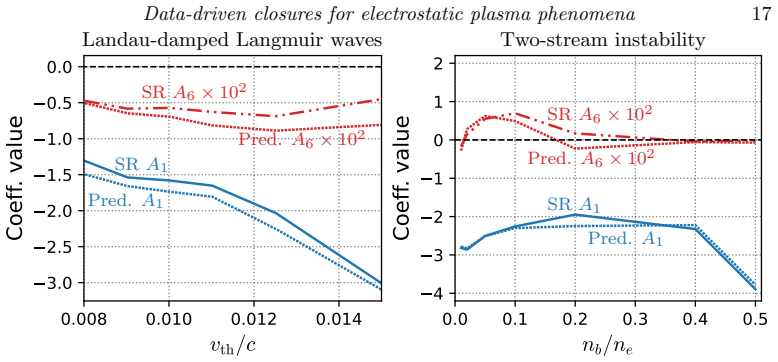
- [§3.4, Eq. (3.3) and §4] Equation (3.3) and the surrounding discussion show that the coefficients A1–A6 are explicit functions of k, ωr, γ, and vth. This means the discovered 'closure' is not a parameter-free local closure: applying it in a fluid code would require knowledge of the mode wavenumber and growth/damping rate, which are typically not known a priori. The paper acknowledges this in §4 but does not explain how the closure could be used predictively. Moreover, the linear-theory comparisons in Figs. 7–8 insert SR-fitted coefficients (e.g., A5 or A2, A3) into the theoretical expressions to predict other SR-fitted coefficients (A1 or A6); this is a consistency check between two quantities derived from the same data, not an independent out-of-sample validation. The authors should either demonstrate predictive use of the closure (e.g., in a fluid simulation) or clearly state that the result is a data-driven parametrization of q for diagnosed mode parameters, not a transferable closure.
- [§3.1–§3.2, Figs. 2–3] The closure coefficients are reported without uncertainty bounds. Given the particle noise in PIC data and the fact that 10-fold cross-validation is used only for term selection, the paper should quantify the sampling variability of A1–A6 and C. For example, Fig. 2b and Fig. 3a show coefficient trends versus vth and nb/ne with no error bars, and statements such as 'some coefficients are close to zero' or 'near-zero coefficients are generally not found consistently' lack a quantitative threshold. Without confidence intervals, the reader cannot assess whether the observed parameter dependences are significant or whether the claimed six-term form is stable under repeated sampling.
minor comments (5)
- [§2.1, Eq. (2.1)] The sentence 'we then collect the volume-integrated y and θj quantities are over these small volumes' contains a grammatical error ('are' should be removed).
- [§2.2.1] The phrase '10^5 (10^4) electrons (ions) per cell' is ambiguous; it should read '10^5 electrons and 10^4 ions per cell'.
- [§3.4, Eq. (3.3)] The shorthand Φ± is used in Eq. (3.3) but not defined until Eq. (3.4); the definition should appear before first use.
- [Fig. 4] The axis label 'γ × 10ω−1 pe' is confusing; specify the units of γ explicitly (e.g., 'γ/ωpe (multiplied by 10)').
- [§1, paragraph 5] In the discussion of Cheng et al. (2023), the phrase 'the the local approximation' contains a duplicated article; it should read 'the local approximation'.
Circularity Check
Linear-theory 'predictions' in Figs. 7-8 are in-sample consistency checks built from the same SR-fitted coefficients; the central cross-validated closure discovery remains independent.
-
fitted input called prediction
[Section 3.4, Fig. 8 caption and text around Eq. (3.3)]
"The values of A1 and A6 found by SR during the growth phase compared to the linear theory prediction given by eq. (3.3), inserting the values of the other coefficients found by SR."
The 'predicted' A1 and A6 are computed by inserting A2, A3, A5 and the wave parameters obtained from the same SR fit to the same PIC data. The two sides of the comparison therefore are not independent: the predicted value is a function of coefficients fitted on the same dataset. Agreement shows that the six-term ansatz is internally consistent with linear collisionless theory, but it is not an external prediction of held-out coefficients. The linear-theory relation is independently derived, so the reduction is only partial; however, presenting this consistency check as a 'prediction' overstates the independence of the validation.
full rationale
The central claim of the paper is a data-driven discovery result: sparse regression finds a six-term local heat flux closure that fits OSIRIS PIC data with low FVU. That claim is supported by 10-fold cross-validation and by a time-transfer test in which a growth-phase-trained model is evaluated on the saturated phase. These are genuine empirical checks and are not circular, because the fitted model is tested on data not used for that particular fit. The arbitrarily restricted term library is an acknowledged completeness assumption, not a circularity: it limits the scope of the discovery but does not make the fitted coefficients equal to their inputs by construction. The only step that resembles circularity is the linear-theory comparison in Figs. 7-8, where 'predicted' coefficient values are obtained by inserting other SR-fitted coefficients into Eq. (3.3); this is an in-sample consistency test rather than an independent prediction. Self-citations, notably Alves & Fiuza (2022) for the modified PDE-FIND algorithm, are methodological and not load-bearing in the sense of supplying the uniqueness or correctness of the discovered closure. Overall, the core empirical result has independent content, and the presentation issue is limited to the labeling of the linear-theory comparison.
Assumptions & free parameters
free parameters (7)
- A1 =
approximately -3 to -4 in the simulations
- A2 =
order 1e-3 to 1e-2 delta_e
- A3 =
order 1e-3 to 1e-2 delta_e, approximately 2*A2 in many cases
- A4 =
order 1e-7 to 1e-6 nbar c^3
- A5 =
order unity, sign depends on propagation direction
- A6 =
order -1e-2 to 1e-2 delta_e
- C =
positive in growth phase, negative in saturation for nb/ne=0.1
assumptions (6)
- domain assumption Vlasov-Maxwell equations are the correct collisionless plasma description and OSIRIS PIC is a faithful discretization.
- ad hoc to paper Heat flux can be represented as a local function of n, V, vth and their first spatial derivatives, with no higher derivatives or nonlocal operators.
- domain assumption Linear perturbation theory with a single complex frequency and real wavenumber applies during the analyzed growth or decay windows.
- domain assumption Only electron dynamics matter on the simulated time scales; ions can be treated as immobile.
- domain assumption Volume integration over small space-time boxes reduces PIC noise without biasing the recovered relations.
- domain assumption Galilean frame invariance: V is interpreted relative to the center-of-mass frame so all library terms are Galilean invariant.
Cite this review
Pith. "Pith review of Data-driven discovery of a heat flux closure for electrostatic plasma phenomena." pith.science (2026). https://pith.science/paper/5OF32WXC
@misc{pith2026241118358,
  author       = {Pith},
  title        = {Pith review of: Data-driven discovery of a heat flux closure for electrostatic plasma phenomena},
  year         = {2026},
  howpublished = {\url{https://pith.science/paper/5OF32WXC}},
  note         = {Machine review of arXiv:2411.18358}
}
read the original abstract
Progress in understanding multi-scale collisionless plasma phenomena requires employing tools which balance computational efficiency and physics fidelity. Collisionless fluid models are able to resolve spatio-temporal scales that are unfeasible with fully kinetic models. However, constructing such models requires truncating the infinite hierarchy of moment equations and supplying an appropriate closure to approximate the unresolved physics. Data-driven methods have recently begun to see increased application to this end, enabling a systematic approach to constructing closures. Here, we utilise sparse regression to search for heat flux closures for one-dimensional electrostatic plasma phenomena. We examine OSIRIS particle-in-cell simulation data of Landau-damped Langmuir waves and two-stream instabilities. Sparse regression consistently identifies six terms as physically relevant, together regularly accounting for more than 95% of the variation in the heat flux. We further quantify the relative importance of these terms under various circumstances and examine their dependence on parameters such as thermal speed and growth/damping rate. The results are discussed in the context of previously known collisionless closures and linear collisionless theory.
Figures


Figures from the paper (7 more)




Reference graph
Works this paper leans on
-
[1]
, " * write output.state after.block = add.period write newline
ENTRY address author booktitle chapter edition editor howpublished institution journal key month note number organization pages publisher school series title type volume year eprint label extra.label sort.label short.list INTEGERS output.state before.all mid.sentence after.sentence after.block FUNCTION init.state.consts #0 'before.all := #1 'mid.sentence ...
-
[2]
write newline
" write newline "" before.all 'output.state := FUNCTION n.dashify 't := "" t empty not t #1 #1 substring "-" = t #1 #2 substring "--" = not "--" * t #2 global.max substring 't := t #1 #1 substring "-" = "-" * t #2 global.max substring 't := while if t #1 #1 substring * t #2 global.max substring 't := if while FUNCTION word.in bbl.in capitalize " " * FUNCT...
-
[3]
2023 Critical magnetic Reynolds number of the turbulent dynamo in collisionless plasmas
Achikanath Chirakkara, Radhika , Seta, Amit , Federrath, Christoph & Kunz, Matthew W. 2023 Critical magnetic Reynolds number of the turbulent dynamo in collisionless plasmas . Monthly Notices of the Royal Astronomical Society 528 (1), 937--953 , arXiv:arXiv: https://academic.oup.com/mnras/article-pdf/528/1/937/56334774/stad3967.pdf
work page 2023
-
[4]
Alves, E. P. & Fiuza, F. 2022 Data-driven discovery of reduced plasma physics models from fully kinetic simulations . Phys. Rev. Res. 4 , 033192
work page 2022
-
[5]
, Squire, Jonathan , Quataert, Eliot & Schekochihin, Alexander A
Arzamasskiy, Lev , Kunz, Matthew W. , Squire, Jonathan , Quataert, Eliot & Schekochihin, Alexander A. 2023 Kinetic turbulence in collisionless high- plasmas . Phys. Rev. X 13 , 021014
work page 2023
-
[6]
Boris, Jay P & Shanny, Ramy A 1972 Proceedings [of The] 4th Conference on Numerical Simulation of Plasmas\/ . Naval Research Laboratory
work page 1972
-
[7]
Braginskii, SI 1958 Transport phenomena in a completely ionized two-temperature plasma . Sov. Phys. JETP 6 (33), 358--369
work page 1958
-
[8]
Brunton, Steven L. , Proctor, Joshua L. & Kutz, J. Nathan 2016 Discovering governing equations from data by sparse identification of nonlinear dynamical systems . Proceedings of the National Academy of Sciences 113 (15), 3932–3937
work page 2016
Show all 50 references
-
[9]
Cambridge, England: Cambridge University Press
Chapman, Sydney & Cowling, T G 1991 The mathematical theory of non-uniform gases: An account of the kinetic theory of viscosity, thermal conduction and diffusion in gases\/ . Cambridge, England: Cambridge University Press
1991
-
[10]
Computer Physics Communications 282 , 108538
Cheng, Wenjie , Fu, Haiyang , Wang, Liang , Dong, Chuanfei , Jin, Yaqiu , Jiang, Mingle , Ma, Jiayu , Qin, Yilan & Liu, Kexin 2023 Data-driven, multi-moment fluid modeling of Landau damping . Computer Physics Communications 282 , 108538
2023
-
[11]
Chew, G. F. , Goldberger, M. L. & Low, F. E. 1956 The Boltzmann equation and the one-fluid hydromagnetic equations in the absence of particle collisions . Proceedings of the Royal Society of London. Series A. Mathematical and Physical Sciences 236 (1204), 112--118 , arXiv:arXi...
1956
-
[12]
2017 Sparse identification of a predator-prey system from simulation data of a convection model
Dam, Magnus , Brøns, Morten , Juul Rasmussen, Jens , Naulin, Volker & Hesthaven, Jan S. 2017 Sparse identification of a predator-prey system from simulation data of a convection model . Physics of Plasmas 24 (2), 022310 , arXiv:arXiv: https://pubs.aip.org/aip/pop/article-pdf/d...
2017 doi
-
[13]
Journal of Plasma Physics 89 (1), 895890105
Donaghy, John & Germaschewski, Kai 2023 In search of a data-driven symbolic multi-fluid ten-moment model closure . Journal of Plasma Physics 89 (1), 895890105
2023
-
[14]
, DiBraccio, Gina A
Dong, Chuanfei , Wang, Liang , Hakim, Ammar , Bhattacharjee, Amitava , Slavin, James A. , DiBraccio, Gina A. & Germaschewski, Kai 2019 Global ten-moment multifluid simulations of the solar wind interaction with Mercury : From the planetary conducting core to the dynamic magnet...
2019 doi
-
[15]
Plasma Physics and Controlled Fusion 50 (12), 124034
Fonseca, R A , Martins, S F , Silva, L O , Tonge, J W , Tsung, F S & Mori, W B 2008 One-to-one direct modeling of experiments and astrophysical scenarios: pushing the envelope on kinetic plasma simulations . Plasma Physics and Controlled Fusion 50 (12), 124034
2008
-
[16]
Fonseca, R. A. , Silva, L. O. , Tsung, F. S. , Decyk, V. K. , Lu, W. , Ren, C. , Mori, W. B. , Deng, S. , Lee, S. , Katsouleas, T. & Adam, J. C. 2002 OSIRIS : A three-dimensional, fully relativistic particle in cell code for modeling plasma based accelerators. In Computational...
2002
-
[17]
Communications on Pure and Applied Mathematics 2 (4), 331--407 , arXiv:arXiv: https://onlinelibrary.wiley.com/doi/pdf/10.1002/cpa.3160020403
Grad, Harold 1949 On the kinetic theory of rarefied gases . Communications on Pure and Applied Mathematics 2 (4), 331--407 , arXiv:arXiv: https://onlinelibrary.wiley.com/doi/pdf/10.1002/cpa.3160020403
1949 doi
-
[18]
, Golden, Matthew R
Gurevich, Daniel R. , Golden, Matthew R. , Reinbold, Patrick A.K. & Grigoriev, Roman O. 2024 Learning fluid physics from highly turbulent data using sparse physics-informed discovery of empirical relations ( SPIDER ) . Journal of Fluid Mechanics 996 , A25
2024
-
[19]
2008 Extended MHD modelling with the ten-moment equations
Hakim, A. 2008 Extended MHD modelling with the ten-moment equations . Journal of Fusion Energy (27), 36--43
2008
-
[20]
, Loverich, J
Hakim, A. , Loverich, J. & Shumlak, U. 2006 A high resolution wave propagation scheme for ideal two-fluid plasma equations . Journal of Computational Physics 219 (1), 418--442
2006
-
[21]
& Perkins, Francis W
Hammett, Gregory W. & Perkins, Francis W. 1990 Fluid moment models for Landau damping with application to the ion-temperature-gradient instability . Phys. Rev. Lett. 64 , 3019--3022
1990
-
[22]
CRC Press
Hockney, R W & Eastwood, J W 2021 Computer Simulation Using Particles\/ . CRC Press
2021
-
[23]
IEEE Signal Processing Magazine 24 (3), 123--125
Jacobsen, Eric & Kootsookos, Peter 2007 Fast, accurate frequency estimators [ DSP tips & tricks] . IEEE Signal Processing Magazine 24 (3), 123--125
2007
-
[24]
Machine Learning: Science and Technology 4 (3), 035049
Joglekar, Archis S & Thomas, Alexander G R 2023 Machine learning of hidden variables in multiscale fluid simulation . Machine Learning: Science and Technology 4 (3), 035049
2023
-
[25]
Nathan & Brunton, Steven L
Kaheman, Kadierdan , Kutz, J. Nathan & Brunton, Steven L. 2020 SINDy-PI : a robust algorithm for parallel implicit sparse identification of nonlinear dynamics . Proceedings of the Royal Society A 476
2020
-
[26]
, Callaham, Jared L
Kaptanoglu, Alan A. , Callaham, Jared L. , Aravkin, Aleksandr , Hansen, Christopher J. & Brunton, Steven L. 2021 a\/ Promoting global stability in data-driven models of quadratic nonlinear dynamics . Phys. Rev. Fluids 6 , 094401
2021
-
[27]
, Hansen, Christopher , Lore, Jeremy D
Kaptanoglu, Alan A. , Hansen, Christopher , Lore, Jeremy D. , Landreman, Matt & Brunton, Steven L. 2023 a\/ Sparse regression for plasma physics . Physics of Plasmas 30 (3), 033906
2023
-
[28]
, Morgan, Kyle D
Kaptanoglu, Alan A. , Morgan, Kyle D. , Hansen, Chris J. & Brunton, Steven L. 2021 b\/ Physics-constrained, low-dimensional models for magnetohydrodynamics: First-principles and data-driven approaches . Phys. Rev. E 104 , 015206
2021
-
[29]
, Zhang, Lanyue , Nicolaou, Zachary G
Kaptanoglu, Alan A. , Zhang, Lanyue , Nicolaou, Zachary G. , Fasel, Urban & Brunton, Steven L. 2023 b\/ Benchmarking sparse system identification with low-dimensional chaos . Nonlinear Dynamics 111 (14), 13143--13164
2023
-
[30]
Khotyaintsev, Yuri V , Graham, Daniel B , Norgren, Cecilia & Vaivads, Andris 2019 Collisionless magnetic reconnection and waves: Progress review . Front. Astron. Space Sci. 6
2019
-
[31]
David 1996 Moment closure hierarchies for kinetic theories
Levermore, C. David 1996 Moment closure hierarchies for kinetic theories . Journal of Statistical Physics 83 (5), 1021--1065
1996
-
[32]
Artificial Intelligence Review 57 (1), 2
Makke, Nour & Chawla, Sanjay 2024 Interpretable scientific discovery with symbolic regression: a review . Artificial Intelligence Review 57 (1), 2
2024
-
[33]
, Burby, Joshua W
Maulik, Romit , Garland, Nathan A. , Burby, Joshua W. , Tang, Xian-Zhu & Balaprakash, Prasanna 2020 Neural network representability of fully ionized plasma fluid model closures . Physics of Plasmas 27 (7), 072106 , arXiv:arXiv: https://pubs.aip.org/aip/pop/article-pdf/doi/10.1...
2020 doi
-
[34]
, Pierce, Jacob R
McGrae-Menge, Madox C. , Pierce, Jacob R. , Fiuza, Frederico & Alves, E. Paulo 2023 Embedding Lorentz covariance in data-driven reduced plasma models from fully kinetic simulations. 65th Annual Meeting of the APS Division of Plasma Physics, UO04.14
2023
-
[35]
& Bortz, David M
Messenger, Daniel A. & Bortz, David M. 2021 Weak SINDy : Galerkin -based data-driven model selection . Multiscale Modeling & Simulation 19 (3), 1474--1497 , arXiv:arXiv: https://doi.org/10.1137/20M1343166
2021 doi
-
[36]
, Wang, L
Ng, Jonathan , Hakim, A. , Wang, L. & Bhattacharjee, A. 2020 An improved ten-moment closure for reconnection and instabilities . Physics of Plasmas 27 (8), 082106 , arXiv:arXiv: https://pubs.aip.org/aip/pop/article-pdf/doi/10.1063/5.0012067/16040735/082106\_1\_online.pdf
2020 doi
-
[37]
Ng, Jonathan , Huang, Yi-Min , Hakim, Ammar , Bhattacharjee, A. , Stanier, Adam , Daughton, William , Wang, Liang & Germaschewski, Kai 2015 The island coalescence problem: Scaling of reconnection in extended fluid models including higher-order moments . Physics of Plasmas 22 (...
2015
-
[38]
Qin, Yilan , Ma, Jiayu , Jiang, Mingle , Dong, Chuanfei , Fu, Haiyang , Wang, Liang , Cheng, Wenjie & Jin, Yaqiu 2023 Data-driven modeling of Landau damping by physics-informed neural networks . Phys. Rev. Res. 5 , 033079
2023
-
[39]
, Brunton, Steven L
Rudy, Samuel H. , Brunton, Steven L. , Proctor, Joshua L. & Kutz, J. Nathan 2017 Data-driven discovery of partial differential equations . Science Advances 3 (4)
2017
-
[40]
Schaeffer, Hayden 2017 Learning partial differential equations via data discovery and sparse optimization . Proceedings of the Royal Society A: Mathematical, Physical and Engineering Sciences 473 (2197), 20160446 , arXiv:arXiv: https://royalsocietypublishing.org/doi/pdf/10.109...
2017
-
[41]
2017 Sparse model selection via integral terms
Schaeffer, Hayden & McCalla, Scott G. 2017 Sparse model selection via integral terms . Phys. Rev. E 96 , 023302
2017
-
[42]
, Quataert, Eliot & Stone, James M
Sharma, Prateek , Hammett, Gregory W. , Quataert, Eliot & Stone, James M. 2006 Shearing box simulations of the MRI in a collisionless plasma . The Astrophysical Journal 637 (2), 952
2006
-
[43]
Earth, Planets and Space 73 (1), 138
Shi, Feng , Lin, Yu , Wang, Xueyi , Wang, Boyi & Nishimura, Yukitoshi 2021 3-D global hybrid simulations of magnetospheric response to foreshock processes . Earth, Planets and Space 73 (1), 138
2021
-
[44]
St-Onge, D. A. , Kunz, M. W. , Squire, J. & Schekochihin, A. A. 2020 Fluctuation dynamo in a weakly collisional plasma . Journal of Plasma Physics 86 (5), 905860503
2020
-
[45]
New York, NY: American Institute of Physics
Stix, Thomas H 1992 Waves in Plasmas\/ , 1992nd edn. New York, NY: American Institute of Physics
1992
-
[46]
TenBarge, J. M. , Ng, J. , Juno, J. , Wang, L. , Hakim, A. H. & Bhattacharjee, A. 2019 An extended MHD study of the 16 October 2015 MMS diffusion region crossing . Journal of Geophysical Research: Space Physics 124 (11), 8474--8487 , arXiv:arXiv: https://agupubs.onlinelibrary....
2019 doi
-
[47]
Journal of Computational Physics 524 , 113719
Vasey, Gina , Messenger, Daniel , Bortz, David , Christlieb, Andrew & O'Shea, Brian 2025 Influence of initial conditions on data-driven model identification and information entropy for ideal MHD problems . Journal of Computational Physics 524 , 113719
2025
-
[48]
, Bhattacharjee, A
Wang, Liang , Hakim, Ammar H. , Bhattacharjee, A. & Germaschewski, K. 2015 Comparison of multi-fluid moment models with particle-in-cell simulations of collisionless magnetic reconnection . Physics of Plasmas 22 (1), 012108
2015
-
[49]
Wang, Libo , Xu, X. Q. , Zhu, Ben , Ma, Chenhao & Lei, Yi-an 2020 Deep learning surrogate model for kinetic Landau -fluid closure with collision . AIP Advances 10 (7), 075108 , arXiv:arXiv: https://pubs.aip.org/aip/adv/article-pdf/doi/10.1063/5.0010917/12913751/075108\_1\_online.pdf
2020 doi
-
[50]
IEEE Transactions on Antennas and Propagation 14 (3), 302--307
Yee, Kane 1966 Numerical solution of initial boundary value problems involving Maxwell's equations in isotropic media . IEEE Transactions on Antennas and Propagation 14 (3), 302--307
1966
Reviewed August 12, 2026 · model on record in the stance chip above.
Discussion (0). Continue with ORCID to comment.