REVIEW 3 major objections 6 minor 128 references
Mapping the Cosmic Gamma-ray Horizon: The 1CGH Catalogue of Fermi-LAT detections above 10 GeV
T0 review · 3 major / 6 minor · reviewed 2026-08-12 · deepseek-v4-flash
Pith's one-line read The 1CGH catalogue lists 2791 blazars and candidates detected above 10 GeV at greater than 3 sigma significance from 16 years of Fermi-LAT observations, including 62 new detections and a 525-source subsample where the extragalactic…
desk verdict A useful and honest catalogue with one soft spot: the absorption subsample inherits unquantified redshift uncertainties. read the letter →
The pith
A machine-rendered reading of the paper's core claim, the machinery that carries it, and where it could break.
The reading
What carries the argument
The load-bearing machinery is the binned likelihood analysis in the 10-800 GeV band with a power-law model, combined with a photon-association step that requires at least four source-type events within 0.12 degrees. The central derived quantity is Ebinmax, the mean energy of the four highest-energy photons, which provides a robust estimate of the highest energy bin a source has; comparing this to the Saldana-Lopez EBL model through the relation F_observed = F_intrinsic exp(-tau(E,z)) yields the tauEbin and ABS-flag columns. The z-flag system, which separates spectroscopic, photometric or uncertain, and lower-limit redshifts, is what makes the absorption classification possible.
What would settle it
Stack the highest-energy bins of the 525 ABS-flag sources and compare the average observed flux with the Saldana-Lopez EBL prediction: if the expected suppression exp(-tau) is absent at the predicted energies, the absorption classification is wrong.
Extended reading notes
Core claim
The central discovery claimed is that a large, carefully curated sample of blazars and blazar candidates can be detected above 10 GeV and ranked by expected EBL absorption. The 1CGH catalogue contains 2791 sources detected at >3 sigma over 10-800 GeV, with 62 previously unreported gamma-ray detections, most of them high-synchrotron-peak blazars from the 3HSP catalogue. After an extensive redshift review covering nearly 70 publications, 38.2 percent of the sources have spectroscopic redshifts, 30.6 percent have photometric or uncertain values, 7.5 percent have lower limits, and 23.7 percent have none. Using the Saldana-Lopez EBL model and the mean energy of the four highest-energy photons as Ebinmax, the paper identifies 525 sources with tau(Ebinmax, z) > 0.1, flagging them as cases where moderate to severe absorption should be measurable with Fermi-LAT.
Load-bearing premise
The absorption classification assumes the literature redshifts are accurate enough for the many sources that lack spectroscopic determinations; if those redshifts are wrong, the computed optical depths and the 525-source subsample change.
Editorial extensions
If this is right
- The 525 ABS-flag sources form a ready-made target list for measuring the EBL optical depth with Fermi-LAT spectra across redshifts 0 to 3.
- The 62 new detections, mostly high-synchrotron-peak blazars, are promising targets for the Cherenkov Telescope Array Observatory and follow-up optical campaigns.
- The redshift review, with quality flags, improves the reliability of any EBL or opacity study built on 3FHL and 4LAC-DR3 data.
- Sources flagged with z-flag=0 but with optical or radio associations are prioritized for spectroscopy; if redshifts are obtained, they can be added to the measurable-absorption sample.
- The catalogue extends the significance distribution toward fainter sources, lowering the effective detection threshold above 10 GeV relative to 3FHL.
Reading between the lines
- The ABS-flag subsample should be treated as provisional: roughly 62 percent of the catalogue lacks robust spectroscopic redshifts, so the 525-source list would change if lower limits or photometric redshifts are revised.
- A direct test of the catalogue's utility is to stack the 10-800 GeV spectra of the 525 flagged sources and check that the observed attenuation matches the Saldana-Lopez prediction; a mismatch would point to either intrinsic spectral features or the need for revised EBL models.
- Because the selection is seeded by known blazars, the 1CGH is biased against gamma-ray emitters without identified counterparts; unassociated 4FGL sources are included, but a fully unbiased horizon map would require an independent all-sky search.
- The Ebinmax statistic could be applied to other energy bands or future missions to extend the horizon mapping beyond Fermi-LAT's reach.
Editorial analysis
A structured set of objections, weighed in public.
Referee Report
Summary. The paper presents the 1CGH catalogue: 2791 gamma-ray emitters above 10 GeV detected at >3 sigma from 16 years of Fermi-LAT data, selected from multifrequency seed positions (5BZcat, 3HSP, TeVcat, 4LAC-DR3, and unassociated 4FGL sources). A binned likelihood analysis in the 10-800 GeV band is followed by a photon-association cut requiring at least four source-type events within 0.12 degrees. The catalogue includes 62 new detections, an extensive literature-based redshift review with quality flags, and an absorption subsample of 525 sources where tau(Ebinmax,z) > 0.1 according to the Saldana-Lopez EBL model. The paper also introduces Ebinmax, the mean energy of the four highest-energy photons, as a robust estimator of the highest detectable energy bin.
Significance. If the catalogue is robust, it is a valuable community resource: it extends >10 GeV detections to fainter fluxes than 3FHL, provides a systematic redshift-quality flagging system, and supplies a well-defined target list for EBL studies and optical follow-up. Strengths include the clear description of the reduction pipeline, the use of public Fermi-LAT data and public catalogues, the explicit estimate of the pre-cut spurious rate, and the extensive literature compilation. However, the central EBL-oriented deliverable, the 525-source absorption subsample, depends on two fragile ingredients: redshift values that lack propagated uncertainties for ~38% of the sample, and the choice of a single EBL model. The paper itself acknowledges the redshift incompleteness qualitatively but does not quantify its impact on the headline number; the post-cut false-positive rate is likewise not quantified. These issues affect the reproducibility of the main claims, though they are addressable within the manuscript's scope.
major comments (3)
- [Section 3.3, Table B2] The ABS-flag and tauEbin values are computed from literature redshifts without propagating redshift uncertainties. The redshift census in Section 3.1 shows that 855/2791 sources (30.6%) have z-flag=2 (photometric/uncertain) and 210/2791 (7.5%) have z-flag=3 (lower limits), and the catalogue's 'z' column lists no errors. Because tau(E,z) rises steeply with z, a source near the tau=0.1 boundary can flip between ABS-flag=1 and 0 under a plausible photometric redshift error of 0.2-0.5. The paper acknowledges the redshift gap qualitatively but does not quantify its impact on the 525-source subsample. Please add a robustness analysis: for example, recompute tauEbin with z +/- sigma_z using typical photometric uncertainties and report how many sources change ABS-flag, or provide a Monte Carlo. For Table B2, mark sources whose ABS-flag determination is fragile.
- [Sections 2.3-2.4] The pre-selection spurious rate for TS>12 is estimated as 20.5/3004 ~ 0.68%, but the paper does not quantify the false-positive rate after the additional requirement of at least four associated photons within 0.12 deg (Section 2.4). The statement that the rate 'should be lower' is not a measurement; the photon cut is an additional selection layer applied to the same data and the matching radius is small, so a background-only Monte Carlo or a source-scrambling test is needed to estimate the post-cut contamination. Without this, the reliability of the 62 new detections and of the full 2791-source catalogue is not fully established.
- [Section 3.3] The ABS-flag selection is based on the Saldana-Lopez et al. (2021) EBL model only, yet the text claims that the resulting subsample is where 'the EBL optical depth can be robustly measured' and that tau values can be derived 'independently of any specific EBL model.' Figure 4 compares the tau=1 curves of four models, but the tau=0.1 boundary used for the 525-source subsample is shown only for one model. Please quantify the model dependence: report how many of the 525 sources remain in the tau>0.1 regime under the Finke et al. (2010), Dominguez et al. (2011), and Franceschini & Rodighiero (2017) models. If the overlap is small, the abstract's 525 number should be presented with a caveat.
minor comments (6)
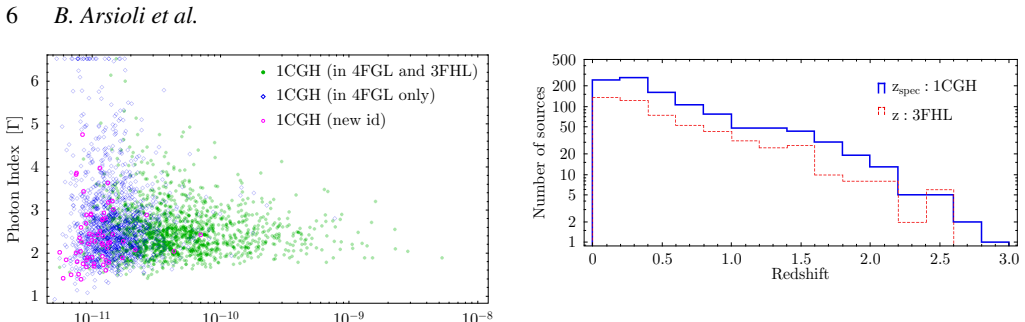
- [Figure 4 and Figure 5 captions] The captions state 'approximately one-third of the 1CGH sources lack assigned redshift,' but Section 3.1 reports 664/2791 = 23.7% without redshift; the captions are inconsistent with the text and should be corrected.
- [Table 1 caption] The caption says 'The first three columns show ...', but the table has more than three columns; also the symbols '?' and '>' in the 'z' column are not defined in the caption, although they are explained later in Section 3.1.
- [Data Availability] The paper states that a complete table is available in the online version and a preliminary version on GitHub; for reproducibility, a machine-readable full catalogue should be included as supplementary material with the submission, including redshift uncertainties.
- [Section 3 (26 and 27 sources)] The 26 sources whose photon index reaches the Gamma=6.5 limit and the 27 sources with 3FHL curvature are listed with fluxes that should be interpreted as upper limits; the catalogue columns should carry a flag that propagates to the tauEbin analysis if any of these sources are in the absorption subsample, so users do not treat the power-law flux as a detection.
- [Section 2.3] The TS-to-sigma conversion is cited to a GitHub repository; for a journal publication, a formal reference or equation should be included in the text.
- [Section 3.3 (Ebinmax definition)] The new Ebinmax estimator (mean of the four highest-energy photons) is introduced without a discussion of its statistical properties or a comparison against the highest-energy photon; a brief justification or a reference to a validation test would help.
Circularity Check
No significant circularity: detection and absorption classification are independent of the paper's inputs.
full rationale
The derivation chain is self-contained. The 1CGH catalogue is an observational product: seed positions are taken from public catalogues (5BZcat, 3HSP, TeVcat, 4LAC-DR3, 4FGL-DR4), and detection is performed via binned likelihood on 16 years of Fermi-LAT data with a fixed TS>12 threshold plus a four-photon association criterion. No parameter is fitted to the quantities that are later called predictions: the 525-source absorption subsample is obtained by evaluating the external Saldana-Lopez EBL optical depth at the observed Ebinmax and at literature redshifts, not by fitting the EBL model to Fermi-LAT data. The authors' prior work is cited for the seed-based method and for 3HSP/2WHSP inputs, but these are not used to derive the central result; removing them would change sample completeness but would not make the detection or the absorption classification tautological. The redshift-uncertainty limitation acknowledged in Section 3.1 (855 sources with z-flag=2, 210 with z-flag=3, 664 with no redshift) is a robustness concern, not a circularity, because the catalogue does not claim to derive the redshifts or the EBL model from its own data. No equation in the paper is equivalent to another by construction, and no fitted parameter is renamed as a prediction. The presence of minor self-citations is normal and does not raise the circularity score.
Assumptions & free parameters
free parameters (6)
- TS detection threshold =
12
- Minimum number of associated photons =
4
- Photon-source matching radius =
0.12 deg
- Highest-energy-bin estimator Ebinmax =
mean of four highest-energy photons
- Absorption flag threshold tau =
0.1
- Spectral index upper limit =
Gamma = 6.5
assumptions (5)
- domain assumption The 4FGL-DR4 source model plus the galactic and isotropic diffuse templates correctly model the gamma-ray sky in every ROI.
- domain assumption The Saldana-Lopez EBL model provides a reliable reference optical depth for computing tau and defining the absorption subsample.
- domain assumption The seed catalogues (5BZcat, 3HSP, TeVcat, 4LAC-DR3, plus unassociated 4FGL-DR4 sources) provide accurate positions and classifications for blazars and candidates.
- domain assumption Literature redshifts, including photometric estimates and lower limits, are accurate enough for the absorption classification.
- domain assumption Power-law spectral shapes adequately describe all sources over 10-800 GeV, with curvature only for the 27 flagged 3FHL counterparts.
Cite this review
Pith. "Pith review of Mapping the Cosmic Gamma-ray Horizon: The 1CGH Catalogue of Fermi-LAT detections above 10 GeV." pith.science (2026). https://pith.science/paper/EYJCACFF
@misc{pith2026241118431,
  author       = {Pith},
  title        = {Pith review of: Mapping the Cosmic Gamma-ray Horizon: The 1CGH Catalogue of Fermi-LAT detections above 10 GeV},
  year         = {2026},
  howpublished = {\url{https://pith.science/paper/EYJCACFF}},
  note         = {Machine review of arXiv:2411.18431}
}
abstract
We present the First Cosmic Gamma-ray Horizon (1CGH) catalogue, featuring $\gamma$-ray detections above 10 GeV based on 16 years of observations with the Fermi Large Area Telescope (LAT) satellite. After carefully selecting a sample of blazars and blazar candidates from catalogues in the literature, we performed a binned likelihood analysis and identified 2791 $\gamma$-ray emitters above 10 GeV, at >3$\sigma$ level, including 62 that are new $\gamma$-ray detections. For each source, we estimated the mean energy of the highest-energy bin and analysed them in the context of the cosmic gamma-ray horizon. By adopting a reference model for the Extragalactic Background Light (EBL), we identified a subsample of 525 sources where moderate to severe $\gamma$-ray absorption could be detected across the redshift range of 0 to 3. This work provides the most up-to-date compilation of detections above 10 GeV, along with their redshift information. We condense extensive results from the literature, including reports on observational campaigns dedicated to blazars and $\gamma$-ray sources, thereby delivering an unprecedented review of the redshift information for sources detected above 10 GeV. Additionally, we highlight key 1CGH sources where redshift information remains incomplete, offering guidance for future optical observation campaigns. The 1CGH catalogue aims to track the most significant sources for studying the $\gamma$-ray transparency of the Universe. Furthermore, it provides a targeted subsample where the EBL optical depth, $\tau_{(E,z)}$, can be robustly measured using Fermi-LAT data.
Figures


Figures from the paper (1 more)

Reference graph
Works this paper leans on
-
[1]
Abdalla H., Cotter G., Backes M., Kasai E., B \"o ttcher M., 2024, @doi [Classical and Quantum Gravity] 10.1088/1361-6382/ad1122 , https://ui.adsabs.harvard.edu/abs/2024CQGra..41a5022A 41, 015022
-
[2]
Abdollahi S., et al., 2020, @doi [ ] 10.3847/1538-4365/ab6bcb , https://ui.adsabs.harvard.edu/abs/2020ApJS..247...33A 247, 33
-
[3]
Abe H., et al., 2024, @doi [Physics of the Dark Universe] 10.1016/j.dark.2024.101425 , https://ui.adsabs.harvard.edu/abs/2024PDU....4401425A 44, 101425
arXiv 2024
-
[4]
Acharya B. S., et al., 2013, @doi [Astroparticle Physics] 10.1016/j.astropartphys.2013.01.007 , https://ui.adsabs.harvard.edu/abs/2013APh....43....3A 43, 3
-
[5]
Ackermann M., et al., 2013, @doi [ ] 10.1088/0067-0049/209/2/34 , https://ui.adsabs.harvard.edu/abs/2013ApJS..209...34A 209, 34
-
[6]
Acosta-Pulido J. A., Agudo I., Barrena R., Ramos Almeida C., Manchado A., Rodr \' guez-Gil P., 2010, @doi [ ] 10.1051/0004-6361/200913953 , https://ui.adsabs.harvard.edu/abs/2010A&A...519A...5A 519, A5
-
[7]
Ajello M., et al., 2017, @doi [ ] 10.3847/1538-4365/aa8221 , https://ui.adsabs.harvard.edu/abs/2017ApJS..232...18A 232, 18
-
[8]
Ajello M., et al., 2020, @doi [ ] 10.3847/1538-4357/ab791e , https://ui.adsabs.harvard.edu/abs/2020ApJ...892..105A 892, 105
Show all 128 references
-
[9]
Ajello M., et al., 2022, @doi [ ] 10.3847/1538-4365/ac9523 , https://ui.adsabs.harvard.edu/abs/2022ApJS..263...24A 263, 24
2022 doi
-
[10]
Albert A., et al., 2023, @doi [ ] 10.1103/PhysRevLett.131.051201 , https://ui.adsabs.harvard.edu/abs/2023PhRvL.131e1201A 131, 051201
2023 doi
-
[11]
\'A lvarez Crespo N., et al., 2016a, @doi [ ] 10.3847/0004-6256/151/2/32 , https://ui.adsabs.harvard.edu/abs/2016AJ....151...32A 151, 32
-
[12]
\'A lvarez Crespo N., et al., 2016b, @doi [ ] 10.3847/0004-6256/151/4/95 , https://ui.adsabs.harvard.edu/abs/2016AJ....151...95A 151, 95
-
[13]
\'A lvarez Crespo N., et al., 2016c, @doi [ ] 10.1007/s10509-016-2902-1 , https://ui.adsabs.harvard.edu/abs/2016Ap&SS.361..316A 361, 316
-
[14]
S., Chamorro Cazorla M., S \'a nchez Bl \'a zquez P., Gil de Paz A., 2025, @doi [ ] 10.1051/0004-6361/202452345 , https://ui.adsabs.harvard.edu/abs/2025A&A...694A..46A 694, A46
\'A lvarez Crespo N., Dom \' nguez A., Paliya V. S., Chamorro Cazorla M., S \'a nchez Bl \'a zquez P., Gil de Paz A., 2025, @doi [ ] 10.1051/0004-6361/202452345 , https://ui.adsabs.harvard.edu/abs/2025A&A...694A..46A 694, A46
2025 doi
-
[15]
Appenzeller I., et al., 1998, @doi [ ] 10.1086/313125 , https://ui.adsabs.harvard.edu/abs/1998ApJS..117..319A 117, 319
1998 doi
-
[16]
L., 2017, @doi [ ] 10.1051/0004-6361/201628691 , https://ui.adsabs.harvard.edu/abs/2017A&A...598A.134A 598, A134
Arsioli B., Chang Y. L., 2017, @doi [ ] 10.1051/0004-6361/201628691 , https://ui.adsabs.harvard.edu/abs/2017A&A...598A.134A 598, A134
2017 doi
-
[17]
Arsioli B., Orlando E., 2024, @doi [ ] 10.3847/1538-4357/ad1bd2 , https://ui.adsabs.harvard.edu/abs/2024ApJ...962...52A 962, 52
2024 doi
-
[18]
Arsioli B., Polenta G., 2018, @doi [ ] 10.1051/0004-6361/201832786 , https://ui.adsabs.harvard.edu/abs/2018A&A...616A..20A 616, A20
2018 doi
-
[19]
M., 2015, @doi [ ] 10.1051/0004-6361/201424148 , https://ui.adsabs.harvard.edu/abs/2015A&A...579A..34A 579, A34
Arsioli B., Fraga B., Giommi P., Padovani P., Marrese P. M., 2015, @doi [ ] 10.1051/0004-6361/201424148 , https://ui.adsabs.harvard.edu/abs/2015A&A...579A..34A 579, A34
2015 doi
-
[20]
Arsioli B., Barres de Almeida U., Prandini E., Fraga B., Foffano L., 2018, @doi [ ] 10.1093/mnras/sty1975 , https://ui.adsabs.harvard.edu/abs/2018MNRAS.480.2165A 480, 2165
2018 doi
-
[21]
L., Musiimenta B., 2020, @doi [ ] 10.1093/mnras/staa368 , https://ui.adsabs.harvard.edu/abs/2020MNRAS.493.2438A 493, 2438
Arsioli B., Chang Y. L., Musiimenta B., 2020, @doi [ ] 10.1093/mnras/staa368 , https://ui.adsabs.harvard.edu/abs/2020MNRAS.493.2438A 493, 2438
2020 doi
-
[22]
B., et al., 2009, @doi [ ] 10.1088/0004-637X/697/2/1071 , https://ui.adsabs.harvard.edu/abs/2009ApJ...697.1071A 697, 1071
Atwood W. B., et al., 2009, @doi [ ] 10.1088/0004-637X/697/2/1071 , https://ui.adsabs.harvard.edu/abs/2009ApJ...697.1071A 697, 1071
2009 doi
- [23]
-
[24]
H., Lott B., The Fermi-LAT collaboration 2023, @doi [arXiv e-prints] 10.48550/arXiv.2307.12546 , https://ui.adsabs.harvard.edu/abs/2023arXiv230712546B p
Ballet J., Bruel P., Burnett T. H., Lott B., The Fermi-LAT collaboration 2023, @doi [arXiv e-prints] 10.48550/arXiv.2307.12546 , https://ui.adsabs.harvard.edu/abs/2023arXiv230712546B p. arXiv:2307.12546
-
[25]
Balmaverde B., et al., 2020, @doi [ ] 10.1093/mnras/stz3532 , https://ui.adsabs.harvard.edu/abs/2020MNRAS.492.3728B 492, 3728
2020 doi
-
[26]
A., Boschin W., Clavero R., Otero-Santos J., Carballo-Bello J
Becerra Gonz \'a lez J., Acosta-Pulido J. A., Boschin W., Clavero R., Otero-Santos J., Carballo-Bello J. A., Dom \' nguez-Palmero L., 2021, @doi [ ] 10.1093/mnras/stab1274 , https://ui.adsabs.harvard.edu/abs/2021MNRAS.504.5258B 504, 5258
2021 doi
-
[27]
Belladitta S., et al., 2020, @doi [ ] 10.1051/0004-6361/201937395 , https://ui.adsabs.harvard.edu/abs/2020A&A...635L...7B 635, L7
2020 doi
-
[28]
Blandford R., Meier D., Readhead A., 2019, @doi [ ] 10.1146/annurev-astro-081817-051948 , https://ui.adsabs.harvard.edu/abs/2019ARA&A..57..467B 57, 467
2019 doi
-
[29]
J., Fong R., Shanks T., Peterson B
Boyle B. J., Fong R., Shanks T., Peterson B. A., 1990, @doi [ ] 10.1093/mnras/243.1.1 , https://ui.adsabs.harvard.edu/abs/1990MNRAS.243....1B 243, 1
1990 doi
- [30]
-
[31]
Buehler R., Gallardo G., Maier G., Dom \' nguez A., L \'o pez M., Meyer M., 2020, @doi [ ] 10.1088/1475-7516/2020/09/027 , https://ui.adsabs.harvard.edu/abs/2020JCAP...09..027B 2020, 027
2020 doi
-
[32]
Caccianiga A., et al., 2019, @doi [ ] 10.1093/mnras/sty3526 , https://ui.adsabs.harvard.edu/abs/2019MNRAS.484..204C 484, 204
2019 doi
-
[33]
L., Arsioli B., Giommi P., Padovani P., 2017, @doi [ ] 10.1051/0004-6361/201629487 , https://ui.adsabs.harvard.edu/abs/2017A&A...598A..17C 598, A17
Chang Y. L., Arsioli B., Giommi P., Padovani P., 2017, @doi [ ] 10.1051/0004-6361/201629487 , https://ui.adsabs.harvard.edu/abs/2017A&A...598A..17C 598, A17
2017 doi
-
[34]
L., Arsioli B., Giommi P., Padovani P., Brandt C
Chang Y. L., Arsioli B., Giommi P., Padovani P., Brandt C. H., 2019, @doi [ ] 10.1051/0004-6361/201834526 , https://ui.adsabs.harvard.edu/abs/2019A&A...632A..77C 632, A77
2019 doi
-
[35]
World Scientific Publishing, @doi 10.1142/10986
Cherenkov Telescope Array Consortium et al., 2019, Science with the Cherenkov Telescope Array . World Scientific Publishing, @doi 10.1142/10986
2019 doi
-
[36]
M., et al., 2013, Technical report, Explanatory Supplement to the AllWISE Data Release Products
Cutri R. M., et al., 2013, Technical report, Explanatory Supplement to the AllWISE Data Release Products
2013
-
[37]
M., et al., 2021, VizieR Online Data Catalog: AllWISE Data Release (Cutri+ 2013) , VizieR On-line Data Catalog: II/328
Cutri R. M., et al., 2021, VizieR Online Data Catalog: AllWISE Data Release (Cutri+ 2013) , VizieR On-line Data Catalog: II/328. Originally published in: IPAC/Caltech (2013)
2013
-
[38]
D'Ammando F., et al., 2012, @doi [ ] 10.1111/j.1365-2966.2012.22041.x , https://ui.adsabs.harvard.edu/abs/2012MNRAS.427..893D 427, 893
2012
-
[39]
D'Ammando F., et al., 2024, @doi [ ] 10.1051/0004-6361/202348507 , https://ui.adsabs.harvard.edu/abs/2024A&A...683A.222D 683, A222
2024 doi
-
[40]
DESI Collaboration et al., 2024, @doi [ ] 10.3847/1538-3881/ad3217 , https://ui.adsabs.harvard.edu/abs/2024AJ....168...58D 168, 58
2024 doi
-
[41]
D'Silva J. C. J., Driver S. P., Lagos C. D. P., Robotham A. S. G., Summers J., Windhorst R. A., 2023, @doi [ ] 10.3847/2041-8213/ad103e , https://ui.adsabs.harvard.edu/abs/2023ApJ...959L..18D 959, L18
2023 doi
-
[42]
Desai A., Marchesi S., Rajagopal M., Ajello M., 2019, @doi [ ] 10.3847/1538-4365/ab01fc , https://ui.adsabs.harvard.edu/abs/2019ApJS..241....5D 241, 5
2019 doi
-
[43]
Dom \' nguez A., Prada F., 2013, @doi [ ] 10.1088/2041-8205/771/2/L34 , https://ui.adsabs.harvard.edu/abs/2013ApJ...771L..34D 771, L34
2013 doi
-
[44]
Dom \' nguez A., et al., 2011, @doi [ ] 10.1111/j.1365-2966.2010.17631.x , https://ui.adsabs.harvard.edu/abs/2011MNRAS.410.2556D 410, 2556
2011
-
[45]
D., Prada F., Primack J
Dom \' nguez A., Finke J. D., Prada F., Primack J. R., Kitaura F. S., Siana B., Paneque D., 2013, @doi [ ] 10.1088/0004-637X/770/1/77 , https://ui.adsabs.harvard.edu/abs/2013ApJ...770...77D 770, 77
2013 doi
-
[46]
Dom \' nguez A., et al., 2024, @doi [ ] 10.1093/mnras/stad3492 , https://ui.adsabs.harvard.edu/abs/2024MNRAS.527.4763D 527, 4763
2024 doi
-
[47]
Essey W., Kusenko A., 2010, @doi [Astroparticle Physics] 10.1016/j.astropartphys.2009.11.007 , https://ui.adsabs.harvard.edu/abs/2010APh....33...81E 33, 81
2010 doi
-
[48]
G., Stecker F
Fazio G. G., Stecker F. W., 1970, @doi [ ] 10.1038/226135a0 , https://ui.adsabs.harvard.edu/abs/1970Natur.226..135F 226, 135
1970 doi
-
[49]
Fermi-LAT Collaboration et al., 2018, @doi [Science] 10.1126/science.aat8123 , https://ui.adsabs.harvard.edu/abs/2018Sci...362.1031F 362, 1031
2018 doi
-
[50]
D., Razzaque S., Dermer C
Finke J. D., Razzaque S., Dermer C. D., 2010, @doi [ ] 10.1088/0004-637X/712/1/238 , https://ui.adsabs.harvard.edu/abs/2010ApJ...712..238F 712, 238
2010 doi
-
[51]
D., Ajello M., Dom \' nguez A., Desai A., Hartmann D
Finke J. D., Ajello M., Dom \' nguez A., Desai A., Hartmann D. H., Paliya V. S., Saldana-Lopez A., 2022, @doi [ ] 10.3847/1538-4357/ac9843 , https://ui.adsabs.harvard.edu/abs/2022ApJ...941...33F 941, 33
2022 doi
-
[52]
Foschini L., et al., 2022, @doi [Universe] 10.3390/universe8110587 , https://ui.adsabs.harvard.edu/abs/2022Univ....8..587F 8, 587
2022 doi
-
[53]
Franceschini A., Rodighiero G., 2017, @doi [ ] 10.1051/0004-6361/201629684 , https://ui.adsabs.harvard.edu/abs/2017A&A...603A..34F 603, A34
2017 doi
-
[54]
A., Prochaska J
Furniss A., Fumagalli M., Danforth C., Williams D. A., Prochaska J. X., 2013, @doi [ ] 10.1088/0004-637X/766/1/35 , https://ui.adsabs.harvard.edu/abs/2013ApJ...766...35F 766, 35
2013 doi
-
[55]
M., Primack J
Furniss A., Sutter P. M., Primack J. R., Dom \' nguez A., 2015, @doi [ ] 10.1093/mnras/stu2196 , https://ui.adsabs.harvard.edu/abs/2015MNRAS.446.2267F 446, 2267
2015 doi
-
[56]
\'E ., Frey S., An T., 2018, @doi [ ] 10.1051/0004-6361/201732286 , https://ui.adsabs.harvard.edu/abs/2018A&A...612A.109G 612, A109
Gab \'a nyi K. \'E ., Frey S., An T., 2018, @doi [ ] 10.1051/0004-6361/201732286 , https://ui.adsabs.harvard.edu/abs/2018A&A...612A.109G 612, A109
2018 doi
-
[57]
Galanti G., Tavecchio F., Roncadelli M., Evoli C., 2019, @doi [ ] 10.1093/mnras/stz1144 , https://ui.adsabs.harvard.edu/abs/2019MNRAS.487..123G 487, 123
2019 doi
-
[58]
Galanti G., Tavecchio F., Landoni M., 2020, @doi [ ] 10.1093/mnras/stz3411 , https://ui.adsabs.harvard.edu/abs/2020MNRAS.491.5268G 491, 5268
2020 doi
-
[59]
Goldoni P., Pita S., Boisson C., Cotter G., Williams D., Lindfors E., 2015, in 34th International Cosmic Ray Conference (ICRC2015). p. 835 ( @eprint arXiv 1508.06059 ), @doi 10.22323/1.236.0835
2015 arXiv
-
[60]
Goldoni P., et al., 2021, @doi [ ] 10.1051/0004-6361/202040090 , https://ui.adsabs.harvard.edu/abs/2021A&A...650A.106G 650, A106
2021 doi
-
[61]
J., Schr \'e der G
Gould R. J., Schr \'e der G. P., 1967, @doi [Physical Review] 10.1103/PhysRev.155.1408 , https://ui.adsabs.harvard.edu/abs/1967PhRv..155.1408G 155, 1408
1967 doi
-
[62]
A., 2023, @doi [arXiv e-prints] 10.48550/arXiv.2304.00835 , https://ui.adsabs.harvard.edu/abs/2023arXiv230400835G p
Gr \'e aux L., Biteau J., Hassan T., Hervet O., Nievas Rosillo M., Williams D. A., 2023, @doi [arXiv e-prints] 10.48550/arXiv.2304.00835 , https://ui.adsabs.harvard.edu/abs/2023arXiv230400835G p. arXiv:2304.00835
-
[63]
A., et al., 2011, @doi [ ] 10.1088/0067-0049/197/2/35 , https://ui.adsabs.harvard.edu/abs/2011ApJS..197...35G 197, 35
Grogin N. A., et al., 2011, @doi [ ] 10.1088/0067-0049/197/2/35 , https://ui.adsabs.harvard.edu/abs/2011ApJS..197...35G 197, 35
2011 doi
-
[64]
G., Dwek E., 2001, @doi [ ] 10.1146/annurev.astro.39.1.249 , https://ui.adsabs.harvard.edu/abs/2001ARA&A..39..249H 39, 249
Hauser M. G., Dwek E., 2001, @doi [ ] 10.1146/annurev.astro.39.1.249 , https://ui.adsabs.harvard.edu/abs/2001ARA&A..39..249H 39, 249
2001 doi
-
[65]
W., Drouart G., Leung J
Ighina L., Caccianiga A., Moretti A., Belladitta S., Broderick J. W., Drouart G., Leung J. K., Seymour N., 2023, @doi [ ] 10.1093/mnras/stac3668 , https://ui.adsabs.harvard.edu/abs/2023MNRAS.519.2060I 519, 2060
2023 doi
-
[66]
Ighina L., et al., 2024, @doi [ ] 10.1051/0004-6361/202451376 , https://ui.adsabs.harvard.edu/abs/2024A&A...692A.241I 692, A241
2024 doi
-
[67]
D., et al., 2019, @doi [ ] 10.3847/2041-8213/ab479a , https://ui.adsabs.harvard.edu/abs/2019ApJ...884L..31J 884, L31
Johnson S. D., et al., 2019, @doi [ ] 10.3847/2041-8213/ab479a , https://ui.adsabs.harvard.edu/abs/2019ApJ...884L..31J 884, L31
2019 doi
-
[68]
a hteenm \
Kasai E., Goldoni P., Pita S., Boisson C., Backes M., Cotter G., D'Ammando F., van Soelen B., 2023a, in Liodakis I., Aller M. F., Krawczynski H., L \"a hteenm \"a ki A., Pearson T. J., eds, IAU Symposium Vol. 375, The Multimessenger Chakra of Blazar Jets. pp 96--100 ( @eprint ...
-
[69]
Kasai E., et al., 2023b, @doi [ ] 10.1093/mnras/stac3167 , https://ui.adsabs.harvard.edu/abs/2023MNRAS.518.2675K 518, 2675
-
[70]
Kaur A., et al., 2017, @doi [ ] 10.3847/1538-4357/834/1/41 , https://ui.adsabs.harvard.edu/abs/2017ApJ...834...41K 834, 41
2017 doi
-
[71]
M., et al., 2011, @doi [ ] 10.1088/0067-0049/197/2/36 , https://ui.adsabs.harvard.edu/abs/2011ApJS..197...36K 197, 36
Koekemoer A. M., et al., 2011, @doi [ ] 10.1088/0067-0049/197/2/36 , https://ui.adsabs.harvard.edu/abs/2011ApJS..197...36K 197, 36
2011 doi
-
[72]
Landoni M., Falomo R., Treves A., Sbarufatti B., Barattini M., Decarli R., Kotilainen J., 2013, @doi [ ] 10.1088/0004-6256/145/4/114 , https://ui.adsabs.harvard.edu/abs/2013AJ....145..114L 145, 114
2013 doi
-
[73]
Landoni M., et al., 2015, @doi [ ] 10.1088/0004-6256/149/5/163 , https://ui.adsabs.harvard.edu/abs/2015AJ....149..163L 149, 163
2015 doi
-
[74]
Landoni M., Paiano S., Falomo R., Scarpa R., Treves A., 2018, @doi [ ] 10.3847/1538-4357/aac77c , https://ui.adsabs.harvard.edu/abs/2018ApJ...861..130L 861, 130
2018 doi
-
[75]
Landoni M., Falomo R., Paiano S., Treves A., 2020, @doi [ ] 10.3847/1538-4365/abb5ae , https://ui.adsabs.harvard.edu/abs/2020ApJS..250...37L 250, 37
2020 doi
-
[76]
F., Peter A
Linden T., Beacom J. F., Peter A. H. G., Buckman B. J., Zhou B., Zhu G., 2022, @doi [ ] 10.1103/PhysRevD.105.063013 , https://ui.adsabs.harvard.edu/abs/2022PhRvD.105f3013L 105, 063013
2022 doi
-
[77]
J., et al., 2019, @doi [ ] 10.1007/s10509-018-3490-z , https://ui.adsabs.harvard.edu/abs/2019Ap&SS.364....5M 364, 5
Marchesini E. J., et al., 2019, @doi [ ] 10.1007/s10509-018-3490-z , https://ui.adsabs.harvard.edu/abs/2019Ap&SS.364....5M 364, 5
2019 doi
-
[78]
Maselli A., et al., 2013, @doi [ ] 10.1088/0067-0049/206/2/17 , https://ui.adsabs.harvard.edu/abs/2013ApJS..206...17M 206, 17
2013 doi
-
[79]
Massaro E., Giommi P., Leto C., Marchegiani P., Maselli A., Perri M., Piranomonte S., Sclavi S., 2009, @doi [ ] 10.1051/0004-6361:200810161 , https://ui.adsabs.harvard.edu/abs/2009A&A...495..691M 495, 691
2009 doi
-
[80]
Massaro F., Masetti N., D'Abrusco R., Paggi A., Funk S., 2014, @doi [ ] 10.1088/0004-6256/148/4/66 , https://ui.adsabs.harvard.edu/abs/2014AJ....148...66M 148, 66
2014 doi
-
[81]
Massaro E., Maselli A., Leto C., Marchegiani P., Perri M., Giommi P., Piranomonte S., 2015a, @doi [ ] 10.1007/s10509-015-2254-2 , https://ui.adsabs.harvard.edu/abs/2015Ap&SS.357...75M 357, 75
-
[82]
A., Tosti G., 2015b, @doi [ ] 10.1051/0004-6361/201425119 , https://ui.adsabs.harvard.edu/abs/2015A&A...575A.124M 575, A124
Massaro F., Landoni M., D'Abrusco R., Milisavljevic D., Paggi A., Masetti N., Smith H. A., Tosti G., 2015b, @doi [ ] 10.1051/0004-6361/201425119 , https://ui.adsabs.harvard.edu/abs/2015A&A...575A.124M 575, A124
-
[83]
Massaro F., et al., 2016, @doi [ ] 10.1007/s10509-016-2926-6 , https://ui.adsabs.harvard.edu/abs/2016Ap&SS.361..337M 361, 337
2016 doi
-
[84]
R., et al., 1996, @doi [ ] 10.1086/177068 , https://ui.adsabs.harvard.edu/abs/1996ApJ...461..396M 461, 396
Mattox J. R., et al., 1996, @doi [ ] 10.1086/177068 , https://ui.adsabs.harvard.edu/abs/1996ApJ...461..396M 461, 396
1996 doi
-
[85]
M., Romani R
Meisner A. M., Romani R. W., 2010, @doi [ ] 10.1088/0004-637X/712/1/14 , https://ui.adsabs.harvard.edu/abs/2010ApJ...712...14M 712, 14
2010 doi
-
[86]
A., Fatkhullin T
Mishra S., Chand H., Krishna G., Joshi R., Shchekinov Y. A., Fatkhullin T. A., 2018, @doi [ ] 10.1093/mnras/stx2684 , https://ui.adsabs.harvard.edu/abs/2018MNRAS.473.5154M 473, 5154
2018 doi
-
[87]
I., 1961, Zhur
Nikishov A. I., 1961, Zhur. Eksptl'. i Teoret. Fiz., 41
1961
-
[88]
Olmo-Garc \' a A., Paliya V. S., \'A lvarez Crespo N., Kumar B., Dom \' nguez A., Gil de Paz A., S \'a nchez-Bl \'a zquez P., 2022, @doi [ ] 10.1093/mnras/stac2640 , https://ui.adsabs.harvard.edu/abs/2022MNRAS.516.5702O 516, 5702
2022 doi
-
[89]
Paggi A., et al., 2014, @doi [ ] 10.1088/0004-6256/147/5/112 , https://ui.adsabs.harvard.edu/abs/2014AJ....147..112P 147, 112
2014 doi
-
[90]
Paiano S., Landoni M., Falomo R., Treves A., Scarpa R., Righi C., 2017a, @doi [ ] 10.3847/1538-4357/837/2/144 , https://ui.adsabs.harvard.edu/abs/2017ApJ...837..144P 837, 144
-
[91]
Paiano S., Landoni M., Falomo R., Treves A., Scarpa R., 2017b, @doi [ ] 10.3847/1538-4357/aa7aac , https://ui.adsabs.harvard.edu/abs/2017ApJ...844..120P 844, 120
-
[92]
Paiano S., Falomo R., Franceschini A., Treves A., Scarpa R., 2017c, @doi [ ] 10.3847/1538-4357/aa9af4 , https://ui.adsabs.harvard.edu/abs/2017ApJ...851..135P 851, 135
-
[93]
Paiano S., Falomo R., Treves A., Franceschini A., Scarpa R., 2019, @doi [ ] 10.3847/1538-4357/aaf6e4 , https://ui.adsabs.harvard.edu/abs/2019ApJ...871..162P 871, 162
2019 doi
-
[94]
Paiano S., Falomo R., Treves A., Scarpa R., 2020, @doi [ ] 10.1093/mnras/staa1840 , https://ui.adsabs.harvard.edu/abs/2020MNRAS.497...94P 497, 94
2020 doi
-
[95]
Paiano S., Falomo R., Treves A., Padovani P., Giommi P., Scarpa R., Bisogni S., Marini E., 2023, @doi [ ] 10.1093/mnras/stad573 , https://ui.adsabs.harvard.edu/abs/2023MNRAS.521.2270P 521, 2270
2023 doi
-
[96]
S., Ajello M., Cao H
Paliya V. S., Ajello M., Cao H. M., Giroletti M., Kaur A., Madejski G., Lott B., Hartmann D., 2020, @doi [ ] 10.3847/1538-4357/ab9c1a , https://ui.adsabs.harvard.edu/abs/2020ApJ...897..177P 897, 177
2020 doi
-
[97]
S., Dom \' nguez A., Ajello M., Olmo-Garc \' a A., Hartmann D., 2021, @doi [ ] 10.3847/1538-4365/abe135 , https://ui.adsabs.harvard.edu/abs/2021ApJS..253...46P 253, 46
Paliya V. S., Dom \' nguez A., Ajello M., Olmo-Garc \' a A., Hartmann D., 2021, @doi [ ] 10.3847/1538-4365/abe135 , https://ui.adsabs.harvard.edu/abs/2021ApJS..253...46P 253, 46
2021 doi
-
[98]
A., et al., 2017, @doi [ ] 10.1007/s10509-017-3208-7 , https://ui.adsabs.harvard.edu/abs/2017Ap&SS.362..228P 362, 228
Pe \ n a-Herazo H. A., et al., 2017, @doi [ ] 10.1007/s10509-017-3208-7 , https://ui.adsabs.harvard.edu/abs/2017Ap&SS.362..228P 362, 228
2017 doi
-
[99]
A., et al., 2019, @doi [ ] 10.1007/s10509-019-3574-4 , https://ui.adsabs.harvard.edu/abs/2019Ap&SS.364...85P 364, 85
Pe \ n a-Herazo H. A., et al., 2019, @doi [ ] 10.1007/s10509-019-3574-4 , https://ui.adsabs.harvard.edu/abs/2019Ap&SS.364...85P 364, 85
2019 doi
-
[100]
A., et al., 2020, @doi [ ] 10.1051/0004-6361/202037978 , https://ui.adsabs.harvard.edu/abs/2020A&A...643A.103P 643, A103
Pe \ n a-Herazo H. A., et al., 2020, @doi [ ] 10.1051/0004-6361/202037978 , https://ui.adsabs.harvard.edu/abs/2020A&A...643A.103P 643, A103
2020 doi
-
[101]
A., et al., 2021a, @doi [ ] 10.3847/1538-3881/abe41d , https://ui.adsabs.harvard.edu/abs/2021AJ....161..196P 161, 196
Pe \ n a-Herazo H. A., et al., 2021a, @doi [ ] 10.3847/1538-3881/abe41d , https://ui.adsabs.harvard.edu/abs/2021AJ....161..196P 161, 196
-
[102]
A., et al., 2021b, @doi [ ] 10.3847/1538-3881/ac1da7 , https://ui.adsabs.harvard.edu/abs/2021AJ....162..177P 162, 177
Pe \ n a-Herazo H. A., et al., 2021b, @doi [ ] 10.3847/1538-3881/ac1da7 , https://ui.adsabs.harvard.edu/abs/2021AJ....162..177P 162, 177
-
[103]
M., Acosta Pulido J
Raiteri C. M., Acosta Pulido J. A., Villata M., Carnerero M. I., Romano P., Vercellone S., 2020, @doi [ ] 10.1093/mnras/staa453 , https://ui.adsabs.harvard.edu/abs/2020MNRAS.493.2793R 493, 2793
2020 doi
-
[104]
Rajagopal M., Marchesi S., Kaur A., Dom \' nguez A., Silver R., Ajello M., 2021, @doi [ ] 10.3847/1538-4365/abf656 , https://ui.adsabs.harvard.edu/abs/2021ApJS..254...26R 254, 26
2021 doi
-
[105]
Rajagopal M., Marcotulli L., Labrie K., Marchesi S., Ajello M., 2023, @doi [ ] 10.3847/1538-3881/aca1be , https://ui.adsabs.harvard.edu/abs/2023AJ....165...42R 165, 42
2023 doi
-
[106]
Ricci F., et al., 2015, @doi [ ] 10.1088/0004-6256/149/5/160 , https://ui.adsabs.harvard.edu/abs/2015AJ....149..160R 149, 160
2015 doi
-
[107]
E., Ellis R
Robertson B. E., Ellis R. S., Dunlop J. S., McLure R. J., Stark D. P., 2010, @doi [ ] 10.1038/nature09527 , https://ui.adsabs.harvard.edu/abs/2010Natur.468...49R 468, 49
2010 doi
- [108]
-
[109]
C., Donzelli C., Pichel A., Muriel H., 2015, @doi [arXiv e-prints] 10.48550/arXiv.1509.08377 , https://ui.adsabs.harvard.edu/abs/2015arXiv150908377R p
Rovero A. C., Donzelli C., Pichel A., Muriel H., 2015, @doi [arXiv e-prints] 10.48550/arXiv.1509.08377 , https://ui.adsabs.harvard.edu/abs/2015arXiv150908377R p. arXiv:1509.08377
-
[110]
C., Muriel H., Donzelli C., Pichel A., 2016, @doi [ ] 10.1051/0004-6361/201527778 , https://ui.adsabs.harvard.edu/abs/2016A&A...589A..92R 589, A92
Rovero A. C., Muriel H., Donzelli C., Pichel A., 2016, @doi [ ] 10.1051/0004-6361/201527778 , https://ui.adsabs.harvard.edu/abs/2016A&A...589A..92R 589, A92
2016 doi
-
[111]
I., Medina-Carrillo B., Pacheco-Ak \'e R
Sahu S., P \'a ez-S \'a nchez D. I., Medina-Carrillo B., Pacheco-Ak \'e R. d. J., S \'a nchez-Col \'o n G., Rajpoot S., 2024, @doi [ ] 10.1093/mnras/stae1847 , https://ui.adsabs.harvard.edu/abs/2024MNRAS.533.2156S 533, 2156
2024 doi
-
[112]
G., Finke J., Ajello M., Primack J
Saldana-Lopez A., Dom \' nguez A., P \'e rez-Gonz \'a lez P. G., Finke J., Ajello M., Primack J. R., Paliya V. S., Desai A., 2021, @doi [ ] 10.1093/mnras/stab2393 , https://ui.adsabs.harvard.edu/abs/2021MNRAS.507.5144S 507, 5144
2021 doi
-
[113]
P., Foschini L., Landoni M., Sbarufatti B., 2013, @doi [ ] 10.1088/0004-6256/146/6/163 , https://ui.adsabs.harvard.edu/abs/2013AJ....146..163S 146, 163
Sandrinelli A., Treves A., Falomo R., Farina E. P., Foschini L., Landoni M., Sbarufatti B., 2013, @doi [ ] 10.1088/0004-6256/146/6/163 , https://ui.adsabs.harvard.edu/abs/2013AJ....146..163S 146, 163
2013 doi
-
[114]
Sbarufatti B., Treves A., Falomo R., Heidt J., Kotilainen J., Scarpa R., 2005, @doi [ ] 10.1086/427138 , https://ui.adsabs.harvard.edu/abs/2005AJ....129..559S 129, 559
2005 doi
-
[115]
Sbarufatti B., Falomo R., Treves A., Kotilainen J., 2006, @doi [ ] 10.1051/0004-6361:20065455 , https://ui.adsabs.harvard.edu/abs/2006A&A...457...35S 457, 35
2006 doi
-
[116]
Sbarufatti B., Ciprini S., Kotilainen J., Decarli R., Treves A., Veronesi A., Falomo R., 2009, @doi [ ] 10.1088/0004-6256/137/1/337 , https://ui.adsabs.harvard.edu/abs/2009AJ....137..337S 137, 337
2009 doi
-
[117]
S., et al., 2012, @doi [ ] 10.1088/0004-637X/748/1/49 , https://ui.adsabs.harvard.edu/abs/2012ApJ...748...49S 748, 49
Shaw M. S., et al., 2012, @doi [ ] 10.1088/0004-637X/748/1/49 , https://ui.adsabs.harvard.edu/abs/2012ApJ...748...49S 748, 49
2012 doi
-
[118]
S., et al., 2013, @doi [ ] 10.1088/0004-637X/764/2/135 , https://ui.adsabs.harvard.edu/abs/2013ApJ...764..135S 764, 135
Shaw M. S., et al., 2013, @doi [ ] 10.1088/0004-637X/764/2/135 , https://ui.adsabs.harvard.edu/abs/2013ApJ...764..135S 764, 135
2013 doi
-
[119]
W., de Jager O
Stecker F. W., de Jager O. C., Salamon M. H., 1992, @doi [ ] 10.1086/186369 , https://ui.adsabs.harvard.edu/abs/1992ApJ...390L..49S 390, L49
1992 doi
-
[120]
W., Scully S
Stecker F. W., Scully S. T., Malkan M. A., 2016, @doi [ ] 10.3847/0004-637X/827/1/6 , https://ui.adsabs.harvard.edu/abs/2016ApJ...827....6S 827, 6
2016 doi
-
[121]
B., 2005, in Shopbell P., Britton M., Ebert R., eds, Astronomical Society of the Pacific Conference Series Vol
Taylor M. B., 2005, in Shopbell P., Britton M., Ebert R., eds, Astronomical Society of the Pacific Conference Series Vol. 347, Astronomical Data Analysis Software and Systems XIV. p. 29
2005
-
[122]
A., Buzzoni A., Andruchow I., Portilla J
Torres-Zafra J., Cellone S. A., Buzzoni A., Andruchow I., Portilla J. G., 2018, @doi [ ] 10.1093/mnras/stx2561 , https://ui.adsabs.harvard.edu/abs/2018MNRAS.474.3162T 474, 3162
2018 doi
-
[123]
M., Padovani P., 1995, @doi [ ] 10.1086/133630 , https://ui.adsabs.harvard.edu/abs/1995PASP..107..803U 107, 803
Urry C. M., Padovani P., 1995, @doi [ ] 10.1086/133630 , https://ui.adsabs.harvard.edu/abs/1995PASP..107..803U 107, 803
1995 doi
-
[124]
P., Horan D., 2008, International Cosmic Ray Conference, http://adsabs.harvard.edu/abs/2008ICRC....3.1341W 3, 1341
Wakely S. P., Horan D., 2008, International Cosmic Ray Conference, http://adsabs.harvard.edu/abs/2008ICRC....3.1341W 3, 1341
2008
-
[125]
de Menezes R., et al., 2019, @doi [ ] 10.1051/0004-6361/201936195 , https://ui.adsabs.harvard.edu/abs/2019A&A...630A..55D 630, A55
2019 doi
-
[126]
de Menezes R., et al., 2020, @doi [ ] 10.1007/s10509-020-3727-5 , https://ui.adsabs.harvard.edu/abs/2020Ap&SS.365...12D 365, 12
2020 doi
-
[127]
von Kienlin A., et al., 2020, @doi [ ] 10.3847/1538-4357/ab7a18 , https://ui.adsabs.harvard.edu/abs/2020ApJ...893...46V 893, 46
2020 doi
-
[128]
write newline
" write newline "" before.all 'output.state := FUNCTION fin.entry write newline FUNCTION new.block output.state before.all = 'skip after.block 'output.state := if FUNCTION new.sentence output.state after.block = 'skip output.state before.all = 'skip after.sentence 'output.stat...
Reviewed August 12, 2026 · model on record in the stance chip above.
Discussion (0). Continue with ORCID to comment.