REVIEW 4 major objections 4 minor 29 references
A Latent Space Approach to Inferring Distance-Dependent Reciprocity in Directed Networks
T0 review · 4 major / 4 minor · reviewed 2026-08-12 · deepseek-v4-flash
Pith's one-line read Reciprocity in a directed network need not be uniform: the paper models the log odds of a mutual tie as a linear function of the squared distance between actors in a latent social space, and builds Bayesian inference for the slope…
desk verdict A clean latent-space model that makes reciprocity a function of latent distance and nests existing LSMs, with sound math and simulations; the empirical typologies are plausible but the dyadic-independence assumption needs robustness work. read the letter →
The pith
A machine-rendered reading of the paper's core claim, the machinery that carries it, and where it could break.
The reading
What carries the argument
The load-bearing object is the dyad-independent exponential family built on the $p_1$ model, with dyad probability written in terms of natural parameters $\mu_{ij} = s_i + r_j - \lVert z_i - z_j\rVert^2$ and $\rho_{ij} = \rho + \phi\lVert z_i - z_j\rVert^2$. The first parameter controls the log odds of an unreciprocated edge and carries the standard latent space distance effect; the second is the log odds ratio that measures reciprocity for the dyad, and it is this parameter that the paper allows to vary linearly with squared latent distance. The same sender ($s_i$) and receiver ($r_i$) effects plus latent positions drive both quantities, so the model adds only two scalar parameters ($\rho$ and $\phi$) over the edge-independent latent space model. Hamiltonian Monte Carlo with hierarchical priors provides posterior inference, and Procrustes matching resolves the rotational and translational invariance of the latent positions.
What would settle it
Simulate directed networks from a data-generating process with no distance-dependent reciprocity but with a strong triangle-closing mechanism or latent community structure, fit the proposed model, and check whether the posterior of $\phi$ is centered away from zero; if it is, the inferred distance-dependent reciprocity can be an artifact of misspecification rather than a genuine property of the process.
Extended reading notes
Core claim
The central claim is that reciprocity is an edge-level property that can depend on actors' latent similarity, not a single global number. The paper captures this with the log odds ratio $\rho_{ij} = \rho + \phi\lVert z_i - z_j\rVert^2$, where $z_i, z_j$ are latent positions and $\lVert z_i - z_j\rVert^2$ is their squared Euclidean distance. A negative $\phi$ means mutual ties are less likely at larger distances relative to unreciprocated ties; a positive $\phi$ means the opposite; $\phi=0$ recovers homogeneous reciprocity; and $\rho=\phi=0$ recovers an edge-independent latent space model. The paper further shows that the posterior of $\phi$ can separate these regimes: for the advice network the homogeneous model is preferred, while the information-sharing network has posterior mean $\hat\phi = 0.54$ with 95% credible interval $(0.37, 0.71)$, and the friendship network has posterior mean $\hat\phi = -1.19$ with 95% credible interval $(-2.12, -0.46)$.
Load-bearing premise
The model assumes that, given latent positions and sender and receiver effects, the dyads are conditionally independent and that the single squared Euclidean distance $\lVert z_i - z_j\rVert^2$ simultaneously governs edge formation and the reciprocity log odds ratio; if unmodeled structure such as triadic closure or community membership beyond Euclidean distance drives mutual ties, the posterior of $\phi$ is biased.
Editorial extensions
If this is right
- Because the edge-independent latent space model is nested at $\rho = \phi = 0$, standard information criteria can distinguish networks with no reciprocity, homogeneous reciprocity, and distance-dependent reciprocity.
- The model can detect networks where reciprocation is likely even when edge formation is unlikely, a pattern edge-independent latent space models cannot represent.
- In the three real applications the inferred reciprocity types are qualitatively distinct, supporting the paper's claim that distance-dependent reciprocity is a measurable feature of directed social networks.
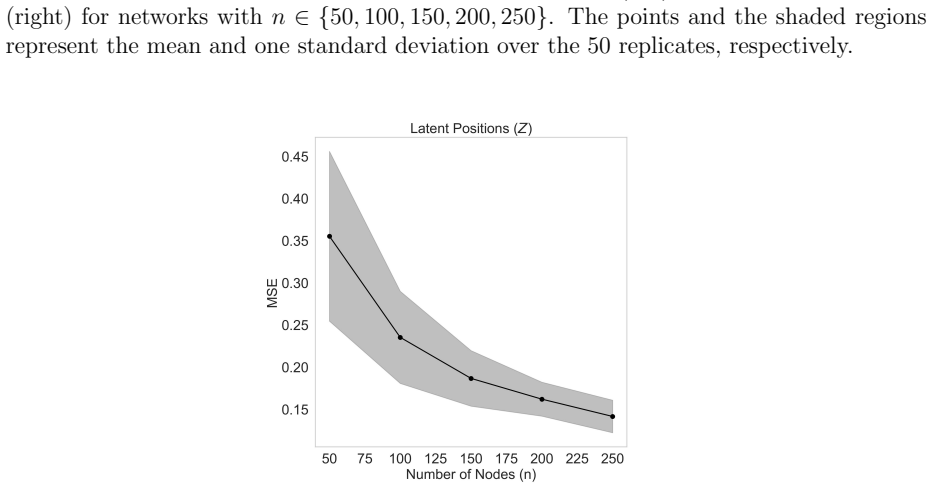
- The simulation study shows consistent recovery of sender and receiver effects, reciprocity parameters, and latent positions as the number of nodes grows from 50 to 250.
Reading between the lines
- A natural extension would be to let the reciprocity slope $\phi$ vary with dyad-level covariates or latent cluster membership, which would test whether reciprocity differences track observable group boundaries rather than continuous distance.
- If the distance-dependent reciprocity signal is real, it suggests substantive hypotheses about social mechanisms: cross-office information-sharing ties may be reciprocated because long-distance communication is more formalized, while close friendships may be reciprocated because of homophily.
- The model's use of the same squared Euclidean distance for both edge formation and reciprocity could be tested against a two-distance-scale version; comparing the two would reveal whether reciprocity responds to similarity differently from edge formation.
- Because the inference is Hamiltonian Monte Carlo and the parameter count grows with $n$, practical scaling to large networks would likely require variational methods, as the paper itself notes.
Editorial analysis
A structured set of objections, weighed in public.
Referee Report
Summary. The paper proposes a latent space model for binary directed networks in which the reciprocity log odds ratio for each dyad is a linear function of squared latent distance, ρ_ij = ρ + φ||z_i - z_j||², while the conditional log odds of an unreciprocated edge is s_i + r_j - ||z_i - z_j||². The model nests the edge-independent latent space model of Krivitsky et al. when ρ = φ = 0, and it nests a homogeneous-reciprocity dyad-independent model when φ = 0. Bayesian inference is carried out with Hamiltonian Monte Carlo in NumPyro. A simulation study reports decreasing estimation error as n grows, and three applications are used to conclude that the advice network has homogeneous reciprocity, the information-sharing network has reciprocity increasing with latent distance (posterior mean φ = 0.54, 95% CI 0.37–0.71), and the friendship network has reciprocity decreasing with latent distance (posterior mean φ = -1.19, 95% CI -2.12 to -0.46). The central derivation and nested structure are clear and correct.
Significance. If the empirical conclusions hold, the paper addresses a real gap: existing latent space models for directed networks, including AMEN, assume reciprocity is homogeneous across dyads. The proposed parameterization is simple, interpretable, and makes edge-independent LSMs a nested special case, which is a useful property for model comparison. The simulation evidence that parameters are recovered as n increases is encouraging, and the model is a natural candidate for analyzing directed network data with heterogeneous reciprocity. The main value of the paper depends on the reliability of the empirical findings and on the adequacy of the inference diagnostics, both of which need strengthening before the application-level claims can be accepted.
major comments (4)
- [§5.3–§5.4, Figures 8a and 10a] The local log odds ratio plots are presented as empirical verification of the inferred reciprocity type, but they are not independent of the model: the distances r̂_ij are posterior mean latent distances from the distance-dependent model being tested, and the windows are then used to aggregate the observed dyads. The plot therefore reflects the model's own latent-space reconstruction and cannot serve as a confirmatory check. Please either replace this with a measure that does not use the fitted distance-dependent model, or explicitly label the plots as descriptive summaries of the fitted model and remove the claim of empirical verification.
- [§2.2–§2.3, Eqs. (1)–(5)] The central identifying assumption is that dyads are conditionally independent given latent positions and sender/receiver effects, and that the same squared Euclidean distance controls both edge formation and the reciprocity odds ratio. In the information-sharing application, Figure 8c shows that the latent positions separate into office clusters; under the model, between-office dyads are necessarily far apart, so the positive φ can be interpreted as 'between-office ties are more likely to be reciprocated.' But if reciprocity between offices is driven by task interdependence or reporting structure rather than by distance, φ̂ = 0.54 will absorb that misspecification. The simulation in Section 4 draws from the fitted model and therefore cannot detect such bias. I recommend a sensitivity analysis that includes office membership or another block/covariate term and reports how φ changes; alternatively, the empirical conclusions should be stated more cautiously.
- [§3.2 and §4] No MCMC convergence diagnostics are reported. The paper states that all chains were run for 5,000 post-burn-in iterations (Sections 4 and 5.1), but it does not give R-hat statistics, effective sample sizes, or trace plots for the simulations or applications. For a model with n(d+2)+2 parameters and hierarchical priors, 5,000 iterations may be too few to assess mixing of the latent positions. The '95% point-wise confidence intervals' in Figures 8a and 10a also have no stated construction method. Please add diagnostics and describe how the intervals are computed.
- [Table 3 and §5] The information criteria are used to select among models whose parameter dimension grows with n, and the paper itself acknowledges that the standard assumptions are not met. For the information-sharing network, the AIC difference between the distance-dependent and homogeneous models is only 18 (2158 vs 2176), and the DIC difference is 4 (1941 vs 1945); no posterior predictive checks are shown for this network. Please report how the DIC effective number of parameters is computed, and provide posterior predictive or cross-validation comparisons for all three networks before concluding that the data support distance-dependent reciprocity.
minor comments (4)
- [§3.1 and Figure captions] The phrase 'distant-dependent' appears in Section 3.1 and in the captions of Figures 8 and 10; it should be 'distance-dependent'.
- [§4] The text says 'means squared errors' where 'mean squared errors' is intended.
- [§3.2] The package is referred to as 'NumPyro' in the text but 'Numpyro' in one place; please use a consistent spelling.
- [§5.3–§5.4] The sliding windows in Figures 8a and 10a are overlapping and only windows containing all four dyad types are plotted; this should be stated in the methods or captions so that the plotted trend is not overinterpreted.
Circularity Check
No significant circularity: the model is a proposed parameterization estimated from data; nesting and simulation are self-consistency checks, and the in-sample diagnostics are not load-bearing predictions.
full rationale
The paper does not derive a substantive result from inputs that are equivalent to the conclusion by construction. Equation (3) defines rho_ij = rho + phi||z_i - z_j||^2 as a newly proposed parameterization; rho and phi are free parameters estimated by HMC, not quantities forced by the data definition. The nesting property (rho = phi = 0 reduces to the edge-independent LSM) is an algebraic identity, not a circular derivation. The simulation study generates data from the model and checks parameter recovery; this is a self-consistency sanity check, not a claim of independent prediction. The real-data conclusions are based on posterior distributions of phi, which are genuine statistical inferences. The local log odds ratio plots in Figures 8a and 10a use posterior mean latent positions from the same fitted model, so they are in-sample goodness-of-fit diagnostics rather than independent confirmations; however, the paper does not present them as out-of-sample predictions, and the reciprocity conclusions do not reduce to those plots. No load-bearing self-citation chain, uniqueness theorem, or ansatz-smuggling is present. Concerns about misspecification, such as unmodeled triadic closure or community structure biasing phi, are substantive correctness risks, not circularity.
Assumptions & free parameters
free parameters (5)
- Baseline reciprocity ρ =
Posterior means vary by application; e.g., advice homogeneous model 95% CI (0.43, 1.16)
- Distance coefficient φ =
Information-sharing posterior mean 0.54 (CI 0.37 to 0.71); friendship posterior mean -1.19 (CI -2.12 to -0.46)
- Sender and receiver effects s_i, r_i
- Latent positions z_i
- Prior hyperparameters =
a_s=b_s=a_r=b_r=3/2, σ_μ=10, σ_ρ=σ_φ=10, a_z=b_z=3/2
assumptions (5)
- domain assumption Dyads are conditionally independent given the model parameters
- domain assumption The same squared Euclidean latent distance drives both edge formation and reciprocity
- domain assumption The reciprocity log odds ratio is linear in squared latent distance
- domain assumption Hamiltonian Monte Carlo chains converge after 5,000 iterations with 2,500 burn-in
- standard math Procrustes matching to the MAP estimate resolves rotational and translational invariance
Cite this review
Pith. "Pith review of A Latent Space Approach to Inferring Distance-Dependent Reciprocity in Directed Networks." pith.science (2026). https://pith.science/paper/OBPWIXLE
@misc{pith2026241118433,
  author       = {Pith},
  title        = {Pith review of: A Latent Space Approach to Inferring Distance-Dependent Reciprocity in Directed Networks},
  year         = {2026},
  howpublished = {\url{https://pith.science/paper/OBPWIXLE}},
  note         = {Machine review of arXiv:2411.18433}
}
read the original abstract
Reciprocity, or the stochastic tendency for actors to form mutual relationships, is an essential characteristic of directed network data. Existing latent space approaches to modeling directed networks are severely limited by the assumption that reciprocity is homogeneous across the network. In this work, we introduce a new latent space model for directed networks that can model heterogeneous reciprocity patterns that arise from the actors' latent distances. Furthermore, existing edge-independent latent space models are nested within the proposed model class, which allows for meaningful model comparisons. We introduce a Bayesian inference procedure to infer the model parameters using Hamiltonian Monte Carlo. Lastly, we use the proposed method to infer different reciprocity patterns in an advice network among lawyers, an information-sharing network between employees at a manufacturing company, and a friendship network between high school students.
Figures


Figures from the paper (7 more)


Reference graph
Works this paper leans on
-
[1]
Coleman, J. S. (1964). Introduction to Mathematical Sociology . Free Press of Glencoe, New York
work page 1964
-
[2]
Cross, R. and Park, A. (2004). The Hidden Power of Social Networks: Understanding How Work Really Gets Done in Organizations . Harvard Business Review Press, Boston, MA
work page 2004
-
[3]
Frank, O. and Strauss, D. (1986). Markov graphs. Journal of the American Statistical Association , 81(395):832--842
work page 1986
-
[4]
Garlaschelli, D. and Loffredo, M. I. (2004). Patterns of link reciprocity in directed networks. Physical Review Letters , 93(268701):1--4
work page 2004
-
[5]
Handcock, M. S., Raftery, A. E., and Tantrum, J. M. (2007). Model-based clustering of social networks. Journal of the Royal Statistical Society Series A , 170(2):301--354
work page 2007
-
[6]
Hoff, P. (2021). Additive and multiplicative effects network models. Statistical Science , 36(1):34--50
work page 2021
-
[7]
Hoff, P. D. (2005). Bilinear mixed-effects models for dyadic data. Journal of the American Statistical Association , 100(469):286--295
work page 2005
-
[8]
D., Raftery, A
Hoff, P. D., Raftery, A. E., and Handcock, M. S. (2002). Latent space approaches to social network analysis. Journal of the American Statistical Association , 97(460):1090--1098
2002
Show all 29 references
-
[9]
Hoffman, M. D. and Gelman, A. (2014). The No-U-Turn Sampler : Adaptively setting path length in Hamiltonian Monte Carlo . Journal of Machine Learning Research , 15(47):1593--1623
2014
-
[10]
W., Laskey, K
Holland, P. W., Laskey, K. B., and Leinhardt, S. (1983). Stochastic blockmodels: First steps. Social Networks , 5:109--137
1983
-
[11]
Holland, P. W. and Leinhardt, S. (1981). An exponential family of probability distributions for directed graphs. Journal of the American Statistical Association , 76(373):33--50
1981
-
[12]
R., Goodreau, S
Hunter, D. R., Goodreau, S. M., and Handcock, M. S. (2008). Goodness of fit of social network models. Journal of the American Statistical Association , 103(408):248--258
2008
-
[13]
Jiang, B., Zhang, Z.-L., and Towsley, D. (2015). Reciprocity in social networks with capacity constraints. In Proceedings of the 21th ACM SIGKDD International Conference on Knowledge Discovery and Data Mining , pages 457--466
2015
-
[14]
N., Handcock, M
Krivitsky, P. N., Handcock, M. S., Raftery, A. E., and Hoff, P. D. (2009). Representing degree distributions, clustering, and homophily in social networks with latent cluster random effects models. Social Networks , 31(3):204--213
2009
-
[15]
Krivitsky, P. N. and Kolaczyk, E. D. (2015). On the question of effective sample size in network modeling: An asymptotic inquiry. Statistical Science , 30(2):184--198
2015
-
[16]
Lazega, E. (2001). The Collegial Phenomenon: The Social Mechanisms of Cooperation amoung Peers in a Corporate Law Partnership . Oxford University Press, Oxford
2001
-
[17]
Li, C., Wang, H., and van Mieghem, P. (2013). Epidemic threshold in directed networks. Physical Review E , 88:062802
2013
-
[18]
Lusher, D., Koskinen, J., and Robins, G. (2013). Exponential Random Graph Models for Social Networks . Cambridge University Press, Cambridge
2013
-
[19]
Ma, Z., Ma, Z., and Yuan, H. (2020). Universal latent space model fitting for large networks with edge covariates. Journal of Machine Learning Research , 21(4):1--67
2020
-
[20]
Neal, R. M. (2011). MCMC using Hamiltonian dynamics. In Brooks, S., Gelman, A., Jones, G. I., and Meng, X.-L., editors, Handbook of Markov chain Monte Carlo , chapter 5, pages 113--162. CRC Press, Boca Raton, FL
2011
-
[21]
Phan, D., Pradhan, N., and Jankowiak, M. (2019). Composable effects for flexible and accelerated probabilistic programming in NumPyro . arXiv preprint arXiv:1912.11554
2019 arXiv
-
[22]
Stewart, J., Schweinberger, M., Bojanowski, M., and Morris, M. (2019). Multilevel network data facilitate statistical inference for curved ergms with geometrically weighted terms. Social Networks , 59(1):98--119
2019
-
[23]
van Duijn, M. A. J., Snijders, T. A. B., and Zijlstra, B. J. H. (2004). p_2 : a random effects model with covariates for directed graphs. Statistica Neerlandica , 58(2):234--254
2004
-
[24]
Q., Hunter, D
Vu, D. Q., Hunter, D. R., and Schweinberger, M. (2013). Model-based clustering of large networks. The Annals of Applied Statistics , 7(2):1010--1039
2013
-
[25]
Wainwright, M. J. and Jordan, M. I. (2008). Graphical models, exponential families, and variational inference. Foundations and Trends in Machine Learning , 1(1-2):1--305
2008
-
[26]
Wang, Y. J. and Wong, G. Y. (1987). Stochastic blockmodels for directed graphs. Journal of the American Statistical Association , 82(397):8--19
1987
-
[27]
Zhang, X., Xue, S., and Zhu, J. (2020). A flexible latent space model for multilayer networks. In Proceedings of the International Conference on Machine Learning , pages 8546--8555
2020
-
[28]
Zhu, Y.-X., Zhang, X.-G., Sun, G.-Q., Tang, M., Zhou, T., and Zhang, Z.-K. (2014). Influence of reciprocal links in social networks. PLoS One , 9(7):e103007
2014
-
[29]
Zijlstra, B. J. H., van Duijn, M. A. J., and Snijders, T. A. B. (2006). The multilevel p_2 model: A random effects model for the analysis of multiple social networks. Methodology: European Journal of Research Methods for the Behavioral and Social Sciences , 2(1):42--47
2006
Reviewed August 12, 2026 · model on record in the stance chip above.
Discussion (0). Continue with ORCID to comment.