REVIEW 3 major objections 4 minor 30 references
Optimizing Coverage in Convex Quadrilateral Regions with a Single UAV
T0 review · 3 major / 4 minor · reviewed 2026-08-12 · deepseek-v4-flash
Pith's one-line read For any convex quadrilateral, one numerical root yields the best single-UAV altitude.
desk verdict The inscribed-ellipse case fails a basic numerical check—Eq (5) gives q=1.34, not 0.527—so the paper's central recipe is currently unreliable. read the letter →
The pith
A machine-rendered reading of the paper's core claim, the machinery that carries it, and where it could break.
The reading
What carries the argument
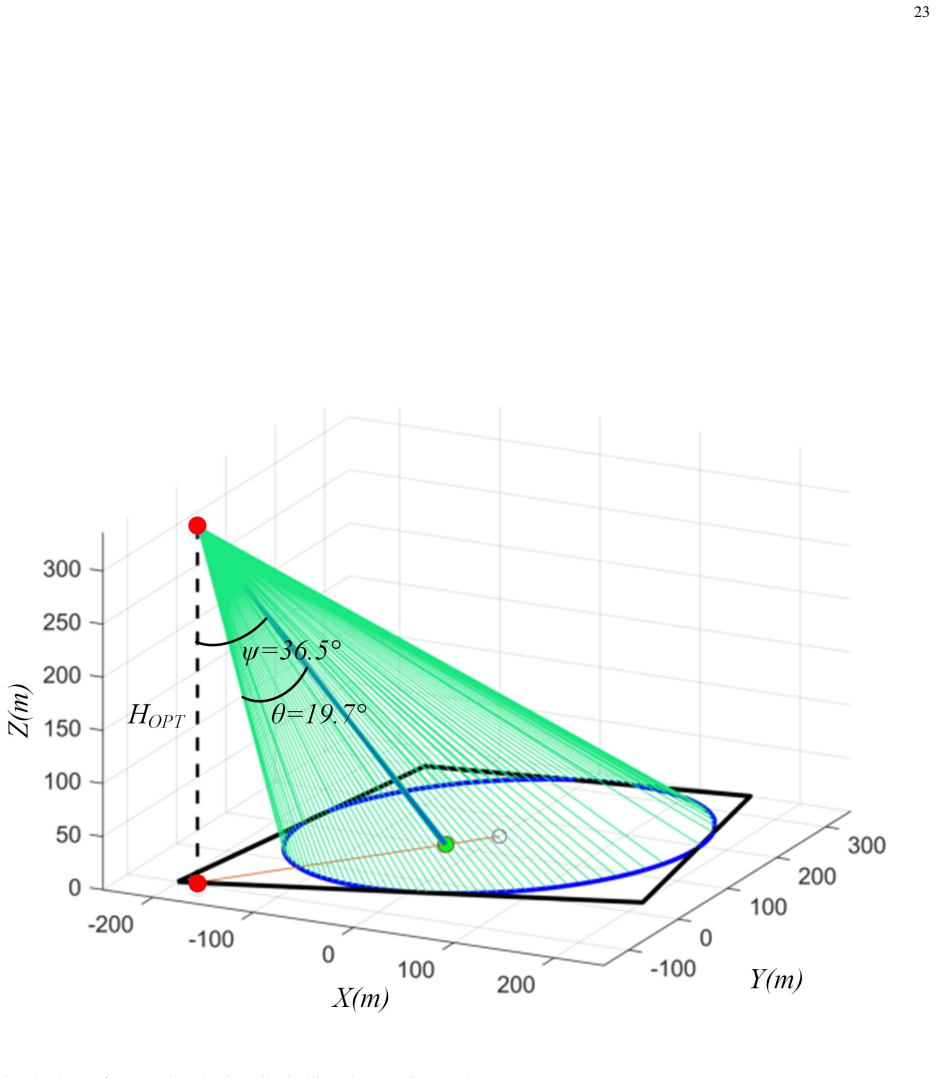
The load-bearing mechanism is the pair of one-parameter families of ellipses inscribed in, and circumscribed about, a convex quadrilateral, with the extremal member selected by Eqs. (5) and (9). These give the semi-axes of the footprint; Eqs. (1) and (2) convert those semi-axes and the altitude into the antenna beam semi-apex angle and tilt angle. With that link, the average path loss at the footprint edge collapses into a univariate expression in altitude, and optimal altitudes for path loss, SNR, and energy are each the root of a first-order stationarity equation (Eqs. (20), (23), and (28)). The entire argument is carried by this reduction from a two-dimensional geometric placement problem to one-variable root finding.
What would settle it
Compare the semi-axis lengths obtained from Eqs. (5), (11), and (12) with the largest-area ellipse found by direct numerical optimization under the containment constraint; a mismatch for any convex quadrilateral would invalidate the footprint stage. Separately, a brute-force scan of maximum path loss as a function of altitude that shows more than one local minimum would break the claim that the root of Eq. (20) is the global optimum.
Extended reading notes
Core claim
The paper argues that for any convex quadrilateral region, the optimal deployment of a single UAV with a tiltable directional antenna can be reduced to two steps. First, the footprint is chosen as either the largest ellipse that fits inside the quadrilateral or the smallest ellipse that contains it, both obtained from closed-form expressions in transformed coordinates. Second, the antenna beam geometry is linked to the altitude and to the ellipse semi-axes, so that the maximum path loss at the footprint boundary becomes an explicit function of altitude; the optimal altitude is the numerical root of the first-order condition (Eq. (19) and Eq. (20)). The same stationarity argument is applied to the minimum SNR at the boundary, using the directional antenna gain model, and to total energy consumption. The paper claims this gives a prescriptive, environment-dependent recipe for single-UAV altitude selection over irregular quadrilateral areas.
Load-bearing premise
The load-bearing premise is that the formulas in Eqs. (5) and (9) really give the unique largest inscribed and smallest circumscribed ellipse for every convex quadrilateral, since the paper does not re-derive or independently validate them; if those formulas fail, the whole altitude optimization built on those footprints collapses.
Editorial extensions
If this is right
- For any convex quadrilateral, the optimal single-UAV altitude can be obtained by solving one nonlinear equation instead of searching the full 3D placement space.
- The inscribed-ellipse choice covers the interior but leaves the boundary uncovered, while the circumscribed choice covers everything and requires a higher altitude and more energy.
- More directional antennas shift the SNR-optimal altitude upward while lowering the minimum SNR at the coverage boundary.
- Energy consumption as a function of altitude is U-shaped: it first falls as forward-flight drag eases, then rises as path loss forces more transmission power, and higher throughput demands push the optimum lower.
- In high-rise urban environments the required beam angle can become so large, around 85.5 degrees, that single-UAV coverage with this geometry is impractical.
Reading between the lines
- The same extremal-ellipse plus stationarity-equation pattern would extend to any convex polygon for which a maximal inscribed or minimal circumscribed ellipse is known, but the paper's formulas are specific to quadrilaterals.
- The three optima derived in the paper (path-loss, SNR, and energy) generally disagree with one another, so a practical deployment would require a Pareto trade-off; the paper presents them side by side rather than combining them.
- The geometric groundwork can be stress-tested independently: brute-force numerical maximization of the inscribed ellipse area over random quadrilaterals would verify whether Eqs. (5) and (9) are complete as claimed.
- For dynamic operations, the stationarity equations could serve as fast initial guesses in a real-time controller, with a few Newton iterations replacing a full grid search.
Editorial analysis
A structured set of objections, weighed in public.
Referee Report
Summary. The manuscript addresses optimal deployment of a single UAV over an arbitrary convex quadrilateral region. The UAV's tilted directional antenna produces an elliptical ground footprint, and the paper considers two geometric choices: the largest ellipse inscribed in the quadrilateral and the smallest ellipse circumscribed about it. Using a standard air-to-ground path-loss model, the authors derive an expression for the maximum path loss as a function of altitude and solve its stationarity condition numerically to obtain an altitude that minimizes worst-case path loss. The same framework is then extended to maximize the minimum SNR at the coverage boundary and to minimize total energy consumption during vertical takeoff, forward flight, and hovering. A single case study with four propagation environments and several antenna directivities illustrates the trade-offs among coverage, SNR, and energy. The paper claims, in its abstract, a complete parametric characterization of all feasible ellipse configurations and a large-scale randomized-quadrilateral evaluation, but the body contains neither.
Significance. If the underlying geometry and derivations are correct, the paper would provide a useful prescriptive method for choosing a single-UAV altitude that balances coverage efficiency, path-loss performance, and energy consumption. A genuine strength is that the optimization does not fit parameters to data: once the propagation model and UAV parameters are fixed, the altitude is obtained from a stationarity condition. The geometric reduction from an arbitrary convex quadrilateral to a one-parameter family of ellipses, following Horwitz [26], is an appealing approach. However, the central geometric anchor of Scenario 1 appears to be internally inconsistent as stated, and the abstract promises validation studies that are absent from the full text. Because these issues affect the main claims, the current version cannot be accepted without substantial correction.
major comments (3)
- [IV-A and Eq. (5)] Substituting the case-study values s=235/307 and t=269/307 into Eq. (5) gives q≈1.34, not the reported q=0.527, and this value lies outside the stated admissible interval q∈[0,1]. If the formula is evaluated as written, the numerator is approximately -0.350 and the denominator approximately -0.261, yielding a ratio greater than one. Since the coefficients Bi, the semi-axes (a,b)=(200.3,155.2), the 77.47% coverage figure, and all Scenario 1 altitude results in Table II and Figures 4-8 are derived from this q, the Scenario 1 optimization is currently anchored to an internally inconsistent maximal inscribed ellipse. The authors should correct Eq. (5) or the reported q, verify the formula against Horwitz [26], and recompute all affected numerical results.
- [Abstract vs. Sections II-V] The abstract claims that the analysis is 'further extended to all feasible inscribed and circumscribed ellipse configurations' and that 'a large-scale evaluation over randomly generated convex quadrilaterals' is provided. The full text, however, contains only a single quadrilateral case study in Section IV, with no parametric study over the full family of feasible ellipses and no randomized-quadrilateral statistical evaluation. This unsupported claim is load-bearing for the paper's stated completeness and robustness, and it must either be implemented and reported or removed from the abstract.
- [III-A, Eqs. (18)-(20)] The derivation of the unified maximum path-loss expression in Eq. (18) from Eqs. (13)-(17), and the resulting stationarity condition in Eq. (20), are stated as 'straightforward algebraic manipulations' without an actual derivation. Since Eq. (18) is the basis for the path-loss, SNR, and energy optimizations, the expression cannot be verified from the manuscript as it stands. Please provide the full derivation or, failing that, a reproducible computation script or notebook that generates Eqs. (18) and (20) and the numerical roots reported in Tables II and Figures 4-8.
minor comments (4)
- [Section IV-A] The notation for the semi-axes changes from (a,b) in Sections II-III to (α,β) in Section IV-A; please use one consistent notation throughout.
- [Section V heading] The heading 'C ONLCUSIONS' appears to be a typo for 'CONCLUSIONS'.
- [Table II and Section IV-C] The table and the discussion refer to angles such as '85.50' without consistently indicating the degree symbol; please add units in the table header and text.
- [Section IV-B, Eq. (9)] For the circumscribed ellipse, the root-selection criterion for the cubic in Eq. (9) is not stated, and the reported root u=1.610 is not validated against the polynomial; please specify which root is selected and confirm that it yields the minimal-area ellipse.
Circularity Check
No circular derivation: the altitude optima are obtained from genuine first-order conditions on analytic path-loss, SNR, and energy expressions, and the geometric inputs are attributed to an external source rather than to the paper's own conclusions.
full rationale
The paper's central results, HOPT, HOPT*, and HOPT**, are obtained by differentiating explicit scalar functions of H (Eqs. (18), (22), and (27)) and solving the stationarity conditions (19), (23), and (28). No parameter is fitted to the quantity being predicted, and no reported optimum is an input renamed as an output. The inscribed and circumscribed ellipse geometry is imported from Horwitz [26], an external mathematical reference, and the paper's own earlier work [23], [25] appears only as motivational context, not as the proof of any equation needed for the altitude calculation. Reliance on an external geometric theorem without re-derivation is an intellectual-dependency or correctness matter, not circularity. Two non-circular concerns should be flagged separately: (i) substituting the case-study values (s,t) = (235/307, 269/307) into Eq. (5) gives q ≈ 1.34 rather than the reported q = 0.527, so the Scenario 1 footprint is internally inconsistent; and (ii) the abstract promises a large-scale random-quadrilateral evaluation that is absent from the full text. Neither concern amounts to the derived optimum being equivalent, by construction, to its inputs.
Assumptions & free parameters
assumptions (6)
- domain assumption Horwitz's classification of all ellipses inscribed in a convex quadrilateral and the unique maximal-area ellipse (Eqs. (4)-(5)) and minimal-area circumscribed ellipse (Eqs. (8)-(9)).
- domain assumption Al-Hourani's LoS probability path-loss model (Eqs. (13)-(17)) with environment-dependent parameters eta, kappa, xiLoS, xiNLoS.
- domain assumption Directional antenna gain model G0 cos^m(theta) (Eq. (21)).
- domain assumption Rotary-wing UAV energy model for hover, forward flight, and vertical takeoff (Eqs. (24)-(26)) from [22],[28].
- domain assumption Geometric relation between cone angles and ellipse semi-axes (Eqs. (1)-(2)).
- domain assumption The maximum path loss occurs at the ellipse boundary point on the major axis farthest from the UAV's ground projection.
Cite this review
Pith. "Pith review of Optimizing Coverage in Convex Quadrilateral Regions with a Single UAV." pith.science (2026). https://pith.science/paper/KLREP5YQ
@misc{pith2026241118454,
  author       = {Pith},
  title        = {Pith review of: Optimizing Coverage in Convex Quadrilateral Regions with a Single UAV},
  year         = {2026},
  howpublished = {\url{https://pith.science/paper/KLREP5YQ}},
  note         = {Machine review of arXiv:2411.18454}
}
read the original abstract
The integration of unmanned aerial vehicles (UAVs) into next-generation wireless networks has emerged as a promising solution for providing flexible and efficient coverage. This paper investigates the optimal deployment of a single UAV over an arbitrary convex quadrilateral region, employing a directional antenna with adjustable tilt that results in an elliptical ground coverage footprint. Two coverage scenarios are considered: (i) the largest inscribed ellipse, which maximizes coverage within the quadrilateral while excluding boundary regions, and (ii) the smallest circumscribed ellipse, which guarantees full coverage of the entire area. An optimization framework is developed to determine the optimal UAV altitude by examining path loss, signal-to-noise ratio (SNR), and energy consumption. Based on a widely adopted path loss model, the altitude that minimizes the maximum path loss is derived, while the effect of antenna directivity on maximizing the minimum SNR at the coverage boundary is also analyzed. Furthermore, UAV energy consumption is evaluated by accounting for hovering, forward flight, and vertical take-off operations. Numerical results illustrate the trade-offs among coverage efficiency, communication performance, and energy consumption under different propagation environments and antenna configurations. The analysis is further extended to all feasible inscribed and circumscribed ellipse configurations, providing a complete parametric characterization of the optimal altitude. In addition, a large-scale evaluation over randomly generated convex quadrilaterals offers a statistical assessment of the proposed framework and demonstrates its robustness under geometric variability.
Figures


Figures from the paper (5 more)



Reference graph
Works this paper leans on
-
[26]
Horwitz, Ellipses Inscribed in, and Circumscribed about, Quadrilat erals
A. Horwitz, Ellipses Inscribed in, and Circumscribed about, Quadrilat erals. Boca Raton, FL, USA: CRC Press, 2024
work page 2024
-
[1]
What will the future of UA V cellular communications be? A flight from 5G to 6G,
G. Geraci, A. Garcia-Rodriguez, M. M. Azari, A. Lozano, M . Mezzavilla, S. Chatzinotas, Y . Chen, S. Rangan, and M. D. Renzo, “What will the future of UA V cellular communications be? A flight from 5G to 6G,” IEEE Commun. Surveys Tuts. , vol. 24, no. 3, pp. 1304–1335, 3rd Quart. 2022
work page 2022
-
[2]
N. V aiopoulos, A. V avoulas, and H. G. Sandalidis, “Explo ring the random location problem inside a truncated conic sh ape: Application in UA V communications,” IEEE Trans. Commun. , vol. 70, no. 4, pp. 2882–2890, Apr. 2022
work page 2022
-
[3]
A survey of air-to-ground propagation channel modeling for unmanned aerial vehicles,
W. Khawaja, I. Guvenc, D. W. Matolak, U.-C. Fiebig, and N. Schneckenburger, “A survey of air-to-ground propagation channel modeling for unmanned aerial vehicles,” IEEE Commun. Surveys Tuts. , vol. 21, no. 3, pp. 2361–2391, 3rd Quart. 2019
work page 2019
-
[4]
Trajectory-predi ction techniques for unmanned aerial vehicles (UA Vs): A comprehensive survey,
P . Shukla, S. Shukla, and A. K. Singh, “Trajectory-predi ction techniques for unmanned aerial vehicles (UA Vs): A comprehensive survey,” IEEE Commun. Surveys Tuts. , 2024, to appear
work page 2024
-
[5]
A tutorial on UA Vs for wireless networks: Applications, challenges, and open problems,
M. Mozaffari, W. Saad, M. Bennis, Y .-H. Nam, and M. Debbah , “A tutorial on UA Vs for wireless networks: Applications, challenges, and open problems,” IEEE Commun. Surveys Tuts. , vol. 21, no. 3, pp. 2334–2360, 3rd Quart. 2019
work page 2019
-
[6]
A. Fotouhi, H. Qiang, M. Ding, M. Hassan, L. G. Giordano, A . Garcia-Rodriguez, and J. Y uan, “Survey on UA V cellular communications: Practical aspects, standardization adva ncements, regulation, and security challenges,” IEEE Commun. Surveys Tuts., vol. 21, no. 4, pp. 3417–3442, 4th Quart. 2019
work page 2019
-
[7]
3D placement optimization in UA V- enabled communications: A systematic mapping study,
J. Carvajal-Rodr´ ıguez, D. S. Guam´ an, C. Tipantu˜ na, F. Grijalva, and L. F. Urquiza, “3D placement optimization in UA V- enabled communications: A systematic mapping study,” IEEE Open J. V eh. Technol. , vol. 5, pp. 523–559, 2024. 17
work page 2024
Show all 30 references
-
[8]
Aerial base station placement: A tutorial introduction,
P . Q. Viet and D. Romero, “Aerial base station placement: A tutorial introduction,” IEEE Commun. Mag. , vol. 60, no. 5, pp. 44–49, May 2022
2022
-
[9]
A tutorial on AI-powered 3D deployment of drone base stations: State of the art, applications and ch allenges,
N. Parvaresh, M. Kulhandjian, H. Kulhandjian, C. D’Amou rs, and B. Kantarci, “A tutorial on AI-powered 3D deployment of drone base stations: State of the art, applications and ch allenges,” V eh. Commun., vol. 36, 2022, Art. no. 100474
2022
-
[10]
UA V placement and power all ocation in uplink and downlink operations of cellular netwo rk,
M. A. Ali and A. Jamalipour, “UA V placement and power all ocation in uplink and downlink operations of cellular netwo rk,” IEEE Trans. Commun. , vol. 68, no. 7, pp. 4383–4393, Jul. 2020
2020
-
[11]
A survey on UA V pl acement optimization for UA V-assisted communication in 5G and beyond networks,
I. A. Elnabty, Y . Fahmy, and M. Kafafy, “A survey on UA V pl acement optimization for UA V-assisted communication in 5G and beyond networks,” Phys. Commun. , vol. 51, 2022, Art. no. 101564
2022
-
[12]
Joint trajectory and commu nication design for multi-UA V enabled wireless networks,
Q. Wu, Y . Zeng, and R. Zhang, “Joint trajectory and commu nication design for multi-UA V enabled wireless networks,” IEEE Trans. Wireless Commun. , vol. 17, no. 3, pp. 2109–2121, Mar. 2018
2018
-
[13]
Communicat ion-aware UA V path planning,
A. Mardani, M. Chiaberge, and P . Giaccone, “Communicat ion-aware UA V path planning,” IEEE Access, vol. 7, pp. 52 609– 52 621, 2019
2019
-
[14]
Optimal L AP altitude for maximum coverage,
A. Al-Hourani, S. Kandeepan, and S. Lardner, “Optimal L AP altitude for maximum coverage,” IEEE Wireless Commun. Lett., vol. 3, no. 6, pp. 569–572, Dec. 2014
2014
-
[15]
Placement optim ization of UA V-mounted mobile base stations,
J. Lyu, Y . Zeng, R. Zhang, and T. J. Lim, “Placement optim ization of UA V-mounted mobile base stations,” IEEE Commun. Lett., vol. 21, no. 3, pp. 604–607, Mar. 2016
2016
-
[16]
3-D placement of an unmanned aerial vehicle base station (UA V-BS) for energy-efficient maximal coverage,
M. Alzenad, A. El-Keyi, F. Lagum, and H. Yanikomeroglu, “3-D placement of an unmanned aerial vehicle base station (UA V-BS) for energy-efficient maximal coverage,” IEEE Wireless Commun. Lett. , vol. 6, no. 4, pp. 434–437, Aug. 2017
2017
-
[17]
Optima l UA V positioning for terrestrial-aerial communication in presence of fading,
M. M. Azari, F. Rosas, K.-C. Chen, and S. Pollin, “Optima l UA V positioning for terrestrial-aerial communication in presence of fading,” in 2016 IEEE Global Commun. Conf. (GLOBECOM) , Washington, DC, USA, 04-08 Dec. 2016
2016
-
[18]
U A V-aided wireless power transfer and data collection in Rician fading,
Y . Liu, K. Xiong, Y . Lu, Q. Ni, P . Fan, and K. B. Letaief, “U A V-aided wireless power transfer and data collection in Rician fading,” IEEE J. Sel. Areas Commun. , vol. 39, no. 10, pp. 3097–3113, Oct. 2021
2021
-
[19]
3-D plac ement of an unmanned aerial vehicle base station for maximum coverage of users with different QoS requirements,
M. Alzenad, A. El-Keyi, and H. Yanikomeroglu, “3-D plac ement of an unmanned aerial vehicle base station for maximum coverage of users with different QoS requirements,” IEEE Wireless Commun. Lett. , vol. 7, no. 1, pp. 38–41, Feb. 2017
2017
-
[20]
On the applicatio n of directional antennas in multi-tier unmanned aerial veh icle networks,
J. Zhang, H. Xu, L. Xiang, and J. Yang, “On the applicatio n of directional antennas in multi-tier unmanned aerial veh icle networks,” IEEE Access , vol. 7, pp. 132 095–132 110, 2019
2019
-
[21]
Position an d orientation planning of the UA V with rectangle coverage area,
E. Zhou, Z. Liu, W. Zhou, P . Lan, and Z. Dong, “Position an d orientation planning of the UA V with rectangle coverage area,” IEEE Trans. V eh. Technol., 2024
2024
-
[22]
Energy-efficient 3- D placement of an unmanned aerial vehicle base station with antenna tilting,
J. Y ou, S. Jung, J. Seo, and J. Kang, “Energy-efficient 3- D placement of an unmanned aerial vehicle base station with antenna tilting,” IEEE Commun. Lett. , vol. 24, no. 6, pp. 1323–1327, Jun. 2020
2020
-
[23]
On the terminal location uncertainty in ellipti cal footprints: Application in air-to-ground links,
A. V avoulas, N. V aiopoulos, H. G. Sandalidis, and K. K. D elibasis, “On the terminal location uncertainty in ellipti cal footprints: Application in air-to-ground links,” 2023. [O nline]. Available: https://arxiv.org/abs/2309.07299
2023
-
[24]
Coverage path planning opt imization of heterogeneous UA Vs group for precision agriculture,
R. I. Mukhamediev, K. Yakunin, M. Aubakirov, I. Assanov , Y . Kuchin, A. Symagulov, V . Levashenko, E. Zaitseva, D. Sokolov, and Y . Amirgaliyev, “Coverage path planning opt imization of heterogeneous UA Vs group for precision agriculture,” IEEE Access , vol. 11, pp. 5789–5803, 2023
2023
-
[25]
Efficient UA V coverage in large conve x quadrilateral areas with elliptical footprints,
A. V avoulas, K. K. Delibasis, H. G. Sandalidis, G. Nousi as, and N. V aiopoulos, “Efficient UA V coverage in large conve x quadrilateral areas with elliptical footprints,” 2025. [O nline]. Available: https://arxiv.org/abs/2502.13032
2025
-
[27]
Directional antennas mo deling and coverage analysis of UA V-assisted networks,
J. Peng, W. Tang, and H. Zhang, “Directional antennas mo deling and coverage analysis of UA V-assisted networks,” IEEE Wireless Commun. Lett. , vol. 11, no. 10, pp. 2175–2179, Oct. 2022
2022
-
[28]
Energy minimization for wi reless communication with rotary-wing UA V,
Y . Zeng, J. Xu, and R. Zhang, “Energy minimization for wi reless communication with rotary-wing UA V,” IEEE Trans. Wireless Commun., vol. 18, no. 4, pp. 2329–2345, Apr. 2019. 18
2019
-
[29]
Shoelace formula,
E. W. Weisstein, “Shoelace formula,” From MathWorld–A Wolfram Web Resource, 2024, accessed: 2024-11-19. [Online ]. Available: https://mathworld.wolfram.com/ShoelaceFormula.html
2024
-
[30]
I. N. Bronshtein, Semendyayev, G. Musiol, and H. M¨ uhli g, Handbook of Mathematics , 6th ed. New Y ork, NY , USA: Springer-V erlag, 2015. 19 (a) Inscribed ellipse (b) Circumscribed ellipse Fig. 1. System configurations 20 (a) (b) Fig. 2. Geometric transformations for determini...
2015
Reviewed August 12, 2026 · model on record in the stance chip above.
Discussion (0). Continue with ORCID to comment.