REVIEW 4 major objections 6 minor 52 references
Central kiloparsec region of Andromeda. I. Dynamical modelling
T0 review · 4 major / 6 minor · reviewed 2026-08-12 · deepseek-v4-flash
Pith's one-line read The paper claims that M31's chaotic central velocity field is a warped, torn nuclear disk reorienting after a recent head-on collision with an M32-like galaxy.
desk verdict A genuinely useful SITELLE velocity field and a plausible three-component warp-and-ring model for M31's center, but the qualitative fit and the spherical-potential assumption keep it conditional rather than accepted. read the letter →
The pith
A machine-rendered reading of the paper's core claim, the machinery that carries it, and where it could break.
The reading
What carries the argument
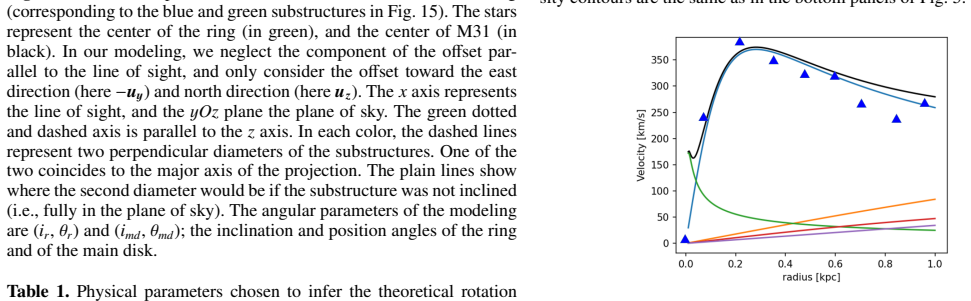
The central machinery is a static three-component dynamical model: a main disk, a tilted offset ring, and a nuclear warped disk, built as a set of misaligned concentric circular orbits in a gravitational potential composed of Plummer spheres for the dark halo, bulge, and nucleus, and Miyamoto-Nagai disks for the stellar and gaseous disks. Each gas particle is assigned the circular-orbit speed in this potential, corrected by an epicyclic asymmetric drift with Toomre parameter Q = 1.3, and then each radius is given its own inclination, position angle, and two sky-plane offsets to create the warp and ring geometry. The fitting procedure compares the predicted velocity field and second moment maps to the SITELLE Hα/[NII] kinematics and the IRAM-30m CO(2-1) data across four geometric scenarios, with scenario 3 (fully decoupled structures) giving the best qualitative match.
What would settle it
A high-resolution stellar kinematic map of the central kiloparsec that measures the actual gravitational potential and its pattern speed would settle the claim: if the box-peanut bulge's non-axisymmetric torques are strong enough to drive the observed S-shape and velocity jumps, then a circular-orbit model in a spherical potential would fail, and a bar-plus-shock model would reproduce the same SITELLE cube. Concretely, measuring the full non-circular velocity field (radial and tangential streaming terms) from the SITELLE Hα/[NII] cube would show whether large radial streaming appears along the bar's major axis rather than the warp geometry.
Extended reading notes
Core claim
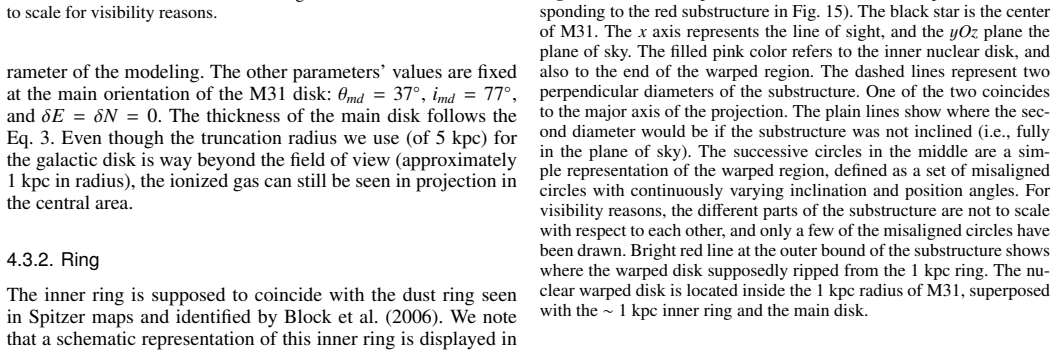
The kinematical observations of the central kiloparsec of Andromeda correspond to a dynamical re-orientation of the perturbed nuclear disk: a series of warps tears the disk into an offset 1-kpc ring, following a recent head-on collision with an M32-like galaxy. The paper argues that the twisted velocity winding within about 200 pc is the signature of a warped nuclear disk that is almost face-on at the center, while the two widely separated velocity components seen along the minor axis in both Hα and CO are the projection of a tilted, offset inner ring superposed on the main disk. The best-fitting geometry has the main disk at inclination 77° and position angle 37°, an inner ring centered about 322 pc north of the nucleus with its own inclination and position angle, and a nuclear warped disk connecting to the ring through a torn transition zone. This structure is presented as the kinematic fingerprint of a collision that tilted and warped the nuclear disk, which is now settling back to equilibrium with the m=1 waves damping down.
Load-bearing premise
The central kiloparsec potential is treated as almost spherical and bulge-dominated, so all gas is put on circular orbits with only a small asymmetric-drift correction; if non-circular motions from the triaxial box-peanut bulge contribute significantly to the velocity kinks, the fitted warped disk and tilted ring would be artifacts.
Editorial extensions
If this is right
- The central gas hole and the double-velocity components along the minor axis are explained by projection of a tilted ring and a warped nuclear disk, rather than by bar-driven shocks.
- The off-centered 1 kpc dust and gas ring is a torn remnant of the nuclear disk, not an inner Lindblad resonance ring of a bar.
- The triaxial box-peanut bulge can remain as a pre-collision bar remnant while the thin bar in the disk was destroyed, reconciling stellar kinematics with the lack of a bar signature in the gas.
- Scenario 3 predicts specific locations where two velocity components should appear along the line of sight, such as the crescent-shaped region in the southwest, which can be checked with higher-resolution integral-field data.
- The nuclear warped disk connects naturally to the previously reported inner warp in HI, extending the known 'warp in the warp' down to the central kiloparsec.
Reading between the lines
- Beyond the paper: if the collision scenario is correct, the fitted 322 pc north offset of the ring center should correlate with the wake of the M32-like encounter; a hydrodynamical simulation of the collision could predict the ring offset and warp amplitude that the static model leaves as free parameters.
- Beyond the paper: the circular-orbit assumption could be tested with a stellar kinematic map of the central kiloparsec at matched resolution; if stars show no corresponding warp or ring structure, the gas-only warps would more plausibly be transient shock features rather than a settled disk reorientation.
- Beyond the paper: a direct spectral fit of the SITELLE cubes with two-component line profiles at every pixel, rather than comparison to moment maps, would provide a quantitative likelihood comparison between scenario 3 and the bar-plus-shock interpretation.
Editorial analysis
A structured set of objections, weighed in public.
Referee Report
Summary. The paper presents a dynamical model for the central kiloparsec of M31, combining newly reduced SITELLE Hα/[NII] integral-field data with archival CO(2-1) and dust maps. The authors identify three gas components—a main disk, a tilted inner ring, and a warped nuclear disk—and construct a static, axisymmetric stellar potential in which gas particles are placed on circular orbits with an epicyclic/asymmetric-drift correction. The geometrical parameters of the three components are adjusted by hand to reproduce the observed velocity field, and the best qualitative match (scenario 3) is interpreted as evidence for a recent head-on collision with an M32-like galaxy. The paper includes a full description of the data reduction, velocity extraction, and the four geometric scenarios considered.
Significance. If the interpretation holds, the paper provides a coherent dynamical explanation for the complex central velocity field of M31, supporting the long-standing collision scenario of Block et al. (2006). The strengths are the fully sampled ionized-gas velocity field, the joint use of ionized and molecular gas tracers, and the explicit modeling of disk warping and tearing. However, the significance is limited by the qualitative nature of the fit: the parameters are not derived from a quantitative optimization, no uncertainties are given, and the comparison with observations is visual. The central kinematic features are real, but the paper does not yet demonstrate that the three-component geometry is uniquely required rather than one of many possible interpretations.
major comments (4)
- [§5.2 and Tables 2–3] The fit is qualitative: Section 5.2 states that the geometrical parameters were 'essentially fitted on the northeast region' and Section 5.3 concludes with 'best qualitative model'. No residuals, chi-squared values, or parameter uncertainties are reported, and the southwest region is excluded from the fit because of a presumed shock. As a result, the central claim that the three-component model reproduces the observed velocity field is not quantitatively established. I ask the authors to provide a quantitative comparison (e.g., residual maps between the model and observed velocity fields, a goodness-of-fit statistic, and an exploration of parameter degeneracies) or to clearly state the model as a schematic interpretation rather than a fitted model.
- [§4.1 and §6] The assumption that the central kpc potential is 'almost spherical' and that gas follows circular orbits (Eq. 4) is load-bearing, because the fitted warps, inclinations, and offsets are derived from this model. Yet Section 6 itself reviews evidence for a triaxial box-peanut bulge with pattern speeds of 20–40 km/s/kpc and for non-circular, S-shaped motions in the ionized gas (Opitsch et al. 2018; Feng et al. 2022, 2024). If non-circular motions contribute substantially to the observed velocity winding and the southeast crescent, the warped nuclear disk and tilted ring may be artifacts of fitting a circular-orbit model to bar-like flows. The authors should quantitively estimate the amplitude of non-circular motions within 1 kpc (e.g., from the Feng et al. models) and show that they are negligible compared to the 100–300 km/s features, or repeat the modeling in the published triaxial potential and demonstrate that the warps and ring are still required.
- [§5.3 and Figs. 21–22] The geometrical parameters (inclinations, position angles, offsets, warp extent) are fitted to the same velocity map that is subsequently compared with the model prediction. The agreement therefore mostly reflects the fitting procedure, not an independent prediction. This circularity should be acknowledged explicitly, and the authors should provide an independent test. For example, they could fit the model to only a subset of the velocity field (e.g., the NE region) and compare the prediction to the SE and SW regions, or predict the CO line profiles at positions not used in the fit and compare with the IRAM-30m data. Without such a test, the 'confrontation' of predicted and observed velocity fields does not validate the three-component scenario over alternative interpretations.
- [Table 2 and §7] There is an inconsistency in the orientation of the main disk: Table 2 lists inclination 35° and position angle 77°, while the text and the conclusion (Section 7) state inclination 77° and PA 37°. This is not a typographical nuance; it directly affects the reproduction of the model and the interpretation of the projected geometry. The authors must correct the table and confirm which values were actually used in the modeling.
minor comments (6)
- [§1] The reference to 'According to ?' is an unresolved citation and should be completed.
- [Eq. (4)] The notation '||− →v||(r) = r sqrt(r dΦ/dr)' is ambiguous; please clarify the square-root placement and the definition of r in cylindrical versus spherical coordinates.
- [§5.3] The phrase 'cube moments 1 and 2' is used without definition; for clarity, specify that these are the intensity-weighted velocity and velocity-dispersion maps.
- [Figs. 5 and 11] The captions of the bottom panels of Fig. 5 and the color coding in Fig. 11 would benefit from a more explicit description of what the green triangles represent and how the flux-ratio threshold for the second component was chosen.
- [Table 3] The note that only varied parameters are displayed is helpful, but the table should explicitly state that unlisted parameters are identical to those in Table 2, to avoid confusion when comparing scenarios.
- [§4.3] The term 'teared apart' is used repeatedly; 'torn apart' is the standard English form. This is a wording issue only.
Circularity Check
Velocity-field 'prediction' is a re-projection of parameters fitted to that same velocity field; the mass model is independent, so the circularity is partial.
-
fitted input called prediction
[Sec. 5, opening paragraph; Sec. 5.3, 'Fitting results']
"The parameters for the modeling are adjusted to fit the velocity map shown in the top right panel of Fig. 5. ... According to these parameters, we predict the velocity field in the four scenarios, represented on Fig. 21 and Fig. 22, for the cube moments 1 and 2 respectively."
The synthetic velocity fields in Fig. 21 are generated from the same geometrical parameters (inclination, PA, radii, and offsets of the warped nuclear disk and tilted ring; Tables 2 and 3) that were optimized to match the observed velocity map. The subsequent confrontation of these maps with the data therefore checks the model's ability to re-describe its fitting target; a mismatch would only indicate failure of the projection or rotation algorithm, not an independent test of the warped-disk-plus-ring hypothesis. The southwest region was excluded from the fit, but the northeast region used for fitting is also part of the later comparison, and the maps are masked with the data.
full rationale
The central circular step is in Sec. 5/5.3: the paper adjusts all geometrical parameters against the observed velocity map and then presents the resulting synthetic maps as 'predictions' of the velocity field, comparing them with the same data. This is a double use of the data: the confrontation validates the fit rather than testing a forecast. The mass model is taken from literature (Sec. 5.1), and the disk-tearing/warp framework of Raj et al. (2021) is external, so no load-bearing self-citation chain is present. The spherical-potential and circular-orbit assumption in Sec. 4.1 is a physical limitation and a possible source of model error, but it is not circular. The conclusion that the kinematics reflect a warped, torn disk after a collision therefore rests on a qualitative fit whose geometry was chosen to reproduce the observations; the match is forced by construction, though the independent mass model prevents the whole argument from being purely definitional. Score 6 reflects this single construction-level reduction rather than a self-citation chain or a fully equivalent derivation.
Assumptions & free parameters
free parameters (11)
- Warped nuclear disk inclination =
85 deg
- Warped nuclear disk position angle =
65 deg
- Warped nuclear disk outer radius =
30 pc
- Inner ring inclination =
48 deg
- Inner ring position angle =
-27 deg
- Inner ring inner radius =
900 pc
- Inner ring width =
300 pc
- Inner ring east offset =
-27 pc
- Inner ring north offset =
322 pc
- Main disk inner hole radius =
400 pc
- Flare thickness parameters alpha and beta =
alpha=6%, beta=30 pc
assumptions (6)
- domain assumption The gravitational potential in the central kpc is dominated by stars and is almost spherical, justifying circular orbits
- domain assumption Gas mass is dynamically negligible in the inner kpc
- domain assumption Gas follows circular orbits with epicyclic perturbations and a Toomre Q=1.3 asymmetric-drift correction
- domain assumption Plummer and Miyamoto-Nagai potentials with literature scale lengths adequately represent the mass distribution
- ad hoc to paper The line-of-sight component of each structure's offset is neglected; only east and north offsets are used
- ad hoc to paper The three dynamical components are independent and rigid except for the warped nuclear disk
Cite this review
Pith. "Pith review of Central kiloparsec region of Andromeda. I. Dynamical modelling." pith.science (2026). https://pith.science/paper/M7X5QLBD
@misc{pith2026241118460,
  author       = {Pith},
  title        = {Pith review of: Central kiloparsec region of Andromeda. I. Dynamical modelling},
  year         = {2026},
  howpublished = {\url{https://pith.science/paper/M7X5QLBD}},
  note         = {Machine review of arXiv:2411.18460}
}
abstract
The Andromeda galaxy (M31) is the most nearby giant spiral galaxy, an opportunity to study with high resolution dynamical phenomena occurring in nuclear disks and bulges, able to explain star formation quenching, and galaxy evolution through collisions and tides. Multi-wavelength data have revealed in the central kpc of M31 strong dynamical perturbations, with an off-centered tilted disk and ring, coinciding with a dearth of atomic and molecular gas. Our goal to understand the origin of these perturbations is to propose a dynamical model, reproducing the global features of the observations. We are reporting about integral field spectroscopy of the ionized gas with H$\alpha$ and [NII] obtained with SITELLE, the optical imaging Fourier transform spectrometer (IFTS) at the Canada France Hawaii telescope (CFHT). Using the fully sampled velocity field of ionized gas, together with the more patchy molecular gas velocity field, previously obtained with the CO lines at IRAM-30m telescope, and the dust photometry, we identify three dynamical components in the gas, the main disk, a tilted ring and a nuclear warped disk. A mass model of the central kpc is computed, essentially from the stellar nuclear disk and bulge, with small contributions of the main stellar and gaseous disk, and dark matter halo. The kinematics of the ionized and molecular gas is then computed in this potential, and the velocity field confronted to observations. The best fit helps to determine the physical parameters of the three identified gas components, size, morphology and geometrical orientation. The results are compatible with a recent head-on collision with a M-32 like galaxy, as previously proposed. The kinematical observations correspond to a dynamical re-orientation of the perturbed nuclear disk, through warps and tearing disk into ring, following the collision.
Figures


Figures from the paper (16 more)





Reference graph
Works this paper leans on
-
[1]
Appleton, P. N. & Struck-Marcell, C. 1996, Fund. Cosmic Phys., 16, 111
work page 1996
-
[2]
Arp, H. C. 1964, Science, 145, 952
work page 1964
- [3]
- [4]
- [5]
-
[6]
Barmby, P., Ashby, M. L. N., Bianchi, L., et al. 2006, ApJ, 650, L45
2006
-
[7]
Beaton, R. L., Majewski, S. R., Guhathakurta, P., et al. 2007, ApJ, 658, L91
work page 2007
-
[8]
2005, ApJ, 631, 280 Blaña Díaz, M., Gerhard, O., Wegg, C., et al
Bender, R., Kormendy, J., Bower, G., et al. 2005, ApJ, 631, 280 Blaña Díaz, M., Gerhard, O., Wegg, C., et al. 2018, MNRAS, 481, 3210 Blaña Díaz, M., Wegg, C., Gerhard, O., et al. 2017, MNRAS, 466, 4279
work page 2005
Show all 52 references
-
[9]
L., Bournaud, F., Combes, F., et al
Block, D. L., Bournaud, F., Combes, F., et al. 2006, Nature, 443, 832 Bogdán, Á. & Gilfanov, M. 2008, MNRAS, 388, 56
2006
-
[10]
P., Lecoarer, E., Marcelin, M., & Monnet, G
Boulesteix, J., Georgelin, Y . P., Lecoarer, E., Marcelin, M., & Monnet, G. 1987, A&A, 178, 91
1987
-
[11]
A., Walterbos, R
Braun, R., Thilker, D. A., Walterbos, R. A. M., & Corbelli, E. 2009, ApJ, 695, 937
2009
-
[12]
2009, ApJ, 705, 1395
Chemin, L., Carignan, C., & Foster, T. 2009, ApJ, 705, 1395
2009
-
[13]
V ., Prugniel, P., Sil’Chenko, O
Chilingarian, I. V ., Prugniel, P., Sil’Chenko, O. K., & Afanasiev, V . L. 2007, MNRAS, 376, 1033
2007
-
[14]
C., Ford, W
Ciardullo, R., Rubin, V . C., Ford, W. Kent, J., Jacoby, G. H., & Ford, H. C. 1988, AJ, 95, 438
1988
-
[15]
C., Dickel, J
Crane, P. C., Dickel, J. R., & Cowan, J. J. 1992, ApJ, 390, L9
1992
-
[16]
J., Bell, E
Dalcanton, J. J., Bell, E. F., Choi, Y ., et al. 2023, AJ, 166, 80
2023
-
[17]
2019, A&A, 625, A148 del Burgo, C., Mediavilla, E., & Arribas, S
Dassa-Terrier, J., Melchior, A.-L., & Combes, F. 2019, A&A, 625, A148 del Burgo, C., Mediavilla, E., & Arribas, S. 2000, ApJ, 540, 741
2019
-
[18]
M., Fardal, M., et al
Escala, I., Gilbert, K. M., Fardal, M., et al. 2022, AJ, 164, 20
2022
-
[19]
2022, ApJ, 933, 233
Feng, Z.-X., Li, Z., Shen, J., et al. 2022, ApJ, 933, 233
2022
-
[20]
2024, ApJ, 963, 22
Feng, Z.-X., Li, Z., Shen, J., et al. 2024, ApJ, 963, 22
2024
-
[21]
1998, A&A, 338, L33
Haas, M., Lemke, D., Stickel, M., et al. 1998, A&A, 338, L33
1998
-
[22]
T., Thornley, M
Helfer, T. T., Thornley, M. D., Regan, M. W., et al. 2003, ApJS, 145, 259
2003
-
[23]
& Combes, F
Horellou, C. & Combes, F. 2001, Ap&SS, 276, 1141
2001
-
[24]
Ibata, R., Chapman, S., Ferguson, A. M. N., et al. 2005, ApJ, 634, 287
2005
-
[25]
H., Ford, H., & Ciardullo, R
Jacoby, G. H., Ford, H., & Ciardullo, R. 1985, ApJ, 290, 136
1985
-
[26]
Josey, S. A. & Arimoto, N. 1992, A&A, 255, 105
1992
-
[27]
2022, AJ, 163, 138
Leahy, D., Seminoff, N., & Leahy, C. 2022, AJ, 163, 138
2022
-
[28]
D., & Wakker, B
Li, Z., Wang, Q. D., & Wakker, B. P. 2009, MNRAS, 397, 148
2009
-
[29]
1956, Stockholms Observatoriums Annaler, 19, 2
Lindblad, B. 1956, Stockholms Observatoriums Annaler, 19, 2
1956
-
[30]
D., Li, Z., & Peterson, J
Liu, J., Wang, Q. D., Li, Z., & Peterson, J. R. 2010, MNRAS, 404, 1879
2010
-
[31]
2001, Chinese Physics Letters, 18, 1420
Ma, J. 2001, Chinese Physics Letters, 18, 1420
2001
-
[32]
P., Drissen, L., Grandmont, F., & Thibault, S
Maillard, J. P., Drissen, L., Grandmont, F., & Thibault, S. 2013, Experimental Astronomy, 35, 527
2013
-
[33]
2021, MNRAS, 502, 1864
Martin, T., Milisavljevic, D., & Drissen, L. 2021, MNRAS, 502, 1864
2021
-
[34]
B., Drissen, L., & Melchior, A.-L
Martin, T. B., Drissen, L., & Melchior, A.-L. 2018, MNRAS, 473, 4130
2018
-
[35]
B., Prunet, S., & Drissen, L
Martin, T. B., Prunet, S., & Drissen, L. 2016, MNRAS, 463, 4223
2016
-
[36]
W., Ibata, R., Martin, N., et al
McConnachie, A. W., Ibata, R., Martin, N., et al. 2018, ApJ, 868, 55
2018
-
[37]
W., Irwin, M
McConnachie, A. W., Irwin, M. J., Ibata, R. A., et al. 2009, Nature, 461, 66
2009
-
[38]
Melchior, A. L. & Combes, F. 2011, A&A, 536, A52
2011
-
[39]
Melchior, A. L. & Combes, F. 2013, A&A, 549, A27
2013
-
[40]
& Combes, F
Melchior, A.-L. & Combes, F. 2016, A&A, 585, A44
2016
-
[41]
& Combes, F
Melchior, A.-L. & Combes, F. 2017, A&A, 607, L7
2017
-
[42]
L., Viallefond, F., Guélin, M., & Neininger, N
Melchior, A. L., Viallefond, F., Guélin, M., & Neininger, N. 2000, MNRAS, 312, L29
2000
-
[43]
& Nagai, R
Miyamoto, M. & Nagai, R. 1975, PASJ, 27, 533
1975
-
[44]
2006, A&A, 453, 459
Nieten, C., Neininger, N., Guélin, M., et al. 2006, A&A, 453, 459
2006
-
[45]
Olsen, K. A. G., Blum, R. D., Stephens, A. W., et al. 2006, AJ, 132, 271
2006
-
[46]
H., Saglia, R
Opitsch, M., Fabricius, M. H., Saglia, R. P., et al. 2018, A&A, 611, A38
2018
-
[47]
J., & Do˘gan, S
Raj, A., Nixon, C. J., & Do˘gan, S. 2021, ApJ, 909, 81
2021
-
[48]
T., Strauss, M
Richards, G. T., Strauss, M. A., Fan, X., et al. 2006, AJ, 131, 2766
2006
-
[49]
Rubin, V . C. & Ford, W. Kent, J. 1971, ApJ, 170, 25
1971
-
[50]
Stark, A. A. 1977, ApJ, 213, 368
1977
-
[51]
& Higdon, J
Struck-Marcell, C. & Higdon, J. L. 1993, ApJ, 411, 108
1993
-
[52]
Tabatabaei, F. S. & Berkhuijsen, E. M. 2010, A&A, 517, A77 Article number, page 15 of 15
2010
Reviewed August 12, 2026 · model on record in the stance chip above.
Discussion (0). Continue with ORCID to comment.