REVIEW 3 major objections 5 minor 24 references
Learning Optimal Linear Block Transform by Rate Distortion Minimization
T0 review · 3 major / 5 minor · reviewed 2026-08-12 · deepseek-v4-flash
Pith's one-line read The paper claims that a linear block transform trained end-to-end to minimize a rate-distortion loss beats the DCT by about 12% in BD-rate and the SOT by about 5% on residual blocks.
desk verdict A genuinely new learned linear transform for residual coding that reports real BD-rate gains, but the missing orthonormality check makes the headline numbers hard to fully trust. read the letter →
The pith
A machine-rendered reading of the paper's core claim, the machinery that carries it, and where it could break.
The reading
What carries the argument
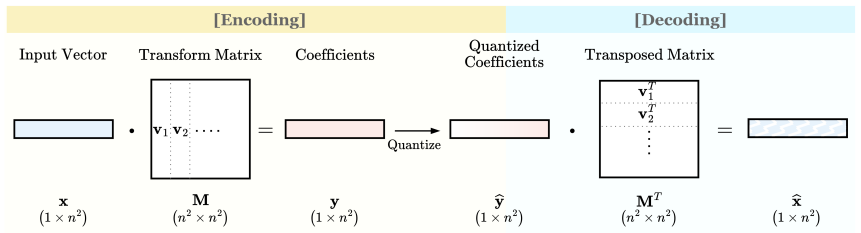
The load-bearing object is the $n^{2}$ by $n^{2}$ transform matrix M itself, treated as a one-layer linear network whose basis functions are applied as y = xM. Training uses additive uniform noise in place of hard rounding, a Gaussian entropy model to estimate coefficient rate, and variable-rate training where a small two-layer network predicts the quantization step-size Q from $\lambda$. Reconstruction uses the transpose M^T as the inverse, a choice the paper says enforces orthonormality. The mechanism that carries the argument is the Gaussian entropy model: replacing crude proxies like the l0 norm with a differentiable estimate of true coefficient entropy is what lets gradient descent find transforms that outperform KLT and SOT.
What would settle it
Retrain RDLT under the paper's setup and compute the orthogonality error ||M M^T - I|| plus the PSNR gap between reconstructing with M^T and with the numerically inverted M; a non-negligible gap would mean part of the reported RD gain is an artifact of using a non-inverse at the decoder.
Extended reading notes
Core claim
The central claim is that the rate-distortion-optimal linear transform is learnable and measurably better than the usual choices. The paper trains the transform matrix M by back-propagating through a differentiable proxy of quantization and minimizing L = D + lambda R, where the rate term is the negative log-likelihood of the quantized coefficients under a Gaussian entropy model with learnable per-coefficient means and variances. It reports about 12% BD-rate saving over the DCT and about 5% over SOT on residual blocks of sizes 8, 16, and 32, with gains appearing at each block size. It further reports that swapping RDLT for DCT inside the multi-transform selection loop of a VVC-like codec improves rate-distortion performance. The paper's intended significance is that accurate rate estimation, not just variance-based linear optimality, is what makes a linear transform effective in practical compression.
Load-bearing premise
The load-bearing premise is that the learned matrix stays close enough to orthonormal that using its transpose as the inverse reconstruction is valid, because the training loss only nudges M in that direction and the paper reports no orthogonality measure.
Editorial extensions
If this is right
- If RDLT's reported gains hold, replacing DCT with the learned matrix inside existing block codecs could yield around 12% BD-rate savings without changing the decoder's block-transform structure.
- The per-block-size results suggest the gains are not an artifact of one block size; separate 8x8, 16x16, and 32x32 transforms each beat DCT.
- The VVC-like MTS simulation implies RDLT can be added as one transform among several and chosen by rate-distortion optimization, rather than requiring a fixed single transform.
- The comparison with SOT indicates that a differentiable Gaussian rate model outperforms an l0-based rate proxy for learning linear transforms.
- Because the resulting transform is linear and intended to be invertible through orthonormality, integration into standards could be decoder-compatible.
Reading between the lines
- Inference: the reported gains are measured on HEVC intra residuals; extending RDLT to inter residuals or other prediction modes may require retraining, and the gain size is an open question.
- Inference: because orthonormality is only encouraged by using M^T, an explicit orthogonality constraint or post-training orthogonalization could make the gains reproducible in a real codec where the inverse must be exact.
- Inference: the method could be extended to a family of learned transforms, one per intra-prediction mode, along the lines of mode-dependent transforms, potentially compounding the RD gain.
- Inference: since the entropy model is trained jointly, one could also tune the quantizer step-size schedule with the transform rather than treating Q as an input, but the paper does not test this.
Editorial analysis
A structured set of objections, weighed in public.
Referee Report
Summary. The manuscript proposes RDLT, a linear block transform for residual blocks, trained end-to-end by minimizing a rate-distortion loss with a learned Gaussian entropy model and variable-rate training. The transform matrix M is applied as y = xM, quantization is modeled as uniform noise during training, and reconstruction uses M^T in Eq. (3). Experiments compare RDLT with DCT, KLT, and SOT on residual blocks of sizes 8, 16, and 32, using arithmetic coding on a held-out split; the authors report about 12% BD-rate saving over DCT and 5% over SOT, and also simulate integration of RDLT into a VVC-like MTS framework. The central claim is that a simple learned linear transform can substantially improve standard-compatible block transform coding.
Significance. If the reported gains hold under a standards-compliant inverse transform, this is a practically interesting result: it would show that a rudimentary linear transform trained with an RD objective and a modern entropy model can beat both the DCT and prior data-driven transforms such as KLT and SOT. The paper has genuine strengths: the rate term is evaluated with actual arithmetic coding rather than only the learned model, the code is promised to be public, and the comparison includes several relevant baselines. However, the central claim depends on the learned M being orthonormal, since Eq. (3) uses M^T as the inverse, and the currently reported experiments do not establish that property. The lack of image-disjoint evaluation and of any uncertainty quantification further weakens the strength of the reported performance margins.
major comments (3)
- [Proposed method / Learning procedure, Eqs. (1)-(3)]
- [Experiments / Experimental settings]
- [Experiments / Rate-distortion comparison, Table 1]
minor comments (5)
- [Learning procedure]
- [References]
- [Title/Abstract]
- [Additional investigation / MTS experiment]
- [Figure 5]
Circularity Check
No significant circularity; the performance claim rests on a held-out arithmetic-coding benchmark rather than the training objective.
full rationale
The paper's central claim—that RDLT yields around 12% BD-rate saving over DCT and 5% over SOT—is supported by a held-out evaluation in which rate is computed with arithmetic coding on quantized coefficients under the same protocol for all transforms. The Gaussian entropy model is used only as a differentiable training proxy for rate; it is not the quantity reported as the result. Training M to minimize the RD loss that also defines the evaluation metric is standard empirical optimization, not circularity, because the evaluation is performed on a held-out split and the arithmetic-coded rate is an external measurement independent of the learned entropy model's parameters. The paper's citations to prior end-to-end compression work [9,22] are external, and the authors' own GFT papers [18-20] appear only as related-work context, not as load-bearing justification for RDLT's design or performance. The orthonormality issue raised in the skeptic headline—using M^T as the inverse in Eq. (3) without an explicit orthonormality constraint—is a correctness and verification risk, not a circularity: it does not make the derivation reduce to its own inputs. No self-definitional, fitted-input-as-prediction, or self-citation-chain pattern is present, so the appropriate finding is no significant circularity.
Assumptions & free parameters
free parameters (3)
- Transform matrix M =
learned, n^4 entries per block size (n=8,16,32)
- Gaussian entropy model parameters (means and variances) =
2n^2 per block size, learned
- Q prediction network weights =
learned two-layer network
assumptions (5)
- domain assumption Residual blocks from HEVC intra prediction on mixed datasets are representative of residuals in practical image/video coding.
- domain assumption The Gaussian entropy model without hyperprior gives a rate estimate accurate enough to find a near-optimal transform.
- standard math Additive uniform noise approximates hard quantization during training.
- ad hoc to paper The learned transform matrix M is orthonormal, so M^T is a valid inverse.
- standard math Arithmetic coding achieves the entropy of the quantized coefficients.
Cite this review
Pith. "Pith review of Learning Optimal Linear Block Transform by Rate Distortion Minimization." pith.science (2026). https://pith.science/paper/IRLL7LI7
@misc{pith2026241118494,
  author       = {Pith},
  title        = {Pith review of: Learning Optimal Linear Block Transform by Rate Distortion Minimization},
  year         = {2026},
  howpublished = {\url{https://pith.science/paper/IRLL7LI7}},
  note         = {Machine review of arXiv:2411.18494}
}
read the original abstract
Linear block transform coding remains a fundamental component of image and video compression. Although the Discrete Cosine Transform (DCT) is widely employed in all current compression standards, its sub-optimality has sparked ongoing research into discovering more efficient alternative transforms even for fields where it represents a consolidated tool. In this paper, we introduce a novel linear block transform called the Rate Distortion Learned Transform (RDLT), a data-driven transform specifically designed to minimize the rate-distortion (RD) cost when approximating residual blocks. Our approach builds on the latest end-to-end learned compression frameworks, adopting back-propagation and stochastic gradient descent for optimization. However, unlike the nonlinear transforms used in variational autoencoder (VAE)-based methods, the goal is to create a simpler yet optimal linear block transform, ensuring practical integration into existing image and video compression standards. Differently from existing data-driven methods that design transforms based on sample covariance matrices, such as the Karhunen-Lo\`eve Transform (KLT), the proposed RDLT is directly optimized from an RD perspective. Experimental results show that this transform significantly outperforms the DCT or other existing data-driven transforms. Additionally, it is shown that when simulating the integration of our RDLT into a VVC-like image compression framework, the proposed transform brings substantial improvements. All the code used in our experiments has been made publicly available at [1].
Figures


Figures from the paper (3 more)


Reference graph
Works this paper leans on
-
[1]
Rate distortion learned transform,
“Rate distortion learned transform,” https://github.com/JoeK6279/Rate_ Distortion_Learned_Transform, Last accessed on 2024-10-11
work page 2024
-
[2]
V. Bhaskaran and K. Konstantinides, The H.261 Video Coding Standard, pp. 195–206, Springer US, Boston, MA, 1995
work page 1995
-
[3]
Intra coding of the HEVC standard,
J. Lainema, F. Bossen, W. J. Han, J. Min, and K. Ugur, “Intra coding of the HEVC standard,” IEEE Trans. on Circuits and Systems for Video Technology, vol. 22, no. 12, pp. 1792–1801, 2012
work page 2012
-
[4]
Overview of the versatile video coding (VVC) standard and its applications,
B. Bross, Y.-K. Wang, Y. Ye, S. Liu, J. Chen, G. J. Sullivan, and J.-R. Ohm, “Overview of the versatile video coding (VVC) standard and its applications,” IEEE Trans. on Circuits and Systems for Video Technology, vol. 31, no. 10, pp. 3736–3764, 2021
work page 2021
-
[5]
The JPEG still picture compression standard,
G. K. Wallace, “The JPEG still picture compression standard,” IEEE Trans. on Consumer Electronics, vol. 38, no. 1, pp. xviii–xxxiv, 1992
work page 1992
-
[6]
“BPG Image format,” https://bellard.org/bpg/, Last accessed on 2022-11-15
work page 2022
-
[7]
N. Ahmed and K. R. Rao, Orthogonal Transforms for Digital Signal Processing, Springer-Verlag, Berlin, 1975
work page 1975
-
[8]
Auto-encoding variational bayes,
Diederik P Kingma and Max Welling, “Auto-encoding variational bayes,” 2022
2022
Show all 24 references
-
[9]
End-to-end optimized image compression,
Johannes Ball´ e, Valero Laparra, and Eero P. Simoncelli, “End-to-end optimized image compression,” 2017
2017
-
[10]
Video coding with rate-distortion op- timized transform,
Xin Zhao, Li Zhang, Siwei Ma, and Wen Gao, “Video coding with rate-distortion op- timized transform,” IEEE transactions on Circuits and Systems for Video Technology, vol. 22, no. 1, pp. 138–151, 2011
2011
-
[11]
Improved H.264 intra coding based on bi-directional intra prediction, directional transform, and adaptive coefficient scanning,
Yan Ye and Marta Karczewicz, “Improved H.264 intra coding based on bi-directional intra prediction, directional transform, and adaptive coefficient scanning,” in 2008 15th IEEE International Conference on Image Processing. IEEE, 2008, pp. 2116–2119
2008
-
[12]
On intra coding using mode dependent 2D- KLT,
Seishi Takamura and Atsushi Shimizu, “On intra coding using mode dependent 2D- KLT,” in 2013 Picture Coding Symposium (PCS). IEEE, 2013, pp. 137–140
2013
-
[13]
Non-separable mode dependent transforms for intra coding in HEVC,
Adri` a Arrufat, Pierrick Philippe, and Oliver D´ eforges, “Non-separable mode dependent transforms for intra coding in HEVC,” in 2014 IEEE Visual Communications and Image Processing Conference. IEEE, 2014, pp. 61–64
2014
-
[14]
Graph signal processing: Overview, challenges, and applications,
A. Ortega, P. Frossard, J. Kovaˇ cevi´ c, J. M. F. Moura, and P. Vandergheynst, “Graph signal processing: Overview, challenges, and applications,” Proceedings of the IEEE, vol. 106, no. 5, pp. 808–828, May 2018
2018
-
[15]
Graph transform optimiza- tion with application to image compression,
Giulia Fracastoro, Dorina Thanou, and Pascal Frossard, “Graph transform optimiza- tion with application to image compression,” IEEE Transactions on Image Processing, vol. 29, pp. 419–432, 2019
2019
-
[16]
Multiresolution graph Fourier transform for compression of piecewise smooth images,
Wei Hu, Gene Cheung, Antonio Ortega, and Oscar C. Au, “Multiresolution graph Fourier transform for compression of piecewise smooth images,” IEEE Transactions on Image Processing, vol. 24, no. 1, pp. 419–433, 2015
2015
-
[17]
Graph-based transforms for video coding,
Hilmi E. Egilmez, Yung-Hsuan Chao, and Antonio Ortega, “Graph-based transforms for video coding,” IEEE Transactions on Image Processing, vol. 29, 2020
2020
-
[18]
Symmetry-based graph Fourier transforms for image representation,
Alessandro Gnutti, Fabrizio Guerrini, Riccardo Leonardi, and Antonio Ortega, “Symmetry-based graph Fourier transforms for image representation,” in IEEE Inter- national Conference on Image Processing, 2018, pp. 2575–2579
2018
-
[19]
Cod- ing of image intra prediction residuals using symmetric graphs,
Alessandro Gnutti, Fabrizio Guerrini, Riccardo Leonardi, and Antonio Ortega, “Cod- ing of image intra prediction residuals using symmetric graphs,” in IEEE International Conference on Image Processing, 2019, pp. 131–135
2019
-
[20]
Symmetry-based graph Fourier transforms: Are they optimal for image compres- sion?,
Alessandro Gnutti, Fabrizio Guerrini, Riccardo Leonardi, and Antonio Ortega, “Symmetry-based graph Fourier transforms: Are they optimal for image compres- sion?,” in IEEE International Conference on Image Processing, 2021, pp. 1594–1598
2021
-
[21]
Approximation and compression with sparse orthonormal transforms,
Osman Gokhan Sezer, Onur G. Guleryuz, and Yucel Altunbasak, “Approximation and compression with sparse orthonormal transforms,” IEEE Transactions on Image Processing, vol. 24, no. 8, pp. 2328–2343, 2015
2015
-
[22]
Variational image compression with a scale hyperprior,
Johannes Ball´ e, David Minnen, Saurabh Singh, Sung Jin Hwang, and Nick Johnston, “Variational image compression with a scale hyperprior,” in International Conference on Learning Representations, 2018
2018
-
[23]
Imagenet: A large-scale hierarchical image database,
Jia Deng, Wei Dong, Richard Socher, Li-Jia Li, Kai Li, and Li Fei-Fei, “Imagenet: A large-scale hierarchical image database,” in 2009 IEEE conference on computer vision and pattern recognition. Ieee, 2009, pp. 248–255
2009
-
[24]
The USC-SIPI image database,
“The USC-SIPI image database,” http://sipi.usc.edu/database/
Reviewed August 12, 2026 · model on record in the stance chip above.
Discussion (0). Continue with ORCID to comment.