REVIEW 5 major objections 5 minor 85 references
Spin liquid properties of the kagome material Cu$_3$(HOTP)$_2$
T0 review · 5 major / 5 minor · reviewed 2026-08-12 · deepseek-v4-flash
Pith's one-line read Muon spin relaxation shows Cu3(HOTP)2 is a gapless kagome quantum spin liquid down to 50 mK.
desk verdict The no-ordering result and the clean kagome platform are solid; the entanglement, Dirac-model, and dimensional-reduction conclusions are model-dependent and need less confidence. read the letter →
The pith
A machine-rendered reading of the paper's core claim, the machinery that carries it, and where it could break.
The reading
What carries the argument
The central object is the 2D spin-diffusion spectral density J2D(ω), the Fourier transform of S2D(t) = [exp(−2D2D t) I0(2D2D t)]^2, which enters the muon relaxation rate as λ(B) = ($A^{2}$/4) J2D(γ_e B_LF). Fitting this formula to the field dependence of the relaxation rate yields the in-layer spin diffusion rate D2D and the effective hyperfine scaling $A^{2}$. From D2D the paper derives the mean free path through D2D = v/(2l), identifies it with an entanglement length, and independently estimates entanglement from the quantum Fisher information FQ built from the same spectral density. DFT+U broken-symmetry calculations provide the intra-layer exchange and interlayer coupling, while a model of electrostatically frustrated slip stacking explains the disordered stacking that turns the ordered metallic band structure into the observed 2D semiconductor.
What would settle it
Measure the muon hyperfine coupling directly versus temperature, for example via avoided level-crossing resonance on the same powder; a temperature-dependent A would invalidate the localized-fraction and entanglement-length interpretation. Separately, high-resolution inelastic neutron scattering that resolves a spin gap above about 0.02 J would rule out the claimed gapless Z2-linear Dirac spectrum.
Extended reading notes
Core claim
The central claim is that the kagome layers of Cu3(HOTP)2 host a gapless Z2-linear Dirac quantum spin liquid and that muon spin relaxation can see both its diffusive spin dynamics and its entanglement. The evidence is a chain: zero-field and longitudinal-field muon data show no static order to 50 mK; the relaxation rate versus field follows the 2D spin-diffusion spectral density J2D(ω), not a 1D power law; the fitted diffusion rate D2D is nearly constant below about J/kB = 2.6 K and increases about threefold in the paramagnetic regime; and the effective squared hyperfine coupling falls to about 2/3 of its high-temperature value, which the authors interpret as localization of one-third of the spin excitations. When the muon exponent nD = 0.03 is combined with the reported susceptibility exponent nχ = −0.31 and specific heat exponent nC = 0.52, spinon Fermi surface, quadratic, and quartic spinon models are excluded, while linearly dispersing spinons with correlation-length exponent ν = 0.673(7) plus quadratic singlet (vison-like) excitations reproduce all three. The paper further estimates that the effective interlayer coupling drops by roughly two orders of magnitude at low temperature, attributing this dimensional reduction to quantum entanglement reducing the number of unentangled spins available for interlayer exchange.
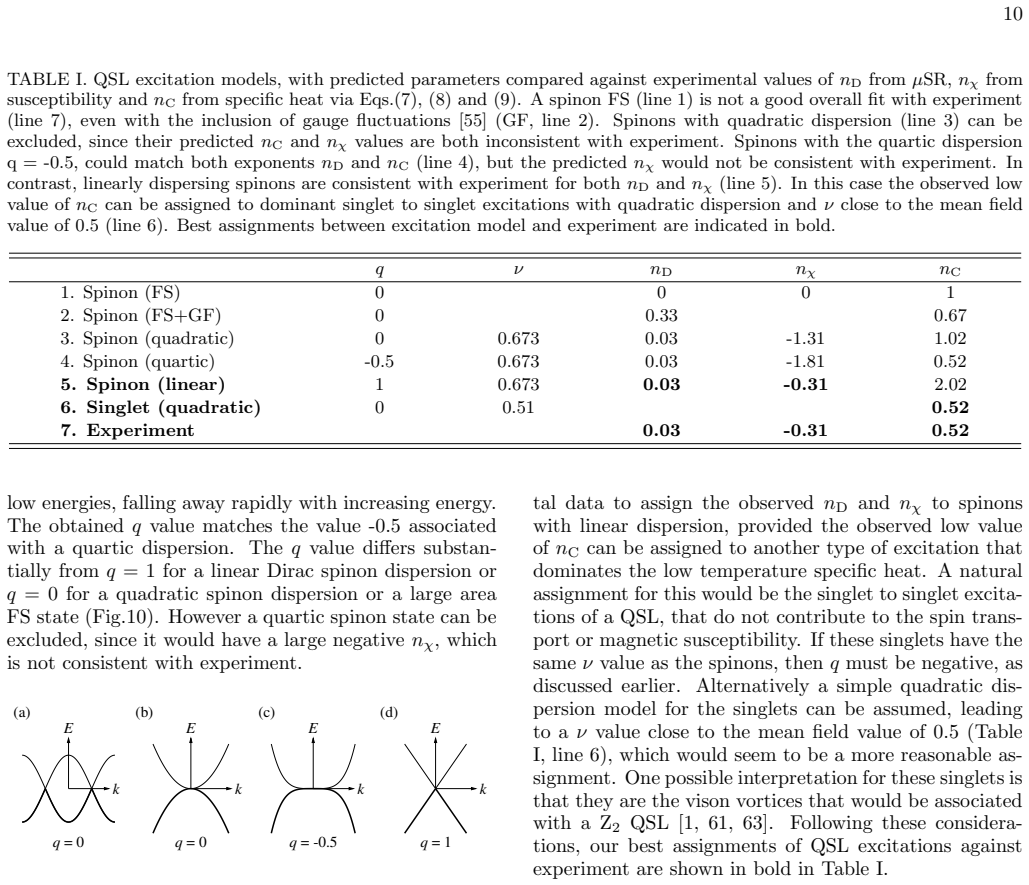
Load-bearing premise
The analysis assumes the muon's effective hyperfine coupling A is temperature-independent, so the measured drop in $A^{2}$ at low temperature can be assigned entirely to a reduced fraction of diffusive spin excitations; if A itself changed with temperature, or the muon site shifted, the localized fraction and entanglement-length estimates would not follow.
Editorial extensions
If this is right
- Cu3(HOTP)2 becomes a benchmark kagome quantum spin liquid: the interlayer magnetic coupling is tiny, the exchange scale J ≈ 2 K puts both the quantum and classical regimes within reach of a single experiment, and there are no interlayer metal sites to create the defect spins that complicate herbertsmithite.
- The three measured exponents nD = 0.03, nχ = −0.31, and nC = 0.52 form a combined constraint that any proposed kagome QSL model must satisfy, and they already exclude Fermi-surface, quadratic, and quartic spinon dispersions.
- If the low-temperature interlayer decoupling is real, it implies that quantum entanglement itself can suppress interlayer magnetic exchange, giving a dimensional-reduction mechanism in a layered QSL analogous to that found near quantum critical points in dimer systems.
- The electrostatic frustration model for layer stacking predicts intrinsically disordered, non-periodic stacking in this MOF family, linking the structural disorder to the measured semiconducting rather than metallic transport.
- The upper bound on the spin gap of roughly 0.02 J places this material among the gapless or nearly gapless kagome candidates, sharpening the experimental distinction between gapped and gapless QSL scenarios.
Reading between the lines
- If the Z2-linear Dirac assignment is correct, the vison (singlet) sector should show up in thermal transport or a thermal Hall signal at temperatures below roughly J/kB; this is a testable prediction the paper does not make.
- The same muon-based inversion from J2D(ω) to D2D and FQ could be applied to other layered kagome MOFs with tunable J, turning the entanglement metric into a systematic probe of how frustration, layer spacing, and stacking disorder shape spin-liquid behavior.
- A single-crystal or aligned-film muon measurement could test whether part of the low-field Lorentzian component assigned to localized excitations is actually a powder-averaging artifact of the 2D spectral density.
- Controlling the stacking slip angle, for example by intercalation or applied pressure, could tune the interlayer decoupling and thereby provide a direct test of the entanglement-based explanation of dimensional reduction.
Editorial analysis
A structured set of objections, weighed in public.
Referee Report
Summary. The paper presents muon spin relaxation (muSR), DFT+U, and modelling results for the kagome metal-organic framework Cu3(HOTP)2. The authors report the absence of magnetic ordering down to 50 mK, interpret the longitudinal-field relaxation in terms of a 2D spin-diffusion spectral density, and extract a temperature-dependent diffusion rate D2D and an effective hyperfine coupling A^2. From these they infer a classical-quantum crossover, a localized fraction of excitations at low temperature, a dimensional reduction of interlayer coupling, and an entanglement length via the quantum Fisher information. Combining these with literature specific-heat and susceptibility exponents, they argue that a Z2-linear Dirac QSL model with additional singlet excitations provides the best match to experiment.
Significance. The no-ordering result is robust and the compound is a clean candidate kagome QSL with a conveniently small exchange scale J ~ 2 K; the muon data are deposited and the material is of clear interest to the frustrated-magnetism community. The paper also proposes a relatively new route to estimating entanglement from muSR. However, the quantitative claims about localized excitations, entanglement growth, and QSL model selection all depend on the unvalidated assumption that the relaxation is described by the specific 2D-diffusion spectral density of Eq. (1) with a temperature-independent hyperfine coupling. If that identification is wrong, most of the quantitative results lose their foundation. The paper is therefore a useful experimental contribution but its central interpretive claims require substantial additional support.
major comments (5)
- [III C 2, Eq. (2) and Fig. 7] The identification of the spectral density as 2D spin diffusion is load-bearing for the rest of the paper, but it is supported only by visual comparison. No residuals, chi-squared values, or information criteria are reported, and the competing 1D power law is dismissed as 'much poorer' without quantitative support. A Lorentzian, stretched-exponential, or a two-component 2D+localized spectrum could in principle reproduce the same field dependence within noise; if so, D2D(T) and A^2(T) in Fig. 8 are not uniquely determined. The authors should report goodness-of-fit statistics and explicitly test alternative spectral shapes before using D2D and A^2 in the subsequent analysis.
- [III C 5, Fig. 8(b)] The drop of the effective A^2 to about 2/3 of its high-temperature value is assigned to a reduced diffusive fraction, based on the statement 'We do not expect strong T dependence in A'. This is an assumption, not a demonstrated result. A temperature-dependent muon site population or hyperfine tensor would produce the same A^2 drop without any localized spin excitations. The later interpretation of a low-field Lorentzian component as localized excitations therefore also rests on this assumption. The authors should either provide independent evidence for a temperature-independent A or quantify the systematic uncertainty this introduces.
- [III C 6, Eq. (6)] The quantum Fisher information FQ is computed from the same spectral density J2D(ω) that was fitted to the muon relaxation rates in Eq. (2). The observation that FQ follows the universal T^-3/4 law is therefore not an independent test of the theoretical prediction; it is a consequence of the fitted spectral shape. The paper should explicitly state that the T^-3/4 agreement is a model-based consistency check, not an independent validation, and should present the comparison with that caveat.
- [III A 3, Fig. 3(b)] The DFT+U calculation of J is tuned by varying U until the calculated J matches the experimental value of 2 K. The agreement is therefore a fit, not a first-principles prediction. The paper should show the full J(U) dependence with the experimental uncertainty and justify that the chosen U values are within the expected accuracy of DFT+U for this system. As written, the statement that the experimental J is 'matched for reasonable values of U' overstates the predictive content.
- [IV A 1, Table I] The model selection in Table I combines the muon-derived exponent nD with the literature exponents nχ and nC via the scaling relations of Eqs. (7)-(9). Since nD is extracted from the model-dependent D2D(T), and nχ and nC come from a different experiment, the conclusion favouring a Z2-linear Dirac QSL is only as strong as the weakest of these inputs. If the 2D-diffusion identification is not secured, the exclusion of spinon-Fermi-surface and quartic-dispersion models in Table I is premature. The discussion should be softened to reflect this dependence.
minor comments (5)
- [IV B] There is a typo: 'orgin' should be 'origin'.
- [III C 4] There is a typo: 'fittted' should be 'fitted'.
- [III C 2, Fig. 7] The 'power law fit' in Fig. 7 is not defined; the exponent and functional form should be stated in the caption or text.
- [II C] The estimate of the hyperfine coupling A0 uses a single model molecule and one muon site. The uncertainty in A0 should be discussed, since A0 is used as the reference for fdiff in Fig. 8(b).
- [IV A 2] The term 'Z2-linear Dirac state' is used without a definition of the spinon dispersion or a discussion of how it differs from the U(1) Dirac state in the present context; a brief explanation would improve accessibility.
Circularity Check
Several 'independent' confirmations reuse the same fitted 2D-diffusion spectral density; the DFT+U J match is tuned by scanning U.
-
self definitional
[Sec. III C 6, Eq. (6), Fig. 9]
"Another way of quantifying the entanglement is to use the quantum Fisher information metric FQ [58, 59], defined here in terms of the spectral density ... The T-dependences of the normalised ξE values calculated via FQ and D2D are compared in Fig.9(b). Both increase approximately threefold in the quantum region compared to the classical region."
FQ in Eq. (6) is an integral of J(ω), and the only J(ω) used in the paper is J2D(ω), the spectral density fitted to the LF-µSR relaxation rates via Eq. (2). The other estimate, ξE from D2D, uses the D2D parameter extracted from the same fit. Consequently the agreement between the two ξE curves in Fig. 9(b) is not an independent confirmation: both curves are functionals of the same two-parameter fit (D2D, A2). The 'universal T^{-3/4}' comparison is likewise applied to FQ built from this fitted J2D, so it validates the fitted model rather than a separately measured entanglement witness.
-
fitted input called prediction
[Sec. III A 3, Fig. 3(b)]
"In these calculations we explored the effect of using different Hubbard U values until we reached convergence with the experimental value of J/kB = 2 K, Fig.3(b)."
The abstract claims the DFT+U intra-layer J 'is shown to match' experiment, but the DFT+U calculation was iterated in U until the computed J matched the experimental 2 K. The agreement is therefore a tuning result, not a parameter-free first-principles prediction. Because this same J scale is later used to interpret D2D(T) (Eq. (3) fit gives J/kB = 2.6(4) K) and to assign the quantum/classical crossover, the 'match' is partly built into the calculation.
1 more flagged steps
-
renaming known result
[Sec. III C 5, Fig. 8(b)]
"We do not expect strong T dependence in A, so this drop in effective scaling factor is assigned to a reduced fraction of diffusive excitations in the overall spectral density, i.e. fdiff = A2/A20. The low temperature missing fraction in the spectral density is assigned to a significant fraction of low frequency localized excitations floc = 1 − fdiff ..."
floc is defined as 1 − A2/A20, where A2 is the amplitude parameter fitted in Eq. (2). The conclusion that 'one third of the excitations localize' is thus a re-labeling of the fitted A2 drop, made possible only by the untested assumption that A itself is temperature-independent. No independent measurement of localized excitations is presented; the localized fraction is the fitted amplitude ratio under a new name.
full rationale
The robust part of the paper is the ZF-µSR demonstration of no magnetic ordering down to 50 mK, which does not rely on a fitted model and is not circular. The central quantitative chain, however, is partially circular: the J2D(ω) spectral density in Eq. (1) is fitted to LF-µSR λ(B) data via Eq. (2), and then the same fitted J2D is inserted into Eq. (6) to compute FQ, while the same fitted D2D is used for the 'independent' ξE estimate; the agreement in Fig. 9(b) is therefore not an independent check. The T^{-3/4} comparison is a check of the fitted model rather than of a directly measured entanglement witness. The localized fraction floc is defined as 1−A2/A20, so the claim that 1/3 of excitations localize is a re-labeling of the fitted amplitude drop under an untested T-independence assumption. The DFT+U J value is matched to experiment by scanning U, so the 'match' in the abstract is a tuning result rather than a parameter-free prediction. These issues do not invalidate the no-ordering result or the raw data quality, but they reduce the apparent number of independent validations.
Assumptions & free parameters
free parameters (8)
- Hubbard U(Cu) =
7.3 eV
- Hubbard U(C,O) =
4 eV
- D0 (2D spin diffusion amplitude) =
53(4) x 10^9 s^-1
- n (power law exponent) =
0.03(3)
- D1 (activated amplitude) =
103(11) x 10^9 s^-1
- J/kB from D2D(T) =
2.6(4) K
- A0 (hyperfine coupling in PM regime) =
135(3) MHz
- Localized fluctuation rate =
80 MHz at 50 mK
assumptions (6)
- domain assumption The spin autocorrelation function for a 2D spin diffusion process has the form S2D(t) = [exp(-2D2Dt) I0(2D2Dt)]^2 (Eq. 1).
- domain assumption The hyperfine coupling A between the muon and the spin system is temperature independent (Section III C 5).
- domain assumption The relationship D2D = v/(2l) and the identification of l with the entanglement length (Eqs. 4-5).
- domain assumption The scaling relations nD = 3 - 2/ν, nχ = q - (2-η)ν, nC = q - 1 + 3ν (Eqs. 7-9).
- domain assumption The muon is assumed to probe a single contact hyperfine interaction with one spin site (Eq. 2).
- domain assumption The electrostatic model of layer stacking with 12 discrete slip directions is a valid representation of the interlayer interactions (Section III B).
Cite this review
Pith. "Pith review of Spin liquid properties of the kagome material Cu$_3$(HOTP)$_2$." pith.science (2026). https://pith.science/paper/XSD6BHBV
@misc{pith2026241118518,
  author       = {Pith},
  title        = {Pith review of: Spin liquid properties of the kagome material Cu$_3$(HOTP)$_2$},
  year         = {2026},
  howpublished = {\url{https://pith.science/paper/XSD6BHBV}},
  note         = {Machine review of arXiv:2411.18518}
}
abstract
The metal-organic-framework (MOF) compound Cu$_3$(HOTP)$_2$, a.k.a. Cu$_3$(HHTP)$_2$, is a small-gap semiconductor containing a kagome lattice of antiferromagnetically coupled $S$=1/2 Cu$^\mathrm{II}$ spins with intra-layer nearest-neighbor exchange coupling $J \sim $ 2 K. The intra-layer $J$ value obtained from DFT+U calculations is shown to match with the experimental value for reasonable values of U. Muon spin relaxation confirms no magnetic ordering down to 50~mK and sees spin fluctuations diffusing on a 2D lattice, consistent with a quantum spin liquid (QSL) ground state being present within highly decoupled kagome layers. Reduction of the spin diffusion rate on cooling from the paramagnetic region to the low-temperature QSL region reflects quantum entanglement. It is also found that the layers become more strongly decoupled in the low-temperature QSL region. Comparison of results for the spin diffusion, magnetic susceptibility and specific heat in the QSL region suggests close proximity to a quantum critical point and a large density of low energy spinless electronic excitations. A Z$_2$-linear Dirac model for the spin excitations of the QSL is found to provide the best match with experiment.
Figures


Figures from the paper (9 more)




Reference graph
Works this paper leans on
-
[1]
Based on this slipped arrange- ment, it was suggested that an ordered structure could have an alternating form [28]
Slipped versus eclipsed stacking As noted in section I, the stacking of successive layers has been suggested to show a small displacement paral- lel to the layer planes. Based on this slipped arrange- ment, it was suggested that an ordered structure could have an alternating form [28]. We first confirm this dis- placement via first principles calculations...
-
[2]
This is caused by the frustrated spin arrangement of the magnetic moments of the Cu 2+ atoms on the kagome lattice structure
Magnetic ground state Our spin-polarized DFT+U calculations elucidate the magnetic properties of Cu 3(HOTP)2, confirming the S = 1/2 magnetic ground state. This is caused by the frustrated spin arrangement of the magnetic moments of the Cu 2+ atoms on the kagome lattice structure. Fig- ure 3(a) reveals that the spin density of the system is mainly located...
-
[3]
This broken symmetry method has been shown to generate ac- curate results for other trinuclear Cu systems [42–46]
Magnetic exchange coupling We followed a systematic broken symmetry approach to calculate the magnetic exchange couplingJ, which can be estimated from the difference in energy of the possi- ble spin configurations as 2 J = ES=1/2 − ES=3/2. This broken symmetry method has been shown to generate ac- curate results for other trinuclear Cu systems [42–46]. In...
-
[4]
How- ever, theory for ordered structures usually predicts a metallic ground state for this type of lattice [47]
Electronic properties of ordered stacking models Experimentally Cu3(HOTP)2 and similar kagome sys- tems are shown to behave as semiconductors [28]. How- ever, theory for ordered structures usually predicts a metallic ground state for this type of lattice [47]. For Cu3(HOTP)2, the calculated band structure assuming a regular crystal formed on the basis of ...
-
[5]
Origin of the semiconducting properties Since the experimental results indicate a highly 2D semiconducting state, rather than a quasi-1D metallic state, there is clearly a major inconsistency between these theoretical calculations for simple regular stacking sce- narios and experiment. This issue has been widely dis- cussed, reaching the conclusion that t...
-
[6]
Quantum entanglement The 2D diffusion rate D2D is related to the diffusion constant, D, the spinon velocity, v, momentum relax- ation time, τ , and the hopping distance or mean free path, l = vτ , via D = 1 2 v2τ = 1 2 vl = D2Dl2, (4) so that D2D = v 2l = 1 2τ . (5) 9 0.3 1 3 FQ 0.42 N (kBT/J ) ( N = 4) -3/4 Quantum Classical J/ kB (a) 1 2 3 E / 0 0.1 1 1...
-
[7]
ZF and LF µSR data Examples of ZF and LF µSR data for Cu3(HOTP)2 are shown in Fig.7(a). No evidence for magnetic ordering is found in our studies taken down to 50 mK, consistent with the 38 mK upper limit for ordering reported earlier [29]. The ZF relaxation shows primarily a Kubo-Toyabe form at all temperatures, reflecting a dominant contri- bution from ...
-
[8]
The corresponding spectral density J2D(ω) is then given by the Fourier transform of S2D(t)
2D spin diffusion For spins diffusing in a 2D layer, the spin autocorrela- tion function S2D(t) reflects a random walk process de- scribing the propagating spin excitations that takes the form [56] S2D(t) = [exp(−2D2Dt)I0(2D2Dt)]2, (1) where I0 is a Bessel function and D2D is the diffusion rate in the layer. The corresponding spectral density J2D(ω) is th...
Show all 85 references
-
[9]
At 25 K the ratio D2D/D⊥ is then estimated to be 1.0(4)×102 and at 50 mK the lower limit for the ratio is estimated to be 10 4
Interlayer coupling The 2D model can be extended to allow for the ef- fects of slow spin diffusion in the interlayer direction D⊥. At 25 K the ratio D2D/D⊥ is then estimated to be 1.0(4)×102 and at 50 mK the lower limit for the ratio is estimated to be 10 4. This gives an expe...
-
[10]
From Fig.8(a) it can be seen that the diffusion rate is almost constant in the QSL region where T ≪ J/kB and in- creases by about a factor of three in the PM region where T ≫ J/kb
Quantum to classical crossover The T dependence of the fitted parameters obtained from the 2D diffusion model is shown in Fig.8. From Fig.8(a) it can be seen that the diffusion rate is almost constant in the QSL region where T ≪ J/kB and in- creases by about a factor of three ...
-
[11]
Localized states The normalised T dependence of the A2 coupling fac- tor in Eq.(2) is shown in Fig.8(b). In the paramagnetic region (T ≫ J/kB), the value of A is found to be A0 = 135(3) MHz, consistent with the size of hyperfine cou- pling expected in a muoniated molecular rad...
-
[12]
The spectral region for finding these localised excitations is below 0.02 T
The low temperature missing fraction in the spectral density is as- signed to a significant fraction of low frequency localized excitations floc = 1 − fdiff that is suggested to emerge in the QSL region of Fig.8(b). The spectral region for finding these localised excitations i...
-
[13]
Hermele, Y
M. Hermele, Y. Ran, P. A. Lee and X.-G. Wen. Properties of an algebraic spin liquid on the kagome lattice. Phys. Rev. B 77, 224413 (2008)
2008
-
[14]
This might be taken to indicate only weak QC fluc- tuations here
Power laws and critical exponents The weak T -dependence of D2D in the QSL region con- trasts with the power law dependence reflecting quan- tum critical (QC) fluctuations that was recently found in D2D for the triangular lattice QSL system 1T-TaS 2 [54]. This might be taken t...
-
[15]
Spinon (FS+GF) 0 0.33 0.67
-
[16]
Spinon (quadratic) 0 0.673 0.03 -1.31 1.02
-
[17]
Spinon (quartic) -0.5 0.673 0.03 -1.81 0.52
-
[18]
Spinon (linear) 1 0.673 0.03 -0.31 2.02
-
[19]
Singlet (quadratic) 0 0.51 0.52
-
[20]
The obtained q value matches the value -0.5 associated with a quartic dispersion
Experiment 0.03 -0.31 0.52 low energies, falling away rapidly with increasing energy. The obtained q value matches the value -0.5 associated with a quartic dispersion. The q value differs substan- tially from q = 1 for a linear Dirac spinon dispersion or q = 0 for a quadratic ...
-
[21]
Mar ´ ıa de Maeztu
Comparison with models The properties of various QSL excitation models are compared with the measured exponents in Table I. As we have noted, spinon FS and quartic spinon models give a poor match with experiment. A quadratic spinon dis- persion can also be excluded, since both...
2018
-
[22]
Y. Zhou, K. Kanoda and T.-K. Ng, Quantum spin liquid states. Rev. Mod. Phys. 89, 025003 (2017)
2017
-
[23]
Savary and L
L. Savary and L. Balents, Quantum spin liquids: a re- view. Rep. Prog. Phys. 80, 016502 (2017)
2017
-
[24]
Waldtmann, H.-U
Ch. Waldtmann, H.-U. Everts, B. Bernu, C. Lhuillier, P. Sindzingre, P. Lecheminant and L. Pierre. First ex- citations of the spin 1/2 Heisenberg antiferromagnet on the kagom´ e lattice. Eur. Phys. J. B2, 501 (1998)
1998
-
[25]
Nakano and T
H. Nakano and T. Sakai. Density Matrix Renormalization Group Numerical Study of the Kagome Antiferromagnet. J. Phys. Soc. Jpn. 80, 053704 (2011)
2011
-
[26]
H. C. Jiang, Z. Y. Weng and D. N. Sheng. Numerical- Diagonalization Study of Spin Gap Issue of the Kagome Lattice Heisenberg Antiferromagnet. Phys. Rev. Lett. 101, 117203 (2008)
2008
-
[27]
S. Yan, D. A. Huse and S. R. White. Spin-Liquid Ground State of the S = 1/2 Kagome Heisenberg Antiferromag- net. Science 332, 1173 (2011)
2011
-
[28]
Deppenbrock, I
S. Deppenbrock, I. P. McCulloch and U. Schollw¨ ock. Na- ture of the Spin-Liquid Ground State of the S = 1/2 Heisenberg Model on the Kagome Lattice. Phys. Rev. Lett. 109, 067201 (2012)
2012
-
[29]
Nishimoto, N
S. Nishimoto, N. Shibata and C. Hotta. Controlling frus- trated liquids and solids with an applied field in a kagome Heisenberg antiferromagnet. Nature Commun. 4, 2287 (2013)
2013
-
[30]
Y.-C. He, M. P. Zaletel, M. Oshikawa and F. Poll- mann. Signatures of Dirac Cones in a DMRG Study of the Kagome Heisenberg Model. Phys. Rev. X 7, 031020 (2017)
2017
-
[31]
Zhu, S.-S
W. Zhu, S.-S. Gong and D. N. Shen. Identifying spinon excitations from dynamic structure factor of spin-1/2 Heisenberg antiferromagnet on the Kagome lattice. Proc. Nat. Acad. Sci. 116, 5437 (2019)
2019
-
[32]
Sun, H.-K
R.-Y. Sun, H.-K. Jin, H.-H. Tu and Y. Zhou. Possible chiral spin liquid state in the S=1/2 kagome Heisenberg model. npj Quantum Materials 9 16 (2024)
2024
-
[33]
Y. Ran, M. Hermele, P. A. Lee and X.-G. Wen. Projected-Wave-Function Study of the Spin-1/2 Heisen- berg Model on the Kagom´ e Lattice. Phys. Rev. Lett.98, 117205 (2007)
2007
-
[34]
S. L. Dudarev, G. A. Botton, S. Y. Savrasov, C. J. Humphreys and A. P. Sutton. Electron-Energy-Loss Spectra and the Structural Stability of Nickel Oxide: An LSDA+U Study. Phys. Rev. B 57, 1505 (1998)
1998
-
[35]
Iqbal, F
Y. Iqbal, F. Becca, S. Sorella and D. Poilblanc. Gapless spin-liquid phase in the kagome spin-1/2 Heisenberg an- tiferromagnet. Phys. Rev. B 87, 060405(R) (2013)
2013
-
[36]
Iqbal, D
Y. Iqbal, D. Poilblanc and F. Becca. Vanishing spin gap in a competing spin-liquid phase in the kagome Heisenberg antiferromagnet. Phys. Rev. B 89, 020407(R) (2014)
2014
-
[37]
Zhang and T
C. Zhang and T. Li. Variational study of the ground state and spin dynamics of the spin-1/2 kagome antifer- romagnetic Heisenberg model and its implication for her- bertsmithite ZnCu3(OH)6Cl2. Phys. Rev. B 102, 195106 (2020)
2020
-
[38]
H. J. Liao, Z. Y. Xie, J. Chen, Z. Y. Liu, H. D. Xie, R. Z. Huang, B. Normand and T. Xiang. Gapless Spin-Liquid Ground State in the S=1/2 Kagome Antiferromagnet. Phys. Rev. Lett. 118, 137202 (2017)
2017
-
[39]
Mei, J.-Y
J.-W. Mei, J.-Y. Chen, H. He and X.-G. Wen. Gapped spin liquid with Z 2 topological order for the kagome Heisenberg model. Phys. Rev. B 95, 235107 (2017)
2017
-
[40]
Hering, J
M. Hering, J. Sonnenschein, Y. Iqbal and J. Reuther. Characterization of quantum spin liquids and their spinon band structures via functional renormalization. Phys. Rev. B 99, 100405 (2019)
2019
-
[41]
M. P. Shores, E. A. Nytko, B. M. Bartlett and D. G. Nocera. A Structurally Perfect S = 1/2 Kagom´ e Antifer- romagnet. J. Am. Chem. Soc. 127, 13462 (2005)
2005
-
[42]
M. R. Norman. Colloquium: Herbertsmithite and the search for the quantum spin liquid. Rev. Mod. Phys. 88, 041002 (2016)
2016
-
[43]
T.-H. Han, J. S. Helton, J. S. Chu, D. G. Nocera, J. A. Rodriguez-Rivera, C. Broholm and Y. S. Lee. Fraction- alized excitations in the spin-liquid state of a kagome- lattice antiferromagnet. Nature 492, 406 (2012)
2012
-
[44]
M. Fu, T. Imai, T. H. Han and Y. S. Lee. Evidence for a gapped spin-liquid ground state in a kagome Heisenberg antiferromagnet. Science 350, 655 (2015)
2015
-
[45]
Khuntia, M
P. Khuntia, M. Velazquez, Q. Barth´ elemy, F. Bert, E. Kermarrec, A. Legros, B. Bernu, L. Messio, A. Zorko and P. Mendels. Gapless ground state in the archetypal quantum kagome antiferromagnet ZnCu 3(OH)6Cl2. Na- ture Phys. 16, 469 (2020). 13
2020
-
[46]
Hmadeh, Z
M. Hmadeh, Z. Lu, Z. Liu, F. G´ andara, H. Furukawa, S. Wan, V. Augustyn, R. Chang, L. Liao, F. Zhou, E. Perre, V. Ozolins, K. Suenaga, X. Duan, B. Dunn, Y. Yamamoto, O. Terasaki and O. M. Yaghi. New Porous Crystals of Extended Metal-Catecholates. Chem. Mater. 24, 3511 (2012)
2012
-
[47]
L. Yang, X. He and M. Dincˇ a. Triphenylene-Bridged Trinuclear Complexes of Cu: Models for Spin Interac- tions in Two-Dimensional Electrically Conductive Metal- Organic Frameworks. J. Am. Chem. Soc. 141, 10475 (2019)
2019
-
[48]
The same material is called Cu 3(HHTP)2 in some of the literature. We however prefer to use Cu 3(HOTP)2, which reflects the deprotonated molecular structure of the HOTP molecule in the compound, in contrast to the original fully protonated HHTP molecule
-
[49]
Rubio-Gim´ enez, M
V. Rubio-Gim´ enez, M. Galbiati, J. Castells-Gil, N. Almora-Barrios, J. Navarro-S´ anchez, G. Escorcia-Ariza, M. Mattera, T. Arnold, J. Rawle, S. Tatay, E. Coronado and C. Mart ´ ı-Gastaldo. Bottom-Up Fabrication of Semi- conductive Metal–Organic Framework Ultrathin Films. Adv...
2018
-
[50]
Misumi, A
Y. Misumi, A. Yamaguchi, Z. Zhang, T. Matsushita, N. Wada, M. Tsuchiizu and K. Awaga. Quantum Spin Liq- uid State in a Two-Dimensional Semiconductive Metal- Organic Framework. J. Am. Chem. Soc. 142, 16513 (2020)
2020
-
[51]
Elstner and A
N. Elstner and A. P. Young, Spin-1/2 Heisenberg anti- ferromagnet on the kagome Lattice: High-temperature expansion and exact-diagonalization studies, Phys. Rev. B 50, 6871 (1994)
1994
-
[52]
Giannozzi, S
P. Giannozzi, S. Baroni, N. Bonini, M. Calandra, R. Car, C. Cavazzoni, D. Ceresoli, G. L. Chiarotti, M. Cococ- cioni, I. Dabo, A. Dal Corso, S. de Gironcoli, S. Fab- ris, G. Fratesi, R. Gebauer, U. Gerstmann, C. Gougous- sis, A. Kokalj, M. Lazzeri, L. Martin-Samos, N. Marzari,...
2009
-
[53]
and layered quantum spin liquids [54, 55]. In all of these studies the first step is to use ZF measurements to confirm that magnetic ordering is suppressed and the second step is to use LF studies to probe the the shape of the spectral density function describing the distribu-...
-
[54]
J. P. Perdew, K. Burke and M. Ernzerhof. Generalized Gradient Approximation Made Simple. Phys. Rev. Lett. 77, 3865 (1996)
1996
-
[55]
Prandini, A
G. Prandini, A. Marrazzo, I. E. Castelli, N. Mounet and N. Marzari. Precision and Efficiency in Solid-State Pseudopotential Calculations. npj Comput. Mater. 4, 72 (2018)
2018
-
[56]
S. Grimme. Semiempirical GGA-Type Density Func- tional Constructed with a Long-Range Dispersion Cor- rection. J. Comput. Chem. 27, 1787 (2006)
2006
-
[57]
H. J. Monkhorst and J. D. Pack, Special Points for Brillouin-Zone Integrations. Phys. Rev. B 13, 5188 (1976)
1976
-
[58]
S. J. Blundell, R. De Renzi, T. Lancaster and F. L. Pratt (eds.), Muon Spectroscopy: An Introduction (Oxford Uni- versity Press, Oxford, 2021)
2021
-
[59]
The muon data files can be found at DOI:10.5286/ISIS.E.RB2010775
-
[60]
M. J. Frisch, G. W. Trucks, H. B. Schlegel, G. E. Scuseria, M. A. Robb, J. R. Cheeseman, G. Scalmani, V. Barone, G. A. Petersson, H. Nakatsuji, X. Li, M. Caricato, A. V. Marenich, J. Bloino, B. G. Janesko, R. Gomperts, B. Mennucci, H. P. Hratchian, J. V. Ortiz, A. F. Izmaylov,...
2016
-
[61]
V. I. Ovcharenko, E. V. Gorelik, S. V. Fokin, G. V. Romanenko, V. N. Ikorskii, A. V. Krashilina, V. K. Cherkasov and G. A. Abakumov. Ligand Effects on the Ferro- to Antiferromagnetic Exchange Ratio in Bis(o- Semiquinonato)Copper(II). J. Am. Chem. Soc. 129, 10512 (2007)
2007
-
[62]
Z. Meng, C. G. Jones, S. Farid, I. U. Khan, H. M. Nelson and K. A. Mirica. Unraveling the Electrical and Magnetic Properties of Layered Conductive Metal-Organic Frame- work With Atomic Precision. Ang. Chem. Int. Ed. 61, e202113569 (2022)
2022
-
[63]
J. Yoon E. I. and Solomon. Ground-State Electronic and Magnetic Properties of a µ3-Oxo-Bridged Trinuclear Cu(II) Complex: Correlation to the Native Intermedi- ate of the Multicopper Oxidases. Inorg. Chem. 44, 8076 (2005)
2005
-
[64]
Kawakami, R
T. Kawakami, R. Takeda, S. Nishihara, T. Saito, M. Shoji, S. Yamada, S. Yamanaka, Y. Kitagawa, M. Okumura and K. Yamaguchi. Symmetry and Broken- Symmetry in Molecular Orbital Descriptions of Unstable Molecules. 3 The Nature of Chemical Bonds of Spin Frus- trated Systems. Journ...
2009
-
[65]
E. T. Spielberg, M. Fittipaldi, D. Geibig, D. Gatteschi and W. Plass. Electronic and Magnetic Structure of a Triacetylphlorogucinol-Bridged C3-Symmetric Trinu- clear Copper Complex: Magnetic Characterization, ESR Spectroscopy, and DFT Calculations. Inorg. Chim. Acta 363, 4269 (2010)
2010
-
[66]
E. T. Spielberg, A. Gilb, D. Plaul, D. Geibig, D. Hornig, D. Schuch, A. Buchholz, A. Ardavan and W. A. Plass. Spin-Frustrated Trinuclear Copper Complex Based on Triaminoguanidine with an Energetically Well-Separated Degenerate Ground State. Inorg. Chem. 54, 3432 (2015)
2015
-
[67]
G. V. Baryshnikov, B. F. Minaev, A. T. Baryshnikova and H. A. ˚Agren. Computational Study of Structural and Magnetic Properties of Bi- and Trinuclear Cu(II) Com- plexes with Extremely Long Cu-Cu Distances. Chem. Phys. 491, 48 (2017)
2017
-
[68]
S. Chen, J. Dai X. C. and Zeng, Metal–Organic Kagome Lattices M3(2,3,6,7,10,11-Hexaiminotriphenylene)2 (M = Ni and Cu): From Semiconducting to Metallic by Metal Substitution. Phys. Chem. Chem. Phys. 17, 5954 (2015). 14
2015
-
[69]
M. E. Foster, K. Sohlberg, C. D. Spataru and M. D. Allendorf. Proposed Modification of the Graphene Ana- logue Ni 3(HITP)2 To Yield a Semiconducting Material. J. Phys. Chem. C 120, 15001, (2016)
2016
-
[70]
M. E. Foster, K. Sohlberg, M. D. Allendorf and A. A. Talin. Unraveling the Semiconducting/Metallic Discrep- ancy in Ni3(HITP)2. J. Phys. Chem. Lett. 9, 481 (2018)
2018
-
[71]
J. L. Mancuso, A. M. Mroz, K. N. Le and C. H. Hendon. Electronic Structure Modeling of Metal-Organic Frame- works. Chem. Rev. 120, 8641 (2020)
2020
-
[72]
F. L. Pratt, S. J. Blundell, T. Lancaster, C. Baines and S. Takagi. Low-Temperature Spin Diffusion in a Highly Ideal S=1/2 Heisenberg Antiferromagnetic Chain Studied by Muon Spin Relaxation. Phys. Rev. Lett. 96, 247203 (2006)
2006
-
[73]
F. Xiao, J. S. Moller, T. Lancaster, R. C. Williams, F. L. Pratt, S. J. Blundell, D. Ceresoli, A. M. Barton and J.L. Manson. Spin diffusion in the low-dimensional molecular quantum Heisenberg antiferromagnet Cu(pyz)(NO3)2 de- tected with implanted muons. Phys. Rev. B 91, 144417 (2015)
2015
-
[74]
Lancaster, F
T. Lancaster, F. Xiao, B. M. Huddart, R. C. Williams, F. L. Pratt, S. J. Blundell, S. J. Clark, R. Scheuermann, T. Goko, S. Ward, J. L. Manson, Ch. R¨ uegg and K. W. Kr¨ amer. Quantum magnetism in molecular spin ladders probed with muon-spin spectroscopy. New. J. Phys. 20, 103...
2018
-
[75]
Ma˜ nas-Valero, B
S. Ma˜ nas-Valero, B. M. Huddart, T. Lancaster, E. Coro- nado and F. L. Pratt. Quantum Phases and Spin Liq- uid Properties of 1T-TaS2, npj Quantum Materials 6, 69 (2021)
2021
-
[76]
F. L. Pratt, F. Lang, W. Steinhardt, S. Haravifard and S. J. Blundell, Spin dynamics, entanglement, and the nature of the spin liquid state in YbZnGaO4. Phys. Rev. B 106, L060401 (2022)
2022
-
[77]
M. A. Butler, L. R. Walker and Z. G. Soos. Dimensional- ity of spin fluctuations in highly anisotropic TCNQ salts. J. Chem. Phys. 64, 3592 (1976)
1976
-
[78]
Verstraete, M
F. Verstraete, M. Popp and J. I. Cirac. Entanglement versus Correlations in Spin Systems. Phys. Rev. Lett. 92, 027901 (2004)
2004
-
[79]
Hauke, M
P. Hauke, M. Heyl, L. Tagliacozzo and P. Zoller. Measur- ing multipartite entanglement through dynamic suscep- tibilities. Nature Physics 12, 778 (2016)
2016
-
[80]
Laurel, A
P. Laurel, A. Scheie, C. J. Mukherjee, M. M. Koza, M. Enderle, Z. Tylczynski, S. Okamoto, R. Coldea, D. A.Tennant and G. Alvarez. Quantifying and Controlling Entanglement in the Quantum Magnet Cs 2CoCl4. Phys. Rev. Lett. 127, 037201 (2021)
2021
-
[81]
J. S. Helton, K. Matan, M. P. Shores, E. A. Nytko, B. M. Bartlett, Y. Yoshida, Y. Takano, A. Suslov, Y. Qiu, J.-H. Chung, D. G. Nocera and Y. S. Lee. Spin Dy- namics of the Spin-1/2 Kagome Lattice Antiferromagnet ZnCu3(OH)6Cl2. Phys. Rev. Lett. 98, 107204 (2007)
2007
-
[82]
Y. Qi, C. Xu and S. Sachdev. Dynamics and Transport of the Z 2 Spin Liquid: Application to κ-ET2Cu2(CN)3. Phys. Rev. Lett. 102, 176401 (2009)
2009
-
[83]
De Polsi, I
G. De Polsi, I. Balog, M. Tissier and N. Wschebor. Preci- sion calculation of critical exponents in the O(N) univer- sality classes with the nonperturbative renormalization group. Phys. Rev. E 101, 042113 (2020)
2020
-
[84]
X. G. Wen. Mean-field theory of spin-liquid states with finite energy gap and topological orders. Phys. Rev. B 44, 2664 (1991)
1991
-
[85]
S. E. Sebastian, N. Harrison, C. D. Batista, L. Balicas, M. Jaime, P. A. Shrma, N. Kawashima and I. R. Fisher. Dimensional reduction at a quantum critical point. Na- ture 441, 617 (2006)
2006
Reviewed August 12, 2026 · model on record in the stance chip above.
Discussion (0). Continue with ORCID to comment.