REVIEW 2 major objections 7 minor 27 references
Tentative Blazar Candidate EP240709A Associated with 4FGL J0031.5-5648: NICER and Archival Multiwavelength Observations
T0 review · 2 major / 7 minor · reviewed 2026-08-12 · deepseek-v4-flash
Pith's one-line read EP240709A, an Einstein Probe X-ray transient, is likely an active blazar rather than a stellar source, making it the probable counterpart of the unassociated Fermi source 4FGL J0031.5−5648.
desk verdict Honest, well-caveated blazar classification of a new Einstein Probe transient; the association with the Fermi source is the weak link, but the paper knows it and the conclusion is appropriately tentative. read the letter →
The pith
A machine-rendered reading of the paper's core claim, the machinery that carries it, and where it could break.
The reading
What carries the argument
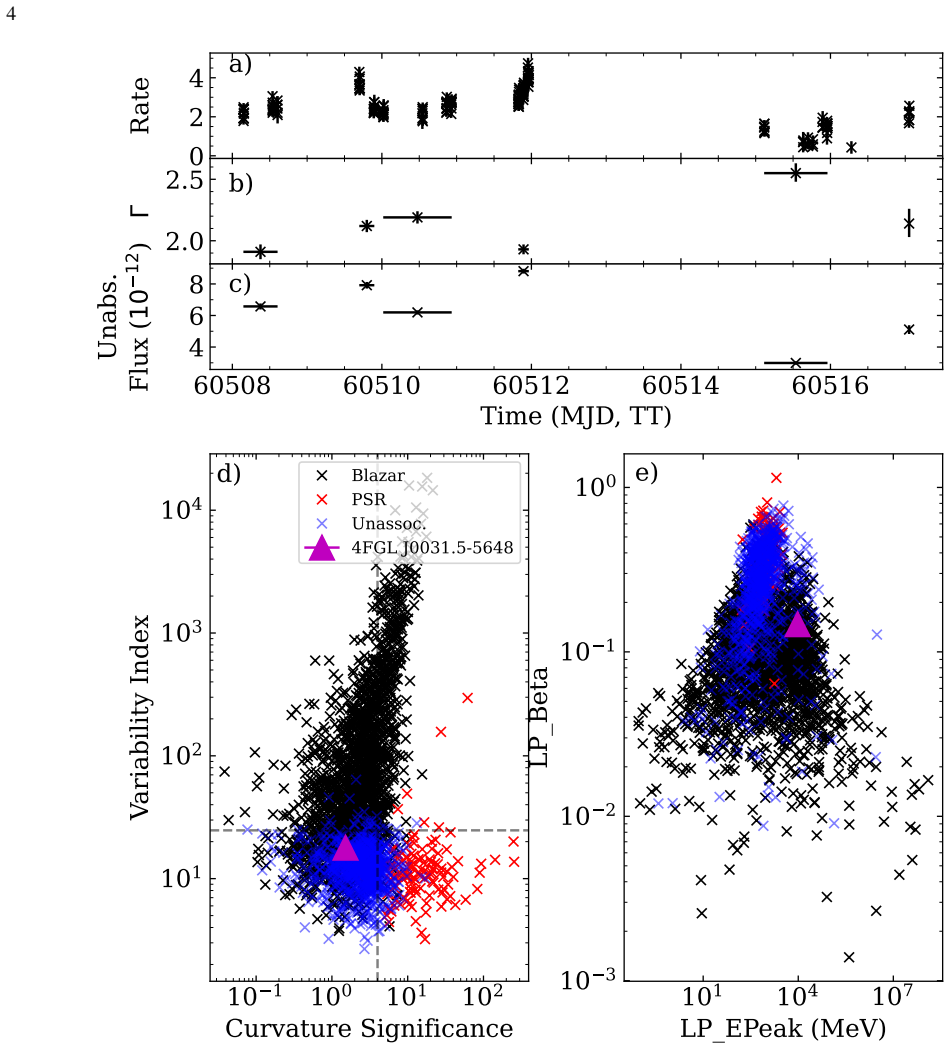
The central mechanism is the cross-identification of EP240709A across six archival catalogs joined by positional overlap, with the Fermi 4FGL diagnostics as the primary classifier. The paper uses two diagnostic planes—variability index versus curvature significance, and log-parabola peak energy versus curvature parameter—to show 4FGL J0031.5−5648 sits where blazars sit and where pulsars do not, and then uses WISE colors and the Gaia DR3 quasar probability to rule out stellar systems. The NICER light curve and spectral evolution supply the time-domain AGN signature. Together these strands converge on a single object: the transient's X-ray flare is the blazar's current active state.
What would settle it
Point a high-resolution X-ray telescope with arcsecond localization at EP240709A: if its position coincides with the Gaia and WISE counterpart, the physical association is confirmed; if it is offset by several arcseconds, the blazar classification collapses. An optical spectrum of the counterpart showing stellar absorption features rather than a featureless or broad-line AGN spectrum would also falsify the claim.
Extended reading notes
Core claim
On the paper's own terms, EP240709A is likely an active blazar. The NICER observations show a power-law spectrum with photon index varying between 1.9 and 2.6 and unabsorbed 0.4–3.0 keV flux varying between $(3\text{--}9)\times10^{-12}$ erg s$^{-1}$ cm$^{-2}$, a pattern consistent with active galactic nuclei rather than stellar flares or transitional millisecond pulsars. The Fermi source 4FGL J0031.5−5648, previously unassociated, sits in the blazar region of the variability-index/curvature-significance plane and lacks the curvature signature typical of pulsars. The Gaia DR3 machine-learning classifier assigns a 99.98% probability that the optical counterpart is a quasar, and the WISE $W1{-}W2$ and $W2{-}W3$ colors match the blazar sequence, possibly a high-frequency-peaked BL Lac. The authors therefore conclude that the transient and the Fermi source are the same active blazar.
Load-bearing premise
The claim rests on the assumption that the Einstein Probe transient, the Gaia and WISE counterparts, and the Fermi source 4FGL J0031.5−5648 are one physical object, even though the Fermi localization is only known to about 4 arcminutes and the agreement could be a chance projection.
Editorial extensions
If this is right
- The previously unassociated Fermi source 4FGL J0031.5−5648 would gain a likely blazar identification, with EP240709A as its X-ray flaring counterpart.
- Einstein Probe transients that are initially ambiguous between stellar and extragalactic can be resolved with a modest X-ray follow-up plus archival diagnostics, making this a template for classifying future EP discoveries.
- If the blazar classification holds, the source likely belongs to the high-frequency-peaked BL Lac population, tying the outburst to synchrotron emission from a relativistic jet.
- NICER's detection of factor-of-several flux variability on week timescales implies the X-ray-emitting region is compact, consistent with AGN disk or jet activity rather than a stellar coronal flare.
Reading between the lines
- Beyond the paper: because the Einstein Probe position is far smaller than the Fermi 4-arcminute error circle, future Fermi catalogues could adopt the X-ray position to re-fit the gamma-ray source and test the association statistically.
- Beyond the paper: applying the same Fermi variability-curvature and WISE color diagnostics to other unassociated 4FGL sources that produce X-ray transients would provide a fast triage tool for blazar identification across the whole sky.
- Beyond the paper: a simultaneous X-ray-to-GeV spectral energy distribution, if it shows the synchrotron peak at high energies, would sharpen the classification as a high-frequency-peaked BL Lac and constrain the jet's electron energy distribution.
Editorial analysis
A structured set of objections, weighed in public.
Referee Report
Summary. EP240709A is an Einstein Probe X-ray transient. The authors present NICER X-ray follow-up observations (10.4 ks) and combine them with archival Swift, Gaia, Fermi, and WISE data to argue that the source is likely a blazar associated with the previously unassociated Fermi source 4FGL J0031.5-5648. The NICER spectra are fit with an absorbed power law over 0.4-3.0 keV, yielding varying photon index and flux. The paper finds no pulsations, and uses Fermi variability and curvature diagnostics, a Gaia photometric quasar probability of 99.98%, and WISE colors to support the blazar classification, while acknowledging a ~4 arcminute Fermi localization uncertainty. The central claim is the tentative identification of EP240709A as an active blazar, based on the positional and multiwavelength agreement with the Fermi source.
Significance. If the association holds, this would identify a new gamma-ray blazar and demonstrate the value of multiwavelength follow-up of Einstein Probe transients. The paper is honest and uses standard, reproducible analyses; the external catalog diagnostics (Fermi, Gaia, WISE) are appropriate and not circular. The NICER spectral fits are standard and the observed variability appears real. However, the central claim is tentative, and the lack of a quantitative chance-coincidence estimate for the Fermi association limits the strength of the conclusion. The result is modest in scope but of interest to the time-domain and AGN communities.
major comments (2)
- [Section 4] The blazar classification depends critically on the association between EP240709A and 4FGL J0031.5-5648. The paper acknowledges that the ~4 arcminute Fermi error circle could yield a chance coincidence, but it does not compute the probability of such a coincidence. Without this estimate, the Fermi diagnostics in Figures 1d and 1e are not securely attached to the X-ray transient, and the remaining evidence (NICER variability, Gaia photometric classification, WISE colors) supports an AGN identification but not uniquely a blazar. Please either estimate a chance-coincidence probability (e.g., from the local surface density of unassociated Fermi sources or of AGN) or explicitly downgrade the conclusion to "an AGN, possibly a blazar" pending confirmation of the association.
- [Section 3.1] The claim that the X-ray "spectral and flux variability" is consistent with AGN is not quantitatively supported. The text reports that Γ varied between 1.9 and 2.6 and that the unabsorbed flux varied between 3 and 9 ×10^-12 erg s^-1 cm^-2, but it does not provide the uncertainties on these parameters or a variability significance statistic (e.g., chi-square, fractional rms, or excess variance). If the variations are within the measurement errors, this evidence would be weakened. Please report the errors and perform a simple variability test, or moderate the claim accordingly.
minor comments (7)
- [Figure 1 caption] The caption for panel (c) states "0.3–10.0 keV unabsorbed flux" while the text reports the 0.4–3.0 keV band; please harmonize the energy bands and clarify which band is used for the flux values.
- [Acknowledgments] The sentence "Due to the word limit, we truncate the acknowledgements and link to the full text" appears in the manuscript and should be removed or replaced with the full acknowledgments; it is likely an artifact of the submission process.
- [Author list] The author name "Gaurav aK. Jaisaw al" appears to be a typesetting error for "Gaurav K. Jaiswal"; please correct.
- [References] In the reference for McHardy (2010), the volume field contains a typo "V ol."; also, the Mushotzky et al. reference has a duplicated DOI string.
- [Section 3.2] The WISE color errors are relatively large (σ_W1-W2 = 0.10, σ_W2-W3 = 0.4); please state whether the quoted colors overlap with the blazar region given these uncertainties.
- [Section 4] The Fermi error circle is quoted as "roughly 4′"; please specify the containment radius (e.g., 68% or 95%) for clarity.
- [Section 3.1 and 4] The text states that the light curve "does not show significant flaring activity" but later refers to "variability"; consider rephrasing to distinguish between flaring episodes and longer-timescale variability.
Circularity Check
No circularity: the blazar classification uses fresh NICER timing/spectral data plus external Fermi, Gaia, and WISE diagnostics; the acknowledged 4FGL association uncertainty is a limitation, not a circular reduction.
full rationale
The paper's central claim, that EP240709A is likely an active blazar, is assembled from independent measurements and external catalog classifications rather than from the claim itself. The NICER data provide new spectral index, flux, and variability measurements (Section 3.1); the Fermi diagnostics in Figures 1d and 1e, the Gaia DR3 quasar probability, and the WISE color-color classification (Section 4) are all independent external products. No parameter is fitted to a subset of data and then relabeled as a prediction: the Fermi, Gaia, and WISE classifications were not derived from the NICER observations, and the NICER spectral parameters are not used to force the blazar conclusion. The only load-bearing assumption is the positional association of EP240709A with 4FGL J0031.5-5648, which the paper explicitly flags: 'given the large error circle of 4FGL J0031.5-5648 of roughly 4' in the Fermi catalog, the counterparts identified above could simply be spatially coincident' (Section 4). This is a genuine uncertainty that weakens the claim, but it is not circular: the association is adopted from the EP team's prior localization work and external catalogs, not derived from the blazar hypothesis. The practice of fixing nH from the same NICER spectra is a standard fitting convenience and does not constitute a fitted-input-called-prediction, since nH is not the predicted quantity and the classification does not depend on it. There is no load-bearing self-citation chain. The verdict is no significant circularity (score 0).
Assumptions & free parameters
free parameters (1)
- Neutral hydrogen column density nH =
0.048 x 10^22 cm^-2 (fixed)
assumptions (6)
- domain assumption The background model nibackgen3C50 accurately estimates the NICER background.
- domain assumption An absorbed power law is an adequate spectral model for the source.
- domain assumption The positional overlap between EP, Swift/XRT, eROSITA, and the Fermi source implies a common physical source.
- domain assumption The Gaia DR3 discrete source classifier probability (99.98% quasar) is reliable without spectroscopic confirmation.
- domain assumption The Fermi catalog diagnostics (variability index, curvature significance, LP parameters) are accurate and applicable.
- domain assumption The WISE color-color diagram classification (Massaro et al. 2011) is valid for this faint infrared source.
Cite this review
Pith. "Pith review of Tentative Blazar Candidate EP240709A Associated with 4FGL J0031.5-5648: NICER and Archival Multiwavelength Observations." pith.science (2026). https://pith.science/paper/FH2BUL4F
@misc{pith2026241118718,
  author       = {Pith},
  title        = {Pith review of: Tentative Blazar Candidate EP240709A Associated with 4FGL J0031.5-5648: NICER and Archival Multiwavelength Observations},
  year         = {2026},
  howpublished = {\url{https://pith.science/paper/FH2BUL4F}},
  note         = {Machine review of arXiv:2411.18718}
}
read the original abstract
We report on follow-up observations of the recently discovered transient by the Einstein Probe, EP240709A, with the Neutron star Interior Composition Explorer (NICER). We also incorporated archival multiwavelength survey data from the Neil Gehrels Swift Observatory (X-ray), Gaia (optical), the Fermi Gamma-ray Space Telescope (gamma-ray), and the Wide-field Infrared Survey Explorer (infrared) to distinguish between blazars and stellar systems. We suggest that EP240709A is likely an active blazar.
Figures
Reference graph
Works this paper leans on
-
[1]
, " * write output.state after.block = add.period write newline
ENTRY address archivePrefix author booktitle chapter doi edition editor eprint howpublished institution journal key month number organization pages publisher school series title misctitle type volume year version url label extra.label sort.label short.list INTEGERS output.state before.all mid.sentence after.sentence after.block FUNCTION init.state.consts ...
-
[2]
write newline
" write newline "" before.all 'output.state := FUNCTION format.url url empty "" new.block "" url * "" * if FUNCTION format.eprint eprint empty "" archivePrefix empty "" archivePrefix "arXiv" = new.block " " eprint * " " * new.block " " eprint * " " * if if if FUNCTION format.doi doi empty "" " " doi * " " * if FUNCTION format.pid doi empty eprint empty ur...
-
[3]
9H/`5L A* u DUH0 &=A ɞ &At i R b7u- H V
thebibliography [1] 20pt to REFERENCES 6pt =0pt -12pt 10pt plus 3pt =0pt =0pt =1pt plus 1pt =0pt =0pt -12pt =13pt plus 1pt =20pt =13pt plus 1pt \@M =10000 =-1.0em =0pt =0pt 0pt =0pt =1.0em @enumiv\@empty 10000 10000 `\.\@m \@noitemerr \@latex@warning Empty `thebibliography' environment \@ifnextchar \@reference \@latexerr Missing key on reference command E...
2021
-
[4]
Astropy Collaboration , Price-Whelan , A. M., et al. 2018, , 156, 123, 10.3847/1538-3881/aabc4f
-
[5]
Astropy Collaboration , Robitaille , T. P., et al. 2013, , 558, A33, 10.1051/0004-6361/201322068
-
[6]
2019, , 242, 4, 10.3847/1538-4365/ab16f4
D'Abrusco , R., et al. 2019, , 242, 4, 10.3847/1538-4365/ab16f4
-
[7]
2023, , 674, A31, 10.1051/0004-6361/202243423
Delchambre , L., et al. 2023, , 674, A31, 10.1051/0004-6361/202243423
-
[8]
Evans , P. A., et al. 2023, , 518, 174, 10.1093/mnras/stac2937
Show all 27 references
-
[9]
M., et al
Folkner , W. M., et al. 2009, Interplanetary Network Progress Report, 42-178, 1
2009
-
[10]
Hunter , J. D. 2007, Computing in Science and Engineering, 9, 90, 10.1109/MCSE.2007.55
2007 doi
-
[11]
S., & Bleeker , J
Kaastra , J. S., & Bleeker , J. A. M. 2016, , 587, A151, 10.1051/0004-6361/201527395
2016 doi
-
[12]
J., et al
Liu , M. J., et al. 2024, The Astronomer's Telegram, 16704, 1
2024
-
[13]
2011, , 740, L48, 10.1088/2041-8205/740/2/L48
Massaro , F., et al. 2011, , 740, L48, 10.1088/2041-8205/740/2/L48
2011 doi
-
[14]
2010, in Lecture Notes in Physics, Berlin Springer Verlag, ed
McHardy , I. 2010, in Lecture Notes in Physics, Berlin Springer Verlag, ed. T. Belloni , Vol. 794, 203, 10.1007/978-3-540-76937-8_8
2010 doi
-
[15]
2024, , 682, A34, 10.1051/0004-6361/202347165
Merloni , A., et al. 2024, , 682, A34, 10.1051/0004-6361/202347165
2024 doi
-
[16]
F., et al
Mushotzky , R. F., et al. 1993, , 31, 717, 10.1146/annurev.aa.31.090193.00344110.1146/annurev.astro.31.1.717
1993
-
[17]
2014, HEAsoft: Unified Release of FTOOLS and XANADU , Astrophysics Source Code Library, record ascl:1408.004
NASA High Energy Astrophysics Science Archive Research Center (HEASARC) . 2014, HEAsoft: Unified Release of FTOOLS and XANADU , Astrophysics Source Code Library, record ascl:1408.004. 1408.004
2014
-
[18]
2022, in Astrophysics and Space Science Library, Vol
Papitto , A., & de Martino , D. 2022, in Astrophysics and Space Science Library, Vol. 465, Astrophysics and Space Science Library, ed. S. Bhattacharyya , A. Papitto , & D. Bhattacharya , 157--200, 10.1007/978-3-030-85198-9_6
2022 doi
-
[19]
Perez , F., & Granger , B. E. 2007, Computing in Science and Engineering, 9, 21, 10.1109/MCSE.2007.53
2007 doi
- [20]
- [21]
- [22]
-
[23]
2020, Nature Methods, 17, 261, 10.1038/s41592-019-0686-2
Virtanen, P., et al. 2020, Nature Methods, 17, 261, 10.1038/s41592-019-0686-2
2020 doi
-
[24]
2020, WISE All-Sky Source Catalog, IPAC, 10.26131/IRSA142
WISE Team . 2020, WISE All-Sky Source Catalog, IPAC, 10.26131/IRSA142
2020 doi
- [25]
-
[26]
2022, in Handbook of X-ray and Gamma-ray Astrophysics, ed
Yuan , W., et al. 2022, in Handbook of X-ray and Gamma-ray Astrophysics, ed. C. Bambi & A. Sangangelo , 86, 10.1007/978-981-16-4544-0_151-1
2022 doi
-
[27]
2023, , 952, 158, 10.3847/1538-4357/ace10b
Zheng , D., et al. 2023, , 952, 158, 10.3847/1538-4357/ace10b
2023 doi
Reviewed August 12, 2026 · model on record in the stance chip above.
Discussion (0). Continue with ORCID to comment.