REVIEW 3 major objections 5 minor 58 references
KIC 4150611: A quadruply eclipsing heptuple star system with a g-mode period-spacing pattern Asteroseismic modelling of the g-mode period-spacing pattern
T0 review · 3 major / 5 minor · reviewed 2026-08-12 · deepseek-v4-flash
Pith's one-line read The g-mode period-spacing pattern of KIC 4150611 Aa, modelled through a neural network and pinned by eclipse and spectroscopic constraints, yields a 1.51-solar-mass primary with a 1.1 Gyr asteroseismic age, in sharp conflict with the…
desk verdict Careful asteroseismic modelling with a credible but boundary-dependent headline age; deserves serious review. read the letter →
The pith
A machine-rendered reading of the paper's core claim, the machinery that carries it, and where it could break.
The reading
What carries the argument
The central object is the g-mode period-spacing pattern: the observed sequence of gravity-mode periods whose separations encode the buoyancy travel time $\Pi_0$ and the near-core rotation frequency $\Omega_c$. Under the traditional approximation of rotation, the asymptotic relation $f_{lmn} = \sqrt{\lambda_{lm,s}}/((n+\alpha)\Pi_0) + m\Omega_c$ turns the pattern into a direct measurement of $\Pi_0$ and $\Omega_c$; the paper then feeds the pattern into a neural-network stellar-model grid (C-3PO) and a parameter-based MCMC grid search to translate those quantities into mass, central hydrogen fraction, overshoot, and age, using the eclipse radius and spectroscopic $T_{\rm eff}$, $\log g$ as external anchors.
What would settle it
A decisive test would be to rerun the same pattern-modelling with a model grid extended down to $Z = 0.007$ and $f_{\rm ov} < 0.01$; if the best-fitting model for the same period-spacing pattern no longer lies at $M \approx 1.5\,M_\odot$, $X_c \approx 0.43$, and age $\approx 1.1$ Gyr within the quoted uncertainties, then grid coverage rather than the pattern is driving the result.
Extended reading notes
Core claim
On the paper's own terms, the central discovery is that the prograde-dipole g-mode period-spacing pattern of Aa, combined with the eclipse-based radius and spectroscopic $T_{\rm eff}$ and $\log g$ constraints, drives all asteroseismic model families to a consistent solution: $M = 1.51 \pm 0.05\,M_\odot$, $X_c = 0.43 \pm 0.04$, $R = 1.66 \pm 0.1\,R_\odot$, $f_{\rm ov} = 0.010$, $\Omega_c = 1.58 \pm 0.01$ d$^{-1}$, $\log T_{\rm eff} = 3.856 \pm 0.008$ dex, $\log g = 4.18 \pm 0.04$ dex, and $\log L = 0.809 \pm 0.005$ dex. The near-core properties agree with eclipse and spectroscopic constraints, the star rotates rigidly from core to surface to within the errors, and the asteroseismic age of $1100 \pm 100$ Myr is far older than the 35 Myr isochrone age of the B binary. The paper backs this with four different pattern constructions and both a neural-network pattern-matching search and a classical MCMC grid search over five stellar grids; the two methods agree where the grids cover the relevant physics.
Load-bearing premise
The load-bearing premise is that the stellar-model grids used in the fitting cover the true interior physics of Aa—especially its metallicity (the star's measured $Z \approx 0.0084$ lies below the grid's lower bound of $Z = 0.011$) and its core overshoot (the best fit sits at the grid edge $f_{\rm ov} = 0.01$); if those choices are mismatched, the quoted mass, hydrogen fraction, and age could be biased beyond their internal uncertainties.
Editorial extensions
If this is right
- If the asteroseismic age of about 1.1 Gyr is correct, the A triple and the B binary in KIC 4150611 cannot be coeval at 35 Myr; either the previous isochrone age is wrong or the components formed separately.
- The quoted parameters give a precisely calibrated $\gamma$ Dor star whose mass, radius, luminosity, and rotation can be cross-checked against future eclipse photometry and spectroscopy of the same system.
- The result that pattern completeness matters more than frequency-extraction differences implies that future period-spacing analyses should prioritize extending patterns to high radial order.
- The compatibility of the neural-network and MCMC approaches suggests the inferred parameters are not an artefact of a single modelling machinery, provided the grid physics is adequate.
Reading between the lines
- Because the star's spectroscopic metallicity ($Z \approx 0.0084$) lies below the model grid's lower bound ($Z = 0.011$), a natural extension beyond this paper is to regenerate the pattern fits with grids covering $Z = 0.007$–$0.009$; the paper's own sensitivity analysis hints the inferred age could shift by enough to matter.
- A testable corollary the authors leave implicit is that if Aa is truly about 1.1 Gyr old, independent modern isochrone fits to the eclipsing B binary that use its measured radii and light ratios should land near that age, settling whether the system is co-evolutionary.
- The near-perfect coincidence between an orbital harmonic and a g-mode in this system is a caution for other dense Kepler multiples: harmonic contamination can masquerade as a pulsation mode unless the frequency extraction couples orbital harmonics.
- The approach of combining a period-spacing pattern with an independently measured eclipse radius is likely to be the sharpest way to break mass–age degeneracies in other $\gamma$ Dor stars that happen to live in multiple systems.
Editorial analysis
A structured set of objections, weighed in public.
Referee Report
Summary. The paper models the g-mode period-spacing pattern of the primary component Aa in the seven-star system KIC 4150611. Using the C-3PO neural-network pattern-matching code, four independently constructed period-spacing patterns, and external spectroscopic/eclipse constraints, the authors derive stellar parameters for Aa: M=1.51±0.05 Msun, Xc=0.43±0.04, R=1.66±0.1 Rsun, f_ov=0.010, Omega_c=1.58±0.01 d^-1, log Teff=3.856±0.008, log g=4.18±0.04, log L=0.809±0.005, and an age of 1100±100 Myr. A parallel MCMC parameter-based grid search on several published grids gives consistent estimates. The central astrophysical conclusion is that Aa is quasi-rigidly rotating and is much older than the 35 Myr isochrone age previously inferred for the B binary.
Significance. If the headline parameters are correct, this is a valuable result: it turns a remarkable multiple system into a rare benchmark with a seismic characterization of the primary and a serious age discrepancy that may test the co-evolution assumption of the A, B, and C components. The paper has several genuine strengths: it considers four different period-spacing patterns to probe systematic extraction choices; it combines pattern-based neural-network modelling with a classical MCMC grid search using five different grids; and it makes explicit use of external radius, spectroscopy, and Gaia luminosity constraints. The consistency of Omega_c and Pi0 with earlier values from Li et al. (2020a) is reassuring, and the agreement between the C-3PO pattern fits and the MCMC grid search is a useful independent check. However, the headline mass, core hydrogen fraction, and age rest on C-3PO models whose training grid does not cover the star's spectroscopically determined metallicity, and the best fits sit at the grid boundary in both Z and f_ov. This is a load-bearing limitation that must be confronted before the quoted precision can be considered robust.
major comments (3)
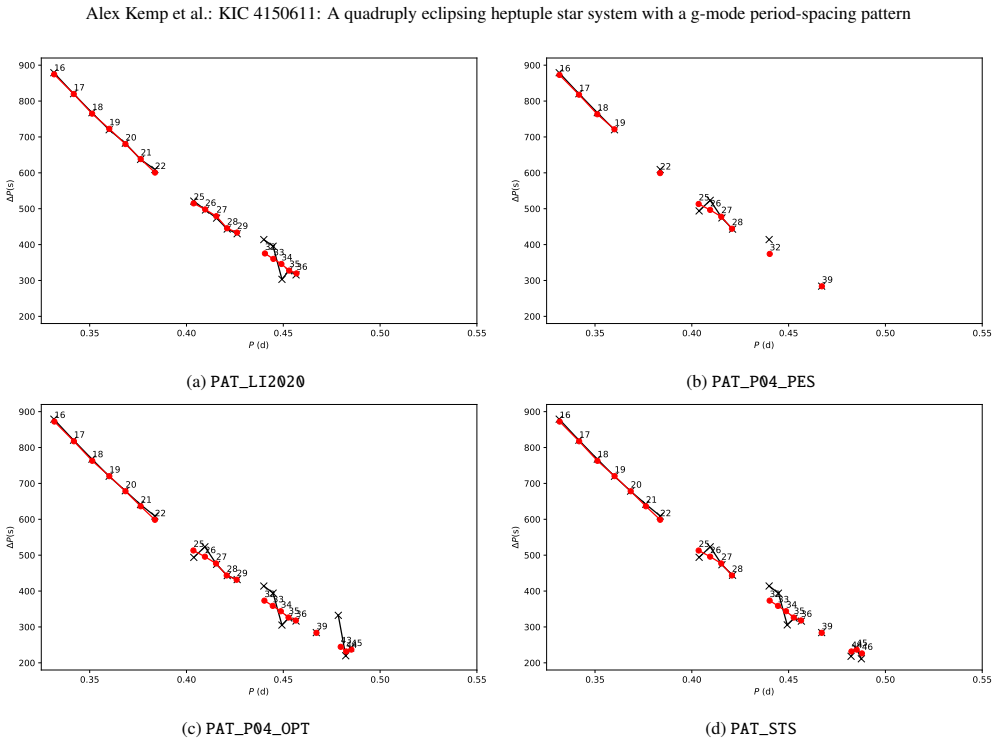
- [Sections 3.3 and 4.2.5; Table 2] The headline parameter set is obtained from C-3PO models whose training grid covers Z=0.011-0.015 and f_ov=0.01-0.03 (Section 3.3), whereas the adopted spectroscopic metallicity of Aa is Z=0.0084±0.0011 (Section 4.2.5), below the grid's lower bound. Table 2 shows that the best-fitting models systematically sit at Z=0.011/0.012 and f_ov=0.010-0.014, i.e., on or very near the grid boundary. Since the g-mode pattern constrains the buoyancy travel time Pi0 of Eq. (1), and Pi0 depends on Z through the Brunt-Väisälä frequency and on f_ov through the convective-core size, a forward model at Z≈0.008 with f_ov<0.01 could compensate with a different Xc and shift the inferred mass and age, without being represented in the C-3PO grid. The MCMC grid E at Z=0.008 (Section 4.3) is supporting evidence, but it fits only Pi0, not the full period-spacing pattern, and it leaves f_ov unconstrained; it therefore does not validate the C-3PO pattern-modelling extrapolation. I request either a low-Z/low-f_ov extension of the C-3PO training set with full-pattern fits, or an explicit and quantified systematic uncertainty from grid-edge truncation before the quoted M, Xc, f_ov, and age can be taken at face value.
- [Section 4.2.9 and Table 2] The quoted age uncertainty of ±100 Myr is not fully supported by the analysis as presented. The age is not a direct C-3PO output; it is obtained by interpolating the nearest training-set model in M, Z, and f_ov (Section 4.2.9), so it inherits the low-metallicity grid-boundary problem of the previous comment. Moreover, the four patterns give externally constrained ages of 1280, 1200, 1100, and 1070 Myr, and the MCMC grid search gives 1110±150 Myr; the internal scatter is therefore bracketed by the quoted ±100 Myr, but no term accounts for the grid-metallicity/overshoot systematics. Given that the central scientific claim is that Aa is about 1.1 Gyr old rather than 35 Myr, the age should be reported with a systematic error term, or the C-3PO grid should be recomputed at the spectroscopic Z, rather than reporting only a statistical uncertainty.
- [Sections 4.1 and 4.2; Figs. 7 and 9-11] The preference for the longer PAT_P04_OPT and PAT_STS patterns over the shorter PAT_LI2020 and PAT_P04_PES patterns is a central choice, because it selects the higher-mass, lower-Xc solution. Yet the extended high-radial-order segments of these preferred patterns are built partly from modes with SNR below 5.6, and the n=43 mode in PAT_P04_OPT is later judged spurious (Section 4.1). The reader therefore cannot tell how much of the headline M and Xc depends on the inclusion of the low-SNR high-order tail. I ask for a sensitivity test in which the high-order members beyond the last common consecutive sequence are removed or varied, and the resulting ranges in M, Xc, and age are reported.
minor comments (5)
- [Abstract and Conclusions] The word "metalicity" appears in the abstract and in the conclusions; it should be "metallicity".
- [Section 3.1] The text refers to "KIC 41501611" in the discussion of the near-perfect coincidence between an 8.65d orbital harmonic and a g-mode; this should be "KIC 4150611".
- [Table 2] The table note gives the units of log(g) as "g cm^-3"; surface gravity is an acceleration, so the units should be cm s^-2, not a density.
- [Figure 12 caption] The caption says the figure uses "data from Mombarg et al. (2021)" and then describes grey lines as coming from Mombarg et al. (2024a); please clarify which grid each set of curves belongs to.
- [Appendix C] The text refers to a "septupole series" where the l=3 series is meant; the standard term for l=3 multipole is octupole.
Circularity Check
No circularity found: the asteroseismic inference uses observed period-spacing patterns and independent external constraints, with model grids that are not fitted to this star.
full rationale
The paper's derivation chain is self-contained. The four observed g-mode period-spacing patterns are forward-modelled with C-3PO, a neural network trained on MESA/GYRE grids from Mombarg et al. (2021); these grids are independent of KIC 4150611 and were not constructed to reproduce its frequencies. The external constraints (Teff, log g, R, Gaia luminosity) come from spectroscopy, eclipse modelling, and astrometry, not from the asteroseismic fit, and the paper explicitly separates unconstrained asteroseismic fits from externally constrained ones. The MCMC grid search uses the measured buoyancy travel time Pi0 as an input; this is a standard two-step procedure, and Pi0 itself is measured from the period-spacing pattern via the asymptotic TAR, not defined in terms of the fitted M, Xc, or age. The age is a post-fit interpolation from the model evolution tracks given the fitted M and Xc, so it is a model-dependent prediction, not a re-statement of the input. The best-fit parameters lie at the low-Z and low-f_ov boundaries of the C-3PO training set, and the paper acknowledges this limitation ('Improved future modelling may come from detailed coverage of metalicity effects'), but boundary truncation is a grid-coverage concern, not a circular reduction. Self-citations to C-3PO and the group's grids are present and load-bearing as tools, but they are published, reproducible model grids whose assumptions are stated, and the matching to this star's data is a genuine forward-model comparison. No equation in the paper defines an output in terms of itself, and no fitted parameter is renamed as a prediction.
Assumptions & free parameters
free parameters (7)
- Stellar mass M =
1.51 Msun
- Core hydrogen fraction Xc =
0.43
- Exponential overshoot factor f_ov =
0.010 to 0.014
- Metallicity Z =
0.010 to 0.012
- Near-core rotation Omega_c =
1.58 d^-1
- Buoyancy travel time Pi0 =
4024 s
- External constraint widths =
2-sigma (doubled errors)
assumptions (4)
- domain assumption The traditional approximation of rotation (TAR) is valid for Aa, allowing separation of the pulsation equations via Hough functions.
- domain assumption High-order g-modes follow the Tassoul asymptotic period-spacing relation (Eq. 2) with a constant phase term and a single buoyancy travel time Pi0.
- domain assumption The MESA/GYRE stellar models used to train C-3PO and to build the MCMC grids (D_mix=1 cm^2/s, f_ov in 0.01 to 0.03, Z in 0.011 to 0.015, and the chosen rotating grids) adequately represent Aa's interior physics.
- domain assumption The external constraints from eclipse modelling (radius), spectroscopy (Teff and log g), and Gaia DR3 (luminosity) are accurate and correctly propagated.
Cite this review
Pith. "Pith review of KIC 4150611: A quadruply eclipsing heptuple star system with a g-mode period-spacing pattern Asteroseismic modelling of the g-mode period-spacing pattern." pith.science (2026). https://pith.science/paper/VF7WTMK2
@misc{pith2026241118777,
  author       = {Pith},
  title        = {Pith review of: KIC 4150611: A quadruply eclipsing heptuple star system with a g-mode period-spacing pattern Asteroseismic modelling of the g-mode period-spacing pattern},
  year         = {2026},
  howpublished = {\url{https://pith.science/paper/VF7WTMK2}},
  note         = {Machine review of arXiv:2411.18777}
}
abstract
In this work, we aim to estimate the stellar parameters of the primary (Aa) by performing asteroseismic analysis on its period-spacing pattern. We use the C-3PO neural network to perform asteroseismic modelling of the g-mode period-spacing pattern of Aa, discussing the interplay of this information with external constraints from spectroscopy ($T_{\rm eff}$ and $\log(g)$) and eclipse modelling ($R$). To estimate the level of uncertainty due to different frequency extraction and pattern identification processes, we consider four different variations on the period-spacing patterns. To better understand the correlations between and the uncertainty structure of our parameter estimates, we also employed a classical, parameter-based MCMC grid search on four different stellar grids. The best-fitting, externally constrained model to the period-spacing pattern arrives at estimates of the stellar properties for Aa of: $M=1.51 \pm 0.05 M_\odot$, $X_c =0.43 \pm 0.04$, $R=1.66 \pm 0.1 R_\odot$, $f_{\rm ov}=0.010$, $\Omega_c=1.58 \pm 0.01$ d$^{-1}$ with rigid rotation to within the measurement errors, $\log(T_{\rm eff})=3.856 \pm 0.008$ dex, $\log(g)=4.18 \pm 0.04$ dex, and $\log(L)=0.809 \pm 0.005$ dex, which agree well with previous measurements from eclipse modelling, spectroscopy, and the Gaia DR3 luminosity. We find that the near-core properties of the best-fitting asteroseismic models are consistent with external constraints from eclipse modelling and spectroscopy. Aa appears to be a typical example of a $\gamma$ Dor star, fitting well within existing populations. We find that Aa is quasi-rigidly rotating to within the uncertainties, and note that the asteroseismic age estimate for Aa (1100 $\pm$ 100 Myr) is considerably older than the young (35 Myr) age implied by previous isochrone fits to the B binary in the literature. Our MCMC parameter-based grid-search agrees well with our pattern-modelling approach.
Figures


Figures from the paper (9 more)




Reference graph
Works this paper leans on
-
[1]
2021, Reviews of Modern Physics, 93, 015001
Aerts, C. 2021, Reviews of Modern Physics, 93, 015001
2021
-
[2]
Aerts, C., Christensen-Dalsgaard, J., & Kurtz, D. W. 2010, Asteroseismology (Springer)
2010
-
[3]
Aerts, C., Molenberghs, G., Michielsen, M., et al. 2018, ApJS, 237, 15
work page 2018
- [4]
-
[5]
Aerts, C., Van Reeth, T., Mombarg, J. S. G., & Hey. 2024, A&A, submitted
work page 2024
-
[6]
Aerts, C., Waelkens, C., Daszy´nska-Daszkiewicz, J., et al. 2004, A&A, 415, 241
work page 2004
-
[7]
J., & Scott, P
Asplund, M., Grevesse, N., Sauval, A. J., & Scott, P. 2009, ARA&A, 47, 481
2009
-
[8]
2003, Advances in Space Research, 31, 345
Baglin, A. 2003, Advances in Space Research, 31, 345
work page 2003
Show all 58 references
-
[9]
Balona, L. A. 2014, MNRAS, 443, 1946
2014
-
[10]
S., Koen, C., & Pokrzywka, B
Baran, A. S., Koen, C., & Pokrzywka, B. 2015, MNRAS, 448, L16
2015
-
[11]
1978, A&A, 70, 597
Berthomieu, G., Gonczi, G., Graff, P., Provost, J., & Rocca, A. 1978, A&A, 70, 597
1978
-
[12]
J., Koch, D., Basri, G., et al
Borucki, W. J., Koch, D., Basri, G., et al. 2010, Science, 327, 977
2010
-
[13]
P., Dupret, M
Bouabid, M. P., Dupret, M. A., Salmon, S., et al. 2013, MNRAS, 429, 2500
2013
-
[14]
& Torres, G
Claret, A. & Torres, G. 2017, ApJ, 849, 18 De Cat, P. & Aerts, C. 2002, A&A, 393, 965 De Cat, P., Eyer, L., Cuypers, J., et al. 2006, A&A, 449, 281
2017
-
[15]
2009, A&A, 506, 471
Degroote, P., Aerts, C., Ollivier, M., et al. 2009, A&A, 506, 471
2009
-
[16]
A., Grigahcène, A., Garrido, R., Gabriel, M., & Scuflaire, R
Dupret, M. A., Grigahcène, A., Garrido, R., Gabriel, M., & Scuflaire, R. 2005, A&A, 435, 927
2005
-
[17]
1960, Physics of Fluids, 3, 421
Eckart, C. 1960, Physics of Fluids, 3, 421
1960
-
[18]
G., & Steffen, M
Freytag, B., Ludwig, H. G., & Steffen, M. 1996, A&A, 313, 497
1996
-
[19]
J., Aerts, C., Mombarg, J
Fritzewski, D. J., Aerts, C., Mombarg, J. S. G., Gossage, S., & Van Reeth, T. 2024, A&A, 684, A112 Gaia Collaboration, Prusti, T., de Bruijne, J. H. J., et al. 2016, A&A, 595, A1 Gaia Collaboration, Vallenari, A., Brown, A. G. A., et al. 2023, A&A, 674, A1
2024
-
[20]
2021, A&A, 650, A151 Hełminiak, K
Gebruers, S., Straumit, I., Tkachenko, A., et al. 2021, A&A, 650, A151 Hełminiak, K. G., Ukita, N., Kambe, E., et al. 2017, A&A, 602, A30
2021
-
[21]
2000, A&A, 360, 952
Herwig, F. 2000, A&A, 360, 952
2000
-
[22]
W., Tkachenko, A., Johnston, C., et al
IJspeert, L. W., Tkachenko, A., Johnston, C., et al. 2024, A&A, 685, A62
2024
-
[23]
A., Wichern, D
Johnson, R. A., Wichern, D. W., et al. 2019, Applied multivariate statistical anal- ysis (Prentice hall Upper Saddle River, NJ)
2019
-
[24]
2019, MNRAS, 482, 1231
Johnston, C., Tkachenko, A., Aerts, C., et al. 2019, MNRAS, 482, 1231
2019
-
[25]
2024, arXiv e-prints, arXiv:2406.04131
Kemp, A., Tkachenko, A., Torres, G., et al. 2024, arXiv e-prints, arXiv:2406.04131
2024 arXiv
-
[26]
& Saio, H
Lee, U. & Saio, H. 1989, MNRAS, 237, 875
1989
-
[27]
& Saio, H
Lee, U. & Saio, H. 1997, ApJ, 491, 839
1997
-
[28]
R., et al
Li, G., Aerts, C., Bedding, T. R., et al. 2024, A&A, 686, A142
2024
-
[29]
Lomb, N. R. 1976, Ap&SS, 39, 447
1976
-
[30]
2009, A&A, 506, 811
Mathis, S. 2009, A&A, 506, 811
2009
-
[31]
P., & Zahn, J
Mathis, S., Talon, S., Pantillon, F. P., & Zahn, J. P. 2008, Sol. Phys., 251, 101
2008
-
[32]
2024, Journal of Open Source Software, 9, 5884
Michielsen, M. 2024, Journal of Open Source Software, 9, 5884
2024
-
[33]
Michielsen, M., Aerts, C., & Bowman, D. M. 2021, A&A, 650, A175
2021
-
[34]
2023, A&A, 679, A6
Michielsen, M., Van Reeth, T., Tkachenko, A., & Aerts, C. 2023, A&A, 679, A6
2023
-
[35]
2008, MNRAS, 386, 1487
Miglio, A., Montalbán, J., Noels, A., & Eggenberger, P. 2008, MNRAS, 386, 1487
2008
-
[36]
Mombarg, J. S. G., Aerts, C., Van Reeth, T., & Hey, D. 2024b, arXiv e-prints, arXiv:2410.05367
-
[37]
Mombarg, J. S. G., Van Reeth, T., & Aerts, C. 2021, A&A, 650, A58
2021
-
[38]
Mombarg, J. S. G., Van Reeth, T., Pedersen, M. G., et al. 2019, MNRAS, 485, 3248
2019
-
[39]
J., Smalley, B., et al
Niemczura, E., Murphy, S. J., Smalley, B., et al. 2015, MNRAS, 450, 2764
2015
-
[40]
Ogilvie, G. I. & Lin, D. N. C. 2004, ApJ, 610, 477
2004
-
[41]
2013, ApJS, 208, 4
Paxton, B., Cantiello, M., Arras, P., et al. 2013, ApJS, 208, 4
2013
-
[42]
Pecaut, M. J. & Mamajek, E. E. 2013, ApJS, 208, 9
2013
-
[43]
G., Aerts, C., Pápics, P
Pedersen, M. G., Aerts, C., Pápics, P. I., et al. 2021, Nature Astronomy, 5, 715 Prša, A., Batalha, N., Slawson, R. W., et al. 2011, AJ, 141, 83
2021
-
[44]
R., Winn, J
Ricker, G. R., Winn, J. N., Vanderspek, R., et al. 2015, Journal of Astronomical
2015
-
[45]
F., Coughlin, J
Rowe, J. F., Coughlin, J. L., Antoci, V ., et al. 2015, ApJS, 217, 16
2015
-
[46]
Scargle, J. D. 1982, ApJ, 263, 835
1982
-
[47]
Schmid, V . S. & Aerts, C. 2016, A&A, 592, A116
2016
-
[48]
& Salpeter, E
Shaviv, G. & Salpeter, E. E. 1973, ApJ, 184, 191
1973
-
[49]
1979, PASJ, 31, 87
Shibahashi, H. 1979, PASJ, 31, 87
1979
-
[50]
& Kurtz, D
Shibahashi, H. & Kurtz, D. W. 2012, MNRAS, 422, 738
2012
-
[51]
Szentgyorgyi, A. H. & Furész, G. 2007, in Revista Mexicana de Astronomia y Astrofisica Conference Series, V ol. 28, Revista Mexicana de Astronomia y Astrofisica Conference Series, ed. S. Kurtz, 129–133
2007
-
[52]
1980, ApJS, 43, 469
Tassoul, M. 1980, ApJS, 43, 469
1980
-
[53]
2015, A&A, 581, A129
Tkachenko, A. 2015, A&A, 581, A129
2015
-
[54]
Townsend, R. H. D. 2020, MNRAS, 497, 2670
2020
-
[55]
Townsend, R. H. D. & Teitler, S. A. 2013, MNRAS, 435, 3406
2013
-
[56]
A., Moravveji, E., Pápics, P
Triana, S. A., Moravveji, E., Pápics, P. I., et al. 2015, ApJ, 810, 16
2015
-
[57]
2011, A&A, 534, A125 Van Beeck, J., Bowman, D
Uytterhoeven, K., Moya, A., Grigahcène, A., et al. 2011, A&A, 534, A125 Van Beeck, J., Bowman, D. M., Pedersen, M. G., et al. 2021, A&A, 655, A59 Van Reeth, T., De Cat, P., Van Beeck, J., et al. 2022, A&A, 662, A58 Van Reeth, T., Johnston, C., Southworth, J., et al. 2023, A&A,...
2011
-
[58]
Zahn, J. P. 1991, A&A, 252, 179 Article number, page 20 of 30 Alex Kemp et al.: KIC 4150611: A quadruply eclipsing heptuple star system with a g-mode period-spacing pattern Appendix A: Detailed period-spacing pattern plots Appendix B: Tight R constraint Appendix C: Other frequ...
2017
Reviewed August 12, 2026 · model on record in the stance chip above.
Discussion (0). Continue with ORCID to comment.