REVIEW 4 major objections 5 minor 60 references
DuetML: Human-LLM Collaborative Machine Learning Framework for Non-Expert Users
T0 review · 4 major / 5 minor · reviewed 2026-08-12 · deepseek-v4-flash
Pith's one-line read This paper claims that multimodal LLM agents collaborating inside an interactive machine-learning interface help non-expert users define training data that better matches the task they actually want to solve.
desk verdict A genuinely useful dual-agent MLLM/IML system whose headline result rests on one fragile Likert item; worth refereeing, not worth citing as established fact. read the letter →
The pith
A machine-rendered reading of the paper's core claim, the machinery that carries it, and where it could break.
The reading
What carries the argument
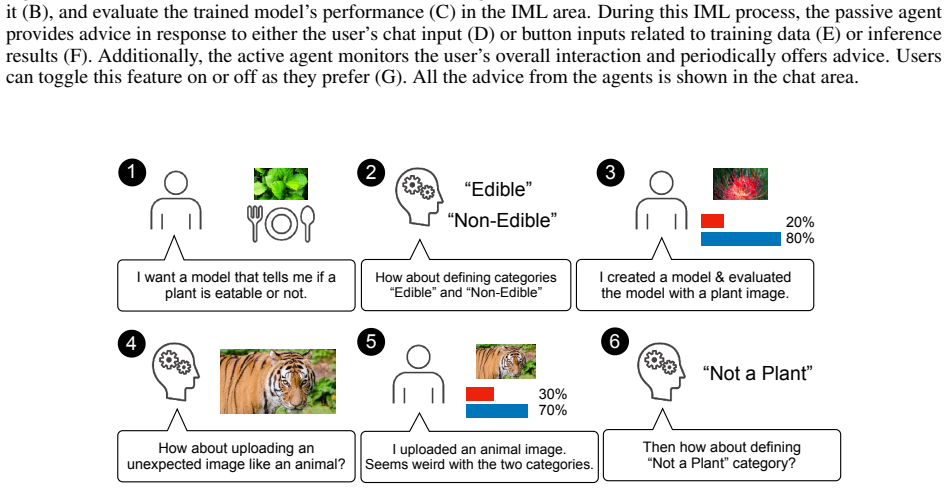
The load-bearing mechanism is DuetML's two-agent design, implemented as two asynchronous GPT-4o models with complementary intervention styles. The passive agent responds reactively to explicit user requests — chat input and 'Ask the assistant' buttons placed in the training-data and evaluation sections — while the active agent monitors the user's overall interaction and volunteers suggestions on a 60-second interval, with a user toggle to disable it. Both agents receive prompts embedding the full dialogue history and the current training data rendered as composite images (each category shown as its name plus up to 50 randomly selected associated photographs), which is what lets the advice reference the user's actual state. The system prompt directs the agents to probe vague initial goals, propose category names, watch for misalignments such as inappropriate names or insufficient categories, and suggest adversarial test images to uncover overlooked categories. A MobileNet-plus-SVM classifier with fast training keeps the workflow interactive, and the study's third-party rubric measures precisely the behaviors the prompt targets — whether category names express object usage, whether images and names match, and whether categories cover and cleanly separate the task.
What would settle it
Re-run the directed task with more than six participants per condition and a pre-registered analysis: the reported $p = 0.002$ is the smallest p-value attainable for a 6-versus-6 Mann-Whitney comparison, so a larger replication either reproduces the EQ1-a effect or reveals it as a multiple-comparison artifact, and reporting inter-rater reliability would show whether the rubric judgments are stable enough to measure task alignment at all. A second decisive test is an ablation that keeps the agents and prompts identical while withholding image access, checking whether the benefit comes from multimodality or from conversational guidance alone.
Extended reading notes
Core claim
The paper's central discovery claim is that human-LLM collaborative ML works: non-expert participants who built an image classifier with DuetML created training data that third-party ML practitioners rated as better aligned with the target task than training data created with an otherwise identical IML system lacking the agents. The significant difference appeared on the primary rubric item, EQ1-a ('category names express object usage', means 0.7 vs −0.6, $p = 0.002$ by Mann-Whitney U test), with the other four rubric metrics also trending in DuetML's favor without reaching significance. The authors further claim this gain came without increasing cognitive load, that users embraced the agents as collaborators rather than a burden, and that interaction-log and interview evidence shows participants thinking more deeply about their ML tasks — refining categories hierarchically, extracting domain knowledge from the agents, and adopting abstraction principles such as 'A' versus 'not A' categories. Underlying these results is the claim that the agents' access to the user's actual training images is what allowed their advice to be concrete, and that this collaborative paradigm preserves human agency while machine intelligence supplies formulation expertise.
Load-bearing premise
The central claim rests on the assumption that the third-party rubric item 'category names express object usage' actually measures how well training data aligns with the target task — the rubric and the task instructions were written by the same researchers, no inter-rater reliability is reported, and only one of the five rubric metrics showed a statistically significant difference.
Editorial extensions
If this is right
- Task-formulation support can improve measurably without users noticing it: self-reported usability and success were statistically indistinguishable between DuetML and the baseline while external ratings favored DuetML.
- The agents' image access appears to be what makes advice actionable — text-only responses to the same scenarios were generic, whereas image-aware responses pointed at specific misplaced images, mislabeled species, and missed categories.
- Users with the agent system spontaneously adopted strategies that IML research has tried to teach novices — hierarchical refinement, abstraction into complementary pairs, and knowledge lookup — indicating the collaboration doubles as an on-demand tutor.
- Reactive and proactive channels serve different needs: participants messaged the passive agent more in the directed task and used the ask buttons more in the open-ended task, suggesting both interaction styles are worth retaining.
Reading between the lines
- A natural next design step, suggested by the logs but not tested in the paper, is adaptive proactivity: the active agent could scale its intervention frequency to the user's observed engagement, which might outperform the fixed 60-second cycle.
- If the category-naming effect is real, the same collaborative pattern should transfer to other places where novices struggle to convert goals into machine-readable structure — prompt writing, data cleaning, schema design — making the paradigm testable well beyond image classification.
- The paper's image-aware versus text-only comparison is illustrative rather than measured, so a controlled ablation that holds prompts and users fixed while toggling image access would be the clean way to prove that multimodality, not conversational scaffolding alone, drives the benefit.
- The paradigm implies a rebalancing of ML prototyping roles: the machine carries formulation expertise while the human keeps final authority, a division of labor that future IML toolkits could standardize rather than treating automation and user control as opposites.
Editorial analysis
A structured set of objections, weighed in public.
Referee Report
Summary. DuetML presents a framework that integrates multimodal LLM agents into an interactive machine-learning (IML) interface, with one reactive and one proactive agent that converse with non-expert users while they build image classifiers. The paper reports a between-subjects user study (N=12) comparing DuetML with a baseline IML system, plus a third-party evaluation by five ML practitioners who rated the participants' training data on five Likert-scale rubric items (EQ1-a through EQ5-a) and corresponding free-response items. The primary quantitative claim is that DuetML users produced category names better aligned with the directed task, based on EQ1-a (0.7 vs. -0.6, p=0.002). The paper also reports no significant usability differences, positive subjective ratings of the agents, qualitative interaction-log analyses, and a comparative analysis of multimodal versus text-only advice. The central claim is that human-LLM collaboration helps non-expert users formulate better ML tasks without increasing cognitive load.
Significance. If the central result holds, DuetML is a useful contribution to the IML and human-AI collaboration literature: it demonstrates a concrete way to combine user agency with proactive LLM guidance, and it provides a reproducible system description with full prompt text. The study design is appropriate for an initial comparison, and the qualitative analyses of interaction logs are informative. However, the load-bearing quantitative evidence is currently thin: the single significant result is based on one subjective rubric item, with no inter-rater reliability, an under-specified statistical test, and a small sample. The significance of the broader 'better task alignment' claim therefore rests on statistical and construct-validity analyses that the manuscript does not yet provide. The framework itself is sound as a proof-of-concept, and the reported qualitative observations support that the agents were useful, but the quantitative demonstration needs strengthening before the advertised claim can be accepted.
major comments (4)
- [§4.3.2] The statistical test for EQ1-a is under-specified. With six participants per arm, the smallest achievable two-tailed Mann-Whitney p is 2/924 ≈ 0.002, which is the exact reported value; this means the result is a perfect separation of the two groups regardless of effect magnitude. The phrase 'comparing the evaluations from each of the five evaluators separately' does not identify the unit of analysis: if participant-level means were used, the paper should report per-participant and per-rater data and an effect size with confidence interval (e.g., rank-biserial correlation); if the five raters' scores were pooled, the observations are not independent and the reported p-value would not be valid. The authors must state the unit of analysis, report raw data, and provide an effect size and confidence interval for EQ1-a. They should also report whether EQ1-a was a pre-registered primary endpoint or one of five endpoints tested; if the latter, a simple multiple-comparison bound (e.g., Bonferroni) should be reported alongside the individual p-values.
- [§4.3.2] No inter-rater reliability is reported for the five practitioners' ratings. Because the central significant result is a single Likert item ('category names express object usage') rated by five individuals, the manuscript must report agreement metrics (e.g., intraclass correlation coefficient for EQ1-a, or at least per-item agreement tables). Without such information, the average scores could reflect rater-specific interpretations of 'express object usage' rather than systematic differences between conditions. This is not a minor omission: it directly bears on whether the reported 0.7 vs. -0.6 difference is a stable property of the training data or an artifact of rater noise.
- [§4.3.1] The usability comparison uses the wrong statistical test. The text states that 'Statistical analysis (Wilcoxon signed-rank test)' was applied to compare DuetML and baseline on Q1-Q5, but these are between-subjects comparisons (different participants used each system), so the paired Wilcoxon signed-rank test is inappropriate; the Mann-Whitney U test should be used. Because the abstract's claim that DuetML works 'without increasing cognitive load' is supported only by the absence of significant differences on these items, the authors must rerun the analysis with the correct test and report the resulting p-values and effect sizes. If the test choice is changed, the conclusion may change.
- [§4.1, Appendix A.1 and B.1] The construct validity of EQ1-a is questionable because the task instructions, the agent prompts, and the evaluation rubric encode the same normative view of good task formulation. The directed task explicitly instructs participants to classify objects 'considering how these objects are used,' and the active/passive system prompts tell the agent to 'Suggest category names' and to 'suggest testing with adversarial or ambiguous images.' The significant EQ1-a result may therefore measure the LLM's success in getting participants to follow the system's own recommended strategy rather than a general improvement in non-experts' task-formulation ability. The abstract's sweeping claim that DuetML enables users to define training data that 'better aligns with target tasks' is also broader than the evidence, since only one of the five primary rubric dimensions reached significance. Please temper the claim or provide an independent evaluation, such as a rubric dimension not present in the agent prompts, a comparison against a text-only LLM condition, or an evaluation of the final trained model's performance.
minor comments (5)
- [§4.3] The submitted text contains an apparent compilation artifact: around the '4.3 Results' heading, there is a stray passage with page headers '12 W. Kawabe et al.' and a figure caption 'Fig. 5: Overall trends in questionnaire responses' that appears to belong to a different manuscript. Please remove or correct it.
- [§4.3.2] Detailed metrics EQ1-b through EQ5-b are reported as descriptive means without statistical tests; if these are intended as supporting evidence, the authors should either add statistical tests or explicitly label them as descriptive trends.
- [§4.2] The word 'objectively' in 'we conducted a third-party evaluation' is misleading, because the evaluation is based on subjective Likert ratings by practitioners; it is better described as 'independent' or 'third-party' rather than 'objective.'
- [§4.3.2] The paper does not provide a data availability statement or supplementary raw data, which would allow readers to verify the reported p-values and to examine the distribution of ratings; please add such a statement or appendix.
- [§4.1] The familiarization task uses a vegetable image dataset, while the two main tasks use animal and Caltech-101 datasets, but the paper does not report whether participants' prior familiarity with these categories varied across conditions; this would be useful context for interpreting the results.
Circularity Check
No significant circularity: the central claim rests on an empirical between-subjects comparison with external raters, not on a fitted parameter or a self-citation chain.
full rationale
The paper's central claim is that DuetML improves non-expert users' task formulation, operationalized as third-party ratings of category names (EQ1-a). This is an empirical outcome measured after the intervention, not a quantity derived from the system's inputs by construction. The MLLM prompts do instruct agents to 'Suggest category names' and to be 'mindful of potential misalignments such as inappropriate category names,' and the directed-task instructions ask participants to categorize by object usage; the evaluation rubric also asks raters whether 'category names express object usage.' This alignment reflects construct validity of the measure rather than logical circularity, because participants were free to ignore the agents, the baseline received the same directed-task instructions, and the ratings were assigned by external practitioners. No parameter was fitted to the evaluation data and then reported as a prediction, and no equation in the paper reduces one claimed output to an input. The self-citations in Sections 1 and 5 (e.g., references [9], [10], and [16]) support background claims about non-expert difficulties with IML, but they are prior empirical user studies rather than a uniqueness theorem or an ansatz imported to force the present result. Statistical and methodological concerns about the EQ1-a finding, such as the lack of inter-rater reliability and the ambiguity of the Mann-Whitney unit of analysis, are validity concerns and do not constitute circularity under the criteria used here. The paper therefore receives a score of 0.
Assumptions & free parameters
free parameters (4)
- active_agent_interval =
60 seconds
- max_categories =
10
- max_images_per_category_in_prompt =
50
- mllm_model =
gpt-4o-2024-05-13
assumptions (6)
- domain assumption Participants self-reported as having no prior ML learning or implementation experience
- domain assumption Third-party ML practitioner ratings are a valid measure of how well training data aligns with a target task
- domain assumption The directed-task instructions define the ground-truth target task for evaluation
- domain assumption The baseline system and DuetML differ only in the presence of the agents
- domain assumption GPT-4o's image recognition and language outputs are sufficiently reliable for advice
- ad hoc to paper The hand-written system prompts (Appendix A.1 and B.1) encode the desired advising strategy; results depend on this prompt design
invented entities (2)
-
Passive (reactive) MLLM agent
independent evidence
-
Active (proactive) MLLM agent
independent evidence
Cite this review
Pith. "Pith review of DuetML: Human-LLM Collaborative Machine Learning Framework for Non-Expert Users." pith.science (2026). https://pith.science/paper/UZ6LQAKQ
@misc{pith2026241118908,
  author       = {Pith},
  title        = {Pith review of: DuetML: Human-LLM Collaborative Machine Learning Framework for Non-Expert Users},
  year         = {2026},
  howpublished = {\url{https://pith.science/paper/UZ6LQAKQ}},
  note         = {Machine review of arXiv:2411.18908}
}
read the original abstract
Machine learning (ML) models have significantly impacted various domains in our everyday lives. While large language models (LLMs) offer intuitive interfaces and versatility, task-specific ML models remain valuable for their efficiency and focused performance in specialized tasks. However, developing these models requires technical expertise, making it particularly challenging for non-expert users to customize them for their unique needs. Although interactive machine learning (IML) aims to democratize ML development through user-friendly interfaces, users struggle to translate their requirements into appropriate ML tasks. We propose human-LLM collaborative ML as a new paradigm bridging human-driven IML and machine-driven LLM approaches. To realize this vision, we introduce DuetML, a framework that integrates multimodal LLMs (MLLMs) as interactive agents collaborating with users throughout the ML process. Our system carefully balances MLLM capabilities with user agency by implementing both reactive and proactive interactions between users and MLLM agents. Through a comparative user study, we demonstrate that DuetML enables non-expert users to define training data that better aligns with target tasks without increasing cognitive load, while offering opportunities for deeper engagement with ML task formulation.
Figures


Figures from the paper (6 more)


Reference graph
Works this paper leans on
-
[1]
Hearst, Susan T Dumais, Edgar Osuna, John Platt, and Bernhard Scholkopf
Marti A. Hearst, Susan T Dumais, Edgar Osuna, John Platt, and Bernhard Scholkopf. Support vector machines. IEEE Intelligent Systems and their applications, 13(4):18–28, 1998. 16 DuetML
work page 1998
-
[2]
Recent advances in convolutional neural networks.Pattern recognition, 77:354–377, 2018
Jiuxiang Gu, Zhenhua Wang, Jason Kuen, Lianyang Ma, Amir Shahroudy, Bing Shuai, Ting Liu, Xingxing Wang, Gang Wang, Jianfei Cai, et al. Recent advances in convolutional neural networks.Pattern recognition, 77:354–377, 2018
2018
-
[3]
Good at captioning, bad at counting: Benchmarking gpt-4v on earth observation data
Chenhui Zhang and Sherrie Wang. Good at captioning, bad at counting: Benchmarking gpt-4v on earth observation data. arXiv preprint arXiv:2401.17600, 2024
arXiv 2024
-
[4]
Yuhui Zhang, Alyssa Unell, Xiaohan Wang, Dhruba Ghosh, Yuchang Su, Ludwig Schmidt, and Serena Yeung- Levy. Why are visually-grounded language models bad at image classification? arXiv preprint arXiv:2405.18415, 2024
arXiv 2024
-
[5]
Pre-train, prompt, and predict: A systematic survey of prompting methods in natural language processing
Pengfei Liu, Weizhe Yuan, Jinlan Fu, Zhengbao Jiang, Hiroaki Hayashi, and Graham Neubig. Pre-train, prompt, and predict: A systematic survey of prompting methods in natural language processing. ACM Computing Surveys, 55(9):1–35, 2023
2023
-
[6]
Evallm: Interactive evaluation of large language model prompts on user-defined criteria
Tae Soo Kim, Yoonjoo Lee, Jamin Shin, Young-Ho Kim, and Juho Kim. Evallm: Interactive evaluation of large language model prompts on user-defined criteria. In Proceedings of the CHI Conference on Human Factors in Computing Systems, pages 1–21, 2024
work page 2024
-
[7]
A review of user interface design for interactive machine learning
John J Dudley and Per Ola Kristensson. A review of user interface design for interactive machine learning. ACM Transactions on Interactive Intelligent Systems (TiiS), 8(2):1–37, 2018
work page 2018
-
[8]
Power to the people: The role of humans in interactive machine learning
Saleema Amershi, Maya Cakmak, William Bradley Knox, and Todd Kulesza. Power to the people: The role of humans in interactive machine learning. Ai Magazine, 35(4):105–120, 2014
work page 2014
Show all 60 references
-
[9]
Image-to-text translation for interactive image recognition: A comparative user study with non-expert users
Wataru Kawabe and Yusuke Sugano. Image-to-text translation for interactive image recognition: A comparative user study with non-expert users. Journal of Information Processing, 32:358–368, 2024
2024
-
[10]
Use of machine learning by non-expert dhh people: Technological understanding and sound perception
Yuri Nakao and Yusuke Sugano. Use of machine learning by non-expert dhh people: Technological understanding and sound perception. In Proceedings of the Nordic Conference on Human-Computer Interaction: Shaping Experiences, Shaping Society, pages 1–12, 2020
2020
-
[11]
Interactive machine learning
Jerry Alan Fails and Dan R Olsen Jr. Interactive machine learning. In Proceedings of the international conference on Intelligent User Interfaces, pages 39–45, 2003
2003
-
[12]
Grounding interactive machine learning tool design in how non-experts actually build models
Qian Yang, Jina Suh, Nan-Chen Chen, and Gonzalo Ramos. Grounding interactive machine learning tool design in how non-experts actually build models. In Proceedings of the Designing Interactive Systems Conference, pages 573–584, 2018
2018
-
[13]
Designing interactive transfer learning tools for ml non-experts
Swati Mishra and Jeffrey M Rzeszotarski. Designing interactive transfer learning tools for ml non-experts. In Proceedings of the 2021 CHI Conference on Human Factors in Computing Systems, pages 1–15, 2021
2021
-
[14]
Investigating audio data visualization for interactive sound recognition
Tatsuya Ishibashi, Yuri Nakao, and Yusuke Sugano. Investigating audio data visualization for interactive sound recognition. In Proceedings of the 25th International Conference on Intelligent User Interfaces, pages 67–77, 2020
2020
-
[15]
Spatial labeling: leveraging spatial layout for improving label quality in non-expert image annotation
Chia-Ming Chang, Chia-Hsien Lee, and Takeo Igarashi. Spatial labeling: leveraging spatial layout for improving label quality in non-expert image annotation. In Proceedings of the 2021 CHI Conference on Human Factors in Computing Systems, pages 1–12, 2021
2021
-
[16]
Technical understanding from interactive machine learning experience: a study through a public event for science museum visitors
Wataru Kawabe, Yuri Nakao, Akihisa Shitara, and Yusuke Sugano. Technical understanding from interactive machine learning experience: a study through a public event for science museum visitors. Interacting with Computers, page iwae007, 2024
2024
-
[17]
Ensemblematrix: interactive visualization to support machine learning with multiple classifiers
Justin Talbot, Bongshin Lee, Ashish Kapoor, and Desney S Tan. Ensemblematrix: interactive visualization to support machine learning with multiple classifiers. In Proceedings of the SIGCHI Conference on Human Factors in Computing Systems, pages 1283–1292, 2009
2009
-
[18]
Squares: Supporting interactive performance analysis for multiclass classifiers
Donghao Ren, Saleema Amershi, Bongshin Lee, Jina Suh, and Jason D Williams. Squares: Supporting interactive performance analysis for multiclass classifiers. IEEE transactions on visualization and computer graphics , 23(1):61–70, 2016
2016
-
[19]
Manifold: A model-agnostic framework for interpretation and diagnosis of machine learning models
Jiawei Zhang, Yang Wang, Piero Molino, Lezhi Li, and David S Ebert. Manifold: A model-agnostic framework for interpretation and diagnosis of machine learning models. IEEE transactions on visualization and computer graphics, 25(1):364–373, 2018
2018
-
[20]
Principles of mixed-initiative user interfaces
Eric Horvitz. Principles of mixed-initiative user interfaces. In Proceedings of the SIGCHI conference on Human Factors in Computing Systems, pages 159–166, 1999
1999
-
[21]
The human side of human-chatbot interaction: A systematic literature review of ten years of research on text-based chatbots
Amon Rapp, Lorenzo Curti, and Arianna Boldi. The human side of human-chatbot interaction: A systematic literature review of ten years of research on text-based chatbots. International Journal of Human-Computer Studies, 151:102630, 2021. 17 DuetML
2021
-
[22]
Artificial intelligence assisted improved human-computer interactions for computer systems
Mohammed S Alkatheiri. Artificial intelligence assisted improved human-computer interactions for computer systems. Computers and Electrical Engineering, 101:107950, 2022
2022
-
[23]
The programmer’s assistant: Conversational interaction with a large language model for software development
Steven I Ross, Fernando Martinez, Stephanie Houde, Michael Muller, and Justin D Weisz. The programmer’s assistant: Conversational interaction with a large language model for software development. In Proceedings of the 28th International Conference on Intelligent User Interface...
2023
-
[24]
Lessons from building stackspot ai: A contextualized ai coding assistant
Gustavo Pinto, Cleidson De Souza, João Batista Neto, Alberto Souza, Tarcísio Gotto, and Edward Monteiro. Lessons from building stackspot ai: A contextualized ai coding assistant. In Proceedings of the 46th International Conference on Software Engineering: Software Engineering ...
2024
-
[25]
Codeaid: Evaluating a classroom deployment of an llm-based programming assistant that balances student and educator needs
Majeed Kazemitabaar, Runlong Ye, Xiaoning Wang, Austin Zachary Henley, Paul Denny, Michelle Craig, and Tovi Grossman. Codeaid: Evaluating a classroom deployment of an llm-based programming assistant that balances student and educator needs. In Proceedings of the CHI Conference...
2024
-
[26]
How do students use chatgpt as a writing support? Journal of Adolescent & Adult Literacy, 2024
Sarah Levine, Sarah W Beck, Chris Mah, Lena Phalen, and Jaylen PIttman. How do students use chatgpt as a writing support? Journal of Adolescent & Adult Literacy, 2024
2024
-
[27]
Can artificial intelligence help for scientific writing? Critical care, 27(1):75, 2023
Michele Salvagno, Fabio Silvio Taccone, and Alberto Giovanni Gerli. Can artificial intelligence help for scientific writing? Critical care, 27(1):75, 2023
2023
-
[28]
Ai assisted fashion design: A review
Ziyue Guo, Zongyang Zhu, Yizhi Li, Shidong Cao, Hangyue Chen, and Gaoang Wang. Ai assisted fashion design: A review. IEEE Access, 2023
2023
-
[29]
Ai-assisted design concept exploration through character space construction
Shin Sano and Seiji Yamada. Ai-assisted design concept exploration through character space construction. Frontiers in Psychology, 12:819237, 2022
2022
-
[30]
Sigma: An open-source interactive system for mixed-reality task assistance research–extended abstract
Dan Bohus, Sean Andrist, Nick Saw, Ann Paradiso, Ishani Chakraborty, and Mahdi Rad. Sigma: An open-source interactive system for mixed-reality task assistance research–extended abstract. In 2024 IEEE Conference on Virtual Reality and 3D User Interfaces Abstracts and Workshops ...
2024
-
[31]
Autonomous workflow for multimodal fine-grained training assistants towards mixed reality
Jiahuan Pei, Irene Viola, Haochen Huang, Junxiao Wang, Moonisa Ahsan, Fanghua Ye, Jiang Yiming, Yao Sai, Di Wang, Zhumin Chen, et al. Autonomous workflow for multimodal fine-grained training assistants towards mixed reality. arXiv preprint arXiv:2405.13034, 2024
2024 arXiv
-
[32]
Artificial intelligence in education: A review
Lijia Chen, Pingping Chen, and Zhijian Lin. Artificial intelligence in education: A review. Ieee Access, 8:75264– 75278, 2020
2020
-
[33]
Chata: Towards an intelligent question-answer teaching assistant using open-source llms
Yann Hicke, Anmol Agarwal, Qianou Ma, and Paul Denny. Chata: Towards an intelligent question-answer teaching assistant using open-source llms. arXiv preprint arXiv:2311.02775, 2023
2023 arXiv
-
[34]
Application of artificial intelligence in wearable devices: Opportunities and challenges
Darius Nahavandi, Roohallah Alizadehsani, Abbas Khosravi, and U Rajendra Acharya. Application of artificial intelligence in wearable devices: Opportunities and challenges. Computer Methods and Programs in Biomedicine, 213:106541, 2022
2022
-
[35]
Advancing health coaching: A comparative study of large language model and health coaches
Qi Chwen Ong, Chin-Siang Ang, Davidson Zun Yin Chee, Ashwini Lawate, Frederick Sundram, Mayank Dalakoti, Leonardo Pasalic, Daniel To, Tatiana Erlikh Fox, Iva Bojic, et al. Advancing health coaching: A comparative study of large language model and health coaches. Available at S...
2024
-
[36]
Supporting physical activity behavior change with llm-based conversational agents
Matthew Jörke, Shardul Sapkota, Lyndsea Warkenthien, Niklas Vainio, Paul Schmiedmayer, Emma Brunskill, and James Landay. Supporting physical activity behavior change with llm-based conversational agents. arXiv preprint arXiv:2405.06061, 2024
2024 arXiv
-
[37]
Designing a large language model-based coaching intervention for lifestyle behavior change
Sophia Meywirth. Designing a large language model-based coaching intervention for lifestyle behavior change. In International Conference on Design Science Research in Information Systems and Technology, pages 81–94. Springer, 2024
2024
-
[38]
Next-gpt: Any-to-any multimodal llm
Shengqiong Wu, Hao Fei, Leigang Qu, Wei Ji, and Tat-Seng Chua. Next-gpt: Any-to-any multimodal llm. arXiv preprint arXiv:2309.05519, 2023
2023 arXiv
-
[39]
A survey of resource-efficient llm and multimodal foundation models
Mengwei Xu, Wangsong Yin, Dongqi Cai, Rongjie Yi, Daliang Xu, Qipeng Wang, Bingyang Wu, Yihao Zhao, Chen Yang, Shihe Wang, et al. A survey of resource-efficient llm and multimodal foundation models. arXiv preprint arXiv:2401.08092, 2024
2024 arXiv
-
[40]
Large multimodal agents: A survey
Junlin Xie, Zhihong Chen, Ruifei Zhang, Xiang Wan, and Guanbin Li. Large multimodal agents: A survey. arXiv preprint arXiv:2402.15116, 2024
2024 arXiv
-
[41]
Gpt-4 technical report
Josh Achiam, Steven Adler, Sandhini Agarwal, Lama Ahmad, Ilge Akkaya, Florencia Leoni Aleman, Diogo Almeida, Janko Altenschmidt, Sam Altman, Shyamal Anadkat, et al. Gpt-4 technical report. arXiv preprint arXiv:2303.08774, 2023. 18 DuetML
2023 arXiv
-
[42]
Gemini 1.5: Unlocking multimodal understanding across millions of tokens of context
Machel Reid, Nikolay Savinov, Denis Teplyashin, Dmitry Lepikhin, Timothy Lillicrap, Jean-baptiste Alayrac, Radu Soricut, Angeliki Lazaridou, Orhan Firat, Julian Schrittwieser, et al. Gemini 1.5: Unlocking multimodal understanding across millions of tokens of context. arXiv pre...
2024 arXiv
-
[43]
Evaluating llm–generated multimodal diagnosis from medical images and symptom analysis
Dimitrios P Panagoulias, Maria Virvou, and George A Tsihrintzis. Evaluating llm–generated multimodal diagnosis from medical images and symptom analysis. arXiv preprint arXiv:2402.01730, 2024
2024 arXiv
-
[44]
Multimodal emotion recognition using feature fusion: An llm-based approach
CU Om Kumar, N Gowtham, Mohammed Zakariah, and Absulaziz Almazyad. Multimodal emotion recognition using feature fusion: An llm-based approach. IEEE Access, 2024
2024
-
[45]
Democratizing large language models via personalized parameter-efficient fine-tuning
Zhaoxuan Tan, Qingkai Zeng, Yijun Tian, Zheyuan Liu, Bing Yin, and Meng Jiang. Democratizing large language models via personalized parameter-efficient fine-tuning. arXiv preprint arXiv:2402.04401, 2024
2024 arXiv
-
[46]
Data-efficient fine-tuning for llm-based recommendation
Xinyu Lin, Wenjie Wang, Yongqi Li, Shuo Yang, Fuli Feng, Yinwei Wei, and Tat-Seng Chua. Data-efficient fine-tuning for llm-based recommendation. In Proceedings of the 47th International ACM SIGIR Conference on Research and Development in Information Retrieval, pages 365–374, 2024
2024
-
[47]
Federatedscope-llm: A comprehensive package for fine-tuning large language models in federated learning
Weirui Kuang, Bingchen Qian, Zitao Li, Daoyuan Chen, Dawei Gao, Xuchen Pan, Yuexiang Xie, Yaliang Li, Bolin Ding, and Jingren Zhou. Federatedscope-llm: A comprehensive package for fine-tuning large language models in federated learning. In Proceedings of the 30th ACM SIGKDD Co...
2024
-
[48]
Automating the development of task-oriented llm-based chatbots
Jesús Sánchez Cuadrado, Sara Pérez-Soler, Esther Guerra, and Juan De Lara. Automating the development of task-oriented llm-based chatbots. In Proceedings of the 6th ACM Conference on Conversational User Interfaces, pages 1–10, 2024
2024
-
[49]
Evaluat- ing very long-term conversational memory of llm agents
Adyasha Maharana, Dong-Ho Lee, Sergey Tulyakov, Mohit Bansal, Francesco Barbieri, and Yuwei Fang. Evaluat- ing very long-term conversational memory of llm agents. arXiv preprint arXiv:2402.17753, 2024
2024 arXiv
-
[50]
Knowledge- augmented large language models for personalized contextual query suggestion
Jinheon Baek, Nirupama Chandrasekaran, Silviu Cucerzan, Allen Herring, and Sujay Kumar Jauhar. Knowledge- augmented large language models for personalized contextual query suggestion. In Proceedings of the ACM on Web Conference 2024, pages 3355–3366, 2024
2024
-
[51]
Generative agents: Interactive simulacra of human behavior
Joon Sung Park, Joseph O’Brien, Carrie Jun Cai, Meredith Ringel Morris, Percy Liang, and Michael S Bernstein. Generative agents: Interactive simulacra of human behavior. In Proceedings of the 36th annual acm symposium on user interface software and technology, pages 1–22, 2023
2023
-
[52]
Mobilenets: Efficient convolutional neural networks for mobile vision applications
Andrew G Howard. Mobilenets: Efficient convolutional neural networks for mobile vision applications. arXiv preprint arXiv:1704.04861, 2017
2017 arXiv
-
[53]
Support-vector networks
Corinna Cortes and Vladimir Vapnik. Support-vector networks. Machine learning, 20(3):273–297, 1995
1995
-
[54]
Dcnn-based vegetable image classification using transfer learning: A comparative study
M Israk Ahmed, Shahriyar Mahmud Mamun, and Asif Uz Zaman Asif. Dcnn-based vegetable image classification using transfer learning: A comparative study. In 2021 5th International Conference on Computer, Communication and Signal Processing (ICCCSP), pages 235–243. IEEE, 2021
2021
-
[55]
One-shot learning of object categories
Li Fei-Fei, Robert Fergus, and Pietro Perona. One-shot learning of object categories. IEEE transactions on pattern analysis and machine intelligence, 28(4):594–611, 2006
2006
-
[56]
Neural style transfer: A review
Yongcheng Jing, Yezhou Yang, Zunlei Feng, Jingwen Ye, Yizhou Yu, and Mingli Song. Neural style transfer: A review. IEEE transactions on visualization and computer graphics, 26(11):3365–3385, 2019
2019
-
[57]
A survey on image data augmentation for deep learning
Connor Shorten and Taghi M Khoshgoftaar. A survey on image data augmentation for deep learning. Journal of big data, 6(1):1–48, 2019
2019
-
[58]
Zero-shot text-to-image generation
Aditya Ramesh, Mikhail Pavlov, Gabriel Goh, Scott Gray, Chelsea V oss, Alec Radford, Mark Chen, and Ilya Sutskever. Zero-shot text-to-image generation. In International Conference on Machine Learning, pages 8821–
-
[59]
Image-to-image translation with conditional adversarial networks
Phillip Isola, Jun-Yan Zhu, Tinghui Zhou, and Alexei A Efros. Image-to-image translation with conditional adversarial networks. In Proceedings of the IEEE conference on computer vision and pattern recognition, pages 1125–1134, 2017
2017
-
[60]
Ask the assistant
Gonzalo Ramos, Christopher Meek, Patrice Simard, Jina Suh, and Soroush Ghorashi. Interactive machine teaching: a human-centered approach to building machine-learned models. Human–Computer Interaction, 35(5-6):413–451, 2020. A Prompts for the Passive Agent We introduce the prom...
2020
Reviewed August 12, 2026 · model on record in the stance chip above.
Discussion (0). Continue with ORCID to comment.