REVIEW 2 major objections 3 minor 39 references
Triangulations of the 3-sphere with knotted edge
T0 review · 2 major / 3 minor · reviewed 2026-08-12 · deepseek-v4-flash
Pith's one-line read For any knot K in the 3-sphere, there exists a one-vertex triangulation of S^3 containing an edge that forms K, and the construction is explicit.
desk verdict Every knot is an edge in some one-vertex triangulation of S^3: a genuinely new construction, with a terse but probably fixable gap in the composite-knot case. read the letter →
The pith
A machine-rendered reading of the paper's core claim, the machinery that carries it, and where it could break.
The reading
What carries the argument
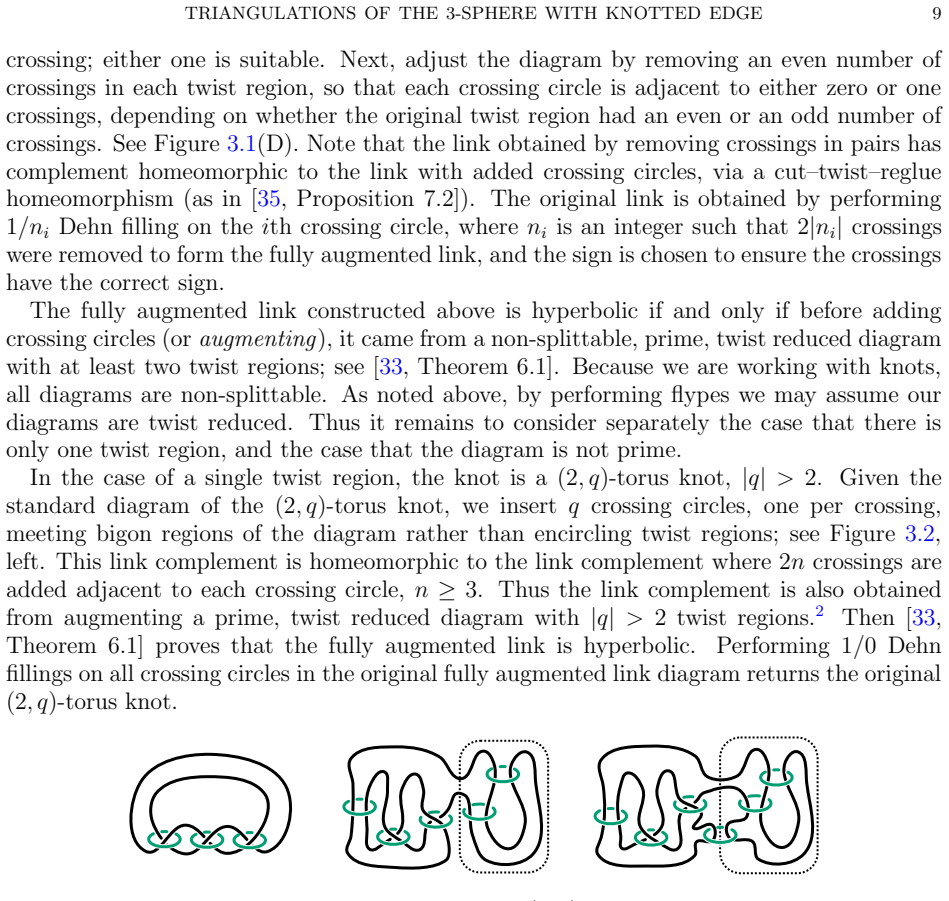
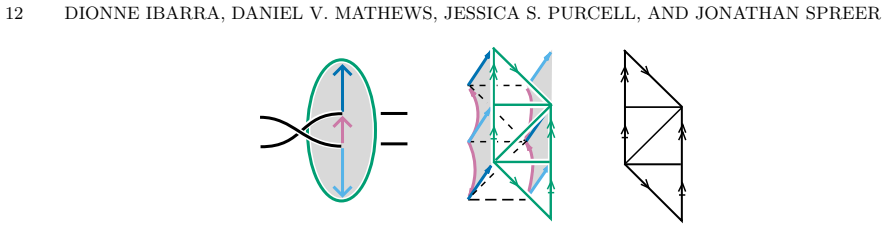
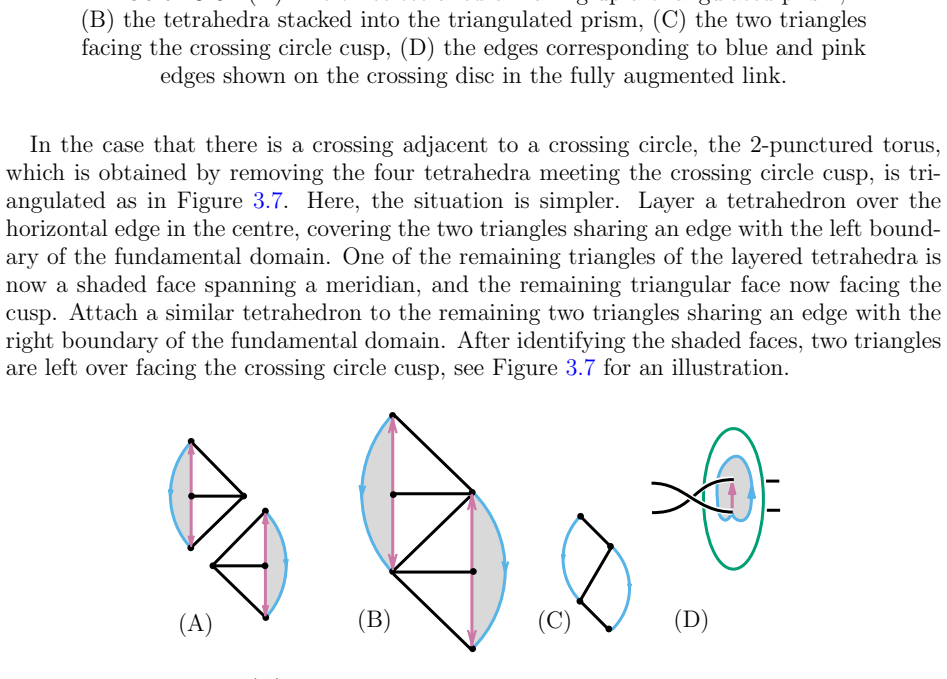
A hat triangle is a face of an ideal triangulation of a knot complement that spans a meridian of the knot's cusp. The key move is the hat-triangle closure: cut the ideal triangulation along such a face, insert a single folded tetrahedron whose two outer faces match the cut face and whose remaining two faces are folded along a distinguished edge E; Lemma 2.5 shows this is exactly meridional Dehn filling, so E represents the knot. To get a hat triangle for an arbitrary knot, the proof uses fully augmented links: augment a twist-reduced diagram with crossing circles, obtain a hyperbolic fully augmented link, triangulate its complement so each crossing circle cusp meets two tetrahedra and each crossing disc contains a meridional face, and then realize the Dehn fillings by layered solid tori.
What would settle it
Take a composite knot such as the square knot, follow Proposition 3.3 to construct its augmented link, and check whether the resulting link is prime, twist-reduced, and hyperbolic; if it is not, or if its Dehn filling does not recover the original knot, the proof chain fails. Alternatively, run the full construction on the trefoil and verify that the distinguished edge of the output one-vertex triangulation is isotopic to the trefoil.
Extended reading notes
Core claim
On the paper's own terms, the central discovery is Theorem 3.8: for any knot K in $S^{3}$ there is a one-vertex triangulation of $S^{3}$ with an edge forming K. The construction is explicit and diagram-driven. It first reduces arbitrary knots to Dehn fillings of hyperbolic fully augmented links (Proposition 3.3), then proves that every such link complement has an ideal triangulation with hat triangles, one per crossing circle (Proposition 3.7), and finally inserts a folded tetrahedron to obtain the closed one-vertex triangulation (Theorem 2.1, Corollary 2.2). The paper further derives tetrahedron bounds: at most 12c + sum |n_i| - 7 tetrahedra for a knot obtained by 1/n_i Dehn fillings on a c-crossing-circle fully augmented link (Theorem 4.1), and for connected sums of trefoils, a simplicial triangulation with edge loop length four, at most 242(48t-19) tetrahedra, with a matching lower bound up to a constant (Corollaries 4.4, 4.5).
Load-bearing premise
The load-bearing premise is that every knot, including composite knots, can be obtained by Dehn filling a hyperbolic fully augmented link; for composite knots the paper's proof of this is compressed, and if that step fails the construction collapses.
Editorial extensions
If this is right
- Every knot type occurs as an edge in some one-vertex triangulation of S^3, so a knotted edge imposes no restriction on admitting such a triangulation.
- The second derived subdivision turns the one-vertex triangulation into a simplicial triangulation with an edge loop of length four forming the same knot (Corollary 1.1).
- For connected sums of trefoils, the construction gives simplicial triangulations with O(t) tetrahedra and edge loops of length four, and any simplicial triangulation with an m-edge loop forming K_t needs at least (t - m + 1)/2 tetrahedra, so the size is optimal up to a constant factor.
- The triangulations force discrete Morse functions to have many critical 2-faces: for K_t, every Morse function has at least t - 3 critical triangles in a 242(48t-19)-tetrahedron triangulation (Corollary 1.3).
- For knots with few crossing circles, such as double twist knots, the construction yields very small one-vertex triangulations with 3 + floor(k/2) + floor(l/2) tetrahedra, conjectured minimal.
Reading between the lines
- The same construction may give explicit geometric ideal triangulations of knot complements whenever the underlying fully augmented link is hyperbolic, which could extend quantum Teichmüller TQFT computations beyond the twist-knot cases.
- The tetrahedron count depends on the number of crossing circles and filling slopes rather than on the crossing number alone, suggesting that twist-region number is the natural diagrammatic complexity measure for this construction.
- One could test sharpness computationally by enumerating small one-vertex triangulations of S^3 and checking which knots appear as edges, to see how close the construction's size is to the true minimum for small knots such as the trefoil and figure-eight.
- For composite knots, different choices of connected-sum decomposition or crossing-circle placement might reduce the tetrahedron count, since the proof pays one crossing circle per connected-sum factor.
Editorial analysis
A structured set of objections, weighed in public.
Referee Report
Summary. This paper gives a constructive proof that for every knot K in S^3 there is a one-vertex triangulation of S^3 with a distinguished edge forming K (Theorem 3.8). The main device is Theorem 2.1: starting from an ideal triangulation of S^3 minus K that contains a 'hat triangle' spanning a meridian, one cuts along that face, inserts a folded tetrahedron, and obtains a closed one-vertex triangulation in which the folded edge is K. The authors then prove, via fully augmented links, that every knot complement admits such a triangulation: Proposition 3.3 reduces an arbitrary knot to a Dehn filling of a hyperbolic fully augmented link; Lemmas 3.4 and 3.5 build explicit ideal triangulations with a meridional face; Lemma 3.6 performs Dehn fillings; Proposition 3.7 and Corollary 2.2 conclude. Section 4 gives explicit tetrahedron bounds, derives simplicial corollaries by second derived subdivision, and applies discrete Morse bounds to produce triangulations with many critical 2-faces, with an asymptotically optimal (up to a constant) treatment of connected sums of trefoils.
Significance. If the main theorem is correct, it is a significant result: it extends H-triangulations from twist knots to all knots, gives a general construction of one-vertex triangulations of S^3 with an arbitrary prescribed knotted edge, and yields concrete upper bounds on triangulation size. The proof is constructive and explicit, and the paper is careful to track tetrahedron counts in Theorem 4.1 and Corollary 4.2. The applications in Section 4, especially the asymptotically optimal (up to a constant) construction for connected sums of trefoils, are concrete and interesting. The paper builds on published work [19, 33, 34] rather than introducing new hyperbolic-geometry machinery, which makes the core construction transparent and reproducible.
major comments (2)
- [Section 3, Proposition 3.3] The composite-knot step is under-proved. The claim that the augmented link obtained by adding a crossing circle through the decomposing curve gamma is prime and twist-reduced is the only step standing between the proof and hyperbolicity for composite knots. The sentence 'if delta runs through a neighbourhood of gamma, our construction ensures that every such curve meets the diagram more than twice' is not a proof: no case analysis is given, and a simple closed curve delta lying in the twice-punctured disc bounded by the new crossing circle and meeting only the two knot strands is precisely a configuration that the text does not rule out. Since [33, Theorem 6.1] is invoked to obtain hyperbolicity, and Lemmas 3.4-3.7 require that hyperbolicity, Theorem 3.8 for composite knots depends on this point. Please supply a complete diagrammatic argument or an alternative proof that the modified augmented link is prime and twist-reduced, and verify that the same argument works when the connected-sum decomposition has several decomposing curves.
- [Section 3, Proposition 3.3] The Dehn-filling slope for the newly added crossing circle is not stated in Proposition 3.3; later Corollary 4.3 indicates that it should be 1/0. Because Proposition 3.7 invokes Lemma 3.6 to perform Dehn fillings, the proof should explicitly record this slope and verify that filling the new crossing circle along that slope recovers the original connected sum K1 # K2 rather than a twisted or otherwise altered knot.
minor comments (3)
- [Section 1, Corollary 1.1] The statement that the second derived subdivision turns the knotted edge into an edge loop of length four is plausible but should be justified briefly, since the edge loop length in the derived subdivision depends on the local edge and vertex structure of the one-vertex triangulation.
- [Section 3, Lemma 3.6] The phrase 'When |n| = 1 (n = 0)' is confusing; it should read 'When |n| = 1 or n = 0', since the case n = 0 is not covered by the condition |n| = 1.
- [Throughout] There are several typographical spacing issues, such as '1 , 2, 3, . . .' in the introduction and the repeated '∆∆∆' symbol in Section 2; these should be corrected in the final version.
Circularity Check
No circular derivation: the main theorem is a new consequence of independent published results on fully augmented links and cusp triangulations.
full rationale
The paper's central claim (Theorem 3.8) is not an input to, nor a restatement of, any result it cites. Proposition 3.3 reduces an arbitrary knot to a Dehn filling of a fully augmented link; for hyperbolic knots this is the standard augmentation argument, and for composite knots the paper supplies a (terse) modification rather than circularly assuming the conclusion. The hyperbolicity criterion invoked in Proposition 3.3 is [33, Theorem 6.1], a published theorem of Purcell with stated hypotheses (non-splittable, prime, twist-reduced diagram with at least two twist regions) that does not include the triangulation result; hence it is independent support, not a self-citation chain. Lemma 3.4 uses the geometric decomposition of fully augmented links from [19] (Ham–Purcell), but that is again an external published result with its own proof, and the present paper adds the cusp-triangulation adjustments (Lemma 3.5) and Dehn-filling realization (Lemma 3.6) rather than renaming [19]. Lemma 3.6 relies on layered solid tori as in [15], [19], and [21]; [21] is co-authored by two of the present authors but is a published, independent derivation. No fitted parameter is renamed as a prediction, no uniqueness theorem is imported to force a choice, and no equation reduces to an input by construction. The one genuine weakness is a correctness gap, not circularity: in Proposition 3.3's composite case the assertion that every simple closed curve meeting the augmented diagram twice must meet it more than twice in a neighbourhood of gamma is justified in only two sentences and is not fully case-analyzed; if that assertion failed, the hyperbolicity criterion could fail for some connected sums. That possible gap does not make the derivation circular, because the claim is neither defined in terms of the target triangulation nor borrowed from the cited hyperbolicity theorem. Accordingly the circularity score is 0.
Assumptions & free parameters
assumptions (5)
- domain assumption Fully augmented links constructed from prime, twist-reduced diagrams with at least two twist regions are hyperbolic.
- domain assumption Hyperbolic fully augmented link complements admit the ideal polyhedral decomposition described in [27], [34], and [19].
- domain assumption Sakuma-Weeks triangulations of hyperbolic 2-bridge knot complements contain a face spanning a meridian.
- domain assumption Layered solid tori along the Farey triangulation realize 1/n Dehn fillings with at most |n|-1 added tetrahedra.
- standard math Every knot has a twist-reduced diagram obtained by flypes, and knots decompose uniquely into prime summands.
Cite this review
Pith. "Pith review of Triangulations of the 3-sphere with knotted edge." pith.science (2026). https://pith.science/paper/JPMCT5OB
@misc{pith2026241118938,
  author       = {Pith},
  title        = {Pith review of: Triangulations of the 3-sphere with knotted edge},
  year         = {2026},
  howpublished = {\url{https://pith.science/paper/JPMCT5OB}},
  note         = {Machine review of arXiv:2411.18938}
}
abstract
We prove that for any knot $K$, there exists a one-vertex triangulation of the $3$-sphere containing an edge forming $K$. The proof is constructive, and based on fully augmented links. We use our method to produce ``complicated'' simplicial triangulations of the $3$-sphere that we show are smallest possible, up to a constant multiplicative factor.
Figures


Figures from the paper (10 more)






Reference graph
Works this paper leans on
-
[1]
Kashaev, A TQFT from quantum Teichm¨ uller theory, Comm
Jørgen Ellegaard Andersen and Rinat M. Kashaev, A TQFT from quantum Teichm¨ uller theory, Comm. Math. Phys. 330 (2014), no. 3, 887–934. MR 3227503
work page 2014
-
[2]
David Barnette, The triangulations of the 3-sphere with up to 8 vertices, J. Combinatorial Theory Ser. A 14 (1973), 37–52. MR 312511
work page 1973
-
[3]
Fathi Ben Aribi, Fran¸ cois Gu´ eritaud, and Eiichi Piguet-Nakazawa, Geometric triangulations and the Teichm¨ uller TQFT volume conjecture for twist knots , Quantum Topol. 14 (2023), no. 2, 285–406. MR 4636640
work page 2023
-
[4]
Bruno Benedetti, Discrete Morse theory for manifolds with boundary , Trans. Amer. Math. Soc. 364 (2012), no. 12, 6631–6670. MR 2958950
work page 2012
-
[5]
Lutz, Knots in collapsible and non-collapsible balls , Electron
Bruno Benedetti and Frank H. Lutz, Knots in collapsible and non-collapsible balls , Electron. J. Combin. 20 (2013), no. 3, Paper 31, 29. MR 3104529
work page 2013
-
[6]
Ziegler, On locally constructible spheres and balls , Acta Math
Bruno Benedetti and G¨ unter M. Ziegler, On locally constructible spheres and balls , Acta Math. 206 (2011), 205–243
work page 2011
- [7]
-
[8]
Benjamin A. Burton, Ryan Budney, Will Pettersson, et al., Regina: Software for 3-manifold topology and normal surface theory , http://regina-normal.github.io/, 1999–2023
work page 1999
Show all 39 references
-
[9]
Benjamin A. Burton and Alexander He, Finding large counterexamples by selectively exploring the pach- ner graph, Proceedings of the 39th International Symposium on Computational Geometry (SoCG 2023) 18 DIONNE IBARRA, DANIEL V. MATHEWS, JESSICA S. PURCELL, AND JONATHAN SPREER (...
2023
-
[10]
Richard Ehrenborg and Masahiro Hachimori, Non-constructible complexes and the bridge index , Euro- pean J. Combin. 22 (2001), no. 4, 475–489. MR 1829741
2001
-
[11]
Robin Forman, Morse theory for cell complexes , Adv. Math. 134 (1998), no. 1, 90–145
1998
-
[12]
, A user’s guide to discrete Morse theory , S´ em. Lothar. Combin.48 (2002), Art. B48c, 35
2002
-
[13]
Purcell, Dehn filling, volume, and the Jones polyno- mial, J
David Futer, Efstratia Kalfagianni, and Jessica S. Purcell, Dehn filling, volume, and the Jones polyno- mial, J. Differential Geom. 78 (2008), no. 3, 429–464. MR 2396249
2008
-
[14]
Purcell, Links with no exceptional surgeries , Comment
David Futer and Jessica S. Purcell, Links with no exceptional surgeries , Comment. Math. Helv. 82 (2007), no. 3, 629–664. MR MR2314056 (2008k:57008)
2007
-
[15]
Fran¸ cois Gu´ eritaud and Saul Schleimer,Canonical triangulations of Dehn fillings , Geom. Topol. 14 (2010), no. 1, 193–242. MR 2578304
2010
-
[16]
Fran¸ cois Gu´ eritaud,On canonical triangulations of once-punctured torus bundles and two-bridge link complements, Geom. Topol. 10 (2006), 1239–1284, With an appendix by David Futer. MR 2255497
2006
-
[17]
Knot Theory Ram- ifications 13 (2004), no
Masahiro Hachimori and Koya Shimokawa, Tangle sum and constructible spheres , J. Knot Theory Ram- ifications 13 (2004), no. 3, 373–383. MR 2061175
2004
-
[18]
Ziegler, Decompositons of simplicial balls and spheres with knots consisting of few edges , Math
Masahiro Hachimori and G¨ unter M. Ziegler, Decompositons of simplicial balls and spheres with knots consisting of few edges , Math. Z. 235 (2000), no. 1, 159–171. MR 1785077
2000
-
[19]
Ham and Jessica S
Sophie L. Ham and Jessica S. Purcell, Geometric triangulations and highly twisted links , Algebr. Geom. Topol. 23 (2023), no. 3, 1399–1462. MR 4598810
2023
-
[20]
Alexander He, Eric Sedgwick, and Jonathan Spreer, Certifying that a knot is composite , 2024, In prepa- ration
2024
-
[21]
Howie, Daniel V
Joshua A. Howie, Daniel V. Mathews, and Jessica S. Purcell, A-polynomials, Ptolemy varieties, and Dehn filling , Algebr. Geom. Topol. (to appear), arXiv:2002.10356, 2020
2002 arXiv
-
[22]
Dionne Ibarra, Daniel Mathews, and Jessica Purcell, On triangulations of double twist knots , 2024, In preparation
2024
-
[23]
Hyam Rubinstein, 0 -efficient triangulations of 3-manifolds , J
William Jaco and J. Hyam Rubinstein, 0 -efficient triangulations of 3-manifolds , J. Differential Geom. 65 (2003), no. 1, 61–168. MR 2057531
2003
-
[24]
Kashaev, Quantum dilogarithm as a 6j-symbol, Modern Phys
Rinat M. Kashaev, Quantum dilogarithm as a 6j-symbol, Modern Phys. Lett. A 9 (1994), no. 40, 3757–
1994
-
[25]
, The hyperbolic volume of knots from the quantum dilogarithm , Lett. Math. Phys. 39 (1997), no. 3, 269–275. MR 1434238
1997
-
[26]
Kashaev, Feng Luo, and Grigory Vartanov, A TQFT of Turaev-Viro type on shaped triangu- lations, Ann
Rinat M. Kashaev, Feng Luo, and Grigory Vartanov, A TQFT of Turaev-Viro type on shaped triangu- lations, Ann. Henri Poincar´ e17 (2016), no. 5, 1109–1143. MR 3486430
2016
-
[27]
London Math
Marc Lackenby, The volume of hyperbolic alternating link complements , Proc. London Math. Soc. (3) 88 (2004), no. 1, 204–224, With an appendix by Ian Agol and Dylan Thurston
2004
-
[28]
W. B. Raymond Lickorish, Unshellable triangulations of spheres , European J. Combin. 12 (1991), no. 6, 527–530. MR 1136394
1991
-
[29]
Lutz, Small examples of nonconstructible simplicial balls and spheres, SIAM Journal on Discrete Mathematics 18 (2004), no
Frank H. Lutz, Small examples of nonconstructible simplicial balls and spheres, SIAM Journal on Discrete Mathematics 18 (2004), no. 1, 103–109
2004
-
[30]
Discrete Math
, Small examples of nonconstructible simplicial balls and spheres , SIAM J. Discrete Math. 18 (2004), no. 1, 103–109. MR 2112491
2004
-
[31]
9, Springer, Berlin, 2007
Sergei Matveev, Algorithmic topology and classification of 3-manifolds, second ed., Algorithms and Com- putation in Mathematics, vol. 9, Springer, Berlin, 2007. MR 2341532
2007
-
[32]
186 (2001), no
Hitoshi Murakami and Jun Murakami, The colored Jones polynomials and the simplicial volume of a knot, Acta Math. 186 (2001), no. 1, 85–104. MR 1828373
2001
-
[33]
Purcell, Cusp shapes under cone deformation , J
Jessica S. Purcell, Cusp shapes under cone deformation , J. Differential Geom. 80 (2008), no. 3, 453–500. MR MR2472480
2008
-
[34]
Math., vol
, An introduction to fully augmented links , Interactions between hyperbolic geometry, quan- tum topology and number theory, Contemp. Math., vol. 541, Amer. Math. Soc., Providence, RI, 2011, pp. 205–220. MR 2796634
2011
-
[35]
209, American Mathematical Society, Providence, RI, [2020] ©2020
, Hyperbolic knot theory , Graduate Studies in Mathematics, vol. 209, American Mathematical Society, Providence, RI, [2020] ©2020. MR 4249621 TRIANGULATIONS OF THE 3-SPHERE WITH KNOTTED EDGE 19
2020
-
[36]
Makoto Sakuma and Jeffrey Weeks, Examples of canonical decompositions of hyperbolic link complements, Japan. J. Math. (N.S.) 21 (1995), no. 2, 393–439. MR 1364387
1995
-
[37]
3 (Geometries), 1922, pp
Ernst Steinitz, Iiiab12: Polyeder und raumeinteilungen , Encyclop¨ adie der mathematischen Wis- senschaften, vol. 3 (Geometries), 1922, pp. 1–139
1922
-
[38]
Thurston, The geometry and topology of three-manifolds, Princeton Univ
William P. Thurston, The geometry and topology of three-manifolds, Princeton Univ. Math. Dept. Notes, 1979
1979
-
[39]
Ziegler,Lectures on polytopes, Graduate Texts in Mathematics, no
G¨ unter M. Ziegler,Lectures on polytopes, Graduate Texts in Mathematics, no. 152, Springer-Verlag, New York, 1995. School of Mathematics, Monash University, VIC 3800, Australia. Email address : dionne.ibarra@monash.edu School of Mathematics, Monash University, VIC 3800, Austr...
1995
Reviewed August 12, 2026 · model on record in the stance chip above.
Discussion (0). Continue with ORCID to comment.