REVIEW 2 major objections 7 minor 20 references
Photon Angular Distribution in Two-Photon Electron Capture by H-Like Uranium
T0 review · 2 major / 7 minor · reviewed 2026-08-12 · deepseek-v4-flash
Pith's one-line read The two-photon angular distribution in resonant electron capture by H-like uranium is governed by interference between dielectronic and radiative recombination, so the full cross section is not a sum of independent channel contributions.
desk verdict Solid QED calculation of a genuinely new observable, with a real but unquantified truncation risk in the intermediate-state basis; worth refereeing. read the letter →
The pith
A machine-rendered reading of the paper's core claim, the machinery that carries it, and where it could break.
The reading
What carries the argument
The two-photon amplitude in the line-profile approach (LPA), a QED method that treats autoionizing intermediate states with complex energies including radiative widths and accounts for self-energy, vacuum polarization, and one- and two-photon exchange corrections. The central object is Eq. (7), where the sum over intermediate two-electron states contains both resonant and nonresonant contributions with a common denominator E_F + ω − E_N + (i/2)Γ_N. The interference appears because for the satellite photon, emitted in the (1s2l) → (1s)² transition, the RR and DR amplitudes differ only by a phase shift. In the XY-plane, the normalized cross section is parameterized as (1/2π)(C(ω1) − A(ω1) sin²φ), with A measuring the strength of the DR-induced angular modulation.
What would settle it
Measure the normalized two-photon angular distribution in the XY-plane for U91+ electron capture at 63.9235 keV, resolving the (1s2s)1 and (1s2p1/2)1 cascade photons. If the observed dependence on the azimuthal angle difference φ matches the incoherent sum of separately computed DR and RR patterns rather than the C − A sin²φ form of Eq. (24), the claimed interference is absent.
Extended reading notes
Core claim
The paper claims that in resonant two-photon electron capture by H-like uranium, the two-photon angular distribution is controlled by coherent interference between the dielectronic recombination and radiative recombination channels, not by their independent contributions. For the dominant cascade states (1s2s)1 and (1s2p1/2)1, the DR channel produces a marked oscillation in the normalized XY-plane cross section as a function of the azimuthal angle difference between the two photon momenta, while RR is nearly isotropic; in the XZ-plane, DR-dominated cascades show strong correlation between the two photon directions, while RR-dominated cascades show only weak correlation. The paper therefore concludes that going beyond the single-photon approximation is necessary and that the full differential cross section cannot be split into separate DR and RR parts.
Load-bearing premise
The load-bearing premise is that two-electron intermediate states with the first electron in principal quantum number n1 ≥ 3 contribute negligibly to the angular distribution at the chosen resonance energy, and the paper gives no convergence estimate for omitting them.
Editorial extensions
If this is right
- Treating DR and RR as independent channels is invalid for the two-photon differential cross section; the interference contribution must be included.
- The satellite photon carries the angular-correlation signal that the single-photon approximation throws away, so two-photon angular measurements are needed to see the full channel interplay.
- The XY-plane normalized cross section is approximately (1/2π)(C(ω1) − A(ω1) sin²φ), giving a compact, testable signature with tabulated coefficients for each cascade state.
- Close-lying resonances with opposite angular patterns compensate one another after energy averaging, so the DR fingerprint is visible only when individual cascade states are resolved.
- For the (1s2p3/2)2 state, the single-photon approximation is especially poor because the ratio of the partial width to the total width is only 0.62, making the full two-photon treatment necessary.
Reading between the lines
- An untested implication is that similar DR–RR interference patterns should appear for other high-Z hydrogen-like ions, and the coefficients in the XY-plane parameterization might scale with nuclear charge, allowing an isoelectronic test of the mechanism beyond uranium.
- A testable extension would be to include two-electron intermediate states with the first electron in n1 ≥ 3 and quantify how much the A(ω1) and C(ω1) coefficients shift; a large shift would require revising the quantitative predictions even if the qualitative DR-versus-RR distinction survives.
- Because the interference for the satellite photon originates from two amplitudes that differ only by a phase, the effect should be sensitive to any experimental asymmetry that breaks the azimuthal averaging, such as circularly polarized photons or a polarized electron beam.
- Measuring the two-photon angular correlation at a single fixed angle difference, combined with a normalization measurement, might extract both coefficients of the paper's parameterization and provide a compact experimental diagnostic for DR dominance.
Signed reviews
Editorial analysis
A structured set of objections, weighed in public.
Referee Report
Summary. This paper presents a QED line-profile calculation of the fully differential cross section for two-photon electron capture by H-like uranium, focusing on the angular distribution of the two emitted photons at an incident energy where dielectronic recombination dominates. The authors analyze four cascade resonances through the (1s2s) and (1s2p) intermediate states, separate the DR and RR contributions, and study the one-photon and two-photon angular distributions in the XY- and XZ-planes. The central claim is that the two-photon angular distribution exhibits strong interference between the DR and RR channels, with DR producing pronounced oscillations in the XY-plane and strong two-photon correlations in the XZ-plane while RR is nearly isotropic. They provide a compact parameterization of the XY-plane normalized cross section in Eq. (24).
Significance. If correct, this work is a significant step beyond the single-photon approximation for resonant two-photon electron capture in high-Z ions, providing concrete predictions for the angular correlation of emitted photons that can be compared with future experiments. The calculation is based on the QED line-profile approach previously developed by the authors, and it benefits from a fully relativistic treatment with a complete Dirac spectrum for the second electron. The explicit separation of DR and RR channels and the identification of interference effects are valuable for interpreting experimental spectra. However, the quantitative reliability of the predictions depends on the convergence of the intermediate-state truncation, which is not yet demonstrated, and the interference claim would benefit from a direct quantitative definition.
major comments (2)
- [Section II, paragraph following Eq. (7)] The truncation of the intermediate two-electron basis to states with n1=1 or 2 is stated to be sufficient without a convergence study. Because Eq. (7) sums over the complete basis of two-electron states, the omission of n1≥3 configurations could affect the amplitudes through off-resonant virtual paths and tails of higher resonances, thereby changing the predicted angular distributions in Figs. 9-13 and the fitted coefficients in Eq. (24). Given that the central conclusion about DR/RR interference depends on these amplitudes, please provide a quantitative estimate of the omitted contributions, for example by including n1=3 states in a test calculation or by bounding the size of the neglected terms.
- [Section IV (Figs. 10 and 12-13) and Section V] The claim of strong interference between the DR and RR channels is not explicitly demonstrated. The full amplitude is the coherent sum of the DR and RR amplitudes, so the interference contribution is the difference between the full cross section and the incoherent sum of the separate DR and RR cross sections. The paper shows full, DR-only, and RR-only curves, but not the incoherent sum. Please show the incoherent sum alongside the full result (or otherwise quantify the interference term) to support the statement that the two-photon angular distribution cannot be reduced to independent DR and RR contributions.
minor comments (7)
- [Table II] The column header 'd3σXZ' appears to be a typo; it should be 'd3σXY' as the parameters refer to the XY-plane normalization in Eq. (22).
- [Section IV.B.1, Eq. (24) and Table II] The normalization condition π(2C-A)=1 stated after Eq. (24) does not appear to be satisfied by the tabulated values when the stated units are taken literally (for the (1s2s)1 row, π(2C-A) ≈ 0.159). Please clarify the normalization convention used for Eqs. (22)-(24) or correct the table entries.
- [Section I] In the Introduction, 'a important role' should be corrected to 'an important role'.
- [Section III] The sentence 'The energies of the emitted photons are lie in the interval' should read 'The energies of the emitted photons lie in the interval'.
- [Section III] The notation 'Eq. ˜(13)' contains a stray tilde and should be simply 'Eq. (13)'.
- [Eq. (22)] The definition of the denominator d3σXY/(dω1 d cosθ1 d cosθ2) should be spelled out explicitly: it is the integral of the fully differential cross section over φ1 and φ2 at θ1=θ2=π/2.
- [Section IV.A] The choice of the energy integration interval [ω1^{(res,N)} - 50Γ_N, ω1^{(res,N)} + 50Γ_N] with N=(1s2p1/2)1 for the first group and N=(1s2p3/2)1 for the second group is plausible but ad hoc; a brief justification (e.g., typical detector resolution) would help the reader.
Circularity Check
No significant circularity: the angular distributions are direct QED calculations, and the reported DR/RR interference is an output of coherent amplitude sums, not an input.
full rationale
The derivation is self-contained in the relevant sense. The central quantity is the two-photon amplitude U_FI in Eq. (7), built from QED matrix elements (8)-(9) and summed over the intermediate-state basis; the differential cross section (10)-(11) is then evaluated at fixed resonance energies with no fitted parameters entering the dynamics. The DR/RR separation is a post-processing of the same amplitude: the full coherent cross section is compared with calculations retaining only DR-type or RR-type intermediate states (Figs. 3-6, 10, 12-13), so the reported strong interference is a computed cross-term effect, not an assumption built into the input. The parameterization Eq. (24) with coefficients C and A in Table II is an accurate fit to the already-computed normalized angular distribution, not an input used to generate the distribution; therefore it is not a fitted-input-called-prediction case. Citations to [4,16,18] supply the line-profile-approach framework; those works are independent published methods and, crucially, this paper's angular-distribution result is not contained in [4], which focused on the energy spectrum. The one notable approximation, truncating the first-electron principal quantum number to n1=1,2 in Section II, is asserted without a convergence study; that is a correctness and convergence risk, but it does not make any predicted quantity equivalent to an input by construction. No self-definitional step, uniqueness import, or ansatz-smuggling via self-citation is present.
Assumptions & free parameters
assumptions (5)
- domain assumption The line-profile approach (LPA) gives a valid QED description of two-photon electron capture with quasidegenerate autoionizing states.
- ad hoc to paper Intermediate two-electron states with n1 = 1 or 2 are sufficient for the angular distribution at the chosen resonance.
- domain assumption Unpolarized incident electrons and unpolarized detected photons are the relevant experimental scenario.
- domain assumption The two photons can be labeled 'resonant' and 'satellite' by their energies at the cascade resonances.
- domain assumption The four selected cascade states dominate the two-photon emission at the chosen incident energy.
Cite this review
Pith. "Pith review of Photon Angular Distribution in Two-Photon Electron Capture by H-Like Uranium." pith.science (2026). https://pith.science/paper/T4ORETWE
@misc{pith2026241119001,
  author       = {Pith},
  title        = {Pith review of: Photon Angular Distribution in Two-Photon Electron Capture by H-Like Uranium},
  year         = {2026},
  howpublished = {\url{https://pith.science/paper/T4ORETWE}},
  note         = {Machine review of arXiv:2411.19001}
}
abstract
We present a comprehensive study of the angular distribution of photons emitted during the resonant two-photon electron capture by H-like uranium ions. Focusing on the energies of incident electrons, at which the dielectronic recombination (DR) dominates, we analyze the angular emission spectrum of the most significant cascade transitions, which make the main contribution to the total cross section. In particular, we consider the cascade transitions that occur with the formation of $(1s2s)$ and $(1s2p)$ intermediate states. We investigate the angular distribution of the emitted photons beyond the single-photon approximation. We separately consider the contributions of the DR and the radiation recombination (RR) channels and demonstrate that the two-photon angular distribution shows strong interference between these channels.
Figures


Figures from the paper (7 more)


Reference graph
Works this paper leans on
-
[4]
Z. Yang, J. Gao, W. Yan, K. Yao, J. Yang, Z. Wu, and Z. Hu, Anisotropy and polarization of x-ray line emissions in the dielectronic recombination of hydrogenlike fe 25+ ions, Phys. Rev. A 104, 022809 (2021)
work page 2021
-
[10]
D. Bernhardt, C. Brandau, Z. Harman, C. Kozhuharov, A. M¨ uller, W. Scheid, S. Schippers, E. W. Schmidt, D. Yu, A. N. Artemyev, I. I. Tupitsyn, S. B¨ ohm, F. Bosch, F. J. Currell, B. Franzke, A. Gumberidze, J. Jacobi, P. H. Mokler, F. Nolden, U. Spillman, Z. Stachura, M. Steck, and T. St¨ ohlker, Breit interaction in dielectronic recombi- nation of hydrog...
work page 2011
-
[1]
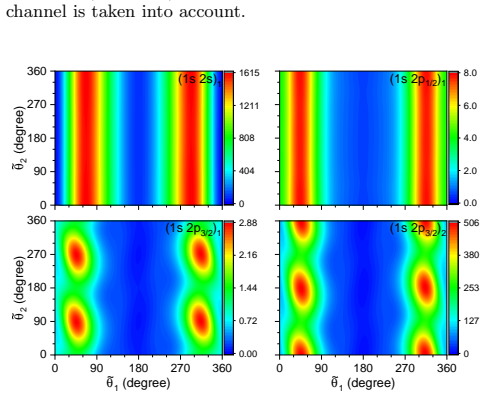
XY-plane In the scenario where both emitted photon momenta lie in the XY-plane (θ1 = θ2 = 90◦), the differential cross section depends only on the angle between the photon 6 0 3 06 09 01 201 501 800.01.0× 1 04 2.0× 1 04 2 .0× 1 05 2 .2× 1 05 2 .4× 1 05 0 3 06 09 01 201 501 800.01.0× 1 04 2.0× 1 04 2 .0× 1 05 2 .2× 1 05 2 .4× 1 05 diff. cross section (barn...
-
[2]
XZ-plane Here, we consider photons with momenta in the XZ- plane, so the photon momenta ( k1 and k2) and the inci- dent electron momentum ( p) lie in the same plane. Ac- cordingly, in this scenario, the azimuthal angles of the emitted photons ( φi, i = 1 , 2) can take two values: 0 ◦ and 180◦. The polar angles ( θi, i = 1, 2) vary within the interval [0, ...
-
[3]
N. Nakamura, H. Tobiyama, H. Nohara, A. P. Kavanagh, H. Watanabe, H. A. Sakaue, Y. Li, D. Kato, F. J. Cur- rell, C. Yamada, and S. Ohtani, Resonant electron pro- cesses with open-shell highly charged ion targets, Journal of Physics: Conference Series 58, 267 (2007)
work page 2007
-
[5]
N. Nakamura, N. Numadate, S. Oishi, X.-M. Tong, X. Gao, D. Kato, H. Odaka, T. Takahashi, Y. Tsuzuki, Y. Uchida, H. Watanabe, S. Watanabe, and H. Yoneda, Strong Polarization of a J = 1 /2 to 1 /2 Transition Arising from Unexpectedly Large Quantum Interference, Phys. Rev. Lett. 130, 113001 (2023)
work page 2023
-
[6]
K. N. Lyashchenko, O. Y. Andreev, and D. Yu, Two- photon electron capture by h-like uranium, Phys. Rev. A 109, 032805 (2024)
work page 2024
-
[7]
J. Eichler and T. St¨ ohlker, Radiative electron capture in relativistic ion-atom collisions and the photoelectric effect in hydrogen-like high-Z systems, Phys. Rep. 439, 1 (2007)
work page 2007
Show all 20 references
-
[8]
Eichler, A
J. Eichler, A. Ichihara, and T. Shirai, Photon angular dis- tributions from radiative electron capture in relativistic atomic collisions, Phys. Rev. A 51, 3027 (1995)
1995
-
[9]
Karasiov, L
V. Karasiov, L. Labzowsky, A. Nefiodov, and V. Shabaev, Overlapping resonances in the process of recombination of an electron with hydrogenlike uranium, Physics Letters A 161, 453 (1992)
1992
-
[11]
K. N. Lyashchenko and O. Y. Andreev, Importance of the Breit interaction for calculation of the differential cross section for dielectronic recombination with one-electron uranium, Phys. Rev. A 91, 012511 (2015)
2015
-
[12]
Zakowicz, W
S. Zakowicz, W. Scheid, and N. Gr¨ un, Dielectronic re- combination into hydrogen-like heavy ions with emission of two photons, Journal of Physics B: Atomic, Molecular and Optical Physics 37, 131 (2004)
2004
-
[13]
Nakamura, A
N. Nakamura, A. P. Kavanagh, H. Watanabe, H. A. Sakaue, Y. Li, D. Kato, F. J. Currell, and S. Ohtani, Evidence for strong breit interaction in dielectronic re- combination of highly charged heavy ions, Phys. Rev. Lett. 100, 073203 (2008)
2008
-
[14]
Mahmood, S
S. Mahmood, S. Ali, I. Orban, S. Tashenov, E. Lindroth, and R. Schuch, Recombination and electron impact exci- tation rate coefficients for S XV and S XVI, The Astro- physical Journal 754, 86 (2012)
2012
-
[15]
Lindroth, I
E. Lindroth, I. Orban, S. Trotsenko, and R. Schuch, Electron-impact recombination and excitation rates for charge-state-selected highly charged Si ions, Phys. Rev. A 101, 062706 (2020)
2020
-
[16]
Z. Hu, G. Xiong, Z. He, Z. Yang, N. Numadate, C. Huang, J. Yang, K. Yao, B. Wei, Y. Zou, C. Wu, Y. Ma, Y. Wu, X. Gao, and N. Nakamura, Giant retar- dation effect in electron-electron interaction, Phys. Rev. A 105, L030801 (2022)
2022
-
[17]
Aharonian et al
F. Aharonian et al. (Hitomi Collaboration), Atomic data and spectral modeling constraints from high-resolution X-ray observations of the Perseus cluster with Hitomi*, Publications of the Astronomical Society of Japan 70, 12 (2018)
2018
-
[18]
O. Y. Andreev, L. N. Labzowsky, G. Plunien, and D. A. Solovyev, QED theory of the spectral line profile and its applications to atoms and ions, Physics Reports 455, 135 (2008)
2008
-
[19]
D. A. Varshalovich, A. N. Moskalev, and V. K. Kher- sonskii, Quantum Theory of Angular Momentum(World Scientific Publishing Co. Pte. Ltd., Singapore, 1988)
1988
-
[20]
O. Yu. Andreev, L. N. Labzowsky, and A. V. Prigorovsky, Line-profile approach to the description of the electron- recombination process for the highly charged ions, Phys. Rev. A 80, 042514 (2009)
2009
Reviewed August 12, 2026 · model on record in the stance chip above.
Discussion (0). Continue with ORCID to comment.