Characterization of Trees with Maximum Security
Pith reviewed 2026-05-23 08:31 UTC · model grok-4.3
The pith
Families of binary trees that maximize the sum of vertex ranks are fully classified.
A machine-rendered reading of the paper's core claim, the machinery that carries it, and where it could break.
Core claim
We produce a classification of families of binary trees for which the security is maximized. Security is the sum of the ranks of all vertices, and the rank of a vertex is the minimum distance to any of its leaf descendants. Extremal results relating to the maximum rank among all vertices in families of trees are also discussed.
What carries the argument
Security of a rooted binary tree, the sum of vertex ranks where each rank is the minimum distance from the vertex to a descendant leaf.
Load-bearing premise
That summing the minimum leaf distances over every vertex produces the correct notion of maximum security for binary trees.
What would settle it
Exhibit one binary tree whose total rank sum exceeds the value attained by every tree in the classified families.
Figures
read the original abstract
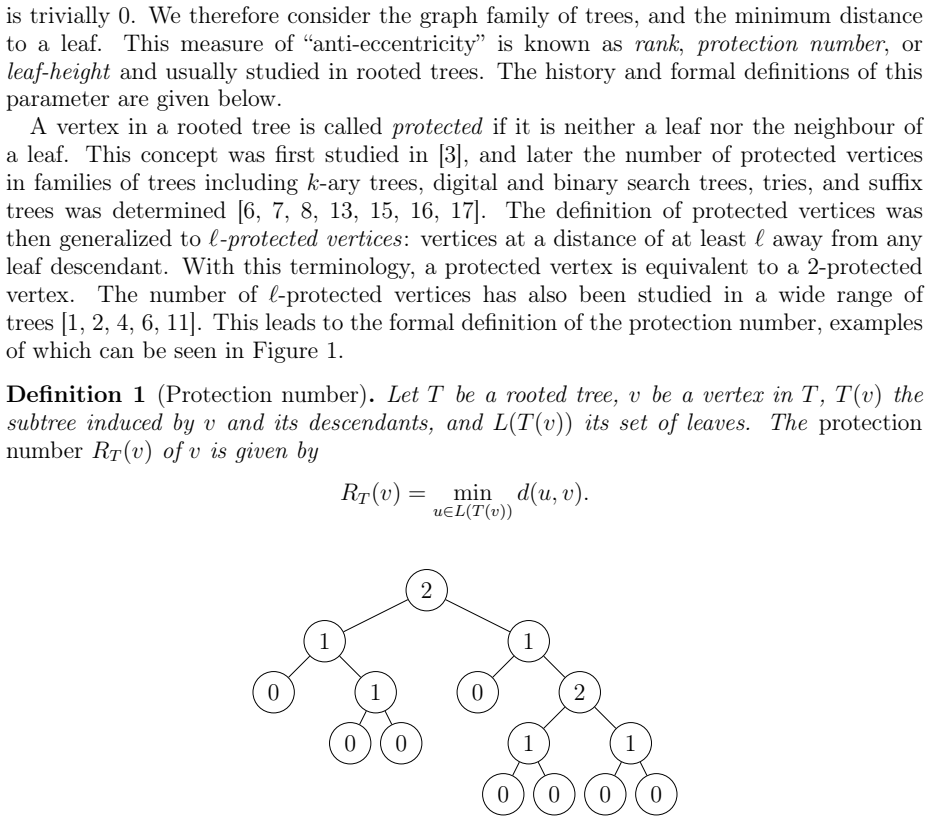
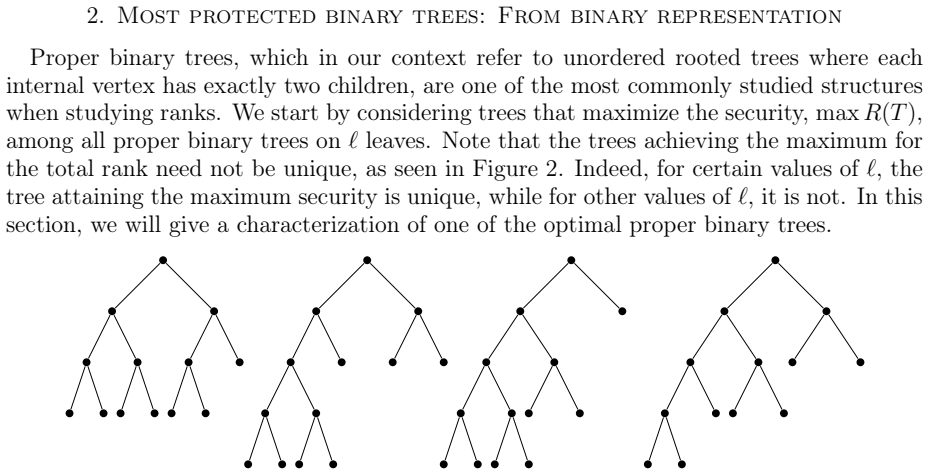
The rank (also known as protection number or leaf-height) of a vertex in a rooted tree is the minimum distance between the vertex and any of its leaf descendants. We consider the sum of ranks over all vertices (known as the security) in binary trees, and produce a classification of families of binary trees for which the security is maximized. In addition, extremal results relating to maximum rank among all vertices in families of trees is discussed.
Editorial analysis
A structured set of objections, weighed in public.
Referee Report
Summary. The paper defines the rank of a vertex in a rooted tree as the minimum distance to any leaf descendant and security as the sum of these ranks over all vertices. It claims to classify families of binary trees that maximize security and discusses related extremal results on the maximum rank among vertices.
Significance. A correct classification of binary trees maximizing security under a fixed size constraint would provide a concrete contribution to extremal problems on rooted trees in combinatorics. The definitions are standard and the problem is well-posed once the size parameter is fixed, but the manuscript's central claim as stated does not address this.
major comments (1)
- [Abstract] Abstract and Introduction: the claim that the paper produces 'a classification of families of binary trees for which the security is maximized' omits any size constraint (e.g., among all rooted binary trees on n vertices or with n leaves). Without such a constraint, security is unbounded because adding levels increases the sum of ranks; the maximality statement is therefore undefined and the classification cannot be verified.
Simulated Author's Rebuttal
We thank the referee for their detailed review and for identifying this important clarification needed in the abstract and introduction. We address the comment below.
read point-by-point responses
-
Referee: [Abstract] Abstract and Introduction: the claim that the paper produces 'a classification of families of binary trees for which the security is maximized' omits any size constraint (e.g., among all rooted binary trees on n vertices or with n leaves). Without such a constraint, security is unbounded because adding levels increases the sum of ranks; the maximality statement is therefore undefined and the classification cannot be verified.
Authors: We agree that the abstract and introduction must explicitly indicate the size constraint. The results classify binary trees on a fixed number n of vertices (equivalently, with a fixed number of leaves) that maximize security; without this the statement is indeed ill-posed. We will revise the abstract to: 'We consider the sum of ranks over all vertices (known as the security) in binary trees with n vertices, and produce a classification of families of binary trees for which the security is maximized.' Parallel wording will be added to the introduction and the statement of the main theorem. This makes the claim precise and verifiable. revision: yes
Circularity Check
No circularity detected; classification claim is a standard extremal result on explicitly defined parameters.
full rationale
The provided abstract and description contain only definitions of rank (min distance to leaf descendant) and security (sum of ranks), followed by a claim to classify families maximizing security in binary trees. No equations, derivations, fitted parameters, or self-citations appear that could reduce a result to its inputs by construction. The extremal problem is well-posed under the standard interpretation of fixed n (vertices or leaves), making the derivation self-contained against external combinatorial benchmarks with no load-bearing self-reference or renaming of known patterns.
Axiom & Free-Parameter Ledger
axioms (1)
- domain assumption Rank of a vertex equals the minimum distance to any leaf descendant.
Reference graph
Works this paper leans on
-
[1]
Mikl´ os B´ ona.k-protected vertices in binary search trees.Adv. in Appl. Math., 53:1–11, 2014
work page 2014
-
[2]
On a random search tree: asymptotic enumeration of vertices by distance from leaves—corrigendum.Adv
Mikl´ os B´ ona and Boris Pittel. On a random search tree: asymptotic enumeration of vertices by distance from leaves—corrigendum.Adv. in Appl. Probab., 54(2):337–339, 2022
work page 2022
-
[3]
Gi-Sang Cheon and Louis W. Shapiro. Protected points in ordered trees.Appl. Math. Lett., 21(5):516– 520, 2008
work page 2008
-
[4]
Keith Copenhaver.k-protected vertices in unlabeled rooted plane trees.Graphs Combin., 33(2):347– 355, 2017
work page 2017
-
[5]
Luc Devroye, Marcel K. Goh, and Rosie Y. Zhao. On the peel number and the leaf-height of Galton- Watson trees.Combin. Probab. Comput., 32(1):68–90, 2023
work page 2023
-
[6]
Protected nodes and fringe subtrees in some random trees.Electron
Luc Devroye and Svante Janson. Protected nodes and fringe subtrees in some random trees.Electron. Commun. Probab., 19:no. 6, 10, 2014
work page 2014
-
[7]
Rosena R. X. Du and Helmut Prodinger. Notes on protected nodes in digital search trees.Appl. Math. Lett., 25(6):1025–1028, 2012
work page 2012
-
[8]
Jeffrey Gaither, Yushi Homma, Mark Sellke, and Mark D. Ward. On the number of 2-protected nodes in tries and suffix trees. In Nicolas Broutin and Luc Devroye, editors,23rd International Meeting on Probabilistic, Combinatorial, and Asymptotic Methods in the Analysis of Algorithms (AofA’12), pages 381–398, Montreal, Canada, 2012. Discrete Mathematics and Th...
work page 2012
-
[9]
Protec- tion numbers in simply generated trees and P´ olya trees.Appl
Bernhard Gittenberger, Zbigniew Go le˛biewski, Isabella Larcher, and Ma lgorzata Sulkowska. Protec- tion numbers in simply generated trees and P´ olya trees.Appl. Anal. Discrete Math., 17:1–24, 2023
work page 2023
-
[10]
Protection number of recursive trees
Zbigniew Go le˛biewski and Mateusz Klimczak. Protection number of recursive trees. InProceedings of the Sixteenth Workshop on Analytic Algorithmics and Combinatorics (ANALCO), pages 45–53, Philadelphia PA, 2019. SIAM
work page 2019
-
[11]
Protection number in plane trees.Appl
Clemens Heuberger and Helmut Prodinger. Protection number in plane trees.Appl. Anal. Discrete Math., 11:314–326, 2017
work page 2017
-
[12]
Clemens Heuberger, Sarah J. Selkirk, and Stephan Wagner. The distribution of the maximum pro- tection number in simply generated trees. arXiv preprint arXiv:2305.09427
-
[13]
CeciliaHolmgrenandSvanteJanson.Asymptoticdistributionoftwo-protectednodesinternarysearch trees.Electron. J. Probab., 20:1–20, 2015. 22
work page 2015
-
[14]
Limit laws for functions of fringe trees for binary search trees and random recursive trees.Electron
Cecilia Holmgren and Svante Janson. Limit laws for functions of fringe trees for binary search trees and random recursive trees.Electron. J. Probab., 20:no. 4, 51, 2015
work page 2015
-
[15]
Hosam M. Mahmoud and Mark D. Ward. Asymptotic properties of protected nodes in random recur- sive trees.J. Appl. Probab., 52(1):290–297, 2015
work page 2015
-
[16]
Hosam M. Mahmoud and Mark Daniel Ward. Asymptotic distribution of two-protected nodes in random binary search trees.Appl. Math. Lett., 25(12):2218–2222, 2012
work page 2012
-
[17]
Protected points ink-ary trees.Appl
Toufik Mansour. Protected points ink-ary trees.Appl. Math. Lett., 24(4):478–480, 2011
work page 2011
-
[18]
On subtrees of trees.Advances in Applied Mathematics, 34(1):138–155, 2005
Laszlo Szekely and Hua Wang. On subtrees of trees.Advances in Applied Mathematics, 34(1):138–155, 2005. (Alex S. A. Alochukwu)Albany State University, United States of America. Email address:alex.alochukwu (at) asurams.edu (AudaceA.V.Dossou-Olory)InstitutNationaldel’Eau, andCentred’Excellenced’Afrique pour l’Eau et l’Assainissement and Institut de Math´em...
work page 2005
discussion (0)
Sign in with ORCID, Apple, or X to comment. Anyone can read and Pith papers without signing in.