REVIEW 4 major objections 4 minor 73 references
Fused-MemBrain: a spiking processor combining CMOS and self-assembled memristive networks
T0 review · 4 major / 4 minor · reviewed 2026-08-12 · deepseek-v4-flash
Pith's one-line read The paper proposes that a planar self-assembled memristive material can replace the engineered synaptic circuits between CMOS neurons, and shows in simulation that such a 'Fused-MemBrain' plexus sustains its own spiking activity and…
desk verdict A fresh architecture and useful simulator, but the main demonstration is undercut by a concrete parameter inconsistency; send to review with requests for fixes. read the letter →
The pith
A machine-rendered reading of the paper's core claim, the machinery that carries it, and where it could break.
The reading
What carries the argument
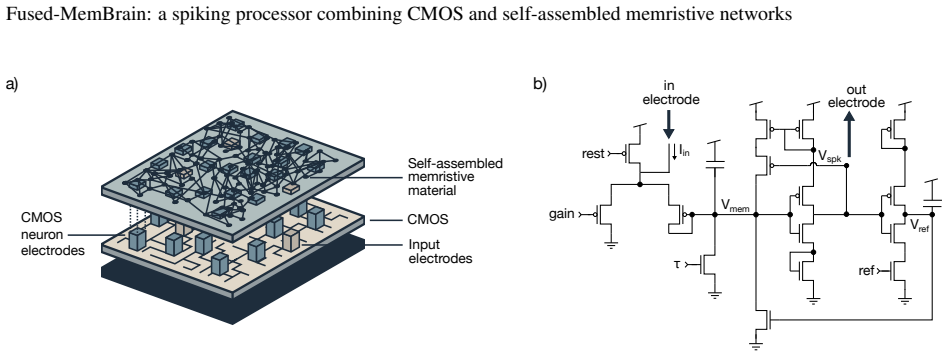
The load-bearing object is the memristive plexus, modeled as a grid-graph of edges, each a memristor with a normalized conductance $g \in [0,1]$ obeying the potentiation-depression balance equation $dg/dt = (1-g)k_p(V) - g\,k_d(V)$, where the rates $k_p, k_d$ depend exponentially on the voltage difference and the edge current is $I = [g\,G_{\max} + (1-g)\,G_{\min}]V$. This gives each edge short-term plasticity with an analytical update $g(t+\Delta t) = \tilde{g}(1-e^{-\theta\Delta t}) + g(t)e^{-\theta\Delta t}$, where $\tilde{g}=k_p/(k_p+k_d)$ is the voltage-dependent conductance attractor. CMOS LIF neurons integrate the current arriving at their electrode, and when they spike they apply a bipolar voltage pulse—positive then negative—back into the plexus, so neuron spikes and memristive conductance continuously drive each other. Spatial coarse-graining at roughly 25 $\mu$m per node keeps physical distance and propagation delays meaningful, allowing higher-order, heterosynaptic interactions that a pairwise connection graph would miss.
What would settle it
Measure the conductance range of a physical self-assembled memristive plexus between electrodes spaced 25 µm apart and apply the paper's bipolar pulse protocol: if the measured per-edge conductance is not in the ~1–200 pS window that yields ~10 pA input currents, or if a single 1.5 V, 1 ms pulse does not leave the network firing for hundreds of milliseconds after the stimulus ends, the simulated attractor regime is falsified for that material.
Extended reading notes
Core claim
The paper's central discovery is that a memristive plexus—a continuous network of memristive edges with short-term plasticity—can act as the complete synaptic substrate for an array of CMOS spiking neurons, and that such a system exhibits self-sustained, self-organizing dynamics. In simulation, applying a single 1.5 V, 1 ms pulse at one corner of the plexus produces a wavefront of neuron firing that spreads through space and time, then relaxes into a sparse, stable attractor of recurrent activity that persists for hundreds of milliseconds. Simultaneously, the conductance of the plexus reorganizes: high-conductivity clusters form around regions with denser neuron activity, reflecting Hebbian-like potentiation of conductive pathways. The authors frame this as evidence that bottom-up, designless connectivity—with higher-order, heterosynaptic interactions that pairwise synapse designs cannot express—can support an attractor-network-like computational regime.
Load-bearing premise
The paper's simulated results depend on the assumption that a coarse-grained grid of memristive edges, with conductances hand-scaled to produce the ~10 pA input currents stated in Table 1, faithfully represents a real self-assembled material deposited on a CMOS chip; if the actual material dynamics or the 25 µm coarse-graining differ from the model, the demonstrated attractor regime may not appear in hardware.
Editorial extensions
If this is right
- A physical Fused-MemBrain chip would remove per-synapse CMOS circuits, trading engineered wiring for a deposited material and shifting the dominant silicon cost from connectivity to electrodes and neuron circuits.
- The demonstrated self-sustained firing regime is a plausible hardware substrate for attractor-network pattern storage, where distinct sustained firing patterns encode stored states.
- Because the plexus couples every electrode through the material, the architecture supports heterosynaptic plasticity and spatially embedded clustering, behaviors that pairwise-connected spiking hardware cannot produce without explicit routing.
- With volatile memristive behavior the system can operate as a reservoir (activity decays after input); with non-volatile behavior, engineered or Hebbian-like conductive paths can persist, opening two distinct learning modes.
- The accompanying open-source simulator gives a concrete tool to search neuron parameters and electrode layouts that yield these regimes before fabrication.
Reading between the lines
- Editorial inference: the decisive unknown is whether the 25 $\mu$m coarse-grained grid preserves the percolation and filamentary physics of a real self-assembled film; a direct way to test this is to measure two-electrode conductance traces on nanowire or nanodot devices and compare them against the grid-model predictions for the same pulse protocols.
- Editorial inference: because synaptic area scales roughly quadratically with neuron count, the proposal implies a crossover—beyond a few thousand neurons, replacing pairwise synapses with a planar plexus should win on area; computing that crossover from measured electrode pitch and material conductivity would sharpen the economic argument.
- Editorial inference: the bipolar spike waveform already resembles spike-timing-dependent plasticity protocols, so a concrete hardware experiment could check whether the simulated heterosynaptic plasticity collapses to standard pairwise STDP when only two neurons are active, which would bridge this design to existing learning rules.
Editorial analysis
A structured set of objections, weighed in public.
Referee Report
Summary. The paper proposes Fused-MemBrain, a neuromorphic architecture in which a self-assembled memristive plexus replaces engineered synaptic connections between CMOS leaky integrate-and-fire neurons. The authors present a simulator based on modified nodal analysis, a grid-graph coarse-graining of the plexus, a voltage-driven memristor model with potentiation, depression, and relaxation (Eqs. 1-4), and an LIF neuron model (Eqs. 5-6). They demonstrate one dynamical regime in Section 4.5 where a stimulus causes self-sustained spiking activity and the formation of high-conductivity clusters, and they discuss reservoir-computing and attractor-network use cases. The central claim is that such a fused CMOS/memristive design can reduce synaptic area and enable higher-order, syncytial-like interactions.
Significance. If the claimed regime is robust and transferable to hardware, the proposal is a relevant architectural contribution to neuromorphic engineering, addressing the area and cost of synaptic circuitry. The paper provides an open-source simulator, which is a reproducible asset, and it makes a falsifiable prediction (self-sustained activity and cluster formation under the described parameter set). The strength of the work is the concrete simulation framework and the clear statement of a hardware-relevant use case; its weakness is that the central demonstration rests on hand-scaled parameters and a coarse-grained model that has not been validated against physical self-assembled networks.
major comments (4)
- [Table 1 caption and Table 2] The parameter-scaling justification is arithmetically inconsistent. The Table 1 caption states that Gmax=200 pS and Gmin=1 pS are 'adapted to obtain suitable values Iext ~ 10 pA currents compatible with the CMOS neurons according to the relation Iext ~ (Gmax - Gmin)*(A(p) - A(n)).' With A(p)=1.2 V and A(n)=-0.1 V from Table 2, this relation gives (199e-12 S)*(1.3 V)=258.7 pA, not approximately 10 pA. Table 2 separately lists Iext ~ 1e-10 A (100 pA). This discrepancy means the currents that actually drive the LIF neurons in Figs. 3-4 cannot be reproduced from the paper's own formula, and the tuning procedure is unclear.
- [Section 4.5 and Fig. 3] The stimulus pulse width is internally inconsistent. Section 4.5 says the network is stimulated with a 1.5 V pulse of 1 microsecond, while the Fig. 3 caption says a voltage pulse of magnitude 1.5 V and width 1 ms is applied. Since pulse width controls the amount of charge injected into the plexus and the resulting spiking dynamics, this is not a cosmetic issue; the reader cannot determine which pulse width produced the shown attractor.
- [Section 4.1 and Section 5.1] The claim that the coarse-grained model captures 'higher-order interactions' is not supported by the model equations. The grid-graph model represents each edge by an independent memristor with dynamics given by Eqs. (1)-(4); the coupling between edges arises only through the shared nodal voltages and currents in the Modified Nodal Analysis. The physical self-assembled plexus, as invoked in Section 5.1, may exhibit percolation paths, shared conductive filaments, and truly non-pairwise ionic dynamics, but the simulator does not implement these effects. The paper should either weaken the higher-order claim or provide a concrete justification (e.g., a comparison against a continuum model) for why independent pairwise edges preserve the relevant physics.
- [Section 4.5, Figs. 3-4] The central demonstration lacks robustness analysis. The attractor regime is shown for a single simulation with no random-seed statistics, no sensitivity sweeps over the 6+1 memristor parameters and the neuron parameters, and no comparison to any physical measurement. Since the conductances were hand-scaled, the self-sustained activity and cluster formation could be an artifact of the specific parameter choice. At minimum, the authors should report variability over random edge configurations and over plausible parameter ranges, or explicitly state that the shown regime is a single illustrative example rather than evidence of a robust hardware property.
minor comments (4)
- [Section 4.2] The text defining the conductivity sigma* says 'defined in the coarse-graining by the CMOS neuron linear size in Section 4.2', but the coarse-graining is described in Section 4.1; the cross-reference is incorrect.
- [Section 5.2] The phrase 'employing an Support Vector Machine' should be 'a support vector machine'; similar article mismatches occur elsewhere (e.g., 'an Multi Layer Perceptron').
- [Fig. 4] Panel (d) is labeled 'V0 CMOS' with a vertical axis in volts, but the caption does not explain the relationship between this voltage and the pulse parameters A(p), A(n), t(p), t(n) in Table 2; readers cannot verify that the plotted waveform matches the stated pulse shape.
- [Code availability] The GitHub link is given without a version identifier or DOI; for reproducibility, a tagged release or archived version should be cited.
Circularity Check
No significant circularity: the simulation uses an externally grounded memristor model, and the demonstrated regime is explicitly presented as a tuned example rather than a prediction.
full rationale
The paper's central contribution is a hardware proposal plus a simulator, not a derivation in which a predicted quantity is constructed from its own definition. The memristor model (Eqs. 1-4) is taken from independent nanowire-network literature [33, 45, 46], and the kinetic parameters kp0, kd0, eta_p, eta_d are cited to the external experimental work of Milano et al. [33]. The only parameters hand-adapted in Table 1 are Gmin and Gmax, and the adaptation is explicitly stated as targeting CMOS-compatible currents rather than as a fit to the observed attractor; the resulting simulation is described as 'one possible dynamical regime ... achieved by tuning neuron parameters and their spatial arrangement' (Section 4.5), not as a validated prediction. Self-citations such as Refs. [40] and [41] provide implementation details and context (CMOS neuron sizing, prior two-electrode simulator) but are not load-bearing for the central claim. The internal inconsistency between the stated ~10 pA target in Table 1 and the ~100 pA value in Table 2 is a correctness or reproducibility concern, but it is not a circularity: no equation of the paper reduces to its own input by construction. The higher-order/syncytial framing is an analogy and a design motivation, not a renamed restatement of the simulation output. Therefore the paper does not exhibit self-definitional, fitted-input-as-prediction, or self-citation-forced circularity.
Assumptions & free parameters
free parameters (7)
- kp0 =
2.56 µs^-1
- kd0 =
64.90 s^-1
- eta_p =
34.90 V^-1
- eta_d =
5.59 V^-1
- Gmax =
200 pS
- Gmin =
1 pS
- edge pristine conductance =
not specified
assumptions (5)
- domain assumption Memristor rate balance equation dg/dt = (1-g)kp(V) - g kd(V) with exponential voltage-dependent rates describes the self-assembled material's dynamics.
- domain assumption The plexus can be coarse-grained into 25 µm square regions coupled by a grid graph with random diagonal edges.
- standard math Modified Voltage Nodal Analysis (MVNA) with exponential Euler integration is a valid solution method for the coupled plexus-neuron system.
- domain assumption CMOS neurons can be modeled as LIF units with a two-electrode interface and bipolar spike pulses.
- ad hoc to paper Conductance values can be rescaled from Ref [33] to match CMOS-compatible currents while preserving the memristive dynamics.
invented entities (2)
-
Memristive plexus as synaptic replacement layer
-
Quantum dot optical input region
Cite this review
Pith. "Pith review of Fused-MemBrain: a spiking processor combining CMOS and self-assembled memristive networks." pith.science (2026). https://pith.science/paper/3TYB4UOA
@misc{pith2026241119353,
  author       = {Pith},
  title        = {Pith review of: Fused-MemBrain: a spiking processor combining CMOS and self-assembled memristive networks},
  year         = {2026},
  howpublished = {\url{https://pith.science/paper/3TYB4UOA}},
  note         = {Machine review of arXiv:2411.19353}
}
read the original abstract
In an era characterized by the rapid growth of data processing, developing new and efficient data processing technologies has become a priority. We address this by proposing a novel type of neuromorphic technology we call Fused-MemBrain. Our proposal is inspired by Golgi's theory modeling the brain as a syncytial continuum, in contrast to Cajal's theory of neurons and synapses being discrete elements. While Cajal's theory has long been the dominant and experimentally validated view of the nervous system, recent discoveries showed that a species of marine invertebrate (ctenophore Mnemiopsis leidyi) may be better described by Golgi's theory. The core idea is to develop hardware that functions analogously to a syncytial network, exploiting self-assembled memristive systems and combining them with CMOS technologies, interfacing with the silicon back-end-of-line. In this way, a memristive self-assembled material can cheaply and efficiently replace the synaptic connections between CMOS neuron implementations in neuromorphic hardware, enhancing the capability of massively parallel computation. The fusion of CMOS circuits with a memristive ``plexus'' allows information transfer without requiring engineered synapses, which typically consume significant area. As the first step toward this ambitious goal, we present a simulation of a memristive network interfaced with spiking neural networks. Additionally, we describe the potential benefits of such a system, along with key technical aspects it should incorporate.
Figures


Figures from the paper (2 more)


Reference graph
Works this paper leans on
-
[1]
Neuromorphic electronic circuits for building autonomous cognitive systems
E. Chicca, F. Stefanini, C. Bartolozzi, and G. Indi- veri, “Neuromorphic electronic circuits for building autonomous cognitive systems”, Proceedings of the IEEE, vol. 102, no. 9, pp. 1367–1388, 2014. DOI: 10.1109/JPROC.2014.2313954
arXiv 2014
-
[2]
Carbon emissions and large neural network train- ing
D. Patterson, J. Gonzalez, Q. Le, C. Liang, et al., “Carbon emissions and large neural network train- ing”, arXiv preprint arXiv:2104.10350, 2021. DOI: 10.48550/arXiv.2104.10350
-
[3]
The chips are down for moore’s law
M. M. Waldrop, “The chips are down for moore’s law”, Nature News, vol. 530, no. 7589, p. 144, 2016. DOI: 10.1038/530144a
doi:10.1038/530144a 2016
-
[4]
How we created neuromorphic engineer- ing
C. Mead, “How we created neuromorphic engineer- ing”, Nature Electronics, vol. 3, no. 7, pp. 434–435,
-
[5]
Neuromorphic silicon neuron circuits
G. Indiveri, B. Linares-Barranco, T. J. Hamilton, A. v. Schaik, et al., “Neuromorphic silicon neuron circuits”, Frontiers in neuroscience, vol. 5, p. 73,
-
[6]
Physics for neuromorphic computing
D. Markovi´c, A. Mizrahi, D. Querlioz, and J. Grol- lier, “Physics for neuromorphic computing”, Nature Reviews Physics, vol. 2, no. 9, pp. 499–510, 2020. DOI: 10.1038/s42254-020-0208-2
-
[7]
M. Cotteret, H. Greatorex, A. Renner, J. Chen, et al., “Distributed representations enable robust multi- timescale symbolic computation in neuromorphic hardware”, 2024. DOI: 10.48550/ARXIV.2405. 01305
-
[8]
Reflections on the memory wall
S. A. McKee, “Reflections on the memory wall”, in Proceedings of the 1st conference on Computing frontiers, 2004. DOI: 10.1145/977091.977115
arXiv 2004
Show all 73 references
-
[9]
Complex brain net- works: Graph theoretical analysis of structural and functional systems
E. Bullmore and O. Sporns, “Complex brain net- works: Graph theoretical analysis of structural and functional systems”, Nature reviews neuroscience, vol. 10, no. 3, pp. 186–198, 2009. DOI: 10.1038/ nrn2575
2009
-
[10]
Emergence of scaling in random networks
A.-L. Barabási and R. Albert, “Emergence of scaling in random networks”, science, vol. 286, no. 5439, pp. 509–512, 1999. DOI: 10 . 1126 / science.286.5439.509
1999
-
[11]
Small-world networks and disturbed func- tional connectivity in schizophrenia
S. Micheloyannis, E. Pachou, C. J. Stam, M. Breaks- pear, P. Bitsios, M. V ourkas, S. Erimaki, and M. Zer- vakis, “Small-world networks and disturbed func- tional connectivity in schizophrenia”, Schizophre- nia research, vol. 87, no. 1-3, pp. 60–66, 2006. DOI: 10.1016/j.schres...
2006 doi
-
[12]
Dis- rupted small-world networks in schizophrenia
Y . Liu, M. Liang, Y . Zhou, Y . He, et al. , “Dis- rupted small-world networks in schizophrenia”, Brain, vol. 131, no. 4, pp. 945–961, 2008. DOI: 10.1093/brain/awn018
2008 doi
-
[13]
Emergent network topology at seizure onset in hu- mans
M. A. Kramer, E. D. Kolaczyk, and H. E. Kirsch, “Emergent network topology at seizure onset in hu- mans”, Epilepsy research, vol. 79, no. 2-3, pp. 173– 186, 2008. DOI: 10.1016/j.eplepsyres.2008. 02.002
2008 doi
-
[14]
Altered small-world brain functional networks in children with attention- deficit/hyperactivity disorder
L. Wang, C. Zhu, Y . He, Y . Zang, Q. Cao, H. Zhang, Q. Zhong, and Y . Wang, “Altered small-world brain functional networks in children with attention- deficit/hyperactivity disorder”, Human brain map- ping, vol. 30, no. 2, pp. 638–649, 2009. DOI: doi. org/10.1002/hbm.20530
2009 doi
-
[15]
Spatial networks
M. Barthélemy, “Spatial networks”,Physics reports, vol. 499, no. 1-3, pp. 1–101, 2011. DOI: 10.1016/ j.physrep.2010.11.002
2011
-
[16]
Geo- metric scaling law in real neuronal networks
X.-Y . Zhang, J. M. Moore, X. Ru, and G. Yan, “Geo- metric scaling law in real neuronal networks”, Phys- ical Review Letters , vol. 133, no. 13, p. 138 401,
-
[17]
Mosaic: In-memory computing and routing for small-world spike-based neuromorphic systems
T. Dalgaty, F. Moro, Y . Demira ˘g, A. De Pra, G. Indiveri, E. Vianello, and M. Payvand, “Mosaic: In-memory computing and routing for small-world spike-based neuromorphic systems”, Nature Com- munications, vol. 15, no. 1, p. 142, 2024. DOI: 10. 1038/s41467-023-44365-x
2024
-
[18]
Brain-inspired computing with self-assembled networks of nano-objects
A. Vahl, G. Milano, Z. Kuncic, S. A. Brown, and P. Milani, “Brain-inspired computing with self-assembled networks of nano-objects”, Jour- nal of Physics D: Applied Physics, vol. 57, no. 50, p. 503 001, 2024. DOI: 10 . 1088 / 1361 - 6463 / ad7a82
2024
-
[19]
In vitro neurons learn and exhibit sen- tience when embodied in a simulated game-world
B. J. Kagan, A. C. Kitchen, N. T. Tran, F. Habibol- lahi, et al., “In vitro neurons learn and exhibit sen- tience when embodied in a simulated game-world”, Neuron, vol. 110, no. 23, pp. 3952–3969, 2022. DOI: 10.1016/j.neuron.2022.09.001
2022 doi
-
[20]
In vitro neural networks minimise variational free energy
T. Isomura and K. Friston, “In vitro neural networks minimise variational free energy”, Scientific reports, vol. 8, no. 1, p. 16 926, 2018. DOI: 10 . 1038 / s41598-018-35221-w
2018
-
[21]
Cultured cortical neurons can perform blind source separa- tion according to the free-energy principle
T. Isomura, K. Kotani, and Y . Jimbo, “Cultured cortical neurons can perform blind source separa- tion according to the free-energy principle”, PLoS computational biology, vol. 11, no. 12, e1004643,
-
[22]
The free-energy principle: A unified brain theory?
K. Friston, “The free-energy principle: A unified brain theory?” Nature reviews neuroscience, vol. 11, no. 2, pp. 127–138, 2010. DOI: /doi . org / 10 . 1038/nrn2787
2010
-
[23]
Golgi, Sulla fina anatomia degli organi centrali del sistema nervosa
C. Golgi, Sulla fina anatomia degli organi centrali del sistema nervosa. 1885
-
[24]
Golgi and cajal: The neuron doc- trine and the 100th anniversary of the 1906 nobel prize
M. Glickstein, “Golgi and cajal: The neuron doc- trine and the 100th anniversary of the 1906 nobel prize”, Current Biology, vol. 16, no. 5, R147–R151,
1906
-
[25]
Electron microscope observations of intraneuronal and neuromuscular synapses
G. E. Palade and S. Palay, “Electron microscope observations of intraneuronal and neuromuscular synapses”, Anat. Rec., vol. 118, pp. 335–336, 1954. 9 Fused-MemBrain: a spiking processor combining CMOS and self-assembled memristive networks
1954
-
[26]
Axo-somatic and axo-dendritic synapses of the cerebral cortex: An electron mi- croscope study
E. G. Gray, “Axo-somatic and axo-dendritic synapses of the cerebral cortex: An electron mi- croscope study”, Journal of Anatomy, vol. 93(Pt 4), pp. 420–33, 1959
1959
-
[27]
Syncytial nerve net in a ctenophore adds in- sights on the evolution of nervous systems
P. Burkhardt, J. Colgren, A. Medhus, L. Digel, et al., “Syncytial nerve net in a ctenophore adds in- sights on the evolution of nervous systems”, Sci- ence, vol. 380, no. 6642, pp. 293–297, 2023. DOI: 10.1126/science.ade5645
2023 doi
-
[28]
On the origin of appetite: GLWamide in jellyfish repre- sents an ancestral satiety neuropeptide
V . Thoma, S. Sakai, K. Nagata, Y . Ishii,et al., “On the origin of appetite: GLWamide in jellyfish repre- sents an ancestral satiety neuropeptide”, Proceed- ings of the National Academy of Sciences, vol. 120, no. 15, 2023. DOI: 10.1073/pnas.2221493120
2023 doi
-
[29]
From single neurons to behav- ior in the jellyfish aurelia aurita
F. Pallasdies, S. Goedeke, W. Braun, and R. -M. Memmesheimer, “From single neurons to behav- ior in the jellyfish aurelia aurita”, eLife, vol. 8, 2019. DOI: 10.7554/elife.50084
2019 doi
-
[30]
A numerical study of jet propulsion of an oblate jelly- fish using a momentum exchange-based immersed boundary-lattice Boltzmann method
H.-Z. Yuan, S. Shu, X.-D. Niu, M. Li, and Y . Hu, “A numerical study of jet propulsion of an oblate jelly- fish using a momentum exchange-based immersed boundary-lattice Boltzmann method”, Advances in Applied Mathematics and Mechanics, vol. 6, no. 3, pp. 307–326, 2014. DOI: 10...
2014 doi
-
[31]
A theoretical and experimental study of neuromorphic atomic switch networks for reservoir computing
H. O. Sillin, R. Aguilera, H.-H. Shieh, A. V . Avizie- nis, M. Aono, A. Z. Stieg, and J. K. Gimzewski, “A theoretical and experimental study of neuromorphic atomic switch networks for reservoir computing”, Nanotechnology, vol. 24, no. 38, p. 384 004, 2013. DOI: 10.1088/0957-44...
2013 doi
-
[32]
Online dynami- cal learning and sequence memory with neuromor- phic nanowire networks
R. Zhu, S. Lilak, A. Loeffler, J. Lizier, A. Stieg, J. Gimzewski, and Z. Kuncic, “Online dynami- cal learning and sequence memory with neuromor- phic nanowire networks”, Nature Communications, vol. 14, no. 1, 2023. DOI: 10.1038/s41467-023- 42470-5
2023 doi
-
[33]
In materia reservoir computing with a fully memristive architecture based on self-organizing nanowire networks
G. Milano, G. Pedretti, K. Montano, S. Ricci, S. Hashemkhani, L. Boarino, D. Ielmini, and C. Ric- ciardi, “In materia reservoir computing with a fully memristive architecture based on self-organizing nanowire networks”, Nature Materials , vol. 21, no. 2, pp. 195–202, 2021. DOI...
2021 doi
-
[34]
Ferroe- lastic domain walls in BiFeO 3 as memristive net- works
J. L. Rieck, D. Cipollini, M. Salverda, C. P. Quin- teros, L. R. B. Schomaker, and B. Noheda, “Ferroe- lastic domain walls in BiFeO 3 as memristive net- works”, Advanced Intelligent Systems, p. 2 200 292,
-
[35]
Potentiation and depression behaviour in a two- terminal memristor based on nanostructured bilayer ZrOx /au films
F. Profumo, F. Borghi, A. Falqui, and P. Milani, “Potentiation and depression behaviour in a two- terminal memristor based on nanostructured bilayer ZrOx /au films”, Journal of Physics D: Applied Physics, vol. 56, no. 35, p. 355 301, 2023. DOI: 10.1088/1361-6463/acd704
2023 doi
-
[36]
Experi- mental demonstration of reservoir computing with self-assembled percolating networks of nanoparti- cles
J. B. Mallinson, J. K. Steel, Z. E. Heywood, S. J. Studholme, P. J. Bones, and S. A. Brown, “Experi- mental demonstration of reservoir computing with self-assembled percolating networks of nanoparti- cles”, Advanced Materials, p. 2 402 319, 2024. DOI: doi.org/10.1002/adma.202402319
2024 doi
-
[37]
Classification with a disordered dopant-atom network in silicon
T. Chen, J. van Gelder, B. van de Ven, S. V . Amitonov, et al., “Classification with a disordered dopant-atom network in silicon”, Nature, vol. 577, no. 7790, pp. 341–345, 2020. DOI: 10 . 1038 / s41586-019-1901-0
2020
-
[38]
Networks of quantum nan- odots: The role of disorder in modifying electronic and optical properties
F. Remacle, C. Collier, G. Markovich, J. Heath, U. Banin, and R. Levine, “Networks of quantum nan- odots: The role of disorder in modifying electronic and optical properties”, The Journal of Physical Chemistry B, vol. 102, no. 40, pp. 7727–7734, 1998. DOI: 10.1021/jp9813948
1998 doi
-
[39]
Colloidal quantum dot electronics
M. Liu, N. Yazdani, M. Yarema, M. Jansen, V . Wood, and E. H. Sargent, “Colloidal quantum dot electronics”, Nature Electronics, vol. 4, no. 8, pp. 548–558, 2021. DOI: 10.1038/s41928-021- 00632-7
2021 doi
-
[40]
TEXEL: A neuromorphic processor with on- chip learning for beyond-CMOS device integration
H. Greatorex, O. Richter, M. Mastella, M. Cotteret, et al., “TEXEL: A neuromorphic processor with on- chip learning for beyond-CMOS device integration”,
-
[41]
Conduction and en- tropy analysis of a mixed memristor-resistor model for neuromorphic networks
D. Cipollini and L. Schomaker, “Conduction and en- tropy analysis of a mixed memristor-resistor model for neuromorphic networks”, Neuromorphic Com- puting and Engineering , 2023. DOI: 10 . 1088 / 2634-4386/acd6b3
2023
-
[42]
Het- erosynaptic depression: A postsynaptic correlate of long-term potentiation
G. S. Lynch, T. Dunwiddie, and V . Gribkoff, “Het- erosynaptic depression: A postsynaptic correlate of long-term potentiation”, Nature, vol. 266, no. 5604, pp. 737–739, 1977. DOI: 10.1038/266737a0
1977 doi
-
[43]
The mod- ified nodal approach to network analysis
C.-W. Ho, A. Ruehli, and P. Brennan, “The mod- ified nodal approach to network analysis”, IEEE Transactions on Circuits and Systems, vol. 22, no. 6, pp. 504–509, 1975. DOI: 10 . 1109 / tcs . 1975 . 1084079
1975
-
[44]
Review of various available spice simulators
R. Pratap, V . Agarwal, and R. K. Singh, “Review of various available spice simulators”, in 2014 Interna- tional Conference on Power, Control and Embedded Systems (ICPCES), 2014, pp. 1–6. DOI: 10.1109/ ICPCES.2014.7062809
2014
-
[45]
Grid- graph modeling of emergent neuromorphic dy- namics and heterosynaptic plasticity in memristive nanonetworks
K. Montano, G. Milano, and C. Ricciardi, “Grid- graph modeling of emergent neuromorphic dy- namics and heterosynaptic plasticity in memristive nanonetworks”, Neuromorphic Computing and En- gineering, vol. 2, no. 1, p. 014 007, 2022. DOI: 10. 1088/2634-4386/ac4d86
2022
-
[46]
Model- ing of short-term synaptic plasticity effects in zno nanowire-based memristors using a potentiation- depression rate balance equation
E. Miranda, G. Milano, and C. Ricciardi, “Model- ing of short-term synaptic plasticity effects in zno nanowire-based memristors using a potentiation- depression rate balance equation”, IEEE Transac- tions on Nanotechnology , vol. 19, pp. 609–612,
-
[47]
Short-term synap- tic plasticity
R. S. Zucker and W. G. Regehr, “Short-term synap- tic plasticity”, Annual Review of Physiology, vol. 64, no. 1, pp. 355–405, 2002. DOI: 10.1146/annurev. physiol.64.092501.114547
2002 arXiv
-
[48]
Memristors with diffusive dynamics as synaptic emulators for neuromorphic computing
Z. Wang, S. Joshi, S. E. Savel’ev, H. Jiang, et al., “Memristors with diffusive dynamics as synaptic emulators for neuromorphic computing”, Nature Materials, vol. 16, no. 1, pp. 101–108, 2016. DOI: 10.1038/nmat4756
2016 doi
-
[49]
Switching voltage and time statis- tics of filamentary conductive paths in HfO2-based ReRAM devices
A. Rodriguez-Fernandez, C. Cagli, J. Suñe, and E. Miranda, “Switching voltage and time statis- tics of filamentary conductive paths in HfO2-based ReRAM devices”, IEEE Electron Device Letters , vol. 39, no. 5, pp. 656–659, 2018. DOI: 10.1109/ LED.2018.2822047
2018
-
[50]
Switching kinetics of electrochemical metalliza- tion memory cells
S. Menzel, S. Tappertzhofen, R. Waser, and I. Valov, “Switching kinetics of electrochemical metalliza- tion memory cells”, Physical Chemistry Chemical Physics, vol. 15, no. 18, p. 6945, 2013. DOI: 10 . 1039/c3cp50738f
2013
-
[51]
Mean field theory of self-organizing memristive connectomes
F. Caravelli, G. Milano, C. Ricciardi, and Z. Kuncic, “Mean field theory of self-organizing memristive connectomes”, Annalen der Physik, vol. 535, no. 8,
-
[52]
Self-organizing neuromorphic nanowire net- works are stochastic dynamical systems
G. Milano, F. Michieletti, C. Ricciardi, and E. Mi- randa, “Self-organizing neuromorphic nanowire net- works are stochastic dynamical systems”, Research Square, 2024. DOI: https : / / doi . org / 10 . 21203/rs.3.rs-4102090/v1
2024
-
[53]
10 Fused-MemBrain: a spiking processor combining CMOS and self-assembled memristive networks
DOI: 10.1109/TNANO.2020.3009734. 10 Fused-MemBrain: a spiking processor combining CMOS and self-assembled memristive networks
2020
-
[54]
D. J. Amit, Modelling Brain Function: The World of Attractor Neural Networks, 1st. 1992
1992
-
[55]
Neural networks and physical sys- tems with emergent collective computational abili- ties
J. J. Hopfield, “Neural networks and physical sys- tems with emergent collective computational abili- ties.” Proceedings of the National Academy of Sci- ences, vol. 79, no. 8, pp. 2554–2558, 1982. DOI: 10.1073/pnas.79.8.2554
1982 doi
-
[56]
Attractors in memory
B. Poucet and E. Save, “Attractors in memory”, Sci- ence, vol. 308, no. 5723, pp. 799–800, 2005. DOI: 10.1126/science.1112555
2005 doi
-
[57]
A recon- figurable on-line learning spiking neuromorphic pro- cessor comprising 256 neurons and 128k synapses
N. Qiao, H. Mostafa, F. Corradi, M. Osswald, F. Ste- fanini, D. Sumislawska, and G. Indiveri, “A recon- figurable on-line learning spiking neuromorphic pro- cessor comprising 256 neurons and 128k synapses”, Frontiers in Neuroscience, vol. 9, 2015. DOI: 10. 3389/fnins.2015.00141
2015
-
[58]
Vector symbolic finite state machines in attractor neural networks
M. Cotteret, H. Greatorex, M. Ziegler, and E. Chicca, “Vector symbolic finite state machines in attractor neural networks”, Neural Computation , vol. 36, no. 4, pp. 549–595, 2024. DOI: 10.1162/ neco_a_01638
2024
-
[59]
Barthelemy, Spatial Networks: A Complete Intro- duction: From Graph Theory and Statistical Physics to Real-World Applications
M. Barthelemy, Spatial Networks: A Complete Intro- duction: From Graph Theory and Statistical Physics to Real-World Applications. 2022. DOI: 10.1007/ 978-3-030-94106-2
2022
-
[60]
Crossover from scale-free to spa- tial networks
M. Barthélemy, “Crossover from scale-free to spa- tial networks”, Europhysics Letters (EPL), vol. 63, no. 6, pp. 915–921, 2003. DOI: 10 . 1209 / epl / i2003-00600-6
2003
-
[61]
Recherches quantitatives sur l’excitation électrique des nerfs traitée comme une polarisation
L. Lapicque, “Recherches quantitatives sur l’excitation électrique des nerfs traitée comme une polarisation”, J. Physiol. Pathol., vol. 9, pp. 620– 635, 1907
1907
-
[62]
The “echo state
H. Jaeger, “The “echo state” approach to analysing and training recurrent neural networks-with an erra- tum note”, Bonn, Germany: German National Re- search Center for Information Technology GMD Technical Report, vol. 148, no. 34, p. 13, 2001
2001
-
[63]
Computa- tional aspects of feedback in neural circuits
W. Maass, P. Joshi, and E. D. Sontag, “Computa- tional aspects of feedback in neural circuits”, PLoS Computational Biology, vol. 3, no. 1, e165, 2007. DOI: 10.1371/journal.pcbi.0020165
2007 doi
-
[64]
Membrain: A cellular neural network model based on a vibrating membrane
J. Henseler and P. J. Braspenning, “Membrain: A cellular neural network model based on a vibrating membrane”, International Journal of Circuit Theory and Applications, vol. 20, no. 5, pp. 483–496, 1992. DOI: 10.1002/cta.4490200505
1992 doi
-
[65]
Wave physics as an analog recurrent neural network
T. W. Hughes, I. A. D. Williamson, M. Minkov, and S. Fan, “Wave physics as an analog recurrent neural network”, Science Advances, vol. 5, no. 12, 2019. DOI: 10.1126/sciadv.aay6946. 11
2019 doi
-
[69]
Spatial growth of real-world networks
M. Kaiser and C. C. Hilgetag, “Spatial growth of real-world networks”, Phys. Rev. E , vol. 69, p. 036 103, 3 2004. DOI: 10.1103/PhysRevE.69. 036103
2004 doi
-
[2006]
DOI: 10.1016/j.cub.2006.02.053
2006 doi
-
[2011]
DOI: 10.3389/fnins.2011.00073
2011 arXiv
-
[2015]
DOI: doi.org/10.1371/journal.pcbi. 1004643
-
[2020]
DOI: 10.1038/s41928-020-0448-2
-
[2022]
DOI: 10.1002/aisy.202200292
-
[2023]
DOI: 10.1002/andp.202300090
-
[2024]
1103 / PhysRevLett
DOI: 10 . 1103 / PhysRevLett . 133 . 138401
Reviewed August 12, 2026 · model on record in the stance chip above.
Discussion (0). Continue with ORCID to comment.