REVIEW 4 major objections 4 minor 83 references
A New LISA-Detectable Type Ia Supernova Progenitor in the Southern Sky: SMSS J1138-5139
T0 review · 4 major / 4 minor · reviewed 2026-08-12 · deepseek-v4-flash
Pith's one-line read SMSS J1138-5139 is an eclipsing ultra-compact binary that will merge in 5.7 ± 0.3 million years and detonate as a Type Ia supernova, making it the first well-constrained supernova progenitor that the LISA space-based gravitational-wave…
desk verdict Genuine new LISA-detectable ultra-compact binary, but the quoted masses are about six times too precise because the K2 uncertainty was not propagated; worth reviewing, but needs a revised error budget. read the letter →
The pith
A machine-rendered reading of the paper's core claim, the machinery that carries it, and where it could break.
The reading
What carries the argument
The load-bearing machinery is the eclipsing geometry: with an inclination of 88.7 degrees, the light curve encodes the relative stellar radii and the mass ratio directly, and the spectroscopic velocity semi-amplitude K2 = 687 ± 13 km/s turns those into absolute masses through the binary mass function. The MCMC light-curve analysis in lcurve fits both the tidally distorted donor and the accretion disc/bright-spot contributions, with Gaussian priors from the spectroscopic and SED analyses. The fate prediction then uses the standard quadrupole formula for gravitational-wave-driven orbital decay to compute the merger timescale from the derived masses and separation. For the LISA forecast, the paper fixes the sky position and distance from astrometric parallax and simulates the signal with ldasoft and LEGWORK.
What would settle it
Measure the orbital-period derivative from eclipse timings over a few years: if the observed decay is several times faster or slower than the gravitational-wave-only prediction for a 0.99 + 0.24 solar-mass binary at 27.69 minutes, the claimed masses and merger time are wrong. Likewise, if LISA later measures a chirp mass that disagrees with the photometric chirp mass by more than the combined uncertainties, the mass model used for the fate prediction fails.
Extended reading notes
Core claim
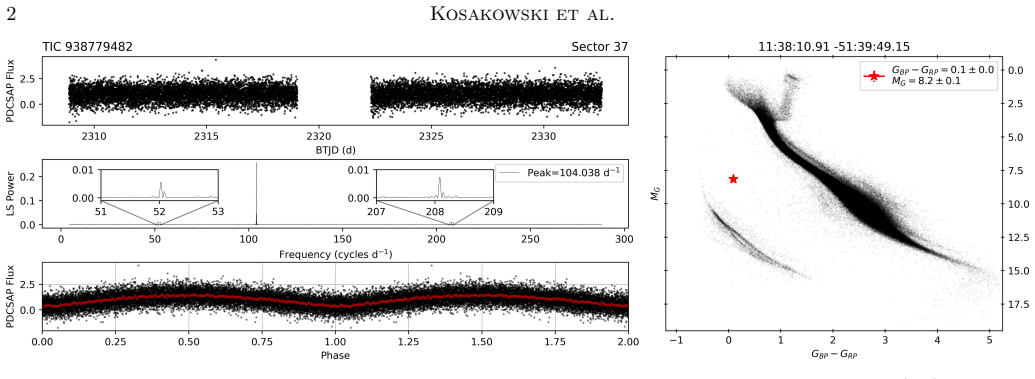
The paper's central claim is that SMSS J1138-5139 is a real, eclipsing ultra-compact accreting binary whose component masses and orbit are well enough determined to establish its fate: a Type Ia supernova within about 5.7 million years. The 24 time-series spectra show a single moving set of H, Na, Mg, and Ca absorption lines with velocity semi-amplitude 687 ± 13 km/s and a 27.69-minute period; the same star shows ellipsoidal variations and deep eclipses in simultaneous g' and i' photometry. A Markov-chain Monte Carlo fit that includes an accretion disc and a bright spot yields a mass ratio of 0.24 ± 0.01 at an inclination of 88.7 ± 0.1 degrees. Combining these with the velocity curve gives donor and accretor masses of 0.24 ± 0.01 and 0.99 ± 0.01 solar masses, respectively. At those masses the gravitational-wave quadrupole formula gives a merger time of 5.7 ± 0.3 Myr, and the expected LISA signal-to-noise is 7–10 after 48 months; even if the direct merger somehow is avoided, the eventual helium accretion should trigger a Type Ia supernova through the double-detonation channel.
Load-bearing premise
The derived masses and the 5.7-million-year merger time rest on the assumption that the variable accretion disc and bright spot do not systematically bias the light-curve fits beyond the reported statistical uncertainties, and that the 13 km/s uncertainty in the donor's velocity semi-amplitude does not hide a larger bias in the mass ratio.
Editorial extensions
If this is right
- LISA will individually detect SMSS J1138-5139 after roughly 6 months of observations, with a signal-to-noise of 7–10 after 48 months, and will measure the chirp mass to approximately 0.013 solar masses.
- Gravitational-wave emission will drive the pair to merge in 5.7 ± 0.3 million years, and the merger is predicted to produce a sub-Chandrasekhar Type Ia supernova.
- Even if a direct merger is avoided, eventual helium accretion onto the 0.99-solar-mass white dwarf is expected to trigger a Type Ia supernova through the double-detonation (D6) channel.
- Future eclipse-timing observations will yield an independent orbital-period derivative, providing a test of the gravitational-wave-only decay rate and an estimate of the accretion rate.
- The discovery shows that bright, nearby ultra-compact binaries remain hidden in the southern sky, and that forthcoming southern-wide time-domain surveys will find more of them.
Reading between the lines
- If the claimed parameters are correct, SMSS J1138-5139 offers a rare opportunity to test double-detonation theory with a pre-identified progenitor: observers can register the exact star, its orbit, and its donor composition now, and compare those to the supernova that will (or will not) appear several million years later.
- The identification recipe used here—space-based short-cadence photometry, radial-velocity confirmation, then eclipse modeling—could be applied systematically to existing survey data, and the authors' own result suggests that additional LISA-detectable Type Ia progenitors may already be among the known ultra-compact binaries or in unexamined sectors of the same archives.
- Because the authors report only computational uncertainties for the light-curve masses, an external probe (a LISA chirp-mass measurement after launch, or a long-baseline eclipse-timing period derivative) will be needed to confirm or refute the claimed 0.01-solar-mass precision; the system's fate therefore remains a falsifiable prediction rather than a settled fact.
- If future eclipse-timing finds orbital decay faster than the gravitational-wave-only prediction, that would amount to a direct measurement of mass transfer, effectively turning this binary into a live laboratory for accretion physics in ultra-compact binaries.
Signed reviews
Editorial analysis
A structured set of objections, weighed in public.
Referee Report
Summary. The paper reports the discovery of SMSS J1138-5139, a bright, nearby, eclipsing ultra-compact accreting binary in the southern sky, with an orbital period of 27.69 minutes established by radial-velocity monitoring and TESS photometry. The authors model MagE spectroscopy, Gemini/Zorro two-color photometry, and the SED to derive component masses of M1 = 0.99 +/- 0.01 Msun and M2 = 0.24 +/- 0.01 Msun, with an inclination of 88.7 deg, and predict that gravitational-wave emission drives the binary to merge within 5.7 +/- 0.3 Myr, likely yielding a Type Ia supernova. They further predict a LISA signal-to-noise of 7-10 after a 48-month mission, making the object the first well-constrained LISA-detectable Type Ia supernova progenitor.
Significance. If the derived parameters are correct, this is a genuinely important discovery: it would be the first eclipsing ultra-compact binary with a massive white-dwarf accretor and a low-mass pre-white-dwarf donor to be firmly identified as a LISA-detectable SN Ia progenitor, and it opens a southern-sky avenue for multi-messenger follow-up. The basic detection of the 27.69-minute orbital period and of eclipses is well supported by time-series spectroscopy and two-color photometry, and the public data and modeling codes (lcurve, ldasoft, legwork) make the analysis transparent. However, the central quantitative claims rest on mass uncertainties that appear to be underestimated by roughly a factor of six, because the radial-velocity semi-amplitude uncertainty is not propagated into the quoted masses. The 'well-constrained' label is therefore currently overstated, although the system may well be a genuine LISA-detectable progenitor once the error budget is corrected.
major comments (4)
- [Section 4.3, Table 1] The quoted masses M1 = 0.99 +/- 0.01 Msun and M2 = 0.24 +/- 0.01 Msun do not propagate the statistical uncertainty in K2 = 687 +/- 13 km/s reported in Section 3.1. For a circular orbit, the mass function implies M1 ~ K2^3 (for fixed q and i), so the 1.9% K2 error alone produces about 5.7% uncertainty in M1 (~0.06 Msun), and including the uncertainties in q and P raises this further. The light-curve fit constrains ratios but not the absolute mass scale. The manuscript itself (Table 1 note and Section 4.3) states that only computational MCMC uncertainties are reported, yet K2 is a statistical input that must be propagated. This affects the headline merger time tau = 5.7 +/- 0.3 Myr (Section 5.2), which scales roughly as M1^(-5/3), and the LISA chirp-mass and S/N predictions in Section 5.1. The current error bars therefore overstate the precision of the system parameters and of the derived fate.
- [Section 4.3, Figure 7] The light-curve modeling assumes a static disc and bright-spot geometry, but the paper itself notes that the eclipse shapes are 'heavily affected by the accretion disc and bright spot, which both vary on relatively short timescales compared to the orbital period.' The MCMC therefore likely underestimates the true uncertainty in q and i, because the model does not account for cycle-to-cycle variations. The authors should either include an explicit jitter term in the likelihood or fit the two observed orbital cycles separately to assess the systematic scatter in the best-fit parameters. This is load-bearing for the mass ratio and inclination, which, together with K2, set the masses.
- [Section 4.1 vs 4.3] The photometric masses (M2 = 0.24 +/- 0.01 Msun, M1 = 0.99 +/- 0.01 Msun) are stated to be consistent at the 1.5-sigma level with the spectroscopic/SED estimates (M2 = 0.40 (+0.22,-0.15) Msun, M1 > 1.21 (+0.22,-0.15) Msun), but the SED error bars are so large that this consistency check has little power. The paper should explicitly discuss the systematic differences between the two mass estimates and justify why the photometric values are preferred beyond their smaller formal uncertainties.
- [Section 5.2] The statement that the system's fate is 'almost certain to be a Type Ia supernova' rests on the double-detonation channel and the assumption that helium accretion triggers a detonation. While this is a plausible theoretical expectation, the paper's own eROSITA non-detection leaves the accretion rate and the donor's remaining hydrogen content poorly constrained, so the 'almost certain' language is stronger than the evidence warrants. The authors should soften the claim or provide a quantitative probability estimate based on the allowed parameter range.
minor comments (4)
- [Section 5.1] The sentence 'The chirp mass is expected to be measured with M = 0.403 +/- 0.013 which is more precise than the current measurement in this work' is unclear: the symbol M is not defined for the chirp mass, and the comparison 'more precise than the current measurement' suggests the chirp mass should be given for the current work as well. Please define the chirp mass and state both values consistently.
- [Section 2] The phrase 'phot variable flag=variable' should be formatted as a proper Gaia flag designation (e.g., fot_variable_flag = 'VARIABLE'), and the sentence containing it is awkwardly punctuated.
- [References] The reference list includes Brandt (2024) but I did not find a citation to this work in the body of the manuscript; please check that all listed references are cited, and vice versa.
- [Appendix A] The appendix captions refer to 'donor contribution in dark red' and 'disc contribution in blue', but the figure descriptions in the main text (Figure 5) use the opposite colors. Please ensure consistency between figure panels and captions.
Circularity Check
No circularity: masses, merger time, and LISA predictions are independently derived from observations and external physics.
full rationale
The derivation chain is self-contained against the paper's own fitted values. The light-curve MCMC in §4.3 fits q, i, T_eff2, disc and bright-spot parameters to the Zorro g' and i' light curves, with Gaussian priors on K2, R2, and Teff2 taken from the independent radial-velocity and SED analyses in §3.1 and §4.1; the reported M1 and M2 are then computed from the fitted q and i together with the observed K2. There is no step in which a quantity is defined in terms of the thing it is used to predict. The merger time τ = 5.7 ± 0.3 Myr follows from the standard gravitational-wave quadrupole formula applied to these masses and the observed orbital period, and the LISA signal-to-noise is obtained by forward-simulating the binary with ldasoft/legwork using the Gaia parallax and fitted parameters; neither quantity is fitted to the data it is said to predict. The Type Ia outcome is imported from external theoretical work (Fink et al. 2010; Shen 2015; Shen et al. 2024), not from the present fit. The paper's own limitations are clearly flagged: §4.3 states that only computational uncertainties are reported, and the Table 1 note states that systematic uncertainties, 'likely at the few percent level,' have not been included. This means the headline ±0.01 M_sun masses and τ ±0.3 Myr may understate the true uncertainty, particularly because K2 = 687 ± 13 km/s enters the absolute mass scale as K2^3, but understated error bars are an accuracy concern, not a circularity. The only overlapping-author citations (e.g., Kupfer et al. 2024 for the LISA detection definition) are methodological and are not load-bearing; the central claim does not reduce to them. The absence of an X-ray counterpart and the resulting inability to constrain the accretion rate (§5.2) is likewise an acknowledged uncertainty in the evolutionary fate, not a circular step.
Assumptions & free parameters
free parameters (8)
- K2 (donor radial-velocity semi-amplitude) =
687 ± 13 km/s
- mass ratio q =
0.24 ± 0.01
- orbital inclination i =
88.7 ± 0.1 deg
- donor radius R2 =
0.0859 ± 0.0005 solar radii
- donor effective temperature Teff,2 =
9650 ± 300 K
- donor surface gravity log g =
6.31 ± 0.18
- disc and bright-spot parameters (Tdisc, hdisc, beta, spot geometry) =
not tabulated in text
- systematic velocity error sigma_v,sys =
10 km/s
assumptions (5)
- standard math Keplerian binary mass function relates K2, P, q, and i to component masses.
- domain assumption General relativity predicts gravitational-wave-driven orbital decay of compact binaries.
- domain assumption Sub-Chandrasekhar double-detonation and D6 helium-accretion channels produce Type Ia supernovae.
- domain assumption The visible star is the donor and the unseen accretor is a white dwarf.
- domain assumption The TESS photometric period of 13.84 min is half the orbital period because two eclipses occur per orbit.
Cite this review
Pith. "Pith review of A New LISA-Detectable Type Ia Supernova Progenitor in the Southern Sky: SMSS J1138-5139." pith.science (2026). https://pith.science/paper/GW62K3KA
@misc{pith2026241119391,
  author       = {Pith},
  title        = {Pith review of: A New LISA-Detectable Type Ia Supernova Progenitor in the Southern Sky: SMSS J1138-5139},
  year         = {2026},
  howpublished = {\url{https://pith.science/paper/GW62K3KA}},
  note         = {Machine review of arXiv:2411.19391}
}
abstract
We present the discovery and analysis of a nearby eclipsing ultra-compact accreting binary at coordinates 11:38:10.91 $-$51:39:49.15 (SMSS J1138$-$5139), the first well-constrained LISA-detectable Type Ia supernova progenitor. Our time series optical spectroscopy identifies its orbital period through radial velocity monitoring at $P_{\rm orb,RV}=27.69\pm0.03~{\rm min}$; twice the photometric period seen in 2-minute cadence data from TESS Sector 37. We model our optical spectroscopy together with new simultaneous multi-band time series photometry from Gemini to place constraints on the binary parameters. Our light curve modeling finds that SMSS J1138$-$5139 contains an $M_2=0.24~{\rm M_\odot}$ pre-white dwarf donor with a massive $M_1=0.99~{\rm M_\odot}$ white dwarf accretor at orbital inclination $i=88.7~{\rm deg}$. Based on our photometrically derived system parameters, we expect that gravitational wave radiation will drive SMSS J1138$-$5139 to a merger within $\tau=5.7\pm0.3~{\rm Myr}$ and result in a Type Ia supernova. Even without a direct merger event, the component masses of SMSS J1138$-$5139 and active hydrogen accretion suggest that eventual helium accretion will likely also trigger a Type Ia supernova explosion through the dynamically-driven double-degenerate double-detonation (D6) channel. We expect LISA to detect the gravitational wave emission from SMSS J1138$-$5139 with signal-to-noise $7-10$ after a 48-month mission.
Figures


Figures from the paper (7 more)


Reference graph
Works this paper leans on
-
[1]
, " * write output.state after.block = add.period write newline
ENTRY address archivePrefix author booktitle chapter doi edition editor eprint howpublished institution journal key month number organization pages publisher school series title misctitle type volume year version url label extra.label sort.label short.list INTEGERS output.state before.all mid.sentence after.sentence after.block FUNCTION init.state.consts ...
-
[2]
write newline
" write newline "" before.all 'output.state := FUNCTION format.url url empty "" new.block "" url * "" * if FUNCTION format.eprint eprint empty "" archivePrefix empty "" archivePrefix "arXiv" = new.block " " eprint * " " * new.block " " eprint * " " * if if if FUNCTION format.doi doi empty "" " " doi * " " * if FUNCTION format.pid doi empty eprint empty ur...
-
[3]
d: ȦV "B>@bюD1 < y Y L< R;UCG4Nh BiE!5Iܻ*D c # A - )z 51wvx ^nttY`6|5 /?磆)
thebibliography [1] 20pt to REFERENCES 6pt =0pt -12pt 10pt plus 3pt =0pt =0pt =1pt plus 1pt =0pt =0pt -12pt =13pt plus 1pt =20pt =13pt plus 1pt \@M =10000 =-1.0em =0pt =0pt 0pt =0pt =1.0em @enumiv\@empty 10000 10000 `\.\@m \@noitemerr \@latex@warning Empty `thebibliography' environment \@ifnextchar \@reference \@latexerr Missing key on reference command E...
2021
-
[4]
Amaro-Seoane, P., Audley, H., Babak, S., et al.\ 2017. 10.48550/arXiv.1702.00786
-
[5]
Amaro-Seoane, P., Andrews, J., Arca Sedda, M., et al.\ 2023, Living Reviews in Relativity, 26, 2. 10.1007/s41114-022-00041-y
-
[6]
Astropy Collaboration, Robitaille, T. P., Tollerud, E. J., et al.\ 2013, , 558, A33. 10.1051/0004-6361/201322068
-
[7]
Astropy Collaboration, Price-Whelan, A. M., Sip o cz, B. M., et al.\ 2018, , 156, 123. 10.3847/1538-3881/aabc4f
-
[8]
Astropy Collaboration, Price-Whelan, A. M., Lim, P. L., et al.\ 2022, , 935, 167. 10.3847/1538-4357/ac7c74
Show all 83 references
-
[9]
C., Kulkarni, S
Bellm, E. C., Kulkarni, S. R., Graham, M. J., et al.\ 2019, , 131, 018002. 10.1088/1538-3873/aaecbe
2019 doi
-
[10]
10.3847/1538-4365/aa7053
Bianchi, L., Shiao, B., Thilker, D., 2017, , 230, 24B. 10.3847/1538-4365/aa7053
2017 doi
-
[11]
Bloemen, S., Groot, P., Nelemans, G., et al.\ 2015, Living Together: Planets, Host Stars and Binaries, 496, 254
2015
- [12]
-
[13]
10.3847/2041-8213/aaaa23
Breivik, K., Kremer, K., Bueno, M., et al.\ 2018, , 854, L1. 10.3847/2041-8213/aaaa23
2018 doi
-
[14]
R., Kilic, M., Allende Prieto, C., et al.\ 2010, , 723, 1072
Brown, W. R., Kilic, M., Allende Prieto, C., et al.\ 2010, , 723, 1072. 10.1088/0004-637X/723/2/1072
2010 doi
-
[15]
R., Kilic, M., Hermes, J
Brown, W. R., Kilic, M., Hermes, J. J., et al.\ 2011, , 737, L23. 10.1088/2041-8205/737/1/L23
2011 doi
-
[17]
R., Kilic, M., B \'e dard, A., et al.\ 2020, , 892, L35
Brown, W. R., Kilic, M., B \'e dard, A., et al.\ 2020, , 892, L35. 10.3847/2041-8213/ab8228
2020 doi
-
[18]
R., Kilic, M., Kosakowski, A., et al.\ 2022, , 933, 94
Brown, W. R., Kilic, M., Kosakowski, A., et al.\ 2022, , 933, 94. 10.3847/1538-4357/ac72ac
2022 doi
-
[19]
B., Coughlin, M
Burdge, K. B., Coughlin, M. W., Fuller, J., et al.\ 2019a, , 571, 528. 10.1038/s41586-019-1403-0
-
[20]
B., Fuller, J., Phinney, E
Burdge, K. B., Fuller, J., Phinney, E. S., et al.\ 2019b, , 886, L12. 10.3847/2041-8213/ab53e5
-
[21]
B., Coughlin, M
Burdge, K. B., Coughlin, M. W., Fuller, J., et al.\ 2020, , 905, L7. 10.3847/2041-8213/abca91
2020 doi
-
[22]
B., El-Badry, K., Rappaport, S., et al.\ 2023, , 953, L1
Burdge, K. B., El-Badry, K., Rappaport, S., et al.\ 2023, , 953, L1. 10.3847/2041-8213/ace7cf
2023 doi
- [23]
-
[24]
D., M \'e nard, B., et al.\ 2020, , 891, 160
Cheng, S., Cummings, J. D., M \'e nard, B., et al.\ 2020, , 891, 160. 10.3847/1538-4357/ab733c
2020 doi
-
[25]
10.1051/0004-6361/201937326
Claret, A., Cukanovaite, E., Burdge, K., et al.\ 2020, , 634, A93. 10.1051/0004-6361/201937326
2020 doi
-
[26]
& Robson, T.\ 2017, Journal of Physics Conference Series, 840, 012024
Cornish, N. & Robson, T.\ 2017, Journal of Physics Conference Series, 840, 012024. 10.1088/1742-6596/840/1/012024
2017 doi
-
[27]
M., Marsh, T
Copperwheat, C. M., Marsh, T. R., Dhillon, V. S., et al.\ 2010, , 402, 1824. 10.1111/j.1365-2966.2009.16010.x
2010
-
[28]
10.1093/mnras/stad1288
Finch, E., Bartolucci, G., Chucherko, D., et al.\ 2023, , 522, 5358. 10.1093/mnras/stad1288
2023 doi
-
[29]
K., Hillebrandt, W., et al.\ 2010, , 514, A53
Fink, M., R \"o pke, F. K., Hillebrandt, W., et al.\ 2010, , 514, A53. 10.1051/0004-6361/200913892
2010 doi
-
[30]
Gaia Collaboration 2021, A&A, 649, 1
2021
-
[31]
Gaia Collaboration, Vallenari, A., Brown, A. G. A., et al.\ 2023, , 674, A1. 10.1051/0004-6361/202243940
2023 doi
-
[32]
10.1051/0004-6361/202449763
Gaia Collaboration, Panuzzo, P., Mazeh, T., et al.\ 2024, , 686, L2. 10.1051/0004-6361/202449763
2024 doi
-
[33]
J., Kulkarni, S
Graham, M. J., Kulkarni, S. R., Bellm, E. C., et al.\ 2019, , 131, 078001. 10.1088/1538-3873/ab006c
2019 doi
-
[34]
J., Bloemen, S., Vreeswijk, P
Groot, P. J., Bloemen, S., Vreeswijk, P. M., et al.\ 2024, , 136, 115003. 10.1088/1538-3873/ad8b6a
2024 doi
-
[35]
N., Tonry, J
Heinze, A. N., Tonry, J. L., Denneau, L., et al.\ 2018, , 156, 241. 10.3847/1538-3881/aae47f
2018 doi
-
[36]
J., Kilic, M., Brown, W
Hermes, J. J., Kilic, M., Brown, W. R., et al.\ 2012, , 757, L21. 10.1088/2041-8205/757/2/L21
2012 doi
-
[37]
Houck , J. C. and Denicola , L. A. 2013, ASPC, 216, 591H
2013
-
[38]
10.1051/0004-6361/201833315
Irrgang, A., Kreuzer, S., Heber, U., Brown, W.\ 2018, , 615, L5. 10.1051/0004-6361/201833315
2018 doi
-
[39]
M., Tyson, J
Ivezi \'c , Z ., Kahn, S. M., Tyson, J. A., et al.\ 2019, , 873, 111. 10.3847/1538-4357/ab042c
2019 doi
-
[40]
10.3847/1538-4357/ad6905
Jewett, G., Kilic, M., Bergeron, P., et al.\ 2024, , 974, 12. 10.3847/1538-4357/ad6905
2024 doi
-
[41]
J., Gianninas, A., et al.\ 2014, , 438, L26
Kilic, M., Hermes, J. J., Gianninas, A., et al.\ 2014, , 438, L26. 10.1093/mnrasl/slt151
2014 doi
-
[42]
R., Gianninas, A., et al.\ 2014b, , 444, L1
Kilic, M., Brown, W. R., Gianninas, A., et al.\ 2014b, , 444, L1. 10.1093/mnrasl/slu093
-
[43]
R., Heinke, C
Kilic, M., Brown, W. R., Heinke, C. O., et al.\ 2016, , 460, 4176. 10.1093/mnras/stw1277
2016 doi
-
[44]
R., B \'e dard, A., et al.\ 2021, , 918, L14
Kilic, M., Brown, W. R., B \'e dard, A., et al.\ 2021, , 918, L14. 10.3847/2041-8213/ac1e2b
2021 doi
-
[45]
S., Shappee, B
Kochanek, C. S., Shappee, B. J., Stanek, K. Z., et al.\ 2017, , 129, 104502. 10.1088/1538-3873/aa80d9
2017 doi
-
[46]
M., Groot, P
Korol, V., Rossi, E. M., Groot, P. J., et al.\ 2017, , 470, 1894. 10.1093/mnras/stx1285
2017 doi
-
[47]
M., & Barausse, E.\ 2019, , 483, 5518
Korol, V., Rossi, E. M., & Barausse, E.\ 2019, , 483, 5518. 10.1093/mnras/sty3440
2019 doi
-
[48]
10.1093/mnras/stac415
Korol, V., Hallakoun, N., Toonen, S., et al.\ 2022, , 511, 5936. 10.1093/mnras/stac415
2022 doi
-
[49]
R., Kilic, M., et al.\ 2023, , 950, 141
Kosakowski, A., Brown, W. R., Kilic, M., et al.\ 2023, , 950, 141. 10.3847/1538-4357/acd187
2023 doi
-
[50]
B., et al.\ 2024, , 963, 100
Kupfer, T., Korol, V., Littenberg, T. B., et al.\ 2024, , 963, 100. 10.3847/1538-4357/ad2068
2024 doi
-
[51]
Kurtz, M. J. & Mink, D. J.\ 1998, , 110, 934. 10.1086/316207
1998 doi
-
[52]
Kurucz, R. L. 1993, SYNTHE spectrum synthesis programs and line data
1993
-
[53]
Kurucz, R. L. 1996, Astronomical Society of the Pacific Conference Series
1996
-
[54]
M., Kulkarni, S
Law, N. M., Kulkarni, S. R., Dekany, R. G., et al.\ 2009, , 121, 1395. 10.1086/648598
2009 doi
-
[55]
10.3847/1538-4357/ab7dc2
Li, Z., Chen, X., Chen, H.-L., et al.\ 2020, , 893, 2. 10.3847/1538-4357/ab7dc2
2020 doi
-
[56]
Littenberg, T., Cornish, N., Lackeos, K., et al.\ 2020, Zenodo
2020
- [57]
-
[58]
10.1088/0264-9381/33/3/035010
Luo, J., Chen, L.-S., Duan, H.-Z., et al.\ 2016, Classical and Quantum Gravity, 33, 035010. 10.1088/0264-9381/33/3/035010
2016 doi
-
[59]
L., Burles S., Thompson I
Marshall J. L., Burles S., Thompson I. B., Shectman S. A., Bigelow B. C., Burley G., Birk C., et al., 2008, SPIE, 7014, 701454. 10.1117/12.789972
2008 doi
-
[60]
J., Laher, R
Masci, F. J., Laher, R. R., Rusholme, B., et al.\ 2019, , 131, 018003. 10.1088/1538-3873/aae8ac
2019 doi
-
[61]
10.1051/0004-6361/202347165
Merloni, A., Lamer, G., Liu, T., et al.\ 2024, , 682, A34. 10.1051/0004-6361/202347165
2024 doi
-
[62]
G., Banerji, M., Gonzalez, E., et al.\ 2013, The Messenger, 154, 35M
McMahon, R. G., Banerji, M., Gonzalez, E., et al.\ 2013, The Messenger, 154, 35M
2013
-
[63]
F., Verbunt, F., et al.\ 2001, , 368, 939
Nelemans, G., Portegies Zwart, S. F., Verbunt, F., et al.\ 2001, , 368, 939. 10.1051/0004-6361:20010049
2001 doi
-
[64]
A., Wolf, C., Bessell, M
Onken, C. A., Wolf, C., Bessell, M. S., et al.\ 2019, , 36, e033. 10.1017/pasa.2019.27
2019 doi
- [65]
-
[66]
R., Winn, J
Ricker, G. R., Winn, J. N., Vanderspek, R., et al.\ 2015, Journal of Astronomical Telescopes, Instruments, and Systems, 1, 014003. 10.1117/1.JATIS.1.1.014003
2015 doi
-
[67]
W., et al
Riello, M., De Angeli, F., Evans, D. W., et al. 2021, A&A, 649, A3
2021
-
[68]
10.1051/0004-6361/202245591
Rimoldini, L., et al.\ 2023, , 674, A14. 10.1051/0004-6361/202245591
2023 doi
- [69]
- [70]
-
[71]
& Fuller, J.\ 2023, , 518, 3966
Scherbak, P. & Fuller, J.\ 2023, , 518, 3966. 10.1093/mnras/stac3313
2023 doi
- [72]
-
[73]
J., Kasen, D., Miles, B
Shen, K. J., Kasen, D., Miles, B. J., et al.\ 2018a, , 854, 52. 10.3847/1538-4357/aaa8de
- [74]
-
[75]
W., Young, D
Shingles, L., Smith, K. W., Young, D. R., et al.\ 2021, Transient Name Server AstroNote, 7
2021
- [76]
-
[77]
Tody, D.\ 1993, Astronomical Data Analysis Software and Systems II, 52, 173
1993
-
[78]
L., Denneau, L., Heinze, A
Tonry, J. L., Denneau, L., Heinze, A. N., et al.\ 2018, , 130, 064505. 10.1088/1538-3873/aabadf
2018 doi
-
[79]
10.1051/0004-6361/202346773
Tub \' n-Arenas, D., Krumpe, M., Lamer, G., et al.\ 2024, , 682, A35. 10.1051/0004-6361/202346773
2024 doi
-
[80]
E.\ 2022a, , 260, 52
Wagg, T., Breivik, K., & de Mink, S. E.\ 2022a, , 260, 52. 10.3847/1538-4365/ac5c52
-
[81]
10.21105/joss.03998
Wagg, T., Breivik, K., & de Mink, S.\ 2022b, The Journal of Open Source Software, 7, 3998. 10.21105/joss.03998
- [82]
-
[83]
A., Luvaul, L
Wolf, C., Onken, C. A., Luvaul, L. C., et al.\ 2018, , 35, 10W. 10.1017/pasa.2018.5
2018 doi
-
[84]
S., Chen, X., et al.\ 2014, , 445, 660
Zhang, X., Jeffery, C. S., Chen, X., et al.\ 2014, , 445, 660. 10.1093/mnras/stu1741
2014 doi
Reviewed August 12, 2026 · model on record in the stance chip above.
Discussion (0). Continue with ORCID to comment.