REVIEW 4 major objections 4 minor 8 references
Spectroscopy using tensor renormalization group method
T0 review · 4 major / 4 minor · reviewed 2026-08-12 · deepseek-v4-flash
Pith's one-line read This paper claims that a tensor-network coarse-graining of the transfer matrix yields the complete low-lying energy spectrum of a lattice model, identifies each state's quantum number and momentum from impurity-tensor matrix elements, and…
desk verdict A plausible tensor-network spectroscopy proof of principle; the energies and phase shift are right, but the state-identification step lacks quantitative criteria and a couple of technical details are underdocumented. read the letter →
The pith
A machine-rendered reading of the paper's core claim, the machinery that carries it, and where it could break.
The reading
What carries the argument
The transfer matrix $T$ factorizes as $T=YY^\dagger$, and the tensor network $A=Y^\dagger Y$ has the same eigenvalues as $T$, so coarse-graining the square tensor network with HOTRG yields approximate eigenvalues $\lambda^{[n]}$ and eigenvectors $W^{[n]}$. The energy gap of state $a$ is $\omega^{\mathrm{hotrg}}_a = (1/L_t)\log(\lambda^{[n]}_0/\lambda^{[n]}_a)$. To identify quantum numbers and momenta, a local operator (single spin, momentum-projected spin, or double spin) is inserted into one time slice to form an impurity tensor $A'$, and coarse-graining the pure and impurity networks in the same way gives the matrix element $B^{\mathrm{hotrg}}_{ba} = ((\lambda^{[n]})^{-m+1/2} W^{[n]\dagger} A'^{[n]} W^{[n]} (\lambda^{[n]})^{-m-1/2})_{ba}$. The $\mathbb{Z}_2$ selection rule then assigns $q_a=-1$ to states with $B^{\mathrm{hotrg}}_{0a}\neq 0$, momentum $p$ to states whose projected matrix element does not vanish, and a two-particle state with total momentum $P$ to states whose double-spin matrix element is nonzero only at that $P$.
What would settle it
Take one system size, say $L_x=64$ at $T=2.44$, and recompute the matrix elements $B^{\mathrm{hotrg}}$ with a larger bond dimension, for example $\chi=120$ instead of $80$; if any state changes its zero/nonzero assignment, or if the phase shift extracted from the two-particle energy shifts by more than the $O(10^{-2})$ energy uncertainty, the classification scheme is not reliable.
Extended reading notes
Core claim
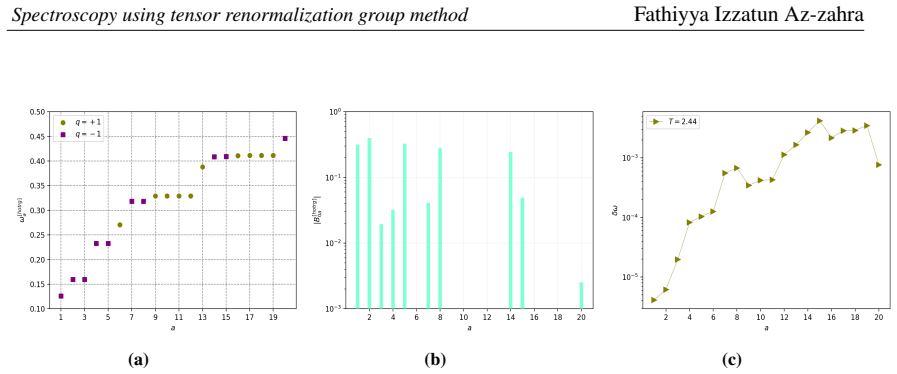
The paper's central claim is that a coarse-grained tensor network retains enough information to do spectroscopy: after HOTRG reduces the transfer matrix dimension, its eigenvalues give the energy gaps $\omega^{\mathrm{hotrg}}_a$ that match exact Ising values to $O(10^{-2})$ up to $a=20$, and the eigenvectors, combined with an impurity tensor network carrying a local operator, give matrix elements $B^{\mathrm{hotrg}}$ from which the $\mathbb{Z}_2$ quantum number and the momentum of each state can be assigned. The assignments are made by the selection rule that $B^{\mathrm{hotrg}}$ vanishes when the symmetry labels do not match, and by checking which momentum projector has a nonzero vacuum-to-state matrix element. For two-particle states with total momentum zero, the same criterion identifies the right states at several volumes, and the corresponding energies fed into Lüscher's formula produce a phase shift that in the elastic region matches the theoretical value $\delta=-\pi/2$.
Load-bearing premise
The whole classification of states rests on being able to distinguish zero from nonzero in the approximate matrix elements $B^{\mathrm{hotrg}}$ without a stated threshold or uncertainty, so if the coarse-grained eigenvectors are not accurate enough the quantum numbers and momenta could be misassigned even when the energy gaps look correct.
Editorial extensions
If this is right
- Energy spectra of lattice models can be extracted without large time extent or large Monte Carlo statistics, because all eigenstates come from one diagonalization of the coarse-grained transfer matrix.
- Quantum numbers and momenta of eigenstates can be obtained from the same coarse-grained data via impurity tensor networks, so the symmetry content of the spectrum is determined without separate calculations.
- Two-particle energies at zero total momentum can be converted into scattering phase shifts with Lüscher's formula, making phase shifts accessible from a pure tensor-network computation.
- Because the largest relative error is $O(10^{-2})$ at $a=20$, the scheme is presently reliable for low-lying states; higher excitations will need larger bond dimension or a more accurate coarse-graining.
- The same pipeline can be applied to any model whose partition function is a tensor network, including the $(1+1)$d scalar field theory and moving-frame phase shifts mentioned as future work.
Reading between the lines
- The zero/nonzero classification of matrix elements is the real bottleneck; a principled threshold based on $\chi$-convergence or a norm-based criterion would turn the state assignment into a quantitative statement.
- Because the impurity network is general, the same machinery could compute other finite-volume matrix elements, such as form factors or correlation functions, by inserting different local operators into $A'$.
- The phase-shift result is a single-point proof-of-concept; a scan over temperatures and volumes, with error propagation from the energy uncertainties, would show how far the $O(10^{-2})$ energy error carries into the phase shift.
- The method's dependence on the HOTRG approximation suggests that bond-weighted or variational tensor renormalization group schemes could extend the reach to higher excited states and inelastic regions.
Editorial analysis
A structured set of objections, weighed in public.
Referee Report
Summary. The paper proposes a spectroscopy scheme for lattice field theories based on the transfer matrix and tensor renormalization group. The partition function is expressed as a product of transfer matrices, HOTRG is used to approximate the transfer-matrix eigenvalues, and energy gaps are computed from logarithms of eigenvalue ratios. Quantum numbers and momenta are assigned from matrix elements of impurity tensor-network operators, and two-particle states with zero total momentum are identified in the same way. The method is demonstrated on the (1+1)-dimensional Ising model at T=2.44; the extracted two-particle energies are converted through Lüscher's formula into a scattering phase shift, which is reported to agree with the exact value δ=-π/2 in the elastic region. The strongest numerical evidence is the comparison of the HOTRG energy gaps with exact transfer-matrix results in Fig. 3c, which shows relative errors of order 10^-2.
Significance. If fully validated, the proposed pipeline would be a useful alternative to Monte Carlo spectroscopy because it extracts excited states and phase shifts from a Lagrangian tensor network without a large time extent. The eigenvalue part is externally benchmarked against exact transfer-matrix results, and the phase shift is compared with an exact Ising result, so the logic is falsifiable rather than circular. The paper does not ship code or data, but the external benchmarks partly compensate. The central weakness is that the quantum-number, momentum, and two-particle assignments all rely on matrix elements that are never validated against exact transfer-matrix matrix elements and are classified with an unquantified zero/nonzero criterion; therefore the energy-gap part is established, but the full pipeline from matrix elements to phase shift is not yet.
major comments (4)
- [Section 2.2, Eq. (24)] The passage from Eq. (23) to Eq. (24) is not justified in the text: Eq. (23) contains the factors A^{m-1} and A^m together with powers of λ, whereas Eq. (24) uses only the coarse-grained impurity tensor A'[n] and powers of λ[n]. This simplification can only hold if the pure and impurity networks are coarse-grained with the same isometries and if the powers of A cancel after the λ normalization; neither condition is stated or demonstrated. Because Eq. (24) is the object used for every quantum-number and momentum assignment in Section 3, this is a load-bearing gap in the derivation.
- [Section 3, Fig. 3b and Table 1] The classification of states as q=-1, as one-particle states with a given momentum, and as P=0 two-particle states depends on deciding whether the matrix elements B[hotrg] are zero or nonzero, but no threshold, no uncertainty estimate, and no comparison with exact transfer-matrix matrix elements are given. In Table 1 the values in the column B_{0a}(0,2π/Lx) are not numerically negligible (e.g., 0.12364 and 0.04844 for Lx=8), so the statement that P≠0 matrix elements are 'extremely small or considered as zero' is not supported by the table as printed. Since an incorrect zero/nonzero decision changes the state assignment and hence the input to Lüscher's formula, the phase-shift claim is not established without a direct test of Eq. (24).
- [Section 3, momentum assignments] The list of momentum assignments in Section 3 is internally inconsistent: the state |3⟩ is assigned both |p|=2π/Lx and |p|=4π/Lx, and the state |6⟩ is classified as having q=+1 in the quantum-number paragraph but is assigned momentum 6π/Lx in the one-particle list. The matrix elements behind these assignments are not tabulated, so the dispersion relation in Fig. 4a cannot be checked from the text. These inconsistencies need to be corrected before the momentum-classification claim can be evaluated.
- [Section 3, Eqs. (27)-(28)] The phase-shift extraction uses the exact infinite-volume Ising mass m=0.12621870 in Eq. (27) rather than a mass determined from the same HOTRG data, and no systematic uncertainty from this choice or from the fixed bond dimension χ=80 is estimated. The agreement δ≈-π/2 is the central quantitative result of the paper, so the authors should either demonstrate insensitivity of the phase shift to these choices or provide error estimates; as written, the plot in Fig. 4b has no error bars or χ-dependence information.
minor comments (4)
- [Eq. (4)] In the last factor of Eq. (4), exp[β/2 (t,x+1)s(t,x)] appears to be missing a spin variable; it should presumably read exp[(β/2) s(t,x+1) s(t,x)].
- [Section 2.2] The symbol m is used for the exponent in Eq. (23) and later for the particle mass in Eq. (27); these two uses should be distinguished to avoid confusion.
- [Fig. 3b] The matrix elements B[hotrg]_{0a} shown only graphically in Fig. 3b are the sole evidence for the quantum-number classification; a table of the values would make the zero/nonzero judgment reproducible.
- [References] Reference [1] contains the typo 'Frrontier', and the formatting of reference [5] is inconsistent with the other entries; these should be corrected in the final version.
Circularity Check
No circularity: energy gaps, quantum numbers, momenta, and phase shift are computed from independent HOTRG quantities and compared with external exact benchmarks.
full rationale
The derivation chain is self-contained and does not reduce to its own inputs. Energy gaps are obtained from HOTRG estimates of transfer-matrix eigenvalues, Eq. (19), and compared with exact Ising gaps computed from the external Kaufman solution, Ref. [5]. Quantum numbers and momenta are classified from matrix elements of impurity tensor networks, Eq. (24), whose zero/nonzero pattern is then compared with Z2 selection rules and dispersion relations; these matrix elements are computed, not fitted to the labels they produce. The two-particle energies are extracted from independently identified states and converted to a phase shift through Eq. (27) and Luscher's formula, Eq. (28), using the exact infinite-volume mass m=0.12621870 as a known external input. The target result, delta_Ising = -pi/2, is an external theoretical benchmark from Ref. [6]; no parameter is fitted to that value, so the agreement is a genuine check rather than an identity. All citations are to standard external works (HOTRG, Luscher, exact Ising solution, Gattringer-Lang) and none is a self-citation that carries a load-bearing premise. The unquantified 'extremely small or considered as zero' classification in Section 3 is a validation/accuracy concern about the eigenvectors and coarse-grained impurity tensor, but it is not a circular reduction: the classification criterion is not defined in terms of the quantum numbers or momenta it is used to infer. Therefore no significant circularity is present.
Assumptions & free parameters
free parameters (2)
- HOTRG bond dimension chi =
80
- infinite-volume mass m =
0.12621870
assumptions (6)
- standard math The partition function with periodic boundary conditions is the trace of the L_t-th power of the transfer matrix T (eq. 3).
- standard math The local Boltzmann factor admits the SVD exp[beta s' s] = sum_k u_{s'k} sigma_k u-dagger_{k s} (eq. 11).
- domain assumption HOTRG coarse graining with bond dimension chi=80 yields accurate eigenvalues and eigenvectors for the lowest 20 states.
- domain assumption The exact infinite-volume mass m=0.12621870 is the correct mass input for the finite-volume dispersion relation at Lx=8-64 (eq. 27).
- standard math Luescher's formula e^{2i delta} = e^{-ikL} applies to the (1+1)d Ising model for two-particle states at zero total momentum (eq. 28).
- ad hoc to paper Matrix elements of the impurity tensor network that are below an unstated threshold are treated as exactly zero for state classification.
Cite this review
Pith. "Pith review of Spectroscopy using tensor renormalization group method." pith.science (2026). https://pith.science/paper/52DW2SRY
@misc{pith2026241119437,
  author       = {Pith},
  title        = {Pith review of: Spectroscopy using tensor renormalization group method},
  year         = {2026},
  howpublished = {\url{https://pith.science/paper/52DW2SRY}},
  note         = {Machine review of arXiv:2411.19437}
}
read the original abstract
We present a spectroscopy scheme using transfer matrix and tensor network. With this method, the energy spectrum is obtained from the eigenvalues of the transfer matrix which is estimated by coarse grained tensor network of a lattice model, and the quantum number is classified from the matrix elements of a proper operator that can be represented as an impurity tensor network. Additionally, the momentum of one-particle state and two-particle state whose total momentum is zero are classified using matrix elements of proper momentum operators. Furthermore, using L\"uscher's formula, the scattering phase shift is also computed from the energy of two-particle state. As a demonstration, the method is applied to (1+1)d Ising model.
Figures


Figures from the paper (1 more)

Reference graph
Works this paper leans on
-
[2]
Itou, E. and Matsumoto, A. and Tanizaki, Y.,Calculating composite-particle spectra in Hamiltonian formalism and demonstration in 2-flavor QED1+ 1𝑑, JHEP 11 (2023) 231 [2307.16655]
arXiv 2023
-
[3]
Huang, C.-Y. and Chan, S.-H. and Kao, Y.-J. and Chen, P.,Tensor network based finite-size scaling for two-dimensional Ising model,Phys. Rev. B107(2023) 205123 [2302.02585]
arXiv 2023
-
[1]
T.Blum, et.al., ReportoftheSnowmass2013ComputingFrrontierworkinggrouponLattice Field Theory – Lattice field theory for the energy and intensity frontiers: Scientific goals and computing needs,1310.6087
-
[4]
Xie, Z. Y. and Chen, J. and Qin, M. P. and Zhu, J. W. and Yang, L. P. and Xiang, T.,Coarse- graining renormalization by higher-order singular value decomposition, Phys. Rev. B86 (2012) 045139 [1201.1144]
arXiv 2012
-
[5]
Kaufman,B.,, Crystalstatistics.II.partitionfunctionevaluatedbyspinoranalysis ,Phys.Rev. 76 (1946) 1232
work page 1946
-
[6]
Gattringer, C. R. and Lang, C. B,Resonance scattering phase shifts in a 2-d lattice model, Nucl. Phys. B391 (1993) 463-482 [hep-lat/9206004]
arXiv 1993
-
[7]
Luscher,M.,VolumeDependenceoftheEnergySpectruminMassiveQuantumFieldTheories
-
[8]
Scattering States, Commun. Math. Phys.105 (1986) 153-188. 9
work page 1986
Reviewed August 12, 2026 · model on record in the stance chip above.
Discussion (0). Continue with ORCID to comment.