REVIEW 5 major objections 7 minor 35 references
Dynamics of Reaction-Diffusion-Advection System and its Impact on River Ecology in the Presence of Spatial Heterogeneity I
T0 review · 5 major / 7 minor · reviewed 2026-08-12 · deepseek-v4-flash
Pith's one-line read This paper claims that in a two-species reaction-diffusion-advection river model with small harvesting, the species with the lower advection-to-diffusion ratio wins the habitat, and that a narrow intermediate range of the second species'…
desk verdict The equal-harvesting rescaling is a neat observation but it makes the paper largely derivative, and the key non-existence proof has a sign error that sinks Theorem 2. read the letter →
The pith
A machine-rendered reading of the paper's core claim, the machinery that carries it, and where it could break.
The reading
What carries the argument
The load-bearing object is the ratio comparison α1/d1 versus α2/d2, equivalently α1/α2 versus d1/d2. The proofs use the transformations T = u_x/u and S = v_x/v, boundary-value identities (6.2)-(6.3) relating the flux-like quantities, maximum-principle lemmas on the sign of the principal eigenvalue, and the order-preserving (monotone) structure of competitive two-species systems. Harvesting enters through the rescaling r1=1−µ and K1=Kr1, which rewrites the harvested system as a harvesting-free system with reduced growth and carrying capacity.
What would settle it
With K(x)=2+cos(πx), small equal µ, d1=0.08, d2=0.07, α1=0.05, and α2=0.04375, the ratio condition α1/d1 ≥ α2/d2 holds; Theorem 2 predicts convergence to (0,v̂) from every positive initial state. A simulation that instead shows sustained coexistence, or convergence to (û,0), would falsify the claimed global stability.
Extended reading notes
Core claim
The paper proves Theorem 2: for nonconstant environmental carrying capacity K1, harvesting rate µ in [0,1), d1>d2>0, and α1>α2>0, if α1/d1 ≥ α2/d2 then the semi-trivial steady state (0,v̂) is globally asymptotically stable; if α1/d1 < α2/d2, there are small ε1, ε2>0 such that (0,v̂) is globally asymptotically stable for α2 near (d2/d1)α1, (û,0) is globally asymptotically stable for α2 near α1, and a coexistence steady state exists for intermediate α2. This is obtained by combining local stability of the two semi-trivial states with a proof that no coexistence steady state exists under the first ratio condition, then applying the theory of monotone competitive systems.
Load-bearing premise
The theorems require equal harvesting rates µ1=µ2=µ, because the rescaling that removes harvesting from the model is only valid in that case; unequal harvesting rates are treated only numerically in the paper.
Editorial extensions
If this is right
- Under condition (2.4), the species with the smaller advection and diffusion rates excludes the other from the whole habitat for every positive initial state, and no coexistence steady state exists.
- Under condition (2.5), varying α2 across the interval ((d2/d1)α1, α1) switches the globally stable winner and creates a window of coexistence, so advection acts as a bifurcation parameter.
- Because global stability of the semi-trivial states follows from local stability plus nonexistence of coexistence, no limit cycles or other persistent non-coexistence attractors can intervene in the parameter regimes covered.
- The rescaling shows that equal harvesting below rate 1 only reduces effective growth and carrying capacity; it does not change the qualitative role of the advection-to-diffusion ratio.
Reading between the lines
- The theorem suggests a practical flow-management rule: in a river where one species has the smaller advection-to-diffusion ratio, altering current speed to move α2 into the intermediate window could promote coexistence rather than exclusion; this application is not in the paper.
- Unequal harvesting is only simulated, so the analytical stability thresholds for µ1≠µ2 are unknown; a testable extension is that the coexistence interval shifts monotonically with the harvesting difference, and beyond some difference the favored species wins outright.
- The coexistence state's stability is not proven in Theorem 2, only its existence; the numerical examples suggest it can be stable, and a linear-stability analysis of that branch would close the gap.
- The same ratio-comparison reasoning might extend to more than two species, predicting a dominance hierarchy ordered by α/d; the paper does not address this.
Editorial analysis
A structured set of objections, weighed in public.
Referee Report
Summary. The paper studies a one-dimensional two-species Lotka-Volterra reaction-diffusion-advection system with logistic growth, spatial heterogeneity in the carrying capacity K(x), and harvesting. For equal harvesting rates μ1=μ2=μ, the authors rescale the model into a harvesting-free system with r1=1−μ and K1=(1−μ)K, then claim existence, uniqueness, and positivity of solutions; local stability of the two semi-trivial steady states; non-existence of a coexistence steady state under a ratio condition on advection and diffusion; and global asymptotic stability results assembled from these ingredients via monotone dynamical systems. The equal-harvesting case is the only one treated analytically; the unequal-harvesting case μ1≠μ2 appears only in a numerical example. The numerical section illustrates coexistence, competitive exclusion, and extinction under various parameter choices.
Significance. If the analytical claims were correct and genuinely new, the paper would provide a useful extension of river-ecology competition models to include harvesting. The rescaling in Section 2, however, makes the equal-harvesting model algebraically identical to the harvesting-free model of the authors' own earlier paper [2] with a rescaled carrying capacity, so the analytical results are largely corollaries of previous work. The central non-existence proof (Lemma 15) contains sign errors and an internal contradiction, and Theorem 2 relies on that lemma. The manuscript does provide a range of numerical experiments, including the unequal-harvesting case, but the theoretical contribution, as written, is not established. There are no machine-checked proofs or reproducible code provided, so the assessment rests on the mathematical arguments in the text.
major comments (5)
- [§6, Lemma 15, Step 3] Step 3 first establishes A<0 and B<0 in (a,δ)∪(b−δ,b) for small δ>0, then defines p as the first zero of A in [δ,b] and asserts A(a)=A(p)=0, A(x)>0 for x∈(a,p), and B(x)>0 for x∈(a,p) when p≤q. These assertions contradict the preceding sign statement: since A(a)=0 and A<0 on (a,δ), continuity forces A(x)<0 on (a,p), not A(x)>0. Moreover A=d1u(T−α1/d1), so A<0 gives T<α1/d1, the opposite of (6.11). The resulting claim that T has a positive local maximum in (a,p), needed to apply Lemma 14(a), is therefore not established. Since Theorem 2 rests on Lemma 15, the global-stability conclusion is unsupported.
- [§6, Lemma 15, Step 4] In the second half of Step 4, the proof assumes B=d2vx−α2v≤0 on (q,b) and uses (6.3) with a1=q and b1=b. With (α1−α2)/(d1−d2)≥α1/d1 and with ux/u<α1/d1 from Lemma 7(b), the factor (ux−(α1−α2)/(d1−d2)u) is negative; since d1−d2>0 and B≤0, the integrand in (6.3) is nonnegative, so the left side is ≥0, not “0 >” as printed. The right side evaluates to −B(q)u(q)≥0, so no contradiction follows. The claimed necessity that B change sign in (q,b) is not proved.
- [§6, Lemma 15, Steps 2 and 5] Lemma 15 is stated for d1>d2>0, but Step 2 begins by analyzing the case d1=d2=d, which is outside the hypotheses, and that case is not used in the remainder of the proof. In Step 5, the proof invokes “by Step 3, B(x)>0 in (a,a0)”, although Step 3 concluded B<0 in (a,δ) for small δ>0, and a0 is a zero of A beyond δ. This is again the reversed sign. These internal inconsistencies prevent Lemma 15 from being a valid contradiction argument.
- [§2, equations (2.2)-(2.3); Theorem 2] The substitution r1=1−μ, K1=r1K makes system (2.2) algebraically identical to the harvesting-free system (2.3) of the authors' previous paper [2] with carrying capacity K1 and growth coefficient rr1. Consequently the analytical results of Sections 4–6 and Theorem 2 are corollaries of [2] (or of the cited monotone-dynamical-systems results) after a rescaling, and the advertised unequal-harvesting case μ1≠μ2 is treated only numerically (Example 3, Figure 11). The paper should state this reduction explicitly and either reposition its contribution or provide analytical results for unequal harvesting.
- [§3, Lemmas 1-2] The existence, uniqueness, and positivity proofs are sketches rather than complete arguments. Lemma 1 defines G1(x,u)=G2(x,u)u but then writes G1(x,u)=(G2(x,u)+G2(x,u)u)u, which does not follow from the definition; the eigenvalue problem (3.3) writes “+G2(x,0)=λΦ”, where the term appears to be missing the factor Φ; and Lemma 2 introduces an unqualified “G(x,u) strictly decreasing in u” and asserts monotonicity of principal eigenvalues without proof. Since Theorem 1 and the paper's first stated contribution depend on these lemmas, they need to be completed or replaced by precise citations.
minor comments (7)
- [Abstract and Section 1] The abstract and introduction discuss different diffusion, advection, and harvesting rates, but all analytical theorems assume equal harvesting rates μ1=μ2=μ; this limitation should be stated clearly in the abstract.
- [Theorem 2, statement 2] The theorem states μ∈[0,1], whereas elsewhere the paper assumes μ∈[0,1); the endpoint μ=1 gives r1=0 and K1=0, so the range should be corrected.
- [Equation (6.7)] The second equation reads −d2∆S+[α2−2d1S]Sx+uT+vS=0; the coefficient of Sx should presumably be α2−2d2S.
- [Lemma 14] The statements are labeled (a) and (a); the second should be (b), with the remaining labels shifted accordingly.
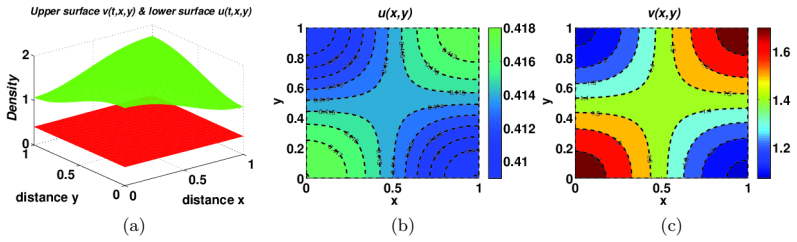
- [Example 2, Section 7] The carrying capacity K=2.0+cos(πx)cos(πy) depends on a second spatial variable y, while the model (2.3) is one-dimensional; either justify a two-dimensional interpretation or restrict K to x.
- [Throughout] Several initial conditions are printed as “≥, ,̸≡0”, which should read “≥0, ̸≡0”; examples appear after (2.1) and in (3.1).
- [Section 6, proof of Theorem 2] In the proof of assertion 2(c), the sets X and Y are defined using Γα2, but the following sentence refers to “Γ” without definition; likely σ is intended.
Circularity Check
No load-bearing circularity: the equal-harvesting model is transparently rescaled to the authors' earlier no-harvesting system, but the conclusion is supported by independent monotone-dynamical-system theory and in-paper proofs; the main caveat is an internal sign error in Lemma 15, not circularity.
full rationale
The derivation is a reduction rather than a circle. The substitution in Section 2, 'If we assume r1 = 1 − µ and K1 = Kr1', converts the equal-harvesting system (2.2) into the harvesting-free system (2.3), which is exactly the same model the authors analyzed in their prior paper [2] with r replaced by rr1 and K by K1. This does mean the analytical harvesting results are corollaries of the no-harvesting theory applied to the rescaled carrying capacity, so the novelty of the equal-µ part is limited. However, the paper states the substitution openly, proves the needed auxiliary Lemmas 1–12 and 15 in the text (Lemma 13, though labeled '[2]', is also proved there), and completes Theorem 2 by 'applying the theory of competitive systems. 2, 21, 22', where [21,22] are independent, standard results and [2] is a published source rather than an unverified premise. No parameter is fitted to data and no predicted quantity is statistically forced, so none of the enumerated circularity patterns (self-definitional, fitted-input-as-prediction, ansatz-smuggling, etc.) is realized in a load-bearing way. Two non-circular problems should be flagged: the theorems only cover equal harvesting µ1=µ2=µ, while unequal harvesting appears only numerically (Example 3, Fig. 11); and Lemma 15 Step 3 reverses the sign of A and B near their first zeros ('A(a)=A(p)=0, A(x)>0, x∈(a,p)' after establishing A<0 on (a,δ)), so the claimed contradiction with Lemma 14(a) does not follow as written. That is an internal correctness gap, not a circularity, and it does not by itself raise the circularity score; the derivation chain is still an honest, if incremental, reduction to prior theory.
Assumptions & free parameters
assumptions (5)
- standard math The comparison principle and strong maximum principle for parabolic and elliptic operators, as used in Lemmas 1, 2, 7, 8.
- standard math The principal eigenvalue of the linearized eigenvalue problem (5.1) is simple with a strictly positive eigenfunction.
- domain assumption Lemma 13 identity (6.2)-(6.3) is taken from the authors' prior paper [2] and not proved here.
- standard math The system (2.3) generates a continuous semi-flow that is competitive, so the monotone dynamical systems framework of Hsu-Smith-Waltman [22] applies.
- domain assumption The spatially heterogeneous carrying capacity K(x) is non-constant, so K1(x) = (1−µ)K(x) is also non-constant.
Cite this review
Pith. "Pith review of Dynamics of Reaction-Diffusion-Advection System and its Impact on River Ecology in the Presence of Spatial Heterogeneity I." pith.science (2026). https://pith.science/paper/HC4NIFAW
@misc{pith2026241200038,
  author       = {Pith},
  title        = {Pith review of: Dynamics of Reaction-Diffusion-Advection System and its Impact on River Ecology in the Presence of Spatial Heterogeneity I},
  year         = {2026},
  howpublished = {\url{https://pith.science/paper/HC4NIFAW}},
  note         = {Machine review of arXiv:2412.00038}
}
read the original abstract
In this study, a spatially distributed reaction-diffusion-advection (RDA) model with harvesting is investigated to signify the outcome of a competition between two competing species in a heterogeneous environment. The study builds upon the concept presented in literature \cite{tisha2}, applying it to river ecology in the context of harvesting activities. We assume that despite of having distinct advection and diffusion rates, two species are competing for the same food supply. This paper's main objective is to study, using theoretical and numerical analysis, the global asymptotic stability and coexistence steady state based on different and unequal rates of diffusion and advection. We establish the result for existence, uniqueness and positivity of the solution. The local stability of two semi trivial steady states is demonstrated. Also, we examine the non-existence of coexistence steady state with the help of some non-trivial presumptions. Finally, we combine the local stability with the non-existence of coexistence to demonstrate the global stability using monotone dynamical systems.
Figures


Figures from the paper (8 more)



Reference graph
Works this paper leans on
-
[2]
Tisha MS, Kamrujjaman M, Zahan I. Dynamics of reaction–diffusion–advection system and its impact on river ecology in the presence of spatial heterogeneity. Partial Differential Equations in Applied Mathematics. 2024 Sep 1;11:100802
work page 2024
-
[1]
Stable isotopes resolve the drift paradox for Baetis mayflies in an arctic river
Hershey AE, Pastor J, Peterson BJ, Kling GW. Stable isotopes resolve the drift paradox for Baetis mayflies in an arctic river. Ecology. 1993 Dec;74(8):2315-25
work page 1993
-
[3]
Gan W, Shao Y, Wang J, Xu F. Global dynamics of a general competitive reaction–diffusion–advection system in one dimensional environments. Nonlinear Analysis: Real World Applications. 2022 Aug 1;66:103523
work page 2022
-
[4]
Reaction-Diffusion Equations in Spatial Ecology (Doctoral dissertation, The Ohio State University)
Lee R. Reaction-Diffusion Equations in Spatial Ecology (Doctoral dissertation, The Ohio State University). 2024, https://people.math.osu.edu/lam.184/paper/Ray\_Lee\_Thesis.pdf
work page 2024
-
[5]
Yan X, Nie H, Zhou P. On a competition-diffusion-advection system from river ecology: mathematical analysis and numerical study. SIAM Journal on Applied Dynamical Systems. 2022;21(1):438-69
work page 2022
-
[6]
He X, Ni WM. Global dynamics of the Lotka‐Volterra competition‐diffusion system: diffusion and spatial heterogeneity I. Communications on Pure and Applied Mathematics. 2016 May;69(5):981-1014
work page 2016
-
[7]
Analysis of a reaction-diffusion system modeling predator-prey with prey-taxis
Bendahmane M. Analysis of a reaction-diffusion system modeling predator-prey with prey-taxis. Networks and Heterogeneous Media. 2008 Sep 30;3(4):863-79
work page 2008
-
[8]
Mathematical Study of a Resource-Based Diffusion Model with Gilpin–Ayala Growth and Harvesting
Zahan I, Kamrujjaman M, Tanveer S. Mathematical Study of a Resource-Based Diffusion Model with Gilpin–Ayala Growth and Harvesting. Bulletin of Mathematical Biology. 2022 Oct;84(10):120
work page 2022
Show all 35 references
-
[9]
Reaction-diffusion-advection models for the effects and evolution of dispersal
Cosner C. Reaction-diffusion-advection models for the effects and evolution of dispersal. Discrete Contin. Dyn. Syst. 2014 May 1;34(5):1701-45
2014
-
[10]
Persistence and extinction in spatial models with a carrying capacity driven diffusion and harvesting
Korobenko L, Kamrujjaman M, Braverman E. Persistence and extinction in spatial models with a carrying capacity driven diffusion and harvesting. Journal of Mathematical Analysis and Applications. 2013 Mar 1;399(1):352-68
2013
-
[11]
Spatio-temporal solutions of a diffusive directed dynamics model with harvesting
Kamrujjaman M, Keya KN, Bulut U, Islam MR, Mohebujjaman M. Spatio-temporal solutions of a diffusive directed dynamics model with harvesting. Journal of Applied Mathematics and Computing. 2023 Feb;69(1):603-30
2023
-
[12]
Gilpin–Ayala model with spatial diffusion and its optimal harvesting policy
Bai L, Wang K. Gilpin–Ayala model with spatial diffusion and its optimal harvesting policy. Applied mathematics and computation. 2005 Dec 1;171(1):531-46
2005
-
[13]
Interplay of harvesting and the growth rate for spatially diversified populations and the testing of a decoupled scheme
Adan MM, Kamrujjaman M, Molla MM, Mohebujjaman M, Buenrostro C. Interplay of harvesting and the growth rate for spatially diversified populations and the testing of a decoupled scheme. Mathematical Biosciences and Engineering. 2023 Jan;20(4)
2023
-
[14]
Evolution of dispersal and the analysis of a resource flourished population model with harvesting
Zahan I, Kamrujjaman M. Evolution of dispersal and the analysis of a resource flourished population model with harvesting. Heliyon. 2024 May 30;10(10)
2024
-
[15]
Kamrujjaman, M. (2019). Kamrujjaman M. Directed vs regular diffusion strategy: evolutionary stability analysis of a competition model and an ideal free pair. Differ. Equ. Appl. 2019;11(2):267-90
2019
-
[16]
Nonlinear parabolic and elliptic equations
Pao CV. Nonlinear parabolic and elliptic equations. Springer Science & Business Media; 2012 Dec 6
2012
-
[17]
On a Lotka-Volterra competition system: diffusion vs advection
Zhou P. On a Lotka-Volterra competition system: diffusion vs advection. Calculus of Variations and Partial Differential Equations. 2016 Dec;55(6):137
2016
-
[18]
Qualitative analysis for a Lotka-Volterra competition system in advective homogeneous environment
Zhou P, Xiao D, Lou Y. Qualitative analysis for a Lotka-Volterra competition system in advective homogeneous environment. Discrete and Continuous Dynamical Systems. 2016 Feb;36(2)
2016
-
[19]
On a Lotka–Volterra competition model: the effects of advection and spatial variation
Zhao XQ, Zhou P. On a Lotka–Volterra competition model: the effects of advection and spatial variation. Calculus of Variations and Partial Differential Equations. 2016 Aug;55(4):73
2016
-
[20]
Stocking and Harvesting Effects in Advection-Reaction-Diffusion Model: Exploring Decoupled Algorithms and Analysis
Tisha MS, Kamrujjaman M, Mohebujjaman M, Khan T. Stocking and Harvesting Effects in Advection-Reaction-Diffusion Model: Exploring Decoupled Algorithms and Analysis. arXiv preprint arXiv:2404.17702. 2024 Apr 26
2024 arXiv
-
[21]
On an abstract competition model and applications
Hess P, Lazer AC. On an abstract competition model and applications. Nonlinear Analysis: Theory, Methods & Applications. 1991 Jan 1;16(11):917-40
1991
-
[22]
Competitive exclusion and coexistence for competitive systems on ordered Banach spaces
Hsu S, Smith H, Waltman P. Competitive exclusion and coexistence for competitive systems on ordered Banach spaces. Transactions of the American Mathematical Society. 1996;348(10):4083-94
1996
-
[23]
Dynamics of Lotka-Volterra diffusion-advection competition system with heterogeneity vs homogeneity
Xu B, Jiang H. Dynamics of Lotka-Volterra diffusion-advection competition system with heterogeneity vs homogeneity. J. Nonlinear Sci. Appl. 2017;10:6132-40
2017
-
[24]
Dispersal dynamics: competitive Symbiotic and predator-prey interactions
Kamrujjaman M. Dispersal dynamics: competitive Symbiotic and predator-prey interactions. Journal of Advanced Mathematics and Applications. 2017 Feb 1;6(1):7-17
2017
-
[25]
Lutscher, F., McCauley, E., & Lewis, M. A. (2007). Spatial patterns and coexistence mechanisms in systems with unidirectional flow. Theoretical population biology, 71(3), 267-277
2007
-
[26]
Y., & Lou, Y
Averill, I., Lam, K. Y., & Lou, Y. (2017). The role of advection in a two-species competition model: a bifurcation approach (Vol. 245, No. 1161). American Mathematical Society
2017
-
[27]
Zhao, X. Q. (2003). Dynamical Systems in Population Biology Springer-Verlag. New York
2003
-
[28]
Braverman, E., & Kamrujjaman, M. (2016). Competitive–cooperative models with various diffusion strategies. Computers & Mathematics with Applications, 72(3), 653-662
2016
-
[29]
Lou, Y. (2008). Some challenging mathematical problems in evolution of dispersal and population dynamics. Tutorials in mathematical biosciences IV: evolution and ecology, 171-205
2008
-
[30]
Q., & Zhao, X
Zhao, X. Q., & Zhao, X. Q. (2003). Dissipative Dynamical Systems. Dynamical Systems in Population Biology, 1-35
2003
-
[31]
Zhou, P., & Zhao, X. Q. (2018). Evolution of passive movement in advective environments: General boundary condition. Journal of Differential Equations, 264(6), 4176-4198
2018
-
[32]
He, X., & Ni, W. M. (2013). The effects of diffusion and spatial variation in Lotka–Volterra competition–diffusion system I: heterogeneity vs. homogeneity. Journal of Differential Equations, 254(2), 528-546
2013
-
[33]
M., Trabelsi, K., & Allaire, G
Allaire, G., Kaber, S. M., Trabelsi, K., & Allaire, G. (2008). Numerical linear algebra (Vol. 55). New York: Springer
2008
-
[34]
Ramos, J. I. (1997). Linearization methods for reaction-diffusion equations: Multidimensional problems. Applied mathematics and computation, 88(2-3), 225-254
1997
-
[35]
Kamrujjaman, M. (2019). Interplay of resource distributions and diffusion strategies for spatially heterogeneous populations. Journal of Mathematical Modeling, 7(2), 175-198
2019
Reviewed August 12, 2026 · model on record in the stance chip above.
Discussion (0). Continue with ORCID to comment.