REVIEW 4 major objections 6 minor 48 references
Invisible Hydrodynamic Tweezers Based on Near-Zero Index Materials
T0 review · 4 major / 6 minor · reviewed 2026-08-12 · deepseek-v4-flash
Pith's one-line read A passive channel-geometry device can trap particles in flowing fluid while leaving the external flow undisturbed.
desk verdict A genuinely new passive hydrodynamic tweezer concept with proof-of-concept experiments, but the analytic model is stretched beyond its thin-gap regime and the validation is more qualitative than quantitative. read the letter →
The pith
A machine-rendered reading of the paper's core claim, the machinery that carries it, and where it could break.
The reading
What carries the argument
The load-bearing mechanism is an analogy between steady thin-channel (Hele-Shaw/Poiseuille) flow, governed by $(h^3/12\mu)\nabla_\parallel^2 P = 0$, and diffusion or wave equations in which a zero-index material has a uniform potential. In this analogy the channel height $h$ plays the role of the index: a sudden expansion to a large height $h_c$ creates a core with $\nabla_\parallel p \to 0$ and fluid velocity approaching zero. The outer shell cancels the core's disturbance through the scattering-cancellation condition $h_s = \sqrt[3]{\frac{r_s^2 - r_c^2}{r_s^2 + r_c^2} h_b^3}$, matching pressure and mass flux at each interface. The trap itself is an equipotential viscous region: no pressure difference means no pressure drag on a particle, and near-zero velocity means negligible friction drag.
What would settle it
Place pressure sensors at the center and near the rim of the core in a fabricated device with $h_c = 5$ cm and $r_c = 3$ cm under the stated 1000 Pa pressure drop. If the mid-plane pressure varies across the core by a substantial fraction of 1000 Pa, the assumption of a uniform-pressure equipotential region is violated, and the trapping and invisibility claims would need revision.
Extended reading notes
Core claim
The central claim is that a hydrodynamic near-zero-index region together with a scattering-cancelling shell can act as a trap: small objects entering the core are decelerated by viscous drag and held there, because the core has essentially uniform pressure and near-zero flow velocity. The shell height is chosen by the relation $h_s = \sqrt[3]{\frac{r_s^2 - r_c^2}{r_s^2 + r_c^2} h_b^3}$ so that the composite device reads as empty space to the external flow. The authors state that this is achieved passively, purely by channel geometry, without continuous energy input, and they demonstrate in experiments that particles are concentrated and captured while outside streamlines remain straight.
Load-bearing premise
The design assumes that a sharply expanded, tall fluid pocket behaves as a near-zero-index region under the same thin-channel equations used to design the shell; if the pressure inside the pocket is not actually uniform, trapped particles still experience pressure drag and the invisibility claim weakens.
Editorial extensions
If this is right
- Particles can be trapped in a flowing liquid with no external excitation source, because the trap is set by channel geometry alone.
- The tweezer does not disturb the external flow, so multiple tweezers can be operated in the same channel without mutual interference.
- Captured particles can be moved by relocating the device, although movement is only downstream or lateral, not upstream.
- The channel-height design can be scaled to different sizes and does not depend on the particle's material properties.
- If correct, the method extends contactless manipulation to dynamic fluid environments, covering a gap left by optical, magnetic, and acoustic tweezers.
Reading between the lines
- Extension: a direct consequence the paper does not develop is that any high-permeability filler with the same hydraulic conductance as the tall pocket should reproduce the trapping, which would show the effect is about local flow resistance rather than the specific expansion geometry.
- Extension: the invisibility result is shown for steady, laminar, low-Reynolds flow; whether the passive trap holds under oscillatory or pulsatile driving is an open question that time-dependent simulations could settle.
- Extension: the paper's closing suggestion to couple flow with heat transfer implies a testable follow-up: a thermal probe of the same equipotential region could map pressure uniformity independently of particle tracking.
Signed reviews
Editorial analysis
A structured set of objections, weighed in public.
Referee Report
Summary. The paper proposes an 'invisible hydrodynamic tweezer' that combines a near-zero-index (NZIM) core, realized by a local channel-height expansion, with a scattering-canceling shell. The core is intended to create an equipotential region with near-zero flow velocity, immobilizing particles passively, while the shell, designed via Eq. (4), is meant to leave the external flow undisturbed. The authors derive the shell-height condition from a depth-averaged Hele-Shaw model, verify the concept in COMSOL simulations for a 30 cm x 20 cm channel with a 5-cm-tall core, and demonstrate trapping and movement of particles in qualitative experiments with a glycerin-filled acrylic channel. The central claim is that this device provides damage-free, non-interfering, passive particle manipulation in flowing fluids, with applications in life sciences and microfluidics.
Significance. If the central mechanism is correct, the paper introduces a genuinely novel concept: using a geometry-tailored hydrodynamic metamaterial to achieve both shielding (zero pressure gradient in a trap region) and cloaking (no external flow disturbance) in one passive device. The analytical derivation of Eq. (4) is transparent, and the qualitative agreement between simulation and experiment in Figures 3-5 supports the plausibility of the idea. The paper also clearly identifies the design parameters and provides a starting point for quantitative follow-up work. These strengths are real and should be credited. However, the load-bearing assumptions about the validity of the Hele-Shaw model for the tall core and the post-hoc tuning of the shell height currently limit the strength of the claims.
major comments (4)
- [Theory and Numerical Demonstration] The derivation of the near-zero-index core and the cloaking condition Eq. (4) relies on the depth-averaged Hele-Shaw equation (Eq. (3)), which is valid only when the channel height is much smaller than the lateral length scale. In the actual device, the core has h_c = 5 cm and r_c = 3 cm, giving h_c/r_c ≈ 1.7, which is outside the thin-gap regime. The paper acknowledges only a 'minimal smooth transition zone' (Section 'Designing invisible hydrodynamic tweezers') but does not address the vertical pressure structure or three-dimensional Stokes corrections inside the tall core. If the pressure is not horizontally uniform at the particle height (z = 3 mm), the equipotential trapping mechanism fails. The authors should support the claim by either performing a full 3D Stokes simulation of the core region or providing a rigorous asymptotic analysis showing that the pressure at the mid-plane is uniform. This is load-bearing because the entire trapping concept depends on the core being an equipotential viscous region.
- [Numerical Demonstration, shell-height optimization] The shell height is first computed from Eq. (4) as h_s = 4.36 mm, but then adjusted to 4.79 mm after 'parameterized scanning' (Section 'Numerical Demonstration'). This post-hoc optimization introduces a free parameter, and the final value differs from the theoretical one by about 10%. Consequently, the observed invisibility of the tweezer in the simulations does not independently confirm the near-zero-index core assumption; the scattering cancellation could be achieved by the tuned shell even if the core is not truly uniform. The paper should report a sensitivity analysis of the external flow perturbation with respect to h_s and, ideally, direct measurement or simulation of the pressure inside the core to verify that it is actually equipotential. Without this, the validation is self-consistent rather than a genuine test of the model.
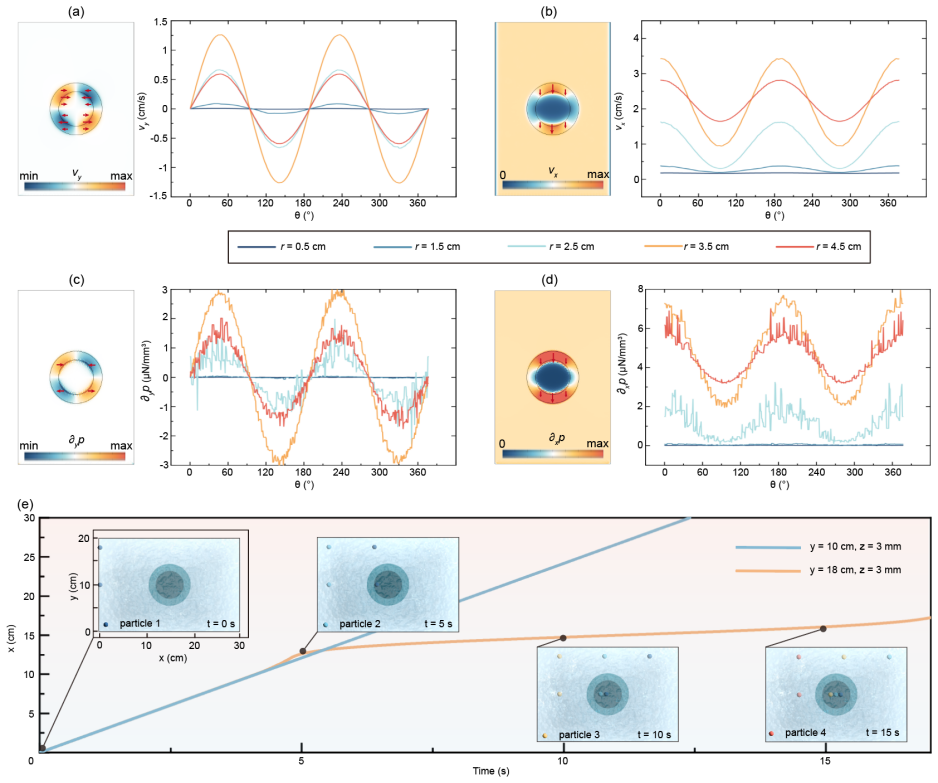
- [Numerical Demonstration, particle-force modeling] The trapping analysis for small particles (Figures 4a-4d) estimates pressure drag as particle volume times local pressure gradient, and friction drag from the depth-averaged fluid velocity. This model neglects confinement effects: the experimental particles are 4 mm in diameter in a 6-mm-high channel, so they occupy a substantial fraction of the gap, and near-wall lubrication forces, the particle's vertical position, and the particle's feedback on the flow are all unaccounted for. These omissions are consequential because the central claim of stable immobilization relies on the force balance being dominated by the assumed drag terms. The authors should either perform boundary-resolved simulations for a representative particle or state clearly the range of particle sizes and heights for which the simplified model is expected to hold.
- [Experimental Demonstration] The experimental validation is qualitative. Invisibility is inferred from visual comparison of streamlines (Figure 5b versus 5c), and trapping is shown by particle snapshots, but there are no quantitative metrics: no deviation of the external velocity or pressure field from the unperturbed case, no particle displacement-versus-time curves, no trapping success rate, and no statistical comparison with the simulation results. Moreover, the authors admit that the rubber membrane in the moving-tweezer experiments produced wrinkles that 'affected only the background flow field and did not impact the flow within the tweezers,' a claim that is asserted without supporting data. Quantitative measurements would substantially strengthen the demonstration and provide a clearer benchmark for the proposed mechanism.
minor comments (6)
- [Introduction] The paper introduces 'hydrodynamic zero-index materials' by analogy to photonics but never defines a refractive index for fluid flow. Please clarify the mapping: the effective 'index' is evidently related to the depth-averaged conductivity h^3/(12µ), and the paper should state this explicitly to avoid a purely metaphorical use of the term.
- [Experimental Demonstration] The text refers to 'Figure 4b' and 'Figure 4c' when describing streamlines in the experimental section; these should be 'Figure 5b' and 'Figure 5c'. The figure numbering should be corrected throughout.
- [Theory, Eq. (1) and Eq. (3)] There is an inconsistency in pressure notation: Eq. (1) uses lowercase p, while Eq. (3) and most of the text use uppercase P; the later sentence 'pressure P in Equation (3) should be modified to p + ρgh' is confusing. Please adopt a single symbol for the modified pressure (e.g., P) and define it consistently.
- [Numerical Demonstration, object-shape claim] The statement that 'the object's shape is irrelevant to the analytical outcomes' is too strong; the supporting evidence is a few simulations in Supplementary Note 5. Please soften the claim to 'the device functionality is unchanged for the tested shapes' or provide a general proof.
- [Discussion] The suggestion that the same principle could 'shield bridge piers from river flow impacts' is speculative and unsupported by any scale analysis; please add a caveat about Reynolds-number and geometry limits, or remove the claim.
- [General] Key details, including the derivation of Eq. (4), the mesh-independence check, and the parameter scan for h_s, are relegated to supplementary notes. For a standalone paper, please include at least the essential steps or summarize the results in the main text, since the current version is difficult to evaluate without access to those notes.
Circularity Check
Invisibility validation is partly a self-consistent fit: shell height is post-hoc tuned (4.36 to 4.79 mm) and the cloaking condition assumes the equipotential core; trapping itself is independently demonstrated.
-
fitted input called prediction
[Section 'Numerical Demonstration of Invisible Hydrodynamic Tweezers', COMSOL setup paragraph ('The external diameter of the shell region is rs = 4.5 cm...')]
"The external diameter of the shell region is rs = 4.5 cm, and as dictated by Equation (4), the corresponding height hs should be 4.36 mm. Based on previous analyses, minor adjustments to hs are necessary to optimize performance. We anticipate that the optimal hs will be slightly greater than 4.36 mm; thus, parameterized scanning is employed to identify an appropriate height close to this value. Post-optimization, we have set hs = 4.79 mm as the parameter for our simulation settings."
The device's invisibility, which is the paper's headline non-interference claim, is validated by the pressure-line comparison in Figure 3j and the external streamlines in Figure 5b only after hs, the cloaking parameter, is re-set from the analytic value 4.36 mm to 4.79 mm by 'parameterized scanning ... to optimize performance' in the simulation. The demonstration therefore measures a calibrated device rather than an out-of-sample prediction of Equation (4). Severity is limited because the tuned value remains within about 10 percent of the analytic value, and the trapping observation is independent of the exact shell height. Still, the reported invisibility result is a self-consistent fit, not a free prediction.
-
self definitional
[Section 'Designing invisible hydrodynamic tweezers based on near-zero index metamaterials', final paragraph]
"It is worth noting that Equation (4) is derived under ideal boundary conditions, where ∇∥p = 0 in the core region. In practical scenarios, as depicted in Figure 2 c, there exists a minimal smooth transition zone between the background and the NZIM region where the velocity and pressure gradients are not zero, which is not accounted for in our initial design. Therefore, after deriving the geometric parameters of the channel structure from Equation (4), further optimizations and adjustments in simulations and experiments are necessary to refine the design and enhance its functionality."
The cloaking formula, Equation (4), which is the step that makes the tweezer 'invisible', is derived by postulating the very equipotential core (∇∥p = 0) that the NZIM mechanism is meant to establish. Invisibility therefore does not independently support the core premise; it is contingent on it. The paper states this limitation openly and the COMSOL core-pressure check provides partial independent support, so this is a stated-ansatz self-consistency rather than a hidden circularity. Nevertheless, in the derivation chain the invisibility condition and the core premise are mutually presupposing.
full rationale
The paper's central derivation is a standard, self-contained scattering-cancellation argument: Equations (1)-(3) give the depth-averaged Laplacian model, and Equation (4) follows from matching pressure and flux at the shell interfaces. Trapping is demonstrated in full-3D COMSOL simulation and in experiment with real 4 mm silicon nitride particles, so the core phenomenon does not reduce to the definition of NZIM by construction. The circularity found is partial and localized. First, the shell height is tuned after the fact: hs predicted as 4.36 mm from Equation (4) is reset to 4.79 mm by parameterized scanning to optimize performance, so the reported invisibility (pressure line matching, straight external streamlines) is the result of a calibrated parameter rather than an out-of-sample prediction; the tuned value stays close to the analytic one and the trapping observation is independent, which limits severity. Second, the cloaking condition itself is derived under the ideal condition ∇∥p = 0 in the core, which the paper explicitly admits, together with an unmodeled smooth transition zone and the need for further optimization and adjustment; thus the invisibility claim presupposes the equipotential premise that the tweezer is meant to provide. Missing support, weighed in the verdict but not itself circularity: the paper states that when h becomes exceedingly large the Poiseuille assumptions no longer hold and Equation (3) becomes inapplicable, yet the fabricated core has hc = 5 cm with rc = 3 cm, giving hc/rc roughly 1.7, outside the thin-gap regime used to derive Equations (3) and (4); a residual vertical pressure structure would break the equipotential trapping premise. No load-bearing self-citation is present: references 29, 41, 42, 44, 46, and 47 are background and development contexts, no uniqueness theorem is imported from the authors' prior work, and the fluid NZIM concept is defined in-paper from the explicit h^3/12mu-to-kappa analogy with Equation (3). Overall, the trapping result is genuinely independent, but the invisibility validation is partly self-consistent fitting, giving score 4.
Assumptions & free parameters
free parameters (2)
- shell height hs =
4.79 mm
- core height hc =
5 cm
assumptions (4)
- domain assumption Hele-Shaw/Poiseuille flow model, Eqs. (1)-(3), applies throughout each region of the device.
- ad hoc to paper Abrupt height expansions produce a near-zero-index core with pressure gradient near zero and near-zero velocity.
- domain assumption Equal pressure and mass conservation at interfaces, with piecewise-constant h, are sufficient to derive the cloaking condition Eq. (4).
- domain assumption For small particles, drag is dominated by viscous friction and pressure drag estimated as volume times pressure gradient; inertia and confinement effects are neglected.
invented entities (1)
-
Hydrodynamic near-zero-index metamaterial region (NZIM)
independent evidence
Cite this review
Pith. "Pith review of Invisible Hydrodynamic Tweezers Based on Near-Zero Index Materials." pith.science (2026). https://pith.science/paper/WCFYOOHP
@misc{pith2026241200130,
  author       = {Pith},
  title        = {Pith review of: Invisible Hydrodynamic Tweezers Based on Near-Zero Index Materials},
  year         = {2026},
  howpublished = {\url{https://pith.science/paper/WCFYOOHP}},
  note         = {Machine review of arXiv:2412.00130}
}
read the original abstract
Manipulating particles, such as cells and tissues, in a flowing liquid environment is crucial for life science research. Traditional contactless tweezers, although widely used for single-cell manipulation, face several challenges. These include potential damage to the target, restriction to static environments, complex excitation setups, and interference outside the target area. To address these issues, we propose an ``invisible hydrodynamic tweezer'' utilizing near-zero index hydrodynamic metamaterials. This metamaterial-based device creates an equipotential resistance zone, effectively immobilizing particles in flowing fluids without disturbing the external flow field and without causing damage to the targets. Unlike traditional active control methods, our tweezer passively captures and releases particles by adjusting the flow channel, eliminating the need for continuous and stable excitation devices, thereby significantly simplifying the setup complexity. Furthermore, these tweezers can be modularly designed in different sizes to flexibly accommodate various application needs. Simulations and experimental validations demonstrated the non-interfering, stable trapping, and precise movement capabilities of these tweezers. This proposed technique holds significant potential for applications in biomedicine, microfluidics, and environmental monitoring.
Figures


Figures from the paper (2 more)

Reference graph
Works this paper leans on
-
[1]
Pinton L, Khedr M, Lionello VM, Sarcar S, Maffioletti SM, Dastidar S, et al. 3D human induced pluripotent stem cell-derived bioengineered skeletal muscles for tissue, disease and therapy modeling. Nature Protocols 2023, 18(4): 1337-1376
work page 2023
-
[2]
Design, clinical transla- tion and immunological response of biomaterials in regenerative medicine
Sadtler K, Singh A, Wolf MT, Wang X, Pardoll DM, Elisseeff JH. Design, clinical transla- tion and immunological response of biomaterials in regenerative medicine. Nature Reviews Materials 2016, 1(7)
work page 2016
-
[3]
Park SE, Georgescu A, Huh D. Organoids-on-a-chip. Science 2019, 364(6444): 960-965
work page 2019
-
[4]
All other walls are subject to no-slip boundary conditions
The model’s inlet features a constant pressure boundary condition of P = 1000 Pa, and the outlet has a boundary condition of P = 0 Pa. All other walls are subject to no-slip boundary conditions. The fluid’s properties correspond to those of a 95% concentrated glycerin solution ( µ = 0.63 Pa · s). First, we examine the forces acting on a large cylindrical ...
-
[5]
Microfluidic Tissue Engineering and Bio-Actuation
Filippi M, Buchner T, Yasa O, Weirich S, Katzschmann RK. Microfluidic Tissue Engineering and Bio-Actuation. Advanced Materials 2022, 34(23)
work page 2022
-
[6]
OPTICAL TRAPPING AND MANIPULATION OF VIRUSES AND BACTERIA
Ashkin A, Dziedzic JM. OPTICAL TRAPPING AND MANIPULATION OF VIRUSES AND BACTERIA. Science 1987, 235(4795): 1517-1520. 15
work page 1987
-
[7]
OPTICAL TRAPPING AND MANIPULATION OF SINGLE CELLS USING INFRARED-LASER BEAMS
Ashkin A, Dziedzic JM, Yamane T. OPTICAL TRAPPING AND MANIPULATION OF SINGLE CELLS USING INFRARED-LASER BEAMS. Nature 1987, 330(6150): 769-771
work page 1987
-
[8]
A revolution in optical manipulation
Grier DG. A revolution in optical manipulation. Nature 2003, 424(6950): 810-816
work page 2003
Show all 48 references
-
[9]
Optical manip- ulation from the microscale to the nanoscale: fundamentals, advances and prospects
Gao D, Ding W, Nieto-Vesperinas M, Ding X, Rahman M, Zhang T, et al. Optical manip- ulation from the microscale to the nanoscale: fundamentals, advances and prospects. Light- Science & Applications 2017, 6
2017
-
[10]
Engineering photonic angular momentum with structured light: a review
Chen J, Wan C, Zhan Q. Engineering photonic angular momentum with structured light: a review. Advanced Photonics 2021, 3(6)
2021
-
[11]
Optical manipulation with metamaterial structures
Shi Y, Song Q, Toftul I, Zhu T, Yu Y, Zhu W, et al. Optical manipulation with metamaterial structures. Applied Physics Reviews 2022, 9(3)
2022
-
[12]
Single-molecule analysis of DNA uncoiling by a type II topoisomerase
Strick TR, Croquette V, Bensimon D. Single-molecule analysis of DNA uncoiling by a type II topoisomerase. Nature 2000, 404(6780): 901-904
2000
-
[13]
Acoustic tweezers for the life sciences
Ozcelik A, Rufo J, Guo F, Gu Y, Li P, Lata J, Huang TJ. Acoustic tweezers for the life sciences. Nature Methods 2018, 15(12): 1021-1028
2018
-
[14]
Holographic acoustic tweezers
Marzo A, Drinkwater BW. Holographic acoustic tweezers. Proceedings of the National Academy of Sciences of the United States of America 2019, 116(1): 84-89
2019
-
[15]
Optoelectronic tweezers
Wu MC. Optoelectronic tweezers. Nature Photonics 2011, 5(6): 322-324
2011
-
[16]
Plasmonic tweezers: for nanoscale optical trapping and beyond
Zhang Y, Min C, Dou X, Wang X, Urbach HP, Somekh MG, Yuan X. Plasmonic tweezers: for nanoscale optical trapping and beyond. Light-Science & Applications 2021, 10(1)
2021
-
[17]
A microfluidic-based hydrodynamic trap: design and implementation
Tanyeri M, Ranka M, Sittipolkul N, Schroeder CM. A microfluidic-based hydrodynamic trap: design and implementation. Lab on a Chip 2011, 11(10): 1786-1794
2011
-
[18]
Hydrodynamic trapping of molecules in lipid bilayers
Joensson P, McColl J, Clarke R W, Ostanin VP, Jonsson B, Klenerman D. Hydrodynamic trapping of molecules in lipid bilayers. Proceedings of the National Academy of Sciences of the United States of America 2012, 109(26): 10328-10333
2012
-
[19]
Fluid-Flow Rotator Based on Hydrodynamic Metamaterial
Park J, Youn JR, Song YS. Fluid-Flow Rotator Based on Hydrodynamic Metamaterial. Phys- ical Review Applied 2019, 12(6)
2019
-
[20]
Design of novel energy harvesting device based on water flow manipulation
Pang HX, Feng AC, You YX, Chen K. Design of novel energy harvesting device based on water flow manipulation. Physics of Fluids 2022, 34(9)
2022
-
[21]
Reconfigurable microfluidics
Paratore F, Bacheva V, Bercovici M, Kaigala GV. Reconfigurable microfluidics. Nature Re- views Chemistry 2022, 6(1): 70-80
2022
-
[22]
Hydrodynamic metamaterials: Principles, experiments, and applica- 16 tions
Chen M, Shen X, Xu L. Hydrodynamic metamaterials: Principles, experiments, and applica- 16 tions. Droplet 2023, 2(4): e79
2023
-
[23]
Realizing the multifunctional microfluidic flow manipulation based on hydro- dynamic metamaterials
Pang H, You Y. Realizing the multifunctional microfluidic flow manipulation based on hydro- dynamic metamaterials. Physics of Fluids 2024, 36(2)
2024
-
[24]
Hydrodynamic metamaterial redirector for steering fluid flow in pipelines with arbitrary curvatures
Pang H, You Y, Chen K. Hydrodynamic metamaterial redirector for steering fluid flow in pipelines with arbitrary curvatures. Journal of Fluid Mechanics 2024, 984
2024
-
[25]
Meta-hydrodynamics for freely manipulating fluid flows
Wu C-L, Wang B, Yao N-Z, Wang H, Wang X. Meta-hydrodynamics for freely manipulating fluid flows. Physics of Fluids 2024, 36(6)
2024
-
[26]
Controlling water waves with artificial structures
Zhu S, Zhao X, Han L, Zi J, Hu X, Chen H. Controlling water waves with artificial structures. Nature Reviews Physics 2024, 6(4): 231-245
2024
-
[27]
Fluid Flow Control with Transformation Media
Urzhumov YA, Smith DR. Fluid Flow Control with Transformation Media. Physical Review Letters 2011, 107(7)
2011
-
[28]
Flow stabilization with active hydrodynamic cloaks
Urzhumov YA, Smith DR. Flow stabilization with active hydrodynamic cloaks. Physical Re- view E 2012, 86(5)
2012
-
[29]
Hydrodynamic Metamaterial Cloak for Drag-Free Flow
Park J, Youn JR, Song YS. Hydrodynamic Metamaterial Cloak for Drag-Free Flow. Physical Review Letters 2019, 123(7)
2019
-
[30]
Intangible Hydrodynamic Cloaks for Convective Flows
Wang B, Shih TM, Xu LJ, Dai GL, Huang JP. Intangible Hydrodynamic Cloaks for Convective Flows. Physical Review Applied 2021, 15(3)
2021
-
[31]
Realizing the multi functional meta- material for fluid flow in a porous medium
Chen M, Shen X, Chen Z, Lo JHY, Liu Y, Xu X, et al. Realizing the multi functional meta- material for fluid flow in a porous medium. Proceedings of the National Academy of Sciences of the United States of America 2022, 119(49)
2022
-
[32]
Realizing the thinnest hydrodynamic cloak in porous medium flow
Chen M, Shen X, Xu L. Realizing the thinnest hydrodynamic cloak in porous medium flow. Innovation 2022, 3(4)
2022
-
[33]
A metamaterial-free fluid-flow cloak
Tay F, Zhang Y, Xu H, Goh H, Luo Y, Zhang B. A metamaterial-free fluid-flow cloak. National Science Review 2022, 9(9)
2022
-
[34]
Transformation hydrodynamic metamaterials: Rigorous arguments on form invariance and structural design with spatial variance
Dai G, Wang J. Transformation hydrodynamic metamaterials: Rigorous arguments on form invariance and structural design with spatial variance. Physical Review E 2023, 107(5)
2023
-
[35]
Microscale Hydrodynamic Cloaking and Shielding via Electro-Osmosis
Boyko E, Bacheva V, Eigenbrod M, Paratore F, Gat AD, Hardt S, Bercovici M. Microscale Hydrodynamic Cloaking and Shielding via Electro-Osmosis. Physical Review Letters 2021, 126(18)
2021
-
[36]
Achieving Environmentally-Adaptive and Multifunc- tional Hydrodynamic Metamaterials through Active Control
Jiang C, Nie H, Chen M, Shen X, Xu L. Achieving Environmentally-Adaptive and Multifunc- tional Hydrodynamic Metamaterials through Active Control. Advanced Materials 2024. 17
2024
-
[37]
Introduction to Microfluidics
Tabeling P. Introduction to Microfluidics. OUP Oxford, 2023
2023
-
[38]
Large optical nonlinearity of indium tin oxide in its epsilon- near-zero region
Alam MZ, De Leon I, Boyd R W. Large optical nonlinearity of indium tin oxide in its epsilon- near-zero region. Science 2016, 352(6287): 795-797
2016
-
[39]
Near-zero refractive index photonics
Liberal I, Engheta N. Near-zero refractive index photonics. Nature Photonics 2017, 11(3): 149-158
2017
-
[40]
Thermal meta-device in analogue of zero-index photonics
Li Y, Zhu K-J, Peng Y-G, Li W, Yang T, Xu H-X, et al. Thermal meta-device in analogue of zero-index photonics. Nature Materials 2019, 18(1): 48-54
2019
-
[41]
Tunable analog thermal material
Xu G, Dong K, Li Y, Li H, Liu K, Li L, et al. Tunable analog thermal material. Nature Communications 2020, 11(1)
2020
-
[42]
Convective Cloak in Hele-Shaw Cells with Bilayer Structures: Hiding Objects from Heat and Fluid Motion Simultaneously
Dai G, Zhou Y, Wang J, Yang F, Qu T, Huang J. Convective Cloak in Hele-Shaw Cells with Bilayer Structures: Hiding Objects from Heat and Fluid Motion Simultaneously. Physical Review Applied 2022, 17(4)
2022
-
[43]
Tunable liquid-solid hybrid thermal metamaterials with a topology transition
Jin P, Liu J, Xu L, Wang J, Ouyang X, Jiang J-H, Huang J. Tunable liquid-solid hybrid thermal metamaterials with a topology transition. Proceedings of the National Academy of Sciences of the United States of America 2023, 120(3)
2023
-
[44]
Diffusion metamaterials
Zhang Z, Xu L, Qu T, Lei M, Lin Z-K, Ouyang X, et al. Diffusion metamaterials. Nature Reviews Physics 2023, 5(4): 218-235
2023
-
[45]
Deep Learning-Assisted Active Metamaterials with Heat-Enhanced Thermal Transport
Jin P, Xu L, Xu G, Li J, Qiu C-W, Huang J. Deep Learning-Assisted Active Metamaterials with Heat-Enhanced Thermal Transport. Advanced Materials 2024, 36(5)
2024
-
[46]
Controlling mass and energy diffusion with metamaterials
Yang F, Zhang Z, Xu L, Liu Z, Jin P, Zhuang P, et al. Controlling mass and energy diffusion with metamaterials. Reviews of Modern Physics 2024, 96(1)
2024
-
[47]
Diffusive pseudo-conformal mapping: Anisotropy- free transformation thermal media with perfect interface matching
Dai G, Yang F, Wang J, Xu L, Huang J. Diffusive pseudo-conformal mapping: Anisotropy- free transformation thermal media with perfect interface matching. Chaos Solitons & Fractals 2023, 174
2023
-
[48]
Free-form and multi-physical metamaterials with forward conformality-assisted tracing
Xu L, Dai G, Yang F, Liu J, Zhou Y, Wang J, et al. Free-form and multi-physical metamaterials with forward conformality-assisted tracing. Nature Computational Science 2024. 18 (a) (b) (c) StreamlineIsobar Step 1 shielding NZIM Step 2 cloaking Shell Tweezer close Tweezer open H...
2024
Reviewed August 12, 2026 · model on record in the stance chip above.
Discussion (0). Continue with ORCID to comment.