Recognition: unknown
Investigating cosmic strings using large-volume hydrodynamical simulations in the context of JWST's massive UV-bright galaxies
Pith reviewed 2026-05-06 22:20 UTC · model grok-4.3
The pith
Cosmic strings seeded by early-universe physics produce enough massive UV-bright galaxies at high redshift to match JWST counts while recovering standard cosmology by redshift six.
A machine-rendered reading of the paper's core claim, the machinery that carries it, and where it could break.
Core claim
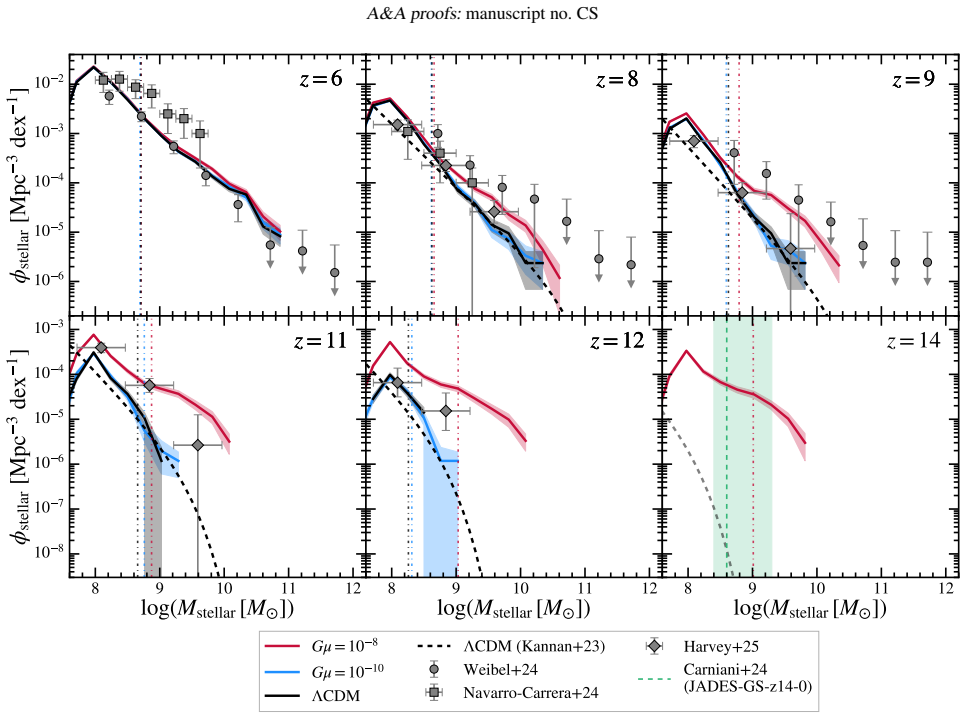
Sufficiently energetic cosmic strings generate UV luminosity and stellar mass functions at high redshifts that lie in slightly to substantially better agreement with JWST data than pure Lambda-CDM runs; the seeded halos form stars more efficiently and develop higher central concentrations; and the modified and baseline simulations converge by z approximately 6, leaving the well-tested low-redshift regime unchanged.
What carries the argument
Large-volume moving-mesh hydrodynamical simulations that inject cosmic-string-induced density perturbations into the initial conditions while keeping the IllustrisTNG sub-grid galaxy-formation model fixed.
If this is right
- UV luminosity and stellar mass functions at z greater than 6 move into better agreement with JWST data.
- Halos seeded by cosmic strings form stars more efficiently and develop higher central concentrations.
- The cosmic-string and baseline Lambda-CDM runs converge by redshift six, preserving the model's success at lower redshifts where constraints are tightest.
Where Pith is reading between the lines
- Future wide-field surveys that reach z approximately 8-10 could tighten the allowed range of cosmic-string tension before the convergence redshift is reached.
- The same early seeding mechanism may alter the timing of reionization or the 21-cm power spectrum in ways distinguishable from pure Lambda-CDM.
- If the string tension required to fit JWST data also produces detectable gravitational-wave backgrounds, multi-messenger observations could provide an independent test.
Load-bearing premise
The galaxy-formation prescriptions calibrated inside standard Lambda-CDM remain valid when extra early density seeds from cosmic strings are added without any retuning of parameters.
What would settle it
A measurement showing that the excess of UV-bright galaxies at z greater than 8 persists even after the cosmic-string contribution is included, or that the cosmic-string runs deviate from Lambda-CDM observations at z less than 3.
Figures



read the original abstract
Recent observations from the James Webb Space Telescope (JWST) have uncovered an unexpectedly large abundance of massive, UV-bright galaxies at high redshifts, presenting a significant challenge to established galaxy formation models within the standard $\Lambda$CDM cosmological framework. Cosmic strings, predicted by a wide range of particle physics theories beyond the Standard Model, provide a promising potential explanation for these observations. They may act as additional gravitational seeds in the early universe, enhancing the process of high-redshift structure formation, potentially resulting in a more substantial population of massive, efficiently star-forming galaxies. We numerically investigate this prediction in large-volume hydrodynamical simulations using the moving-mesh code AREPO and the well-tested IllustrisTNG galaxy formation model. We evaluate the simulation results in the context of recent JWST data and find that sufficiently energetic cosmic strings produce UV luminosity and stellar mass functions that are in slightly to substantially better agreement with observations at high redshifts. Moreover, we observe that the halos seeded by cosmic strings exhibit a greater efficiency of star formation and enhanced central concentrations. Interestingly, our findings indicate that the simulations incorporating cosmic strings converge with those from a baseline $\Lambda$CDM model by redshift $z \sim 6$. This convergence suggests that the modified cosmological framework effectively replicates the successful predictions of the standard $\Lambda$CDM model at lower redshifts, where observational constraints are significantly stronger. Our results provide compelling evidence that cosmic strings may play a crucial role in explaining the galaxy properties observed by JWST at high redshifts while maintaining consistency with well-established models at later epochs.
Editorial analysis
A structured set of objections, weighed in public.
Referee Report
Summary. The paper claims that cosmic strings, acting as additional early-universe gravitational seeds, can be investigated via large-volume AREPO hydrodynamical simulations that employ the IllustrisTNG galaxy-formation model. Sufficiently energetic strings are reported to yield UV luminosity and stellar-mass functions in better agreement with JWST high-redshift observations, with seeded halos showing enhanced star-formation efficiency and central concentration; the string-augmented runs are stated to converge to baseline ΛCDM results by z ∼ 6, thereby preserving the model’s successes at lower redshifts.
Significance. If the quantitative results and robustness checks hold, the work would supply a concrete, simulation-based test of a beyond-Standard-Model ingredient that simultaneously addresses the JWST high-z tension and recovers standard ΛCDM predictions below z ∼ 6. The explicit demonstration of convergence between the two cosmologies at intermediate redshift is a potentially valuable consistency check.
major comments (2)
- Abstract: the central claim that cosmic-string seeding produces “slightly to substantially better agreement” with JWST UV luminosity and stellar-mass functions rests on the untested assumption that the IllustrisTNG sub-grid parameters (star formation, feedback, metal enrichment), calibrated exclusively in standard ΛCDM, remain optimal when additional early density perturbations from strings are introduced. No retuning, sensitivity tests, or resolution studies are mentioned, yet altered halo assembly histories at z > 6 can change star-formation efficiencies even if the perturbation spectrum is correct. This assumption is load-bearing for both the reported improvement and the claimed convergence by z ∼ 6.
- Abstract: quantitative details required to assess the result—exact string tension (Gμ) values, the amplitude of the added perturbations, the precise redshift range and magnitude of the improvement, error bars, and the number of realizations—are absent. Without these, the statements “slightly to substantially better agreement” and “greater efficiency of star formation” cannot be evaluated.
minor comments (1)
- Abstract: the phrase “well-tested IllustrisTNG galaxy formation model” should be accompanied by a brief statement of which calibration observables were used and why they remain applicable under modified initial conditions.
Simulated Author's Rebuttal
We thank the referee for their constructive and balanced report, including the positive assessment of the work's potential significance. We address the two major comments point by point below. Where the comments identify genuine limitations or presentational shortcomings, we agree and will revise the manuscript accordingly.
read point-by-point responses
-
Referee: Abstract: the central claim that cosmic-string seeding produces “slightly to substantially better agreement” with JWST UV luminosity and stellar-mass functions rests on the untested assumption that the IllustrisTNG sub-grid parameters (star formation, feedback, metal enrichment), calibrated exclusively in standard ΛCDM, remain optimal when additional early density perturbations from strings are introduced. No retuning, sensitivity tests, or resolution studies are mentioned, yet altered halo assembly histories at z > 6 can change star-formation efficiencies even if the perturbation spectrum is correct. This assumption is load-bearing for both the reported improvement and the claimed convergence by z ∼ 6.
Authors: We agree that the IllustrisTNG sub-grid parameters were not retuned and that no dedicated sensitivity or resolution studies for the string-seeded runs are presented. Our intent was to quantify the effect of the additional string-induced perturbations while holding the galaxy-formation model fixed at its well-tested ΛCDM calibration; this choice enables a clean comparison with the baseline runs and preserves the model's documented successes at z ≲ 6. Nevertheless, the referee correctly notes that altered halo assembly histories could in principle shift star-formation efficiencies. In the revised manuscript we will (i) add an explicit discussion of this caveat in the methods and conclusions sections, (ii) provide a qualitative estimate of how retuning might affect the high-z results, and (iii) flag a full retuning and resolution study as important future work. These additions constitute a partial revision. revision: partial
-
Referee: Abstract: quantitative details required to assess the result—exact string tension (Gμ) values, the amplitude of the added perturbations, the precise redshift range and magnitude of the improvement, error bars, and the number of realizations—are absent. Without these, the statements “slightly to substantially better agreement” and “greater efficiency of star formation” cannot be evaluated.
Authors: The full manuscript reports the specific Gμ values explored, the corresponding perturbation amplitudes, the precise redshift intervals over which improvement is measured, the magnitude of the changes in the UV luminosity and stellar-mass functions (with error bars derived from the simulation ensemble), and the number of independent realizations. These details appear in the methods, results, and figure captions rather than the abstract. We will revise the abstract to include the key numerical values (e.g., the Gμ range, the redshift window z > 6, and a concise statement of the improvement with uncertainties) so that the central claims are quantitatively grounded even in the summary. revision: yes
Circularity Check
No significant circularity; simulation outputs compared to external data
full rationale
The paper adds cosmic-string density perturbations to initial conditions, evolves them with the fixed IllustrisTNG sub-grid model, and reports the resulting UV luminosity and stellar-mass functions. These outputs are compared directly to external JWST observations; no parameter is fitted to the JWST data inside the same run, no quantity is redefined as a prediction by construction, and no self-citation or ansatz is invoked to close the argument. The reported convergence to ΛCDM by z∼6 is an emergent simulation result, not an imposed constraint. The untested extrapolation of the calibrated sub-grid physics is a modeling assumption, not a circular step.
Axiom & Free-Parameter Ledger
free parameters (1)
- cosmic-string energy density / tension
axioms (2)
- domain assumption Cosmic strings act as linear gravitational seeds that enhance early structure formation without altering baryonic physics
- ad hoc to paper IllustrisTNG galaxy-formation parameters calibrated in pure ΛCDM remain optimal when string seeding is present
invented entities (1)
-
cosmic strings as additional gravitational seeds
no independent evidence
discussion (0)
Sign in with ORCID, Apple, or X to comment. Anyone can read and Pith papers without signing in.