REVIEW 1 major objections 4 minor 34 references
Vagueness and the Connectives
T0 review · 1 major / 4 minor · reviewed 2026-08-12 · deepseek-v4-flash
Pith's one-line read The paper establishes that the Sorites premises—extremes plus denial of sharp cutoffs—are jointly consistent in orthologic and in fundamental logic, so the paradox does not force classical or intuitionistic logic, and fundamental logic is…
desk verdict Solid new models for the Sorites in orthologic, compatibility logic, and fundamental logic; the central consistency results hold, and Fact 10 has a one-character typo that should be fixed before publication. read the letter →
The pith
A machine-rendered reading of the paper's core claim, the machinery that carries it, and where it could break.
The reading
What carries the argument
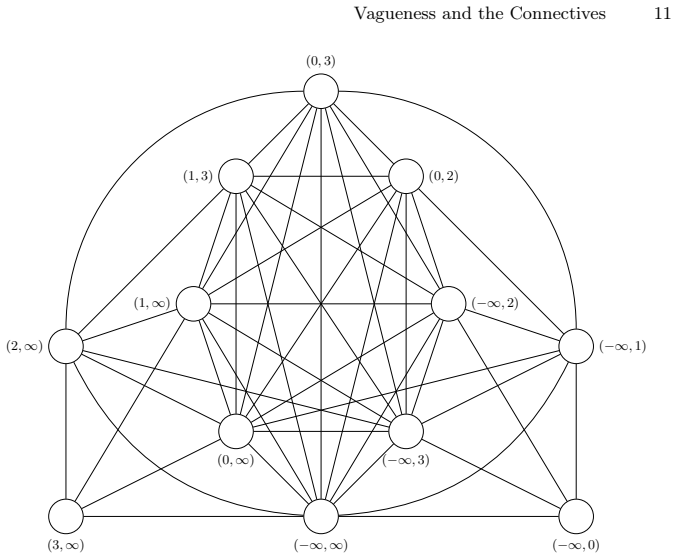
The central object is a relational model with an 'openness' relation $\mathrel{\rhd}$, read as 'x does not reject any proposition that y accepts.' A valuation is required to be a fixed point of the closure operator $c_\rhd(A)=\{x : \forall x'\rhd x\ \exists x''\lhd x' \text{ with } x''\in A\}$, which makes every formula's truth set a fixed point. Negation is interpreted as rejection along open states, and disjunction as the closure of the union, so a disjunction can be forced without either disjunct already being forced. In the Sorites models, states are pairs $(i,j)$ with $i+\delta<j$; the reflexive-symmetric symmetric model validates orthologic, and the pseudosymmetric model adds states $k$ for which $p_k\vee\neg p_k$ is rejected, validating fundamental logic. The spacing constraint $i+\delta<j$ is the workhorse: it forces $\neg(p_k\wedge\neg p_{k+\ell})$ for every $\ell\le\delta$, yielding the no-sharp-cutoff conjuncts.
What would settle it
A robust experimental demonstration that ordinary speakers accept sentences of the form '$φ$ and might not $φ$' as assertable without sarcasm or irony would falsify the paper's central motivation, since the rejection of distributivity—the ground for orthologic and fundamental logic—depends on those sentences being contradictions.
Extended reading notes
Core claim
On the paper's own terms, the central discovery is that the formula $p_0 \wedge \neg p_{n-1} \wedge \bigwedge \neg(p_k \wedge \neg p_{k+\ell})$ is satisfiable, not only in classical or intuitionistic semantics, but in orthologic and in fundamental logic. The symmetric Sorites model uses states $(i,j)$ with $i+\delta<j$, letting $i$ mark the last predicate that holds and $j$ the first that is negated, so the gap $\delta$ blocks sharp cutoffs of length up to $\delta$. Since the model is reflexive and symmetric, it is a model of orthologic; with no constraints on the valuation beyond the fixed-point property, it also serves the compatibility semantics for weak pseudocomplementation. The pseudosymmetric model adds one state per $k$ that rejects $p_k\vee\neg p_k$, so the same formula stays consistent while excluded middle acquires expressive content, marking exactly where the series has a fact of the matter. The paper concludes that fundamental logic—obtained by dropping both distributivity and double-negation elimination—accommodates the non-classicality of epistemic modals and of vagueness together.
Load-bearing premise
The paper takes for granted the arguments that 'It's raining and it might not be raining' is a contradiction, and that this undermines the distributive laws; if those natural-language data are wrong, the case for orthologic and fundamental logic as the base for vagueness loses its footing.
Editorial extensions
If this is right
- The Sorites premises are satisfiable in orthologic and compatibility logic, so denying distributivity is a sufficient logical response to the paradox.
- The same premises are satisfiable in fundamental logic, so the paradox does not require accepting excluded middle.
- In the fundamental approach, each instance of excluded middle $p_k\vee\neg p_k$ is forced exactly at states that settle the $k$-th item, giving a formal way to express 'there is a fact of the matter' versus 'no fact of the matter.'
- The conjunctive and disjunctive versions of the Sorites behave differently in the fundamental treatment: $\neg(p_k\wedge\neg p_{k+1})$ is forced everywhere, but $\neg p_k\vee p_{k+1}$ is not, so one can accept the former without the latter.
- The Gödel–Gentzen translation embeds orthologic faithfully into fundamental logic, so moving to fundamental logic loses no orthological reasoning.
Reading between the lines
- The $\delta$ gap that limits sharp cutoffs is a free parameter; fitting it to psychophysical just-noticeable differences could turn the model into a quantitative account of granularity in vague predicates.
- The paper's dual treatment suggests a unified picture: both 'might' contradictions and sharp cutoffs are states that block common refinement, so one semantic notion of openness handles modal and vagueness incompatibility.
- If fundamental logic becomes the base, then $p\vee\neg p$ becomes an expressive assertion about determinacy; this could give a formal language for debates about whether certain mathematical or metaphysical questions have an objective answer.
Signed reviews
Editorial analysis
A structured set of objections, weighed in public.
Referee Report
Summary. The paper investigates which non-classical base logic for conjunction, disjunction, and negation can accommodate two sources of non-classicality: epistemic modals, which according to earlier work motivate dropping distributivity and moving to orthologic, and vagueness, which has motivated weakening classical logic along intuitionistic or Finean lines. It recalls the systems of fundamental logic, orthologic, compatibility logic, intuitionistic logic, and classical logic, together with relational fixed-point models. The paper's main formal contribution is a symmetric Sorites model S_{n,δ} in which the extremes p0 and ¬p_{n−1} together with all no-sharp-cutoff claims ¬(p_k∧¬p_{k+ℓ}) are jointly forced (Fact 4), yielding consistency in orthologic and compatibility logic (Fact 5). It then defines a pseudosymmetric model S_{n,δ} in which excluded middle instances are no longer tautologies but express settledness, and Facts 6–10 show the corresponding consistency in fundamental logic. The paper argues that fundamental logic is a natural common weakening and includes a discussion of costs and benefits relative to orthologic, including the Gödel–Gentzen embedding of orthologic into fundamental logic.
Significance. If the main model-theoretic results stand, the paper gives a clear and explicit demonstration that the Sorites constellation 'extremes plus no sharp cutoffs' does not force classical or intuitionistic logic, and that the retreat to orthologic or fundamental logic is coherent. The constructions are transparent, the main facts are proved directly, and the paper is candid about its reliance on the epistemic-modal data of [24], which it explicitly takes as a premise rather than re-deriving. The paper therefore makes a solid contribution to the debate on the right non-classical base logic for vagueness and epistemic modals, even though the philosophical conclusions are appropriately conditional and the completeness theorems for compatibility logic are only sketched.
major comments (1)
- [§6, Fact 10] Fact 10 as printed is false. By Fact 9, the extension of p0∨¬p0 is {(i,j)∈S | 0≤i or j≤0}. For n≥2 the state (−∞,n−1) satisfies neither disjunct, so it does not force p0∨¬p0 and hence cannot belong to the extension of the conjunction of all instances of excluded middle. The correct second state is (−∞,0), since j=0≤k for every k∈n. With that correction, the second equality—that the negation of the conjunction is forced exactly at the states with finite coordinates—does hold; as printed, that equality also fails, because (−∞,0) is related to (−∞,n−1) and would therefore not lie in the indicated set. Because Fact 10 is cited in §7 as the model-theoretic witness of Fine's 'global indeterminacy' point, it should be corrected before publication. This is a local one-symbol error: Facts 4–9 and the consistency results for orthologic, compatibility logic, and fundamental logic are unaffected.
minor comments (4)
- [§2, after Definition 2] The rule of proof-by-cases with side assumptions is misprinted: the conclusion should be α∧(ϕ∨ψ)⊢χ, not α∧(ϕ∨ψ)⊢ψ. As written, the rule does not match the informal description or the intended notion of compatibility logic.
- [§2, after Definition 2] The word 'psuedocomplementation' should be 'pseudocomplementation'.
- [§6, proof of Fact 7] In the second equation, the forward direction only considers successors (i′,j′) in S, but the frame also contains the integer states ℓ∈n, and Definition 12.4 makes (i,j)⊳ℓ for every ℓ. The proof should explicitly note that no integer state forces ¬pk (because (k,∞)⊳ℓ and (k,∞)⊩pk); the claim is true, but the proof as written is incomplete.
- [§4, Theorems 4 and 5] The completeness proof for compatibility logic is only a sketch; since these theorems are not needed for the central satisfiability results, this is acceptable, but a little more detail on why the Stone representation preserves weak pseudocomplementation would improve self-containedness.
Circularity Check
No significant circularity: the consistency results are direct model-theoretic constructions, with self-citations confined to background definitions and explicitly assumed motivations.
full rationale
The paper's central formal claims—that the Sorites premises are jointly satisfiable in orthologic, compatibility logic, and fundamental logic—are established by explicit model constructions in §§5–6. Facts 4, 5, 8, 9, and 10 are computed directly from Definitions 10–12 and the forcing clauses of Definition 6, not derived by restating prior conclusions. The soundness theorems invoked (Theorem 1 from Goldblatt [17], Theorem 5 proved in the paper, Theorem 2 from the author's [21]) are used only to connect these models to the target logics; they are independent published results rather than placeholders for the paper's conclusions. The paper explicitly flags that it is 'simply taking for granted here the arguments against distributivity involving epistemic modals from [24]' (§7), so that reliance is a stated conditional premise, not a hidden circular step. The same applies to fundamental logic, whose definition and proof theory come from [21]; the new contribution is the pseudosymmetric Sorites model showing consistency in that system. There are no fitted parameters renamed as predictions, no uniqueness theorem imported to force a conclusion, and no ansatz smuggled in via citation. The apparent error in Fact 10's printed extension—the second state should be (−∞,0) rather than (−∞,n−1)—is a mathematical correctness issue (likely a one-symbol typo) rather than a circularity, since it does not make the conclusion depend on its own input. Overall, the derivation chain is self-contained and non-circular.
Assumptions & free parameters
free parameters (1)
- δ (tolerance width in Sorites models)
assumptions (4)
- standard math ZFC set theory and standard algebraic facts (Stone representation, prime filters) for model constructions
- domain assumption Epistemic-modal data from [24]: sentences like p ∧ ♦¬p are contradictions, so proof-by-cases with side assumptions and pseudocomplementation are invalid
- domain assumption Fine's global approach to vagueness, including weak pseudocomplementation as the negation of compatibility logic
- domain assumption Soundness and completeness of fundamental logic with respect to reflexive pseudosymmetric fixpoint frames (Theorem 2 from [21])
Cite this review
Pith. "Pith review of Vagueness and the Connectives." pith.science (2026). https://pith.science/paper/SFLW4XZY
@misc{pith2026241200356,
  author       = {Pith},
  title        = {Pith review of: Vagueness and the Connectives},
  year         = {2026},
  howpublished = {\url{https://pith.science/paper/SFLW4XZY}},
  note         = {Machine review of arXiv:2412.00356}
}
read the original abstract
Challenges to classical logic have emerged from several sources. According to recent work, the behavior of epistemic modals in natural language motivates weakening classical logic to orthologic, a logic originally discovered by Birkhoff and von Neumann in the study of quantum mechanics. In this paper, we consider a different tradition of thinking that the behavior of vague predicates in natural language motivates weakening classical logic to intuitionistic logic or even giving up some intuitionistic principles. We focus in particular on Fine's recent approach to vagueness. Our main question is: what is a natural non-classical base logic to which to retreat in light of both the non-classicality emerging from epistemic modals and the non-classicality emerging from vagueness? We first consider whether orthologic itself might be the answer. We then discuss whether accommodating the non-classicality emerging from epistemic modals and vagueness might point in the direction of a weaker system of fundamental logic.
Figures

Reference graph
Works this paper leans on
-
[24]
Journal of Philosophical Logic 53, 831–907 (2024)
Holliday, W.H., Mandelkern, M.: The orthologic of epist emic modals. Journal of Philosophical Logic 53, 831–907 (2024). https://doi.org/10.1007/s10992-024-09746-7, arXiv:22 03.02872 [cs.LO]
-
[1]
ACM Transactions on Computational Logic 25(3), 17:1–17:14 (2024)
Aguilera, J.P., Byd˘ zovský, J.: Fundamental logic is dec idable. ACM Transactions on Computational Logic 25(3), 17:1–17:14 (2024). https://doi.org/10.1145/3665328
-
[2]
Studia Logica 91(2), 171–199 (2009)
Almeida, A.: Canonical extensions and relational repres entations of lattices with negation. Studia Logica 91(2), 171–199 (2009). https://doi.org/10.1007/s11225-009-9171-8
-
[3]
Annals of Math- ematics 37(4), 823–843 (1936)
Birkhoff, G., von Neumann, J.: The logic of quantum mechani cs. Annals of Math- ematics 37(4), 823–843 (1936)
work page 1936
-
[4]
Journal of Philosophical Logic 49, 221–248 (2020)
Bobzien, S., Rumfitt, I.: Intuitionism and the modal logic of vagueness. Journal of Philosophical Logic 49, 221–248 (2020). https://doi.org/10.1007/s10992-019-09507-x
-
[5]
https://doi.org/10.1387/theoria
Burgess, J.P.: Which modal models are the right ones (for l ogical necessity)? Theo- ria 18(47), 145–158 (2003). https://doi.org/10.1387/theoria. 418
-
[6]
Dragalin, A.G.: Mathematical Intuitionism: Introducti on to Proof Theory, Trans- lations of Mathematical Monographs, vol. 67. American Math ematical Society, Providence, RI (1988)
work page 1988
-
[7]
Zeitschrift für Mathematische Logik und Grundlagen der Mathematik 5, 250–264 (1959)
Dummett, M.A.E., Lemmon, E.J.: Modal logics between S4 an d S5. Zeitschrift für Mathematische Logik und Grundlagen der Mathematik 5, 250–264 (1959). https://doi.org/10.1002/malq.19590051405
Show all 34 references
-
[8]
In: Relations and Kleene Alge bra in Computer Sci- ence
Dzik, W., Orlowska, E., van Alten, C.: Relational represe ntation theorems for gen- eral lattices with negations. In: Relations and Kleene Alge bra in Computer Sci- ence. RelMiCS 2006. Lecture Notes in Computer Science, vol. 4136, pp. 162–176. Springer (2006). https://doi.org/...
2006 doi
-
[9]
Lecture Notes in Artificial I ntelligence 4342, 245– 266 (2006)
Dzik, W., Orlowska, E., van Alten, C.: Relational represe ntation theorems for lat- tices with negations: A survey. Lecture Notes in Artificial I ntelligence 4342, 245– 266 (2006). https://doi.org/10.1007/11964810_12
2006 doi
-
[10]
Feferman, S.: Is the continuum hypothesis a definite math ematical problem? (2011), https://math.stanford.edu/~feferman/papers/IsCHdefinite.pdf
2011
-
[11]
Australasian Journal of Philosophy 81(4), 457–480 (2003)
Field, H.: No fact of the matter. Australasian Journal of Philosophy 81(4), 457–480 (2003). https://doi.org/10.1080/713659756
2003 doi
-
[12]
Oxford Universi ty Press, New York (2020)
Fine, K.: Vagueness: A Global Approach. Oxford Universi ty Press, New York (2020)
2020
-
[13]
In: F aroldi, F., Van De Putte, F
Fine, K.: In defense of a global view of vagueness: Respon se to An- dreas Ditter’s ‘Fine on the possibility of vagueness’. In: F aroldi, F., Van De Putte, F. (eds.) Kit Fine on Truthmakers, Relevance, and N on-classical Logic, Outstanding Contributions to Logic, vol. 26. Spri...
2023 doi
-
[14]
Mathematische Annalen 112, 493–565 (1936), English translation in [31], pp
Gentzen, G.: Die Widerspruchsfreiheit der reinen Zahle ntheorie. Mathematische Annalen 112, 493–565 (1936), English translation in [31], pp. 132-213 Vagueness and the Connectives 21
1936
-
[15]
Oxford University Press, Ne w York (1986)
Gödel, K.: Collected Works. Oxford University Press, Ne w York (1986)
1986
-
[16]
Ergebnisse eines Mathematischen Kolloquiums 4, 34–38 (1933), English translation in [15], pp
Gödel, K.: Zur intuitionistischen Arithmetik und Zahle ntheorie. Ergebnisse eines Mathematischen Kolloquiums 4, 34–38 (1933), English translation in [15], pp. 286- 295
1933
-
[17]
Jour nal of Philosophical Logic 3(1), 19–35 (1974)
Goldblatt, R.I.: Semantic analysis of orthologic. Jour nal of Philosophical Logic 3(1), 19–35 (1974). https://doi.org/10.1007/BF00652069
1974 doi
-
[18]
Indagationes Mathematicae 26, 596–601 (1964)
Grzegorczyk, A.: A philosophically plausible formal in terpretation of intuitionistic logic. Indagationes Mathematicae 26, 596–601 (1964)
1964
-
[19]
Algebra Universalis 82(26) (2021)
Holliday, W.H.: Three roads to complete lattices: Order s, compatibility, polarity. Algebra Universalis 82(26) (2021). https://doi.org/10.1007/s00012-021-00711 -y
2021 doi
-
[20]
In: Duque, D.F., Pal migiano, A
Holliday, W.H.: Compatibility and accessibility: latt ice representations for seman- tics of non-classical and modal logics. In: Duque, D.F., Pal migiano, A. (eds.) Ad- vances in Modal Logic, Vol. 14, pp. 507–529. College Publica tions, London (2022), arXiv:2201.07098 [math.LO]
2022 arXiv
-
[21]
Log ics 1(1), 36–79 (2023)
Holliday, W.H.: A fundamental non-classical logic. Log ics 1(1), 36–79 (2023). https://doi.org/10.3390/logics1010004
2023 doi
-
[22]
In: Ciabat toni, A., Gabelaia, D., Sedlár, I
Holliday, W.H.: Modal logic, fundamentally. In: Ciabat toni, A., Gabelaia, D., Sedlár, I. (eds.) Advances in Modal Logic, Vol. 15, pp. 423–4 46. College Publi- cations, London (2024), arXiv:2403.14043 [math.LO]
2024 arXiv
-
[23]
In: Proceedings of the 23rd Amsterdam Colloquium
Holliday, W.H., Mandelkern, M.: Compatibility, compos sibility, and epistemic modality. In: Proceedings of the 23rd Amsterdam Colloquium . pp. 120–126 (2022)
2022
-
[25]
Natural Lan- guage Semantics 20, 137–175 (2012)
Klinedinst, N., Rothschild, D.: Connectives without tr uth-tables. Natural Lan- guage Semantics 20, 137–175 (2012). https://doi.org/10.1007/s11050-011-9 079-5
2012 doi
-
[26]
In: Crossley, J.N., Dum- mett, M.A.E
Kripke, S.A.: Semantical analysis of intuitionistic lo gic I. In: Crossley, J.N., Dum- mett, M.A.E. (eds.) Formal Systems and Recursive Functions , pp. 92–130. North- Holland, Amsterdam (1965)
1965
-
[27]
Annals of Pure and Applied L ogic 174(5), 103245 (2023)
Massas, G.: B-frame duality. Annals of Pure and Applied L ogic 174(5), 103245 (2023). https://doi.org/10.1016/j.apal.2023.103245
2023
-
[28]
The Journal of Philosophy 82(9), 462–471 (1985)
McGee, V.: A counterexample to modus ponens. The Journal of Philosophy 82(9), 462–471 (1985). https://doi.org/10.2307/2026276
1985 doi
-
[29]
Fundamenta Informaticae 17(2-4), 319–338 (1993)
Rebagliato, J., Verdú, V.: On the algebraization of some Gentzen systems. Fundamenta Informaticae 17(2-4), 319–338 (1993). https://doi.org/10.3233/FI-1993-182-417
1993 doi
-
[30]
Časopis pro pěstování matematiky a fysiky 67(1), 1–25 (1938)
Stone, M.: Topological representation of distributive lattices and Brouwerian logics. Časopis pro pěstování matematiky a fysiky 67(1), 1–25 (1938)
1938
-
[31]
(ed.): The Collected Papers of Gerhard Gentz en
Szabo, M.E. (ed.): The Collected Papers of Gerhard Gentz en. North-Holland Pub- lishing Company, Amsterdam (1969)
1969
-
[32]
Troelstra, A.S., van Dalen, D.: Constructivism in Mathe matics, vol. I. North- Holland, Amsterdam (1988)
1988
-
[33]
Routledge, New York, NY (199 4)
Williamson, T.: Vagueness. Routledge, New York, NY (199 4)
-
[34]
Mind 110(437), 45–98 (2001)
Wright, C.: On being in a quandary: relativism, vaguenes s, logical revisionism. Mind 110(437), 45–98 (2001). https://doi.org/10.1093/mind/110. 437.45
2001 doi
Reviewed August 12, 2026 · model on record in the stance chip above.
Discussion (0). Continue with ORCID to comment.