Advancing Object-Centric Process Mining with Multi-Dimensional Data Operations
Pith reviewed 2026-05-23 08:38 UTC · model grok-4.3
The pith
Defines and implements four granularity-adjusting operations for object-centric event logs, validated on educational and BPI challenge datasets with reported gains in model precision and fitness.
A machine-rendered reading of the paper's core claim, the machinery that carries it, and where it could break.
Core claim
The four operations enable analysts to seamlessly transition between detailed and aggregated process models, facilitating the discovery of insights that require varying levels of abstraction, with demonstrated improvements in the precision and fitness of the discovered models on real-world OCEL data.
Load-bearing premise
That the formal definitions of drill-down, roll-up, unfold, and fold correctly preserve the semantics and object interactions of the original OCEL when granularity is changed, and that observed improvements in precision and fitness are caused by these operations rather than by other modeling choices or data properties.
Figures
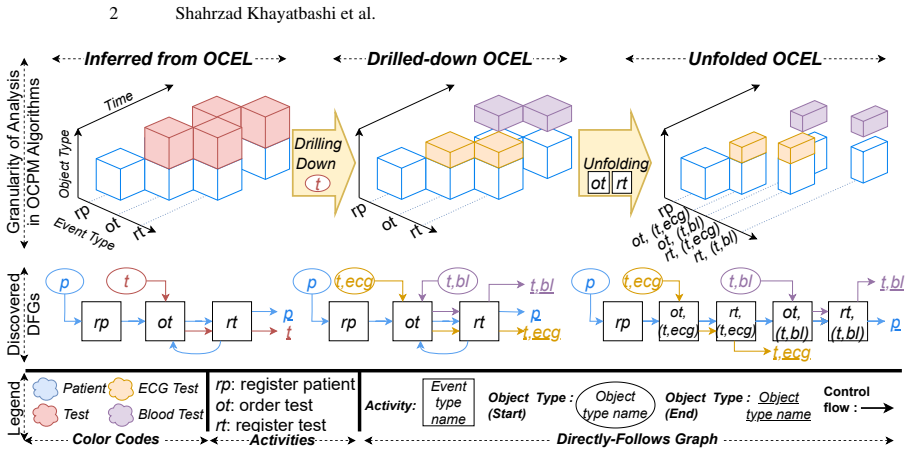


read the original abstract
Analyzing process data at varying levels of granularity is important to derive actionable insights and support informed decision-making. Object-Centric Event Data (OCED) enhances process mining by capturing interactions among events and multiple objects, leading to the discovery of more detailed and realistic yet complex process models. The lack of methods to adjust the granularity of the analysis prevents users from leveraging the full potential of Object-Centric Process Mining (OCPM). To address this gap, we propose four operations: drill-down, roll-up, unfold, and fold, which enable analysts to change the granularity of analysis when working with Object-Centric Event Logs (OCEL). These operations allow analysts to seamlessly transition between detailed and aggregated process models, facilitating the discovery of insights that require varying levels of abstraction. We formally define these operations and implement them in an open-source Python library. To validate their utility, we applied the approach to real-world OCEL data extracted from a learning management system, covering a four-year period and approximately 400 students, as a case of object-centric educational process mining. This case study shows significant improvements in the precision and fitness of the discovered models after applying the operations. In addition, we evaluate the scalability of the operators on large, publicly available OCELs derived from the Business Process Intelligence Challenge datasets, demonstrating that the operations remain computationally feasible on industrial-scale event logs. This approach can empower analysts to perform more flexible and comprehensive process exploration, unlocking actionable insights through flexible granularity adjustments.
Editorial analysis
A structured set of objections, weighed in public.
Axiom & Free-Parameter Ledger
axioms (1)
- domain assumption Object-centric event logs admit well-defined hierarchical granularity changes via the four named operations without loss of object-interaction semantics.
Lean theorems connected to this paper
-
IndisputableMonolith/Foundation/AbsoluteFloorClosure.lean, Cost/FunctionalEquation.leanreality_from_one_distinction unclear?
unclearRelation between the paper passage and the cited Recognition theorem.
We formally define these operations and implement them in an open-source Python library... drill-down, roll-up, unfold, and fold
What do these tags mean?
- matches
- The paper's claim is directly supported by a theorem in the formal canon.
- supports
- The theorem supports part of the paper's argument, but the paper may add assumptions or extra steps.
- extends
- The paper goes beyond the formal theorem; the theorem is a base layer rather than the whole result.
- uses
- The paper appears to rely on the theorem as machinery.
- contradicts
- The paper's claim conflicts with a theorem or certificate in the canon.
- unclear
- Pith found a possible connection, but the passage is too broad, indirect, or ambiguous to say the theorem truly supports the claim.
Reference graph
Works this paper leans on
-
[1]
Jan Niklas Adams, Emilie Hastrup-Kiil, Gyunam Park, and Wil MP van der Aalst. Super variants. In International Conference on Business Process Management , pages 111–128. Springer, 2024
work page 2024
-
[2]
ocpa: A python library for object-centric process analysis
Jan Niklas Adams, Gyunam Park, and Wil MP van der Aalst. ocpa: A python library for object-centric process analysis. Software Impacts, 14:100438, 2022
work page 2022
-
[3]
Alessandro Berti, Istv ´an Koren, Jan Niklas Adams, Gyunam Park, Benedikt Knopp, Nina Graves, Majid Rafiei, Lukas Liß, Leah Tacke Genannt Unterberg, Yisong Zhang, Christo- pher Schwanen, Marco Pegoraro, and W.M.P. van der Aalst. OCEL (Object-Centric Event Log) 2.0 specification. https://www.ocel-standard.org/2.0/ocel20_ specification.pdf, 2023
work page 2023
-
[4]
Oc-pm: analyzing object-centric event logs and process models
Alessandro Berti and Wil MP van der Aalst. Oc-pm: analyzing object-centric event logs and process models. International Journal on Software Tools for Technology Transfer, 25(1):1– 17, 2023
work page 2023
-
[5]
Pm4py: A process mining library for python
Alessandro Berti, Sebastiaan van Zelst, and Daniel Schuster. Pm4py: A process mining library for python. Software Impacts, 17:100556, 2023
work page 2023
-
[6]
Alfredo Bolt, Massimiliano De Leoni, Wil MP Van Der Aalst, and Pierre Gorissen. Exploit- ing process cubes, analytic workflows and process mining for business process reporting: A case study in education. SIMPDA, 1527:33–47, 2015
work page 2015
-
[7]
Multidimensional process mining using process cubes
Alfredo Bolt and Wil MP van der Aalst. Multidimensional process mining using process cubes. In International Workshop on Business Process Modeling, Development and Support, pages 102–116. Springer, 2015
work page 2015
-
[8]
Getting a grasp on clinical pathway data: an approach based on process mining
Jochen De Weerdt, Filip Caron, Jan Vanthienen, and Bart Baesens. Getting a grasp on clinical pathway data: an approach based on process mining. In Emerging Trends in Knowledge Dis- covery and Data Mining: PAKDD 2012 International Workshops: DMHM, GeoDoc, 3Clust, and DSDM, Kuala Lumpur, Malaysia, May 29–June 1, 2012, Revised Selected Papers 16 , pages 22–3...
work page 2012
-
[9]
Dirk Fahland, Marco Montali, Julian Lebherz, Wil MP van der Aalst, Maarten van Assel- donk, Peter Blank, Lien Bosmans, Marcus Brenscheidt, Claudio di Ciccio, Andrea Delgado, et al. Towards a simple and extensible standard for object-centric event data (oced)–core model, design space, and lessons learned. arXiv preprint arXiv:2410.14495, 2024
-
[10]
Process cube for software defect resolution
Monika Gupta and Ashish Sureka. Process cube for software defect resolution. In 2014 21st Asia-Pacific Software Engineering Conference, volume 1, pages 239–246. IEEE, 2014
work page 2014
-
[11]
Reflections on the use of chord diagrams in social network visualization in process mining
Amin Jalali. Reflections on the use of chord diagrams in social network visualization in process mining. In 2016 IEEE Tenth International Conference on Research Challenges in Information Science (RCIS), pages 1–6. IEEE, 2016
work page 2016
-
[12]
Teaching business process development through experience-based learning and agile principle
Amin Jalali. Teaching business process development through experience-based learning and agile principle. In Perspectives in Business Informatics Research: 17th International Con- ference, BIR 2018, Stockholm, Sweden, September 24-26, 2018, Proceedings 17, pages 250–
work page 2018
-
[13]
Object type clustering using markov directly-follow multigraph in object-centric process mining
Amin Jalali. Object type clustering using markov directly-follow multigraph in object-centric process mining. IEEE Access, 10:126569–126579, 2022
work page 2022
-
[14]
Shahrzad Khayatbashi, Olaf Hartig, and Amin Jalali. Transforming event knowledge graph to object-centric event logs: A comparative study for multi-dimensional process analysis. In International Conference on Conceptual Modeling, pages 220–238. Springer, 2023
work page 2023
-
[15]
Transforming object-centric event logs to temporal event knowledge graphs
Shahrzad Khayatbashi, Olaf Hartig, and Amin Jalali. Transforming object-centric event logs to temporal event knowledge graphs. Accepted in BPM Workshop, 2024
work page 2024
-
[16]
Totem: Temporal object type model for object-centric process mining
Lukas Liss, Jan Niklas Adams, and Wil MP van der Aalst. Totem: Temporal object type model for object-centric process mining. In International Conference on Business Process Management, pages 107–123. Springer, 2024. 16 Shahrzad Khayatbashi et al
work page 2024
-
[17]
Wil Van Der Aalst. Spreadsheets for business process management: Using process min- ing to deal with “events” rather than “numbers”? Business Process Management Journal , 24(1):105–127, 2018
work page 2018
-
[18]
Process cubes: Slicing, dicing, rolling up and drilling down event data for process mining
Wil MP Van Der Aalst. Process cubes: Slicing, dicing, rolling up and drilling down event data for process mining. In Asia Pacific Business Process Management: First Asia Pacific Conference, AP-BPM 2013, Beijing, China, August 29-30, 2013. Selected Papers 1 , pages 1–22. Springer, 2013
work page 2013
-
[19]
Process mining in the large: a tutorial
Wil MP Van der Aalst. Process mining in the large: a tutorial. Business Intelligence: Third European Summer School, eBISS 2013, Dagstuhl Castle, Germany, July 7-12, 2013, Tutorial Lectures 3, pages 33–76, 2014
work page 2013
-
[20]
Object-centric process mining: Dealing with divergence and con- vergence in event data
Wil MP van der Aalst. Object-centric process mining: Dealing with divergence and con- vergence in event data. In Software Engineering and Formal Methods: 17th International Conference, SEFM 2019, Oslo, Norway, September 18–20, 2019, Proceedings 17, pages 3–
work page 2019
-
[21]
Comparative process mining in education: An approach based on process cubes
Wil MP van der Aalst, Shengnan Guo, and Pierre Gorissen. Comparative process mining in education: An approach based on process cubes. In Data-Driven Process Discovery and Analysis: Third IFIP WG 2.6, 2.12 International Symposium, SIMPDA 2013, Riva del Garda, Italy, August 30, 2013, Revised Selected Papers 3, pages 110–134. Springer, 2015
work page 2013
-
[22]
Event abstraction in process mining: literature review and taxonomy
Sebastiaan J van Zelst, Felix Mannhardt, Massimiliano de Leoni, and Agnes Koschmider. Event abstraction in process mining: literature review and taxonomy. Granular Computing, 6:719–736, 2021
work page 2021
-
[23]
Visual drift detection for event sequence data of business processes
Anton Yeshchenko, Claudio Di Ciccio, Jan Mendling, and Artem Polyvyanyy. Visual drift detection for event sequence data of business processes. IEEE Transactions on Visualization and Computer Graphics, 28(8):3050–3068, 2021
work page 2021
discussion (0)
Sign in with ORCID, Apple, or X to comment. Anyone can read and Pith papers without signing in.