REVIEW 3 major objections 5 minor 85 references
Seismocardiography for Emotion Recognition: A Study on EmoWear with Insights from DEAP
T0 review · 3 major / 5 minor · reviewed 2026-08-12 · deepseek-v4-flash
Pith's one-line read The paper argues that seismocardiography (the chest-wall vibration from each heartbeat) is as informative for emotion recognition as ECG or blood-volume-pulse signals, and that combining it with respiration from the same chest-worn…
desk verdict SCG is a plausible HRV-carrying modality for emotion recognition and the relative comparison to ECG/BVP is the solid part; the absolute 'single accelerometer works' claim needs a nested validation before it is taken at face value. read the letter →
The pith
A machine-rendered reading of the paper's core claim, the machinery that carries it, and where it could break.
The reading
What carries the argument
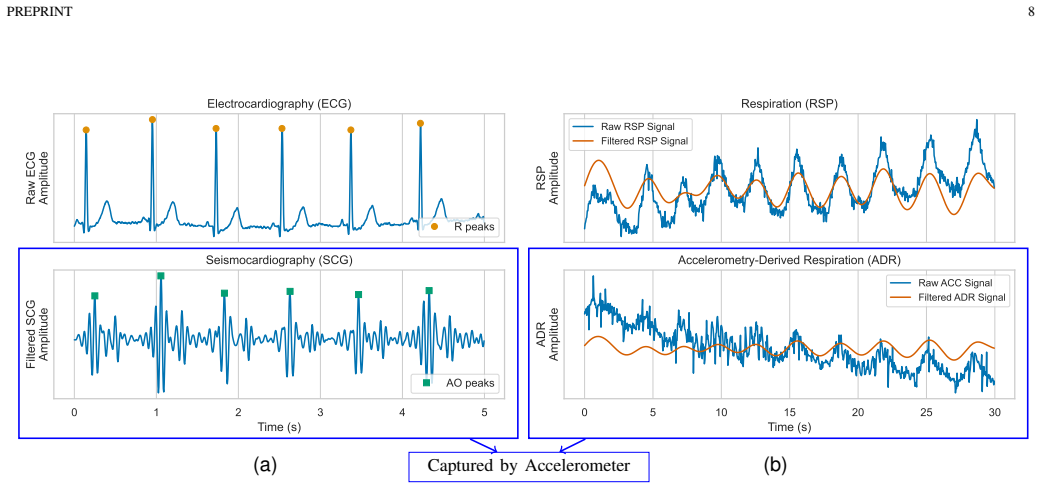
The load-bearing mechanism is the detection of aortic-valve-opening (AO) peaks in the SCG signal: the mechanical event of the aortic valve opening, visible as a chest-wall vibration shortly after the ECG R-peak. These AO peaks are treated as mechanical analogues of ECG R-peaks, from which inter-beat intervals and heart-rate-variability features are computed and passed to the classifiers. The detection chain applies band-pass filtering at 10–20 Hz, Hilbert-transform envelope extraction, a second 0.5–2 Hz band-pass, and then peak picking. Respiratory context comes from ADR, obtained by band-pass filtering the same accelerometer signal at 0.15–0.35 Hz and detrending, so that both cardiac and respiratory inputs come from one sensor.
What would settle it
Record the same subjects with a chest-worn accelerometer and a reference ECG while they walk, talk, and move their torso; if the detected vibration peaks lose alignment with the ECG peaks and the resulting heart-rhythm features diverge from ECG-derived features by more than the distance between emotion classes, the central parity claim would be refuted.
Extended reading notes
Core claim
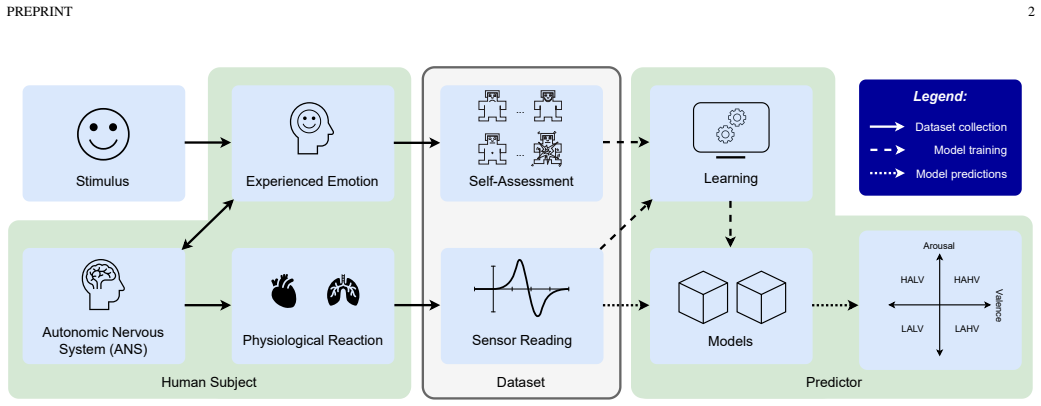
The central claim, on the paper's own terms, is that seismocardiography (SCG) is a viable and previously unexplored physiological modality for recognizing emotional valence and arousal. Using the EmoWear dataset and a pipeline validated by replicating the DEAP single-trial classification study, the authors train subject-dependent naive Bayes, SVM, and logistic regression classifiers on heart-rate and heart-rate-variability features extracted from AO peaks in the SCG signal. SCG-based setups land in the same macro-F1 range as ECG- and BVP-based setups (for example, SCG plus all peripherals with SVM reaches 0.587 valence and 0.579 arousal, versus 0.584/0.579 for ECG and 0.585/0.573 for BVP in the same configuration). Combining SCG with accelerometry-derived respiration (ADR) yields results that are significantly above baseline voting for SVM and logistic regression, although naive Bayes does not reach significance with that pairing. The paper concludes that a single chest-worn accelerometer can serve as a physiological gateway for emotion recognition, and positions its EmoWear results as the first benchmarks for this dataset.
Load-bearing premise
The load-bearing premise is that the vibration peak picked out in each heartbeat stands in reliably for the electrical spike that ECG measures, so that the heart-rhythm variability features computed from the chest accelerometer carry the same emotion information as ECG-derived features; if body movement or sensor shift breaks that peak detection, SCG's parity with ECG and BVP no longer follows.
Editorial extensions
If this is right
- SCG-based emotion recognition reaches the same macro-F1 range as ECG- and BVP-based recognition for both valence and arousal, so a single accelerometer can reproduce the information that established cardiac pipelines provide.
- SCG combined with ADR, both derived from one chest-worn accelerometer, produces SVM and logistic regression classifiers whose F1 distributions are significantly above baseline voting for valence and arousal.
- Deep CNN and LSTM models overfit on this dataset size, so classical feature-based classifiers remain the working choice for EmoWear-scale data until larger datasets or pre-training become available.
- The EmoWear F1 heatmaps and averaged results provide subject-level benchmarks that future emotion-recognition studies can compare against.
Reading between the lines
- If the parity with ECG and BVP holds, emotion recognition becomes a zero-hardware add-on to accelerometers already worn for activity tracking, fall detection, and gait analysis.
- A direct validation of AO-peak detection against ECG during natural motion would settle the surrogate question; the paper does not report beat-to-beat timing error, so that check remains open.
- Because the same sensor records body motion, motion artifacts in SCG could in principle be modeled and removed using the accelerometer's own movement channel — an option ECG and BVP do not offer as naturally.
- A subject-independent or cross-dataset replication would test whether SCG's parity with ECG and BVP extends beyond the 42 EmoWear subjects analyzed here.
Signed reviews
Editorial analysis
A structured set of objections, weighed in public.
Referee Report
Summary. This paper introduces seismocardiography (SCG) and accelerometry-derived respiration (ADR), both obtained from a single chest-worn accelerometer, as modalities for emotion recognition. The authors replicate the peripheral-signal emotion classification pipeline of the DEAP study on DEAP, obtaining similar performance, and then apply the same pipeline to the EmoWear dataset, comparing SCG against ECG and BVP as cardiac sources. They report macro-F1 scores around 0.55-0.59 for SCG, similar to ECG and BVP, and report that SVM and LR classifiers using SCG+ADR significantly exceed baseline voting, leading to the claim that a single chest-worn accelerometer provides a working emotion recognition framework. The paper also contains a critical review of methodological weaknesses in prior DEAP-based studies, including class imbalance, F1 reporting, and validation practices.
Significance. If the results survive a leakage-free evaluation, the contribution is meaningful: it is the first evaluation of SCG as an emotion-recognition modality, it establishes initial benchmarks on a public dataset, and it demonstrates that cardiac and respiratory information can be obtained from a single chest-worn accelerometer. The study's strengths include the use of macro-averaged F1, the inclusion of multiple baselines, a DEAP replication as a sanity check, and the use of a publicly available dataset. The reported effect sizes are modest, however, and the central single-accelerometer claim rests on significance tests that are compromised by the current model-selection procedure; the contribution is therefore best viewed as promising but not yet fully supported.
major comments (3)
- [Section III-C, 'Classifiers'] The grid-search optimization described in Section III-C maximizes macro-F1 on the entire EmoWear dataset before the LOVO evaluation. This means the held-out videos in each LOVO fold have already influenced the choice of classifier family (SVM/LR over NB, k-NN, trees, boosting, and neural networks) and the hyperparameters (regularization C, solver). The LOVO estimates in Table VI, including rows 20-21 for SCG+ADR, are therefore not unbiased estimates of a fixed pipeline, and the one-sample t-tests against the 0.500 baseline do not test generalization of a pre-specified method. Because the margins over baseline are small (macro-F1 0.550-0.564 vs 0.500), selection leakage could account for the reported significance. I recommend nested cross-validation, or fixing the pipeline on the DEAP data alone and applying it unchanged to EmoWear.
- [Section III-C, 'Feature Selection'] The paper does not state whether the Fisher score threshold (Eq. 1) and the minimum ranked feature count of 15 are computed inside each LOVO training fold or on the entire dataset before splitting. If feature selection is performed on all videos of a subject, including the held-out video, then the test labels are used to choose features and the reported F1 values are optimistically biased. This is not a minor detail: the discussion notes that only RSP features were selected in some configurations, so the selected feature set is small and potentially unstable. The authors should clarify the timing of feature selection and, if it is not already nested, re-run the experiments with feature selection performed on the training folds only.
- [Section III-B, 'Seismocardiography'] The HR and HRV features from SCG are derived from AO peaks detected with the Massaroni algorithm, but the manuscript provides no validation of these detections on the EmoWear recordings. The EmoWear dataset includes simultaneous ECG, so the authors can report detection agreement (e.g., F1 of AO peaks against ECG R-peaks) or the correlation between SCG-derived IBI/HRV and ECG-derived IBI/HRV. Without such a check, the reader cannot distinguish a genuinely cardiac SCG feature set from one that is partly driven by motion artifacts or missed/false detections. Given that the paper's central equivalence claim is that SCG carries HRV information comparable to ECG, this validation is load-bearing.
minor comments (5)
- [Section V.A] The phrase 'gate-analysis' appears to be a typo for 'gait-analysis'.
- [Figure 2] The markers '†' and '‡' in the pipeline figure are not defined in the caption or in the surrounding text; please add a legend explaining their meaning.
- [Table VI] Row 22 places 'Baseline' in the classifier column, which is confusing; consider aligning baseline rows with the setup columns for clarity.
- [Section V.A] The claim that SCG is 'less affected by motion artifacts than other accelerometer-based methods' is not tested in this study; if retained, it should be supported with evidence or softened.
- [Section I] The statement that EmoWear is 'the only one to provide chest-worn accelerometer data validated for both SCG and ADR purposes' relies on the authors' own dataset paper; an independent validation citation would strengthen the claim.
Circularity Check
No circular derivation: the SCG/ADR emotion-recognition results are empirical and benchmarked against the external DEAP dataset; self-citations are to public data and tools, and the full-data model selection is a validation leak, not a circular step.
full rationale
The paper's claimed chain is empirical rather than definitional: raw chest accelerometry is band-pass filtered into SCG (10-20 Hz) and ADR (0.15-0.35 Hz) using externally published methods (Massaroni et al.; BioSPPy), hand-crafted features are extracted, and LOVO-per-subject classification is compared with ECG and BVP under the same pipeline. At no point is the target emotion label used to define the features or the sensor signals, so the SCG 'prediction' is not equivalent to its inputs by construction. The DEAP replication in Table V is a genuine external benchmark: matching the original DEAP results with the same pipeline and BVP/RSP/EDA/SKT/EMG/EOG does not depend on any EmoWear-derived constant. The authors' self-references ([18], [21], [65], [67]) are to the EmoWear dataset, the ColEmo stimulus interface, and a prior survey; they support data provenance and motivation, not the emotion-recognition result itself. The most serious validity threat is disclosed in Sections III-C and V-C: SVM/LR and hyperparameters were selected by grid search on the entire EmoWear dataset before LOVO evaluation, so the one-sample t-tests for SCG+ADR in Table VI rows 20-21 are not tests of a pipeline chosen without seeing the test videos. This is a data-splitting and selection-bias problem for soundness review, not circularity: the reported F1 is not equal by definition to the selection objective, and the paper explicitly acknowledges the procedure in its Limitations. No candidate equation or fitted constant is renamed as a prediction. Overall circularity is therefore minimal; score 2 reflects the admitted full-data selection and non-load-bearing self-citations, while the central claim retains independent empirical content.
Assumptions & free parameters
free parameters (4)
- Fisher score threshold 0.3 =
0.3
- Minimum feature count 15 =
15
- Subject exclusion rating-balance threshold 10% =
10%
- SVM/LR hyperparameters (regularization C, solver) =
not fully reported
assumptions (5)
- domain assumption AO peaks in SCG are a valid mechanical surrogate for ECG R-peaks for HR and HRV estimation.
- domain assumption Self-assessed SAM ratings, binarized at the midpoint of 5, are valid ground truth for valence and arousal.
- domain assumption Emotional stimuli produce ANS-driven changes in HRV and respiration within trial windows that are separable by the hand-crafted features.
- domain assumption The pipeline validated on DEAP transfers to EmoWear despite different sensors, subjects, and context.
- standard math Standard signal processing and statistical methods (band-pass filtering, Hilbert envelope, Fisher score, one-sample t-test) are correctly applied.
Cite this review
Pith. "Pith review of Seismocardiography for Emotion Recognition: A Study on EmoWear with Insights from DEAP." pith.science (2026). https://pith.science/paper/Z4QYLBUV
@misc{pith2026241200411,
  author       = {Pith},
  title        = {Pith review of: Seismocardiography for Emotion Recognition: A Study on EmoWear with Insights from DEAP},
  year         = {2026},
  howpublished = {\url{https://pith.science/paper/Z4QYLBUV}},
  note         = {Machine review of arXiv:2412.00411}
}
read the original abstract
Emotions have a profound impact on our daily lives, influencing our thoughts, behaviors, and interactions, but also our physiological reactions. Recent advances in wearable technology have facilitated studying emotions through cardio-respiratory signals. Accelerometers offer a non-invasive, convenient, and cost-effective method for capturing heart- and pulmonary-induced vibrations on the chest wall, specifically Seismocardiography (SCG) and Accelerometry-Derived Respiration (ADR). Their affordability, wide availability, and ability to provide rich contextual data make accelerometers ideal for everyday use. While accelerometers have been used as part of broader modality fusions for Emotion Recognition (ER), their stand-alone potential via SCG and ADR remains unexplored. Bridging this gap could significantly help the embedding of ER into real-world applications, minimizing the hardware, and increasing contextual integration potentials. To address this gap, we introduce SCG and ADR as novel modalities for ER and evaluate their performance using the EmoWear dataset. First, we replicate the single-trial emotion classification pipeline from the DEAP dataset study, achieving similar results. Then we use our validated pipeline to train models that predict affective valence-arousal states using SCG and compare them against established cardiac signals, Electrocardiography (ECG) and Blood Volume Pulse (BVP). Results show that SCG is a viable modality for ER, achieving similar performance to ECG and BVP. By combining ADR with SCG, we achieved a working ER framework that only requires a single chest-worn accelerometer. These findings pave the way for integrating ER into real-world, enabling seamless affective computing in everyday life.
Figures


Figures from the paper (7 more)


Reference graph
Works this paper leans on
-
[1]
Emotion Recognition From Full-Body Motion Using Multiscale Spatio-Temporal Network,
T. Wang, S. Liu, F. He et al. , “Emotion Recognition From Full-Body Motion Using Multiscale Spatio-Temporal Network,”IEEE Transactions on Affective Computing , vol. 15, pp. 898–912, 2024
2024
-
[2]
Electrocardiogram- Based Emotion Recognition Systems and Their Applications in Healthcare–A Review,
M. A. Hasnul, N. A. A. Aziz, S. Alelyani et al. , “Electrocardiogram- Based Emotion Recognition Systems and Their Applications in Healthcare–A Review,” Sensors 2021, Vol. 21, Page 5015 , vol. 21, p. 5015, Jul. 2021
2021
-
[3]
Game difficulty adaptation and experience personalization: A literature review,
P. D. Paraschos and D. E. Koulouriotis, “Game difficulty adaptation and experience personalization: A literature review,” International Journal of Human–Computer Interaction , vol. 39, no. 1, pp. 1–22, 2023
2023
-
[4]
Facial Emotion Recognition in Smart Education Systems: A Review,
H. Farman, A. Sedik, M. M. Nasralla et al., “Facial Emotion Recognition in Smart Education Systems: A Review,” Proceedings of 2023 IEEE International Smart Cities Conference, ISC2 2023 , 2023
2023
-
[5]
An extensive study on the evolution of context-aware personalized travel recommender systems,
S. Renjith, A. Sreekumar, and M. Jathavedan, “An extensive study on the evolution of context-aware personalized travel recommender systems,” Information Processing & Management , vol. 57, p. 102078, Jan. 2020
2020
-
[6]
S. Saganowski, B. Perz, A. G. Polak et al. , “Emotion Recognition for Everyday Life Using Physiological Signals From Wearables: A Sys- tematic Literature Review,” IEEE Transactions on Affective Computing , vol. 14, pp. 1876–1897, Jul. 2023
work page 2023
-
[7]
Autonomic nervous system activity in emotion: A review,
S. D. Kreibig, “Autonomic nervous system activity in emotion: A review,” Biological Psychology, vol. 84, pp. 394–421, 2010
work page 2010
-
[8]
K. Wac and C. Tsiourti, “Ambulatory Assessment of Affect: Survey of Sensor Systems for Monitoring of Autonomic Nervous Systems Activation in Emotion,” IEEE Transactions on Affective Computing , vol. 5, pp. 251–272, 2014
work page 2014
Show all 85 references
-
[9]
Wearable-Based Affect Recognition–A Review,
P. Schmidt, A. Reiss, R. D ¨urichen et al. , “Wearable-Based Affect Recognition–A Review,” Sensors, vol. 19, p. 4079, Sep. 2019
2019
-
[10]
A systematic review on affective com- puting: emotion models, databases, and recent advances,
Y . Wang, W. Song, W. Taoet al., “A systematic review on affective com- puting: emotion models, databases, and recent advances,” Information Fusion, vol. 83-84, pp. 19–52, Jul. 2022
2022
-
[11]
Facial expressions of emotion,
P. Ekman and H. Oster, “Facial expressions of emotion,” Annual review of psychology, vol. 30, pp. 527–554, 1979
1979
-
[12]
A circumplex model of affect,
J. A. Russell, “A circumplex model of affect,” Journal of personality and social psychology , vol. 39, p. 1161, 1980
1980
-
[13]
The limbic system and cerebral circuits for reward, emotions, and memory,
J. Martin, “The limbic system and cerebral circuits for reward, emotions, and memory,” Neuroanatomy Text and Atlas, 4th Edn,(New York, NY: McGraw-Hill Publishing), pp. 385–413, 2012
2012
-
[14]
Heart rate variability as an index of regulated emotional responding,
B. M. Appelhans and L. J. Luecken, “Heart rate variability as an index of regulated emotional responding,” Review of General Psychology, vol. 10, pp. 229–240, Sep. 2006
2006
-
[15]
Measuring emotion: the self-assessment manikin and the semantic differential,
M. M. Bradley and P. J. Lang, “Measuring emotion: the self-assessment manikin and the semantic differential,” Journal of behavior therapy and experimental psychiatry, vol. 25, pp. 49–59, 1994
1994
-
[16]
Automatic ECG-Based Emotion Recognition in Music Listening,
Y . Hsu, J. Wang, W. Chiang et al. , “Automatic ECG-Based Emotion Recognition in Music Listening,” IEEE Transactions on Affective Com- puting, vol. 11, pp. 85–99, 2020
2020
-
[17]
Dimensional Affect Recognition from HRV: An Approach Based on Supervised SOM and ELM,
L. A. Bugnon, R. A. Calvo, and D. H. Milone, “Dimensional Affect Recognition from HRV: An Approach Based on Supervised SOM and ELM,” IEEE Transactions on Affective Computing , vol. 11, pp. 32–44, 2020
2020
-
[18]
EmoWear: Wearable Physiological and Motion Dataset for Emotion Recognition and Context Awareness,
M. H. Rahmani, M. Symons, O. Sobhani et al. , “EmoWear: Wearable Physiological and Motion Dataset for Emotion Recognition and Context Awareness,” Scientific Data 2024 11:1 , vol. 11, pp. 1–18, Jun. 2024
2024
-
[19]
Ballistocardiography and Seismocardiography: A Review of Recent Advances,
O. T. Inan, P. F. Migeotte, K. S. Park et al., “Ballistocardiography and Seismocardiography: A Review of Recent Advances,” IEEE Journal of Biomedical and Health Informatics , vol. 19, pp. 1414–1427, Jul. 2015
2015
-
[20]
A comprehensive review on seismocardiogram: current advancements on acquisition, annotation, and applications,
D. Rai, H. K. Thakkar, S. S. Rajput et al. , “A comprehensive review on seismocardiogram: current advancements on acquisition, annotation, and applications,” Mathematics, vol. 9, no. 18, p. 2243, 2021
2021
-
[21]
Chest-Worn Inertial Sensors: A Survey of Applications and Methods,
M. H. Rahmani, R. Berkvens, and M. Weyn, “Chest-Worn Inertial Sensors: A Survey of Applications and Methods,” Sensors, vol. 21, p. 2875, Apr. 2021
2021
-
[22]
Adaptive Accelerom- etry Derived Respiration: Comparison with Respiratory Inductance Plethysmography during Sleep,
A. Bricout, J. Fontecave-Jallon, D. Colas et al., “Adaptive Accelerom- etry Derived Respiration: Comparison with Respiratory Inductance Plethysmography during Sleep,”Proceedings of the Annual International Conference of the IEEE Engineering in Medicine and Biology Society, EMB...
2019
-
[23]
How emotions are shaped by bodily states,
H. D. Critchley and Y . Nagai, “How emotions are shaped by bodily states,” Emotion Review, vol. 4, no. 2, pp. 163–168, 2012
2012
-
[24]
Autonomic nervous system differences among emo- tions,
R. W. Levenson, “Autonomic nervous system differences among emo- tions,” 1992
1992
-
[25]
DEAP: A Database for Emotion Analysis; Using Physiological Signals,
S. Koelstra, C. Muhl, M. Soleymani et al. , “DEAP: A Database for Emotion Analysis; Using Physiological Signals,” IEEE Transactions on Affective Computing, vol. 3, pp. 18–31, Jan. 2012
2012
-
[26]
Emognition dataset: emotion recognition with self-reports, facial expressions, and physiology using wearables,
S. Saganowski, J. Komoszy ´nska, M. Behnke et al., “Emognition dataset: emotion recognition with self-reports, facial expressions, and physiology using wearables,” Scientific Data 2022 9:1 , vol. 9, pp. 1–11, Apr. 2022
2022
-
[27]
A Multimodal Database for Affect Recognition and Implicit Tagging,
M. Soleymani, J. Lichtenauer, T. Pun et al. , “A Multimodal Database for Affect Recognition and Implicit Tagging,” IEEE Transactions on Affective Computing, vol. 3, pp. 42–55, Jan. 2012
2012
-
[28]
A dataset of continuous affect annotations and physiological signals for emotion analysis,
K. Sharma, C. Castellini, E. L. van den Broek et al. , “A dataset of continuous affect annotations and physiological signals for emotion analysis,” Scientific Data 2019 6:1 , vol. 6, pp. 1–13, Oct. 2019
2019
-
[29]
Psychophysiology of positive and negative emotions, dataset of 1157 cases and 8 biosignals,
M. Behnke, M. Buchwald, A. Bykowski et al. , “Psychophysiology of positive and negative emotions, dataset of 1157 cases and 8 biosignals,” Scientific Data 2022 9:1 , vol. 9, pp. 1–15, Jan. 2022
2022
-
[30]
DECAF: MEG-Based Multimodal Database for Decoding Affective Physiological Responses,
M. K. Abadi, R. Subramanian, S. M. Kia et al., “DECAF: MEG-Based Multimodal Database for Decoding Affective Physiological Responses,” IEEE Transactions on Affective Computing , vol. 6, pp. 209–222, Jul. 2015
2015
-
[31]
Ascertain: Emotion and personality recognition using commercial sensors,
R. Subramanian, J. Wache, M. K. Abadi et al., “Ascertain: Emotion and personality recognition using commercial sensors,” IEEE Transactions on Affective Computing , vol. 9, pp. 147–160, Apr. 2018
2018
-
[32]
BIRAFFE: Bio-Reactions and Faces for Emotion-based Personalization
K. Kutt, D. Drazyk, P. Jemiolo et al. , “BIRAFFE: Bio-Reactions and Faces for Emotion-based Personalization.” in AfCAI, 2019
2019
-
[33]
K-EmoPhone: A mobile and wearable dataset with in-situ emotion, stress, and attention labels,
S. Kang, W. Choi, C. Y . Park, N. Cha, A. Kim, A. H. Khandoker, L. Hadjileontiadis, H. Kim, Y . Jeong, and U. Lee, “K-EmoPhone: A mobile and wearable dataset with in-situ emotion, stress, and attention labels,” Scientific data, vol. 10, no. 1, p. 351, 2023
2023
-
[34]
Introducing WESAD, a Multimodal Dataset for Wearable Stress and Affect Detection,
P. Schmidt, A. Reiss, R. Duerichen et al. , “Introducing WESAD, a Multimodal Dataset for Wearable Stress and Affect Detection,” in Proceedings of the 20th ACM International Conference on Multimodal Interaction. Acm, 2018
2018
-
[35]
Motion Reveal Emotions: Identifying Emotions from Human Walk Using Chest Mounted Smart- phone,
M. A. Hashmi, Q. Riaz, M. Zeeshan et al., “Motion Reveal Emotions: Identifying Emotions from Human Walk Using Chest Mounted Smart- phone,” IEEE Sensors Journal , vol. 20, pp. 13 511–13 522, Nov. 2020
2020
-
[36]
Self-Supervised ECG Representation Learn- ing for Emotion Recognition,
P. Sarkar and A. Etemad, “Self-Supervised ECG Representation Learn- ing for Emotion Recognition,” IEEE Transactions on Affective Comput- ing, vol. 13, pp. 1541–1554, 2022
2022
-
[37]
Transformer-Based Self-Supervised Multimodal Representation Learning for Wearable Emotion Recogni- tion,
Y . Wu, M. Daoudi, and A. Amad, “Transformer-Based Self-Supervised Multimodal Representation Learning for Wearable Emotion Recogni- tion,” IEEE Transactions on Affective Computing , vol. 15, pp. 157–172, Jan. 2024
2024
-
[38]
End-to-End Modeling and Transfer Learning for Audiovisual Emotion Recognition in-the- Wild,
D. Dresvyanskiy, E. Ryumina, H. Kaya et al. , “End-to-End Modeling and Transfer Learning for Audiovisual Emotion Recognition in-the- Wild,” Multimodal Technologies and Interaction 2022, Vol. 6, Page 11 , vol. 6, p. 11, Jan. 2022
2022
-
[39]
Discussions of Different Deep Transfer Learning Models for Emotion Recognitions,
C. T. Yen and K. H. Li, “Discussions of Different Deep Transfer Learning Models for Emotion Recognitions,” IEEE Access, vol. 10, pp. 102 860–102 875, 2022
2022
-
[40]
Emotion recognition using multi- modal data and machine learning techniques: A tutorial and review,
J. Zhang, Z. Yin, P. Chen et al. , “Emotion recognition using multi- modal data and machine learning techniques: A tutorial and review,” Information Fusion, vol. 59, pp. 103–126, Jul. 2020
2020
-
[41]
A Survey of Emotion Recognition using Physiological Signal in Wearable Devices,
H. Z. Wijasena, R. Ferdiana, and S. Wibirama, “A Survey of Emotion Recognition using Physiological Signal in Wearable Devices,” AIMS 2021 - International Conference on Artificial Intelligence and Mecha- tronics Systems, Apr. 2021
2021
-
[42]
Selection of the Most Relevant Physiological Features for Classifying Emotion,
C. Godin, F. Prost-Boucle, A. Campagne et al., “Selection of the Most Relevant Physiological Features for Classifying Emotion,” PhyCS 2015 PREPRINT 16 - 2nd International Conference on Physiological Computing Systems, Proceedings, vol. 2, pp. 17–25, Feb. 2015
2015
-
[43]
Emotion recognition from peripheral physiological signals enhanced by EEG,
S. Chen, Z. Gao, and S. Wang, “Emotion recognition from peripheral physiological signals enhanced by EEG,” ICASSP , IEEE International Conference on Acoustics, Speech and Signal Processing - Proceedings , vol. 2016-May, pp. 2827–2831, May 2016
2016
-
[44]
Respiration-based emotion recogni- tion with deep learning,
Q. Zhang, X. Chen, Q. Zhan et al., “Respiration-based emotion recogni- tion with deep learning,” Computers in Industry , vol. 92-93, pp. 84–90, Nov. 2017
2017
-
[45]
Recognition of emotions using multimodal physiological signals and an ensemble deep learning model,
Z. Yin, M. Zhao, Y . Wang et al. , “Recognition of emotions using multimodal physiological signals and an ensemble deep learning model,” Computer Methods and Programs in Biomedicine, vol. 140, pp. 93–110, Mar. 2017
2017
-
[46]
Emotion Based Music Recommendation System Using Wearable Physiological Sensors,
D. Ayata, Y . Yaslan, and M. E. Kamasak, “Emotion Based Music Recommendation System Using Wearable Physiological Sensors,” IEEE Transactions on Consumer Electronics , vol. 64, pp. 196–203, 2018
2018
-
[47]
Arousal and Valence Classification Model Based on Long Short-Term Memory and DEAP Data for Mental Healthcare Management,
E. J. Choi and D. K. Kim, “Arousal and Valence Classification Model Based on Long Short-Term Memory and DEAP Data for Mental Healthcare Management,” Healthcare Informatics Research, vol. 24, pp. 309–316, Oct. 2018
2018
-
[48]
Fast Emotion Recognition Based on Single Pulse PPG Signal with Convolutional Neural Network,
M. S. Lee, Y . K. Lee, D. S. Pae et al. , “Fast Emotion Recognition Based on Single Pulse PPG Signal with Convolutional Neural Network,” Applied Sciences 2019, Vol. 9, Page 3355 , vol. 9, p. 3355, Aug. 2019
2019
-
[49]
Emotion Recognition Using Convolutional Neural Network with Selected Statistical Photoplethys- mogram Features,
M. S. Lee, Y . K. Lee, M. T. Lim et al. , “Emotion Recognition Using Convolutional Neural Network with Selected Statistical Photoplethys- mogram Features,” Applied Sciences 2020, Vol. 10, Page 3501 , vol. 10, p. 3501, May 2020
2020
-
[50]
Multimodal Physiological Signal Emotion Recognition Based on Convolutional Recurrent Neural Net- work,
X. Wu, W.-L. Zheng, Z. Li et al. , “Multimodal Physiological Signal Emotion Recognition Based on Convolutional Recurrent Neural Net- work,” IOP Conference Series: Materials Science and Engineering , vol. 782, p. 032005, Mar. 2020
2020
-
[51]
Valence-arousal model based emotion recognition using EEG, peripheral physiological signals and Facial Expression,
Q. Zhu, G. Lu, and J. Yan, “Valence-arousal model based emotion recognition using EEG, peripheral physiological signals and Facial Expression,” ACM International Conference Proceeding Series , pp. 81– 85, Jan. 2020
2020
-
[52]
Multi-modal emotion recognition using recurrence plots and transfer learning on physiological signals,
R. Elalamy, M. Fanourakis, and G. Chanel, “Multi-modal emotion recognition using recurrence plots and transfer learning on physiological signals,” 2021 9th International Conference on Affective Computing and Intelligent Interaction, ACII 2021 , 2021
2021
-
[53]
1D Convolutional Autoencoder-Based PPG and GSR Signals for Real-Time Emotion Classification,
D. H. Kang and D. H. Kim, “1D Convolutional Autoencoder-Based PPG and GSR Signals for Real-Time Emotion Classification,” IEEE Access, vol. 10, pp. 91 332–91 345, 2022
2022
-
[54]
End-to-End Emotion Recognition using Peripheral Physiological Signals,
M. Pidgeon, N. Kanwal, N. Murray et al. , “End-to-End Emotion Recognition using Peripheral Physiological Signals,” 35th British HCI Conference Towards a Human-Centred Digital Society, HCI 2022 , vol. 2022, pp. 1–10, Jul. 2022
2022
-
[55]
Utilizing Deep Learning Towards Multi-Modal Bio-Sensing and Vision-Based Affective Comput- ing,
Siddharth, T. P. Jung, and T. J. Sejnowski, “Utilizing Deep Learning Towards Multi-Modal Bio-Sensing and Vision-Based Affective Comput- ing,” IEEE Transactions on Affective Computing , vol. 13, pp. 96–107, 2022
2022
-
[56]
Emotion Recognition based on PPG and GSR Signals using DEAP Dataset,
B. Shubha, N. Poornima, V . M. Gowda et al. , “Emotion Recognition based on PPG and GSR Signals using DEAP Dataset,” 2023 Interna- tional Conference on Network, Multimedia and Information Technology, NMITCON 2023, 2023
2023
-
[57]
Emotion recognition with multi- modal peripheral physiological signals,
J. Gohumpu, M. Xue, and Y . Bao, “Emotion recognition with multi- modal peripheral physiological signals,” Frontiers in Computer Science, vol. 5, p. 1264713, Dec. 2023
2023
-
[58]
Emotion Recognition Based on Galvanic Skin Response and Photoplethysmography Signals Using Artificial Intelligence Algorithms,
M. F. Bamonte, M. Risk, and V . Herrero, “Emotion Recognition Based on Galvanic Skin Response and Photoplethysmography Signals Using Artificial Intelligence Algorithms,” in Advances in Bioengineering and Clinical Engineering, F. E. Ballina, R. Armentano, R. C. Acevedo, and G. ...
2024
-
[59]
Mehrabian and J
A. Mehrabian and J. A. Russell, An approach to environmental psychol- ogy. the MIT Press, 1974
1974
-
[60]
PToPI: A Comprehensive Review, Analysis, and Knowledge Representation of Binary Classifica- tion Performance Measures/Metrics,
G. Canbek, T. T. Temizel, and S. Sagiroglu, “PToPI: A Comprehensive Review, Analysis, and Knowledge Representation of Binary Classifica- tion Performance Measures/Metrics,” SN Computer Science , vol. 4, pp. 1–30, Jan. 2023
2023
-
[61]
Facing imbalanced data - Recommendations for the use of performance metrics,
L. A. Jeni, J. F. Cohn, and F. D. L. Torre, “Facing imbalanced data - Recommendations for the use of performance metrics,” Proceedings - 2013 Humaine Association Conference on Affective Computing and Intelligent Interaction, ACII 2013 , pp. 245–251, 2013
2013
-
[62]
Field and G
A. Field and G. Hole, How to design and report experiments . Sage, 2002
2002
-
[63]
Xu and R
Y . Xu and R. Goodacre, “On Splitting Training and Validation Set: A Comparative Study of Cross-Validation, Bootstrap and Systematic Sampling for Estimating the Generalization Performance of Supervised Learning,” Journal of Analysis and Testing , vol. 2, pp. 249–262, Jul. 2018
2018
-
[64]
Scanning the horizon: towards transparent and reproducible neuroimaging research,
R. A. Poldrack, C. I. Baker, J. Durnez et al. , “Scanning the horizon: towards transparent and reproducible neuroimaging research,” Nature Reviews Neuroscience 2017 18:2 , vol. 18, pp. 115–126, Jan. 2017
2017
-
[65]
M. H. Rahmani, M. Symons, R. Berkvens et al. , EmoWear Data . Zenodo, 2023. [Online]. Available: https://doi.org/10.5281/ZENODO. 10407278
2023 doi
-
[66]
Presentation® Software
“Presentation® Software.” [Online]. Available: https://www.neurobs. com
-
[67]
ColEmo: A Flexible Open Source Software Interface for Collecting Emotion Data,
M. H. Rahmani, R. Berkvens, and M. Weyn, “ColEmo: A Flexible Open Source Software Interface for Collecting Emotion Data,” in 2023 11th International Conference on Affective Computing and Intelligent Interaction Workshops and Demos (ACIIW) , 2023, pp. 1–8
2023
-
[68]
Array program- ming with NumPy,
C. R. Harris, K. J. Millman, S. J. van der Walt et al., “Array program- ming with NumPy,” Nature, vol. 585, pp. 357–362, Sep. 2020
2020
-
[69]
pandas-dev/pandas: Pandas,
T. pandas development team, “pandas-dev/pandas: Pandas,” Apr. 2024. [Online]. Available: https://doi.org/10.5281/zenodo.10957263
2024 doi
-
[70]
Data Structures for Statistical Computing in Python,
W. McKinney, “Data Structures for Statistical Computing in Python,” in Proceedings of the 9th Python in Science Conference , 2010, pp. 56–61
2010
-
[71]
NeuroKit2: A Python toolbox for neurophysiological signal processing,
D. Makowski, T. Pham, Z. J. Lau et al., “NeuroKit2: A Python toolbox for neurophysiological signal processing,” Behavior Research Methods , vol. 53, pp. 1689–1696, Feb. 2021
2021
-
[72]
Physiology, Cardiac Cycle,
J. D. Pollock and A. N. Makaryus, “Physiology, Cardiac Cycle,” StatPearls, Oct. 2017
2017
-
[73]
Comparison of Different Methods for Estimating Cardiac Timings: A Comprehensive Multimodal Echocardiography Investigation,
P. Dehkordi, F. Khosrow-Khavar, M. D. Rienzo et al., “Comparison of Different Methods for Estimating Cardiac Timings: A Comprehensive Multimodal Echocardiography Investigation,” Frontiers in Physiology , vol. 10, p. 452771, Aug. 2019
2019
-
[74]
Aortic-finger pulse transit time vs. R-derived Pulse Arrival Time: A beat-to-beat assessment,
E. Vaini, P. Lombardi, and M. D. Rienzo, “Aortic-finger pulse transit time vs. R-derived Pulse Arrival Time: A beat-to-beat assessment,” Computing in Cardiology , vol. 42, pp. 253–256, Feb. 2015
2015
-
[75]
Heart Rate And Heart Rate Variability Indexes Estimated By Mechanical Signals From A Skin- Interfaced IMU,
C. Massaroni, C. Romano, F. D. Tommasi et al., “Heart Rate And Heart Rate Variability Indexes Estimated By Mechanical Signals From A Skin- Interfaced IMU,” 2022 IEEE International Workshop on Metrology for Industry 4.0 and IoT, MetroInd 4.0 and IoT 2022 - Proceedings , pp. 322...
2022
-
[76]
Respiratory rate assessments using a dual-accelerometer device,
S. Lapi, F. Lavorini, G. Borgioli et al. , “Respiratory rate assessments using a dual-accelerometer device,” Respiratory Physiology & Neurobi- ology, vol. 191, pp. 60–66, Jan. 2014
2014
-
[77]
BioSPPy: Biosignal Processing in Python,
C. Carreiras, A. P. Alves, A. Lourenc ¸o et al. , “BioSPPy: Biosignal Processing in Python,” 2015. [Online]. Available: https://github.com/ PIA-Group/BioSPPy/
2015
-
[78]
Frequency Bands Effects on QRS Detection
M. Elgendi, M. Jonkman, and F. D. Boer, “Frequency Bands Effects on QRS Detection.” Biosignals, vol. 2003, p. 2002, 2010
2003
-
[79]
Neurophysiological Data Analysis with NeuroKit2,
D. Makowski, “Neurophysiological Data Analysis with NeuroKit2,”
-
[80]
Emotion recognition using smart watch sensor data: Mixed-design study,
J. C. Quiroz, E. Geangu, and M. H. Yong, “Emotion recognition using smart watch sensor data: Mixed-design study,” JMIR mental health , vol. 5, no. 3, p. e10153, 2018
2018
-
[81]
Multi-target affect detection in the wild: an exploratory study,
P. Schmidt, R. D ¨urichen, A. Reiss, K. Van Laerhoven, and T. Pl ¨otz, “Multi-target affect detection in the wild: an exploratory study,” in Proceedings of the 2019 ACM international symposium on wearable computers, 2019, pp. 211–219
2019
-
[82]
Emotion Detection through Smartphone’s Accelerometer and Gyroscope Sensors,
O. Piskioulis, K. Tzafilkou, and A. Economides, “Emotion Detection through Smartphone’s Accelerometer and Gyroscope Sensors,” in Pro- ceedings of the 29th ACM Conference on User Modeling, Adaptation and Personalization, ser. Umap ’21. New York, NY , USA: Association for Comput...
2021
-
[83]
The use of electrodermal activity (EDA) measurement to understand consumer emotions – A literature review and a call for action,
D. Caruelle, A. Gustafsson, P. Shams et al., “The use of electrodermal activity (EDA) measurement to understand consumer emotions – A literature review and a call for action,” Journal of Business Research , vol. 104, pp. 146–160, Nov. 2019
2019
-
[84]
The subjective experience of emotion: a fearful view,
J. E. LeDoux and S. G. Hofmann, “The subjective experience of emotion: a fearful view,” Current Opinion in Behavioral Sciences , vol. 19, pp. 67–72, Feb. 2018. PREPRINT 17 Mohammad Hasan Rahmani is currently pursuing a Ph.D. in applied engineering at the University of Antwerp,...
2018
-
[2021]
Available: https://neuropsychology.github.io/NeuroKit/
[Online]. Available: https://neuropsychology.github.io/NeuroKit/
Reviewed August 12, 2026 · model on record in the stance chip above.
Discussion (0). Continue with ORCID to comment.