REVIEW 4 major objections 5 minor 38 references
MaintAGT:Sim2Real-Guided Multimodal Large Model for Intelligent Maintenance with Chain-of-Thought Reasoning
T0 review · 4 major / 5 minor · reviewed 2026-08-12 · deepseek-v4-flash
Pith's one-line read MaintAGT, a multimodal system that turns vibration signals into text descriptions and reasons over them with chain-of-thought prompting, matches the accuracy of an ISO Level III human vibration analyst on certification test questions…
desk verdict A sensible engineering pipeline with an evaluation that does not support its headline claim; the test/training overlap and an internal contradiction make the 70% ISO Level III result uninterpretable. read the letter →
The pith
A machine-rendered reading of the paper's core claim, the machinery that carries it, and where it could break.
The reading
What carries the argument
The central object is the Sig2Txt module, a signal-to-text converter that transforms monitoring signals into structured text descriptions of their mathematical features, such as RMS, kurtosis, fundamental frequency, and sideband spacing, using a flexible tensor singular spectrum decomposition for denoising and rule-based text templates. The text descriptions are then fused with equipment information and fed into a LoRA-fine-tuned GLM4 text model prompted with chain-of-thought reasoning, so the model combines quantitative signal features with physical context before producing a diagnosis. This integration is what lets the model handle both raw signals and textual queries within a single large-language-model framework.
What would settle it
Search the training corpus for the exact evaluation questions used in Section 5.2, or re-test MaintAGT on a newly published set of ISO Level III questions guaranteed to be absent from its training data; if accuracy on the cleanly excluded set falls well below 70%, the reported expert-level score reflects memorization rather than diagnostic reasoning.
Extended reading notes
Core claim
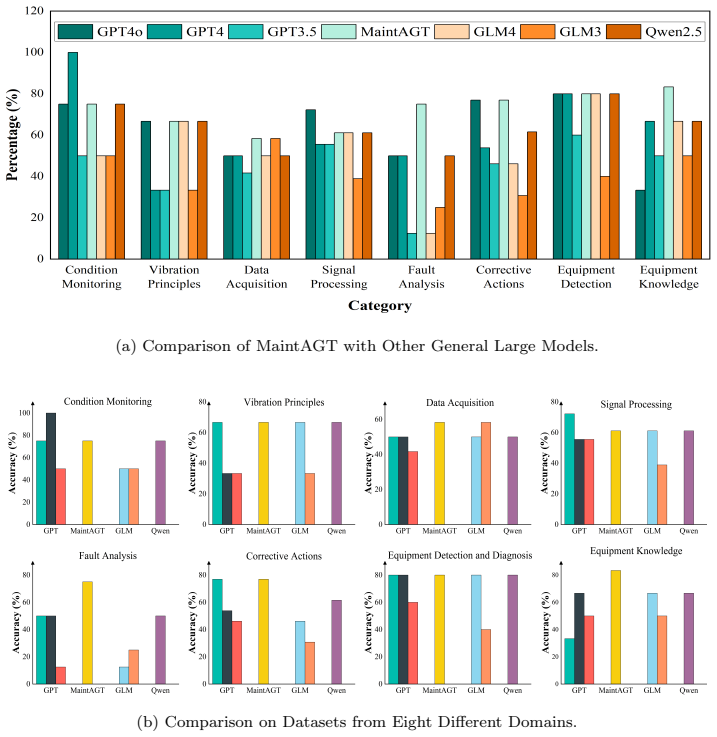
The paper's central claim is that MaintAGT can diagnose equipment faults from vibration signals with accuracy matching a certified ISO Level III vibration analyst. The system first denoises raw signals with a flexible tensor singular spectrum decomposition, then converts the denoised signal into a standardized textual description of time-domain and frequency-domain features via the Sig2Txt module, and finally prompts a specialist text model, built by fine-tuning GLM4 on a domain corpus, to reason over that description together with equipment information using chain-of-thought. On a general test set of Category III certification questions spanning eight knowledge areas, the paper reports 70% accuracy, above the scores of general large language models such as GPT-4o, ChatGLM4, and Qwen2.5. The authors present the model as the first step from traditional, expert-dependent maintenance toward AI-driven maintenance solutions.
Load-bearing premise
The 70% accuracy claim assumes the ISO Level III test questions used for evaluation were not part of the instruction-tuning corpus, and the paper never states that the test set was excluded from training.
Editorial extensions
If this is right
- MaintAGT accepts raw vibration signals plus text questions and returns a fault diagnosis written as natural-language reasoning steps.
- The paper's signal-to-text pipeline can generate large-scale signal-fault datasets without manual labeling of raw signals.
- The 70% accuracy on ISO Level III certification questions spans all eight evaluated knowledge areas, from condition monitoring to corrective actions.
- In the reported multimodal case study, MaintAGT's diagnosis matched the expected answer while two general large language models chose a different fault type.
Reading between the lines
- A decisive check would be to apply the same signal-to-text pipeline to another sensor modality, such as motor current or acoustic data, and see whether the accuracy advantage over general LLMs persists.
- Because the paper does not report training/test overlap checks or confidence intervals, the 70% figure should be treated as an upper bound until confirmed on a pre-registered held-out test set.
- If rule-based text templates were replaced by a learned signal-caption model, the pipeline could describe non-stationary and noisy real-world signals more flexibly than the current version.
- The chain-of-thought output could serve as an audit trail for human analysts, allowing them to review the model's reasoning before acting on a maintenance recommendation.
Editorial analysis
A structured set of objections, weighed in public.
Referee Report
Summary. The paper presents MaintAGT, a multimodal large language model for intelligent operations and maintenance, composed of a signal-to-text (Sig2Txt) module, a GLM4-based text model fine-tuned with LoRA on domain-specific question-answer pairs, and a chain-of-thought reasoning framework. The authors claim that MaintAGT achieves 70% accuracy on test questions designed for ISO Level III vibration analysts, surpassing general LLMs such as GPT-4o, ChatGLM4, and Qwen2.5, and that it reaches the level of a human ISO Level III vibration analyst. The paper also describes a flexible tensor singular spectrum decomposition method for denoising and reports qualitative evaluations of signal-to-text conversion and a multimodal fault-diagnosis example.
Significance. If the central evaluation claims were sound, MaintAGT would be a notable contribution: it proposes a concrete pipeline for converting raw vibration signals into structured textual descriptions, demonstrates a domain-adapted LLM with chain-of-thought reasoning, and tackles the practical problem of generating labeled maintenance data. The paper also provides useful design elements, including explicit feature tables, signal description templates, and training configurations. However, the main claim depends on an evaluation protocol whose integrity is not established: the training corpus overlaps in source and format with the test questions, and the paper does not demonstrate that the test set was held out. The reported 70% accuracy is therefore not interpretable as evidence of generalized expert-level diagnostic ability, and the central conclusion is unsupported as written.
major comments (4)
- [§3.1, §3.3, §5.2] The central 70% ISO Level III claim is not verifiable because the paper never establishes that the evaluation questions were excluded from the instruction-tuning data. Section 3.1 states that the text dataset was sourced from "training and certification materials for vibration analysts," and Section 3.3 reports that over 5,000 guidance data entries were used for supervised fine-tuning. Section 5.2 evaluates on "Test questions designed for Category III vibration analysts." Appendix B shows training examples in exactly the same multiple-choice format as the evaluation questions ("Select one correct answer from the list..."). If the test questions or near-duplicates appear in the fine-tuning set, the 70% score could reflect memorization rather than generalization. The manuscript must disclose the exact construction of the test set, its overlap with the training corpus, and the procedure used to prevent contamination.
- [§5.3, Table 7, Figure 13] The multimodal evaluation example is internally contradictory. Table 7 states that the standard answer is "B. Misalignment" and that MaintAGT correctly answers "B. Misalignment," while the text immediately after Table 9 states that the standard answer is "A: Unbalance" and that MaintAGT correctly diagnosed "A: Unbalance." The conclusion then again says MaintAGT diagnosed "B. Misalignment," consistent with the standard answer. These conflicting ground truths make it impossible to determine which model, if any, produced the correct answer and invalidate the claimed superiority of MaintAGT in this example.
- [§5.2, Figure 11] The comparison across the eight knowledge areas lacks basic statistical information. The paper reports only overall accuracy (70%) and per-area accuracies in Figure 11 without stating the number of test questions per area, the total test set size, or any confidence intervals or significance tests. With unknown sample sizes, the claim that MaintAGT "outperformed other models in all eight knowledge areas" cannot be assessed; the differences in Figure 11 may be within sampling error, particularly if any per-area question count is small. The authors should report the full test set composition and per-item results.
- [§5.1] The evaluation of the Sig2Txt module is anecdotal rather than quantitative. Section 5.1 presents two simulated-signal examples and states that the module demonstrates "high accuracy" in capturing frequency, amplitude, and phase, but no numerical metrics, error statistics, comparison against baseline signal-description methods, or ablation of the denoising step are provided. Since Sig2Txt is a load-bearing component of MaintAGT, its claimed performance needs a measured evaluation, not just illustrative examples.
minor comments (5)
- [Abstract, §1] There are recurrent capitalization and grammatical inconsistencies: "This paper Proposes" and "we Proposes" should be "proposes" and "we propose," and the abstract mixes present and past tense in describing the same system.
- [§2.2] The phrase "ISO Level III Hankel matrix" appears to be a typo or an accidental insertion; ISO Level III is an analyst certification level and is not a property of a Hankel matrix. This should be corrected to refer to the relevant matrix construction.
- [§2.2, Eq. (12)] Equation (12), presented as the convolution of f(x) and h(x), is identical to Equation (11), the stationarity condition for random signals. The convolution formula is missing and should be supplied.
- [§5.3, Table 9 and Figure 13] The narrative around Table 9 and Figure 13 is confusing: the table is introduced after Figure 13, and the text refers to answers that do not match the table entries (e.g., ChatGLM is described as answering "D: Resonance" while Table 7 shows "A. Unbalance"). The example would benefit from a single consistent presentation.
- [§2.3, Table 2] The text states that the features are "as shown in Table 2," but the feature list is in Table 1; Table 2 contains the flexible tensor SVD algorithm. This cross-reference should be fixed.
Circularity Check
The 70% ISO Level III result is built from the same certification-material pool used for fine-tuning, and the multimodal example's ground truth is inconsistent, so the claimed expert-level generalization is not independently established.
-
fitted input called prediction
[Abstract; Section 3.1 'Text Dataset'; Section 3.3 'Training Process'; Section 5.2 'Text Model Evaluation'; Appendix B]
"The dataset used for training and evaluation was sourced from academic papers, textbooks, international standards, and vibration analyst training materials. ... Test questions designed for Category III vibration analysts were input into the constructed model, covering eight key knowledge areas ..."
The accuracy claim is presented as a prediction on 'Test questions designed for Category III vibration analysts' (Section 5.2), while the fine-tuning corpus was constructed from 'training and certification materials for vibration analysts' (Section 3.1) with 'over 5,000 high-standard guidance data entries' (Section 3.3). The abstract explicitly states that the same materials were used for training and evaluation, and Appendix B shows training examples in the same multiple-choice certification format ('Select one correct answer from the list...'). No statement anywhere excludes the test questions from the training entries.
-
self definitional
[Section 5.3 'Multimodal Large Model Evaluation', Table 7 and following narrative; Conclusion item 3]
"Table 7 lists the standard answer as 'B. Misalignment' and MaintAGT's answer as 'B. Misalignment.' The following narrative states: 'The standard answer to the question is: "A: Unbalance." ... MaintAGT ... accurately diagnosed ... "A: Unbalance."' The conclusion then says MaintAGT diagnosed 'B. Misalignment, consistent with the standard answer.'"
The same multimodal Example 3 is assigned two mutually exclusive ground-truth labels in Section 5.3. If the standard answer is B (Table 7), then the model's B is correct; if the standard answer is A (narrative), then the model's A is correct. Since the text does not fix a single answer key, the claimed 'success' of MaintAGT on this example is self-confirming: whichever option MaintAGT outputs, the passage provides a corresponding 'standard answer' that makes it right. This is not a measured agreement with an external ground truth, so the multimodal validation step reduces to a post hoc assignment of correctness.
full rationale
The central derivation chain is: build Sig2Txt using templates and a self-cited flexible tensor SVD, fine-tune GLM4 on domain QA pairs from certification materials, convert signals to text, and evaluate on Category III analyst test questions. The step that should establish generalization is Section 5.2, but the paper nowhere separates the test questions from the training pool; the abstract explicitly says training and evaluation data were sourced from the same materials. Because Appendix B shows training examples in the identical multiple-choice certification format, the 70% figure cannot be interpreted as a prediction on an independent benchmark. The multimodal Example 3 is additionally unfalsifiable: Table 7 gives standard answer B, the narrative gives A, and the conclusion reasserts B, so 'correct' is not fixed. The self-citation of the flexible tensor SVD (reference [35]) is method reuse rather than a load-bearing circular step, so it does not by itself raise the score. Overall, the headline accuracy claim reduces to a memorization/recall setup unless a holdout is demonstrated, and the multimodal success claim is self-confirming because the ground truth shifts; hence a high circularity score is warranted.
Assumptions & free parameters
free parameters (5)
- LoRA rank =
16
- LoRA alpha =
16
- Learning rate =
5.0e-05
- Training epochs =
20
- Cutoff length =
1024
assumptions (4)
- domain assumption Vibration signals can be represented by the template types in Table 3.
- domain assumption ISO Level III multiple-choice questions are a valid measure of human analyst expertise.
- ad hoc to paper The test set is disjoint from the instruction-tuning corpus.
- standard math Flexible tensor SVD from the authors' prior work denoises real signals correctly.
Cite this review
Pith. "Pith review of MaintAGT:Sim2Real-Guided Multimodal Large Model for Intelligent Maintenance with Chain-of-Thought Reasoning." pith.science (2026). https://pith.science/paper/TYGXJVST
@misc{pith2026241200481,
  author       = {Pith},
  title        = {Pith review of: MaintAGT:Sim2Real-Guided Multimodal Large Model for Intelligent Maintenance with Chain-of-Thought Reasoning},
  year         = {2026},
  howpublished = {\url{https://pith.science/paper/TYGXJVST}},
  note         = {Machine review of arXiv:2412.00481}
}
read the original abstract
In recent years, large language models have made significant advancements in the field of natural language processing, yet there are still inadequacies in specific domain knowledge and applications. This paper Proposes MaintAGT, a professional large model for intelligent operations and maintenance, aimed at addressing this issue. The system comprises three key components: a signal-to-text model, a pure text model, and a multimodal model. Firstly, the signal-to-text model was designed to convert raw signal data into textual descriptions, bridging the gap between signal data and text-based analysis. Secondly, the pure text model was fine-tuned using the GLM4 model with specialized knowledge to enhance its understanding of domain-specific texts. Finally, these two models were integrated to develop a comprehensive multimodal model that effectively processes and analyzes both signal and textual data.The dataset used for training and evaluation was sourced from academic papers, textbooks, international standards, and vibration analyst training materials, undergoing meticulous preprocessing to ensure high-quality data. As a result, the model has demonstrated outstanding performance across multiple intelligent operations and maintenance tasks, providing a low-cost, high-quality method for constructing large-scale monitoring signal-text description-fault pattern datasets. Experimental results indicate that the model holds significant advantages in condition monitoring, signal processing, and fault diagnosis.In the constructed general test set, MaintAGT achieved an accuracy of 70%, surpassing all existing general large language models and reaching the level of an ISO Level III human vibration analyst.This advancement signifies a crucial step forward from traditional maintenance practices toward intelligent and AI-driven maintenance solutions.
Figures


Figures from the paper (11 more)




Reference graph
Works this paper leans on
-
[1]
Technol- ogy forecasting and roadmapping of intelligent manufacturing by 2035
Zang, Jiyuan and Liu, Yufei and Wang, Baicun and others. Technol- ogy forecasting and roadmapping of intelligent manufacturing by 2035. Journal of Mechanical Engineering , 2022, 58(4), 285-308
work page 2022
-
[2]
A review of manufacturing big data: Connotation, methodology, application and trends
Wang, Junliang and Gao, Pengjie and Zhang, Jie and Wang, Lihui and others. A review of manufacturing big data: Connotation, methodology, application and trends. Journal of Mechanical Engineering, 2023, 59(12), 1-16
work page 2023
-
[3]
Multi- sensor fault diagnosis for misalignment and unbalance detection using 46 machine learning
Tauheed, Mian and Choudhary, Anurag and Shahab, Fatima. Multi- sensor fault diagnosis for misalignment and unbalance detection using 46 machine learning. IEEE Transactions on Industry Applications , 2023, 59(5), 5749-5759
work page 2023
-
[4]
Applications of machine learning to machine fault diagnosis: A review and roadmap
Lei, Yaguo and Yang, Bin and Jiang, Xinwei and others. Applications of machine learning to machine fault diagnosis: A review and roadmap. Mechanical Systems and Signal Processing , 2020, 138, 106587
work page 2020
-
[5]
Chen, Jiaxian and Huang, Ruyi and Chen, Zhuyun and others. Transfer learning algorithms for bearing remaining useful life prediction: A com- prehensive review from an industrial application perspective.Mechanical Systems and Signal Processing , 2023, 193, 110239
work page 2023
-
[6]
Rolling element bearing fault diagnosis using a three-step scheme
Huang, Baoyu and Zhang, Yongxiang. Rolling element bearing fault diagnosis using a three-step scheme. Journal of Mechanical Engineering, 2024, 60(14)
work page 2024
-
[7]
Ren, Shan and Wang, Jin and Zhao, Xin and others. “Doubly-fed” man- ufacturing service of intelligent design and preventive maintenance for complex products. Journal of Mechanical Engineering, 2024, 60(6), 127- 136
work page 2024
-
[8]
Intelligent technologies for construction machinery using data-driven methods
Zheng, Zhe and Wang, Fei and Gong, Guofang and others. Intelligent technologies for construction machinery using data-driven methods. Au- tomation in Construction , 2023, 147, 104711
work page 2023
Show all 38 references
-
[9]
Opportunities and challenges of machinery intelligent fault diagnosis in big data era
Lei, Yaguo and Jia, Feng and Kong, Detong and others. Opportunities and challenges of machinery intelligent fault diagnosis in big data era. Journal of Mechanical Engineering , 2018, 54(5), 94-104
2018
-
[10]
Semi- supervised multi-sensor information fusion tailored graph embedded low-rank tensor learning machine under extremely low labeled rate
Xu, Haifeng and Wang, Xu and Huang, Jinfeng and others. Semi- supervised multi-sensor information fusion tailored graph embedded low-rank tensor learning machine under extremely low labeled rate. In- formation Fusion, 2024, 105, 102222
2024
-
[11]
Intelligent fault di- agnosis by fusing domain adversarial training and maximum mean dis- crepancy via ensemble learning
Li, Yibin and Song, Yan and Jia, Lei and others. Intelligent fault di- agnosis by fusing domain adversarial training and maximum mean dis- crepancy via ensemble learning. IEEE Transactions on Industrial Infor- matics, 2021, 17(4), 2833-2841
2021
-
[12]
Deep ad- versarial domain adaptation model for bearing fault diagnosis
Liu, Zhaohua and Lu, Biliang and Wei, Hualiang and others. Deep ad- versarial domain adaptation model for bearing fault diagnosis. IEEE 47 Transactions on Systems, Man, and Cybernetics: Systems , 2021, 51(7), 4217-4226
2021
-
[13]
Har- nessing the power of LLMs in practice: A survey on ChatGPT and beyond
Yang, Jingfeng and Jin, Hongye and Tang, Ruixiang and others. Har- nessing the power of LLMs in practice: A survey on ChatGPT and beyond. ACM Transactions on Knowledge Discovery from Data , 2024, 18(6), 1-32
2024
-
[14]
A survey of large language models
Zhao, Wayne Xin and Zhou, Kun and Li, Junyi and others. A survey of large language models. arXiv preprint arXiv:2303.18223 , 2023
2023 arXiv
-
[15]
Lan- guage models are few-shot learners
Brown, Tom and Mann, Benjamin and Ryder, Nick and others. Lan- guage models are few-shot learners. Advances in Neural Information Processing Systems, 2020, 33, 1877-1901
2020
-
[16]
Language models are unsupervised multitask learners
Radford, Alec and Wu, Jeffrey and Child, Rewon and others. Language models are unsupervised multitask learners. OpenAI blog, 2019, 1(8), 9
2019
-
[17]
Improving language understanding by generative pre-training
Radford, Alec and Narasimhan, Karthik and Salimans, Tim and others. Improving language understanding by generative pre-training. Unpub- lished manuscript, 2018
2018
-
[18]
Sparks of artificial general intelligence: Early experiments with GPT-4
Bubeck, S´ ebastien and Chandrasekaran, Varun and Eldan, Ronen and others. Sparks of artificial general intelligence: Early experiments with GPT-4. arXiv preprint arXiv:2303.12712 , 2023
2023 arXiv
-
[19]
LLaMA 2: Open foundation and fine-tuned chat models
Touvron, Hugo and Martin, Louis and Stone, Kevin and others. LLaMA 2: Open foundation and fine-tuned chat models. arXiv preprint arXiv:2307.09288, 2023
2023 arXiv
-
[20]
Introducing Meta LLaMA 3: The most capable openly avail- able LLM to date
Meta AI. Introducing Meta LLaMA 3: The most capable openly avail- able LLM to date. Meta AI , 2024
2024
-
[21]
Llama: Open and efficient foundation language models
Touvron, Hugo and Lavril, Thibaut and Izacard, Gautier and others. Llama: Open and efficient foundation language models. arXiv preprint arXiv:2302.13971, 2023
2023 arXiv
-
[22]
BloombergGPT: A Large Language Model for Finance
Wu, Shijie and Irsoy, Ozan and Lu, Steven and others. BloombergGPT: A Large Language Model for Finance. arXiv preprint arXiv:2303.17564, 2023. 48
2023 arXiv
-
[23]
Large Lan- guage Models in Law: A Survey
Lai, Jinqi and Gan, Wensheng and Wu, Jiayang and others. Large Lan- guage Models in Law: A Survey. arXiv preprint arXiv:2312.03718, 2023
2023 arXiv
-
[24]
BioGPT: Gen- erative Pre-trained Transformer for Biomedical Text Generation and Mining
Luo, Renqian and Sun, Liai and Xia, Yingce and others. BioGPT: Gen- erative Pre-trained Transformer for Biomedical Text Generation and Mining. Briefings in Bioinformatics , 23(6): bbac409, 2022
2022
-
[25]
Empowering digital twins with large language models for global temporal feature learning
Sun, Y., Zhang, Q., Bao, J., and others. Empowering digital twins with large language models for global temporal feature learning. Journal of Manufacturing Systems , 74: 83-99, 2024
2024
-
[26]
Leverag- ing error-assisted fine-tuning large language models for manufacturing excellence
Xia, Liqiao and Li, Chengxi and Zhang, Canbin and others. Leverag- ing error-assisted fine-tuning large language models for manufacturing excellence. Robotics and Computer-Integrated Manufacturing , 2024, 88, 102728
2024
-
[27]
Empirical study on fine-tuning pre-trained large language models for fault diagnosis of complex systems
Zheng, Shuwen and Pan, Kai and Liu, Jie and others. Empirical study on fine-tuning pre-trained large language models for fault diagnosis of complex systems. Reliability Engineering and System Safety , 2024, 252, 110382
2024
-
[28]
Technical language supervision for intelligent fault diagnosis in process industry
Lowenmark, Karl and Taal, Cees and Schnabel, Stephan and others. Technical language supervision for intelligent fault diagnosis in process industry. arXiv preprint arXiv:2112.07356 , 2021
2021 arXiv
-
[29]
Self-supervised signal representation learning for machinery fault diagnosis under lim- ited annotation data
Wang, Huan and Liu, Zhiliang and Ge, Yipei and others. Self-supervised signal representation learning for machinery fault diagnosis under lim- ited annotation data. Knowledge-Based Systems, 2022, 239, 107978
2022
-
[30]
Chain- of-thought prompting elicits reasoning in large language models
Wei, Jason and Wang, Xuezhi and Schuurmans, Dale and others. Chain- of-thought prompting elicits reasoning in large language models. Ad- vances in Neural Information Processing Systems , 2022, 35, 24824- 24837
2022
-
[31]
Towards faithful chain-of-thought: Large language models are bridging reasoners
Li, Jiachun and Cao, Pengfei and Chen, Yubo and others. Towards faithful chain-of-thought: Large language models are bridging reasoners. arXiv preprint arXiv:2405.18915 , 2024
2024 arXiv
-
[32]
Large Language Models are Zero-Shot Reasoners
Kojima, Takeshi, Gu, Shixiang, Reid, Mark, and others. Large Language Models are Zero-Shot Reasoners. Advances in Neural Information Pro- cessing Systems, 35: 22199-22213, 2022. 49
2022
-
[33]
Automatic Chain of Thought Prompting in Large Language Models
Zhang, Zhuosheng, Zhang, Aston, Li, Mu, and others. Automatic Chain of Thought Prompting in Large Language Models. arXiv preprint arXiv:2210.03493, 2022
2022 arXiv
-
[34]
Semi-supervised multi-sensor information fusion tailored graph embed- ded low-rank tensor learning machine under extremely low labeled rate
Xu, Haifeng, Wang, Xu, Huang, Jinfeng, Zhang, Feibin, and Chu, Fulei. Semi-supervised multi-sensor information fusion tailored graph embed- ded low-rank tensor learning machine under extremely low labeled rate. Information Fusion, 105: 102222, 2024
2024
-
[35]
The Flexible Tensor Singular Value Decomposition and Its Applications in Multisen- sor Signal Fusion Processing
Huang, Jinfeng, Zhang, Feibin, Safaei, Babak, and others. The Flexible Tensor Singular Value Decomposition and Its Applications in Multisen- sor Signal Fusion Processing. Mechanical Systems and Signal Processing, 220: 111662, 2024
2024
-
[36]
Data annotation and feature extraction in fault detection in a wind turbine hydraulic pitch system
Korkos, Panagiotis, Linjama, Matti, Kleemola, Jaakko, and Lehtovaara, Arto. Data annotation and feature extraction in fault detection in a wind turbine hydraulic pitch system. Renewable Energy, 185: 692-703, 2022
2022
-
[37]
Self- supervised signal representation learning for machinery fault diagnosis under limited annotation data
Wang, Huan, Liu, Zhiliang, Ge, Yipei, and Peng, Dandan. Self- supervised signal representation learning for machinery fault diagnosis under limited annotation data. Knowledge-Based Systems, 239: 107978, 2022
2022
-
[38]
ChatGLM: A Family of Large Language Models from GLM-130B to GLM-4 All Tools
GLM, Team, Zeng, Aohan, Xu, Bin, and others. ChatGLM: A Family of Large Language Models from GLM-130B to GLM-4 All Tools. arXiv preprint arXiv:2406.12793, 2024. 50
2024 arXiv
Reviewed August 12, 2026 · model on record in the stance chip above.
Discussion (0). Continue with ORCID to comment.