REVIEW 2 major objections 4 minor 11 references
Sesquicuspidal curves, scattering diagrams, and symplectic nonsqueezing
T0 review · 2 major / 4 minor · reviewed 2026-08-12 · deepseek-v4-flash
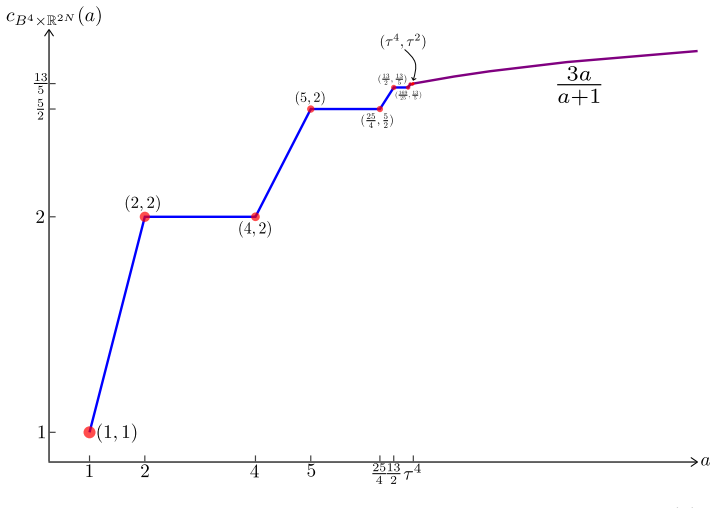
Pith's one-line read Exact formula for stabilized ellipsoid embeddings into the round ball: Fibonacci staircase below τ⁴, then the rational fold 3a/(a+1).
desk verdict A major result: the stabilized ellipsoid embedding function for the ball is now known exactly, via a new scattering-diagram bridge to singular curves, but one internal lemma is asserted without proof and needs a referee's attention. read the letter →
The pith
A machine-rendered reading of the paper's core claim, the machinery that carries it, and where it could break.
The reading
What carries the argument
The load-bearing bridge is a bijection between $(p,q)$-well-placed rational curves in a uninodal Looijenga pair and curves in a toric model that meet one distinguished toric divisor with contact order one, together with the theorem that existence of such curves is detected by nonvanishing of a coefficient in the minimal scattering diagram $S(D_T)_{\min}$. A scattering diagram is a collection of rays in the plane labeled by power series; the completion algorithm adds outgoing rays until the monodromy around every loop is trivial. For rigid del Pezzo surfaces the paper exhibits toric models whose diagrams are basic scattering diagrams with two or three initial rays, and a change-of-lattice reduction turns the relevant two-ray cases into the standard diagrams $D^{\ell_1,\ell_2}_{e_1,e_2}$. Known positivity results for these standard diagrams then supply the required nonzero coefficients, yielding the curve existence theorems and hence the embedding obstructions.
What would settle it
Evaluate the stabilized capacity at any $a>\tau^4$ by an independent method, for example by computing the relevant higher symplectic capacities at $a=7$ or $a=8$, and compare with $3a/(a+1)$; any value below $3a/(a+1)$ would refute Theorem A. On the algebraic side, run the completion of the scattering diagram $D^{3,3}_{e_1,e_2}$ to sufficiently high order in $t$ and check that the coefficient at the relevant lattice point is nonzero for every coprime $p,q$ with $p+q$ divisible by $3$ and $p/q>\tau^4$; a single zero coefficient, or a failure of the predicted Fibonacci condition below $\tau^4$, would refute Theorem B and with it the curve construction behind the embedding theorem.
Extended reading notes
Core claim
On the paper's own terms, the central discovery is Theorem A: for every $N\ge 1$, the stabilized ellipsoid embedding function of the round ball is $c_{B^4\times\mathbb{R}^{2N}}(a) = \frac{1}{\sqrt{\alpha_k}}\,a$ on each interval $[\alpha_k,\beta_k]$, is $\sqrt{\alpha_{k+1}}$ on each interval $[\beta_k,\alpha_{k+1}]$, and is $3a/(a+1)$ for all $a\ge\tau^4$, where the numbers $\alpha_k,\beta_k$ are built from Fibonacci numbers and accumulate at $\tau^4$. The paper derives this from Theorem B, a complete answer to the minimal-degree problem for rational plane curves with a $(p,q)$ cusp when $p+q$ is divisible by $3$: such a curve of degree $(p+q)/3$ exists exactly for the Fibonacci pairs $(\mathrm{Fib}_{k+4},\mathrm{Fib}_k)$ with $k$ odd, or when $p/q>\tau^4$. Because the symplectic obstruction mechanism turns these curves into lower bounds and known folding constructions give matching upper bounds, the two theorems together determine the capacity. The same framework is extended to del Pezzo surfaces, yielding a complete description of their stabilized embedding functions in the rigid cases and a universal rational lower bound in the non-rigid cases.
Load-bearing premise
The paper assumes as a black box that a singular rational sphere in a symplectic four-manifold, with one cusp whose parameters satisfy the rigidity condition $p+q=c_1([C])$ and only node-like other singularities, always obstructs stabilized ellipsoid embeddings in the stated way; the present paper does not reprove the compactness and transversality behind that implication.
Editorial extensions
If this is right
- The stabilized embedding capacity of the round four-ball is now known for every $a\ge 1$ and every $N\ge 1$, replacing the previous piecemeal lower bounds with one explicit formula.
- Hind's folding embeddings are sharp in the whole tail region $a\ge\tau^4$, so no stronger stabilized obstruction can exist beyond the accumulation point.
- For plane curves with a prescribed $(p,q)$ cusp and $p+q$ divisible by $3$, the minimal degree is $(p+q)/3$ except in finitely many cases of low singularity excess, and the curves realizing the minimum are rational and can be chosen well-placed with respect to any nodal cubic.
- For rigid del Pezzo surfaces, the same framework computes the stabilized capacity as the unstabilized staircase up to the accumulation point and $a/(a+1)$ beyond; for non-rigid del Pezzo surfaces it proves the lower bound $a/(a+1)$ for all $a$.
- The ratio set $S_X$ of cusp types realized by rational curves is dense beyond the accumulation point for rigid del Pezzo surfaces and dense in $[1,\infty)$ for non-rigid ones, giving an abundance of algebraic obstructions.
Reading between the lines
- Editorial inference: if the scattering-diagram bridge is as robust as the paper suggests, the same coefficient-nonvanishing criterion should compute stabilized capacities for other monotone targets beyond del Pezzo surfaces, where the rational tail $a/(a+1)$ would be governed by the same folding construction.
- Editorial inference: the byproduct equality $c_{B^4\times\mathbb{R}^{2N}} = c_{\mathbb{CP}^2\times\mathbb{R}^{2N}}$ suggests that in the stabilized regime the capacity depends mainly on the symplectic area class and the minimal cusp ratios available, not on finer features of the four-dimensional target.
- Editorial inference: the conjectural exact count of well-placed curves carrying the tail obstructions, if proved, would give a quantitative refinement of Theorem A and a sharp check on the scattering coefficients at $t=1$.
- Editorial inference: the refined multi-variable scattering coefficients described in the paper should detect the auxiliary singularity counts and homology classes of well-placed curves, potentially linking the stabilized embedding problem to the subtle combinatorial phenomena seen in the classification of unicuspidal curves.
Editorial analysis
A structured set of objections, weighed in public.
Referee Report
Summary. The paper computes the stabilized symplectic embedding function c_{B^4 \times \mathbb{R}^{2N}}(a) for ellipsoids into the round ball, proving an explicit piecewise formula: an infinite Fibonacci staircase for a below the accumulation point \tau^4, followed by the rational tail 3a/(a+1) for a \ge \tau^4. The proof proceeds by converting symplectic embedding obstructions into statements about existence of (p,q)-well-placed rational algebraic curves, then using a correspondence with scattering diagrams, the change-of-lattice trick, and positivity results for basic scattering diagrams from Gross--Pandharipande and Gr\"afnitz--Luo. The paper also proves analogous results for del Pezzo surfaces and gives new families of sesquicuspidal plane curves, including a resolution of the minimal-degree problem in many cases.
Significance. If the proof is completed, the paper fully solves the stabilized ellipsoid embedding problem for the round ball, a central open problem in quantitative symplectic geometry after McDuff--Schlenk. The explicit formula is parameter-free and exhibits a sharp phase transition from the unstabilized staircase to a rational folding tail. Conceptually, the paper builds a bridge from singular algebraic curve theory and scattering diagrams to symplectic nonsqueezing, and it gives a large new supply of low-degree cuspidal rational plane curves. The exposition is largely careful and the main reductions are clearly laid out; the paper is explicit that it avoids unproved symplectic field theory virtual techniques. The main reservations are the unproved internal Lemma 6.3.2 and the heavy reliance on the imported obstruction theorem from [McS23].
major comments (2)
- [Section 6.3, Lemma 6.3.2] Lemma 6.3.2 is stated without proof, and it is the hinge for Theorem B and for the J=2 cases of Theorem F(a), and hence, through Section 3 and Section 2, for Theorem A. The lemma identifies, under the bijection W_X, the discrete rays of S(D^{\ell_1,\ell_2}_{m_1,m_2})_{min} with outer corners of the infinite staircase c_X|_{[1,a_X^{acc}]} and the dense region with (a_X^{acc},\infty). After the statement the text moves directly to Corollary 6.3.3 and the proofs of Theorem B and Theorem F, with no further argument. If this identification is incorrect at any boundary value, or if a non-outer fraction maps to a discrete ray, the dense lower bounds c_{X\times\mathbb{R}^{2N}}(a)\ge a/(a+1) would not follow, and Theorems A and E would fail. Please supply a complete proof of both bullets, or reduce them explicitly to published results such as [GP10, Thm. 5] together with the staircase classification in [MS24]/[Cri+25], including the congruence conditions stated in Corollary 6.3.3.
- [Section 2, Theorem 2.0.1] All symplectic embedding obstructions in the paper pass through Theorem 2.0.1, imported from [McS23] (Cor. 2.7.2, Cor. 2.3.8, Thm. D, Thm. E), which is described only by a short sketch involving moduli of J-holomorphic curves. This is the unique bridge from existence of algebraic curves to the lower bounds c_{X\times\mathbb{R}^{2N}}\ge a/(a+1). The manuscript should state the publication status of [McS23] and either give a complete proof of Theorem 2.0.1 or a precise reference to a published version with all hypotheses verified. In particular, the hypotheses of Corollary 2.0.2 (monotonicity of X or N\le 1, semipositivity, index-zero condition) should be checked explicitly for the unimonotone del Pezzo surfaces used in Theorem E(b), and the perturbation step from algebraic sesquicuspidal curves to symplectic sesquicuspidal curves in the proof of Theorem E should be justified in the presence of auxiliary singularities.
minor comments (4)
- [Corollary D] The monotonicity inequalities in the proof of Corollary D appear reversed. Since U\subset B^4(3), one has c_{U\times\mathbb{R}^{2N}}\ge c_{B^4(3)\times\mathbb{R}^{2N}}, and since X\subset U, one has c_{U\times\mathbb{R}^{2N}}\le c_{X\times\mathbb{R}^{2N}}. The displayed chain of inequalities should be corrected so that the two directions give the claimed equality.
- [Corollary 6.3.3] The sentence 'Inspecting Table 4.2.1' refers to the wrong table; the relevant data appears in Table 4.3.1.
- [Various] There are several typographical errors: 'especicially' in Remark 1.0.9, 'geoemtry' and 'resuls' in Remark 1.0.10, 'Cantour' in Remark 5.2.10, 'necesarrily' in Remark 3.0.6, and 'if and only of one if' in Corollary 6.3.1.
- [Section 6.2, Theorem 6.2.1] The sentence 'an inspection of their argument shows that we can take \kappa=1' would benefit from a precise pointer to the relevant part of [GP10], since the sharp 'if and only if' in Theorem B depends on nonvanishing for the primitive ray, not merely for some positive multiple of it.
Circularity Check
No circular derivation detected; the staircase formula is not hardwired into the inputs, though the proof leans on prior same-author theorems and an unproved bridge lemma.
full rationale
The claimed derivation is not circular by construction. Theorem A's upper bound on [τ^4, ∞) comes from explicit folding embeddings [Hin15; CHS22], while the lower bound is obtained by combining the general obstruction theorem 2.0.1 (imported from [McS23]) with existence of (p,q)-well-placed curves certified by scattering-coefficient nonvanishing theorems [GP10, Thm 6.2.1; Gro+18, Prop C.13; GL23, Thm 1]. The staircase constants α_k, β_k, τ^4 are not fitted to c; they are generated by the Fibonacci recursion and by the roots ξ of R(t)=t^2/ℓ2 - t + 1/ℓ1, matched to the staircase via the explicit bijection W_X in Table 4.3.1 and Proposition 4.2.1. The same-author citations [McS23, MS24] are load-bearing, but they are used as general theorems whose stated assumptions (semipositivity, index-zero sesquicuspidal curves, unimonotone del Pezzo surfaces) do not include Theorem A; hence they are not 'uniqueness imported from authors' in the forbidden sense. Caveat, not circularity: Lemma 6.3.2, which identifies discrete scattering rays with outer staircase corners and the dense region with (a_acc,∞), is stated without proof and is essential for Theorems B and F; if that identification failed the density argument would collapse. This is an omitted proof/correctness risk rather than a reduction of the conclusion to its inputs; no equation in the paper defines the staircase corners as the scattering rays.
Assumptions & free parameters
assumptions (8)
- standard math Kontsevich-Soibelman: every scattering diagram has a unique minimal consistent completion
- domain assumption GPS10 Thm 5.4: scattering coefficients of basic diagrams equal relative Gromov-Witten invariants
- domain assumption GP10 and Reineke quiver nonvanishing for equal weights
- domain assumption GL23 Thm 1: dense region positivity for unequal weights
- domain assumption McS23 obstruction theorem: index-zero sesquicuspidal curves yield embedding obstructions (Thm 2.0.1 black box)
- standard math GHK15 Prop 1.3: existence of toric models for Looijenga pairs
- domain assumption Classification of rational unicuspidal curves for Fibonacci pairs (Orevkov, Kashiwara, BLMN)
- standard math K3 surfaces are not uniruled (used in Lemma 5.2.8)
Cite this review
Pith. "Pith review of Sesquicuspidal curves, scattering diagrams, and symplectic nonsqueezing." pith.science (2026). https://pith.science/paper/M33HXAW2
@misc{pith2026241200561,
  author       = {Pith},
  title        = {Pith review of: Sesquicuspidal curves, scattering diagrams, and symplectic nonsqueezing},
  year         = {2026},
  howpublished = {\url{https://pith.science/paper/M33HXAW2}},
  note         = {Machine review of arXiv:2412.00561}
}
read the original abstract
We solve the stabilized symplectic embedding problem for four-dimensional ellipsoids into the four-dimensional round ball. The answer is neatly encoded by a piecewise smooth function which exhibits a phase transition from an infinite Fibonacci staircase to an explicit rational function related to symplectic folding. Our approach is based on a bridge between quantitative symplectic geometry and singular algebraic curve theory, and a general framework for approaching both topics using scattering diagrams. In particular, we construct a large new family of rational algebraic curves in the complex projective plane with a (p,q) cusp singularity, many of which solve the classical minimal degree problem for plane curves with a prescribed cusp. A key role is played by the tropical vertex group of Gross--Pandharipande--Siebert and ideas from mirror symmetry for log Calabi--Yau surfaces. Many of our results also extend to other target spaces, e.g. del Pezzo surfaces and more general rational surfaces.
Figures


Figures from the paper (1 more)

Reference graph
Works this paper leans on
-
[1]
Symplectic packing in dimension 4
[Bir97] Paul Biran. “Symplectic packing in dimension 4”.Geometric & Functional Analysis GAFA7.3 (1997), pp. 420–437. [BLMN] Javier Fernández de Bobadilla, Ignacio Luengo, Alejandro Melle Hernández, and Andras Némethi. “Classification of rational unicuspidal projective curves whose singularities have one Puiseux pair”.Real and complex singularities. Spring...
work page 1997
-
[9]
LogK3 surfaces with irreducible boundary
sur le plan projectif complexe”. Osaka J. Math.24.3 (1987), pp. 521–577. [Kol24] János Kollár. “LogK3 surfaces with irreducible boundary”.arXiv:2407.08051 (2024). [KV24] János Kollár and David Villalobos-Paz. “Cubic surfaces with infinite, discrete automorphism group”.arXiv:2410.03934 (2024). [KS06] Maxim Kontsevich and Yan Soibelman. “Affine Structures a...
arXiv 1987
-
[49]
[EG22] John B Etnyre and Marco Golla. “Symplectic hats”.Journal of topology15.4 (2022), pp. 2216–2269. [Eva23] Jonny Evans.Lectures on Lagrangian torus fibrations. Vol
work page 2022
-
[61]
Lattice Formulas For Rational SFT Capacities
[CW21] Julian Chaidez and Ben Wormleighton. “Lattice Formulas For Rational SFT Capacities”. arXiv:2106.07920 (2021). [Che+17] Man Wai Cheung, Mark Gross, Greg Muller, Gregg Musiker, Dylan Rupel, Salvatore Stella, and Harold Williams. “The greedy basis equals the theta basis: a rank two haiku”.Journal of Combinatorial Theory, Series A145 (2017), pp. 150–17...
work page Pith review arXiv 2021
-
[71]
Infinitely many monotone Lagrangian tori in del Pezzo surfaces
[Via17] Renato Vianna. “Infinitely many monotone Lagrangian tori in del Pezzo surfaces”. Selecta Mathematica23 (2017), pp. 1955–1996. 47
work page 2017
-
[168]
Canonical bases for cluster algebras
[Gro+18] Mark Gross, Paul Hacking, Sean Keel, and Maxim Kontsevich. “Canonical bases for cluster algebras”.J. Amer. Math. Soc.31.2 (2018), pp. 497–608. [GHS22] Mark Gross, Paul Hacking, and Bernd Siebert. “Theta functions on varieties with effective anti-canonical class”.Mem. Amer. Math. Soc.278.1367 (2022), pp. xii+103. [GP10] Mark Gross and Rahul Pandha...
work page 2018
-
[1993]
Counting (tropical) curves via scattering.sage
[Grä22] Tim Gräfnitz. “Counting (tropical) curves via scattering.sage”. arXiv:2210.10455 (2022). [GL23] Tim Gräfnitz and Patrick Luo. “Scattering diagrams: polynomiality and the dense region”.arXiv:2312.13990 (2023). [GLS18] Gert-Martin Greuel, Christoph Lossen, and Eugenii Shustin.Singular alge- braic curves. Springer,
work page Pith review arXiv 2022
-
[2004]
[Sym] Margaret Symington. “Four dimensions from two in symplectic topology. Topology and geometry of manifolds (Athens, GA, 2001), 153–208”.Proc. Sympos. Pure Math. Vol
work page 2001
Show all 11 references
-
[2011]
On infinite staircases in toric symplectic four-manifolds
[Cri+25] Dan Cristofaro-Gardiner, Tara S Holm, Alessia Mandini, and Ana Rita Pires. “On infinite staircases in toric symplectic four-manifolds”.Journal of Differential Geometry129.2 (2025), pp. 335–413. [CH18] Daniel Cristofaro-Gardiner and Richard Hind. “Symplectic embeddings...
2025
-
[2018]
Plane algebraic curves with pre- scribed singularities
[GS21] Gert-Martin Greuel and Eugenii Shustin. “Plane algebraic curves with pre- scribed singularities”.Handbook of Geometry and Topology of Singularities II. Springer, 2021, pp. 67–122. [Gro85] Mikhael Gromov. “Pseudo holomorphic curves in symplectic manifolds”. Inventiones M...
1985
-
[2023]
Genus one cobordisms between torus knots
[FP21] Peter Feller and JungHwan Park. “Genus one cobordisms between torus knots”. International Mathematics Research Notices2021.1 (2021), pp. 521–
2021
Reviewed August 12, 2026 · model on record in the stance chip above.
Discussion (0). Continue with ORCID to comment.