REVIEW 2 major objections 2 minor 57 references
Macroeconomics of Racial Disparities: Discrimination, Labor Market, and Wealth
T0 review · 2 major / 2 minor · reviewed 2026-05-23 · grok-4.3
Pith's one-line read A search-and-matching model attributes 57% of the black-white unemployment gap to discriminatory hiring by prejudiced firms.
desk verdict Standard search-and-matching model attributes big shares of racial gaps to hiring discrimination, but the decomposition rests on whether calibration cleanly isolates prejudice from other factors. read the letter →
The pith
A machine-rendered reading of the paper's core claim, the machinery that carries it, and where it could break.
The reading
What carries the argument
Search-and-matching model with prejudiced and non-prejudiced firms, where labor market frictions sustain discriminatory hiring as an equilibrium.
What would settle it
Direct observation that reducing search frictions shrinks the share of gaps attributable to discrimination, or that removing prejudiced firms fails to close gaps by the modeled percentages, would test the mechanism.
Extended reading notes
Core claim
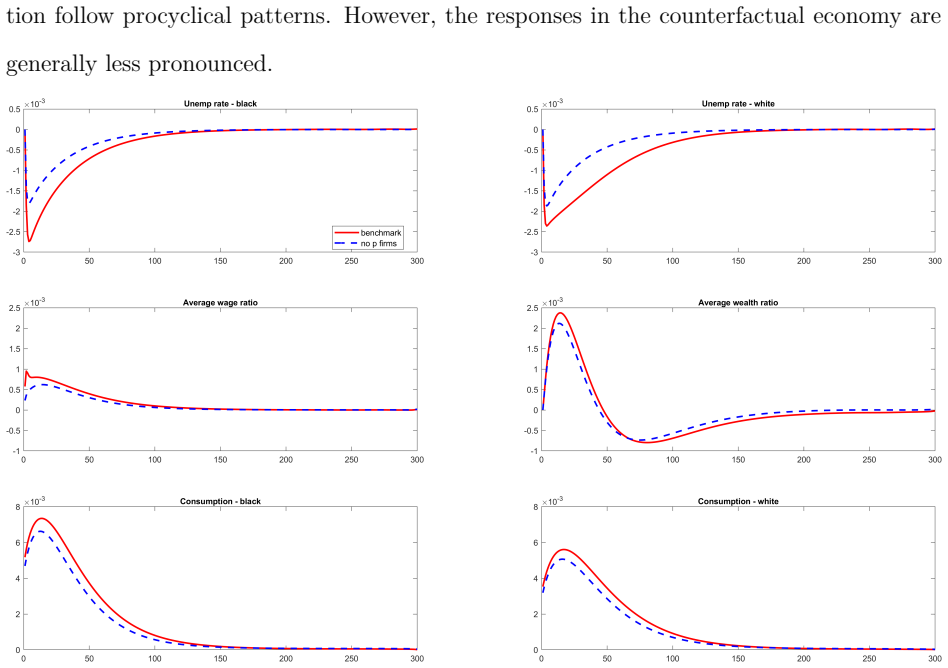
Using a labor search-and-matching model with racially prejudiced and non-prejudiced firms, the authors demonstrate that labor market frictions sustain discriminatory hiring as an equilibrium outcome. These practices account for 57% of the racial unemployment gap, 48% of the average wage gap, and 16% of the median wealth gap. Discriminatory hiring increases unemployment and wage volatility for black workers over the business cycle. Eliminating prejudiced firms reduces these disparities and improves welfare.
Load-bearing premise
Labor market frictions suffice to keep prejudiced hiring as an equilibrium, and the calibration parameters correctly isolate discrimination's contribution from other unmodeled factors.
Editorial extensions
If this is right
- Discriminatory hiring increases unemployment and wage volatility for black workers over the business cycle.
- Eliminating prejudiced firms reduces racial disparities in unemployment, wages, and wealth.
- Both black workers' welfare and overall economic welfare rise when prejudiced firms are removed.
- Labor market risks for black workers are amplified by discrimination across economic cycles.
Reading between the lines
- Policies that lower search frictions could indirectly reduce discrimination by making prejudiced hiring less stable.
- The volatility channel suggests discrimination widens racial gaps most during recessions.
- Similar search-friction mechanisms could operate in other markets where hiring is costly and prejudice is present.
Editorial analysis
A structured set of objections, weighed in public.
Referee Report
Summary. The paper develops a search-and-matching model with prejudiced and non-prejudiced firms to examine how racial discrimination in hiring affects employment, wages, and wealth gaps between black and white workers. Labor market frictions are shown to sustain prejudiced hiring in equilibrium. Counterfactual removal of prejudiced firms is reported to account for 57% of the unemployment gap, 48% of the average wage gap, and 16% of the median wealth gap, while also reducing volatility for black workers and raising their welfare as well as aggregate welfare.
Significance. If the decomposition is identified, the results would quantify the equilibrium role of firm-level prejudice in generating macro disparities across labor and wealth margins, an area where most existing models treat discrimination as exogenous or focus on one margin only. The linkage from hiring discrimination to wealth accumulation via labor-market risk is a potentially useful contribution.
major comments (2)
- [Calibration and counterfactual analysis] Calibration section: the reported shares (57% unemployment, 48% wage, 16% wealth) are obtained from a counterfactual that shuts down prejudiced firms while holding all other parameters fixed. The manuscript must demonstrate that the calibrated share of prejudiced firms and discrimination intensity are not simply recovering the residual gaps after other observables are controlled for; otherwise the attribution is not independent of the targets.
- [Model setup and equilibrium] Model section on equilibrium prejudice: the claim that matching frictions sustain prejudiced hiring as an equilibrium is load-bearing for the entire exercise. The paper should report the precise condition (e.g., the wage or vacancy-posting threshold) under which prejudiced firms remain active and show that this condition is robust to alternative bargaining protocols or to the introduction of productivity heterogeneity between groups.
minor comments (2)
- [Abstract] Abstract and introduction: the specific numerical claims are presented without any reference to the underlying data sources, sample periods, or calibration targets used to match the observed gaps.
- [Results] Notation: the distinction between average and median wealth gaps should be clarified when reporting the 16% figure, and the exact definition of the wealth variable (e.g., net worth, liquid assets) should be stated explicitly.
Simulated Author's Rebuttal
We thank the referee for the constructive comments. We address each major point below and will revise the manuscript accordingly to strengthen the identification discussion and equilibrium analysis.
read point-by-point responses
-
Referee: [Calibration and counterfactual analysis] Calibration section: the reported shares (57% unemployment, 48% wage, 16% wealth) are obtained from a counterfactual that shuts down prejudiced firms while holding all other parameters fixed. The manuscript must demonstrate that the calibrated share of prejudiced firms and discrimination intensity are not simply recovering the residual gaps after other observables are controlled for; otherwise the attribution is not independent of the targets.
Authors: We agree that explicit identification discussion is needed. The share of prejudiced firms is calibrated to external estimates from audit and correspondence studies on hiring discrimination (independent of aggregate gaps), while discrimination intensity targets conditional wage differentials from microdata. Unemployment, wage, and wealth moments are matched separately. We will revise the calibration section to detail these sources, add a dedicated identification subsection, and include sensitivity analyses varying the prejudiced-firm share to confirm the decomposition is not merely residual. revision: yes
-
Referee: [Model setup and equilibrium] Model section on equilibrium prejudice: the claim that matching frictions sustain prejudiced hiring as an equilibrium is load-bearing for the entire exercise. The paper should report the precise condition (e.g., the wage or vacancy-posting threshold) under which prejudiced firms remain active and show that this condition is robust to alternative bargaining protocols or to the introduction of productivity heterogeneity between groups.
Authors: We accept this request for greater precision. Prejudiced firms post vacancies when the expected profit from a black-worker match (net of the prejudice-adjusted meeting rate and bargained wage) exceeds the vacancy cost. We will insert the exact analytical threshold in the equilibrium section. We will also add robustness exercises replacing Nash bargaining with alternating-offer protocols and introducing group-specific productivity differences, verifying that prejudiced hiring remains an equilibrium outcome under these alternatives. revision: yes
Circularity Check
No significant circularity; counterfactual shares are model outputs, not tautological fits
full rationale
The paper builds a search-and-matching model with prejudiced and non-prejudiced firms, derives equilibrium conditions for discriminatory hiring sustained by frictions, calibrates parameters (including prejudice intensity and firm share) to match aggregate moments, and then computes counterfactual gaps after removing prejudiced firms. The 57%/48%/16% figures are simulation results from that counterfactual exercise, not direct re-statements of fitted inputs. The model also generates auxiliary predictions on volatility and welfare that are not mechanically identical to the calibration targets. No self-citation chain, self-definitional equations, or imported uniqueness theorems appear in the derivation. The attribution therefore rests on the model's structure and identification assumptions rather than reducing to its own inputs by construction.
Assumptions & free parameters
free parameters (2)
- share of prejudiced firms
- discrimination intensity parameter
assumptions (1)
- domain assumption Labor market frictions sustain discriminatory hiring as an equilibrium outcome
Cite this review
Pith. "Pith review of Macroeconomics of Racial Disparities: Discrimination, Labor Market, and Wealth." pith.science (2026). https://pith.science/paper/2412.00615
@misc{pith2026241200615,
  author       = {Pith},
  title        = {Pith review of: Macroeconomics of Racial Disparities: Discrimination, Labor Market, and Wealth},
  year         = {2026},
  howpublished = {\url{https://pith.science/paper/2412.00615}},
  note         = {Machine review of arXiv:2412.00615}
}
read the original abstract
This paper examines the impact of racial discrimination in hiring on employment, wages, and wealth disparities between black and white workers. Using a labor search-and-matching model with racially prejudiced and non-prejudiced firms, we show that labor market frictions sustain discriminatory practices as an equilibrium outcome. These practices account for 57% of the racial unemployment gap, 48% of the average wage gap, and 16% of the median wealth gap. Discriminatory hiring also increases unemployment and wage volatility for black workers, increasing their labor market risks over the business cycle. Eliminating prejudiced firms reduces these disparities and improves the welfare of black workers as well as the overall economic welfare.
Figures

Reference graph
Works this paper leans on
-
[1]
Aliprantis, D., D. Carroll, and E. R. Young (2023). The dynamics of the racial wealth gap
work page 2023
- [2]
-
[3]
Bartscher, A. K., M. Kuhn, M. Schularick, and P. Wachtel (2021). Monetary policy and racial inequality. FRB of New York Staff Report\/ (959)
work page 2021
-
[4]
Becker, G. (1957). The economics of discrimination . Chicago: University of Chicago Press
work page 1957
-
[5]
Bertrand, M. and E. Duflo (2017). Field experiments on discrimination. Handbook of economic field experiments\/ 1 , 309--393
work page 2017
-
[6]
Bertrand, M. and S. Mullainathan (2004). Are emily and greg more employable than lakisha and jamal? a field experiment on labor market discrimination. American economic review\/ 94\/ (4), 991--1013
work page 2004
-
[7]
Biddle, J. E. and D. S. Hamermesh (2013). Wage discrimination over the business cycle. IZA Journal of Labor Policy\/ 2\/ (1), 7
work page 2013
-
[8]
Bils, M. J. (1985). Real wages over the business cycle: evidence from panel data. Journal of Political economy\/ 93\/ (4), 666--689
work page 1985
Show all 57 references
-
[9]
Black, D. A. (1995). Discrimination in an equilibrium search model. Journal of labor Economics\/ 13\/ (2), 309--334
1995
-
[10]
Boerma, J. and L. Karabarbounis (2021). Reparations and persistent racial wealth gaps. Technical report, National Bureau of Economic Research
2021
-
[11]
Krusell, and K
Boppart, T., P. Krusell, and K. Mitman (2018). Exploiting mit shocks in heterogeneous-agent economies: the impulse response as a numerical derivative. Journal of Economic Dynamics and Control\/ 89 , 68--92
2018
-
[12]
De Nardi, and F
Borella, M., M. De Nardi, and F. Yang (2018). The aggregate implications of gender and marriage. The Journal of the Economics of Ageing\/ 11 , 6--26
2018
-
[13]
Caballero, R. and M. L. Hammour (1994). The cleansing effect of recessions. American Economic Review\/ 84\/ (5), 1350--68
1994
-
[14]
Radler, D
Cajner, T., T. Radler, D. Ratner, and I. Vidangos (2017). Racial gaps in labor market outcomes in the last four decades and over the business cycle
2017
-
[15]
Slacalek, K
Carroll, C., J. Slacalek, K. Tokuoka, and M. N. White (2017). The distribution of wealth and the marginal propensity to consume. Quantitative Economics\/ 8\/ (3), 977--1020
2017
-
[16]
Cheng, S., C. R. Tamborini, C. Kim, and A. Sakamoto (2019). Educational variations in cohort trends in the black-white earnings gap among men: Evidence from administrative earnings data. Demography\/ 56 , 2253--2277
2019
-
[17]
Cho, D. and E. Ma (2023). The heterogeneous welfare effects of business cycles. European Economic Review\/ 153 , 104400
2023
-
[18]
Coate, S. and G. C. Loury (1993). Will affirmative-action policies eliminate negative stereotypes? The American Economic Review\/ , 1220--1240
1993
-
[19]
Cooley, T. F., E. C. Prescott, et al. (1995). Economic growth and business cycles. Frontiers of business cycle research\/ 1 , 1--38
1995
-
[20]
Couch, K. A. and R. Fairlie (2010). Last hired, first fired? black-white unemployment and the business cycle. Demography\/ 47\/ (1), 227--247
2010
-
[21]
Daly, M. C., B. Hobijn, and J. H. Pedtke (2020). Labor market dynamics and black--white earnings gaps. Economics Letters\/ 186 , 108807
2020
-
[22]
Den Haan, W. J., K. L. Judd, and M. Juillard (2010). Computational suite of models with heterogeneous agents: Incomplete markets and aggregate uncertainty. Journal of Economic Dynamics and Control\/ 34\/ (1), 1--3
2010
-
[23]
Den Haan, W. J., G. Ramey, and J. Watson (2000). Job destruction and propagation of shocks. American economic review\/ 90\/ (3), 482--498
2000
-
[24]
Derenoncourt, E., C. H. Kim, M. Kuhn, and M. Schularick (2022). Wealth of two nations: The us racial wealth gap, 1860-2020. Technical report, National Bureau of Economic Research
2022
-
[25]
Derenoncourt, E., C. H. Kim, M. Kuhn, and M. Schularick (2023). Changes in the distribution of black and white wealth since the us civil war. Journal of Economic Perspectives\/ 37\/ (4), 71--89
2023
-
[26]
Derenoncourt, E. and C. Montialoux (2021). Minimum wages and racial inequality. The Quarterly Journal of Economics\/ 136\/ (1), 169--228
2021
-
[27]
Devereux, P. J. (2001). The cyclicality of real wages within employer-employee matches. ILR Review\/ 54\/ (4), 835--850
2001
-
[28]
Jones, P
Ganong, P., D. Jones, P. J. Noel, F. E. Greig, D. Farrell, and C. Wheat (2020). Wealth, race, and consumption smoothing of typical income shocks. Technical report, National Bureau of Economic Research
2020
-
[29]
Perri, and G
Heathcote, J., F. Perri, and G. L. Violante (2020, June). The rise of us earnings inequality: Does the cycle drive the trend? Working Paper 27345, National Bureau of Economic Research
2020
-
[30]
Horvath, J. and G. Yang (2022). Unemployment dynamics and informality in small open economies. European Economic Review\/ 141 , 103949
2022
-
[31]
Jaimovich, N. and H. E. Siu (2020). Job polarization and jobless recoveries. Review of Economics and Statistics\/ 102\/ (1), 129--147
2020
-
[32]
Kaplan, G., G. L. Violante, and J. Weidner (2014). The wealthy hand-to-mouth (brookings papers on economic activity). Economic Studies Program, The Brookings Institution\/ 45\/ (1)
2014
-
[33]
Kline, P., E. K. Rose, and C. R. Walters (2022). Systemic discrimination among large us employers. The Quarterly Journal of Economics\/ 137\/ (4), 1963--2036
2022
-
[34]
Mukoyama, and A
Krusell, P., T. Mukoyama, and A. S ahin (2010). Labour-market matching with precautionary savings and aggregate fluctuations. The Review of Economic Studies\/ 77\/ (4), 1477--1507
2010
-
[35]
Krusell, P. and A. A. Smith, Jr (1998). Income and wealth heterogeneity in the macroeconomy. Journal of Political Economy\/ 106\/ (5), 867--896
1998
-
[36]
Schularick, and U
Kuhn, M., M. Schularick, and U. I. Steins (2020). Income and wealth inequality in america, 1949--2016. Journal of Political Economy\/ 128\/ (9), 3469--3519
2020
-
[37]
Lang, K. and A. K.-L. Spitzer (2020). Race discrimination: An economic perspective. Journal of Economic Perspectives\/ 34\/ (2), 68--89
2020
-
[38]
Macaluso, and F
Lee, M., C. Macaluso, and F. Schwartzman (2021). Minority unemployment, inflation, and monetary policy
2021
-
[39]
Vermeiren, and S
Lippens, L., S. Vermeiren, and S. Baert (2023). The state of hiring discrimination: A meta-analysis of (almost) all recent correspondence experiments. European Economic Review\/ 151 , 104315
2023
-
[40]
Manduca, R. (2018). Income inequality and the persistence of racial economic disparities. Sociological Science\/ 5 , 182
2018
-
[41]
McIntosh, K., E. Moss, R. Nunn, and J. Shambaugh (2020). Examining the black-white wealth gap. Washington DC: Brooking Institutes\/
2020
-
[42]
Mitman, K. and S. Rabinovich (2015). Optimal unemployment insurance in an equilibrium business-cycle model. Journal of Monetary Economics\/ 71 , 99--118
2015
-
[43]
Mukoyama, T. (2010). Welfare effects of unanticipated policy changes with complete asset markets. Economics Letters\/ 109\/ (2), 134--138
2010
-
[44]
Mukoyama, T. (2013). Understanding the welfare effects of unemployment insurance policy in general equilibrium. Journal of Macroeconomics\/ 38 , 347--368
2013
-
[45]
Nakajima, M. (2012). Business cycles in the equilibrium model of labor market search and self-insurance. International Economic Review\/ 53\/ (2), 399--432
2012
-
[46]
Nakajima, M. (2021). Monetary policy with racial inequality. Technical report, mimeo
2021
-
[47]
Pena, A. A. (2018). Skills and economic inequality across race and ethnicity in the united states: New evidence on wage discrimination using piaac. The Review of Black Political Economy\/ 45\/ (1), 40--68
2018
-
[48]
Zhang, and L.-A
Petrosky-Nadeau, N., L. Zhang, and L.-A. Kuehn (2018). Endogenous disasters. American Economic Review\/ 108\/ (8), 2212--2245
2018
-
[49]
Ragusett, J. M. (2022). Re-examining the effect of job sprawl on the black-white housing consumption gap: Evidence following the great recession. The Review of Black Political Economy\/ 49\/ (3), 281--308
2022
-
[50]
Ros \'e n, . (1997). An equilibrium search-matching model of discrimination. European Economic Review\/ 41\/ (8), 1589--1613
1997
-
[51]
Setty, O. and Y. Yedid-Levi (2021). On the provision of unemployment insurance when workers are ex-ante heterogeneous. Journal of the European Economic Association\/ 19\/ (1), 664--706
2021
-
[52]
Shimer, R. (2005). The cyclical behavior of equilibrium unemployment and vacancies. American economic review\/ 95\/ (1), 25--49
2005
-
[53]
Small, M. L. and D. Pager (2020). Sociological perspectives on racial discrimination. Journal of Economic Perspectives\/ 34\/ (2), 49--67
2020
-
[54]
Barsky, and J
Solon, G., R. Barsky, and J. A. Parker (1994). Measuring the cyclicality of real wages: how important is composition bias? The quarterly journal of economics\/ 109\/ (1), 1--25
1994
-
[55]
Stockman, A. C. (1983). Aggregation bias and the cyclical behavior of real wages. Unpublished manuscript\/
1983
-
[56]
Wolcott, E. L. (2021). Employment inequality: Why do the low-skilled work less now? Journal of Monetary Economics\/ 118 , 161--177
2021
-
[57]
Jang, and T
Yum, M., Y. Jang, and T. Sunakawa (2023). Heterogeneity, transfer progressivity, and business cycles. Technical report, CEPR Discussion Papers
2023
Reviewed May 23, 2026 · model on record in the stance chip above.
Discussion (0). Sign in to comment.