REVIEW 3 major objections 4 minor 1 cited by
Stochastic PDE approach to fluctuating interfaces
T0 review · 3 major / 4 minor · reviewed 2026-08-12 · deepseek-v4-flash
Pith's one-line read The paper claims that under the scaled SPDE (3.10) the fluctuation field converges to $\psi(t,x)e(z)$, making microscopic interface fluctuations Gaussian at the stretched scale.
desk verdict New scaling framework for interface fluctuations with a solid single-time linear limit, but the claimed Brownian/SHE process limit needs a missing two-time covariance estimate. read the letter →
The pith
A machine-rendered reading of the paper's core claim, the machinery that carries it, and where it could break.
The reading
What carries the argument
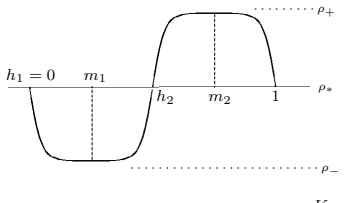
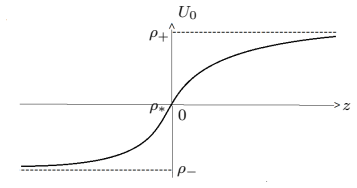
The argument is carried by the Sturm-Liouville operator $A^K=-\partial_z^2-f'(\bar{v}_K(z))$, the linearization of the stationary Allen-Cahn equation around the stretched transition profile $\bar{v}_K(z)=v_K(z/\sqrt{K})$. Spectral estimates from the one-dimensional metastable Allen-Cahn literature show $A^K$ has two exponentially small eigenvalues, coming from the two interfaces, and a uniform spectral gap above them, so $e^{-tKA^K}$ projects any $L^2$ initial data onto the zero mode $e(z)=U_0'(-z)/\|U_0'\|_{L^2(\mathbb{R})}$ after time $t>0$. The scaling $\Psi=K^{-3/4}\Phi(t,z/\sqrt{K},x)$ is chosen so that exactly one noise term survives with $O(1)$ size, and the projection onto $e(z)$ turns the limiting SPDE into the additive stochastic heat equation, or into Brownian motion when $d=1$. The higher-order Boltzmann-Gibbs principle (A.18) is the derivation mechanism: it replaces the microscopic Glauber creation-minus-annihilation rate by $K$ times the Taylor expansion of $f$ around $u_K$ in powers of $N^{-d/2}\Phi$, with a remainder that is ignored.
What would settle it
Run the Glauber-Kawasaki dynamics with a bistable $f$, flat interface, and scaling $K\ll N^{2d/3}$; if the rescaled fluctuation field $\langle\Psi^K(t),H\rangle$ does not converge to $\langle\psi(t,x)e(z),H\rangle$ with $\psi$ solving the additive stochastic heat equation and noise constant $c_*$ given by (4.7), then either the Boltzmann-Gibbs replacement (A.18) or the SPDE limit fails. A more targeted check: in $d=1$, compare the variance of the interface location to $c_*^2t\,N^{-1}K^{1/2}$; any other scaling would falsify.
Extended reading notes
Core claim
Under the scaling $\Psi^{K}(t,z,x)=K^{-3/4}\Phi(t,z/\sqrt{K},x)$, the linear SPDE (3.10) has a Gaussian limit $\Psi(t,z,x)=\psi(t,x)e(z)$ in which $e(z)=U_0'(-z)/\|U_0'\|_{L^2(\mathbb{R})}$ is the normalized derivative of the standing-wave profile. The height function $\psi$ solves the additive stochastic heat equation $\partial_t\psi=\Delta_x\psi+c_*\dot{W}$ on $\mathbb{T}^{d-1}$ when $d\ge 2$, and equals $c_*B_t$ when $d=1$, with $c_*$ given by (4.7). This yields an interface shift of order $N^{-d/2}K^{1/4}\psi/\|U_0'\|_{L^2(\mathbb{R})}$ in the normal direction, meaning the interface moves as the graph $x_1=N^{-d/2}K^{1/4}\phi(t,x)$ with $\phi=\psi/\|U_0'\|$ in the $d=2$ case. The author also shows that the quadratic nonlinearity in the nonlinear SPDE vanishes identically ($c_2=0$), so the first surviving interaction term is cubic; writing $K=N^{2d/5}$ gives the dynamic P($\phi$)-type equation $\partial_t\psi=\Delta_x\psi+c_*\dot{W}+c_3\psi^3$ with $c_3<0$ under a convexity assumption on $f$.
Load-bearing premise
The load-bearing premise is the higher-order Boltzmann-Gibbs principle, Eq. (A.18): that the microscopic Glauber term can be replaced, after local ensemble averaging, by $K$ times the third-order Taylor expansion of the bistable function $f$ around the macroscopic profile $u_K$ in powers of $N^{-d/2}\Phi$, discarding all remainder terms; the paper cites this principle to an in-preparation companion work and gives no proof.
Editorial extensions
If this is right
- In $d=1$ the two transition-layer positions converge to a Brownian motion with diffusivity $c_*^2/\|U_0'\|^2$, so microscopic phase separation produces random diffusive motion of the interface at scale $N^{-1/2}K^{1/4}$.
- In $d=2$ the interface height is a function $\psi(t,x)$ solving $\partial_t\psi=\Delta_x\psi+c_*\dot{W}$ on $\mathbb{T}$, giving a Gaussian random curve whose covariance is explicit from the heat kernel.
- For $d\ge 3$ the limit $\psi(t,x)e(z)$ is distribution-valued, so the phrase 'fluctuating interface' loses a pointwise geometric meaning in high dimensions.
- The quadratic coefficient $c_2$ in the nonlinear SPDE vanishes for any $f$ satisfying $f(\rho_\pm)=0$ and $\int_{\rho_-}^{\rho_+}f=0$, so the first surviving nonlinearity is cubic and, under the convexity assumptions, has a negative coefficient $c_3<0$.
- Away from the interface the density fluctuation collapses to independent centered Gaussian variables with variance given by (6.3), so fluctuations decouple in space-time at that scale.
Reading between the lines
- If the higher-order Boltzmann-Gibbs principle is later proved from the particle dynamics, Theorem 4.1 would turn the interface-fluctuation problem into a spectral-gap plus martingale argument, so the same semigroup tools would produce a theorem about the particle system rather than about an auxiliary SPDE.
- The vanishing of $c_2$ follows from $f(\rho_\pm)=0$ and needs no information about the shape of $f$ between the stable phases; this suggests the same cancellation, and hence the same cubic-then-linear ordering, will appear in other bistable particle systems and in anisotropic interface problems.
- The condition $K^{7/4}\ll N^{d/2}$ for the linear regime and the choices $K=N^{2d/7}$, $N^{2d/5}$ for nonlinear regimes imply a crossover: a simulation sweeping $(N,K)$ should see the interface-shift variance pass from Gaussian linear behavior to nonlinear behavior near those curves, which is a testable prediction the paper does not state.
Editorial analysis
A structured set of objections, weighed in public.
Referee Report
Summary. The paper proposes a family of singular or regularized SPDEs, Eq. (2.3), intended as mesoscopic fluctuation equations for the density field of a Glauber–Kawasaki particle system near a flat interface. After stretching the coordinate normal to the interface by sqrt(K) and rescaling the fluctuation amplitude by K^{-3/4}, the linear member of the family is scaled to the SPDE (3.10)/(4.1). The central rigorous result, Theorem 4.1, asserts that for each fixed time the rescaled fluctuation field converges weakly, after testing against smooth functions, to a Gaussian field with spatial profile e(z) = U_0'(-z)/||U_0'||_{L^2}, whose amplitude solves an additive stochastic heat equation on the tangent torus (or a Brownian motion when d=1). Corollary 4.2 and Theorem 4.4 upgrade this to finite-dimensional convergence in time. Section 5 heuristically studies nonlinear corrections and finds that the quadratic correction vanishes and the cubic correction gives a dynamic P(phi)-type equation. Appendices provide the Carr–Pego spectral estimates and a heuristic derivation of the SPDE from the particle system via the higher-order Boltzmann–Gibbs principle.
Significance. If the process-level gap noted below is repaired, the paper gives a clean and testable route from a singular SPDE to Gaussian interface fluctuations: the interface shift N^{-d/2}K^{1/4}psi/||U_0'|| and the dominance of the neutral mode e(z) are explicit and falsifiable. The use of Carr–Pego spectral estimates to identify the projection onto the slow mode is a genuine technical strength, and the single-time convergence proof is carried out in considerable detail. The paper is also transparent about its heuristic parts: the derivation from the particle system is labelled as assuming the higher-order Boltzmann–Gibbs principle, and Section 5 is explicitly heuristic. The main value of the paper is as a proposal and partial rigorous validation of a new class of SPDEs; with the requested revisions it would be a solid contribution to the stochastic interface literature.
major comments (3)
- [Corollary 4.2 and Theorem 4.4] The proof of Corollary 4.2 does not establish the claimed joint-in-time convergence. Theorem 4.1 proves, for each fixed t, weak convergence in L^2(Omega) of the real variable <Psi^K(t),H> to <Psi(t),H>. The proof of Corollary 4.2 contains only the sentence 'Theorem 4.1 implies ...' and gives no computation of two-time covariances, no tightness argument, and no joint characteristic-function argument. Single-time marginal convergence says nothing about the joint law of {Psi^K(t_1),...,Psi^K(t_n)}. Since the central claim is that the interface fluctuation is the additive SPDE solution psi(t,x) (or, for d=1, the Brownian motion c_* B_t in Theorem 4.4), the multipoint law is essential and is currently unproven. The gap is fixable in principle, for example by proving convergence of E[<Psi^K(t_1),H_1><Psi^K(t_2),H_2>] to the corresponding covariance of the limiting Gaussian field, but that argument is absent. Until then Corollary 4.2 and Theorem 4.4 should be weakened to single-time statements.
- [Eq. (4.3) and the proof of Theorem 4.1] Equation (4.3) is not consistent with the weak-form limit used in the proof of Theorem 4.1. In the proof, the noise contribution I_1(t) is defined with the integrand g_1(check U_0(w)) partial_w H_{t-s}(w,y), and since H_{t-s}(w,y) is asymptotically e(w) times a function of (t-s,x), the limiting coefficient involves g_1(check U_0) e'(w), not e(w) partial_w g_1(check U_0). If Eq. (4.3) is read as an ordinary stochastic integral with integrand e(w) partial_w[g_1(check U_0(w))], it gives a different noise coefficient, and the formula for c_* in (4.7) becomes ambiguous. If the intended meaning is the distributional pairing <partial_w(g_1(check U_0) dot W_1), e> = - integral g_1(check U_0) e' W_1, then Eq. (4.3) should be rewritten in that dual form. As written, a reader cannot verify that the variance of the limiting SHE or Brownian motion is correct, and this coefficient is load-bearing for the main interface-fluctuation statement.
- [Appendix A, Eq. (A.18)] The derivation of the SPDE (2.3) from the Glauber–Kawasaki dynamics relies on the higher-order Boltzmann–Gibbs principle, Eq. (A.18), which is assumed and cited to the in-preparation reference [14]; no proof is given. The paper explicitly labels this derivation heuristic, so this is not an internal inconsistency, but it is a genuine limitation: Theorem 4.1 and Corollary 4.2 are theorems about the model SPDE, not about the original particle system. The Introduction and Section 2.5 should state this distinction more prominently, and if the paper intends to claim interface fluctuation for the particle system, the Boltzmann–Gibbs principle must either be proved or formulated as a precise conjecture.
minor comments (4)
- [Abstract and Section 2.3] There are typos: 'Bolt zmann-Gibbs' in the abstract should be 'Boltzmann–Gibbs', and 'due to the luck of regularity' in Section 2.3 should read 'due to the lack of regularity'.
- [Appendix B, proof of Lemma B.2] The text refers to 'Lemma 4.5 (doubly called Lemma 4.4)'; this is confusing and should be corrected to a single unambiguous citation.
- [Eq. (4.7)] In the formula for c_*, the expression 'partial_w e g_1(check U_0)' is ambiguous. Use parentheses, e.g. (partial_w e(w)) g_1(check U_0(w)) or partial_w(e(w)g_1(check U_0(w))), to match the intended definition of psi_1.
- [Reference [14]] The higher-order Boltzmann–Gibbs principle is attributed to an in-preparation paper [14]. If the manuscript is revised before that paper is available, the dependence on [14] should be made explicit in the main text, and the reference should be updated if possible.
Circularity Check
The linear SPDE limit is derived rigorously once the SPDE is granted, but the SPDE itself rests on an unproved higher-order Boltzmann-Gibbs principle cited to the authors' in-preparation work, making the particle-system link conditional.
-
self citation load bearing
[Appendix A, Eq. (A.18); Section 2.5; reference [14]]
"We now assume the validity of the higher-order Boltzmann-Gibbs principle (cf. [14]), that is, a combination of the averaging under the local ergodicity ... ∼K{ f′(uK)ΦN (s, p/N ) + 1/2 f′′(uK)N−d/2ΦN (s, p/N )2 + 1/6 f′′′(uK)N−dΦN (s, p/N )3 }."
The assumed principle is exactly the third-order Taylor expansion that defines F^N_3 in (2.4), and therefore defines the drift of the SPDE (2.3). The SPDE is thus not derived from the Glauber-Kawasaki dynamics; it is a restatement of the assumed expansion. The only justification offered for this expansion is the citation to [14], the authors' own in-preparation paper, and no proof or independent verification is supplied in the present text. Consequently, the advertised derivation chain from the particle system to the Gaussian interface limit is carried by an unverified self-citation. Theorems 4.1 and 4.4 are rigorous for the assumed SPDE, but the claimed connection to the original particle dynamics is conditional on the ansatz and does not stand on its own.
full rationale
The derivation of the linear SPDE limit (Theorems 4.1 and 4.4, Corollary 4.2) is internally rigorous given the SPDE: Proposition 3.3 uses the Carr-Pego spectral gap to project onto e(z), and the noise convergence is computed directly from Itô isometries; no parameter is fitted to data. The circularity burden lies upstream: the SPDE (2.3) is constructed from the higher-order Boltzmann-Gibbs principle (A.18), which is exactly the same Taylor expansion as F^N_n in (2.4), and that principle is assumed and cited to the authors' in-preparation reference [14]. Thus the advertised connection from the particle system to the Gaussian interface shift is conditional on an unverified, self-cited ansatz. The paper is explicit about this heuristic status ('For linear SPDEs, our proofs are rigorous; otherwise, our arguments are at the heuristic level'), so the circularity is limited to the load-bearing premise rather than the SPDE analysis. Separately, Corollary 4.2 and Theorem 4.4 assert joint-in-time convergence, but the proof of Corollary 4.2 only cites the single-time Theorem 4.1 and gives no two-time covariance argument; this is an internal proof gap, not a circularity, and does not affect the circularity score.
Assumptions & free parameters
free parameters (4)
- K(N) scaling parameter =
unspecified; K diverges with K=o(N)
- amplitude exponent 3/4 in Psi=K^{-3/4}tildePsi =
3/4
- nonlinear balance K=N^{2d/7} =
N^{2d/7}
- nonlinear balance K=N^{2d/5} =
N^{2d/5}
assumptions (6)
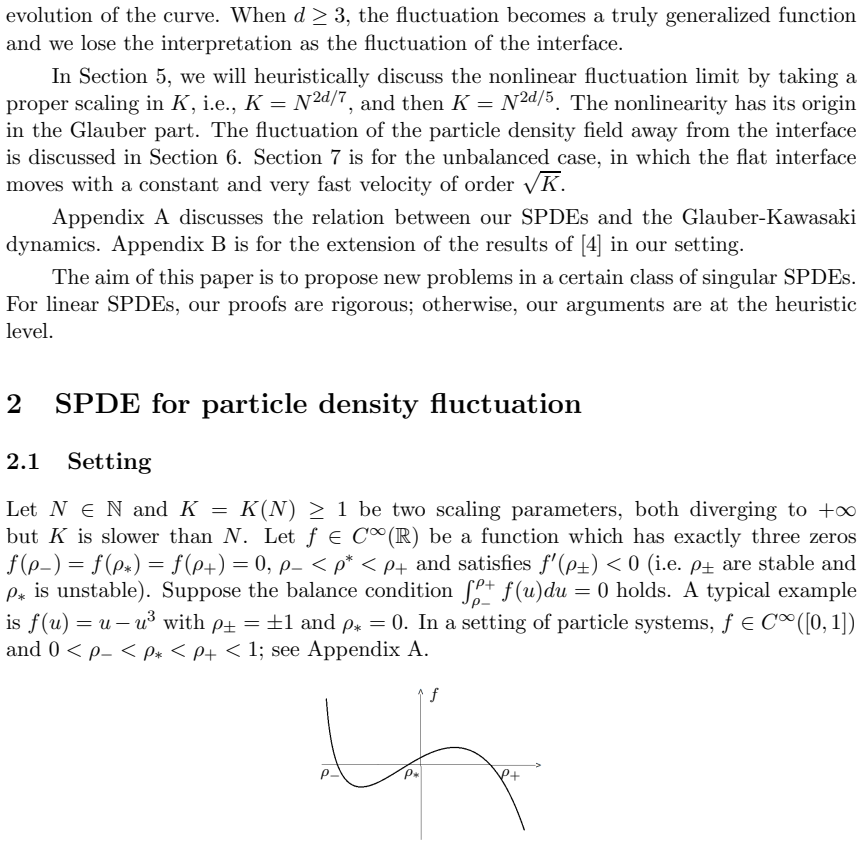
- domain assumption Bistable f with exactly three zeros, f'(rho+-)<0, and balance condition integral f=0
- ad hoc to paper Validity of the higher-order Boltzmann-Gibbs principle (A.18)
- ad hoc to paper Regularized noises satisfying covariance conditions (2.11)-(2.14), or space-time white noises in the linear case
- standard math Carr-Pego spectral estimates for two-layer metastable patterns
- standard math Exponential tail decay of the standing wave U0 (Lemma 2.1)
- domain assumption f'''(u)<0 for global existence with regularized noises in the cubic case
Cite this review
Pith. "Pith review of Stochastic PDE approach to fluctuating interfaces." pith.science (2026). https://pith.science/paper/AVXS6IXD
@misc{pith2026241200708,
  author       = {Pith},
  title        = {Pith review of: Stochastic PDE approach to fluctuating interfaces},
  year         = {2026},
  howpublished = {\url{https://pith.science/paper/AVXS6IXD}},
  note         = {Machine review of arXiv:2412.00708}
}
abstract
We propose a new type of SPDEs, singular or with regularized noises, motivated by a study of the fluctuation of the density field in a microscopic interacting particle system. They include a large scaling parameter $N$, which is the ratio of macroscopic to microscopic size, and another scaling parameter $K=K(N)$, which controls the formation of the interface of size $K^{-1/2}$ in the density field. They are derived heuristically from the particle system, assuming the validity of the so-called ``Boltzmann-Gibbs principle", that is, a combination of the local ensemble average due to the local ergodicity and its asymptotic expansion. We study a simple situation where the interface is flat and immobile. Under making a proper stretch to the normal direction to the interface, we observe a Gaussian fluctuation of the interface. We also heuristically derive a nonlinear SPDE which describes the fluctuation of the interface.
Figures
Figures from the paper (1 more)
Forward citations
Cited by 1 Pith paper
-
Linear fluctuation of interfaces in Glauber-Kawasaki dynamics
The scaled density fluctuation field of a Glauber-Kawasaki lattice gas near a stationary flat interface converges to e(ϑ)√̟B_t in dimension 1 and to e(ϑ)Z_t(θ), with Z solving the additive-noise one-dimensional stocha...
Reference graph
Works this paper leans on
- [14]
- [1]
-
[2]
G. Cannizzaro and F. Toninelli , Lecture notes on stationary critical and super- critical SPDEs , arXiv:2403.15006
-
[3]
F. Caravenna, R. Sun and N. Zygouras , The critical 2d stochastic heat flow , Invent. Math., 233 (2023), 325–460
work page 2023
-
[4]
J. Carr and R.L. Pego , Metastable patterns in solutions of ut = ǫ2uxx −f (u), Commun. Pure Appl., Math., XLII (1989), 523–576
work page 1989
-
[5]
A central limit theorem for nonlinear conservative SPDEs
A. Clini and B. Fehrman , A central limit theorem for nonlinear conservative SPDEs, arXiv:2310.19924. 50
-
[6]
F. Cornalba, J. Fischer, J. Ingmanns and C. Raithel , Density fluc- tuations in weakly interacting particle systems via the Dea n-Kawasaki equation , arXiv:2303.00429
-
[7]
G. Da Prato and A. Debussche , Strong solutions to the stochastic quantization equations, Ann. Probab., 31 (2003), 1900–1916
work page 2003
Show all 29 references
-
[8]
Foondun, D
M. Foondun, D. Khoshnevisan and E. Nualart , Instantaneous everywhere- blowup of parabolic SPDEs , arXiv:2305.08458
-
[9]
Funaki , The scaling limit for a stochastic PDE and the separation of ph ases, Probab
T. Funaki , The scaling limit for a stochastic PDE and the separation of ph ases, Probab. Theory Relat. Fields, 102 (1995), 221–288
1995
-
[10]
Funaki , Singular limit for stochastic reaction-diffusion equation and generation of random interfaces , Acta Math
T. Funaki , Singular limit for stochastic reaction-diffusion equation and generation of random interfaces , Acta Math. Sinica, English Series, 15 (1999), 407–438
1999
-
[11]
Funaki , Lectures on Random Interfaces, SpringerBriefs in Probability and Math- ematical Statistics, 2016, xii+138 pp
T. Funaki , Lectures on Random Interfaces, SpringerBriefs in Probability and Math- ematical Statistics, 2016, xii+138 pp
2016
-
[12]
Funaki , Hydrodynamic limit for exclusion processes , Comm
T. Funaki , Hydrodynamic limit for exclusion processes , Comm. Math. Statis., 6 (2018), 417–480
2018
-
[13]
Funaki , Interface motion from Glauber-Kawasaki dynamics of non-gra dient type, arXiv:2404.18364
T. Funaki , Interface motion from Glauber-Kawasaki dynamics of non-gra dient type, arXiv:2404.18364
-
[15]
Funaki, P
T. Funaki, P. van Meurs, S. Sethuraman and K. Tsunoda , Constant-speed interface flow from unbalanced Glauber-Kawasaki dynamics , Ensaios Matem´ aticos, 38 (2023), 223–248
2023
-
[16]
Funaki, Y
T. Funaki, Y. Nishijima and H. Suda , Stochastic eight-vertex model, its invariant measures and KPZ limit , J. Statis. Phys., 184 (2021), Article no. 11, 1–30
2021
-
[17]
Funaki and S
T. Funaki and S. Sethuraman , Schauder estimate for quasilinear discrete PDEs of parabolic type , to appear in Memoirs of the American Mathematical Society, arXiv:2112.13973
-
[18]
Hairer , Renormalisation in the presence of variance blowup , arXiv:2401.10868
M. Hairer , Renormalisation in the presence of variance blowup , arXiv:2401.10868
-
[19]
Kawasaki, Non-equilibrium and Phase Transition — Statistical Physic s of Meso- scale (in Japanese), Asakura-Shoten, 2000
K. Kawasaki, Non-equilibrium and Phase Transition — Statistical Physic s of Meso- scale (in Japanese), Asakura-Shoten, 2000
2000
-
[20]
Kawasaki and T
K. Kawasaki and T. Ohta , Kinetic drumhead model of interface I , Prog. Theoret. Phys., 67 (1982), 147–163
1982
-
[21]
Krylov and B.L
N.V. Krylov and B.L. Rozovskii , Stochastic evolution equations, J. Soviet Math., 16 (1981), 1233–1277. 51
1981
-
[22]
Pel ´aez, F.B
R.P. Pel ´aez, F.B. Usabiaga, S. Panzuela, Q. Xiao, R. Delgado-Buscalion i and A. Donev , Hydrodynamic fluctuations in quasi-two dimensional diffusi on, J. Stat. Mech. Theory Exp., 2018 Article ID 063207, 44p. (2018)
2018
-
[23]
Savin, Regularity of flat level sets in phase transitions , Ann
O. Savin, Regularity of flat level sets in phase transitions , Ann. Math. (2) 169 (2009), 41–78
2009
-
[24]
Savin, Phase transitions, minimal surfaces and a conjecture of de G iorgi, Current developments in mathematics, 2009, 59–113 (2010)
O. Savin, Phase transitions, minimal surfaces and a conjecture of de G iorgi, Current developments in mathematics, 2009, 59–113 (2010)
2010
-
[25]
Spohn , Nonlinear fluctuating hydrodynamics for anharmonic chains , J
H. Spohn , Nonlinear fluctuating hydrodynamics for anharmonic chains , J. Stat. Phys., 154 (2014), 1191–1227
2014
-
[26]
Spohn and G
H. Spohn and G. Stoltz , Nonlinear fluctuating hydrodynamics in one dimension: the case of two conserved fields , J. Stat. Phys., 160 (2015), 861–884
2015
-
[27]
W akasa and S
T. W akasa and S. Yotsutani , Limiting classification on linearized eigenvalue problems for 1-dimensional Allen-Cahn equation I — asymptot ic formulas of eigen- values, J. Differential Equations, 258 (2015), 3960–4006
2015
-
[28]
Weber , On the short time asymptotic of the stochastic Allen-Cahn equ ation, Ann
H. Weber , On the short time asymptotic of the stochastic Allen-Cahn equ ation, Ann. Inst. H. Poincar´ e Probab. Statist., 46 (2010), 965–975
2010
-
[29]
W. Xu, W. Zhao and S. Zhou , Sharp interface limit for 1D stochastic Allen-Cahn equation in full small noise regime , arXiv:2402.19070. 52
Reviewed August 12, 2026 · model on record in the stance chip above.
Discussion (0). Continue with ORCID to comment.