REVIEW 5 major objections 6 minor 48 references
QuakeFormer: A Uniform Approach to Earthquake Ground Motion Prediction Using Masked Transformers
T0 review · 5 major / 6 minor · reviewed 2026-08-12 · deepseek-v4-flash
Pith's one-line read A single masked Transformer architecture outperforms specialized models on forecasting, interpolation, and early-warning ground motion.
desk verdict A promising unified transformer for ground-motion tasks with a credible held-out split, but the 'outperforms specialized architectures' claim rests on modified baselines and still needs code and error bars before it can be taken at face value. read the letter →
The pith
A machine-rendered reading of the paper's core claim, the machinery that carries it, and where it could break.
The reading
What carries the argument
The load-bearing mechanism is a masking schedule over station intensity tokens and waveform tokens. Masking all intensity tokens ($r_s=1$) reproduces forecasting, masking a fraction ($r_s<1$) produces interpolation, and a time mask on waveforms produces early warning; the Transformer predicts the masked tokens, so one architecture covers all three tasks. Spatial reasoning is carried by two location encodings: a multi-scale sinusoidal encoder of absolute coordinates plus a learned network, and Rotary Position Embedding applied to continuous geographic coordinates inside self-attention, which encodes relative separation between stations.
What would settle it
Rerun the three comparisons against the original published ASK14 coefficients, an MVN interpolator conditioned on an independent ground-motion mean, and an EPS that estimates its own epicenter from P-wave arrivals; if QuakeFormer no longer leads on R2 on the 2023 California test events, the claimed superiority fails.
Extended reading notes
Core claim
The paper's central claim is that a uniform transformer-based architecture, QuakeFormer, outperforms task-specialized ground-motion prediction models on forecasting, interpolation, and earthquake early warning. The same network predicts the distribution of peak ground acceleration at any station from whatever observations are available: no observations for forecasting, partial station intensities for interpolation, and partial early-arrival waveforms for early warning. Pretraining the forecasting–interpolation model before fine-tuning on the early-warning task improves early-warning accuracy relative to training early warning from scratch, which the paper attributes to the model having already absorbed site and regional effects.
Load-bearing premise
The headline comparison assumes the baselines represent state-of-the-art specialized practice, yet ASK14 is refit to the training data, the MVN interpolator uses QuakeFormer as its mean model, and the EPS system is handed catalog hypocenters.
Editorial extensions
If this is right
- A single QuakeFormer model can serve hazard forecasting, ShakeMap-style interpolation, and early warning, removing the need to maintain separate specialized models.
- Because early-warning intensity is predicted end-to-end, the cascaded errors of source estimation followed by a ground-motion prediction equation are reduced.
- Adding even a small number of observed stations (mask ratio 0.8) sharply improves shaking prediction, and full waveforms add further gains.
- Pretraining on the full historical California dataset transfers useful site and regional knowledge to the early-warning task, improving magnitude and PGA estimates within seconds of P arrival.
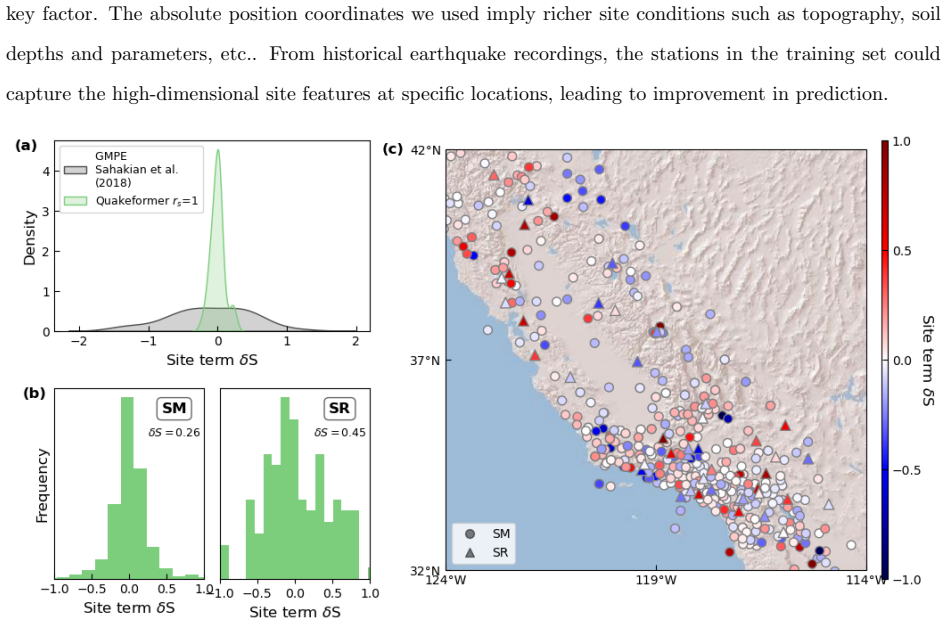
- Residual decomposition shows smaller location-based event and site terms than GMPE-based studies, suggesting much of what is treated as aleatory randomness is actually modeled.
Reading between the lines
- If the reported margins survive stronger baselines, QuakeFormer-type models could become the core of regional ShakeMap and EEW pipelines, with forecast, alert, and post-event products generated by one checkpoint.
- The masking formulation suggests a natural continuum: the same checkpoint could serve any observational completeness, including sparse networks or degraded telemetry, by adjusting mask ratios at inference.
- A direct test is to probe the architecture on a different tectonic regime (for example, Japan or New Zealand) without retraining the location encoder, to see whether the learned relative-dependency structure transfers.
- Because site terms shrink for seen stations but remain large at unseen sites, the paper's own limitation points to a promising direction: conditioning on 3D velocity models or geological surveys should yield the largest further gains.
Signed reviews
Editorial analysis
A structured set of objections, weighed in public.
Referee Report
Summary. The paper introduces QuakeFormer, an encoder-only masked Transformer for ground-motion prediction that jointly handles three tasks: forecasting PGA from event and site metadata, interpolating PGA from partial intensity and waveform observations, and earthquake early warning from real-time partial waveforms. A unified model is first pretrained on forecasting and interpolation via a randomized station/wave masking strategy, then fine-tuned for early warning. The evaluation uses 2023 events as a time-held-out set and spatially held-out stations, with comparisons to ASK14, MVN, EPS, and PLUM baselines. The paper also reports position-embedding ablations, a non-ergodic residual decomposition, and claims that the unified model outperforms specialized architectures across all three tasks.
Significance. The core idea of a single masked-Transformer architecture that unifies three ground-motion tasks is timely and potentially impactful for operational seismic hazard workflows. The held-out event and held-out station split is a genuine strength, and the non-ergodic residual analysis is a constructive way to inspect what the model learns. The masking formulation and the use of both absolute and relative spatial position encodings are well motivated. However, the headline comparative claim is not yet fully supported: several baselines are modified or hybridized relative to their published operational form, and the reported R2 values lack confidence intervals or significance tests. If the comparisons are run against unmodified published baselines, or clearly recast as comparisons against simplified implementations, the central claim would be much stronger.
major comments (5)
- [Section 3, Appendix C.1, Eq. (S4)] The forecasting baseline is not the published ASK14 model but a simplified one-dimensional equation whose coefficients are refit by least squares to the training set TM+SM. Since the paper's central claim is that QuakeFormer outperforms state-of-the-art forecasting models, the comparison in Fig. 3(a) must either use the original published ASK14 coefficients (with an explicit discussion of small-magnitude extrapolation) or the claim must be limited to "outperforms a simplified refit ASK14". This is load-bearing for the forecasting result.
- [Section 3, Appendix C.2, Eqs. (S5)-(S7)] The MVN interpolation baseline uses QuakeFormer itself as the forecasting model for the prior mean, so Fig. 3(a) does not compare against an independent ShakeMap/MVN system. The paper's stated rationale of isolating the interpolation algorithm does not justify the abstract's unqualified claim of outperforming state-of-the-art interpolation. Moreover, the uncertainty parameters required by the MVN are unspecified: the text reads "we assume phi= and tau=" without values. Please supply the assumed values and, ideally, a parallel comparison with an MVN using an independent GMPE prior.
- [Section 3, Appendix C.3] The EPS baseline is given catalog hypocenters and ShakeAlert magnitude reports, so it does not perform real-time source estimation. This removes the main source-estimation error from the EPS baseline. The paper acknowledges this in C.3, but the abstract and Section 3.2 present QuakeFormer's end-to-end superiority without this caveat. A fair comparison should include an EPS that estimates its own source, or the claims must be explicitly limited to "QuakeFormer outperforms an EPS provided with perfect locations." The comparison of QuakeFormer's magnitude error to a literature value for ElarmS-3 is also not a concurrent run and should be labeled as such.
- [Section 3, Figs. 3, 7, 8 and Table S2] All R2 comparisons are reported as point estimates without confidence intervals or significance tests. Some differences are numerically small (e.g., Fig. 8(a) M1 vs M2 on SR; Fig. 7 finetune vs single), and the reader cannot tell whether they are meaningful beyond the large sample size. Please report event-based or bootstrap confidence intervals, and where possible paired comparisons on the same held-out events, for the headline forecasting, interpolation, and early-warning results.
- [Section 4.2, Table 3] The residual standard deviations (sigma, tau, phi, tauL, phiS) are compared directly with values from Baltay et al. (2017) and Villani & Abrahamson (2015), but the datasets, magnitude ranges, and residual-decomposition methods differ substantially. For example, this study is dominated by small-magnitude events, while the cited studies include larger earthquakes and use different decomposition approaches. The claim of "significantly smaller values" for tauL and phiS should be supported by matching magnitude/distance distributions, or restated as an indicative comparison.
minor comments (6)
- [Section 6] "Sourth California" should be "Southern California"; the data availability statement saying the implementation "will be available after paper reception" should be replaced with a concrete repository URL or a clear statement of how code will be shared.
- [Section 2.3.1] "Conventional Neural Network (CNN)" should read "Convolutional Neural Network (CNN)".
- [Figure 3 caption] "if the total residual distributions" should be "The total residual distributions".
- [Table 2 and Figure 7 caption] There are typos in Table 2 ("atfer OT", "atrer OT") and in the Figure 7 caption ("finuetune"); these should be corrected.
- [Section 3.2 and Figure S3] The text states 88 relatively large events in 2023 (M > 3.5), while Figure S3 says 95 large earthquakes; the numbers should be reconciled.
- [Figure 8 caption] Use "R2" consistently; the caption "R2-squared" is redundant.
Circularity Check
No significant circularity: the central comparisons are run on held-out events and stations, and the baseline modifications noted in the manuscript are external-validity concerns rather than equation-level reductions.
full rationale
The paper does not contain a derivation chain in which a predicted quantity is equivalent to a fitted input or to a self-cited result. Training and evaluation are separated event-wise and station-wise: the paper states that events occurring in 2023 are designated as test events and that reference points are randomly separated into train, validation, and test locations, so the reported R2 values are not fit to the evaluation targets. The ASK14 baseline is refit on the training split but evaluated on held-out 2023 events; this is standard regression practice, not a renamed prediction. The MVN interpolation baseline is given QuakeFormer's own forecasting mean, but its interpolation output is produced by conditioning on observed intensities through the fixed exponential correlation model of Eq. S5-S7; the result is not algebraically forced, and supplying QuakeFormer as its prior mean if anything makes the baseline harder to beat. The EPS baseline is supplied catalog hypocenters and ShakeAlert magnitudes, which inflates the baseline rather than manufacturing QuakeFormer's advantage. The only relevant self-citation (Datta et al. 2022 in the introduction) is contextual and not load-bearing. Hyperparameters such as L1, LN, bs, and masking distributions are selected on validation data, which is normal model selection and not a circular reduction. The limitations section explicitly acknowledges larger errors on unseen sites and near-source underestimation, further indicating that the results are not produced by construction. Overall, the baseline-fidelity caveats identified in the manuscript are genuine external validity concerns, but they do not constitute circularity under the required standard of exhibiting a specific reduction. Score 0.
Assumptions & free parameters
free parameters (6)
- Location embedding scale range L1 and LN =
L1 = -2, LN = 5
- RoPE base parameter bs =
bs = 5000
- Station mask ratio distribution =
rs sampled from truncated arccos with mean 0.64
- Wave mask ratio rw =
rw sampled from a uniform distribution
- Maximum wave-time mask duration =
t up to 17 s
- Model architecture dimensions =
d = 384, 5 layers, 8 heads, about 2M parameters
assumptions (6)
- standard math Sinusoidal positional encoding preserves distance so that embedding similarity decreases monotonically with geographic distance (Mai et al., 2021).
- standard math Rotary Position Embedding maintains a long-term decay property when the base parameter bs is large enough (Su et al., 2024).
- domain assumption The curated NCEDC/SCEDC dataset, with its filtering criteria, is representative of future California ground motions.
- domain assumption Reliable P-wave arrival picks are available for all stations, as provided by the AI4EPS phase-pick dataset.
- domain assumption A point-source event description containing location, depth, and magnitude is sufficient for ground-motion forecasting.
- ad hoc to paper The introduced mask tokens [EVENT], [IM], and [WAVE], and the attention-mask invariance rule, are valid architectural choices for combining the three tasks.
Cite this review
Pith. "Pith review of QuakeFormer: A Uniform Approach to Earthquake Ground Motion Prediction Using Masked Transformers." pith.science (2026). https://pith.science/paper/2MNJ7J5I
@misc{pith2026241200815,
  author       = {Pith},
  title        = {Pith review of: QuakeFormer: A Uniform Approach to Earthquake Ground Motion Prediction Using Masked Transformers},
  year         = {2026},
  howpublished = {\url{https://pith.science/paper/2MNJ7J5I}},
  note         = {Machine review of arXiv:2412.00815}
}
read the original abstract
Ground motion prediction (GMP) models are critical for hazard reduction before, during and after destructive earthquakes. In these three stages, intensity forecasting, early warning and interpolation models are corresponding employed to assess the risk. Considering the high cost in numerical methods and the oversimplification in statistical methods, deep-learning-based approaches aim to provide accurate and near-real-time ground motion prediction. Current approaches are limited by specialized architectures, overlooking the interconnection among these three tasks. What's more, the inadequate modeling of absolute and relative spatial dependencies mischaracterizes epistemic uncertainty into aleatory variability. Here we introduce QuakeFormer, a unified deep learning architecture that combines these three tasks in one framework. We design a multi-station-based Transformer architecture and a flexible masking strategy for training QuakeFormer. This data-driven approach enables the model to learn spatial ground motion dependencies directly from real seismic recordings, incorporating location embeddings that include both absolute and relative spatial coordinates. The results indicate that our model outperforms state-of-the-art ground motion prediction models across all three tasks in our research areas. We also find that pretraining a uniform forecasting and interpolation model enhances the performance on early warning task. QuakeFormer offers a flexible approach to directly learning and modeling ground motion, providing valuable insights and applications for both earthquake science and engineering.
Figures


Figures from the paper (8 more)


Reference graph
Works this paper leans on
-
[1]
abrahamson2019probabilistic APACrefauthors Abrahamson, N A. , Kuehn, N M. , Walling, M. \ Landwehr, N. APACrefauthors \ 2019 . Probabilistic seismic hazard analysis in California using nonergodic ground-motion models Probabilistic seismic hazard analysis in california using nonergodic ground-motion models . Bulletin of the Seismological Society of America...
work page 2019
-
[2]
Abrahamson2014ASK14 APACrefauthors Abrahamson, N A. , Silva, W J. \ Kamai, R. APACrefauthors \ 2014 08 . Summary of the ASK14 Ground Motion Relation for Active Crustal Regions Summary of the ASK14 Ground Motion Relation for Active Crustal Regions . Earthquake Spectra 30 3 1025-1055 . APACrefURL https://doi.org/10.1193/070913EQS198M APACrefURL APACrefDOI d...
-
[3]
atkinson2007did APACrefauthors Atkinson, G M. \ Wald, D J. APACrefauthors \ 2007 . “Did You Feel It?” intensity data: A surprisingly good measure of earthquake ground motion “did you feel it?” intensity data: A surprisingly good measure of earthquake ground motion . Seismological Research Letters 78 3 362--368
work page 2007
-
[4]
baker2013introduction APACrefauthors Baker, J W. APACrefauthors \ 2013 . An introduction to probabilistic seismic hazard analysis An introduction to probabilistic seismic hazard analysis . White paper version 2 1 79
work page 2013
-
[5]
baltay2017uncertainty APACrefauthors Baltay, A S. , Hanks, T C. \ Abrahamson, N A. APACrefauthors \ 2017 . Uncertainty, variability, and earthquake physics in ground-motion prediction equations Uncertainty, variability, and earthquake physics in ground-motion prediction equations . Bulletin of the Seismological Society of America 107 4 1754--1772
work page 2017
-
[6]
bose2012real APACrefauthors B \"o se, M. , Heaton, T H. \ Hauksson, E. APACrefauthors \ 2012 . Real-time finite fault rupture detector (FinDer) for large earthquakes Real-time finite fault rupture detector (finder) for large earthquakes . Geophysical Journal International 191 2 803--812
work page 2012
-
[7]
bose2018finder APACrefauthors B \"o se, M. , Smith, D E. , Felizardo, C. , Meier, M A. , Heaton, T H. \ Clinton, J F. APACrefauthors \ 2018 . FinDer v. 2: Improved real-time ground-motion predictions for M2--M9 with seismic finite-source characterization Finder v. 2: Improved real-time ground-motion predictions for m2--m9 with seismic finite-source charac...
work page 2018
-
[8]
center2013southern APACrefauthors Center, E. APACrefauthors \ 2013 . Southern California earthquake center Southern california earthquake center . Caltech. Dataset
work page 2013
Show all 48 references
-
[9]
, Zhang, H
chang2023muse APACrefauthors Chang, H. , Zhang, H. , Barber, J. , Maschinot, A. , Lezama, J. , Jiang, L. others APACrefauthors \ 2023 . Muse: Text-to-image generation via masked generative transformers Muse: Text-to-image generation via masked generative transformers . arXiv p...
2023 arXiv
-
[10]
, Henson, I
chung2019optimizing APACrefauthors Chung, A I. , Henson, I. \ Allen, R M. APACrefauthors \ 2019 . Optimizing earthquake early warning performance: ElarmS-3 Optimizing earthquake early warning performance: Elarms-3 . Seismological Research Letters 90 2A 727--743
2019
-
[11]
\ Galasso, C
cremen2020earthquake APACrefauthors Cremen, G. \ Galasso, C. APACrefauthors \ 2020 . Earthquake early warning: Recent advances and perspectives Earthquake early warning: Recent advances and perspectives . Earth-Science Reviews 205 103184
2020
-
[12]
, Wu, D J
datta2022deepshake APACrefauthors Datta, A. , Wu, D J. , Zhu, W. , Cai, M. \ Ellsworth, W L. APACrefauthors \ 2022 . DeepShake: Shaking intensity prediction using deep spatiotemporal RNNs for earthquake early warning Deepshake: Shaking intensity prediction using deep spatiotem...
2022
-
[13]
, Chang, M W
devlin2018bert APACrefauthors Devlin, J. , Chang, M W. , Lee, K. \ Toutanova, K. APACrefauthors \ 2018 . Bert: Pre-training of deep bidirectional transformers for language understanding Bert: Pre-training of deep bidirectional transformers for language understanding . arXiv pr...
2018 arXiv
-
[14]
APACrefauthors \ 2003
douglas2003earthquake APACrefauthors Douglas, J. APACrefauthors \ 2003 . Earthquake ground motion estimation using strong-motion records: a review of equations for the estimation of peak ground acceleration and response spectral ordinates Earthquake ground motion estimation us...
2003
-
[15]
, Astroza, R
fayazrewfers APACrefauthors Fayaz, J. , Astroza, R. \ Medalla, M. APACrefauthors \ . REWFERS: A Regional Early Warning Framework for Estimating Response Spectra Rewfers: A regional early warning framework for estimating response spectra
-
[16]
\ Galasso, C
fayaz2023deep APACrefauthors Fayaz, J. \ Galasso, C. APACrefauthors \ 2023 . A deep neural network framework for real-time on-site estimation of acceleration response spectra of seismic ground motions A deep neural network framework for real-time on-site estimation of accelera...
2023
-
[17]
\ Hong, H P
goda2008spatial APACrefauthors Goda, K. \ Hong, H P. APACrefauthors \ 2008 . Spatial correlation of peak ground motions and response spectra Spatial correlation of peak ground motions and response spectra . Bulletin of the Seismological Society of America 98 1 354--365
2008
-
[18]
, Jordan, T H
graves2011cybershake APACrefauthors Graves, R. , Jordan, T H. , Callaghan, S. , Deelman, E. , Field, E. , Juve, G. others APACrefauthors \ 2011 . CyberShake: A physics-based seismic hazard model for southern California Cybershake: A physics-based seismic hazard model for south...
2011
-
[19]
APACrefauthors \ 1979
hanks1979b APACrefauthors Hanks, T C. APACrefauthors \ 1979 . b values and - seismic source models: Implications for tectonic stress variations along active crustal fault zones and the estimation of high-frequency strong ground motion b values and - seismic source models: Impl...
1979
-
[20]
, Chen, X
he2022masked APACrefauthors He, K. , Chen, X. , Xie, S. , Li, Y. , Doll \'a r, P. \ Girshick, R. APACrefauthors \ 2022 . Masked autoencoders are scalable vision learners Masked autoencoders are scalable vision learners . Proceedings of the IEEE/CVF conference on computer visio...
2022
-
[21]
, Raman, B
joshi2024application APACrefauthors Joshi, A. , Raman, B. , Mohan, C K. \ Cenkeramaddi, L R. APACrefauthors \ 2024 . Application of a new machine learning model to improve earthquake ground motion predictions Application of a new machine learning model to improve earthquake gr...
2024
-
[22]
, Lomax, A
jozinovic2020rapid APACrefauthors Jozinovi \'c , D. , Lomax, A. , S tajduhar, I. \ Michelini, A. APACrefauthors \ 2020 . Rapid prediction of earthquake ground shaking intensity using raw waveform data and a convolutional neural network Rapid prediction of earthquake ground sha...
2020
-
[23]
, Yamada, Y
kodera2018propagation APACrefauthors Kodera, Y. , Yamada, Y. , Hirano, K. , Tamaribuchi, K. , Adachi, S. , Hayashimoto, N. Hoshiba, M. APACrefauthors \ 2018 . The propagation of local undamped motion (PLUM) method: A simple and robust seismic wavefield estimation approach for ...
2018
-
[24]
, Smith, D E
kohler2020earthquake APACrefauthors Kohler, M D. , Smith, D E. , Andrews, J. , Chung, A I. , Hartog, R. , Henson, I. Guiwits, S. APACrefauthors \ 2020 . Earthquake early warning ShakeAlert 2.0: Public rollout Earthquake early warning shakealert 2.0: Public rollout . Seismologi...
2020
-
[25]
\ Allen, R M
kuyuk2013global APACrefauthors Kuyuk, H S. \ Allen, R M. APACrefauthors \ 2013 . A global approach to provide magnitude estimates for earthquake early warning alerts A global approach to provide magnitude estimates for earthquake early warning alerts . Geophysical Research Let...
2013
-
[26]
, Kuehn, N M
landwehr2016nonergodic APACrefauthors Landwehr, N. , Kuehn, N M. , Scheffer, T. \ Abrahamson, N. APACrefauthors \ 2016 . A nonergodic ground-motion model for California with spatially varying coefficients A nonergodic ground-motion model for california with spatially varying c...
2016
-
[27]
, Cheng, Q
lu2021regional APACrefauthors Lu, X. , Cheng, Q. , Tian, Y. \ Huang, Y. APACrefauthors \ 2021 . Regional ground-motion simulation using recorded ground motions Regional ground-motion simulation using recorded ground motions . Bulletin of the Seismological Society of America 11...
2021
-
[28]
, Janowicz, K
Mai2021ARO APACrefauthors Mai, G. , Janowicz, K. , Hu, Y. , Gao, S. , Yan, B. , Zhu, R. Lao, N. APACrefauthors \ 2021 . A review of location encoding for GeoAI: methods and applications A review of location encoding for geoai: methods and applications . International Journal o...
2021
-
[29]
, Bock, Y
melgar2012real APACrefauthors Melgar, D. , Bock, Y. \ Crowell, B W. APACrefauthors \ 2012 . Real-time centroid moment tensor determination for large earthquakes from local and regional displacement records Real-time centroid moment tensor determination for large earthquakes fr...
2012
-
[30]
NeRF: Representing Scenes as Neural Radiance Fields for View Synthesis
Mildenhall2020NeRF APACrefauthors Mildenhall, B. , Srinivasan, P P. , Tancik, M. , Barron, J T. , Ramamoorthi, R. \ Ng, R. APACrefauthors \ 2020 . "NeRF: Representing Scenes as Neural Radiance Fields for View Synthesis" "nerf: Representing scenes as neural radiance fields for ...
2020 doi
-
[31]
, Callaghan, S
monterrubio2024machine APACrefauthors Monterrubio-Velasco, M. , Callaghan, S. , Modesto, D. , Carrasco, J C. , Badia, R M. , Pallares, P. de la Puente, J. APACrefauthors \ 2024 . A machine learning estimator trained on synthetic data for real-time earthquake ground-shaking pre...
2024
-
[32]
, Mendicelli, A
mori2022ground APACrefauthors Mori, F. , Mendicelli, A. , Falcone, G. , Acunzo, G. , Spacagna, R L. , Naso, G. \ Moscatelli, M. APACrefauthors \ 2022 . Ground motion prediction maps using seismic-microzonation data and machine learning Ground motion prediction maps using seism...
2022
-
[33]
, Bindi, D
munchmeyer2021transformer APACrefauthors M \"u nchmeyer, J. , Bindi, D. , Leser, U. \ Tilmann, F. APACrefauthors \ 2021 . The transformer earthquake alerting model: A new versatile approach to earthquake early warning The transformer earthquake alerting model: A new versatile ...
2021
-
[34]
\ Saita, J
nakamura2007uredas APACrefauthors Nakamura, Y. \ Saita, J. APACrefauthors \ 2007 . UrEDAS, the earthquake warning system: Today and tomorrow Uredas, the earthquake warning system: Today and tomorrow . Earthquake early warning systems 249--281
2007
-
[35]
APACrefauthors \ 2014
NCEDC2014dataset APACrefauthors NCEDC. APACrefauthors \ 2014 . Northern California Earthquake Data Center. UC Berkeley Seismological Laboratory Northern california earthquake data center. uc berkeley seismological laboratory . Dataset. doi:10.7932/NCEDC
2014 doi
-
[36]
, Kurima, J
otake2020deep APACrefauthors Otake, R. , Kurima, J. , Goto, H. \ Sawada, S. APACrefauthors \ 2020 . Deep learning model for spatial interpolation of real-time seismic intensity Deep learning model for spatial interpolation of real-time seismic intensity . Seismological Society...
2020
-
[37]
, Baratin, A
rahaman2019spectral APACrefauthors Rahaman, N. , Baratin, A. , Arpit, D. , Draxler, F. , Lin, M. , Hamprecht, F. Courville, A. APACrefauthors \ 2019 . On the spectral bias of neural networks On the spectral bias of neural networks . International conference on machine learning...
2019
-
[38]
, Camps-Valls, G
reichstein2019deep APACrefauthors Reichstein, M. , Camps-Valls, G. , Stevens, B. , Jung, M. , Denzler, J. , Carvalhais, N. \ Prabhat, F. APACrefauthors \ 2019 . Deep learning and process understanding for data-driven Earth system science Deep learning and process understanding...
2019
-
[39]
, Baltay, A
sahakian2018decomposing APACrefauthors Sahakian, V. , Baltay, A. , Hanks, T. , Buehler, J. , Vernon, F. , Kilb, D. \ Abrahamson, N. APACrefauthors \ 2018 . Decomposing leftovers: Event, path, and site residuals for a small-magnitude Anza region GMPE Decomposing leftovers: Even...
2018
-
[40]
, Ahmed, M
su2024roformer APACrefauthors Su, J. , Ahmed, M. , Lu, Y. , Pan, S. , Bo, W. \ Liu, Y. APACrefauthors \ 2024 . Roformer: Enhanced transformer with rotary position embedding Roformer: Enhanced transformer with rotary position embedding . Neurocomputing 568 127063
2024
-
[41]
APACrefauthors \ 2022
Eric2022Vs30 APACrefauthors Thompson, E M. APACrefauthors \ 2022 . An Updated Vs30 Map for California with Geologic and Topographic Constraints An updated vs30 map for california with geologic and topographic constraints . USGS Digital Object Identifier Catalog . APACrefDOI do...
2022 doi
-
[42]
, Allen, R M
tsang2007magnitude APACrefauthors Tsang, L L. , Allen, R M. \ Wurman, G. APACrefauthors \ 2007 . Magnitude scaling relations from P-waves in southern California Magnitude scaling relations from p-waves in southern california . Geophysical Research Letters 34 19
2007
-
[43]
APACrefauthors \ 2017
vaswani2017attention APACrefauthors Vaswani, A. APACrefauthors \ 2017 . Attention is all you need Attention is all you need . Advances in Neural Information Processing Systems
2017
-
[44]
\ Abrahamson, N A
villani2015repeatable APACrefauthors Villani, M. \ Abrahamson, N A. APACrefauthors \ 2015 . Repeatable site and path effects on the ground-motion sigma based on empirical data from southern California and simulated waveforms from the CyberShake platform Repeatable site and pat...
2015
-
[45]
, Worden, C B
wald2022shakemap APACrefauthors Wald, D J. , Worden, C B. , Thompson, E M. \ Hearne, M. APACrefauthors \ 2022 . ShakeMap operations, policies, and procedures Shakemap operations, policies, and procedures . Earthquake Spectra 38 1 756--777
2022
-
[46]
, Thompson, E M
Worden2018interpolationMVN APACrefauthors Worden, C B. , Thompson, E M. , Baker, J W. , Bradley, B A. , Luco, N. \ Wald, D J. APACrefauthors \ 2018 02 . Spatial and Spectral Interpolation of Ground‐Motion Intensity Measure Observations Spatial and Spectral Interpolation of Gro...
2018 doi
-
[47]
, Deng, B
yan2019tener APACrefauthors Yan, H. , Deng, B. , Li, X. \ Qiu, X. APACrefauthors \ 2019 . TENER: adapting transformer encoder for named entity recognition Tener: adapting transformer encoder for named entity recognition . arXiv preprint arXiv:1911.04474
2019 arXiv
-
[48]
, Reichard-Flynn, W
zhang2022spatiotemporal APACrefauthors Zhang, X. , Reichard-Flynn, W. , Zhang, M. , Hirn, M. \ Lin, Y. APACrefauthors \ 2022 . Spatiotemporal graph convolutional networks for earthquake source characterization Spatiotemporal graph convolutional networks for earthquake source c...
2022
Reviewed August 12, 2026 · model on record in the stance chip above.
Discussion (0). Continue with ORCID to comment.