REVIEW 3 major objections 5 minor 56 references
Multi-Electrode Dielectric Barrier Discharge Actuators: Geometrical Optimization of High Power Density Array
T0 review · 3 major / 5 minor · reviewed 2026-08-12 · deepseek-v4-flash
Pith's one-line read An optimized four-stage dielectric barrier discharge actuator array produces thrust above 250 mN/m with a wall jet thicker than 15 mm, while keeping thrust scaling linear with stage count.
desk verdict Worth a serious referee: the direct thrust result is strong and the resistor-delay story is clean, but the velocity-derived efficiency numbers rest on a pitot transmitter that appears overranged at the reported top speeds. read the letter →
The pith
A machine-rendered reading of the paper's core claim, the machinery that carries it, and where it could break.
The reading
What carries the argument
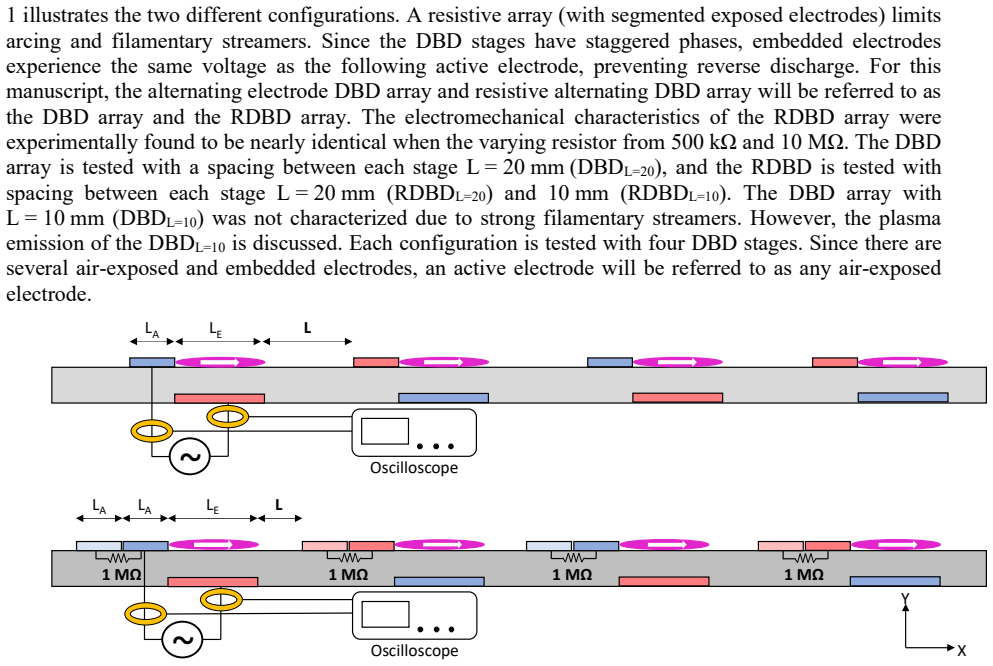
The key mechanism is the alternating-phase electrode configuration (Φ = 180°), where pairs of air-exposed electrodes are connected to two out-of-phase high-voltage outputs so that the upstream embedded electrode and the downstream active electrode have negligible potential difference, suppressing reverse discharge. The resistive variant adds a 1 MΩ resistor and a segmented electrode upstream of each active electrode, which delays the surface-charge 'sliding' and filamentary streamers that otherwise limit high-power DBD arrays. The paper validates the array's force output by comparing direct force-balance thrust with control-volume integration of pitot-tube velocity profiles.
What would settle it
Measure the wall-jet velocity at the highest operating voltages with a technique independent of the pitot tube and pressure transmitter, such as PIV or laser Doppler anemometry, and compare the integrated momentum with the force-balance thrust; a systematic shortfall would indicate pressure-transducer saturation and bias in the reported wall-jet thickness, mechanical power, and efficiency.
Extended reading notes
Core claim
The central claim is that alternating the phase of the high-voltage electrodes in a multi-stage DBD array eliminates backward cross-talk discharge, and that adding a resistor-segmented electrode before each active electrode delays the onset of sliding and filamentary discharge, permitting higher-voltage operation and larger thrust. With four stages, the resistive array achieved 251 mN/m at 45 kV peak-to-peak, the simple array reached 181 mN/m at 40 kV, and both configurations showed linear thrust scaling with the number of stages before discharge instability. Velocity-profile integration and direct force-balance measurements agreed within 10%, and the resulting wall jet was roughly 20 mm thick, several times thicker than a single-stage DBD wall jet.
Load-bearing premise
The velocity-derived momentum and efficiency numbers assume the 0–25 Pa pressure transmitter stays accurate near the roughly 33 Pa dynamic pressure implied by the 7.4 m/s maximum wall-jet velocity; if the transmitter saturates, only the direct force-balance thrust remains unaffected.
Editorial extensions
If this is right
- The DBD array can be powered with a standard sinusoidal AC waveform while achieving thrust an order of magnitude larger than earlier low-voltage arrays, removing a practical barrier to deployment.
- Linear thrust scaling with stage count means adding stages can increase force predictably, provided the geometric spacing is large enough to delay sliding discharge.
- The wall-jet thickness of about 20 mm makes the array suitable for injecting momentum into boundary layers and separated flows at higher speeds than single DBD actuators.
- Because the simple (non-resistive) array has higher force efficiency but lower maximum thrust, designers can trade efficiency against maximum force by choosing either configuration.
- The total efficiency of both arrays increases with the number of stages, suggesting that longer arrays become relatively more effective at converting electrical power into flow momentum.
Reading between the lines
- The observed linear stage scaling hints that even longer arrays may continue to add momentum until the wall-jet mixing or the onset of sliding discharge sets a practical length limit, a point the paper leaves open.
- The resistor's role in delaying filamentary discharge suggests that tuning the resistance value or adding reactive components could push the onset voltage still higher, a testable extension not covered in the paper.
- Because the velocity measurements are time-averaged, time-resolved forcing of the individual stages may reveal whether the slight velocity drop above each active electrode is caused by mixing or by a stage-to-stage phase interaction, which could inform future electrode layouts.
Editorial analysis
A structured set of objections, weighed in public.
Referee Report
Summary. This manuscript experimentally characterizes four-stage dielectric-barrier-discharge (DBD) actuator arrays with alternating-phase AC excitation, comparing a simple alternating-electrode array (DBD) with a 'resistive' version (RDBD) in which a 1 MΩ resistor is inserted between an extra electrode and each active electrode. The authors report plasma emission imaging, direct force-balance thrust, pressure-probe velocity profiles, and electrical power measurements. They find that alternating-phase operation suppresses cross-talk, the RDBD configuration delays sliding/filamentary discharge and reaches 251 mN/m thrust at 45 kV, and thrust scales linearly with the number of stages before discharge onset. They also report a wall jet thicker than 15 mm and total efficiencies increasing with stage number.
Significance. If the measurements are reliable, this is a meaningful step toward high-power DBD arrays for flow control, demonstrating that out-of-phase AC supply and resistor-segmented electrodes can avoid backward-discharge losses and produce thrust per stage comparable to single actuators. The direct force-balance measurements are a strength: they are separate from the velocity chain and show good repeatability (reported 3% standard deviation). The comparison between force-balance and velocity-integrated momentum (within 10%) at one condition supports the control-volume method. However, the paper's velocity-derived headline metrics depend on a pressure transducer whose calibration constant is not reported and whose range appears to be exceeded at the highest velocities, so the quantitative claims about wall-jet thickness and efficiency need verification.
major comments (3)
- [Section 2.2, Eq. (1), Section 3.3] The calibration factor C in Eq. (1) is never reported, and the 0–25 Pa Ashcroft CXLdp transmitter range appears incompatible with the reported Vmax = 7.4 m/s. Using the standard Pitot relation ΔP = ½ρv² (C = 0.5) with ρ = 1.225 kg/m³ gives ΔP ≈ 33.5 Pa at 7.4 m/s and ≈ 30.9 Pa at 7.1 m/s, both above the 25 Pa full scale. Because the momentum (Eq. 2), mechanical power (Eq. 3), total efficiency (Eq. 5), and wall-jet thickness in the abstract all derive from these velocity profiles, the authors must report C, demonstrate that the transmitter remained linear for all reported pressures, or restrict the velocity-derived claims to the transducer's calibrated range.
- [Section 3.2, Figure 4 caption, Section 3.4] The onset voltage for sliding/filamentary discharge in the simple DBDL=20 array is stated inconsistently: the text says it occurs at ~45 kV (Section 3.2), the Figure 4 caption says 'shows filamentary streamers at 40 kV', and Section 3.4 says the simple array was tested to 45 kV with filamentary streamers at the highest voltage. Since the central benefit of the RDBD array is that it delays this onset, the exact threshold should be stated consistently and supported by the plasma images.
- [Section 3.3 and abstract] The 'wall jet thickness' is reported as '~20 mm' in the text and '>15 mm' in the abstract, but no definition is given (e.g., the height at which the velocity drops to 1% or 5% of its maximum). Without this definition, the thickness metric is ambiguous and cannot be compared to the '<5 mm' single-actuator value cited earlier. Please define the metric and harmonize the reported values.
minor comments (5)
- [Eq. (3)] Equation (3) has an integration upper limit of y→∞, while the text says profiles are measured to 20 mm; state whether the upper limit is 20 mm or an extrapolation.
- [Figure 2] Both subpanels of Figure 2 are labeled '(b)'; the in-phase and alternating-phase cases appear to be mislabeled.
- [Nomenclature] The nomenclature lists variables such as Q and U∞ that are not defined in the text or are unused; please remove or define them.
- [Table 1] The 'Presented work' row lists ηforce values 0.25 and 0.32, while the text reports 0.254 and 0.316; use consistent rounding.
- [Section 2.2] The thrust standard deviation is reported as ~3%, but the number of replicate measurements that produce each data point should be stated explicitly.
Circularity Check
No circularity: thrust, momentum, and efficiency values come from direct measurements; self-citations are contextual, not load-bearing.
full rationale
The paper's central claims—thrust greater than 250 mN/m, approximate linear thrust scaling with stage count, delayed sliding/filamentary onset with the resistive electrode, and thick wall-jet formation—are derived from direct experimental measurements: force-balance thrust, pitot-tube velocity profiles, and Rogowski-coil voltage/current power integration. No parameter is fitted to the reported thrust or efficiency values. The pitot calibration factor C in Eq. (1) is a transducer/tube constant, not a fit to the target thrust, and the velocity-derived momentum, mechanical power, and efficiency (Eqs. 2, 3, 5) are computed from the measured velocity and power data without reference to the thrust result they are compared against. The authors' own prior work is cited for the AC-augmentation mechanism, co-flow momentum-injection behavior, and experimental methodology, but those citations are contextual explanations rather than evidence that forces the present numerical results. Even if the cited mechanism were wrong, the measured thrust scaling, plasma images, and efficiency trends would stand as independent observations. The stated limitation about average-velocity measurements concerns temporal resolution, not circularity. The potential pitot-transducer overrange is a calibration/measurement-validity risk, not a circular-derivation issue. The derivation chain is self-contained: optical, electrical, force, and velocity measurements are independent inputs, and the comparisons between velocity-derived and directly measured thrust are empirical cross-checks rather than constructional identities.
Assumptions & free parameters
free parameters (3)
- Pitot tube calibration correction factor C =
not reported
- Control-volume evaluation station offset =
15 mm downstream of each active electrode
- Resistor value for segmented electrode =
1 MΩ
assumptions (5)
- standard math Bernoulli equation with constant density relates pitot pressure to time-averaged velocity (Eq. 1).
- domain assumption The flow is spanwise-uniform and two-dimensional, so a single vertical velocity profile defines the momentum and mechanical power of the wall jet (Eqs. 2-3).
- domain assumption Linear interpolation between the no-slip wall and the first measured point at y=0.4 mm captures near-wall velocity.
- domain assumption Each DBD stage behaves independently before sliding discharge, so total thrust and power scale linearly with stage count.
- domain assumption Current and voltage traces on the high-voltage side give the true electrical power (Eq. 4).
Cite this review
Pith. "Pith review of Multi-Electrode Dielectric Barrier Discharge Actuators: Geometrical Optimization of High Power Density Array." pith.science (2026). https://pith.science/paper/JCNK5B4F
@misc{pith2026241201237,
  author       = {Pith},
  title        = {Pith review of: Multi-Electrode Dielectric Barrier Discharge Actuators: Geometrical Optimization of High Power Density Array},
  year         = {2026},
  howpublished = {\url{https://pith.science/paper/JCNK5B4F}},
  note         = {Machine review of arXiv:2412.01237}
}
read the original abstract
Dielectric barrier discharge (DBD) plasma actuator arrays have been suggested as active flow control devices due to the robust electrohydrodynamic (EHD) force generation in variable atmospheric conditions. DBD plasma augmentation schemes allow for significant performance improvements. However, the transitions to sliding discharge or counter-flow discharge limit their use in high-power arrays. Here, we experimentally demonstrate the performance of a scalable DBD array for two alternating phases of air-exposed electrode configuration. Plasma emissions, direct thrust, velocity profiles, and power consumption measurements of the DBD array reveal that cross-talk between DBD stages can be eliminated to create high-power density actuators. AC augmentation of plasma provides additional gains in thrust; however, the transition to sliding and filamentary discharge reveals geometric limits when increasing the array power density. Introducing a segmented electrode with a resistor delays the onset of adverse sliding and filamentary discharge, allowing it to operate at higher voltage inputs. An optimized four-stage DBD array generated thrust > 250 mN/m with a wall jet thickness > 15 mm, enabling a broader range of flow control applications.
Figures


Figures from the paper (5 more)


Reference graph
Works this paper leans on
-
[1]
The 2017 Plasma Roadmap: Low temperature plasma science and technology,
I. Adamovich et al., "The 2017 Plasma Roadmap: Low temperature plasma science and technology," Journal of Physics D: Applied Physics, vol. 50, no. 32, p. 323001, 2017
work page 2017
-
[2]
Airflow control by non-thermal plasma actuators,
E. Moreau, "Airflow control by non-thermal plasma actuators," Journal of Physics D: Applied Physics, vol. 40, no. 3, pp. 605-636, 2007, doi: 10.1088/0022-3727/40/3/S01
-
[3]
Surface Virus Inactivation by Non-Thermal Plasma Flow Reactor,
A. Tang, A. Ong, N. Beck, J. S. Meschke, and I. V. Novosselov, "Surface Virus Inactivation by Non-Thermal Plasma Flow Reactor," 2023
work page 2023
-
[4]
SDBD plasma enhanced aerodynamics: concepts, optimization and applications,
T. C. Corke, M. L. Post, and D. M. Orlov, "SDBD plasma enhanced aerodynamics: concepts, optimization and applications," Progress in Aerospace Sciences, vol. 43, no. 7, pp. 193-217, 2007, doi: 10.1016/j.paerosci.2007.06.001
-
[5]
Dielectric Barrier Discharge Plasma Actuators for Flow Control *,
T. C. Corke, C. L. Enloe, and S. P. Wilkinson, "Dielectric Barrier Discharge Plasma Actuators for Flow Control *," Annu. Rev. Fluid Mech., vol. 42, no. 1, pp. 505-529, 2010, doi: 10.1146/annurev-fluid-121108-145550
-
[6]
Dielectric barrier discharge actuators: Momentum injection into co-flow and counter-flow freestream,
A. Tang, N. Li, B. Price, A. Mamishev, A. Aliseda, and I. Novosselov, "Dielectric barrier discharge actuators: Momentum injection into co-flow and counter-flow freestream," Journal of Electrostatics, vol. 129, p. 103918, 2024/06/01/ 2024, doi: https://doi.org/10.1016/j.elstat.2024.103918
arXiv 2024
-
[7]
Plasma actuators for aeronautics applications-State of art review,
G. Touchard, "Plasma actuators for aeronautics applications-State of art review," International Journal of Plasma Environmental Science and Technology, vol. 2, no. 1, pp. 1-25, 2008. 17
work page 2008
-
[8]
Z. Su, H. Zong, H. Liang, J. Li, and Y. Wu, "Optimization in frequency characteristics of an oscillating dielectric barrier discharge plasma actuator," Sensors and Actuators A: Physical, vol. 351, p. 114195, 2023
work page 2023
Show all 56 references
-
[9]
Electric wind generation by nanosecond repetitively pulsed microplasmas,
T. Orrière, É. Moreau, and D. Z. Pai, "Electric wind generation by nanosecond repetitively pulsed microplasmas," Journal of physics. D, Applied physics, vol. 52, no. 46, p. 464002, 2019, doi: 10.1088/1361-6463/ab372f
2019 doi
-
[10]
On durable materials for dielectric-barrier discharge plasma actuators,
P. Warlitz, M. T. Hehner, S. Pasch, J. Serpieri, T. Blank, and J. Kriegseis, "On durable materials for dielectric-barrier discharge plasma actuators," Sensors and Actuators A: Physical, vol. 366, p. 114985, 2024
2024
-
[11]
Fabrication and performance evaluation of full-inkjet-printed dielectric- barrier-discharge plasma actuators,
S. Sato et al., "Fabrication and performance evaluation of full-inkjet-printed dielectric- barrier-discharge plasma actuators," Sensors and Actuators A: Physical, vol. 344, p. 113751, 2022
2022
-
[12]
Stokes-layer formation under absence of moving parts—A novel oscillatory plasma actuator design for turbulent drag reduction,
M. T. Hehner, D. Gatti, and J. Kriegseis, "Stokes-layer formation under absence of moving parts—A novel oscillatory plasma actuator design for turbulent drag reduction," Physics of Fluids, vol. 31, no. 5, p. 051701, 2019
2019
-
[13]
Turbulent boundary layer drag reduction using pulsed-dc plasma actuation,
A. Duong, T. Corke, F. Thomas, and K. Yates, "Turbulent boundary layer drag reduction using pulsed-dc plasma actuation," Journal of Fluid Mechanics, 2019
2019
-
[14]
Aerodynamic performance enhancement of a flying wing using nanosecond pulsed DBD plasma actuator,
M. Han, J. Li, Z. Niu, H. Liang, G. Zhao, and W. Hua, "Aerodynamic performance enhancement of a flying wing using nanosecond pulsed DBD plasma actuator," Chinese Journal of Aeronautics, vol. 28, no. 2, pp. 377-384, 2015, doi: 10.1016/j.cja.2015.02.006
2015 doi
-
[15]
Lift and drag performances of an axisymmetric airfoil controlled by plasma actuator,
N. Benard, J. Jolibois, and E. Moreau, "Lift and drag performances of an axisymmetric airfoil controlled by plasma actuator," Journal of Electrostatics, vol. 67, no. 2 3, p. 133, 2009, doi: 10.1016/j.elstat.2009.01.008. 18
2009 doi
-
[16]
Experimental investigation of separation bubble control on an iced airfoil using plasma actuator,
S. G. Pouryoussefi, M. Mirzaei, F. Alinejad, and S. M. Pouryoussefi, "Experimental investigation of separation bubble control on an iced airfoil using plasma actuator," Applied Thermal Engineering, vol. 100, pp. 1334-1341, 2016
2016
-
[17]
Modeling, fabrication and plasma actuator coupling of flexible pressure sensors for flow separation detection and control in aeronautical applications,
L. Francioso, C. De Pascali, E. Pescini, M. De Giorgi, and P. Siciliano, "Modeling, fabrication and plasma actuator coupling of flexible pressure sensors for flow separation detection and control in aeronautical applications," Journal of Physics D: Applied Physics, vol. 49, no...
2016
-
[18]
Flight of an aeroplane with solid-state propulsion,
H. Xu et al., "Flight of an aeroplane with solid-state propulsion," Nature, vol. 563, no. 7732, pp. 532-535, 2018
2018
-
[19]
First takeoff of a flying microrobot with no moving parts,
D. S. Drew and K. S. Pister, "First takeoff of a flying microrobot with no moving parts," in Manipulation, Automation and Robotics at Small Scales (MARSS), 2017 International Conference on, 2017: IEEE, pp. 1-5
2017
-
[20]
A laser-microfabricated electrohydrodynamic thruster for centimeter-scale aerial robots,
H. K. Hari Prasad, R. S. Vaddi, Y. M. Chukewad, E. Dedic, I. Novosselov, and S. B. Fuller, "A laser-microfabricated electrohydrodynamic thruster for centimeter-scale aerial robots," PloS one, vol. 15, no. 4, p. e0231362, 2020
2020
-
[21]
Analytical model for electrohydrodynamic thrust,
R. S. Vaddi, Y. Guan, A. Mamishev, and I. Novosselov, "Analytical model for electrohydrodynamic thrust," Proceedings A: Mathematical, Physical and Engineering Sciences, vol. 476, no. 2241, 2020
2020
-
[22]
Plasma actuator application on a full-scale aircraft tail,
D. Keisar, D. Hasin, and D. Greenblatt, "Plasma actuator application on a full-scale aircraft tail," AIAA Journal, vol. 57, no. 2, pp. 616-627, 2019
2019
-
[23]
Comparison of the linear and spanwise- segmented DBD plasma actuators on flow control around a NACA0015 airfoil,
H. Akbıyık, H. Yavuz, and Y. E. Akansu, "Comparison of the linear and spanwise- segmented DBD plasma actuators on flow control around a NACA0015 airfoil," IEEE Transactions on Plasma Science, vol. 45, no. 11, pp. 2913-2921, 2017. 19
2017
-
[24]
Control of air micro-jets by the use of dielectric barrier discharges,
P. G. Eijo, R. Sosa, J.-L. Aider, and J. M. Cabaleiro, "Control of air micro-jets by the use of dielectric barrier discharges," Sensors and Actuators A: Physical, vol. 305, p. 111937, 2020
2020
-
[25]
Electrohydrodynamic Actuators for Propulsion and Flow Control,
R. S. Vaddi, "Electrohydrodynamic Actuators for Propulsion and Flow Control," 2021
2021
-
[26]
Dynamic evolution of vortex structures induced by tri- electrode plasma actuator,
B.-R. Zheng, M. Xue, and C. Ge, "Dynamic evolution of vortex structures induced by tri- electrode plasma actuator," Chinese physics B, vol. 29, no. 2, p. 24704, 2020, doi: 10.1088/1674-1056/ab671f
2020 doi
-
[27]
Experimental investigation of influence of sliding discharge DBD plasma on low-speed boundary layer,
K. Chen, X. Geng, Z. Shi, K. Cheng, and H. Cui, "Experimental investigation of influence of sliding discharge DBD plasma on low-speed boundary layer," AIP advances, vol. 10, no. 3, pp. 35108-035108-9, 2020, doi: 10.1063/1.5134848
2020 doi
-
[28]
Electric wind produced by surface plasma actuators: a new dielectric barrier discharge based on a three-electrode geometry,
E. Moreau, R. Sosa, and G. Artana, "Electric wind produced by surface plasma actuators: a new dielectric barrier discharge based on a three-electrode geometry," Journal of Physics D: Applied Physics, vol. 41, no. 11, p. 115204, 2008
2008
-
[29]
Electric wind produced by sliding discharges,
A. Debien, N. Benard, and E. Moreau, "Electric wind produced by sliding discharges," Proceeding of 2nd ISNPEDADM new electrical technologies for environment, Nouméa, 2011
2011
-
[30]
DC-Augmented Dielectric Barrier Discharge (DCA-DBD),
A. Tang, A. Aliseda, A. Mamishev, and I. Novosselov, "DC-Augmented Dielectric Barrier Discharge (DCA-DBD)," arXiv preprint arXiv:2403.18064, 2024
2024 arXiv
-
[31]
AC-Augmented Dielectric Barrier Discharge,
A. Tang, A. Mamishev, and I. Novosselov, "AC-Augmented Dielectric Barrier Discharge," arXiv preprint arXiv:2411.17677, 2024
2024 arXiv
-
[32]
Optimization of a dielectric barrier discharge actuator by stationary and non-stationary measurements 20 of the induced flow velocity: application to airflow control,
M. Forte, J. Jolibois, J. Pons, E. Moreau, G. Touchard, and M. Cazalens, "Optimization of a dielectric barrier discharge actuator by stationary and non-stationary measurements 20 of the induced flow velocity: application to airflow control," Experiments in Fluids, vol. 43, no....
2007 doi
-
[33]
Optimization of Dielectric Barrier Discharge Plasma Actuators for Active Aerodynamic Flow Control,
F. O. Thomas, T. C. Corke, M. Iqbal, A. Kozlov, and D. Schatzman, "Optimization of Dielectric Barrier Discharge Plasma Actuators for Active Aerodynamic Flow Control," AIAA Journal, vol. 47, no. 9, pp. 2169-2178, 2009, doi: 10.2514/1.41588
2009 doi
-
[34]
Elongated DBD with floating interelectrodes for actuators,
A. Berendt, J. Podliński, and J. Mizeraczyk, "Elongated DBD with floating interelectrodes for actuators," The European Physical Journal-Applied Physics, vol. 55, no. 1, p. 13804, 2011
2011
-
[35]
A large-scale multiple dielectric barrier discharge actuator based on an innovative three-electrode design,
N. Benard, A. Mizuno, and E. Moreau, "A large-scale multiple dielectric barrier discharge actuator based on an innovative three-electrode design," Journal of physics. D, Applied physics, vol. 42, no. 23, p. 235204, 2009, doi: 10.1088/0022-3727/42/23/235204
2009 doi
-
[36]
Streamer inhibition for improving force and electric wind produced by DBD actuators,
A. Debien, N. Benard, and E. Moreau, "Streamer inhibition for improving force and electric wind produced by DBD actuators," Journal of Physics D: Applied Physics, vol. 45, no. 21, p. 215201, 2012
2012
-
[37]
Successively accelerated ionic wind with integrated dielectric-barrier-discharge plasma actuator for low-voltage operation,
S. Sato, H. Furukawa, A. Komuro, M. Takahashi, and N. Ohnishi, "Successively accelerated ionic wind with integrated dielectric-barrier-discharge plasma actuator for low-voltage operation," Scientific reports, vol. 9, no. 1, pp. 1-11, 2019
2019
-
[38]
Role of the electric waveform supplying a dielectric barrier discharge plasma actuator,
N. Benard and E. Moreau, "Role of the electric waveform supplying a dielectric barrier discharge plasma actuator," Applied Physics Letters, vol. 100, no. 19, p. 193503, 2012
2012
-
[39]
Electrical and mechanical characteristics of surface AC dielectric barrier discharge plasma actuators applied to airflow control,
N. Benard and E. Moreau, "Electrical and mechanical characteristics of surface AC dielectric barrier discharge plasma actuators applied to airflow control," Experiments in Fluids, vol. 55, no. 11, p. 1846, 2014. 21
2014
-
[40]
Empirical relations for discharge current and momentum injection in dielectric barrier discharge plasma actuators,
A. Tang, R. S. Vaddi, A. Mamishev, and I. V. Novosselov, "Empirical relations for discharge current and momentum injection in dielectric barrier discharge plasma actuators," Journal of Physics D: Applied Physics, vol. 54, no. 24, p. 245204, 2021/03/31 2021, doi: 10.1088/1361-6...
2021 doi
-
[41]
Temporal evolution of a surface dielectric barrier discharge for different groups of plasma microdischarges,
I. Biganzoli, R. Barni, and C. Riccardi, "Temporal evolution of a surface dielectric barrier discharge for different groups of plasma microdischarges," Journal of physics. D, Applied physics, vol. 46, no. 2, p. 025201, 2013, doi: 10.1088/0022-3727/46/2/025201
2013 doi
-
[42]
Highly time-resolved investigation of the electric wind caused by surface DBD at various ac frequencies,
N. Benard, P. Noté, M. Caron, and E. Moreau, "Highly time-resolved investigation of the electric wind caused by surface DBD at various ac frequencies," Journal of electrostatics, vol. 88, pp. 41-48, 2017, doi: 10.1016/j.elstat.2017.01.018
2017 doi
-
[43]
Electrical and aerodynamic characteristics of atmospheric pressure barrier discharges in ambient air,
J. Pons, E. Moreau, and G. Touchard, "Electrical and aerodynamic characteristics of atmospheric pressure barrier discharges in ambient air," 2004
2004
-
[44]
Evaluation of thrust measurement techniques for dielectric barrier discharge actuators,
R. Durscher and S. Roy, "Evaluation of thrust measurement techniques for dielectric barrier discharge actuators," Experiments in fluids, vol. 53, pp. 1165-1176, 2012
2012
-
[45]
Unsteady aspect of the electrohydrodynamic force produced by surface dielectric barrier discharge actuators,
A. Debien, N. Benard, L. David, and E. Moreau, "Unsteady aspect of the electrohydrodynamic force produced by surface dielectric barrier discharge actuators," Applied Physics Letters, vol. 100, no. 1, 2012
2012
-
[46]
Sliding discharge in air at atmospheric pressure: electrical properties,
C. Louste, G. Artana, E. Moreau, and G. Touchard, "Sliding discharge in air at atmospheric pressure: electrical properties," Journal of Electrostatics, vol. 63, no. 6-10, pp. 615-620, 2005
2005
-
[47]
Power consumption, discharge capacitance and light emission as measures for thrust production of dielectric barrier discharge 22 plasma actuators,
J. Kriegseis, S. Grundmann, and C. Tropea, "Power consumption, discharge capacitance and light emission as measures for thrust production of dielectric barrier discharge 22 plasma actuators," Journal of Applied Physics, vol. 110, no. 1, 2011, doi: 10.1063/1.3603030
2011 doi
-
[48]
Interrelation of phase-averaged volume force and capacitance of dielectric barrier discharge plasma actuators,
M. Kuhnhenn, B. Simon, I. Maden, and J. Kriegseis, "Interrelation of phase-averaged volume force and capacitance of dielectric barrier discharge plasma actuators," Journal of Fluid Mechanics, vol. 809, 2016
2016
-
[49]
Differences between dielectric barrier discharge plasma actuators with cylindrical and rectangular exposed electrodes,
A. R. Hoskinson and N. Hershkowitz, "Differences between dielectric barrier discharge plasma actuators with cylindrical and rectangular exposed electrodes," Journal of Physics D: Applied Physics, vol. 43, no. 6, p. 065205, 2010, doi: 10.1088/0022- 3727/43/6/065205
2010 doi
-
[50]
Effect of external flow velocity on momentum transfer of dielectric barrier discharge plasma actuators,
R. Pereira, D. Ragni, and M. Kotsonis, "Effect of external flow velocity on momentum transfer of dielectric barrier discharge plasma actuators," Journal of applied physics, vol. 116, no. 10, p. 103301, 2014, doi: 10.1063/1.4894518
2014 doi
-
[51]
Enhancement of the electromechanical performances of a single dielectric barrier discharge actuator,
J. Jolibois and E. Moreau, "Enhancement of the electromechanical performances of a single dielectric barrier discharge actuator," IEEE Transactions on Dielectrics and Electrical Insulation, vol. 16, no. 3, pp. 758-767, 2009
2009
-
[52]
Performance improvement of plasma actuators using asymmetric high voltage waveforms,
M. Kotsonis and S. Ghaemi, "Performance improvement of plasma actuators using asymmetric high voltage waveforms," Journal of Physics D: Applied Physics, vol. 45, no. 4, p. 045204, 2012
2012
-
[53]
On the mechanical efficiency of dielectric barrier discharge plasma actuators,
R. Giepman and M. Kotsonis, "On the mechanical efficiency of dielectric barrier discharge plasma actuators," Applied Physics Letters, vol. 98, no. 22, 2011
2011
-
[54]
Comparisons of force measurement methods for DBD plasma actuators in quiescent air,
A. Hoskinson, N. Hershkowitz, and D. Ashpis, "Comparisons of force measurement methods for DBD plasma actuators in quiescent air," in 47th AIAA Aerospace Sciences Meeting including The New Horizons Forum and Aerospace Exposition, 2009, p. 485. 23
2009
-
[55]
Parameterization of Temporal Structure in the Single-Dielectric-Barrier Aerodynamic Plasma Actuator,
C. L. Enloe, T. E. McLaughlin, G. I. Font, and J. W. Baughn, "Parameterization of Temporal Structure in the Single-Dielectric-Barrier Aerodynamic Plasma Actuator," AIAA Journal, vol. 44, no. 6, pp. 1127-1136, 2006, doi: 10.2514/1.16297
2006 doi
-
[56]
Thrust measurement of dielectric barrier discharge plasma actuators and power requirements for aerodynamic control,
J. Ferry and J. Rovey, "Thrust measurement of dielectric barrier discharge plasma actuators and power requirements for aerodynamic control," in 5th Flow Control Conference, 2010, p. 4982
2010
Reviewed August 12, 2026 · model on record in the stance chip above.
Discussion (0). Continue with ORCID to comment.