REVIEW 3 major objections 3 minor 34 references
Stability of Hypergraph Invariants and Transformations
T0 review · 3 major / 3 minor · reviewed 2026-08-11 · deepseek-v4-flash
Pith's one-line read This paper introduces a metric on hypernetworks and proves common hypergraph-to-graph reductions are 1-Lipschitz, so close hypergraphs have close graph summaries.
desk verdict Solid new hypernetwork GH distance and a genuinely novel affinity graphification, but Theorem 3's proof contains a false identity and two other proofs are incomplete; send to a serious referee and expect revision. read the letter →
The pith
A machine-rendered reading of the paper's core claim, the machinery that carries it, and where it could break.
The reading
What carries the argument
The central object is the hypernetwork $H=(X,Y,\omega)$, an arbitrary real function on $X\times Y$, with $d_H$ defined by $\frac{1}{2}\inf$ over correspondences $S\subset X\times X'$ and $T\subset Y\times Y'$ of $\sup |\omega(x,y)-\omega'(x',y')|$. The affinity graph $\mathrm{An}/\mathrm{Ae}$ is built from chains of node-edge pairs, with chain energy $E(c)=\min_{(x,y)\in c}|\omega(x,y)|$ and affinity the maximum energy over chains; this construction carries the argument for the new 1-Lipschitz results and ties the metric to dendrogram structure. The Dowker filtrations $D^n_{\delta,H}$ and $D^e_{\delta,H}$ translate hypernetwork closeness into interleaving of persistent homology modules, providing the tractable lower bounds.
What would settle it
Compute, for an explicit pair of finite hypernetworks $H,H'$, the quantities $d_H(H,H')$ and $d_N(\mathrm{An}(H),\mathrm{An}(H'))$. If $d_N(\mathrm{An}(H),\mathrm{An}(H'))$ exceeds $d_H(H,H')$, the central 1-Lipschitz conclusion fails. A smaller check: in the chain-energy comparison of Theorem 3, plug $a=(10,1)$ and $b=(9,0)$ into the displayed identity; the left side is 1 while the minimum of $|a_i-b_j|$ is 0, showing the proof's key equality is false.
Extended reading notes
Core claim
The paper's central claim is that the hypernetwork distance $d_H$, defined by aligning both node sets and hyperedge sets through a pair of correspondences and taking half the worst-case difference in the incidence function, provides a metric up to weak isomorphism (Theorem 1). In the finite setting, the graphification maps $B$, $Q$, $L$, $\mathrm{An}$, and $\mathrm{Ae}$ are 1-Lipschitz from $(\mathcal{FH}, d_H)$ to $(\mathcal{FN}, d_N)$ (Theorem 2, Corollary 3.8, Theorem 3); in particular, the affinity graph, built by maximizing over node/edge chains the minimal absolute incidence weight, is a new graph summary that also satisfies a strong triangle inequality, connecting it to single linkage hierarchical clustering. The paper further claims that lower bounds on $d_H$ can be computed from summary statistics and from the interleaving distance between Dowker persistent homologies, and that the Hausdorff map on hypernetworks is 1-Lipschitz while non-negative cross curvature is closed under $d_H$-convergence.
Load-bearing premise
The load-bearing premise is the step in Section 3.3 that converts a difference of chain-energy minima into a minimum over pairwise absolute differences; that equality fails for ordinary numbers (e.g., $a=(10,1)$, $b=(9,0)$), so the proof of the affinity-graph Lipschitz bound as written does not go through unless replaced by a valid inequality.
Editorial extensions
If this is right
- If two finite hypernetworks are $\epsilon$-close in $d_H$, then their bipartite, clique-expansion, and line graph summaries are at most $\epsilon$-close in network distance.
- The node- and edge-affinity graphs satisfy the same 1-Lipschitz bound, so the new affinity summary inherits stability under $d_H$.
- The spectrum, capacity, and circum-radius invariants give polynomial-time lower bounds on $d_H$, making the distance estimable in practice.
- The interleaving distance between Dowker persistence barcodes of two hypernetworks is at most $d_H$, so persistent homology serves as a stable invariant.
- If cost functions are close in $d_H$, so are their Hausdorff/Wasserstein-type spaces of subsets; non-negative cross curvature passes to $d_H$-limits.
Reading between the lines
- The affinity-graph inequality hints that $d_H$ could be characterized by a minimax over chains, which would connect hypernetwork geometry to hierarchical clustering and could make $d_H$ computable by dynamic programming on chains.
- The NNCC stability result suggests that the hypernetwork distance can serve as a topology on cost functions for optimal transport, so algorithmic constructions of convergent cost sequences could be transferred.
- Since $d_H$ treats nodes and edges symmetrically, the same lower-bound machinery applies to data matrices via the hypernetwork model, so the paper's invariants could be used directly as matrix comparison tools.
Signed reviews
Editorial analysis
A structured set of objections, weighed in public.
Referee Report
Summary. The paper introduces a Gromov-Hausdorff-type distance d_H on hypernetworks (X, Y, ω), proves that it is a pseudometric whose zero set is weak isomorphism, and studies stability properties of hypergraph transformations and invariants. The main advertised results are: (i) the distance d_H is a metric up to weak isomorphism (Theorem 1); (ii) several graphification maps, including bipartite, clique expansion, line graph, and the novel node/edge affinity constructions, are 1-Lipschitz from (F_H, d_H) to (F_N, d_N) (Theorem 2, Theorem 3, Corollary 3.8); (iii) lower bounds for d_H from summary invariants and from Dowker persistent homology (Theorems 4 and 5); and (iv) stability results for the Hausdorff map and for non-negative cross curvature in the cost-function interpretation (Theorems 6--9). The paper is written as a theoretical contribution in metric geometry, with an exposition style that deliberately omits or sketches proofs when they are adaptations of known results.
Significance. If the results are fully established, the paper makes a useful contribution: it provides a common metric framework for hypergraph comparison, gives a clean Lipschitz theory for classical heuristic graph reductions, and connects hypernetwork distances to persistent homology and optimal-transport stability. The theorems are parameter-free and are derived against external benchmarks (the network GH distance of Chowdhury and Mémoli and classical Gromov-Hausdorff theory), so there is no circularity concern. The affinity graphification with its single-linkage-hierarchical-clustering flavor is a genuine new construction, and the claimed Lipschitz bounds improve on analogous results in the measure-hypernetwork literature. The significance is substantial but contingent on repairing the proof gaps described below; in particular, the 1-Lipschitz claim for the affinity maps and the Hausdorff-map stability claims are central to the paper's thesis and are not fully proven as written.
major comments (3)
- [Section 3.3, equations (8)--(11)] The proof of Theorem 3 contains a false identity concerning minima of chain energies. The equality between displayed equations (8) and (9) asserts |min_i a_i - min_j b_j| = min_{i,j} |a_i - b_j|, but this is false. For example, with a=(100,0) and b=(99,50), the left-hand side is |0-50|=50, while the right-hand side is min(1,50,99,50)=1. Consequently line (9), which further restricts to the diagonal, is also invalid as an upper bound; for the same example min_i |a_i-b_i|=1 < 50. The correct bound is |min_i a_i - min_j b_j| ≤ max_i |a_i-b_i|. Since replacing the false minimum with a maximum in (9) would still yield the desired final bound max_{(x,y)} |ω(x,y)-ω'(x,y)|, Theorem 3 is likely true, but the printed derivation is invalid. This is load-bearing because Corollary 3.8 and the graphification-based lower bounds in Theorem 4 rely on Theorem 3.
- [Section 5.1, Theorems 7 and 8] The proof of Theorem 7 is incomplete. The mapping formulation of d_N involves four quantities: dis(φ), dis(ψ), codis(φ,ψ), and codis(ψ,φ). The proof verifies dis(φ_Haus) in detail and asserts that the other three follow by adaptation, but no argument is given for codis(ψ_Haus, φ_Haus), which involves a different sup-inf structure. More seriously, Theorem 8, one of the paper's advertised results, is stated with no proof at all: the text says the proof is obtained by only superficially adapting the proof strategy of Theorem 7 and omits details. Since the Hausdorff-map stability is a central theme of Section 5 and of the abstract, both proofs need to be supplied in full.
- [Section 5.2, Theorem 9] The proof of Theorem 9 has several unstated choices and notational inconsistencies. The sequence element y_n is used in inequalities (26)--(28) but is never defined; one must choose y_n with (y_n,y) ∈ T_n for the fixed y ∈ Y, and this should be stated. In addition, the correspondences are denoted Rn, Sn, and Tn inconsistently: the text writes (x^n_0,x_0),(x^n_1,x_1) ∈ Rn and (ȳ^n,ȳ) ∈ Sn, but by the preceding definitions the node pairs should lie in S_n and the edge pair in T_n. Finally, compactness only gives a pointwise convergent subsequence z_n(s) for each fixed s; the proof does not explain how this produces a single path x:[0,1]→X satisfying the endpoint conditions x(0)=x_0 and x(1)=x_1. These gaps need to be closed before the stability theorem can be considered established.
minor comments (3)
- [Section 3, Lemma 3.1] In the proof of Lemma 3.1, the text says that S ∈ R(X,X') and T ∈ R(Y,Y') are a pair of correspondences that give d_H(H,H')=0. This should say that S and T realize the infimum in d_H(H,H'); otherwise the subsequent equality (7) is not justified and the phrase contradicts the case d_H(H,H')>0.
- [Throughout] There are several typos that should be corrected in a revision: 'Haudorff' in Theorem 7, 'Lipchitz' in Remark 3.9, 'perpsective' in Example 2.8, and 'swtiching' in the sentence after equation (11).
- [Section 2.4, Proposition 2.17] Proposition 2.17 is stated without proof and is later used in the proof sketches of Theorem 5 and Theorem 8. Since the mapping formulation is a key tool, a concise proof or an explicit citation to a proved network analogue would improve readability and verifiability.
Circularity Check
No circularity: the hypernetwork distance and stability results are derived from first principles; the false identity in Theorem 3's proof is a correctness issue, not circularity.
full rationale
The paper's central construction, dH, is defined independently in Definition 2.13 and its metric property is proved directly in Theorem 1. The graphification Lipschitz results are supported by explicit inequalities (Theorem 3) and by reductions to the affinity network construction (Corollary 3.8), with the bipartite case proved via a self-contained sketch in Theorem 2. Lower bounds are adapted from external references [26, 8] and the persistent homology stability argument follows the external Dowker-theorem framework of [6]. The only same-author citation is [9], which is used for comparison and for a proof sketch in a different measure-hypernetwork setting; it is not load-bearing, and no fitted parameter is renamed as a prediction. The skeptical observation about the proof of Theorem 3 is a genuine mathematical gap: the displayed identity between |min a_i - min b_j| and min_{i,j}|a_i - b_j| is false, so the proof as written does not establish the desired bound. However, this is a correctness defect, not circularity, because the faulty step does not reduce the theorem to its inputs or to a self-citation. Thus no significant circularity is present.
Assumptions & free parameters
assumptions (4)
- standard math The paper works in ZFC set theory with standard topology and measure-free settings.
- domain assumption In Section 5, network functions are bounded so that sup and inf in the definitions of Hausdorff spaces and cross curvature are finite.
- domain assumption In Theorem 9, the limit hypernetwork has compact metrizable X and each ω(·,y) is locally Lipschitz.
- standard math Standard persistence homology and interleaving distance stability results are accepted as background.
Cite this review
Pith. "Pith review of Stability of Hypergraph Invariants and Transformations." pith.science (2026). https://pith.science/paper/ZDGDRY2D
@misc{pith2026241202020,
  author       = {Pith},
  title        = {Pith review of: Stability of Hypergraph Invariants and Transformations},
  year         = {2026},
  howpublished = {\url{https://pith.science/paper/ZDGDRY2D}},
  note         = {Machine review of arXiv:2412.02020}
}
read the original abstract
Graphs are fundamental tools for modeling pairwise interactions in complex systems. However, many real-world systems involve multi-way interactions that cannot be fully captured by standard graphs. Hypergraphs, which generalize graphs by allowing edges to connect any number of vertices, offer a more expressive framework. In this paper, we introduce a new metric on the space of hypergraphs, inspired by the Gromov-Hausdorff distance for metric spaces. We establish Lipschitz properties of common hypergraph transformations, which send hypergraphs to graphs, including a novel graphification method with ties to single linkage hierarchical clustering. Additionally, we derive lower bounds for the hypergraph distance via invariants coming from basic summary statistics and from topological data analysis techniques. Finally, we explore stability properties of cost functions in the context of optimal transport. Our results in this direction consider Lipschitzness of the Hausdorff map and conservation of the non-negative cross curvature property under limits of cost functions.
Figures
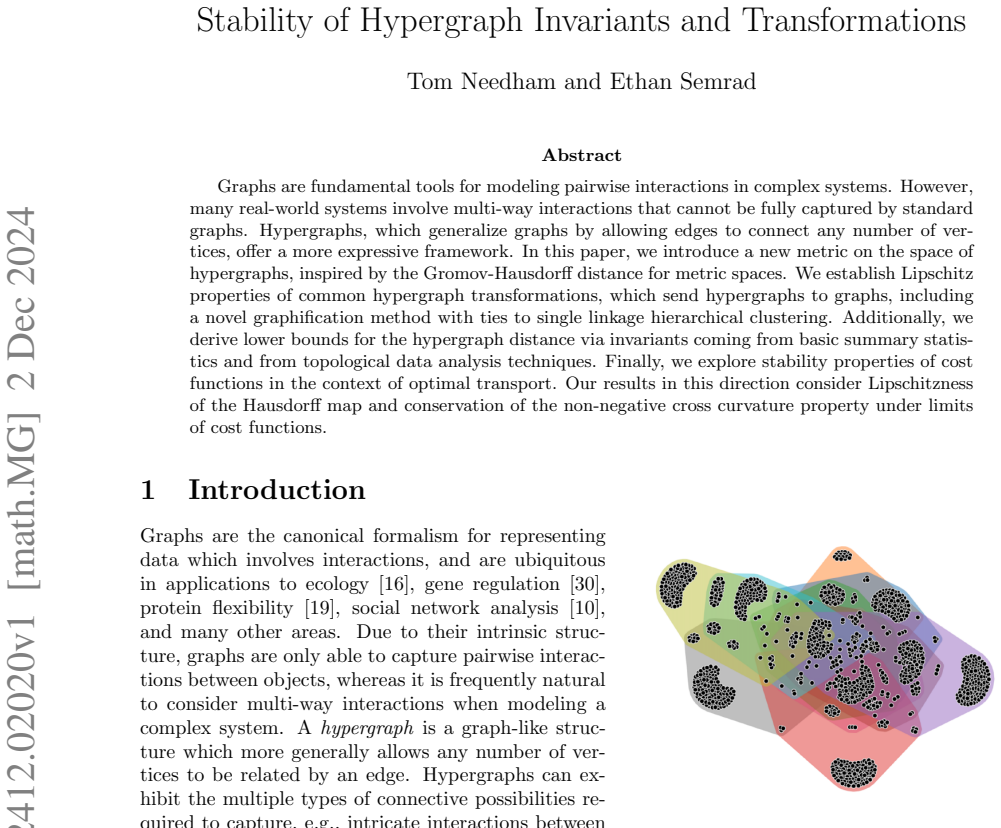


Figures from the paper (8 more)


Reference graph
Works this paper leans on
-
[1]
Persistence homology of networks: methods and applications
Mehmet Emin Aktas, Esra Akbas, and Ahmed El Fatmaoui. Persistence homology of networks: methods and applications. Applied Network Science , 4, 2019
work page 2019
-
[2]
D Burago. A course in metric geometry. American Mathematical Society, 2001
work page 2001
-
[3]
Characterization, stability and convergence of hierarchical clustering methods
Gunnar Carlsson and Facundo M´ emoli. Characterization, stability and convergence of hierarchical clustering methods. Journal of Machine Learning Research , 11:1425–1470, 2010
work page 2010
-
[4]
Proximity of persistence modules and their diagrams
Fr´ ed´ eric Chazal, David Cohen-Steiner, Marc Glisse, Leonidas J Guibas, and Steve Y Oudot. Proximity of persistence modules and their diagrams. In Proceedings of the twenty-fifth annual symposium on Computational geometry , pages 237–246, 2009
work page 2009
-
[5]
Distances between directed networks and applications
Samir Chowdhury and Facundo M´ emoli. Distances between directed networks and applications. In 2016 IEEE International Conference on Acoustics, Speech and Signal Processing (ICASSP) , pages 6420–6424. IEEE, 2016
work page 2016
-
[6]
A functorial dowker theorem and persistent homology of asymmetric networks
Samir Chowdhury and Facundo M´ emoli. A functorial dowker theorem and persistent homology of asymmetric networks. Journal of Applied and Computational Topology , 2, 10 2018
work page 2018
-
[7]
The Gromov–Wasserstein distance between networks and stable network invariants
Samir Chowdhury and Facundo M´ emoli. The Gromov–Wasserstein distance between networks and stable network invariants. Information and Inference: A Journal of the IMA , 8:757–787, 12 2019
work page 2019
-
[8]
Distances and isomorphism between networks: stability and convergence of network invariants
Samir Chowdhury and Facundo M´ emoli. Distances and isomorphism between networks: stability and convergence of network invariants. Journal of Applied and Computational Topology , pages 1–119, 2022
work page 2022
Show all 34 references
-
[9]
Hypergraph co-optimal transport: metric and categorical properties
Samir Chowdhury, Tom Needham, Ethan Semrad, Bei Wang, and Youjia Zhou. Hypergraph co-optimal transport: metric and categorical properties. Journal of Applied and Computational Topology, pages 1–60, 09 2023
2023
-
[10]
The spread of obesity in a large social network over 32 years
Nicholas Christakis. The spread of obesity in a large social network over 32 years. New England Journal of Medicine , 357, 07 2007. 23
2007
-
[11]
Computational topology for data analysis
Tamal Krishna Dey and Yusu Wang. Computational topology for data analysis . Cambridge University Press, 2022
2022
-
[12]
Homology groups of relations
Clifford H Dowker. Homology groups of relations. Annals of mathematics , 56(1):84–95, 1952
1952
-
[13]
Persistent homology-a survey
Herbert Edelsbrunner, John Harer, et al. Persistent homology-a survey. Contemporary mathe- matics, 453(26):257–282, 2008
2008
-
[14]
The structure of superspace
David A Edwards. The structure of superspace. In Studies in topology , pages 121–133. Elsevier, 1975
1975
-
[15]
Rodr ´ ıguez-Vel´ azquez
Ernesto Estrada and Juan A. Rodr ´ ıguez-Vel´ azquez. Subgraph centrality and clustering in complex hyper-networks. Physica A: Statistical Mechanics and its Applications , 364:581–594, May 2006
2006
-
[16]
Network ecology in dynamic landscapes
Marie-Jos´ ee Fortin, Mark Dale, and Chris Brimacombe. Network ecology in dynamic landscapes. Proceedings of the Royal Society B: Biological Sciences , 288, 04 2021
2021
-
[17]
Persistent homology: a step-by-step introduction for newcomers
Ulderico Fugacci, Sara Scaramuccia, Federico Iuricich, and Leila De Floriani. Persistent homology: a step-by-step introduction for newcomers. In Smart Tools and Applications in Graphics , 2016
2016
-
[18]
Groups of polynomial growth and expanding maps (with an appendix by jacques tits)
Michael Gromov. Groups of polynomial growth and expanding maps (with an appendix by jacques tits). Publications Math´ ematiques de l’IH´ES, 53:53–78, 1981
1981
-
[19]
Jacobs, A.J
Donald J. Jacobs, A.J. Rader, Leslie A. Kuhn, and M.F. Thorpe. Protein flexibility predictions using graph theory. Proteins: Structure, Function, and Bioinformatics , 44(2):150–165, 2001
2001
-
[20]
Distances between banach spaces
Nigel J Kalton and Mikhail I Ostrovskii. Distances between banach spaces. In Forum Math , volume 2, pages 17–48. Springer, 1999
1999
-
[21]
Two-mode networks exhibiting data loss
Steve Kirkland. Two-mode networks exhibiting data loss. Journal of Complex Networks, 6(2):297– 316, 08 2017
2017
-
[22]
Nonnegative cross-curvature in infinite dimensions: synthetic definition and spaces of measures
Flavien L´ eger, Gabriele Todeschi, and Fran¸ cois-Xavier Vialard. Nonnegative cross-curvature in infinite dimensions: synthetic definition and spaces of measures. arXiv preprint arXiv:2409.18112, 2024
2024
-
[23]
The theory of the interleaving distance on multidimensional persistence modules
Michael Lesnick. The theory of the interleaving distance on multidimensional persistence modules. Foundations of Computational Mathematics , 15(3):613–650, 2015
2015
-
[24]
Regularity of potential functions of the optimal transportation problem
Xi-Nan Ma, Neil S Trudinger, and Xu-Jia Wang. Regularity of potential functions of the optimal transportation problem. Archive for rational mechanics and analysis , 177:151–183, 2005
2005
-
[25]
Gromov–Wasserstein distances and the metric approach to object matching
Facundo M´ emoli. Gromov–Wasserstein distances and the metric approach to object matching. Foundations of computational mathematics , 11:417–487, 2011
2011
-
[26]
Some properties of Gromov–Hausdorff distances
Facundo M´ emoli. Some properties of Gromov–Hausdorff distances. Discrete & Computational Geometry, 48:416–440, 2012
2012
-
[27]
Characterization of Gromov-type geodesics
Facundo M´ emoli and Zhengchao Wan. Characterization of Gromov-type geodesics. Differential Geometry and its Applications , 88:102006, 2023
2023
-
[28]
Hausdorff mapping: 1-lipschitz and isometry properties
Ivan A Mikhailov. Hausdorff mapping: 1-lipschitz and isometry properties. Moscow University Mathematics Bulletin , 73:211–216, 2018
2018
-
[29]
Co-optimal transport, 2020
Ievgen Redko, Titouan Vayer, R´ emi Flamary, and Nicolas Courty. Co-optimal transport, 2020
2020
-
[30]
Current approaches to gene regulatory network modelling
Thomas Schlitt and Alvis Brazma. Current approaches to gene regulatory network modelling. BMC Bioinformatics , 8:S9 – S9, 2007
2007
-
[31]
Hypergraph dissimilarity measures
Amit Surana, Can Chen, and Indika Rajapakse. Hypergraph dissimilarity measures. arXiv preprint arXiv:2106.08206, 2021
2021 arXiv
-
[32]
Springer, 2009
C´ edric Villani et al.Optimal transport: old and new , volume 338. Springer, 2009. 24
2009
-
[33]
Geometry of the space of partitioned networks: A unified theoretical and computational framework
Stephen Y Zhang, Fangfei Lan, Youjia Zhou, Agnese Barbensi, Michael PH Stumpf, Bei Wang, and Tom Needham. Geometry of the space of partitioned networks: A unified theoretical and computational framework. arXiv preprint arXiv:2409.06302 , 2024
2024 arXiv
-
[34]
Topological simplifications of hypergraphs
Youjia Zhou, Archit Rathore, Emilie Purvine, and Bei Wang. Topological simplifications of hypergraphs. CoRR, abs/2104.11214, 2021. 25
2021 arXiv
Reviewed August 11, 2026 · model on record in the stance chip above.
Discussion (0). Continue with ORCID to comment.