Topology Reconstruction of a Resistor Network with Limited Boundary Measurements: An Optimization Approach
Pith reviewed 2026-05-23 08:12 UTC · model grok-4.3
The pith
A multistage optimization approach reconstructs the topology of a circular planar resistor network from limited boundary measurements.
A machine-rendered reading of the paper's core claim, the machinery that carries it, and where it could break.
Core claim
The central claim is that the topology and edge resistances of an unknown circular planar passive resistive network can be reconstructed using a multistage method that poses difference of convex programs Π1, Π2, and Π3, combined with a heuristic for interior node placement and the modified Auslander-Parter-Goldstein algorithm for planarity, given known numbers of nodes, conductance bounds, and Kirchhoff index.
What carries the argument
Difference-of-convex programming problems (Π1 for switch positions, Π2 for node placement, Π3 for weight re-optimization) applied to a maximal circular planar network with switches.
If this is right
- The network topology can be recovered even with limited boundary measurements if the priors hold.
- Interior nodes can be placed heuristically by relaxing constraints in a DC program.
- Multiple planar topologies can be generated and evaluated by solving Π3 for each.
- The method works for passive resistive networks that are circular planar.
Where Pith is reading between the lines
- This could extend to networks where some priors are estimated rather than known exactly.
- The approach might apply to non-planar or 3D resistor networks with modifications to the planarity step.
- Numerical stability of the DC programs could be tested on larger networks.
Load-bearing premise
The number of boundary and interior nodes, the maximum and minimum edge conductances, and the Kirchhoff index must be known in advance.
What would settle it
A counterexample network where the method, given correct priors, outputs a different topology or resistance values than the true one when tested on simulated boundary measurements.
Figures




read the original abstract
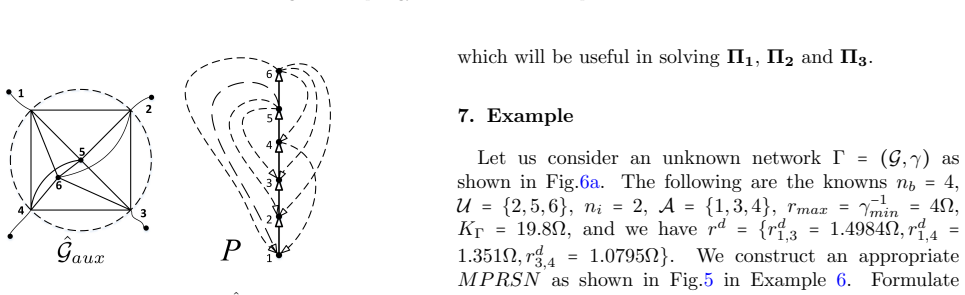
A problem of reconstruction of the topology and the respective edge resistance values of an unknown circular planar passive resistive network using limitedly available resistance distance measurements is considered. We develop a multistage topology reconstruction method, assuming that the number of boundary and interior nodes, the maximum and minimum edge conductance, and the Kirchhoff index are known apriori. First, a maximal circular planar electrical network consisting of edges with resistors and switches is constructed; no interior nodes are considered. A sparse difference in convex program $\mathbf{\Pi}_1$ accompanied by round down algorithm is posed to determine the switch positions. The solution gives us a topology that is then utilized to develop a heuristic method to place the interior nodes. The heuristic method consists of reformulating $\mathbf{\Pi}_1$ as a difference of convex program $\mathbf{\Pi}_2$ with relaxed edge weight constraints and the quadratic cost. The interior node placement thus obtained may lead to a non-planar topology. We then use the modified Auslander, Parter, and Goldstein algorithm to obtain a set of planar network topologies and re-optimize the edge weights by solving $\mathbf{\Pi}_3$ for each topology. Optimization problems posed are difference of convex programming problem, as a consequence of constraints triangle inequality and the Kalmansons inequality. A numerical example is used to demonstrate the proposed method.
Editorial analysis
A structured set of objections, weighed in public.
Referee Report
Summary. The paper claims to develop a multistage optimization method for reconstructing the topology and edge resistances of a circular planar resistive network from limited boundary resistance-distance measurements. It assumes a priori knowledge of the numbers of boundary and interior nodes, bounds on edge conductances, and the Kirchhoff index. The pipeline solves a difference-of-convex program Π1 (with rounding) on a maximal network to select edges, applies a heuristic Π2 to place interior nodes, uses a modified Auslander-Parter-Goldstein procedure to enforce planarity, and re-optimizes conductances via Π3; the approach is illustrated by a numerical example.
Significance. If the a priori quantities can be independently supplied and the DC programs reliably recover the correct topology, the method would offer a concrete optimization-based procedure for a class of network-identification problems. The explicit use of triangle and Kalmanson inequalities to obtain DC formulations is a technical feature that could be reusable, but the dependence on global scalars not derivable from the stated limited measurements restricts the result to a narrow setting.
major comments (2)
- [Abstract] Abstract: the reconstruction pipeline is conditioned on knowing the Kirchhoff index a priori, yet the only data source is a proper subset of boundary-to-boundary resistance distances. No procedure is supplied for recovering this global scalar from the given measurements, rendering the input requirements inconsistent with the problem formulation.
- [Abstract] Abstract (numerical example): the demonstration is described only at the level of 'a numerical example is used'; no error metrics, recovery rates, or verification that the recovered topology matches the ground truth under the stated assumptions are provided, leaving the empirical support for the central claim unassessed.
minor comments (1)
- The modifications made to the Auslander-Parter-Goldstein algorithm are not detailed; a brief description of the changes would improve reproducibility.
Simulated Author's Rebuttal
We thank the referee for the detailed review and constructive comments. We respond to each major comment below, maintaining consistency with the manuscript's stated assumptions and content.
read point-by-point responses
-
Referee: [Abstract] Abstract: the reconstruction pipeline is conditioned on knowing the Kirchhoff index a priori, yet the only data source is a proper subset of boundary-to-boundary resistance distances. No procedure is supplied for recovering this global scalar from the given measurements, rendering the input requirements inconsistent with the problem formulation.
Authors: The manuscript explicitly formulates the problem under the assumption that the Kirchhoff index (along with node counts and conductance bounds) is known a priori. The reconstruction method is developed and analyzed within this setting, using the limited boundary measurements as the primary data source. This is consistent with the problem statement, which does not claim that all required scalars must be derived solely from the measurements. The approach applies when these quantities can be supplied independently, as is common in certain network identification scenarios. No inconsistency exists with the stated formulation. revision: no
-
Referee: [Abstract] Abstract (numerical example): the demonstration is described only at the level of 'a numerical example is used'; no error metrics, recovery rates, or verification that the recovered topology matches the ground truth under the stated assumptions are provided, leaving the empirical support for the central claim unassessed.
Authors: The abstract is a concise summary and refers to the detailed numerical example in Section 5 of the manuscript, which includes verification that the recovered topology matches the ground truth under the assumptions. To enhance the abstract's clarity regarding empirical support, we will revise it to briefly note the verification and key outcomes from the example. revision: yes
Circularity Check
No significant circularity; assumptions stated explicitly as inputs
full rationale
The paper states its multistage optimization method (Π1, Π2, Π3) under explicit a priori assumptions on node counts, conductance bounds, and Kirchhoff index. These are presented as known inputs rather than quantities derived or fitted within the derivation chain. No step reduces a claimed prediction or result to the measurements by construction, no self-citation load-bearing is present, and no ansatz or uniqueness theorem is smuggled in. The derivation is self-contained given the stated assumptions; any concern that the assumptions cannot be obtained from limited measurements is a question of problem formulation or correctness, not circularity in the mathematical steps.
Axiom & Free-Parameter Ledger
free parameters (3)
- number of boundary and interior nodes
- maximum and minimum edge conductance
- Kirchhoff index
axioms (2)
- domain assumption The unknown network is circular planar and passive resistive
- domain assumption Limited resistance distance measurements are available only at boundary nodes
Reference graph
Works this paper leans on
- [1]
- [2]
-
[3]
F. Veldman-de Roo, A. Tejada, H. van Waarde, H. L. Trentel- man, Towards observer-based fault detection and isolation for branched water distribution networks without cycles, in: 2015 European Control Conference (ECC), IEEE, 2015, pp. 3280– 3285
work page 2015
- [4]
-
[5]
F. Lundstrom, K. Frogner, M. Andersson, A resistor network model for analysis of current and temperature distribution in carbon fibre reinforced polymers during induction heating, Jour- nal of Composite Materials 56 (20) (2022) 3159–3183
work page 2022
-
[6]
Y. Zhao, C. K. Khaw, Y. Wang, Measuring a soft resistive strain sensor array by solving the resistor network inverse problem, in: 2023 IEEE International Conference on Soft Robotics (Ro- boSoft), IEEE, 2023, pp. 1–7
work page 2023
-
[7]
V. V. Cheianov, V. I. Fal’ko, B. L. Altshuler, I. L. Aleiner, Random resistor network model of minimal conductivity in graphene, Physical review letters 99 (17) (2007) 176801
work page 2007
- [8]
-
[9]
J. Zhu, A. Jabini, K. Golden, H. Eicken, M. Morris, A network model for fluid transport through sea ice, Annals of Glaciology 44 (2006) 129–133
work page 2006
- [10]
-
[11]
F. Dorfler, F. Bullo, Kron reduction of graphs with applica- tions to electrical networks, IEEE Transactions on Circuits and Systems I: Regular Papers 60 (1) (2012) 150–163
work page 2012
- [12]
-
[13]
E. B. Curtis, J. A. Morrow, Determining the resistors in a net- work, SIAM Journal on Applied Mathematics 50 (3) (1990) 918– 930
work page 1990
-
[14]
E. B. Curtis, J. A. Morrow, Inverse problems for electrical net- works, Vol. 13, World Scientific, 2000
work page 2000
- [15]
- [16]
-
[17]
K. Soumalas, G. Messinis, N. Hatziargyriou, A data driven ap- proach to distribution network topology identification, in: 2017 IEEE Manchester PowerTech, IEEE, 2017, pp. 1–6
work page 2017
-
[18]
H. J. van Waarde, P. Tesi, M. K. Camlibel, Topology identifica- tion of heterogeneous networks: Identifiability and reconstruc- tion, Automatica 123 (2021) 109331
work page 2021
-
[19]
M. Nabi-Abdolyousefi, M. Mesbahi, Network identification via node knockout, IEEE Transactions on Automatic Control 57 (12) (2012) 3214–3219
work page 2012
-
[20]
B. M. Sanandaji, T. L. Vincent, M. B. Wakin, Exact topol- ogy identification of large-scale interconnected dynamical sys- tems from compressive observations, in: Proceedings of the 2011 American Control Conference, IEEE, 2011, pp. 649–656. 11
work page 2011
-
[21]
D. Materassi, M. V. Salapaka, On the problem of reconstructing an unknown topology via locality properties of the wiener filter, IEEE transactions on automatic control 57 (7) (2012) 1765– 1777
work page 2012
-
[22]
S. Biradar, D. U. Patil, Topology reconstruction of a circular planar resistor network, in: 2023 European Control Conference (ECC), IEEE, 2023, pp. 1–6
work page 2023
-
[23]
D. Cox, J. Little, D. O’Shea, M. Sweedler, Ideals, varieties, and algorithms, American Mathematical Monthly 101 (6) (1994) 582–586
work page 1994
-
[24]
S. Biradar, D. U. Patil, Topology reconstruction of a resistive network with limited boundary measurements, in: 2022 Eighth Indian Control Conference (ICC), IEEE, 2022, pp. 379–384
work page 2022
-
[25]
J. Hopcroft, R. Tarjan, Efficient planarity testing, Journal of the ACM (JACM) 21 (4) (1974) 549–568
work page 1974
-
[26]
P. Christiano, J. A. Kelner, A. Madry, D. A. Spielman, S.-H. Teng, Electrical flows, laplacian systems, and faster approxima- tion of maximum flow in undirected graphs, in: Proceedings of the forty-third annual ACM symposium on Theory of comput- ing, 2011, pp. 273–282
work page 2011
-
[27]
M. C. Choi, On resistance distance of markov chain and its sum rules, Linear Algebra and its Applications 571 (2019) 14–25
work page 2019
-
[28]
T. Nishizeki, M. S. Rahman, Planar graph drawing, Vol. 12, World Scientific, 2004
work page 2004
-
[29]
X. Shen, S. Diamond, Y. Gu, S. Boyd, Disciplined convex- concave programming, in: 2016 IEEE 55th conference on de- cision and control (CDC), IEEE, 2016, pp. 1009–1014
work page 2016
-
[30]
T. Lipp, S. Boyd, Variations and extension of the convex– concave procedure, Optimization and Engineering 17 (2016) 263–287
work page 2016
- [31]
-
[32]
R. Tarjan, Depth-first search and linear graph algorithms, SIAM journal on computing 1 (2) (1972) 146–160
work page 1972
-
[33]
L. Auslander, Psv on imbedding graphs in the plane, Journal of Mathematics and Mechanics 10 (3) (1961) 517–523
work page 1961
-
[34]
A. Goldstein, An efficient and constructive algorithm for test- ing whether a graph can be embedded in a plane, in: Graph and Combinatorics Conference, Contract No. NONR 1858-(21), Office of Naval Research Logistics Proj., Dept. of Mathematics, Princeton University, May 16-18, 1963
work page 1963
-
[35]
W. T. Tutte, A census of planar triangulations, Canadian Jour- nal of Mathematics 14 (1962) 21–38
work page 1962
-
[36]
M. Bianchi, A. Cornaro, J. L. Palacios, A. Torriero, Bounds for the kirchhoff index via majorization techniques, Journal of mathematical chemistry 51 (2) (2013) 569–587
work page 2013
-
[37]
V. V. Fedorov, Theory of optimal experiments, Elsevier, 2013
work page 2013
-
[38]
Behrens, Planarity testing–the efficient way? Appendix A
K. Behrens, Planarity testing–the efficient way? Appendix A. Convexity of Resistance Distance & Kirchhoff’s Index The convexity of resistance distance with respect to the edge conductance is discussed in [15] by omitting proof. Here, we mention the same with detailed alternate proof. Proposition 10. Let c be a vector of edge conductances of Γ, then the re...
-
[39]
edge resistance r(n)(st) is increased by 1Ω
the edge st can be deleted, or, 2. edge resistance r(n)(st) is increased by 1Ω. Let us call an operation in point 1 as OP1 and, operation in point 2 as OP2. In case- 1, first implement operation OP1, then operation OP2 on Γ (n) I = ( G(n) I , γ(n)) independently. Let ˜rd s,t(OP1) and ˜rd s,t(OP2) be the resistance distance error across s, t∈VB after commi...
discussion (0)
Sign in with ORCID, Apple, or X to comment. Anyone can read and Pith papers without signing in.