REVIEW 2 major objections 5 minor 42 references
Generation of Subfemtosecond Deep and Vacuum UV pulses via Two-Photon Rabi Oscillations in Alkali Atoms or Alkaline Earth Ions
T0 review · 2 major / 5 minor · reviewed 2026-08-11 · deepseek-v4-flash
Pith's one-line read Resonant two-photon Rabi oscillations in sodium or Mg+ can generate third-harmonic pulses down to 0.97 fs, 2-4 times shorter and up to 10^4 times more efficient than nonresonant generation
desk verdict Credible single-atom mechanism for subfemtosecond DUV/VUV pulse compression via two-photon Rabi oscillations, but the headline efficiency gain is computed without propagation and will not survive a real resonant medium as stated. read the letter →
The pith
A machine-rendered reading of the paper's core claim, the machinery that carries it, and where it could break.
The reading
What carries the argument
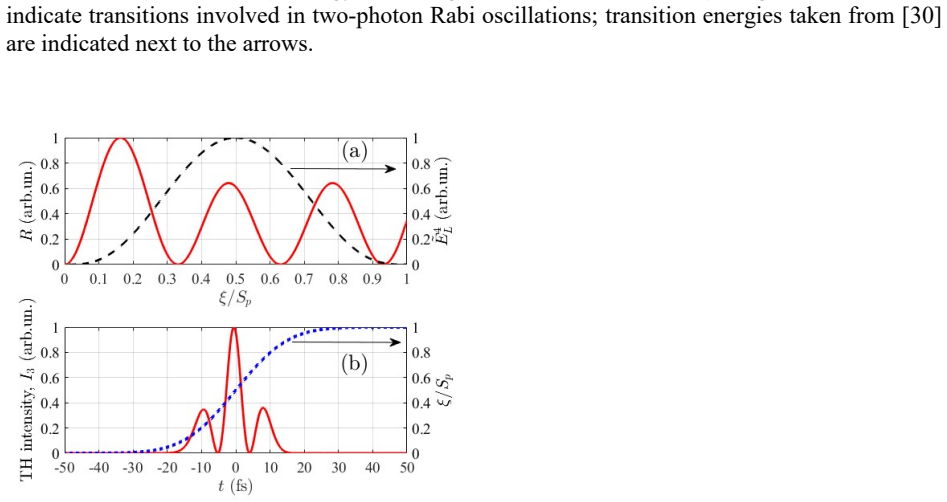
The load-bearing object is the quasi-equidistant four-level ladder of Na or Mg$^+$: ground state $|1\rangle$, intermediate state $|2\rangle$, and two upper states $|3\rangle$, $|4\rangle$ connected by transition dipoles $d_{12}$, $d_{23}$, and $d_{24}$. Because the upper states are near-degenerate, the system behaves as an effective three-level system with total dipole $D$. The instantaneous laser pulse area $\xi(t)$ acts as the time variable for the Rabi oscillations, and the analytic solution shows that the third-harmonic field is a product of Rabi-oscillation amplitudes and interference terms, so the intensity factors as the envelope $E_L^4$ times a beat function $R(D\xi)$. At the optimal total area, the central beat falls near the pulse peak while the side beats sit on the weak wings, isolating one short burst. This area-controlled mechanism is what makes the output duration independent of the driving-pulse duration and yields the compression coefficients $\beta=\Delta t_p/\Delta t_{3H}$.
What would settle it
The clearest check would be an experiment in an optically thin, low-density vapor of Na or Mg$^+$ measuring the third-harmonic pulse duration and yield at the optimal pulse area versus a detuned drive; a numerical propagation run that includes resonant absorption and group-velocity dispersion would also settle whether the 0.97--1.4 fs single-atom pulses and the 3--4 order efficiency advantage survive in a macroscopic medium.
Extended reading notes
Core claim
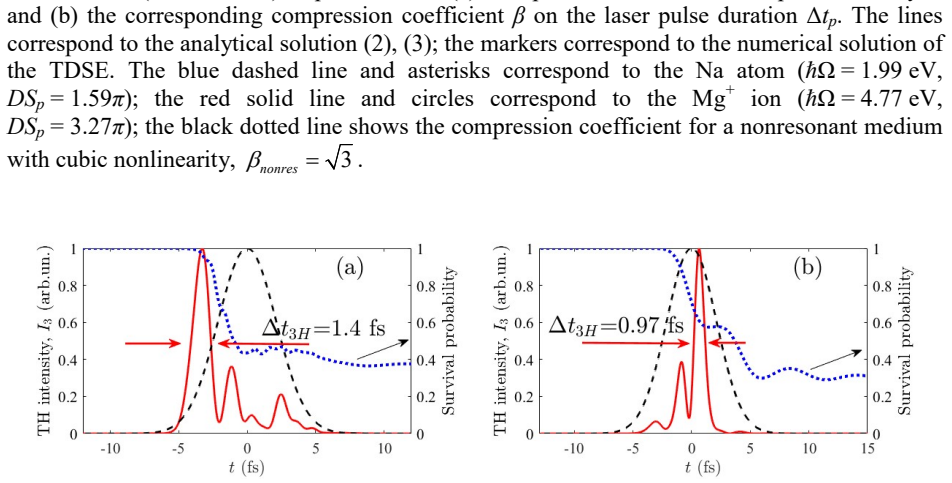
The central claim is that resonant two-photon Rabi oscillations in a quasi-equidistant four-level system generate third-harmonic radiation whose time envelope is set by the laser pulse area rather than by the cube of the field. In the analytic model the third-harmonic intensity factorizes as $I_3\propto (E_L/E_0)^4 R(D\xi)$, where $\xi(t)=\int^t E_L(t')dt'$ and $D=\sqrt{d_{12}^2+d_{23}^2+d_{24}^2}$; the beat function $R$ arises from Rabi oscillations among states $|1\rangle$, $|2\rangle$, $|3\rangle$, and $|4\rangle$ and from interference between different third-harmonic emission paths. For a Gaussian pulse with optimal area $D S_p=1.59\pi$ for Na or $3.27\pi$ for Mg$^+$, the laser envelope selects one central Rabi burst while side bursts are about 2.8 times weaker. The resulting pulse is 4.6 times (Na) or 5.4 times (Mg$^+$) shorter than the driving pulse, and the resonant efficiency exceeds nonresonant third-harmonic generation by up to 3--4 orders of magnitude. Ab initio TDSE calculations reproduce the effect and give the concrete subfemtosecond examples.
Load-bearing premise
The load-bearing premise is that a single atom's dipole acceleration in an optically thin medium represents the real generated field: propagation, reabsorption, phase mismatch, and group-velocity walk-off are left out, and those could lengthen the pulse or erase the efficiency gain.
Editorial extensions
If this is right
- For any laser pulse duration in the tested 5--60 fs range, choosing the optimal pulse area gives a third-harmonic pulse 2--4 times shorter than nonresonant cubic-medium generation, with the compression set by pulse area rather than by pulse duration.
- In resonance with a cascade two-photon transition, third-harmonic generation efficiency is up to 3--4 orders of magnitude higher than far from resonance, as long as ionization does not suppress the resonant interaction.
- With 5 fs, $2.5\times10^{13}$ W/cm$^2$ drivers, the method yields a 1.4 fs pulse at 196 nm from Na and a 0.97 fs pulse at 93.2 nm from Mg$^+$, about two and three carrier cycles respectively.
- The regime is stable to 2--3-fold changes in laser intensity and to frequency detunings of order the Rabi frequency, for example $\pm10\%$ for Mg$^+$ at 5 fs, so it does not require fine experimental tuning.
- The method needs only moderate intensities of $10^{11}$--$10^{13}$ W/cm$^2$ and does not rely on macroscopic phase-matching effects in the single-atom formulation.
Reading between the lines
- If the single-atom result survives propagation effects, the same area-control mechanism could provide compact tabletop sources of subfemtosecond DUV/VUV pulses without gas-filled fibers or multiwave-mixing setups.
- The analytical structure suggests the mechanism is not specific to Na and Mg$^+$: any medium with a quasi-equidistant cascade of three transitions and tolerable ionization could be driven at its optimal Rabi area, possibly extending to other atoms, ions, or condensed-phase systems with similar level ladders.
- The efficiency comparison with nonresonant generation is made at the single-atom level; the natural next test is a propagation-including calculation or a dilute-gas experiment that adds absorption, phase mismatch, and group-velocity walk-off.
- Because the compression is controlled by pulse area, the approach could be scaled to other wavelengths by choosing species whose cascade transitions are quasi-resonant at the desired driving frequency.
Signed reviews
Editorial analysis
A structured set of objections, weighed in public.
Referee Report
Summary. The paper proposes generating femto- and subfemtosecond deep-UV (DUV) and vacuum-UV (VUV) pulses by resonant third-harmonic generation in alkali atoms (Na) or alkaline-earth ions (Mg+) through two-photon Rabi oscillations in a quasi-equidistant four-level ladder. An analytic four-level solution gives the third-harmonic intensity as I3 ∝ E_L^4 R(Dξ), where the time dependence is controlled by the local pulse area Dξ; choosing an optimal total area (DSp = 1.59π for Na, 3.27π for Mg+) produces an isolated compressed third-harmonic pulse. Ab initio three-dimensional TDSE simulations with model atomic potentials for Na and Mg+ reproduce the compression qualitatively over 5–60 fs driving pulses, yielding a 1.4 fs, 196 nm pulse for Na and a 0.97 fs, 93.2 nm pulse for Mg+ at 5 fs, 2.5×10^13 W/cm^2. The paper also claims the resonant scheme is 3–4 orders of magnitude more efficient than nonresonant third-harmonic generation and is robust to intensity and detuning variations.
Significance. If the mechanism survives macroscopic propagation, it would offer a comparatively simple, moderate-intensity route to subfemtosecond DUV/VUV pulses for attosecond pump-probe and coherent-control experiments. The analytic four-level model is a useful closed-form result, and the comparison with ab initio TDSE across a wide parameter range is a genuine strength: the two approaches agree qualitatively, and the residual discrepancies are attributed to specific physical effects (non-equidistant levels, ionization, additional bound states). The paper is also careful to state that propagation is neglected. However, the headline claims about generation efficiency and the practical usability of pulses in a medium go beyond what the single-atom, optically-thin-medium calculations can support, so the current version overreaches in its abstract and conclusions.
major comments (2)
- [Main text near Eq. (2); Supplemental Material, Fig. S7] The central efficiency claim ('up to 3–4 orders of magnitude higher', abstract and final paragraph) is not supported as stated. The only quantitative efficiency comparison, Fig. S7(a,b), uses the single-atom quantity I3 = |d3H|^2 for an optically thin medium, and the paper explicitly neglects propagation. In a macroscopic gas or ion medium, the resonant fundamental is strongly dispersive and absorbing near Ω; for Na, the third harmonic photon energy of 6.3 eV exceeds the 5.14 eV ionization potential, so the generated harmonic can be reabsorbed by ground-state atoms, and phase mismatch plus group-velocity walk-off between a few-cycle fundamental and a subfemtosecond harmonic can broaden the output pulse and reduce its peak intensity. I therefore ask the authors to either add a propagation estimate (e.g., a one-dimensional Maxwell-Bloch treatment or a quantitative optically-thin criterion in terms of absorption and coherence lengths) or explicitly qualify all efficiency and duration claims as single-atom / optically-thin-medium results and soften the abstract accordingly.
- [Appendix C; Fig. 3; text near Eq. (2)] The subfemtosecond headline cases with Δtp = 5 fs lie outside the validity domain of the analytic solution used to motivate the mechanism. The derivation of Eq. (2) assumes dij E0 ≪ Ω, but for Na at I0 = 2.5×10^13 W/cm^2 one has d12E0/Ω ≈ 0.9, so the condition is strongly violated; the TDSE results in this regime also show significant ionization and excitation of additional bound states, as the authors themselves note. The paper nevertheless presents these 5 fs results as demonstrations of the two-photon Rabi-oscillation mechanism. To make the physical attribution load-bearing, the authors should either restrict the Rabi-oscillation mechanism to the regime where the analytic model is valid and present the 5 fs, subfemtosecond cases as a related but ionization-assisted regime, or provide a quantitative decomposition (for example, ionization-gated emission versus Rabi-induced coherence) showing that the short-pulse formation mechanism is unchanged.
minor comments (5)
- [Eqs. (2) and (3)] The formula for R(ξ/D) in Eq. (3) appears corrupted in the compiled manuscript (missing brackets and a misrendered denominator); please check all mathematical expressions in Eqs. (2)–(3) and in the Supplemental derivation against the original source.
- [Text near Fig. 2(b)] The nonresonant third-harmonic duration is written as Δtp/3 in the text, but the numerical value cited for Δtp = 20 fs (11.5 fs) corresponds to Δtp/√3; please correct the typography so the formula matches the quoted number.
- [Abstract and Fig. S7] The term 'efficiency' is used without an explicit definition. Please state in the main text that the reported 3–4 orders of magnitude refers to the peak single-atom intensity ratio I3 = |d3H|^2, not to macroscopic energy conversion efficiency, and specify the units of I3 in Fig. S7.
- [Supplemental Material, Fig. S7] Please state the criteria used to choose the nonresonant comparison frequencies (2.5 eV for Na and 7 eV for Mg+) and confirm that they are sufficiently far from all intermediate resonances; otherwise the efficiency comparison may inadvertently include detuning and ionization effects unrelated to the claimed mechanism.
- [Main text, paragraph after Eq. (5)] The sentence stating that the compression coefficient is 'determined exclusively by the area' should be qualified: it holds only within the four-level, rotating-wave, exact-resonance model that yields Eq. (2), not for the full TDSE results in Fig. 3(b), which show a nonmonotonic dependence on pulse duration.
Circularity Check
No significant circularity: the Rabi-oscillation derivation and the independent TDSE check stand on their own.
full rationale
The central derivation chain is self-contained. The analytical four-level solution, Eqs. (2)-(3) in the main text with the Supplemental derivation in Section 2, produces an explicit expression for the third-harmonic intensity I3(t) in terms of the transition dipoles, the laser envelope, and the pulse area. The optimal pulse area DSp is then selected by maximizing the compression coefficient beta while suppressing side bursts, not by fitting to a pre-specified output duration; the reported compression factors and subfemtosecond durations are computed consequences of the model. The full 3D TDSE calculation is an independent check: it solves the time-dependent Schrodinger equation with a model potential that is benchmarked to NIST energies and dipole moments, and it does not assume the Rabi-oscillation solution. The agreement and the discrepancies between the analytical and numerical results are discussed explicitly in Appendix C in terms of ionization, non-equidistant level spacings, and additional excitation channels. The efficiency comparison in Fig. S7 is computed from the single-atom dipole acceleration in an optically thin medium; the paper explicitly states that propagation effects are beyond the scope of the article, which is a limitation for macroscopic claims rather than a circular step. Self-citations to Refs. [31] and [4] concern numerical methods (split-step TDSE and absorbing potentials) and are not load-bearing for the physical mechanism. No fitted parameter is renamed as a prediction, and no uniqueness claim is imported from the authors' prior work.
Assumptions & free parameters
assumptions (5)
- domain assumption The time-dependent Schrödinger equation with a single active electron is an adequate model for Na and Mg+ in these fields.
- domain assumption The four-level truncation and the assumption of equal transition frequencies omega21 = omega32 = omega42 for the analytic solution.
- domain assumption The weak-field condition d_ij E0 << Omega and the slowly varying envelope approximation, used in the perturbation expansion for the analytic I3.
- domain assumption Optically thin medium, with propagation neglected.
- domain assumption M = 0 selection rule for linearly polarized excitation from an s ground state.
Cite this review
Pith. "Pith review of Generation of Subfemtosecond Deep and Vacuum UV pulses via Two-Photon Rabi Oscillations in Alkali Atoms or Alkaline Earth Ions." pith.science (2026). https://pith.science/paper/F2HKUEVJ
@misc{pith2026241204223,
  author       = {Pith},
  title        = {Pith review of: Generation of Subfemtosecond Deep and Vacuum UV pulses via Two-Photon Rabi Oscillations in Alkali Atoms or Alkaline Earth Ions},
  year         = {2026},
  howpublished = {\url{https://pith.science/paper/F2HKUEVJ}},
  note         = {Machine review of arXiv:2412.04223}
}
read the original abstract
A method is proposed for the formation of femto- and subfemtosecond pulses of the deep ultraviolet and vacuum ultraviolet radiation via generating the third harmonic of femtosecond laser pulses during their resonant interaction with alkali atoms or alkaline earth ions. The pulse formation occurs due to two-photon Rabi oscillations between quasi-equidistant energy levels of atoms or ions. The duration of the generated third harmonic pulse is several times shorter than far from resonance, while the generation efficiency is up to 3-4 orders of magnitude higher.
Figures


Figures from the paper (1 more)
Reference graph
Works this paper leans on
- [1]
-
[2]
R. Ell, U. Morgner, F. X. Kärtner, J. G. Fujimoto, E. P. Ippen, V. Scheuer, G. Angelow, T. Tschudi, M. J. Lederer, A. Boiko, and B. Luther-Davies, Generation of 5-fs pulses and octave-spanning spectra directly from a Ti:sapphire laser, Opt. Lett. 26, 373 (2001)
work page 2001
-
[3]
L. Xu, Ch. Spielmann, A. Poppe, T. Brabec, F. Krausz, and T. W. Hänsch, Route to phase control of ultrashort light pulses, Opt. Lett. 21, 2008 (1996)
work page 1996
-
[4]
D. J. Jones, S. A. Diddams, J. K. Ranka, A. Stentz, R. S. Windeler, J. L. Hall, and S. T. Cundiff, Carrier-envelope phase control of femtosecond mode-locked lasers and direct optical frequency synthesis, Science 288, 635 (2000)
work page 2000
-
[5]
Th. Brabec and F. Krausz, Intense few-cycle laser fields: Frontiers of nonlinear optics, Rev. Mod. Phys. 72, 545 (2000)
work page 2000
-
[6]
Krausz and M
F. Krausz and M. Ivanov, Attosecond physics, Rev. Mod. Phys. 81, 163 (2009)
2009
-
[7]
P. M. Paul, E. S. Toma, P. Breger, G. Mullot, F. Augé, Ph. Balcou, H. G. Muller, and P. Agostini, Observation of a train of attosecond pulses from high harmonic generation, Sci- ence 292, 1689 (2001)
work page 2001
-
[8]
M. Hentschel, R. Kienberger, Ch. Spielmann, G. A. Reider, N. Milosevic, T. Brabec, P. Corkum, U. Heinzmann, M. Drescher, and F. Krausz, Attosecond metrology, Nature 414, 509 (2001)
work page 2001
Show all 42 references
-
[9]
Sansone, E
G. Sansone, E. Benedetti, F. Calegari, C. Vozzi, L. Avaldi, R. Flammini, L. Poletto, P. Villoresi, C. Altucci, R. Velotta, S. Stagira, S. De Silvestri, and M. Nisoli, Isolated sin- gle-cycle attosecond pulses, Science 314, 443 (2006)
2006
-
[10]
Goulielmakis , M
E. Goulielmakis , M. Schultze, M. Hofstetter, V. S. Yakovlev, J. Gagnon, M. Uiberacker, A. L. Aquila, E. M. Gullikson, D. T. Attwood, R. Kienberger, F. Krausz, and U. Kleineberg, Single-cycle nonlinear optics, Science 320, 1614 (2008)
2008
-
[11]
V. V. Strelkov, V. T. Platonenko, A. F. Sterzhantov, and M. Yu. Ryabikin, Attosecond electromagnetic pulses: generation, measurement, and application. Generation of high- order harmonics of an intense laser field for attosecond pulse production, Phys. Usp. 59, 425 (2016)
2016
-
[12]
Schoenlein, Th
R. Schoenlein, Th. Elsaesser, K. Holldack, Z. Huang, H. Kapteyn, M. Murnane, and M. Woerner, Recent advances in ultrafast X-ray sources, Philos. Trans. R. Soc. A 377, 20180384 (2019)
2019
-
[13]
J. Li, J. Lu, A. Chew, S. Han, J. Li, Y. Wu, H. Wang, S. Ghimire, and Z. Chang, Attosecond science based on high harmonic generation from gases and solids. Nat. Commun. 11, 2748 (2020)
2020
-
[14]
M. Wu, S. Chen, S. Camp, K. J. Schafer, and M. B. Gaarde, Theory of strong-field attosecond transient absorption, J. Phys. At. Mol. Opt. Phys. 49, 062003 (2016)
2016
-
[15]
Young, K
L. Young, K. Ueda, M. Gühr, P. H. Bucksbaum, M. Simon, S. Mukamel et al., Roadmap of ultrafast x-ray atomic and molecular physics, J. Phys. B At. Mol. Opt. Phys. 51, 032003 (2018)
2018
-
[16]
M. Yu. Ryabikin, M. Yu. Emelin, and V. V. Strelkov, Attosecond electromagnetic puls- es: generation, measurement, and application. Attosecond metrology and spectroscopy, Phys. Usp. 66 360 (2023)
2023
-
[17]
E. M. Bothschafter, A. Schiffrin, V. S. Yakovlev, A. M. Azzeer, F. Krausz, R. Ernstorfer, and R. Kienberger, Collinear generation of ultrashort UV and XUV pulses, Opt. Express 18, 9173 (2010)
2010
-
[18]
Bergé and S
L. Bergé and S. Skupin, Few-cycle light bullets created by femtosecond filaments, Phys. Rev. Lett. 100, 113902 (2008)
2008
-
[19]
Reiter, U
F. Reiter, U. Graf, E. E. Serebryannikov, W. Schweinberger, M. Fiess, M. Schultze, A. M. Azzeer, R. Kienberger, F. Krausz, A. M. Zheltikov, and E. Goulielmakis, Route to attosecond nonlinear spectroscopy, Phys. Rev. Lett. 105, 243902 (2010)
2010
-
[20]
Reiter, U
F. Reiter, U. Graf, M. Schultze, W. Schweinberger, H. Schröder, N. Karpowicz, A. M. Azzeer, R. Kienberger, F. Krausz, and E. Goulielmakis, Generation of sub-3 fs pulses in the deep ultraviolet, Opt. Lett. 35, 2248 (2010)
2010
-
[21]
Galli, V
M. Galli, V. Wanie, D. P. Lopes, E. P. Månsson, A. Trabattoni, L. Colaizzi, K. Saraswathula, A. Cartella, F. Frassetto, L. Poletto, F. Légaré, S. Stagira, M. Nisoli, R. M. Vázquez, R. Osellame, and F. Calegari, Generation of deep ultraviolet sub-2-fs pulses, Opt. Lett. 44, 1308 (2019)
2019
-
[22]
J. C. Travers, T. F. Grigorova, Ch. Brahms, and F. Belli, High-energy pulse self- compression and ultraviolet generation through soliton dynamics in hollow capillary fi- bres, Nat. Photon. 13, 547 (2019)
2019
-
[23]
C. G. Durfee III, S. Backus, H. C. Kapteyn, and M. M. Murnane, Intense 8-fs pulse gen- eration in the deep ultraviolet, Opt. Lett. 24, 697 (1999)
1999
-
[24]
P. St. J. Russell, P. Hölzer, W. Chang, A. Abdolvand, and J. C. Travers, Hollow-core photonic crystal fibres for gas-based nonlinear optics, Nat. Photon. 8, 278 (2014)
2014
-
[25]
Brahms, F
Ch. Brahms, F. Belli, and J. C. Travers, Infrared attosecond field transients and UV to IR few-femtosecond pulses generated by high-energy soliton self-compression, Phys. Rev. Res. 2, 043037 (2020)
2020
-
[26]
Jiang, J
Y. Jiang, J. P. Messerschmidt, F. Scheiba, I. Tyulnev, L. Wang, Z. Wei, and G. M. Rossi, Ultraviolet pulse compression via cross-phase modulation in a hollow-core fiber, Optica 11, 291 (2024)
2024
-
[27]
V. A. Kostin and N. V. Vvedenskii, Generation of few- and subcycle radiation in midinfrared-to-deep-ultraviolet range during plasma production by multicolor femto- second pulses, Phys. Rev. Lett. 120, 065002 (2018)
2018
-
[28]
M. F. Ciappina, J. A. Pérez-Hernández, A. S. Landsman, T. Zimmermann, M. Lewenstein, L. Roso, and F. Krausz, Carrier-wave Rabi-flopping signatures in high-order harmonic generation for alkali atoms, Phys. Rev. Lett. 114, 143902 (2015)
2015
-
[29]
K. N. Avanaki, D. A. Telnov, and S.-I. Chu, Harmonic generation of Li atoms in one- and two-photon Rabi-flopping regimes, Phys. Rev. A 94, 053410 (2016)
2016
-
[33]
Kang and Z
L. Kang and Z. Lin, Deep-ultraviolet nonlinear optical crystals: concept development and materials discovery, Light. Sci. Appl. 11, 201 (2022). FIG. 1. (Color online) Energy level diagram of (a) Na atom and (b) Mg+ ion. Red arrows indicate transitions involved in two-photon Ra...
2022
-
[34]
The definition (S2), (S3) ensures that the constant component of the electric field ( )LE t is equal to zero for arbitrary parameters of the laser pulse
Theoretical model and description of the method used for numerical solution of the TDSE The direct numerical simulation of the interaction of Na atom and Mg+ ion with an intense linearly polarized laser pulse is performed on the basis of the solution of the three-dimensional T...
-
[35]
1 from the main text of the article
Derivation of the analytical solution Let us consider a four-level model of the Na atom or Mg+ ion, including the resonance states 1 4 , see Fig. 1 from the main text of the article. In this case, the wave function of the active electron of the atom (ion) can be represented a...
-
[36]
Analysis of optimal conditions for generating a shortened third harmonic pulse in a medium of Na atoms based on an analytical TDSE solution The analytical solution (2), (3), and (S33) is valid for a laser pulse (S13) with an arbitrary envelope ( )LE t . Further, we will assum...
-
[37]
S5 and S6
Analysis of optimal conditions for generating a shortened third harmonic pulse in a medium of Mg+ ions based on an analytical TDSE solution Now let us consider the results of the analytical solution (2), (3), and (S33) for the Mg+ ion (see Section 6, Table 2), the characterist...
-
[38]
Figure S7(a,b) shows the dependences of the peak intensity of the third harmonic generated by Na atoms (Fig
Results of the first-principles solution of the TDSE: efficiency of the third harmonic generation and stability of the solution to changes in laser parameters The efficiency of third harmonic generation in resonance with a cascade two-photon transition of an atom or ion turns ...
-
[39]
model atom
Parameters of resonance states of Na atom and Mg+ ion This section presents the characteristics of the resonance states of the Na atom (Table 1) and the Mg+ ion (Tables 2, 3) calculated on the basis of the one-electron potential (“model atom”, “model ion”, “model”) used to sol...
-
[40]
Sarsa, F
A. Sarsa, F. J. Gálvez, and E. Buendía, Parameterized optimized effective potential for the ground state of the atoms He through Xe, At. Data Nucl. Data Tables 88, 163 (2004)
2004
-
[41]
A. A. Romanov, A. A. Silaev, T. S. Sarantseva, M. V. Frolov, and N. V. Vvedenskii, Study of high-order harmonic generation in xenon based on time-dependent density- functional theory, New J. Phys. 23, 043014 (2021)
2021
-
[42]
https://www.nist.gov/pml/atomic-spectra-database
-
[43]
A. A. Silaev, A. A. Romanov, and N. V. Vvedenskii, Multi-hump potentials for efficient wave absorption in the numerical solution of the time-dependent Schrödinger equation, J. Phys. B: At. Mol. Opt. Phys. 51, 065005 (2018)
2018
-
[44]
V. M. Akulin and N. V. Karlov, Intense Resonant Interactions in Quantum Electronics (Springer-Verlag, Berlin Heidelberg, 1992)
1992
-
[45]
R. P. Feynman, R. B. Leighton, and M. Sands, The Feynman Lectures on Physics, The Definite Edition, Vol. II: Electromagnetism and Matter (Pearson Education, Inc., Addison-Wesley, 2006)
2006
Reviewed August 11, 2026 · model on record in the stance chip above.
Discussion (0). Continue with ORCID to comment.